

Voicemail Drop: The 2026 Guide (Data, Scripts, Tools)
Your SDR team leaves 40+ voicemails a day, reciting the same pitch each time. At a minute per voicemail, that's 40 minutes of dead air - time that should go toward live conversations. A huge share of cold calls still go to voicemail. That's not a bug; it's the reality of outbound in 2026.
The question isn't whether to leave voicemails. It's whether you can automate the process without torching your compliance posture or annoying every prospect on your list.
The Quick Version
Ringless vs. dialer-based: This technology comes in two flavors. Ringless delivers server-to-server with no ring. Dialer-based places a real call and drops a recording when it hits voicemail. Ringless carries clearer prerecorded-voice consent exposure under TCPA; dialer-based drops still need to follow TCPA/DNC rules, but they run inside a normal live-call workflow. For B2B sales, dialer-based is usually the right call.
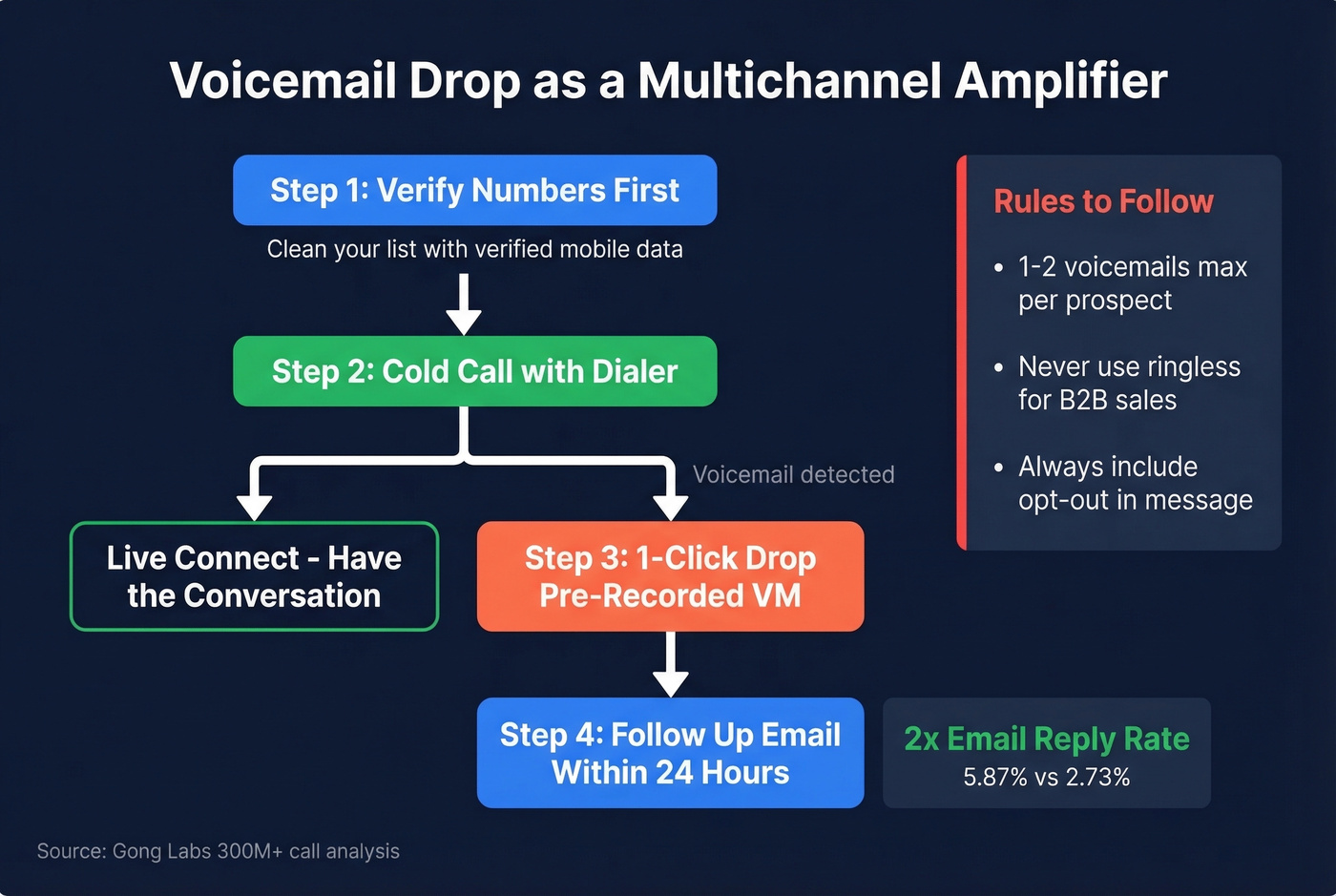
Use it as a multichannel amplifier. Data from 300M+ cold calls shows voicemails reduce direct connect rates by 28% but more than double email reply rates. Cap at one or two per prospect. Three or more actually hurts.
Verify your numbers first. Dropping pre-recorded messages to disconnected or wrong numbers wastes credits and tanks your campaign metrics. Run your list through Prospeo's mobile finder - 125M+ verified numbers with a 30% pickup rate - before loading anything into your dialer.
What Is Voicemail Drop?
Voicemail drop lets sales reps leave a pre-recorded voicemail without manually waiting through the ring-and-beep cycle every time. Instead of reciting the same 20-second pitch 40 times a day, you record it once and deploy it at scale.
Two distinct subtypes exist, and the difference matters more than most people realize. Ringless voicemail delivers messages directly to a voicemail server without ever making the phone ring. Dialer-based drops place a live call first, then let the rep deposit a pre-recorded message when it hits voicemail. We've tested both approaches across client campaigns, and the distinction has real consequences for deliverability, perception, and compliance.
Ringless vs. 1-Click Drop Compared
| Feature | Ringless Voicemail | 1-Click Dialer Drop |
|---|---|---|
| How it works | Server-to-server delivery | Live call, then drop on VM |
| Phone rings? | No | Yes |
| TCPA consent needed? | Yes (prior express) | Standard live-call rules apply (TCPA/DNC) |
| Best for | Marketing, notifications | B2B sales prospecting |
| Perception risk | High - no missed call feels like spam | Low - looks like a normal call |
| iOS Live Voicemail | Message appears instantly | Prospect can screen in real time |
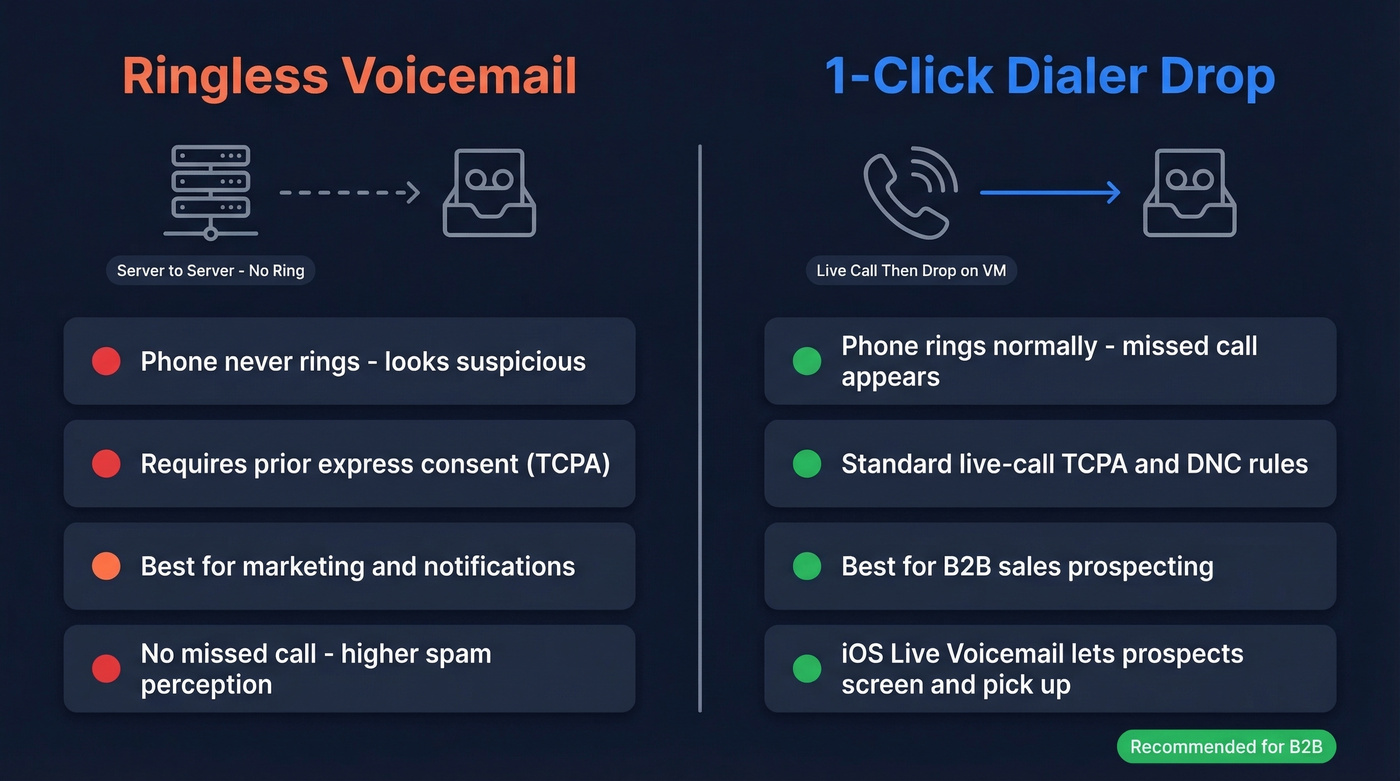
Ringless voicemail routes a pre-recorded message directly to the carrier's voicemail server. The prospect's phone never rings - a voicemail just appears. That sounds efficient, but a voicemail without a corresponding missed call looks suspicious to most people, and carriers increasingly push back on spam-like traffic patterns.
Dialer-based drops work differently. The rep initiates a real call. If it goes to voicemail, they click a button to leave the pre-recorded message while the dialer moves to the next contact. The phone rang. There's a missed call. The voicemail looks normal.
Here's the thing: iOS Live Voicemail, which Apple introduced in iOS 17, transcribes messages in real time as they're being left. In a live-call scenario, a prospect can screen the message and pick up mid-voicemail. Ringless drops don't create that same "answer mid-message" moment - the voicemail just lands silently.
For B2B sales teams, dialer-based drops are the default recommendation.
Is It Legal in 2026?
The FCC Ruling That Changed Everything
In November 2022, the FCC issued Declaratory Ruling FCC-22-85, finding that ringless voicemail to wireless phones is a "call" using an artificial or prerecorded voice under the TCPA. That means it requires prior express consent - full stop.
Some vendors still try to label ringless voicemail as an "Enhanced Information Service." The FCC's ruling makes the practical bottom line clear: ringless voicemail to wireless phones is treated as a TCPA-covered call.
What Changed in 2024-2026
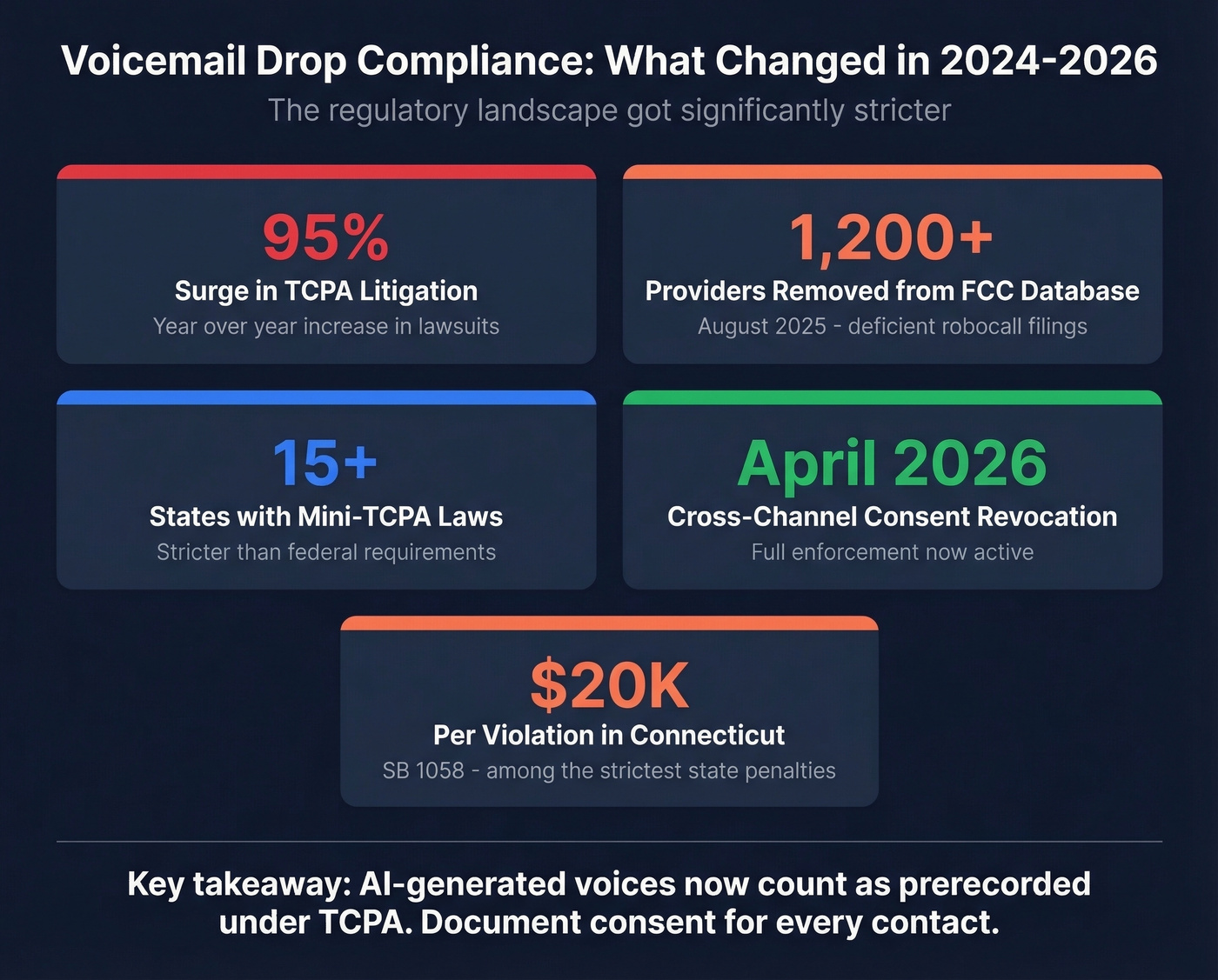
Compliance requirements have gotten significantly stricter and more fragmented. TCPA litigation surged nearly 95% compared to the prior year. The Supreme Court's McLaughlin v. McKesson decision in June 2025 ruled that district courts aren't bound by FCC interpretations in civil TCPA cases - meaning judges can interpret the rules differently across jurisdictions. In August 2025, the FCC removed 1,200+ providers from the Robocall Mitigation Database for deficient filings, forcing downstream carriers to block their traffic.
The FCC also clarified in February 2024 that AI-generated voices count as "artificial or prerecorded" under TCPA. Consent revocation rules took effect in April 2025, and cross-channel consent revocation reached full enforcement in April 2026. At least 15 states have enacted mini-TCPA laws that go beyond federal requirements - Texas SB 140 adds treble damages, Virginia SB 1339 requires honoring text opt-outs for 10 years, and Connecticut SB 1058 carries penalties up to $20,000 per violation.
UK Compliance
If your team prospects into the UK, cold calling voicemail rules differ from US TCPA requirements. The UK's Privacy and Electronic Communications Regulations (PECR) and ICO guidance govern pre-recorded voicemail messages to businesses, and the rules around automated dialing and consent don't map neatly onto US frameworks. Consult local counsel before running outreach into UK numbers.
Compliance Checklist
Before running any campaign, lock down these six items:
- Document consent - written records of opt-in for every contact, especially for ringless
- Include opt-out in every message - phone number or text keyword to unsubscribe
- Honor opt-outs immediately - not "within 10 business days," immediately
- Scrub against DNC lists - federal and state-level
- Check state-specific rules - 15+ states have stricter requirements than federal TCPA
- Monitor carrier feedback - carriers can block traffic when complaint rates spike

Every voicemail dropped to a disconnected number is a wasted credit and a hit to your campaign metrics. Prospeo's mobile finder gives you 125M+ verified numbers with a 30% pickup rate - so your pre-recorded messages actually land in real inboxes attached to real prospects.
Clean your list before you drop a single voicemail.
Does It Actually Work?
Let's be honest about the data. This isn't a callback machine - it's a multichannel amplifier. In our experience, the biggest ROI comes from email reply lift, not callbacks. (If you're building a full outbound motion, start with these sales prospecting techniques.)
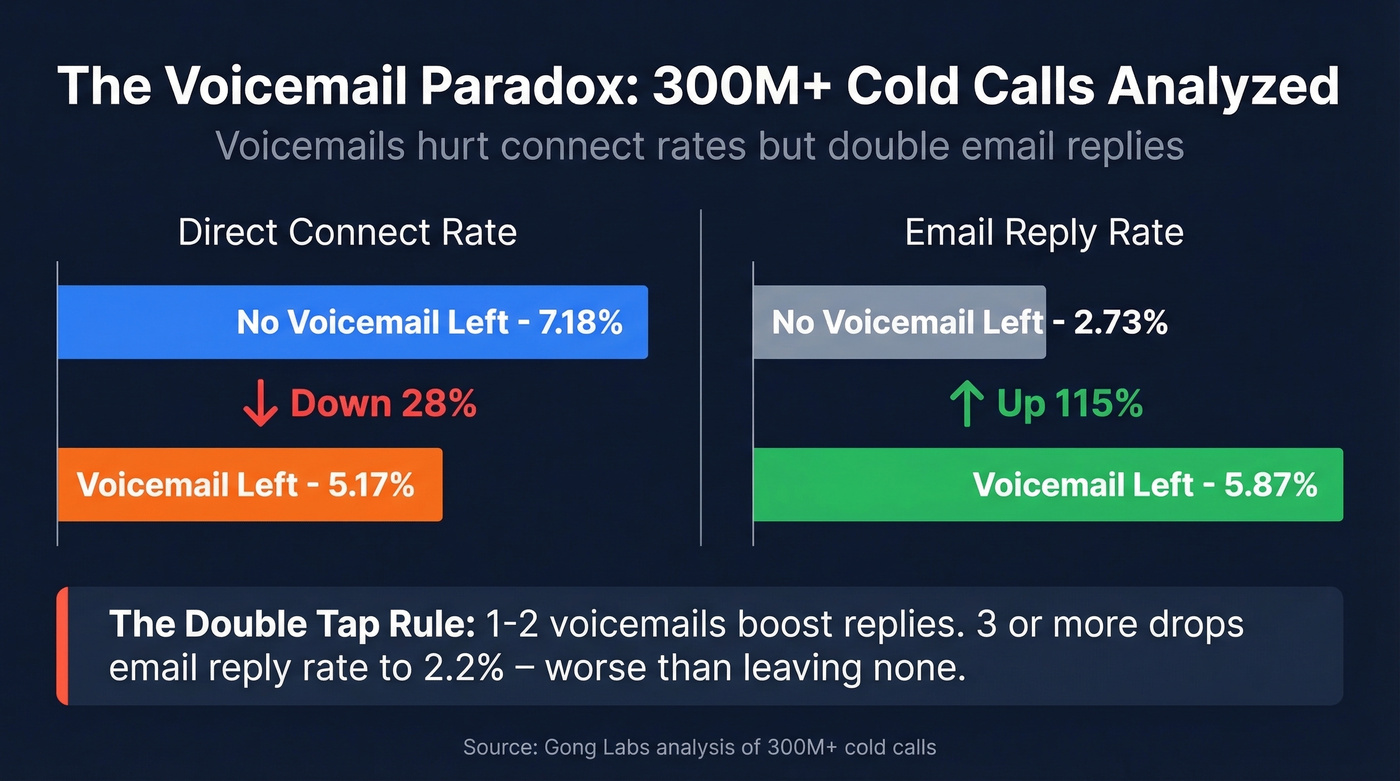
Gong Labs analyzed 300M+ cold calls and found that leaving voicemails actually reduces your future connect rate by 28% (5.17% vs. 7.18% without voicemails). That sounds bad until you see the other side: voicemails more than double email reply rates, from 2.73% to 5.87%. So should you leave a voicemail when cold calling? Yes - but only as part of a multichannel sequence, and only once or twice per prospect.
The critical nuance is what the researchers call the "Double Tap" rule. One or two voicemails boost email replies. Three or more drops the email reply rate to 2.2% - worse than leaving none at all. More isn't better. Restraint is the strategy.
On the practitioner side, one r/sales contributor reported leaving 25-35 researched voicemails per week, generating roughly 15 callbacks and 3-5 conversions. The key word there is "researched" - this doesn't work if you're spraying generic messages to unqualified lists.
For ringless voicemail specifically, vendor-reported benchmarks paint a rosier picture:
| Industry | Delivery Rate | Listen Rate | Response Rate |
|---|---|---|---|
| Real estate | 92% | 78% | 12% |
| Financial services | 90% | 72% | 8% |
| Automotive | 88% | 70% | 9% |
| Insurance | 91% | 75% | 7% |
| Retail | 87% | 65% | 6% |
Vendor-reported averages via Robotalker.
A note on deal size: if your average deal is under $10K, you probably don't need this at all. The compliance overhead and per-drop costs only make sense when a single booked meeting is worth hundreds or thousands of dollars. For low-ACV motions, put that energy into email sequences instead.
Scripts That Get Callbacks
The debate around personalized voicemail vs. pre-recorded comes down to volume and deal size. Pre-recorded messages work well when you're prospecting into a large, relatively homogeneous list - same persona, same pain point, same industry. But for named accounts or high-ACV deals, a personalized message referencing the prospect's company, role, or a recent trigger event will always outperform a generic drop.
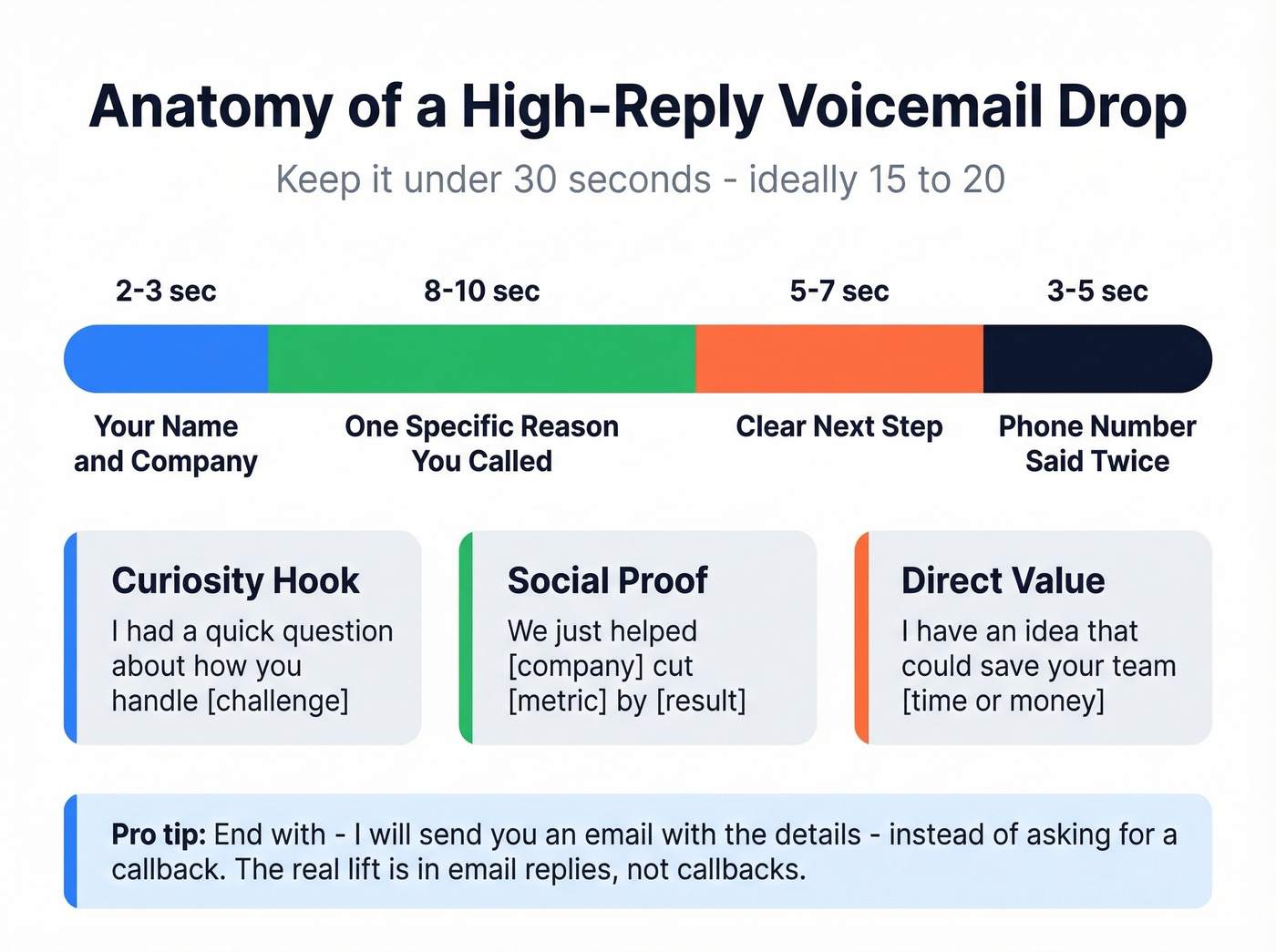
Keep every voicemail under 30 seconds. Ideally 15-20. The building blocks are simple: your name, your company, one specific reason you're calling, and your phone number said twice. If you want more options, pull from these talk track examples.
Curiosity-based:
"Hi [Name], it's [Your Name] from [Company]. I'm calling about your [specific team/initiative] - I had a quick question about how you're handling [specific challenge]. My number is [number]. Again, that's [number]."
Social-proof-based:
"Hey [Name], [Your Name] at [Company]. We just helped [similar company] cut their [metric] by [result], and I think the same approach applies to your team. Call me back at [number] - [number]."
Direct-value:
"Hi [Name], [Your Name] from [Company]. I've got an idea that could save your team [specific time/money estimate] on [specific process]. Worth a 5-minute call. [Number]. Again, [number]."
One important caveat: the 300M-call study suggests directing prospects to your email rather than asking for a callback. Voicemail's real lift shows up in email reply rates, not callback logs. Consider ending with "I'll send you an email with the details" instead of your phone number.
The Callback Flip (Reddit Tactic)
When prospects do call back, act a little confused. Let them explain who they are and what they do. Then pivot into a personalized pitch based on what they just told you. It sounds counterintuitive, but it flips the dynamic - they're selling themselves to you. The consensus on r/sales is that this approach feels more natural than launching into a rehearsed pitch the second someone returns your call.
Timing and Mistakes to Avoid
Skip Monday mornings and Friday afternoons - voicemails left during these windows get buried or ignored. Mid-week, mid-morning performs best.
Common mistakes that kill callback rates: sounding robotic or reading from a script too literally, offering no clear call to action ("just wanted to touch base" isn't a reason to call back), going over 30 seconds when attention drops off a cliff, only saying your number once while they're driving or multitasking, and leaving more than two voicemails for the same prospect. The data shows that third voicemail backfires.
Best Voicemail Drop Tools in 2026
Start With Clean Data
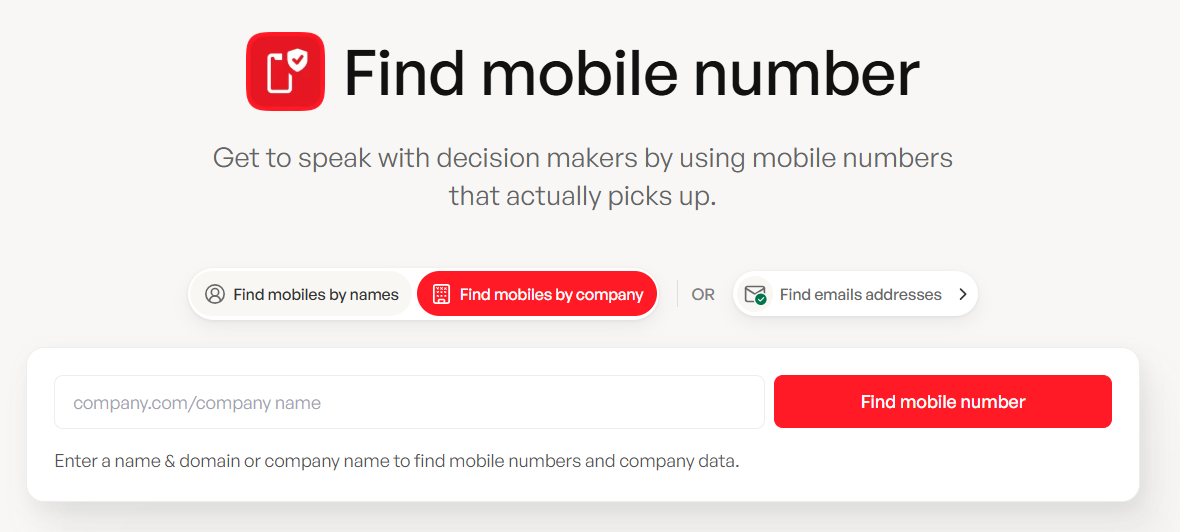
Any automated voicemail campaign is only as good as your contact data. Every wrong number is a wasted credit and a wasted slot in your campaign. We've seen teams burn through thousands of drops before realizing 30%+ of their numbers were stale - that's money and time you don't get back. Run your list through a verification tool before loading anything into your dialer. (If you're comparing vendors, these data enrichment services are a good starting point.)
Ringless Voicemail Services
Slybroadcast is the go-to for low-volume or pay-as-you-go ringless voicemail. Pricing starts at $10 for 100 delivered drops, $60 for 1,000, and scales to $400 for 10,000. Monthly plans run $8-$500/mo. You only pay for successful deliveries. SOC 2 and PCI compliant, with Zapier and Salesforce integrations. If you're testing ringless voicemail for the first time, start here - the low entry cost makes it easy to validate whether the channel works for your audience before committing to a bigger platform.
Drop Cowboy targets high-volume operations. Plans run $125-$4,000/mo with unused funds rolling over. Watch the hidden fees: there's a $0.0031/message compliance fee, forwarded calls cost $0.15 each, and AI voice cloning runs $0.005 per 100 characters. The BYOC option can run as low as $0.004/message plus carrier fees for teams already on Twilio.
Drop.co has strong per-drop pricing at scale - $0.05/drop at 1,000 units down to $0.006/drop at 2.5M. Callbacks consume 5 credits each, and some carriers charge pass-through fees.
Call Loop combines ringless voicemail with SMS in a single platform. Per-drop pricing isn't publicly listed - expect around $0.03-$0.06/drop based on comparable platforms. Skip this one if you don't need the SMS component.
B2B Sales Dialers (1-Click Drop)
Kixie is purpose-built for sales teams that want voicemail drop inside their dialer workflow. Free 7-day trial, with plans around $35-$95/user/month. CRM integrations with Salesforce and HubSpot come standard. We'd recommend most B2B teams evaluate Kixie first for dialer-based drops - it's the most focused option in this category, and the trial lets you validate the workflow before committing. (If you're shopping the category, compare a few SDR tools side by side.)

Dialpad Sell plans run around $60-$95/user/month with the feature included alongside AI-powered call analytics. Solid for teams already in the Dialpad ecosystem, but overkill if you just need the drop functionality.
Apollo offers the feature on paid dialer plans around $49-$119/user/month, bundled with email sequencing and its prospecting database. The free tier covers prospecting, but automated voicemail requires a paid plan.
JustCall and CloudCall both offer CRM integrations in the $30-$60/user/month range.
Pricing Comparison
| Tool | Starting Price | Per-Drop Cost | Hidden Fees | Best For |
|---|---|---|---|---|
| Slybroadcast (Ringless) | $10/100 drops | $0.04-0.10 | None | Low-volume / testing |
| Drop Cowboy (Ringless) | $125/mo | ~$0.02 | $0.0031/msg + extras | High-volume |
| Drop.co (Ringless) | $50/1K drops | $0.006-0.05 | 5 credits/callback | Scale campaigns |
| Call Loop (Ringless) | ~$50/mo est. | ~$0.03-0.06 | Not public | RVM + SMS combo |
| Kixie (1-Click) | ~$35/user/mo | Included | None | B2B sales teams |
| Dialpad (1-Click) | ~$60/user/mo | Included | None | AI call analytics |
| Apollo (1-Click) | ~$49/user/mo | Included | None | All-in-one outbound |
Step-by-Step Workflow
1. Build a verified prospect list. Pull your target contacts and run the phone numbers through a verification tool to confirm they're active. Dropping to dead numbers wastes credits and skews your metrics. Prospeo's mobile finder covers 125M+ verified numbers at roughly $0.01 per lead with no contracts - far cheaper than burning credits on bad data. (If you're building lists from scratch, start with a solid ideal customer profile.)
2. Record your voicemail. Use the script templates above. Record 2-3 variations so you can A/B test. Keep each under 20 seconds. Say your number twice - or better yet, tell them to check their email.
3. Choose your tool. Running B2B outbound with a CRM-connected dialer? Go dialer-based with Kixie, Dialpad, or Apollo. Running marketing-style campaigns at scale with documented consent? Consider ringless options like Slybroadcast or Drop Cowboy.
4. Set compliance guardrails. Document consent for every contact. Include opt-out instructions in every message. Scrub against federal and state DNC lists. Check the rules for every state you're calling into.
5. Run a small test batch and measure. Start with 50-100 drops. Track delivery rate, listen rate, and - most importantly - email reply lift. The real value shows up in your email metrics, not your callback log. (To tighten the follow-up, use these sales follow-up templates.)
The whole point of automating voicemails is to save time so your reps can focus on live conversations. A well-tuned workflow reclaims 30-40 minutes per rep per day. That's time going straight back into dials that actually connect.
The data is clear: voicemails double email reply rates. But that only works if you're pairing drops with verified email addresses. Prospeo delivers 98% email accuracy across 143M+ contacts - so the follow-up email your prospect opens after hearing your voicemail actually reaches them.
Pair every voicemail drop with a verified email for 2x reply rates.
FAQ
Does ringless voicemail work on landlines?
Yes, ringless voicemail can deliver to voicemail-enabled lines, including many landlines. That said, most B2B prospects use mobile phones, so landline-heavy campaigns have limited reach. Verify your list's phone types before launching.
Can prospects tell it's pre-recorded?
With ringless delivery, often yes - the voicemail appears without a corresponding missed call, which feels off. With dialer-based drops, the phone rings first, so it looks like a normal missed call. iOS Live Voicemail transcribes messages in real time, making natural delivery critical either way.
How do I avoid dropping to wrong numbers?
Verify numbers before loading them into your dialer or ringless platform. Stale databases are the biggest source of wasted drops, and we've seen teams lose thousands of credits before catching the problem.
Is voicemail drop worth it for small teams?
For teams with deal sizes above $10K, absolutely. Even 3-5 SDRs leaving 30+ voicemails daily can reclaim hours of selling time each week with a dialer-based solution. Pair it with a multichannel sequence so the voicemail amplifies your email and social touches rather than standing alone.