

VP of Sales Operations: Role, Salary & Playbook (2026)
You just got promoted. Your CRO wants a 90-day plan by Friday. The forecast is off by 15%, your CRM has 40% duplicate records, and finance is asking why you're spending $180k/year on six tools when reps only use two. Welcome to the VP of sales operations - the most under-defined, high-leverage role in B2B.
Here's what you actually need to know, fast.
- The role owns three things above all else: forecast governance, tech stack ROI, and cross-functional alignment.
- Total comp ranges from $160K to $393K depending on company stage, metro, and equity structure.
- RevOps is absorbing Sales Ops at 75% of high-growth companies - lean into it, don't fight it.
- Your first 90 days: audit the forecast process, audit the tech stack, audit the data.
- The fastest path from this role to CRO runs through RevOps leadership.
What This Role Actually Does
The textbook answer is that the VP of sales operations bridges strategy and execution. The real answer is messier. You're the person who makes the revenue machine actually work, without carrying a quota yourself. You report to the CRO or Chief Sales Officer, and you own the systems, processes, and data that let sellers sell.
The distinction from a Director of Sales Ops is scope and authority. A Director executes the playbook. A VP designs it, defends it to the C-suite, and kills the projects that aren't working. The Director manages Salesforce workflows; the VP decides whether Salesforce is even the right system.
Don't confuse this with VP of Sales, either. The VP of Sales owns a number - they're accountable for revenue. The sales operations VP builds the operating system that makes that number achievable. One carries a quota; the other builds the infrastructure that determines whether quotas are realistic in the first place.
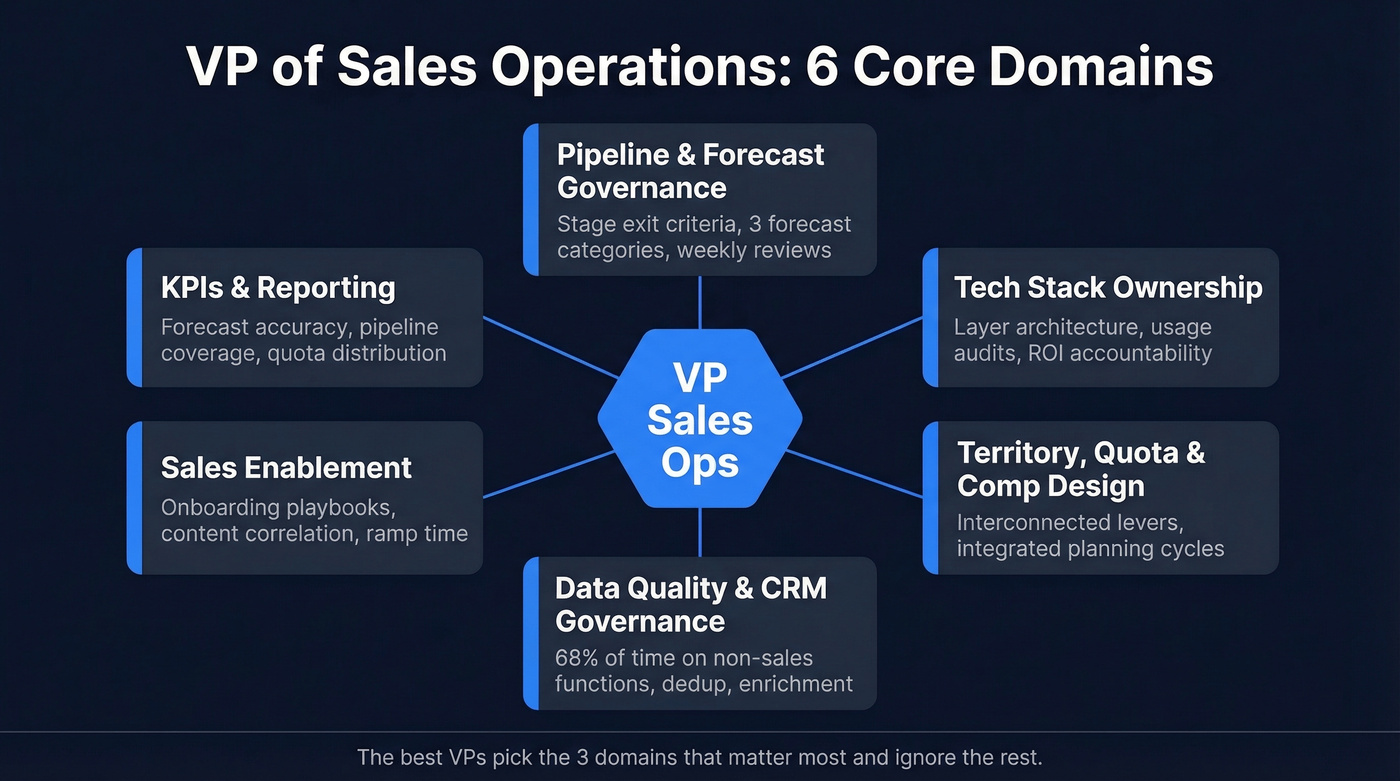
Here's the thing: the role is deliberately under-defined, and that's the feature, not the bug. Every company's version of this job looks different because every company's operational gaps are different. The best leaders in this seat figure out which three problems matter most and ignore everything else.
If your average deal size is under $15k and your sales team is under 20 reps, you probably don't need a VP-level ops hire. A strong Director and a clear CRM process will get you further. The VP-level role earns its keep when cross-functional complexity - marketing handoffs, CS alignment, multi-segment territory design - starts breaking things.
Core Responsibilities by Domain
Pipeline & Forecast Governance
This is where you earn your keep. Only 18.7% of sales organizations achieve forecast accuracy of 75% or better, per Korn Ferry data. Eighty-five percent of B2B firms miss their monthly forecast by more than 5%, and 79% miss by more than 10%. The downstream cost is staggering: inaccurate pipeline data contributes to up to 27% of lost forecasted revenue.
The fix isn't a better tool - it's a better process. Teams with weekly pipeline tracking hit 87% forecast accuracy versus 52% for teams that review ad-hoc. Discipline, not technology.
Build your forecast governance around three pillars:
- Stage exit criteria - one to two verifiable conditions per stage, not subjective gut checks. "Demo completed and technical requirements documented" is verifiable. "Prospect is interested" is not.
- Three forecast categories: Commit (will close this period, binary), Best Case (high probability, needs one more event), and Pipeline (everything else).
- Review cadence: weekly at the manager level, biweekly at leadership. No exceptions, no rescheduling.
Tech Stack Ownership
Finance just asked why you're paying $180k/year across six tools when reps only use two. This conversation defines your first quarter.
Stop thinking about your tech stack as a list of tools. Think about it as infrastructure - layered systems that either reinforce each other or contradict each other. The model looks like this: systems of record at the base, then integration and identity resolution, workflow orchestration, revenue intelligence, and governance at the top. When OpenPhone unified their enrichment and routing into a single workflow layer, they improved speed-to-lead by 67%. That's what system-level thinking gets you.
Your job isn't to buy the best tool in each category. It's to make sure the layers talk to each other and that reps actually use what you've bought. AI-powered forecasting and automated pipeline scoring are now table stakes at the revenue intelligence layer - if your stack doesn't include them, you're already behind.
Territory, Quota & Comp Design
These three are interconnected levers, not separate projects. Territory design determines addressable opportunity. Quota allocation distributes that opportunity across reps. Comp design motivates behavior against those quotas. Change one without adjusting the others and you'll create misaligned incentives that take a full quarter to surface and another to fix.
Run territory and quota planning as a single integrated cycle, not as sequential handoffs between finance and sales leadership.
Data Quality & CRM Governance
Sales Ops teams now dedicate 68% of their time to non-sales functions, up from 39% in 2019. A huge chunk of that time goes to cleaning up bad data - duplicate records, stale contacts, bounced emails, and missing fields that break every downstream workflow.
Data quality is the silent killer of both forecast accuracy and outbound conversion. Your forecast is only as good as the pipeline data feeding it, and your outbound sequences are only as good as the contact data powering them. We've seen teams cut bounce rates from 35%+ down to under 4% just by switching to an enrichment provider with a weekly refresh cycle and real verification infrastructure - that kind of improvement cascades through every metric downstream. (If you're evaluating vendors, start with a shortlist of data enrichment services.)
Sales Enablement
Sales enablement often lands on the operations VP's desk, even when it's not in the job description. Onboarding playbooks, content repositories, and training cadences all depend on the same systems and data you already own. The best operators treat enablement as a data problem: which content correlates with closed deals, which training modules actually shorten ramp time, and where are reps spending time on non-selling activities.
If nobody else owns it, you do. (This is also where a dedicated Sales Enablement Manager can pay for themselves fast.)
KPIs Worth Tracking
Five metrics tell you whether the operating system is working: forecast accuracy percentage, pipeline coverage ratio (3x minimum for most B2B), tech stack adoption rate, speed-to-lead, and quota attainment distribution. If you're only tracking one, make it quota attainment distribution - it reveals territory imbalance, comp plan issues, and hiring problems simultaneously. Every KPI should tie back to operational efficiency or revenue outcomes. If a metric doesn't connect to either, it's a vanity number you should stop reporting. For a deeper KPI set, use a standard sales operations metrics framework.
The Tech Stack This Role Owns
| Layer | Category | Example Tools | Typical Cost |
|---|---|---|---|
| 1 | CRM | Salesforce, HubSpot, Dynamics | $20-$300/user/mo |
| 2 | Sales Engagement | Outreach, Salesloft | $100-$150/user/mo |
| 3 | Enrichment & Verification | Prospeo, ZoomInfo, Clearbit | $0.01/lead-$40K+/yr |
| 4 | Revenue Intelligence | Gong, Clari | $100-$150/user/mo |
| 5 | BI & Analytics | Tableau, Looker, Power BI | $10-$70/user/mo |
| 6 | Integration | Zapier, Make, n8n, Workato | $0-$500/mo |
| 7 | Intent Data | Bombora | ~$25K-$60K/yr |
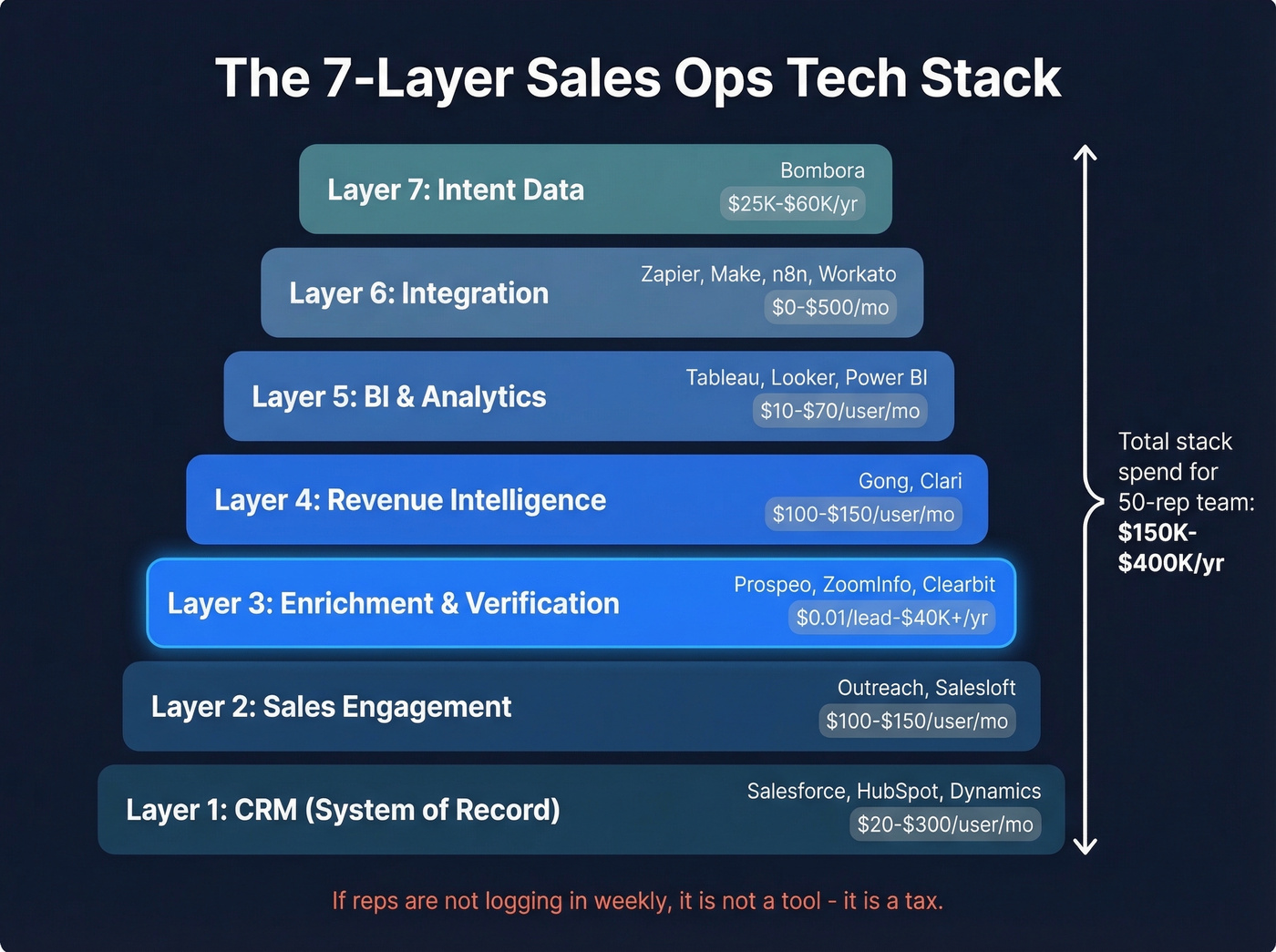
For a 50-person sales team, you're looking at $150k-$400k/year in total stack spend, depending on how enterprise your choices are. The biggest line items are always CRM and data enrichment - and enrichment is where the fastest ROI lives. (If you're comparing vendors, start with best B2B company data providers.)
The mistake we see repeatedly: teams buy a $40k/year data platform for the database, then realize they're also paying for intent, chat, and workflow features they never activate. Audit usage before you renew anything. If reps aren't logging into a tool at least weekly, it's not a tool - it's a tax.
The RevOps Shift
RevOps isn't killing Sales Ops - it's promoting it. Gartner projected that by 2026, 75% of the highest-growth companies would adopt a RevOps model, and that projection is becoming reality. Forrester's data backs the business case: aligned revenue operations drive 19% faster revenue growth and 15% higher profitability.
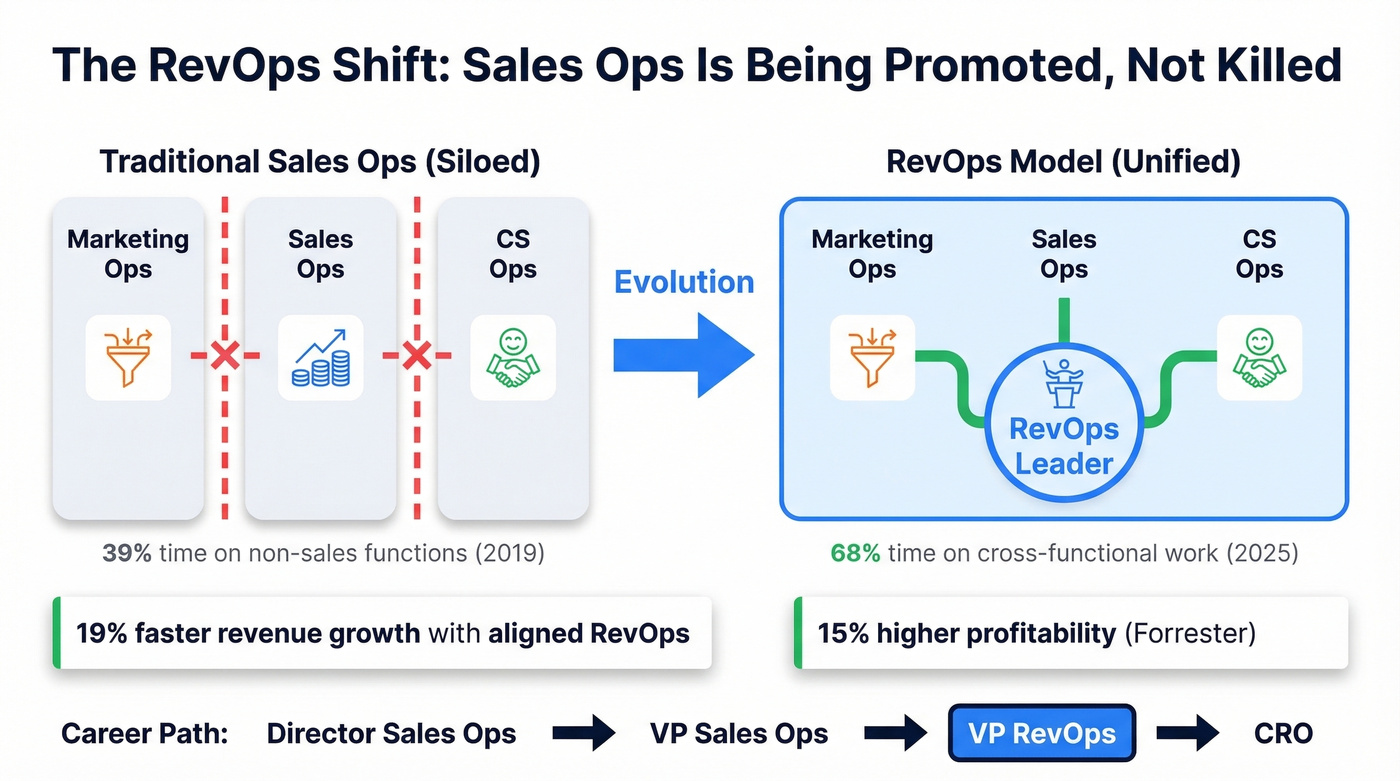
What's actually happening is that Sales Ops teams are already doing RevOps work - they just don't have the title or the mandate. That 68% of time spent on non-sales functions? Much of it is marketing alignment, customer success handoffs, and cross-functional data governance. The RevOps model formalizes what's already true.
For your career, this is an opportunity, not a threat. The sales operations leader who thinks cross-functionally - who owns the full customer journey from lead to renewal - becomes the natural candidate for CRO. The one who stays siloed in sales-only operations gets absorbed into someone else's org chart. If you're mapping the next step, compare the scope of a RevOps Manager role versus a VP seat.

The article says it plainly: data quality is the silent killer of forecast accuracy and outbound conversion. Prospeo's 5-step verification delivers 98% email accuracy, 125M+ verified mobiles, and a 7-day refresh cycle - so your pipeline data actually reflects reality. Teams using Prospeo cut bounce rates from 35%+ to under 4%.
Stop letting bad data sabotage your forecast. Start with 75 free verified emails.
Compensation Benchmarks in 2026
What the Data Says
| Source | Avg/Median | Range (10th-90th) | Date |
|---|---|---|---|
| PayScale%2C_Sales_Operations/Salary) | $192,280 base | $150K-$374K base; $160K-$393K total | Oct 2025 |
| Salary.com | $274,086 total | $218K-$329K | Mar 2026 |
| Glassdoor | $305K median total | $235K-$405K (25th-75th) | Apr 2025 |
Variable comp from PayScale breaks down as: bonus $7K-$65K, profit sharing $0-$48K, commission $0-$39K. The wide ranges reflect how wildly comp structures vary by company stage and philosophy.
Why These Numbers Diverge
A ~$113K gap between PayScale's average base and Glassdoor's median total isn't a data error - it's a story about how different the role looks at different companies.
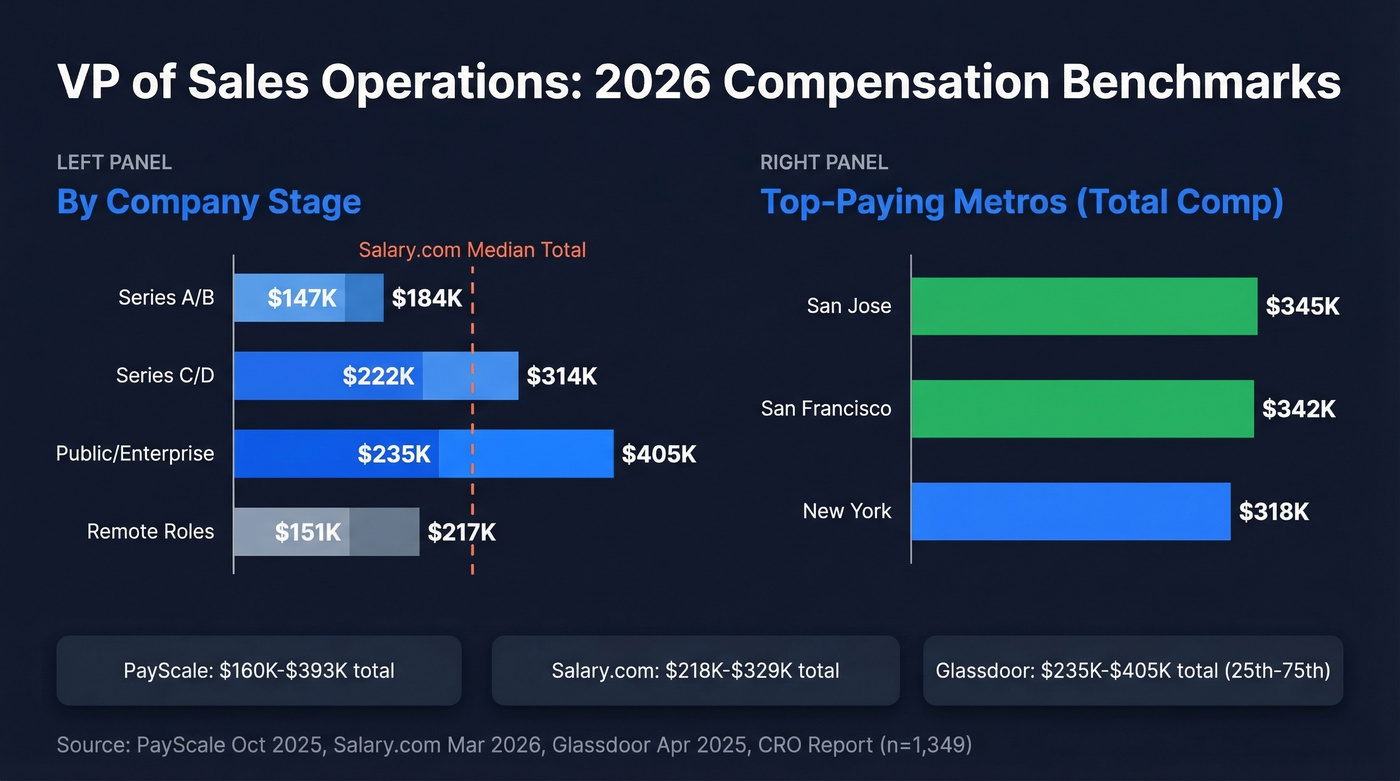
Stage matters enormously. CRO Report data from 1,349 executive sales postings shows how much company maturity moves pay: Series A/B base ranges of $147K-$184K versus Series C/D at $222K-$314K. Metro matters too - San Francisco posts at $244K-$347K while remote roles land at $151K-$217K.
The top-paying metros per Salary.com: San Jose ($345K), San Francisco ($342K), and New York ($318K). If you're negotiating remote comp against Bay Area benchmarks, expect pushback.
Equity complicates things further. At a Series A company, you might take $160K base with 0.15-0.30% equity. At a public company, you're looking at $250K+ base with RSUs that vest over four years. Only 54.8% of executive sales postings even disclose base comp, which makes benchmarking harder than it should be.
Let's be honest: if you're evaluating an offer, don't compare base-to-base across stages. Compare total comp over three years, including realistic equity scenarios. A $170K base with meaningful equity at a Series B can outperform a $280K base at a late-stage company where the stock is flat.
Team Sizing & Org Design
The benchmark ratio is 12:1 - twelve sales reps per RevOps/Sales Ops headcount, based on PeerSignal's analysis of 2,500 B2B SaaS companies. This is the single most useful planning number you'll find for this role. At $100M ARR with 87-116 sales professionals, that translates to 7-10 RevOps team members: one Director or VP, one Manager, and six to eight individual contributors.
The reporting structure is straightforward. The VP reports to the CRO or CSO. In a RevOps model, you report to a Chief Revenue Officer who also oversees marketing ops and CS ops. In a sales-only model, you report to the head of sales.
We've seen teams try to stretch the ratio to 20:1 or higher. It works until it doesn't - usually around the time forecast accuracy drops below 70% and territory planning becomes a quarterly fire drill. If you're running lean, protect forecast governance and data quality first. Everything else can wait.
Qualifications & Career Path
The typical profile: bachelor's degree (MBA preferred but not required), 7-10 years of progressive experience in sales operations or revenue operations, and a track record of managing both people and systems.
The skills that actually matter aren't on the resume. Systems thinking - the ability to see how a change in territory design cascades into quota attainment, comp plan satisfaction, and ultimately attrition. Forecasting rigor that goes beyond "the reps say they'll close it." Cross-functional influence, because you'll spend half your time convincing marketing, finance, and CS leaders to change their processes. And change management, because every initiative you launch requires adoption from people who didn't ask for it.
The career progression runs: Director of Sales Ops, then VP of Sales Ops, then VP of RevOps, then CRO or COO. The fastest path to CRO runs through RevOps - it's the role that gives you visibility across the entire revenue engine, not just the sales silo. Join communities like Pavilion or the Sales Ops Society to build the cross-functional network that accelerates this path.
Hiring or Becoming a VP of Sales Operations
Job descriptions for this role list 15 responsibilities and zero priorities. The actual job is three things: make the forecast trustworthy, make the tech stack earn its cost, and make cross-functional handoffs work. Everything else is a subset. If you need a starting point for the first month, adapt a 30-60-90 day plan template to an ops context.
If you're hiring, evaluate candidates on five criteria: forecast governance track record, tech stack rationalization experience, comp and territory design chops, data governance philosophy, and cross-functional influence style. The last one matters most - a brilliant analyst who can't get the VP of Marketing to agree on lead definitions will fail in this seat regardless of their technical skills.
If you're the candidate, resist the urge to lead with dashboards. If your instinct is to build a dashboard before asking what decision it supports, you're an analyst, not an operator. The best people in this seat start with "what decision are we trying to make?" and work backward to the data, the process, and the tool.
For anyone feeling imposter syndrome in this role - that's normal. Threads on r/SalesOperations are full of newly promoted ops leaders sharing the same anxiety: "I got the title, now what do I actually do Monday morning?" The answer is always the same. Pick the three biggest operational gaps, build a 90-day plan around them, and start earning trust through small wins before you propose the big ones. The role is ambiguous by design. Your job is to impose structure on ambiguity, not to have all the answers on day one.
Your tech stack audit starts here. Instead of paying $180K/year across six tools, Prospeo consolidates enrichment, verification, and intent data into one platform at roughly $0.01 per email - 90% cheaper than ZoomInfo with higher accuracy. CRM enrichment returns 50+ data points per contact at a 92% match rate.
Cut your enrichment spend by 90% and get better data. No contracts required.
FAQ
VP Sales Ops vs. Director: What's Different?
The VP sets strategy, owns cross-functional alignment, and reports to the CRO, typically earning $200K-$350K total comp. The Director executes - managing CRM workflows, reports, and day-to-day processes. VPs carry larger scope, greater equity participation, and authority to kill underperforming initiatives.
VP Sales vs. VP Sales Ops: How Do They Differ?
The VP of Sales carries a revenue number and manages sellers directly. The VP of Sales Operations builds the systems, processes, and data infrastructure that make hitting that number possible. One owns the outcome; the other owns the operating system behind it.
Is Sales Ops Being Replaced by RevOps?
Not replaced - expanded. Gartner's 75% RevOps adoption projection is becoming reality across high-growth companies in 2026. Sales Ops becomes a function within RevOps, gaining broader scope over marketing and CS operations. For practitioners, this is a career accelerator toward CRO.
What Does a VP Sales Ops Do Day-to-Day?
Weekly forecast reviews, pipeline governance, tech stack audits, cross-functional alignment with marketing and CS, and territory or quota cycle planning consume most of the calendar. Q4 is heavy on forecasting; Q1 on territory redesign and comp plan rollout.
Which Tools Should a VP Sales Ops Prioritize?
Start with three layers: CRM (Salesforce or HubSpot), enrichment and verification (Prospeo delivers 98% email accuracy at ~$0.01/lead with native CRM integrations), and revenue intelligence (Gong or Clari). Add engagement and intent tools only after the foundation is solid. Skip this if your team is under 10 reps - a well-configured CRM and a basic enrichment workflow will cover you.