

Website Visitor Identification: How It Works in 2026
You spent $15,000 driving traffic to your product pages last quarter. Google Analytics says 4,200 visitors hit the pricing page. Twelve filled out a form. The other 4,188? Gone - no name, no company, no way to follow up.
That's the core frustration behind website visitor identification. The technology to unmask some of those ghosts exists, but the gap between vendor promises and reality is wide enough to waste a budget.
The Ghost Funnel Problem
97% of B2B website visitors remain anonymous - they never fill out a form, never start a chat, never raise their hand. For a company spending real money on B2B content marketing, SEO, and paid campaigns, that anonymous gap represents pipeline you're funding but never capturing.
At a 30-65% company-level match rate (depending on your traffic mix), that $15K campaign yields roughly 1,260-2,730 identified companies. After ICP filtering, maybe 200 worth pursuing - if the contact data is verified. Most teams never run that math.
What Visitor Identification Is (and Isn't)
This technology is database matching, not surveillance magic. A tool places a pixel on your site, captures signals from the visit - IP address, cookies, device data - and matches those signals against a database to return either a company name or, in some cases, an individual contact.
The critical distinction: company-level tells you "someone from Acme Corp visited your pricing page." Person-level tells you "Sarah Chen, VP of Marketing at Acme Corp, visited at 2:14 PM." The second is dramatically more useful but covers a much smaller slice of your traffic.
What visitor ID doesn't do: track individuals across the internet, work on every visitor, or hand you verified contact data ready for outreach. Most tools return a name and a company. Whether that email bounces or that phone number connects is a separate problem entirely.
How It Actually Works - 5 Methods
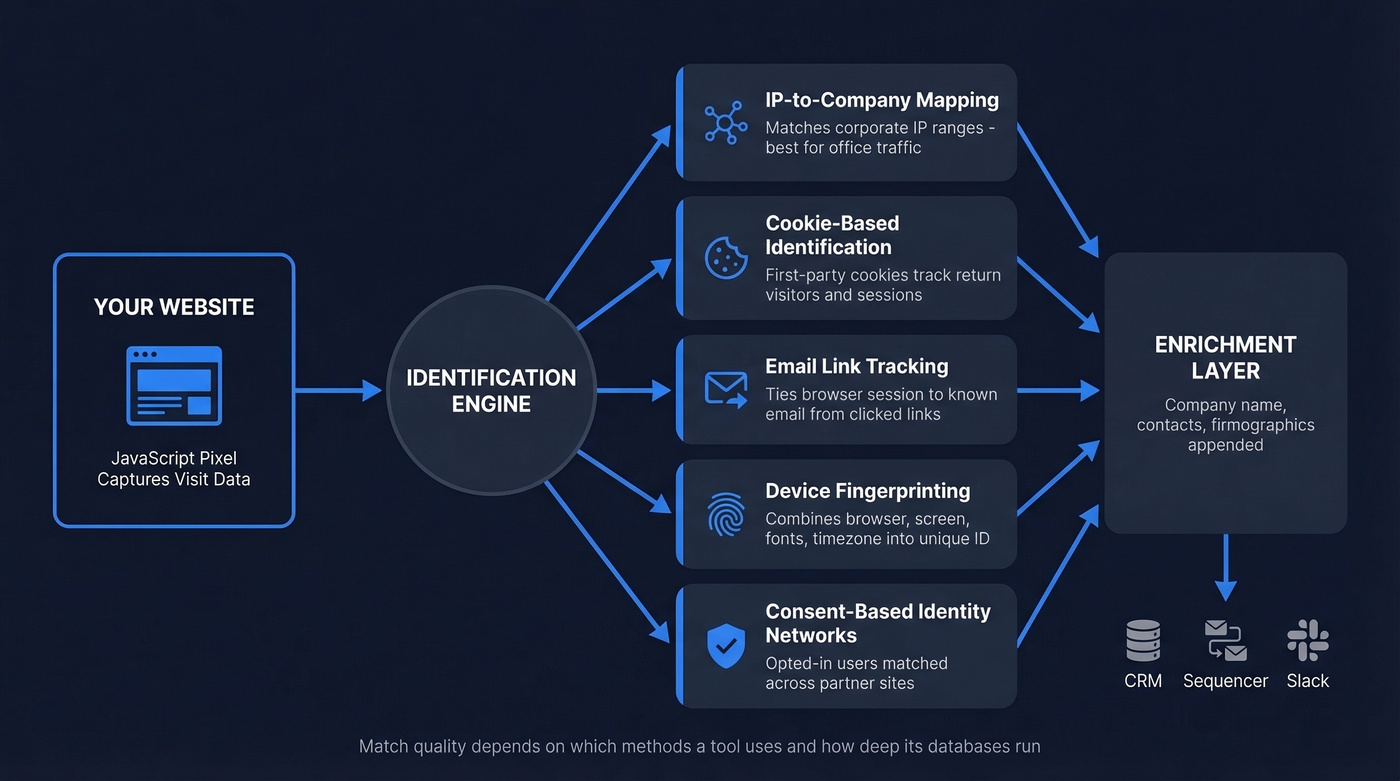
Most tools follow a common architecture. A JavaScript pixel captures visit data, an identification engine matches it against databases, an enrichment layer appends company or contact details, and integrations push results to your CRM or sequencer. The differences come down to which matching methods a tool uses and how deep its databases run.
IP-to-Company Mapping
The oldest method. Your visitor's IP address gets matched against corporate IP ranges, and corporate static IPs identify visitors at 60-80% accuracy. The problem: remote workers on residential ISPs, mobile networks, and VPNs break this completely. A VP browsing from their home office in Denver shows up as a Comcast subscriber, not a Snowflake employee.
Cookie-Based Identification
First-party cookies track return visitors and build session histories. Third-party cookies, increasingly blocked by browsers, used to enable cross-site matching. Cookie-based identification can link a visitor to a known contact if they've previously engaged - clicked an email link, filled out a form on a partner site, or opted into a tracking network. Powerful when it works, but consent requirements in the EU make deployment harder.
Email Link Tracking
When a known contact clicks a link in your marketing email, the click passes an identifier tying their browser session to their email address. This is the highest-accuracy method, but it only works for contacts already in your database. It's a retention play, not net-new identification.
Device Fingerprinting
Combines browser type, screen resolution, installed fonts, timezone, and other device attributes to create a semi-unique identifier. Works without cookies but raises significant privacy concerns. Accuracy degrades as browsers add anti-fingerprinting protections, and GDPR regulators have flagged it as potentially requiring consent.
Consent-Based Identity Networks
Some platforms participate in identity networks where users have opted in across multiple sites. Match rates are lower than IP-based methods, but data quality tends to be higher because there's an explicit consent chain. This is the model gaining traction in privacy-conscious markets.
Realistic Match Rates
When a tool claims "80% match rate," they almost always mean company-level identification under ideal conditions - corporate office traffic, US-based visitors, known IP ranges. Here's what teams actually experience:
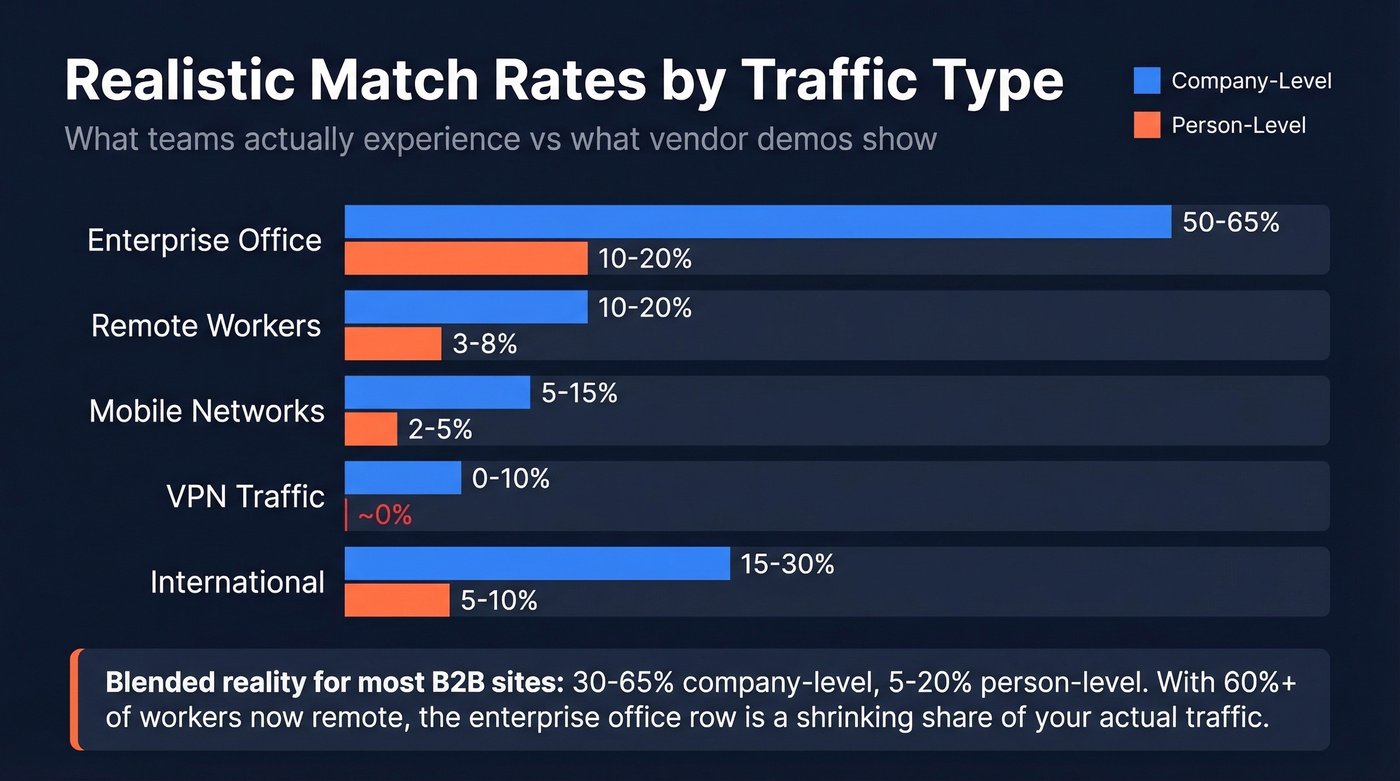
| Traffic Type | Company-Level Match | Person-Level Match |
|---|---|---|
| Enterprise office | 50-65% | 10-20% |
| Remote workers | 10-20% | 3-8% |
| Mobile networks | 5-15% | 2-5% |
| VPN traffic | 0-10% | ~0% |
| International | 15-30% | 5-10% |
With 60%+ of knowledge workers now remote or hybrid, the "enterprise office" row - the one that makes vendor demos look impressive - represents a shrinking share of your actual traffic. Blended reality for most B2B sites: 30-65% company-level, 5-20% person-level.
Even when a tool identifies a visitor, the contact data attached is often weeks or months old. Stale data is the #1 reason outbound sequences from visitor ID tools bounce. (If you want to benchmark and fix bounces, see email bounce rate.)

Visitor ID tools tell you who visited. Prospeo tells you how to reach them. Enrich identified companies with 98% accurate emails and verified mobile numbers - refreshed every 7 days, not months. No more bounced sequences from stale visitor data.
Turn identified visitors into booked meetings for $0.01 per email.
The Intent Noise Problem
Here's the thing: the biggest complaint about identifying anonymous visitors isn't accuracy - it's noise. One Reddit thread on r/b2bmarketing describes a platform flagging thousands of accounts with under 2% conversion when the team actually reached out. That's not a lead list. That's a distraction.
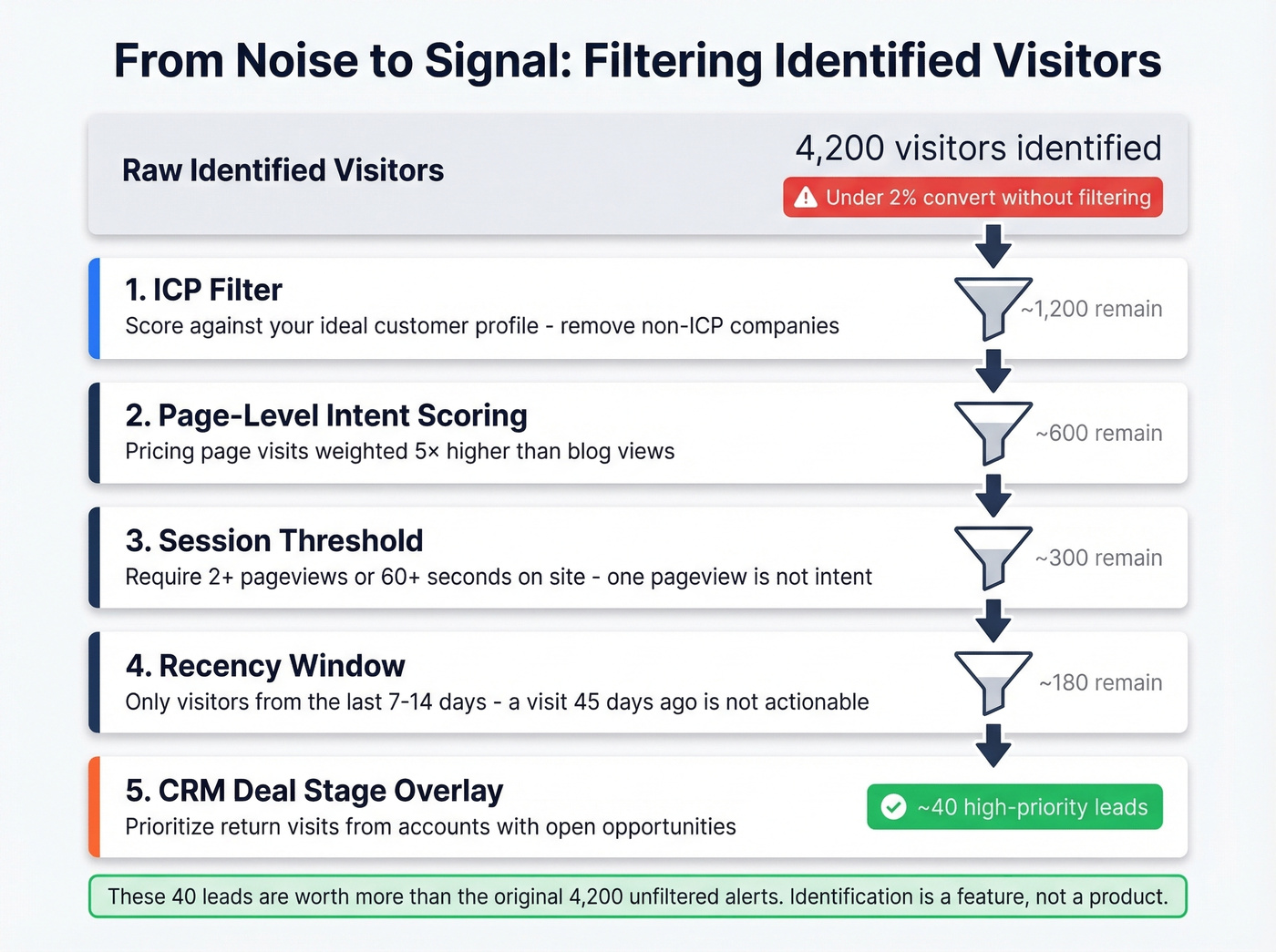
The fix isn't better identification - it's better filtering. Score identified visitors against your ICP before routing to sales. Weight page-level intent: pricing pages matter more than blog posts. Set minimum session thresholds, because one pageview isn't intent. Apply recency windows, because a visit 45 days ago isn't actionable today. Set alert rules that combine page type, dwell time, and CRM deal stage - a return visit to pricing from an account with an open five-figure opportunity is a signal; a blog bounce from an unknown company is not.
Identification is a feature, not a product. The tool that tells you "someone from Acme visited" is only as valuable as your ability to filter that signal, enrich it with verified contact data, and act on it fast. We've watched teams over-invest in the identification layer and under-invest in everything after it. (For a practical framework, use a lead generation workflow.)
Privacy and Compliance
EU (GDPR): IP addresses and cookie identifiers are personal data. Non-essential cookies require explicit opt-in consent before placement - pre-ticked boxes are invalid. Regulators are increasingly checking "backend alignment," verifying whether your banner's promises match what your code actually does. Company-level IP identification without cookies sits in a grayer area, which is why tools like Leadinfo market their cookieless option as GDPR-friendly. On Reddit, EU-based marketers consistently describe person-level identification as invasive and "shady" - the reputational risk in European markets is real regardless of legality.
US: The model is opt-out, not opt-in. 15+ states now have privacy laws with varying requirements. California's CCPA/CPRA requires honoring Global Privacy Control signals. The practical floor: disclose what you're tracking, honor opt-out requests, and don't sell personal data without consent.
Quick compliance checklist: Audit whether your visitor ID tool fires before or after consent. Make sure your privacy policy describes visitor identification. Honor GPC signals for US visitors. Use cookieless methods for EU traffic. Test your consent banner against actual cookie behavior.
Best Tools for Identifying Website Visitors in 2026
The visitor identification software market hit $3.55B in 2024 and is projected to reach $9.99B by 2032 at a 12.4% CAGR. More tools, more noise, more vendor claims to sort through. Let's break down what actually matters.
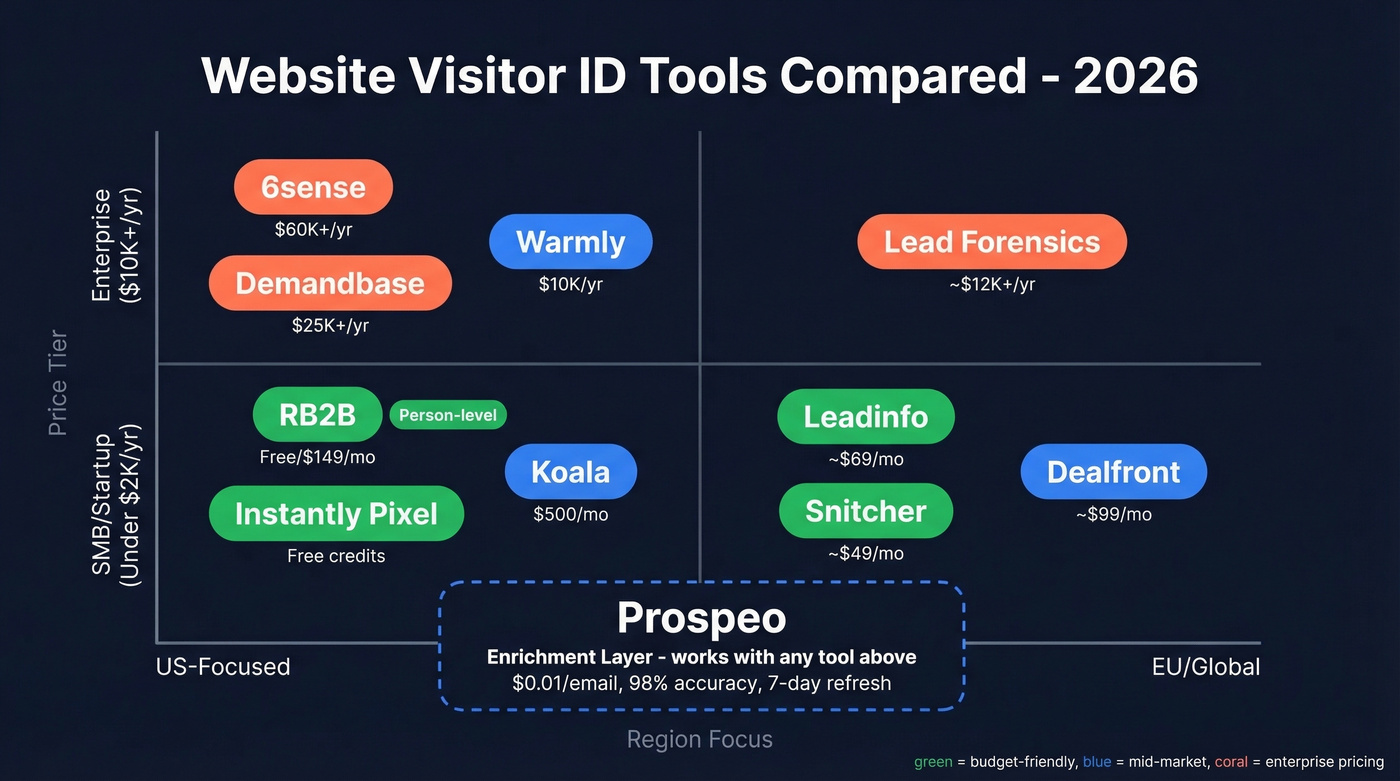
| Tool | Type | Best For | Region Strength | Starting Price |
|---|---|---|---|---|
| RB2B | Person | SMB outbound alerts | US | Free / $149/mo |
| Prospeo | Enrichment | IDs into replies | Global | Free / ~$0.01/email |
| Leadinfo | Company | EU mid-market | EU | ~€69/mo |
| Snitcher | Company | Budget EU teams | EU | ~€49/mo |
| Dealfront | Company | EU ABM | EU | ~€99/mo |
| Lead Forensics | Company | Enterprise legacy | UK/US | ~€1,000+/mo |
| Instantly Pixel | Person | Outreach-integrated | US | Free credits |
| Koala | Both | Mid-market intent | US | $500/mo |
| Warmly | Both | Mid-market + chat | US | $10,000/yr |
| 6sense | Both | Enterprise ABM | Global | $60,000+/yr |
| Demandbase | Both | Enterprise ABM | Global | $25,000+/yr |

RB2B
RB2B does one thing well: person-level identification for US traffic with dead-simple Slack alerts. The free tier gives you 150 credits per month. Pro runs $149/mo and unlocks more credits plus integrations.
The Slack workflow is genuinely useful - your SDR sees "Sarah Chen from Acme just viewed pricing" in real time and can act within minutes. But person-level coverage is strongest in the US, and the tool doesn't include a full enrichment and verification layer. We've seen teams get excited when their RB2B Slack channel blows up with alerts, then discover that half the emails bounce when loaded into sequences. Identification without verification is a leaky bucket.
Use this if: You're a US-focused SMB running outbound and want free person-level alerts. Skip this if: You sell into Europe, need verified contact data, or have under 2,000 monthly visitors.
Prospeo
Not a visitor identification tool - it's the enrichment and verification layer that makes identification actionable.
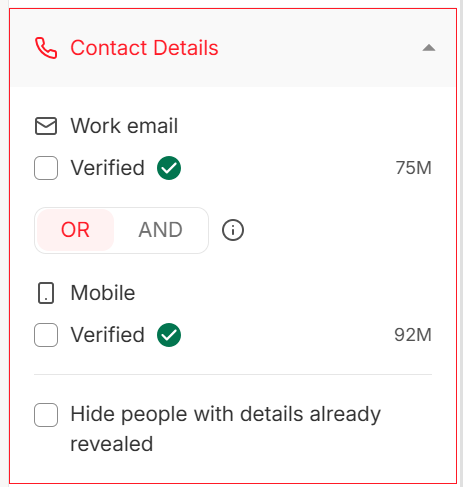
Once a visitor ID tool tells you Acme Corp visited your pricing page, Prospeo gives you the verified contacts to reach decision-makers there. The database covers 300M+ professional profiles with 143M+ verified emails at 98% accuracy and 125M+ verified mobile numbers with a 30% pickup rate. The 7-day data refresh cycle means you aren't emailing someone who changed jobs two months ago.
Export identified companies from your visitor ID tool, run them through Prospeo's enrichment workflows with a 92% API match rate, and push verified contacts directly to Salesforce, HubSpot, Instantly, or Lemlist. (If you're comparing providers, start with data enrichment services.) Free tier includes 75 emails per month. Paid plans run roughly $0.01 per email with no contracts.
Leadinfo
A strong option for EU company-level identification. European tools often score higher on EU visitors - around 35-40% identification rates - because they're built on deeper European databases. Pricing starts around €69/mo.
The cookieless identification option is the real differentiator. By relying on IP-to-company mapping without placing tracking cookies, Leadinfo can run core company identification without cookie-based tracking. The tradeoff: company-level only. You'll know Siemens visited, but not which person at Siemens.
Use this if: You sell into European markets and want GDPR-friendly company identification out of the box. Skip this if: You need person-level data or your traffic is primarily US-based.
Dealfront (Leadfeeder)
Solid EU company-level identification with ABM features. Merged Leadfeeder and Echobot into a platform combining visitor identification with European company data. Pricing starts around €99/mo, with higher tiers around €139/mo. Good CRM integrations, but pricier than Leadinfo for similar EU coverage.
Snitcher
The budget EU option from €49/mo. Good for small teams testing whether identifying anonymous visitors adds value before committing to a larger tool. Smaller database than Leadinfo, so expect lower match rates on European traffic.
Lead Forensics
Has been around longer than most competitors, and it shows - both in market presence (4.4/5 on G2 with 1,048 reviews) and in recurring complaints about outdated contacts and incorrect data. At €1,000+/mo for company-level identification, the pricing is hard to justify when newer tools deliver comparable or better results for a fraction of the cost. The fact that they still don't publish pricing on their website is frustrating - it's 2026.
6sense
Enterprise ABM suite where visitor identification is one feature among many. Intent data, predictive analytics, account scoring, orchestration - the full stack. At $60,000+/yr, it only makes sense with a dedicated RevOps team. If you're evaluating 6sense for visitor ID alone, you're buying a fighter jet to commute to work.
Demandbase
Enterprise ABM suite from $25,000+/yr. Competes directly with 6sense; choose based on which platform your RevOps team already knows.
Koala
Mid-market intent plus identification from $500/mo. Combines visitor tracking with intent scoring in a single platform. Worth evaluating if you want both capabilities without stitching together separate tools. (Related: intent based segmentation.)
Warmly
Mid-market chat plus visitor reveal from $10,000/yr. Best for teams wanting live chat conversations triggered by visitor identification - the "someone from your target account is on the site right now" use case.
Instantly Pixel
Bundled with Instantly's outreach platform. 25 free credits to start, then pay only for resolved profiles. US-focused. The draw is identified visitors flowing directly into Instantly's sequencer without manual export. (If you're building a safer outbound stack, see cold email marketing.)
Vector
Early-stage player focused on contact-level identification with an ad audience activation angle. Pricing isn't public yet. Too new to evaluate against established options, but worth watching if ghost funnel recovery is your primary use case.
How to Run a Bake-Off
Don't trust any vendor's demo data. Run your own test:
- Install 2 tools simultaneously on the same pages for 30 days
- Validate against known form submissions - if someone filled out a form and the tool didn't identify them, that's a miss
- Measure false positive rate - are identified companies actually visiting, or is the IP mapping wrong?
- Check data freshness - email someone identified 30 days ago and see if the address still works
- Calculate cost per qualified identified visitor - not cost per identification, cost per visitor who matches your ICP and has valid contact data
In our experience, the bake-off is where inflated vendor claims fall apart. One team we spoke with found a 40% gap between two tools' match rates on the same traffic - same pages, same 30-day window, wildly different results. (To standardize your scoring, use an ideal customer profile template.)
When Visitor ID Isn't Worth It
Skip website visitor identification entirely if your site gets under 2,000 monthly visitors. The math just doesn't work - after match rates and ICP filtering, you're looking at maybe 50 actionable accounts per month, and that's optimistic. Same goes if your traffic is primarily B2C consumer, if nobody on your team will actually act on the data, or if your traffic comes from broad-targeting paid social that sends unqualified visitors. Identifying noise just creates more noise.
Identification without enrichment is just a company name on a dashboard. Prospeo's enrichment API returns 50+ data points per contact at a 92% match rate - layer it on top of any visitor ID tool to get verified emails, direct dials, and job titles that are actually current.
Stop paying for visitor signals you can't act on.
FAQ
Is website visitor identification legal?
Yes, but rules differ by region. EU GDPR requires opt-in consent before tracking cookies; IP addresses count as personal data. US states mostly use opt-out models under CCPA and similar laws. Always disclose tracking in your privacy policy and honor opt-out requests promptly.
What match rates should I realistically expect?
Company-level: 30-65%. Person-level: 5-20%. Vendors quoting 80%+ are measuring ideal conditions - corporate office IPs, US traffic only. Run a 30-day bake-off against your actual traffic before committing to an annual contract. Remote and mobile visitors drag blended rates down significantly.
Company-level vs person-level - which should I choose?
Company-level is more reliable with higher match rates (30-65% vs 5-20%). Person-level gives you names but covers a smaller slice of traffic. Most teams benefit from company-level identification paired with an enrichment tool to get verified contacts at the companies that matter.
How much does visitor identification cost?
From free (RB2B's 150 credits/mo) to $60,000+/year (6sense). Most SMB tools run $39-199/month. Budget for an enrichment layer on top - because visitor ID data alone rarely has the accuracy needed for cold outreach.
How do I turn identified visitors into actual pipeline?
Verify the contact data before outreach - this is the step most teams skip. Use your visitor ID tool to surface the company, then run it through an enrichment platform to get verified emails and direct dials. Score identified contacts against your ICP and route high-intent matches to sales within hours, not days. Stale data kills reply rates faster than bad messaging.