

What Does a Sales Operations Manager Do? The Real Job Behind the Title
It's Monday morning. You open Salesforce and 40% of this quarter's opportunities are missing next steps. The VP of Sales wants a forecast by noon. Two reps are fighting over the same account. And someone just uploaded 3,000 contacts with no phone numbers.
Welcome to Sales Ops.
So what does a sales operations manager do? The job boils down to three things: make the data trustworthy, make the tools work, make the forecast accurate. Everything else is a sub-task of one of those three.
A Sales Operations Manager exists to reduce friction so reps spend time selling, not wrestling with systems. The three pillars are clean data, a functional tech stack, and accurate forecasts. Median total comp sits around $115K/year in the US, climbing higher in IT and pharma.
Core Responsibilities
Let's break these down with real examples, not abstract bullet points.
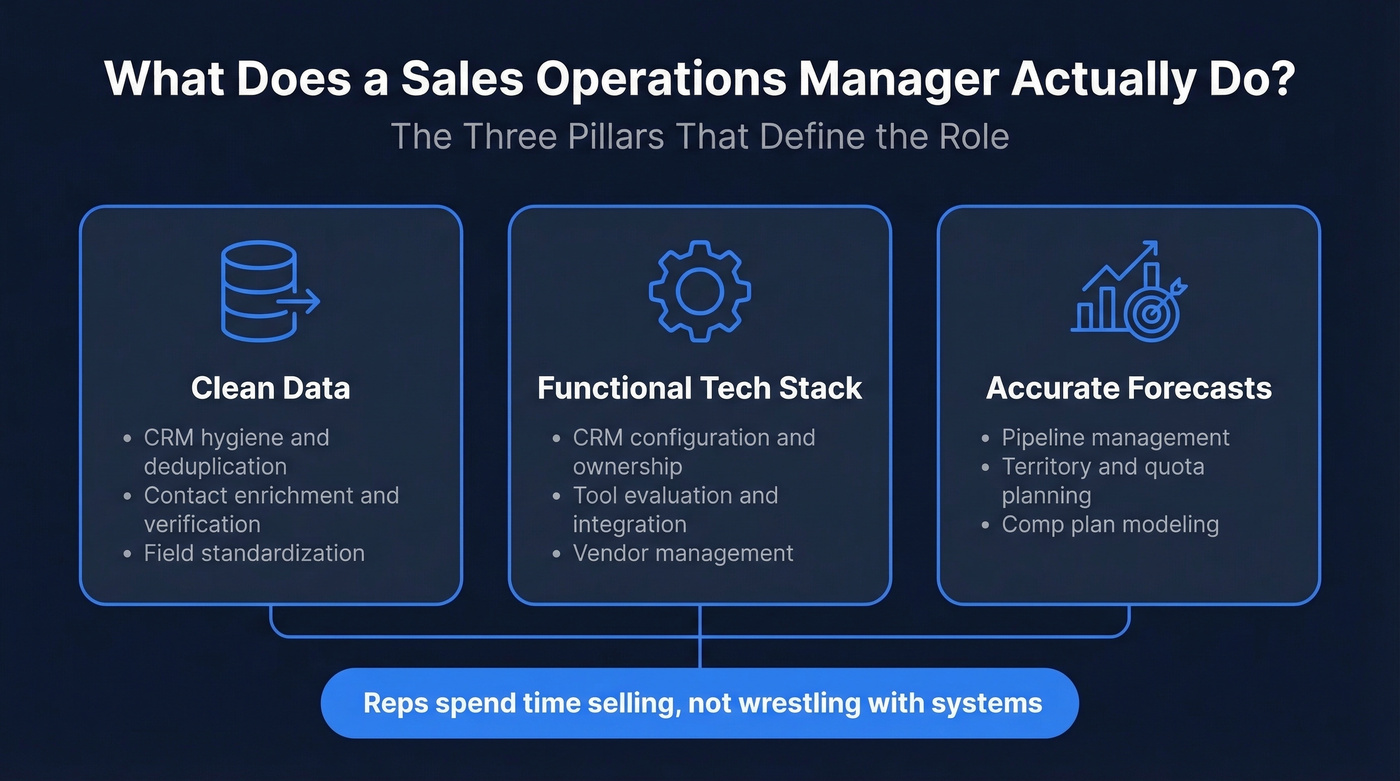
Data governance comes first because everything downstream depends on it. If you're seeing email bounce rates around 35%, your forecasts are built on fiction and your reps are burning domain reputation on dead addresses. It isn't glamorous, but it's the foundation.
CRM ownership means you're the person who decides how Salesforce or HubSpot is configured, what fields are required, and how pipeline stages map to your sales process. When a rep says "the CRM is broken," they're calling you.
Forecasting and pipeline management is where Sales Ops earns its seat at the leadership table. You're pulling data from multiple sources, normalizing it, and telling the VP whether the team will hit number. Get this wrong and you lose credibility fast - there's no recovering from a forecast that's off by 30%. (If you’re evaluating tooling here, see sales forecasting solutions.)
Territory and quota planning requires balancing rep capacity, market potential, and historical performance. A bad territory plan creates sandbagging in one region and burnout in another.
Compensation modeling sits at the intersection of finance and sales. You're designing plans that motivate the right behaviors without blowing the budget. Expect to partner closely with finance and HR on this one.
Process optimization is the catch-all. As Sonia Groff, a Sales Ops Manager at HubSpot, puts it: the best in this role have excellent project management and interpersonal skills - because you're constantly juggling stakeholders across finance, strategy, and HR while negotiating competing priorities.
AI is reshaping several of these responsibilities. Clari uses it for deal inspection, Gong for coaching insights, and increasingly, sales operations managers are expected to evaluate and deploy AI tools across the entire stack. (More on the broader role shift in RevOps Manager.)
A Typical Week in Sales Ops
Here's what surprises people about this role: Gartner found that Sales Ops teams now dedicate 68% of their time to non-sales functions, up from 39% in 2019. The job has expanded well beyond "help reps close deals."
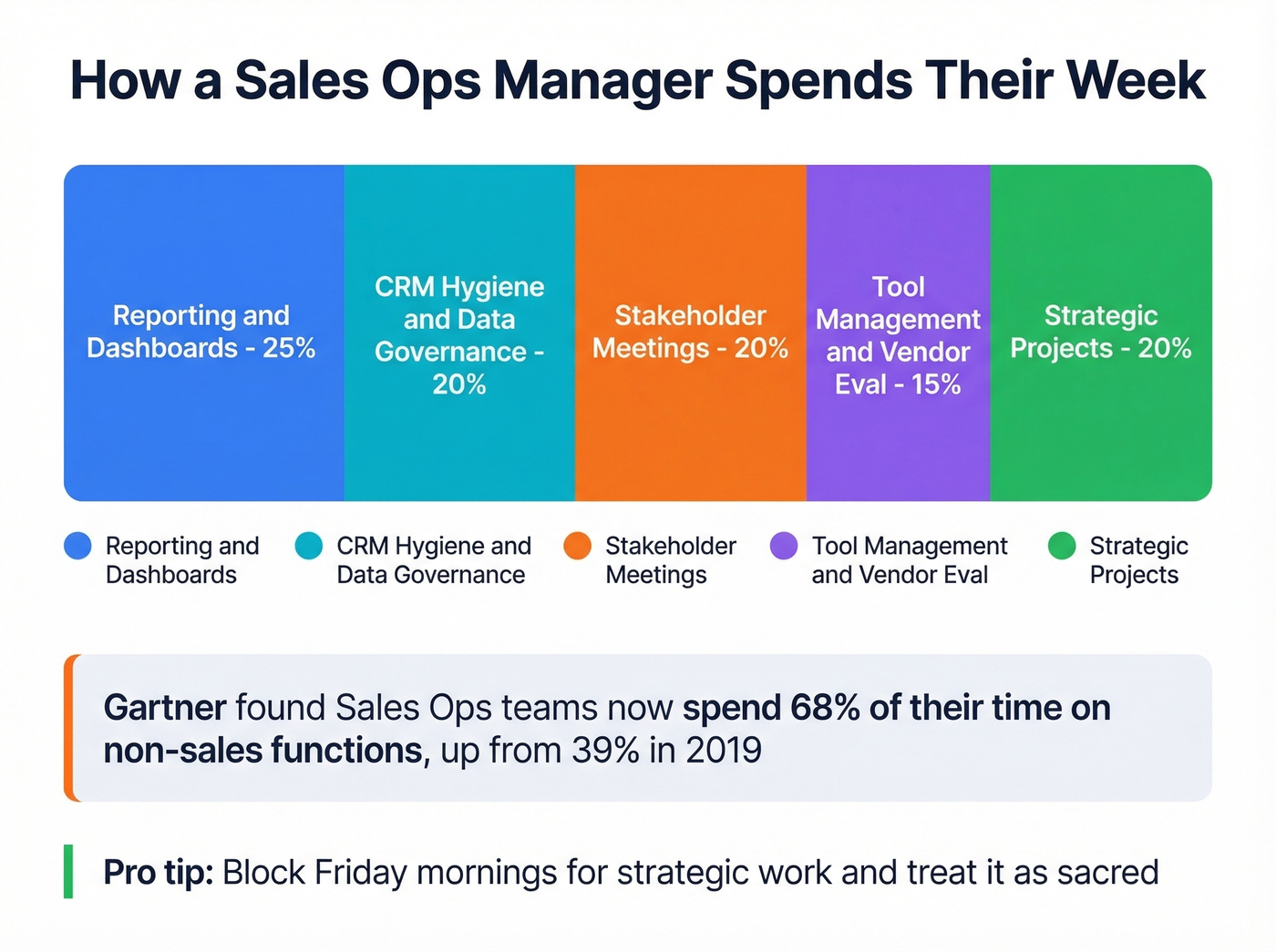
A realistic weekly time split looks something like this. Roughly 25% goes to reporting and dashboards - pulling numbers, building forecasts, answering ad-hoc data requests from leadership. Another 20% is CRM hygiene and data governance: deduplication, field standardization, enrichment audits. Stakeholder meetings eat about 20%, tool management and vendor evaluation take 15%, and the remaining 20% goes to strategic projects like territory redesigns, comp plan revisions, or new process rollouts. (If you’re standardizing what “good” looks like, use a sales operations metrics framework.)
One recently promoted Sales Ops Manager on r/SalesOperations described the reality of being a solo ops hire - high autonomy, heavy reliance on Excel and Power BI (with ChatGPT helping write DAX formulas), and comp nearly $150K. That tracks with what we've seen across our network: managers who don't protect time for strategic work get buried in reactive requests. The best ones block Friday mornings for project work and treat it as sacred.
Three fastest ways to fail in this role: letting tool sprawl go unchecked, accepting dirty CRM data as "good enough," and spending all your time on fire drills instead of protecting strategic project time. (For a practical playbook, see sales process optimization.)
The 2026 Sales Ops Tech Stack
A Sales Operations Manager doesn't just use tools - they own the stack. You're the person deciding what gets bought, configured, integrated, and retired. Here's what a modern stack looks like:
| Category | Tool(s) | What It Does for Sales Ops | Starting Price |
|---|---|---|---|
| CRM | Salesforce, HubSpot | Pipeline source of truth | ~$25/user/mo (SF); free tier (HS) |
| Forecasting | Clari | AI-driven deal inspection | ~$50K+/yr (enterprise) |
| Conversation Intel | Gong | Call analysis, coaching data | ~$100/user/mo |
| Sales Engagement | Outreach, Salesloft | Sequence management, activity tracking | ~$100/user/mo |
| Compensation | Xactly, CaptivateIQ | Comp plan modeling, payout tracking | ~$30-50/user/mo |
| BI / Analytics | Tableau, Power BI | Custom dashboards, exec reporting | ~$10-70/user/mo |
Your forecast is only as good as the data feeding it. If a big chunk of contacts in your CRM have stale emails or wrong titles, every downstream metric is compromised. Prospeo covers the enrichment and verification layer with 300M+ professional profiles, 98% email accuracy, and a 7-day data refresh cycle - so the contact records your reps and forecasts depend on stay current. It plugs directly into Salesforce and HubSpot, meaning enrichment runs inside your existing workflow rather than requiring a separate process. (If you’re comparing vendors, start with data enrichment services.)

You just read that 35% bounce rates destroy forecasts and domain reputation. That's exactly the problem Sales Ops Managers are hired to fix. Prospeo's 98% email accuracy and 7-day data refresh cycle keep your CRM clean automatically - plugging directly into Salesforce and HubSpot.
Stop forecasting on fiction. Start with data that's verified weekly.
KPIs a Sales Ops Manager Owns
The industry has moved away from activity metrics like calls-per-day toward outcome-based KPIs. These five matter most:
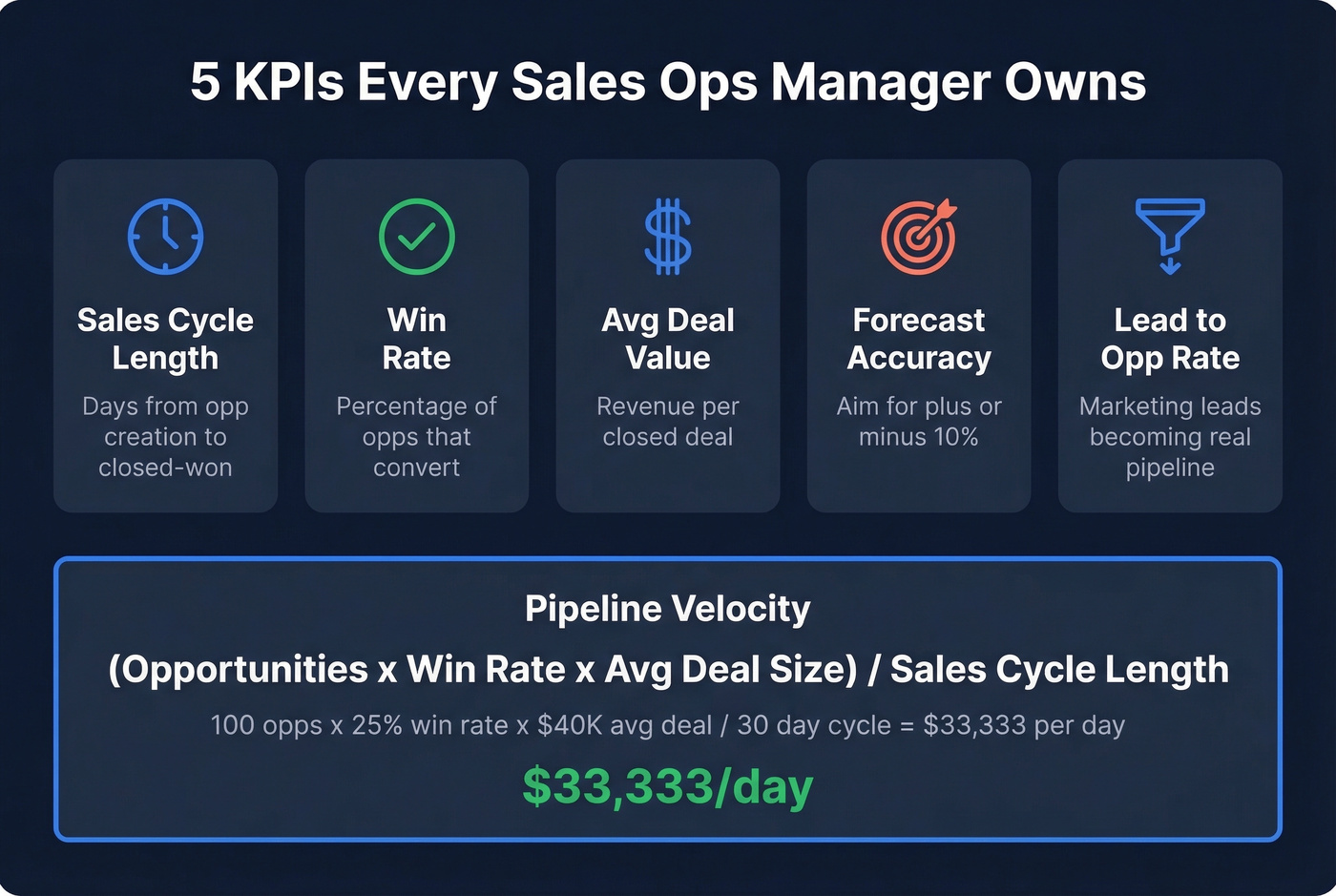
- Sales cycle length - days from opportunity creation to closed-won
- Win rate - percentage of opportunities that convert
- Average deal value - revenue per closed deal
- Forecast accuracy - predicted vs. actual revenue (aim for +/-10%)
- Lead-to-opportunity conversion rate - how efficiently marketing leads become real pipeline (benchmarks: average B2B lead conversion rate)
One formula worth memorizing: pipeline velocity. It tells you how much revenue moves through your pipeline per day.
Pipeline Velocity = (Total Opportunities x Win Rate x Avg Deal Size) / Sales Cycle Length
Example: 100 opps x 25% win rate x $40K avg deal / 30-day cycle = $33,333/day
According to ZS research, 79% of high-growth B2B companies set KPIs annually, while 22% do it at the beginning of each quarter - a cadence worth matching to your growth stage. And one more benchmark to keep in your back pocket: average lead response time should be under five minutes.
Salary Benchmarks
Three sources, three different angles on comp:
| Source | Base Salary | Total Comp | Sample Size | Updated |
|---|---|---|---|---|
| PayScale | $95,935 avg | $66K-$136K range | 912 profiles | Feb 2026 |
| Glassdoor | $70K-$107K | $115K median total | ~3K salaries | Mar 2026 |
| Indeed | $84,321 avg | +$23K commission | 1.2K postings | Mar 2026 |
The Glassdoor median of $115K total comp is the most useful number for benchmarking, since it includes base plus variable pay across a large sample. (If you want a role-by-role comparison, see Sales Enablement Manager.)
Industry matters a lot. IT pays a median of $143,097 total, pharma and biotech hit $130,776, and manufacturing sits around $117,305. At the top end, Google shows ranges starting around $190K for the role, and Stripe ranges up to $261K. Geography creates its own premiums - Las Vegas leads at $116,480, followed by New York at $113,140 and Austin at $104,438. Entry-level total comp starts at $63,959, which isn't bad for a first ops role.
Here's the thing: if your company's average contract value is under $10K and your sales team is fewer than 15 reps, you probably don't need a full-time Sales Ops Manager yet. A CRM-savvy rep or a fractional ops consultant will get you 80% of the value at a fraction of the cost. The role pays for itself when pipeline complexity outgrows spreadsheets - not before. (Related: sales pipeline challenges.)
Sales Ops vs. RevOps
These terms get used interchangeably, but they aren't the same thing.
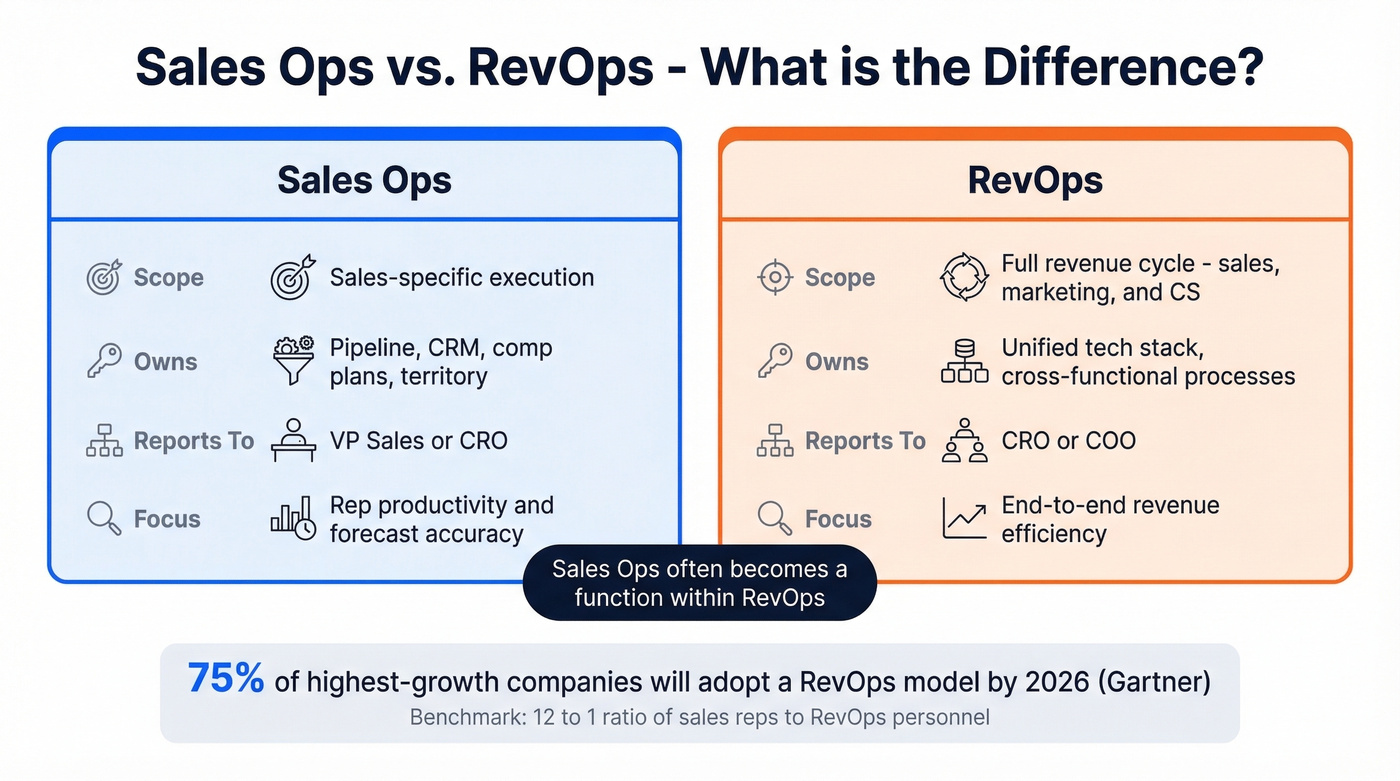
| Sales Ops | RevOps | |
|---|---|---|
| Scope | Sales-specific execution | Full revenue cycle (sales + marketing + CS) |
| Owns | Pipeline, CRM, comp plans, territory | Unified tech stack, cross-functional processes |
| Reports to | VP Sales or CRO | CRO or COO |
| Focus | Rep productivity, forecast accuracy | End-to-end revenue efficiency |
Gartner projects that 75% of the highest-growth companies will adopt a RevOps model by 2026. That doesn't mean Sales Ops disappears - it means Sales Ops often becomes a function within RevOps. The staffing benchmark from PeerSignal's analysis of 2,500 B2B SaaS companies is roughly 12:1 sales reps to RevOps personnel.
Marketing Ops exists alongside both, focused on the martech stack, lead gen, and campaign attribution. In smaller companies, one person wears all three hats. We've seen this firsthand - our team works with plenty of solo ops people who are simultaneously managing Salesforce, running enrichment workflows, and building attribution models for marketing. It's a lot. (If you’re building the system end-to-end, start with lead generation workflow.)
Career Path
The typical ladder: Sales Ops Associate -> Specialist (1-2 years) -> Manager (2-4 years) -> Senior Manager -> Director (3-6 years) -> VP of Sales Ops -> CRO.
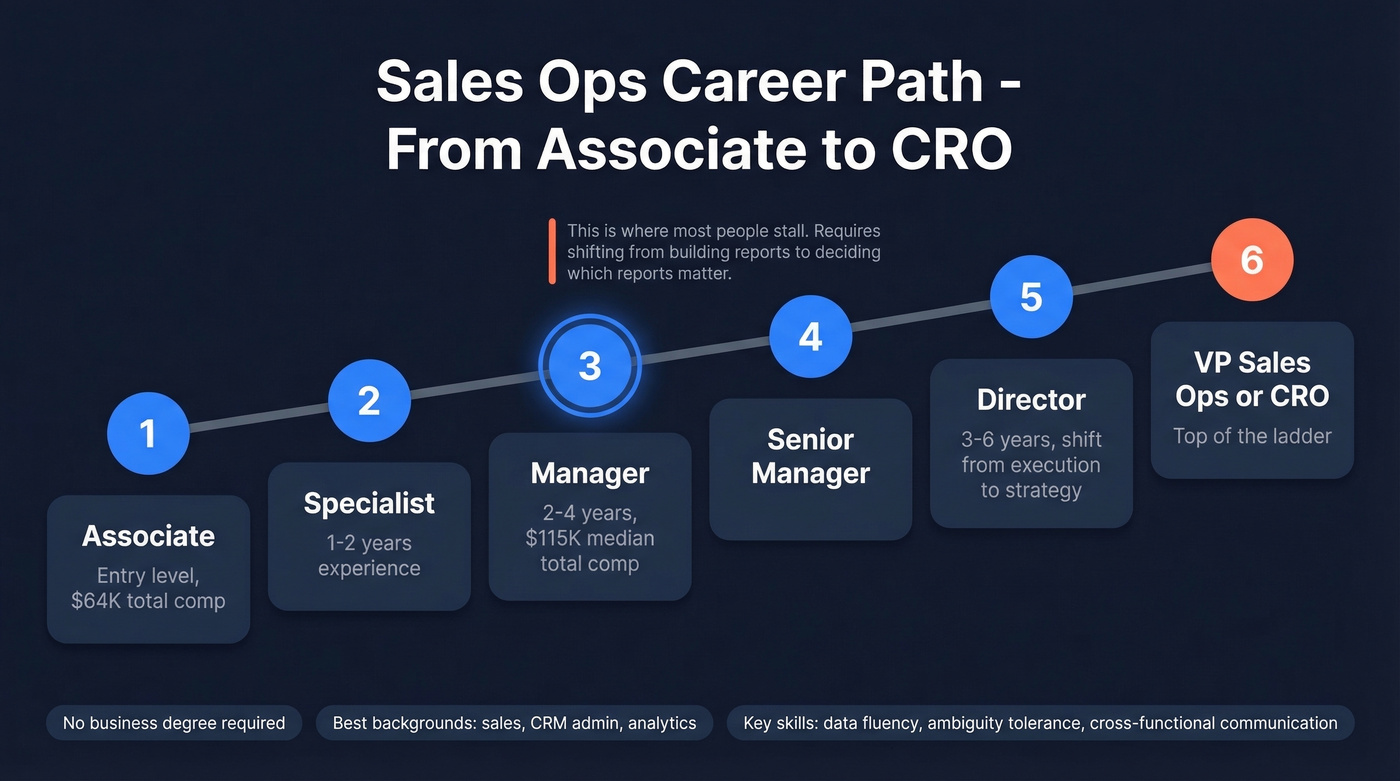
You don't need a business degree. The best Sales Ops managers we've worked with came from sales, CRM administration, or analytics backgrounds. What matters is fluency with data, comfort with ambiguity, and the ability to translate between sales leadership and finance. If you can build a Salesforce report, model a comp plan in a spreadsheet, and present a forecast to a CFO without flinching, you're qualified. (For the full role breakdown, see Sales Ops Manager: Role, Salary & Skills.)
The jump from Manager to Director is where most people stall. It requires shifting from execution to strategy - owning the operating model, not just the dashboards. Skip this level if you aren't ready to stop being the person who builds the reports and start being the person who decides which reports matter.
Every KPI a Sales Ops Manager owns - win rate, pipeline velocity, forecast accuracy - degrades when contact data goes stale. Prospeo enriches CRM records with 50+ data points at a 92% match rate, for roughly $0.01 per email. No contracts, no sales calls required.
Your forecast is only as good as the data behind it.
FAQ
Is Sales Ops the same as RevOps?
No. Sales Ops focuses on sales team processes, tools, and forecasting. RevOps spans the full revenue cycle across sales, marketing, and customer success. By 2026, 75% of high-growth companies will use a RevOps model, but Sales Ops roles still exist within that structure - they report into a broader revenue organization rather than disappearing entirely.
What tools should a sales operations manager learn first?
Start with Salesforce or HubSpot, then add a BI tool like Tableau or Power BI for reporting. For data quality, a platform like Prospeo handles CRM enrichment and email verification at $0.01/email - critical since bad contact data undermines every forecast and pipeline metric you own.
How much does a Sales Operations Manager make?
Median total compensation is $115K/year in the US, based on roughly 3,000 salaries reported to Glassdoor. In IT, that climbs to $143,097. Pharma and biotech averages $130,776. Entry-level roles start at $63,959 total comp, with significant upside at senior and director levels.
What skills matter most for this role?
CRM fluency (especially Salesforce admin), spreadsheet modeling, and data storytelling are non-negotiable. Beyond technical skills, the ability to manage competing stakeholder priorities - translating between sales leadership, finance, and marketing - separates good ops managers from great ones.