

What Does Sales Operations Actually Do? (And Why It's Not Just CRM Admin)
A thread on r/SalesOperations nails the confusion around this role - the poster described Sales Ops as "a bit of everything," from insights and tool implementation to leadership-to-BDR alignment and whatever else nobody wants to own.
That ambiguity is the point. Sales Ops is one of the most strategically important functions in a B2B company and one of the most misunderstood. Most people outside the function think it's CRM admin. Most people inside it know it's closer to being the operating system of the entire sales org.
Quick Overview
Sales Ops owns the systems, data, and processes that let reps sell instead of doing admin work. It's not CRM admin, not sales enablement, not RevOps - though it overlaps with all three. The core mandate: remove friction so reps can actually sell.
- Median total comp: $120K/year across ~1.6K reported salaries on Glassdoor
- Impact: Companies with world-class Sales Ops see 20-30% productivity gains, per McKinsey
- Trend: 85% of sales professionals say Sales Ops is becoming more strategic
- Data quality matters most - CRM data decays fast, and tools with high accuracy and frequent refresh cycles are what keep it clean
Core Responsibilities Day-to-Day
The term goes back to the 1970s. J. Patrick Kelly at Xerox described sales operations as "all the nasty number things you don't want to do, but need to do to make a great sales force." Fifty years later, that's still the best one-line definition anyone's come up with.
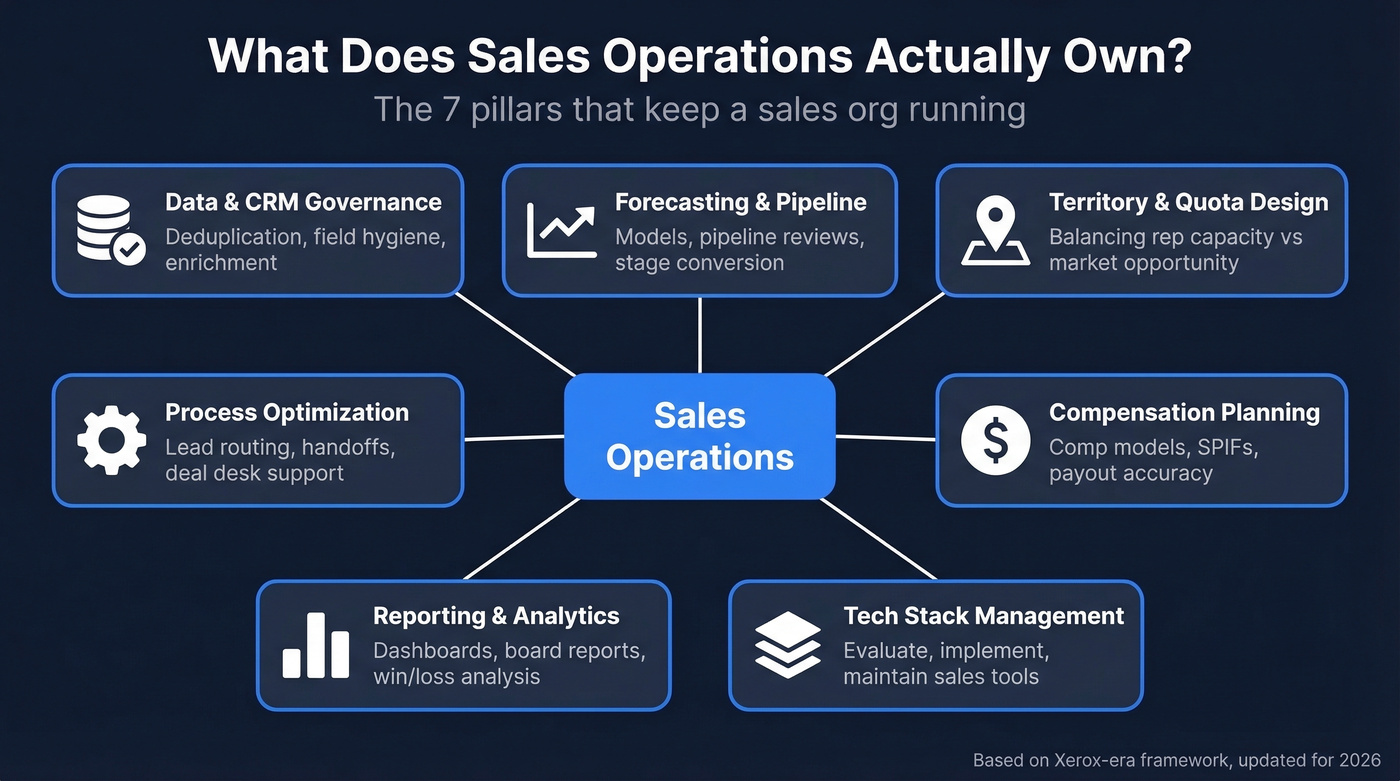
Salesforce defines it as using systems and technology to ensure sales teams reach their targets - grounded in data around hiring, coverage, and incentives, with goals of efficiency and process optimization every day. The average sales rep spends about one-third of their time actually selling. Sales Ops exists to win back the rest.
Here's what falls under the umbrella, grouped by function:
- Data & CRM governance - deduplication, field hygiene, enrichment workflows, data quality standards
- Forecasting & pipeline management - building models, running pipeline reviews, tracking stage conversion (see pipeline management)
- Territory design & quota setting - balancing rep capacity against market opportunity (often supported by sales mapping software)
- Compensation planning - modeling comp plans, managing SPIFs, ensuring payout accuracy
- Tech stack management - evaluating, implementing, and maintaining sales tools (especially SDR tools)
- Reporting & analytics - dashboards, board-level reporting, win/loss analysis
- Process optimization - lead routing, handoff workflows, approval chains, deal desk support (core sales process optimization)
None of these are glamorous. All of them are load-bearing.
A Day in Sales Ops
Gartner found that Sales Ops teams now dedicate 68% of their time to non-sales functions - up from 39% in 2019. That's a massive shift toward cross-functional work, strategic projects, and stakeholder management.
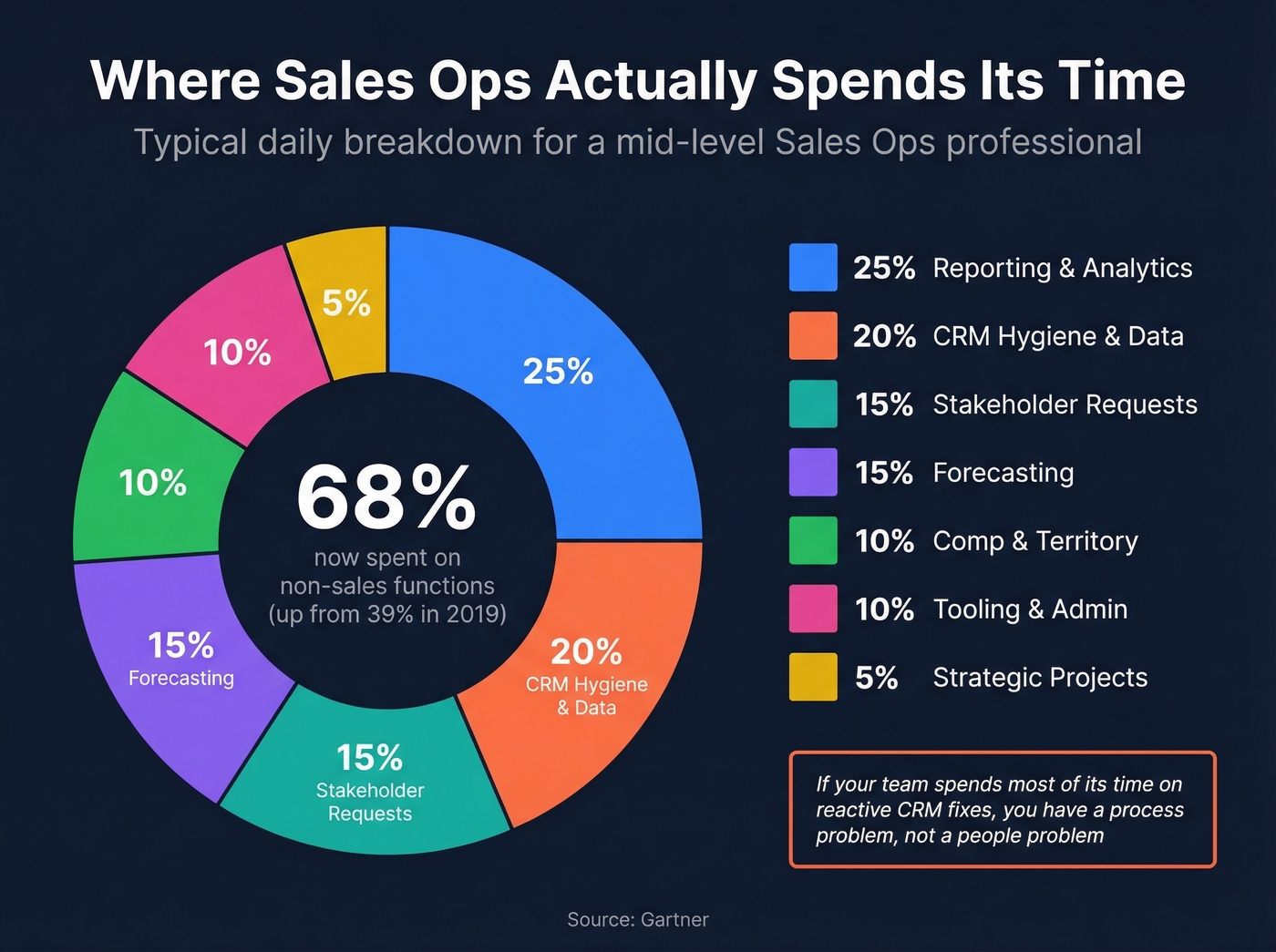
Here's a realistic time split for a mid-level Sales Ops professional:
| Activity | % of Time |
|---|---|
| Reporting & analytics | ~25% |
| CRM hygiene & data | ~20% |
| Stakeholder requests | ~15% |
| Forecasting | ~15% |
| Comp & territory | ~10% |
| Tooling & admin | ~10% |
| Strategic projects | ~5% |
If your Sales Ops team spends a big chunk of its time on reactive CRM fixes, you've got a process problem, not a people problem. The best teams automate the data hygiene layer so they can spend more time on forecasting, territory optimization, and the strategic work that actually moves revenue (often by tightening sales operations metrics).
What "Good" Looks Like
Most articles about Sales Ops describe the responsibilities without ever telling you what success looks like. Here are practical targets many teams use:
| KPI | Target |
|---|---|
| Forecast accuracy | Within 10% of actual |
| Pipeline coverage | 3-4x for SMB/mid-market |
| CRM data decay rate | Under 5%/month |
| Rep selling time | Above 40% |
| Email bounce rate | Under 5% |
| Sales cycle length | Sub-90 days (mid-market) |
If your numbers are worse than these, that's your roadmap. In our experience, the best Sales Ops teams spend their first 90 days auditing the tech stack and data quality before adding anything new. The impulse is always to buy another tool. The right move is almost always to fix what you have first.

The article says CRM data decay under 5%/month is the target. Prospeo's 7-day refresh cycle and 98% email accuracy make that automatic - no manual hygiene sprints. Enrich your entire CRM and get 50+ data points per contact with a 92% match rate.
Stop spending 20% of your week on data cleanup.
Sales Ops vs. Everything Else
Sales Ops vs. Enablement
These two get conflated constantly. Katie Drury at PandaDoc draws a clean line: enablement owns knowledge flow, playbooks, and tool training. Operations owns processes, reporting, tool configuration, compensation, forecasting, and capacity planning.
| Dimension | Sales Enablement | Sales Ops |
|---|---|---|
| Owns | Content, training, coaching | Systems, data, processes |
| Measures | Ramp time, win rates | Forecast accuracy, cycle length |
| Focus | Rep effectiveness | Org efficiency |
| Reports to | Often CRO or VP Sales | Often CRO or VP Sales |
They collaborate constantly - enablement can't train reps on a tool that ops hasn't configured, and ops can't optimize a process that reps haven't been trained on. But the skill sets are different, and conflating them usually means one side gets neglected.
Sales Ops vs. Marketing Ops vs. RevOps
Default.com frames the distinction well: RevOps aligns marketing, sales, and customer success under one operational strategy built on four pillars - people, process, technology, and data. Sales Ops optimizes the sales team specifically. Marketing Ops does the same for the marketing function, owning campaign execution, lead scoring, attribution modeling, and the marketing tech stack. The three overlap, but the scope is different: Marketing Ops feeds the top of funnel, Sales Ops converts it, and RevOps ties the full journey together (more on lead scoring).
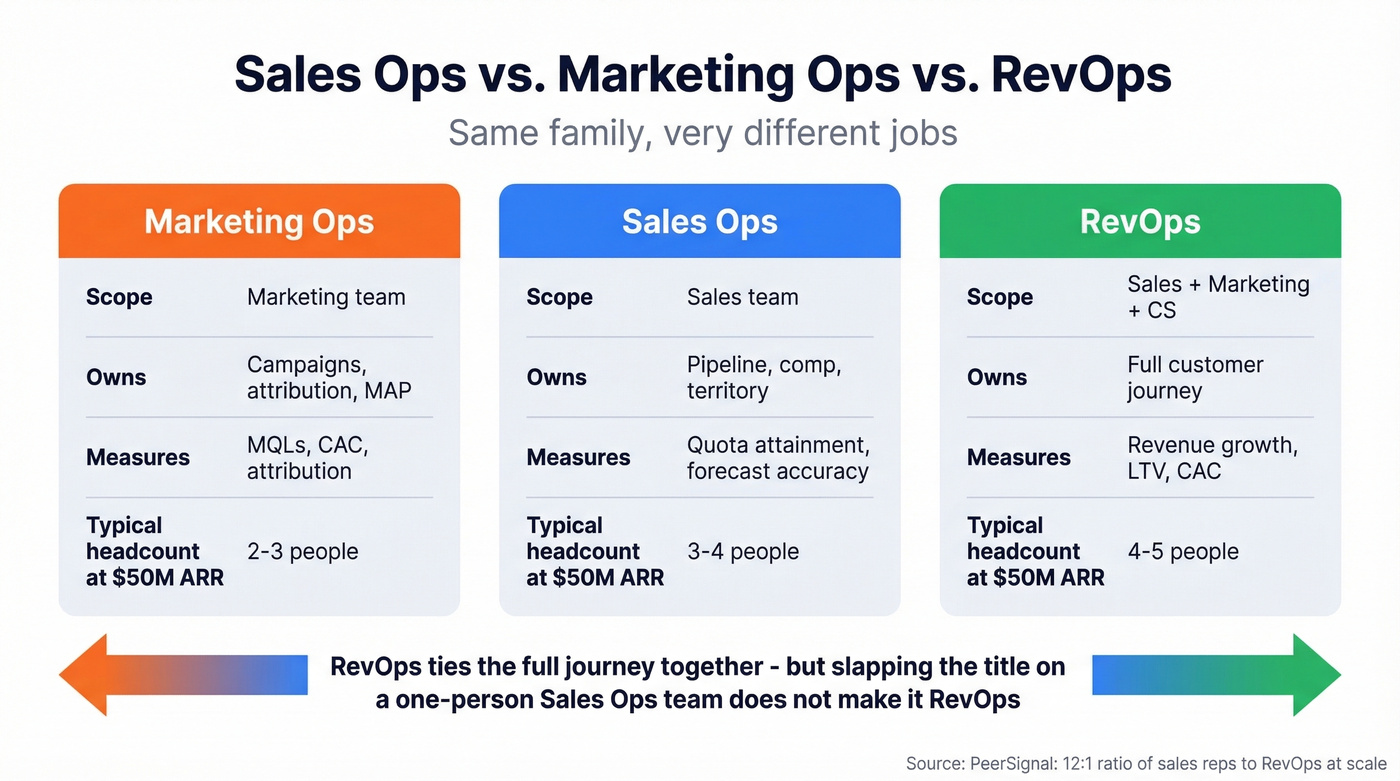
| Dimension | Marketing Ops | Sales Ops | RevOps |
|---|---|---|---|
| Scope | Marketing team | Sales team | Sales + Marketing + CS |
| Owns | Campaigns, attribution, MAP | Pipeline, comp, territory | Full customer journey |
| Measures | MQLs, CAC, attribution | Quota attainment, forecast | Revenue growth, LTV, CAC |
PeerSignal's analysis of 2,500 B2B SaaS companies found a 12:1 ratio of sales reps to RevOps personnel. At ~$50M ARR, that's typically 4-5 RevOps people. At $100M, it's 7-10.
Let's be honest: slapping "RevOps" on a one-person Sales Ops team doesn't make it RevOps. If you're the only ops person and you're only supporting sales, you're Sales Ops - and that's fine. Own it.
What Sales Operations Owns in the Tech Stack
Sales Ops teams manage a stack that keeps growing, and the data on tool fatigue is brutal. 49% of sellers feel overwhelmed by their tech, and that overwhelm reduces quota attainment likelihood by 43%. Even worse, 47% say their stack doesn't actually boost productivity. The function is responsible for configuration, integration, data governance, and ROI measurement for every platform reps touch.
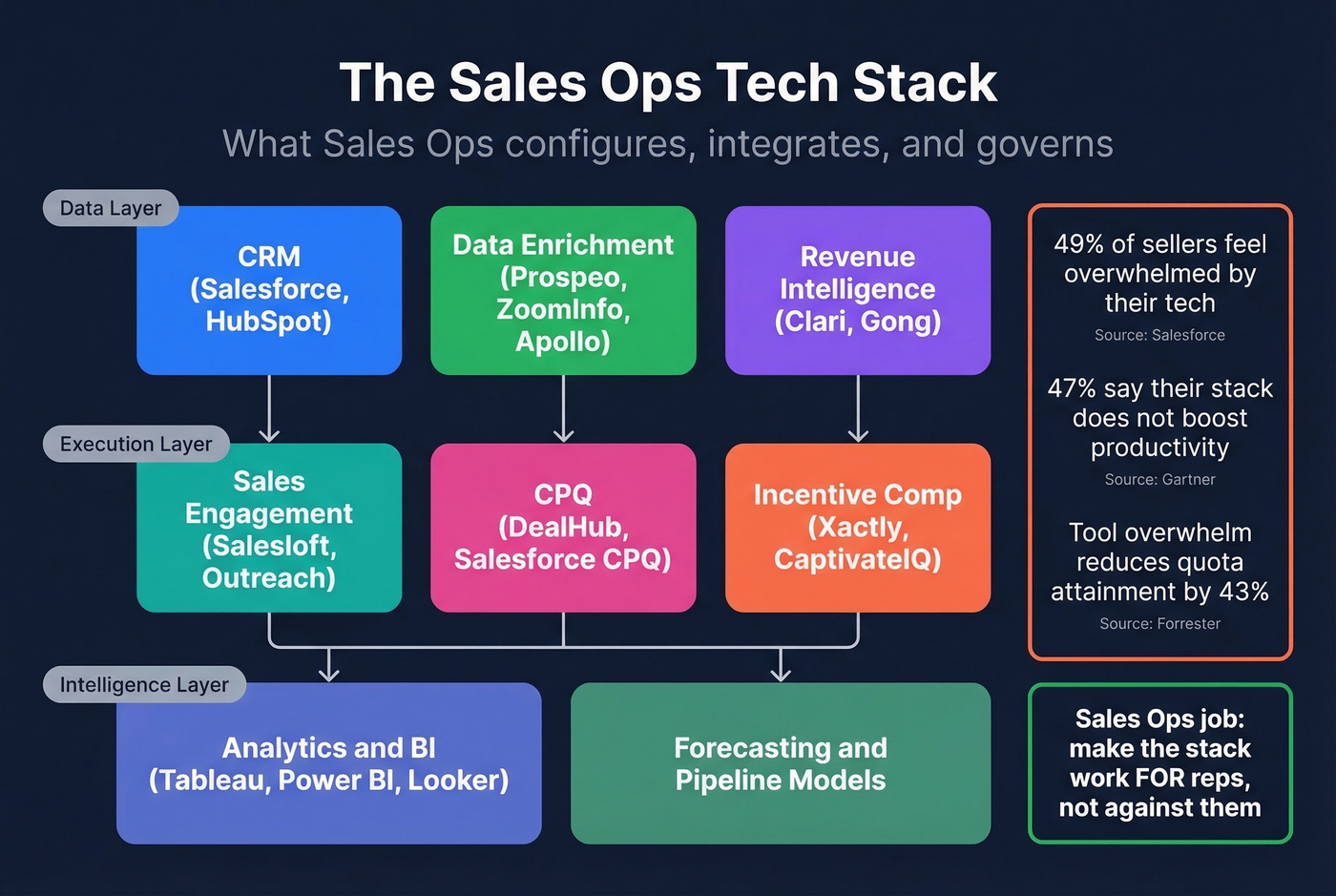
| Category | Examples | Sales Ops Owns |
|---|---|---|
| CRM | Salesforce, HubSpot | Config, data governance |
| Data Enrichment | Prospeo, ZoomInfo, Apollo | Contact accuracy, enrichment |
| Sales Engagement | Salesloft, Outreach | Sequence strategy, deliverability |
| Analytics / BI | Tableau, Power BI, Looker | Dashboards, forecasting |
| Revenue Intelligence | Clari, Gong | Pipeline visibility |
| Incentive Comp | Xactly, CaptivateIQ | Comp modeling, payouts |
| CPQ | DealHub, Salesforce CPQ | Quote accuracy, approvals |
Your CRM is only as good as the data in it. This is where most Sales Ops teams bleed time - cleaning stale contacts, fixing bounced emails, deduplicating records that three different tools created. We've seen teams spend 20+ hours a week on this kind of cleanup, which is time that should go toward forecasting and territory work. Prospeo's 7-day data refresh cycle and 98% email accuracy help cut that maintenance burden significantly - one team we work with, Meritt, dropped bounce rates from 35% to under 4% after switching their enrichment layer (see benchmarks and fixes for email bounce rate).
Sales Ops exists to win back selling time. Every bounce, every bad number, every stale record steals it back. Prospeo delivers 143M+ verified emails at 98% accuracy and 125M+ mobile numbers with a 30% pickup rate - for roughly $0.01 per email.
Give your reps clean data so they actually hit those KPIs.
Salary & Career Path
Salary by Role Level
Glassdoor pegs the US median total pay for "Sales Operations" at $120K/year, with a range of $91K-$159K across ~1,600 reported salaries. Base pay runs $68K-$115K, with additional comp adding $24K-$44K.
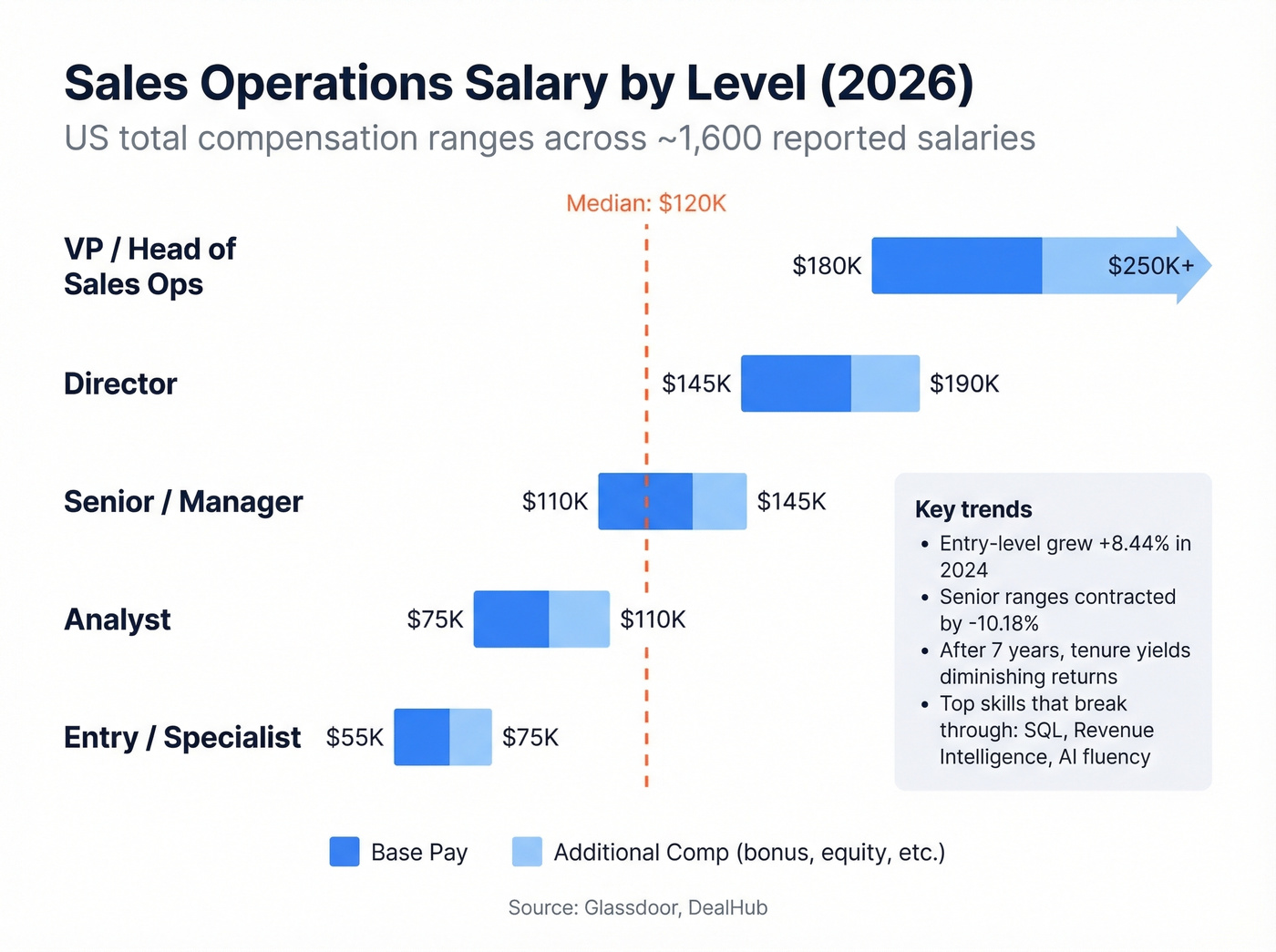
That median masks a wide spread by seniority:
| Level | Typical Base | Total Comp Range |
|---|---|---|
| Entry / Specialist | ~$45K-$60K | $55K-$75K |
| Analyst | $60K-$90K | $75K-$110K |
| Senior / Manager | $90K-$120K | $110K-$145K |
| Director | $120K-$150K+ | $145K-$190K+ |
| VP / Head of Sales Ops | $150K+ | $180K-$250K+ |
Career Trajectory
The standard ladder runs Sales Ops Analyst to Senior Analyst to Manager to Director to VP/Head of Sales Ops. Some people branch into Head of RevOps or CRO tracks, though the skill sets diverge meaningfully after the manager level (typical scope for a RevOps Manager).
There's no "Sales Ops degree." Most practitioners come from sales, marketing, or business analytics backgrounds. The two most valuable credentials are a Salesforce Admin certification and SQL proficiency, followed closely by fluency in BI tools like Tableau or Looker.
The salary market has shifted in interesting ways. After a 33.98% average growth surge during the pandemic hiring boom, growth flatlined to 0.35% in 2024, and the compression trend is real. Entry-level roles saw +8.44% growth while senior ranges contracted by 10.18%. The market rewards specific skills - Revenue Intelligence platforms, SQL, AI fluency, cross-functional collaboration - more than years of experience. Beyond about seven years, additional tenure yields diminishing salary returns.
Here's the thing: if you're a senior Sales Ops professional and your comp has stagnated, it's probably not about your performance. The market is compressing. The way to break through is to stack technical skills on top of your operational expertise - SQL, BI tools, AI-driven forecasting. That combination is what hiring managers pay a premium for in 2026.
What's Changing in 2026
The complexity Sales Ops manages is growing, not shrinking. Buying committees have expanded from 6.8 to 14 decision-makers. 72% of B2B buyers now demand a rep-free experience for at least part of the journey. And the average sales rep still sells for about a third of their day - that's a Sales Ops failure, not a rep failure.
AI is reshaping the function faster than most teams realize. AI-driven forecasting models are replacing spreadsheet-based pipeline calls, automated pipeline scoring flags at-risk deals before reps notice, and agentic workflow tools handle lead routing, data enrichment, and CRM updates without human intervention. The Sales Ops teams that learn to manage AI agents - not just dashboards - will be the ones that survive the next wave of headcount scrutiny (especially teams investing in sales forecasting solutions).
The broader response is consolidation. Organizations with unified revenue operations tools grow up to 19% faster than those running fragmented stacks. The trend in 2026 isn't adding more tools - it's reducing tool count while increasing data quality and integration depth.
I'll say it plainly: most Sales Ops teams don't have a tools problem. They have a data quality problem dressed up as a tools problem. You can buy the most expensive Revenue Intelligence platform on the market, but if 20% of your contact records bounce and your pipeline stages are inconsistently applied, you're just building prettier dashboards on top of garbage. Fix the data layer first. Everything else gets easier after that.
The role isn't getting less important. It's getting harder. And the teams that invest in data quality infrastructure - rather than bolting on another dashboard nobody checks - are the ones that'll actually move the needle on rep productivity.
FAQ
Is Sales Ops the same as CRM admin?
No. CRM admin is one task within the broader function. Sales Ops owns forecasting, territory design, compensation modeling, and tech stack ROI - not just field mapping and workflow rules. A CRM admin keeps Salesforce running; Sales Ops decides how it should be configured to drive revenue.
When should a company hire its first Sales Ops person?
Most B2B companies benefit from a dedicated hire once they hit 10-15 reps. Before that, a sales leader or RevOps generalist can cover the basics. Once forecasting becomes unreliable and CRM data starts decaying faster than anyone can fix it, it's time.
What tools do Sales Ops teams rely on most?
CRM (Salesforce or HubSpot), data enrichment platforms for email accuracy and contact freshness, BI platforms like Tableau or Looker, and sales engagement tools like Salesloft or Outreach. The stack varies by company size, but those four categories are universal.
How does the function help reps daily?
The biggest impact is reclaiming selling time. By automating data enrichment, maintaining CRM hygiene, optimizing lead routing, and running accurate forecasts, Sales Ops lets reps focus on conversations instead of admin. When ops runs well, reps spend less time searching for contacts, updating fields, and chasing approvals - and more time closing deals.
What's the difference between Sales Ops and RevOps?
Sales Ops optimizes the sales team specifically - pipeline, comp, territory, forecasting. RevOps aligns sales, marketing, and customer success under one operational strategy. Most companies evolve from Sales Ops to RevOps as they approach ~$50M+ ARR and need end-to-end alignment. Skip the RevOps title if you're a team of one supporting only sellers - it'll just confuse your stakeholders.