

What Is a Good Open Rate for Cold Email? (The Honest Answer)
One source says 60% is good. Another says 22%. A Reddit poster reports 10.55% opens with a 7% bounce rate. Breakcold's blog claims anything above 60% is the target, while Campaign Monitor pegs a "good" rate at 17-28%. The range is absurd - and the reason is that these numbers measure different things under different conditions.
One practitioner sent 147,000 cold emails last year and landed a 1.2% positive reply rate, which is proof that opens alone tell you nothing about pipeline.
The Short Answer
A well-executed cold campaign in 2026 should see 40-60% reported opens - but that number is inflated by Apple's privacy changes. The metric that actually correlates with revenue is reply rate: 3-5% is baseline, 5-10% is strong, 10%+ is elite. If your reported opens fall below 20%, you've got a deliverability or list quality problem, not a copy problem.
Why Open Tracking Is Broken
Every open-rate stat relies on the same trick: a 1x1 invisible image embedded in the email. When a recipient's client loads it, the server logs an "open." Simple enough - until Apple broke it.
Apple Mail Privacy Protection preloads all images via proxy regardless of whether anyone actually reads the email. Omeda's data showed unique open rates nearly doubled within six months of the rollout. Gmail and Yahoo route images through their own proxies too. A deliverability expert at Spamresource illustrated the problem: a reported 60% open rate might represent only around 36% real human opens once you strip out machine-generated loads. Some practitioners now track inbox placement rate instead - the percentage of emails landing in primary rather than spam - which at least can't be faked by a proxy.
Opens aren't useless. A sudden cliff still signals a deliverability problem. But treating the number as a precise performance metric? That's a mistake.
Real Cold Email Benchmarks
| Source | Dataset | "Good" Range | Context |
|---|---|---|---|
| ActiveCampaign | Warm marketing, 2026 campaigns | 39.26% avg | Opt-in lists, not cold |
| Belkins | 16.5M cold emails, 2024 | Up to 46% early 2024; 31-32% before tracking stopped | Stopped tracking mid-2024 |
| Breakcold | Product marketing | 60%+ | Aspirational, MPP-inflated |
| Reddit practitioner | 256 cold emails | 10.55% | 7% bounce rate, broken campaign |
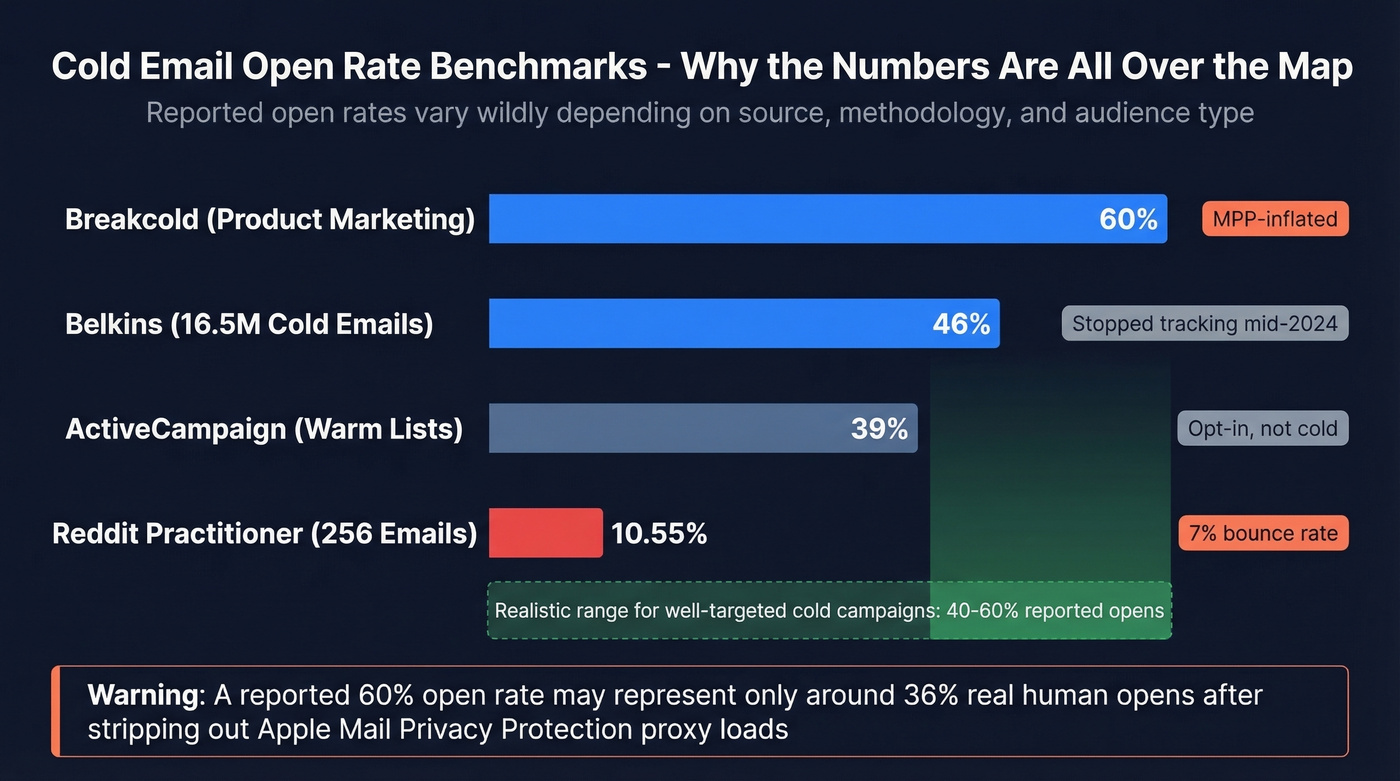
Three factors explain the chaos:
Cold vs. warm. ActiveCampaign's 39% comes from opted-in marketing lists. Apples and oranges.
MPP inflation. Any dataset from 2022 onward includes phantom opens from Apple's proxy, and there's no clean way to separate them.
Methodology. Some sources report unique opens, others total opens, and most don't disclose which. Enterprise-heavy verticals like finance and IT security typically see lower true opens due to aggressive filtering, while SMB and local services tend to run higher. We treat 40-60% reported opens as realistic for a well-targeted cold campaign with clean infrastructure - but directional only.

The article makes it clear: open rates are broken, and reply rates depend on reaching real inboxes. Teams using unverified lists see 35%+ bounce rates that destroy domain reputation and tank every metric downstream. Prospeo's 5-step email verification - with catch-all handling, spam-trap removal, and honeypot filtering - delivers 98% accuracy at ~$0.01 per email. Snyk cut their bounce rate from 35-40% to under 5% and generated 200+ new opportunities per month.
Fix your list before you fix your subject line.
Track Reply Rate Instead
Here's the thing: optimizing for open rate as your primary KPI is optimizing for a number that privacy proxies have made unreliable. Track reply rate instead. It correlates directly with meetings and revenue, and no proxy can fake it.
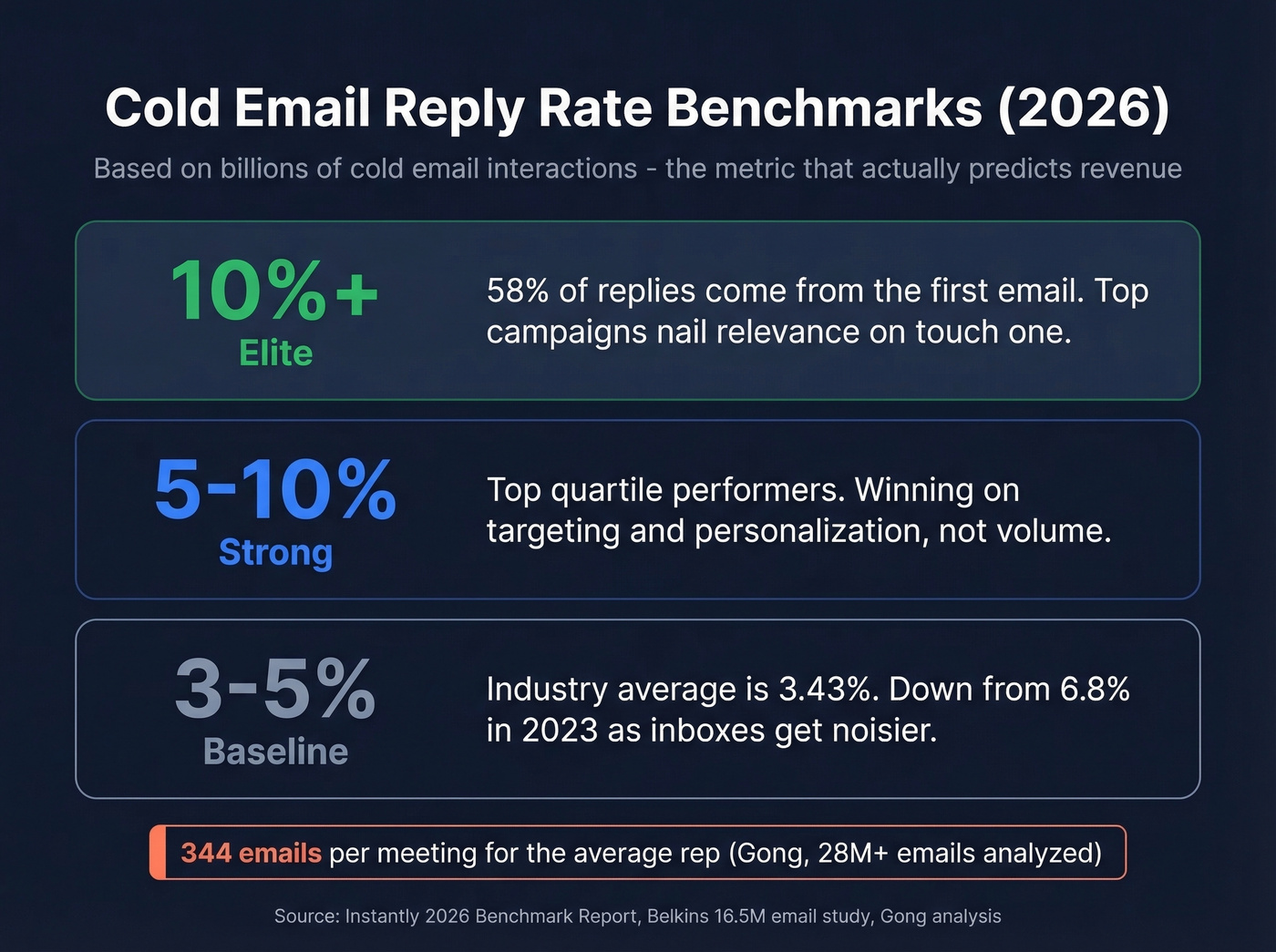
Instantly's 2026 benchmark report, analyzing billions of cold email interactions across thousands of active workspaces, found an average reply rate of 3.43%. Top quartile hit 5.5%+. Elite campaigns exceeded 10.7%. A separate study of 16.5M cold emails landed at 5.8% average reply rate, down from 6.8% in 2023 - and the researchers stopped tracking opens entirely mid-2024. That tells you everything about where the industry is heading.
58% of all replies come from the first email in a sequence, making that first touch disproportionately important.
Reddit practitioners confirm the erosion. People who saw 15-25% reply rates in 2023-early 2024 now report 8-10% against enterprise targets and consider that a win. Gong's analysis of 28M+ cold emails found the average rep sends 344 emails to land one meeting. Top performers aren't winning on impressive open numbers - they're winning on relevance and reply quality.
If your reported open rate is above 70%, you don't have great copy. You have a lot of Apple Mail users on your list. Stop celebrating and start measuring replies.
What to Do If Opens Are Below 20%
A 10.55% open rate with a 7% bounce rate isn't a copy problem. It's infrastructure and data quality. Here's the diagnostic order:
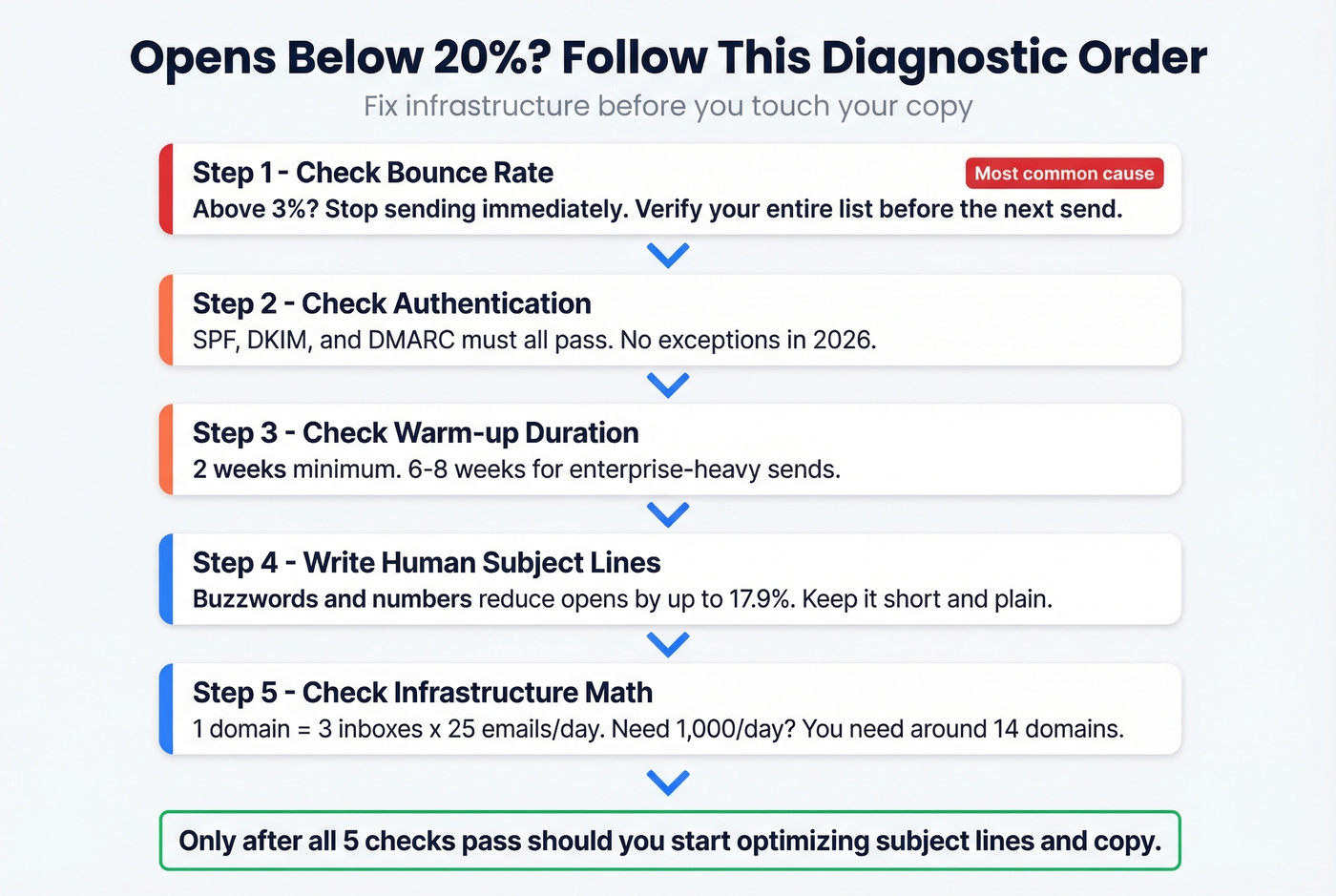
Check your bounce rate first. Above 3%? Stop sending and fix your list. Run your addresses through Prospeo's email verification before your next send - bad data is the first domino in the deliverability chain. Teams like Snyk cut bounce rates from 35-40% to under 5% after switching to verified data.
Check authentication. SPF, DKIM, and DMARC must all be properly configured. No exceptions. (If you want a deeper technical checklist, start with DMARC and SPF record basics.)
Check warm-up duration. Two weeks is the bare minimum. For enterprise-heavy sends, plan 6-8 weeks. If you're scaling volume, follow a clear email velocity plan.
Write human subject lines. Gong's data shows buzzwords and numbers reduce open rates by up to 17.9%. Keep them short and plain. If you need ideas, use these cold email subject line examples.
Check infrastructure math. One domain supports roughly 3 inboxes at 25 emails/day each. To send 1,000/day, you need around 14 domains. If you're cramming volume through too few domains, that's your problem right there.
Five Levers That Actually Improve Opens
1. Verify every email before sending. Bounces damage domain reputation, which tanks inbox placement, which kills opens. Prospeo runs every address through a 5-step verification process - catch-all handling, spam-trap removal, honeypot filtering - delivering 98% accuracy at roughly $0.01 per verified email. (If you're cleaning lists at scale, this spam trap removal guide helps.)
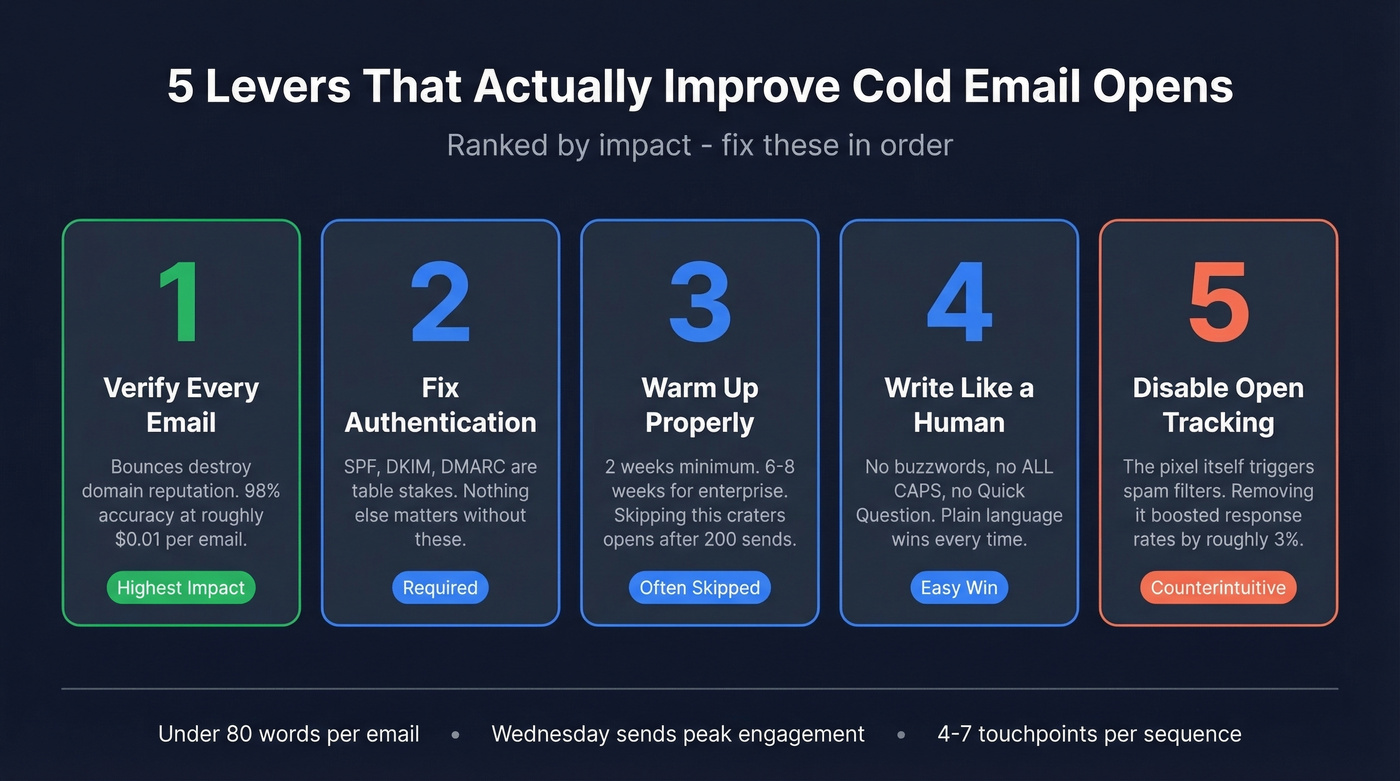
2. Fix authentication. SPF, DKIM, and DMARC are table stakes for inbox placement in 2026. If you haven't set these up, nothing else matters. Use this email deliverability guide to audit the full stack.
3. Warm up properly. Two weeks minimum, 6-8 weeks for enterprise targets. We've seen teams skip this step and wonder why their open rates crater after the first 200 sends. If you're choosing tooling, compare unlimited email warmup tools.
4. Write like a human. No buzzwords, no ALL CAPS, no "Quick question" subject lines that everyone and their SDR manager uses. Plain language wins across every dataset we've reviewed.
5. Consider disabling open tracking pixels entirely. Disabling pixel tracking produced roughly 3% higher response rates in one large study. The pixel itself can trigger spam filters - if you don't trust open data anyway, why keep it? Let's be honest: most teams would be better off removing the pixel and focusing on reply metrics. (If you want the technical breakdown, see email tracking pixels.)
For copy, Instantly's data points to emails under 80 words, Wednesday sends for peak engagement, and a 4-7 touchpoint sweet spot in sequences.
You read the data: 344 emails per meeting for the average rep. Top performers close that gap with relevance - sending to the right person at the right company at the right time. Prospeo's 300M+ profiles with 30+ filters (buyer intent, job changes, technographics, headcount growth) let you build lists where replies happen because the targeting is precise, not because you A/B tested a subject line.
Stop optimizing open rates. Start reaching buyers who actually reply.
FAQ
What's a good open rate for cold email in 2026?
A well-targeted campaign with clean infrastructure typically reports 40-60%, but Apple MPP inflates these significantly. A reported 60% can be closer to around 36% real-human opens once you strip out machine-generated loads. Focus on reply rate as your primary performance metric: 3-5% is baseline, 5-10% is strong.
Is reply rate more important than open rate?
Yes. Reply rate correlates directly with revenue and can't be inflated by privacy proxies. The 2026 average across billions of emails is 3.43%, with top-quartile campaigns hitting 5.5%+. Track replies, meetings booked, and pipeline generated - not phantom opens.
How do I reduce my cold email bounce rate?
Verify every email address before sending and keep bounces below 3%. A 5-step verification process that catches invalid addresses, spam traps, and honeypots makes the biggest difference - teams regularly cut bounce rates from 35-40% to under 5% after switching to verified data. Bad data is the fastest way to kill domain reputation.