

What Is a Lead Magnet? (And How to Build One That Actually Converts)
A lead magnet is a free resource you offer in exchange for someone's contact info - usually an email address. That's the textbook definition. The real question is whether yours actually moves people toward buying, or just collects emails that never open another message.
Most lead magnets fail not because the tactic is broken, but because everything after the download is an afterthought. The PDF gets delivered, the prospect skims page one, and then... nothing. No follow-up, no scoring, no segmentation. Just a name rotting in a spreadsheet.
Let's fix that.
The Short Version
- A lead magnet is a free resource exchanged for contact info. Both sides should get something real.
- The best formats in 2026 are interactive - quizzes, calculators - not static PDFs nobody reads past page two.
- Keep your form to 3 fields max. Going from 3 to 5 fields can drop conversions by about 27%.
- Set up a 5-email nurture sequence before you launch. The lead magnet is the handshake; the sequence is the conversation.
- Score your leads so sales only calls people worth calling.
Lead Magnets Defined
A lead magnet is any free item or service given away to gather contact details - trials, templates, white papers, free consultations. You give something useful, and the prospect gives you permission to start a relationship. No tricks, no bait-and-switch.
Don't confuse it with a tripwire. A tripwire is a low-cost paid offer - typically $1-$20 - designed to convert a lead into a first-time buyer. The lead magnet comes before that. It's free, it's frictionless, and its only job is to open the door.
One thing worth being direct about: downloading a lead magnet doesn't equal consent to be marketed to. Someone grabs your checklist, they didn't sign up for a 47-email drip campaign. Treat the opt-in as the beginning of trust, not a blank check.
Do Lead Magnets Still Work in 2026?
The skepticism is real. A popular r/marketing thread argues lead magnets mainly produce freebie seekers who never buy - and worse, they train ad platform algorithms to optimize for low-intent conversions. Fair point if you're running Meta ads to a generic ebook.
But the data tells a different story when execution is solid. Email as a distribution channel converts at 6.5%, and webinars hit 11.2%. Industry-specific numbers are even more telling: SaaS B2B email-to-lead rates average 8.05%, and biotech hits 12%. Companies that excel at lead nurturing generate 50% more sales-ready leads at 33% lower cost.
The failure mode is treating every lead the same. Someone who downloads a pricing calculator and visits your case studies page three times is fundamentally different from someone who grabbed a generic "10 Tips" PDF and never came back. Without nurture sequences and lead scoring, you can't tell them apart - and that's where the "lead magnets don't work" complaints come from.
Here's the thing: 65% of marketers say generating traffic and leads is their biggest challenge, yet most of them are still gating 40-page PDFs nobody asked for. The tactic isn't broken. The lead magnets are just boring.
Formats That Convert in 2026
Stop creating ebooks. We've watched teams spend $3,000-$5,000 on a 40-page PDF that gets downloaded 200 times and read by maybe 15 people. Prospects want immediate, personalized value - not another document for their "read later" graveyard.
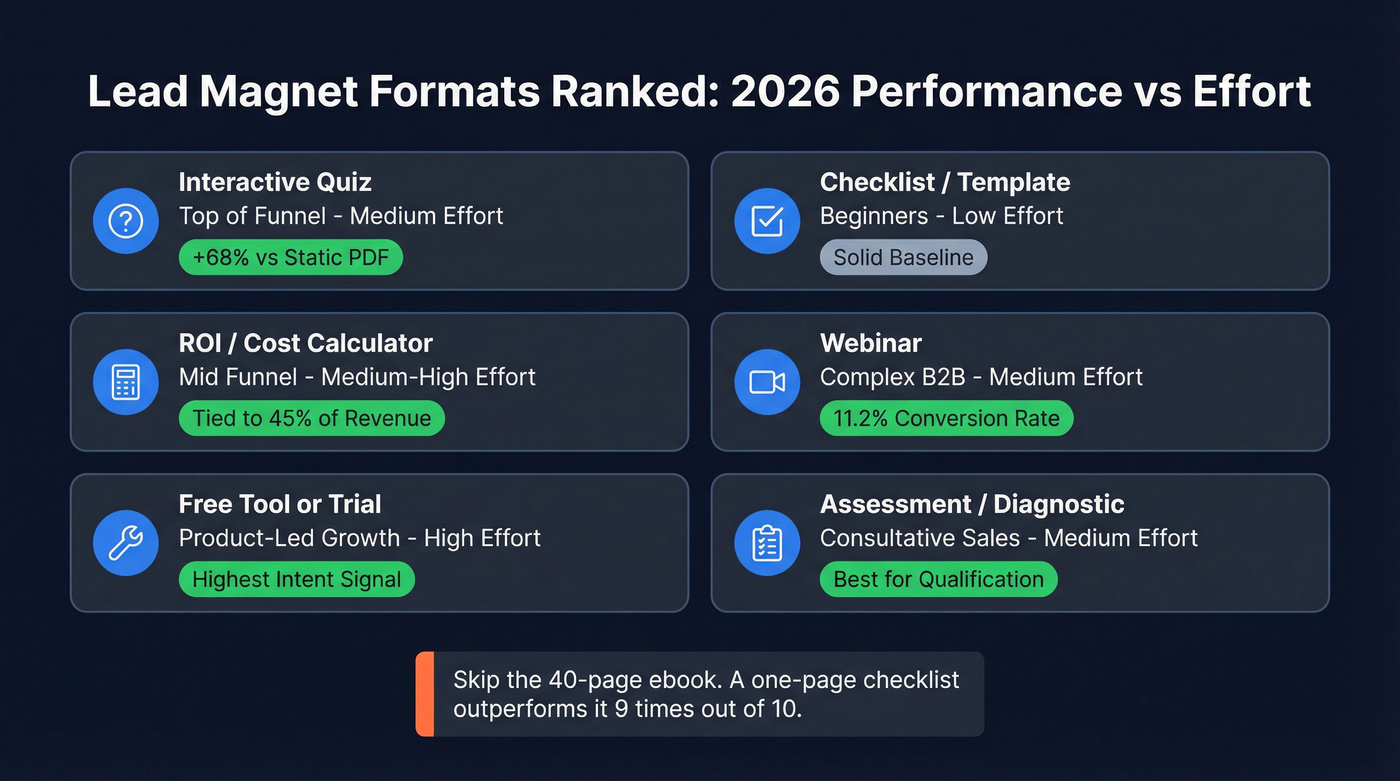
Interactive formats are dominating. Replacing a static PDF with a quiz drove +68% lead opt-ins for one e-commerce brand. A "Project Cost Estimator" calculator was tied to 45% of a company's annual revenue. These formats work because they deliver personalized results before you ever send a follow-up.
Real-world proof: HubSpot's Website Grader is the gold standard diagnostic tool - it's generated millions of leads by giving instant, personalized scores. Shopify's business name generator works the same way at top-of-funnel. Typeform built an entire business around making interactive quizzes easy to create. The pattern is clear: give value first, capture the email second.
| Format | Best For | Effort Level | 2026 Performance |
|---|---|---|---|
| Interactive quiz | Top-of-funnel, high volume | Medium | +68% vs static PDF |
| ROI/cost calculator | Mid-funnel, high intent | Medium-High | Tied to 45% of revenue |
| Checklist/template | Beginners, quick wins | Low | Solid baseline performer |
| Free tool or trial | Product-led growth | High | Highest intent signal |
| Webinar | Complex B2B sales | Medium | 11.2% conversion rate |
| Assessment/diagnostic | Consultative sales | Medium | Best for qualification |
If you're a small team with limited design resources, skip the ebook entirely. A one-page checklist or a simple Google Sheets calculator will outperform it nine times out of ten.

Lead magnets collect emails - but what about the prospects who never download anything? Prospeo gives you direct access to 300M+ professional profiles with 98% verified email accuracy, so you can reach decision-makers without waiting for them to find your landing page.
Stop gating PDFs. Start reaching buyers directly at $0.01 per email.
How to Create a Lead Magnet in 5 Steps
1. Identify Your Audience's Sharpest Pain
Don't start with what's easy to create. Start with what your prospects are actively trying to solve. Talk to your sales team - what questions come up on every discovery call? What objections keep killing deals? That's your topic.
If you need a tighter definition of your ICP first, use an Ideal Customer Profile template before you build anything.
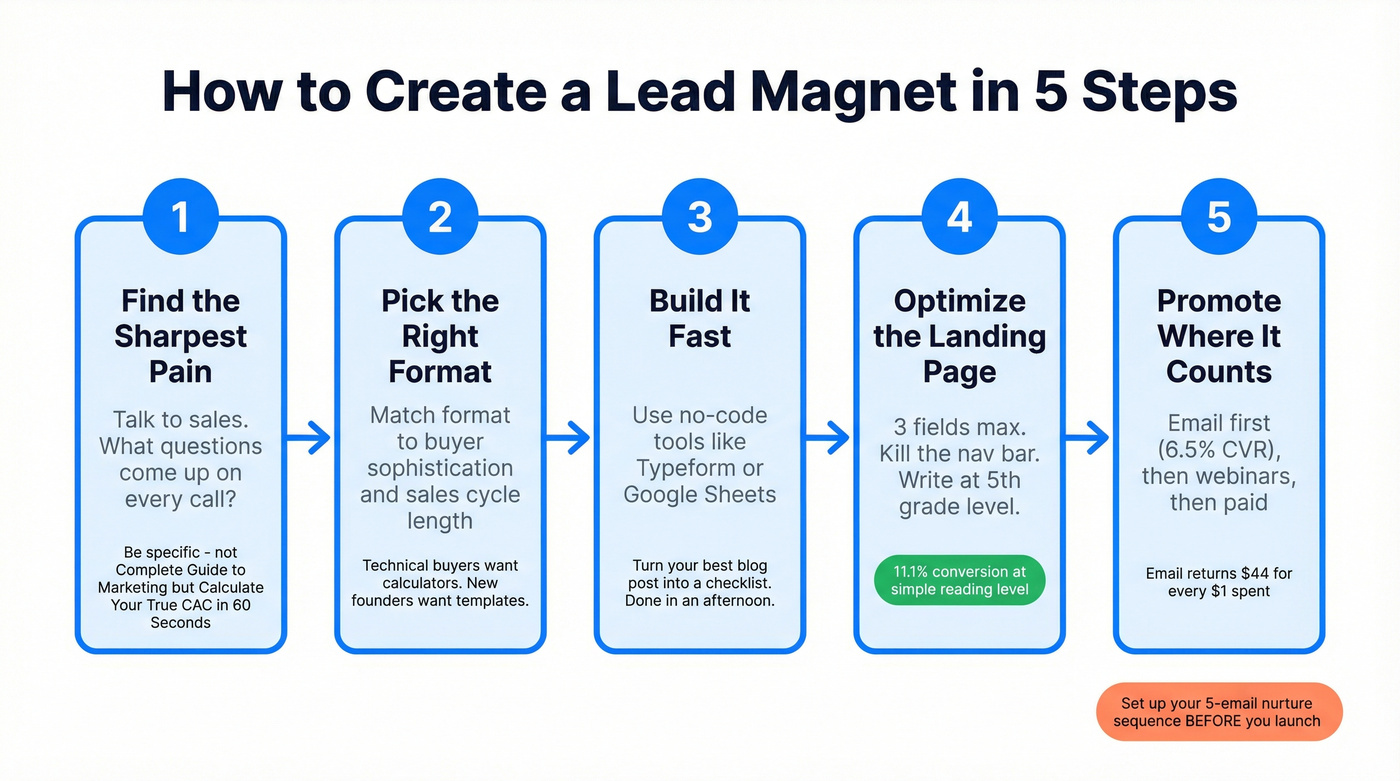
"The Complete Guide to Marketing" is useless. "Calculate Your True Customer Acquisition Cost in 60 Seconds" is specific, actionable, and immediately valuable. If you can only build one, make it a self-assessment or diagnostic tool that gives personalized results - someone who completes a 5-question assessment about their sales pipeline is telling you exactly what they need, and it qualifies intent automatically.
2. Pick the Right Format
Match the format to your audience's sophistication and your sales cycle. Technical buyers respond to calculators and assessments. First-time founders want a simple template they can use today, not a 60-page guide they'll never finish. When you're a small team shipping fast, effort level matters.
3. Build It Fast
You don't need a design agency. A checklist can take an afternoon. An interactive calculator is often doable for $500-$2,000 with no-code tools like Typeform or Outgrow, or free with Google Sheets and an embed widget. A professionally designed ebook runs $1,000-$5,000+ - and it's almost never worth it.
The fastest path: take your best-performing blog post, turn the key takeaways into a checklist or template, and gate it. You already know the topic resonates.
4. Optimize Your Landing Page
The median landing page conversion rate is about 6.6%. The top 10% convert above 11%. Here's a stat most teams miss: scaling from 10 to 15 landing pages increases leads by 55%. Yet 77% of landing pages are actually home pages - meaning many companies send traffic to pages that aren't purpose-built for conversion.
Three things move the needle most:
Simplify your copy. Pages written at a 5th-7th grade reading level convert at 11.1%, compared to 5.3% for jargon-heavy copy.
Cut your form fields. Three-field forms convert 27% better than five-field forms. Name, email, company - that's all you need.
Kill the navigation bar. Your landing page has one job: get the opt-in. Every other link is a leak. And make sure it's mobile-optimized - a form that's painful on a phone is a form that doesn't get filled out.
5. Promote It Where It Counts
Not all channels deliver equal results, and the cost differences are dramatic.
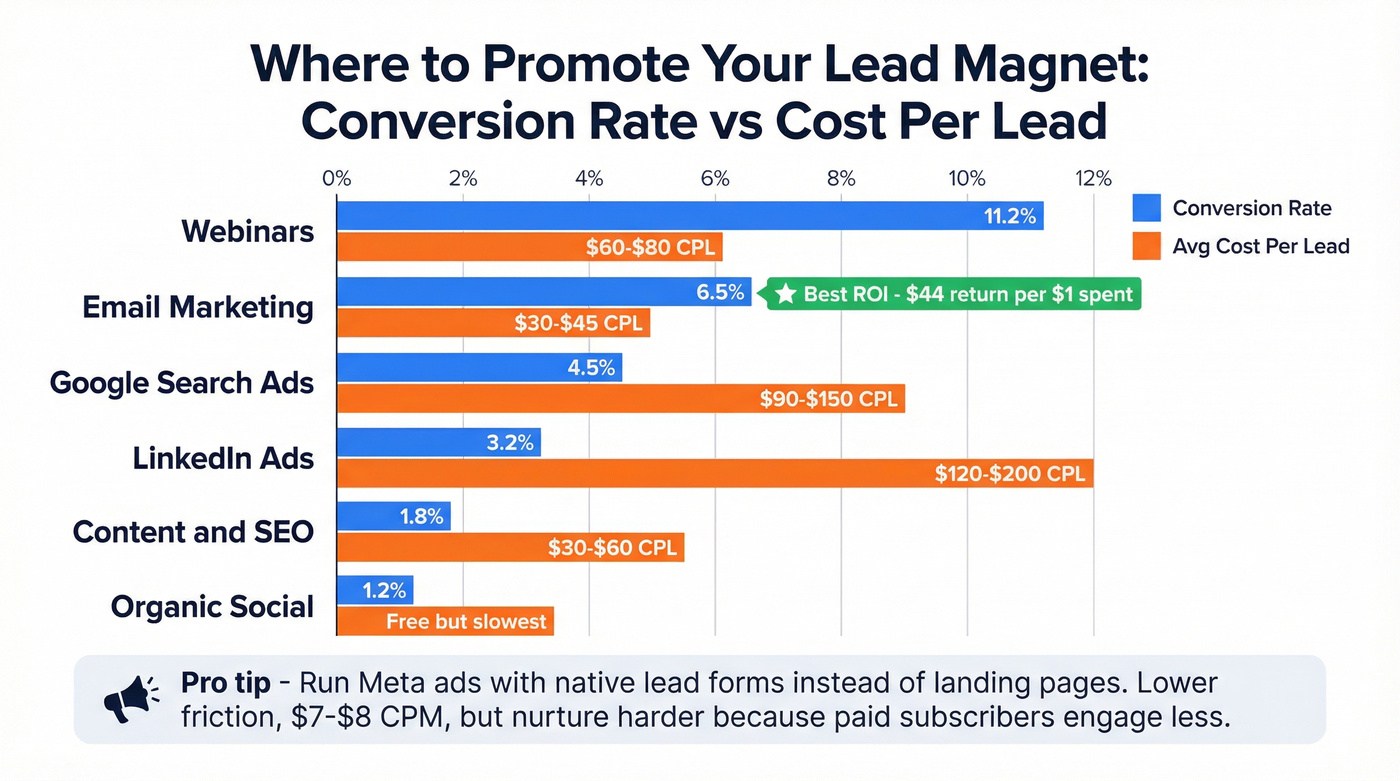
| Channel | Conversion Rate | Avg CPL |
|---|---|---|
| Email marketing | 6.5% | $30-$45 |
| Webinars | 11.2% | $60-$80 |
| Google Search Ads | 4.5% | $90-$150 |
| LinkedIn Ads | 3.2% | $120-$200 |
| Content/SEO | 1.8% | $30-$60 |
| Organic social | 1.2% | - |
Email is the clear winner on efficiency - with email marketing returning $44 for every $1 spent, it's not even close. Webinars convert highest but require more production effort. LinkedIn ads are expensive at $120-$200 per lead, but the targeting precision justifies it for high-ACV B2B sales.
One underrated tactic: run Meta ads with native lead forms instead of sending traffic to a landing page. CPMs average $7-$8 per thousand impressions, and the friction reduction is significant. Just know that paid subscribers tend to be less engaged, so your nurture sequence needs to do heavier lifting.
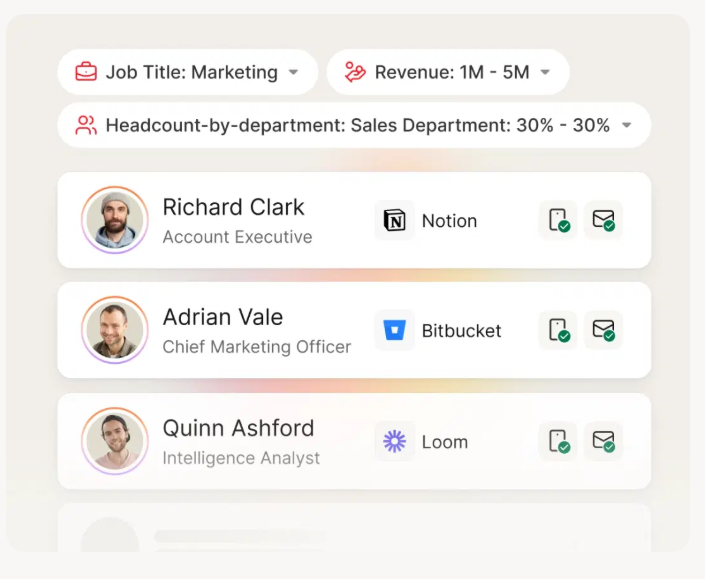
For outbound distribution, you need verified emails for your target audience. We use Prospeo to build prospect lists with 30+ filters - industry, job title, company size, intent signals - and deliver 98% verified emails so the lead magnet lands in real inboxes, not spam folders. Cold outbound promoting a genuinely useful free resource converts surprisingly well when the targeting is tight. If you're building a broader system, map this into a repeatable lead generation workflow.
GDPR & Privacy Checklist
Since 2018, data protection authorities have issued EUR 2.8B+ in GDPR fines. If you're collecting data from EU residents - regardless of where your company is based - these rules apply.
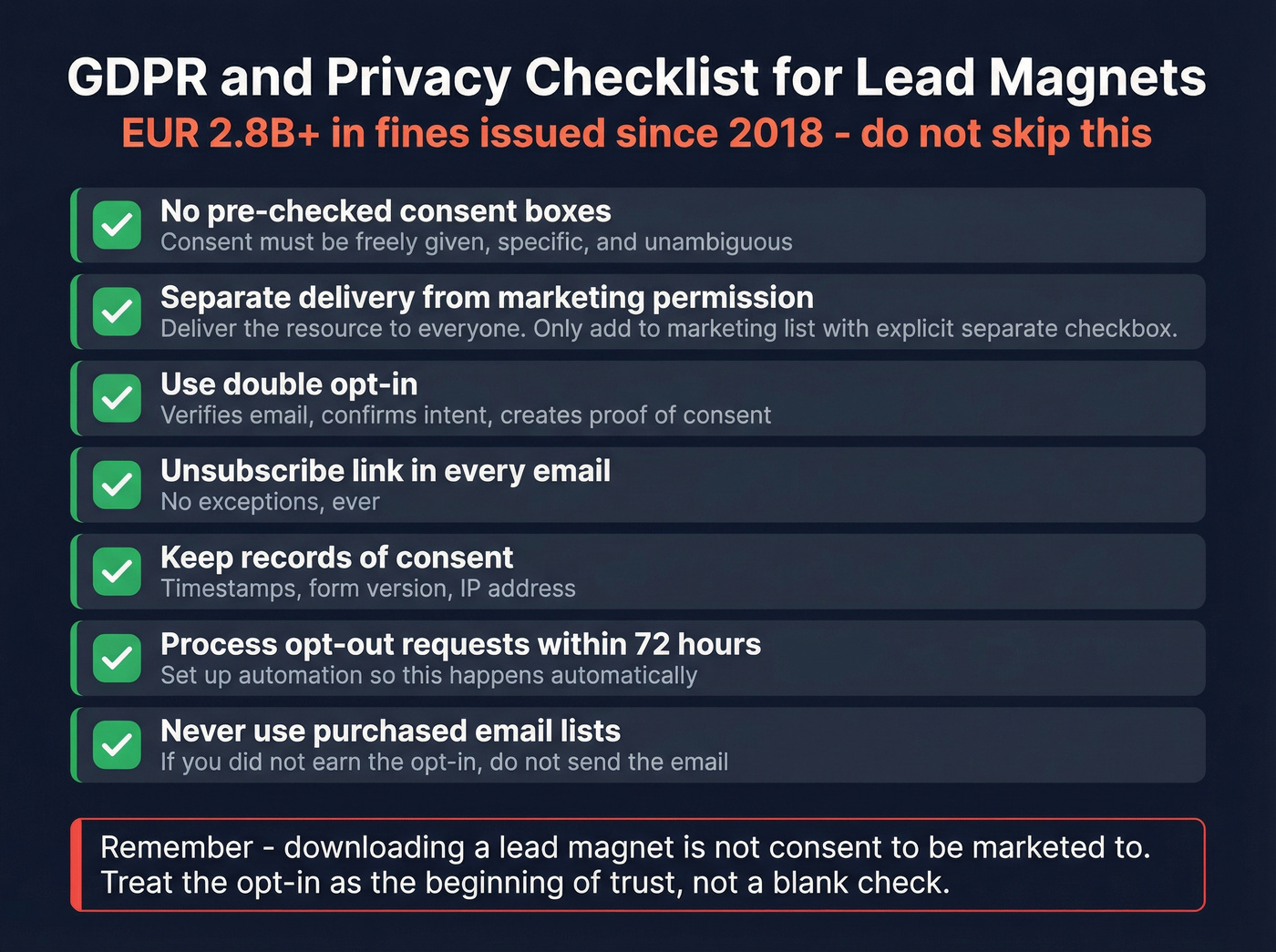
- No pre-checked boxes. Consent must be freely given, specific, and unambiguous.
- Separate freebie delivery from marketing permission. Deliver the resource to everyone. Only add people to your marketing list if they explicitly check a separate box.
- Use double opt-in. It verifies the email, confirms intent, and creates proof of consent.
- Include an unsubscribe link in every email. No exceptions.
- Keep records of consent - timestamps, form version, IP address.
- Process opt-out requests within 72 hours.
- Never use purchased lists. (If you're unsure where the line is, read Is It Illegal to Buy Email Lists?.)
The 5-Email Nurture Sequence
Welcome emails deliver 4x higher open rates and 5x higher click-through rates than standard campaigns. Yet 41% of brands don't send a welcome email within 48 hours. In our experience, the nurture sequence matters more than the lead magnet itself - a mediocre checklist with a great follow-up sequence outperforms a polished ebook with no follow-up every single time.
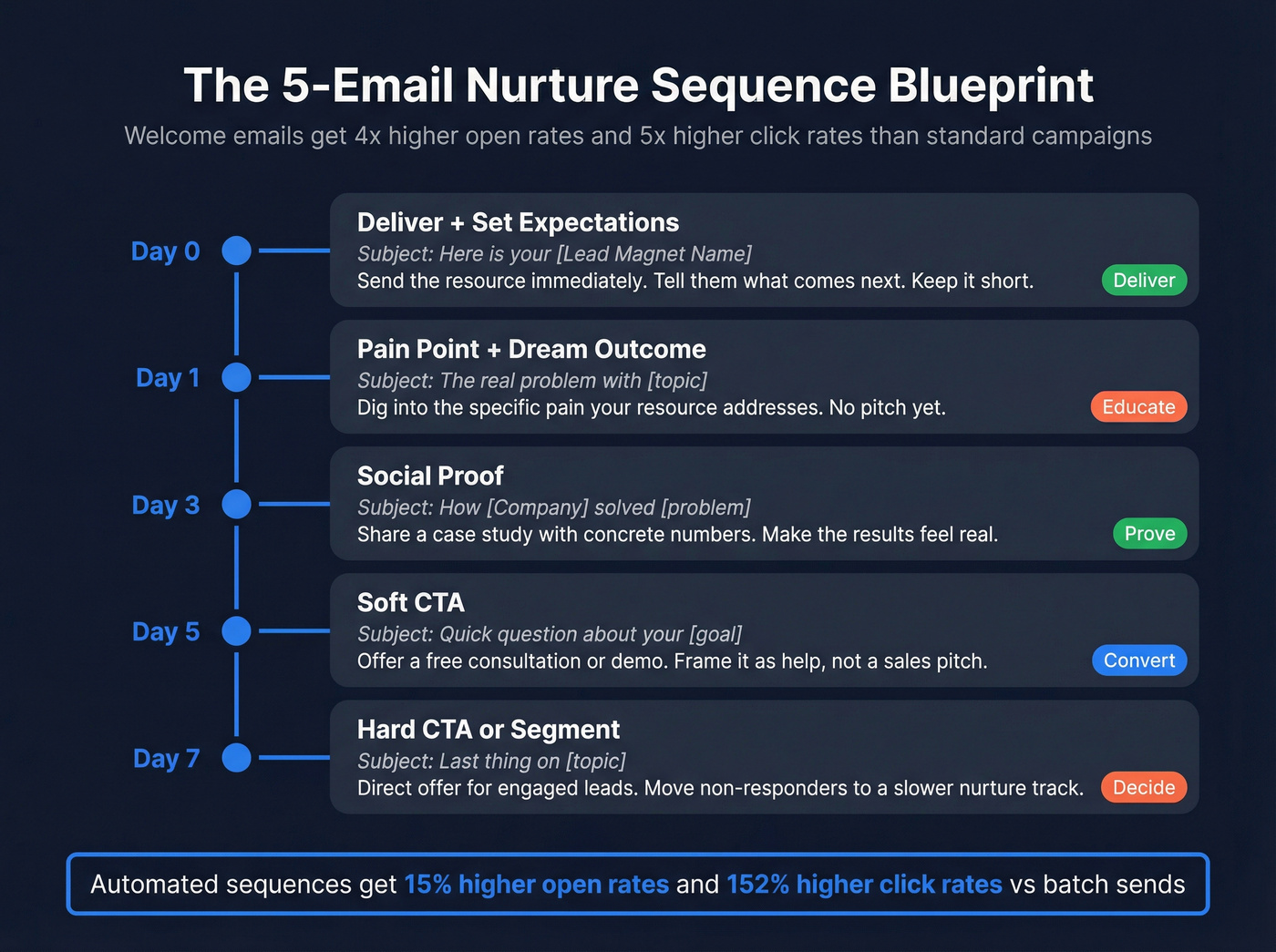
Automated sequences outperform batch broadcasts by a wide margin - 15% higher open rates and 152% higher click rates. Here's the blueprint:
Email 1 (Day 0): Deliver + Set Expectations. Subject: "Here's your [Lead Magnet Name]." Deliver the resource immediately. Tell them what to expect next. Keep it short.
Email 2 (Day 1): Pain Point + Dream Outcome. Subject: "The real problem with [topic]." Dig into the specific pain your resource addresses. No pitch yet.
Email 3 (Day 3): Social Proof. Subject: "How [Company] solved [problem]." Share a case study with concrete numbers. "Pipeline tripled from $100K to $300K/week" beats "our customers love us."
Email 4 (Day 5): Objections + Offer. Subject: "The #1 reason teams hesitate." Address the biggest objection head-on, then make your offer - free trial, demo, or consultation.
Email 5 (Day 7): Urgency + Final CTA. Subject: "Last chance: [specific offer]." A time-limited bonus, a pricing window, or a direct "this is the last email - here's what to do next."
A/B test your subject lines from day one. Even small changes - a question vs. a statement, a number vs. no number - can swing open rates by double digits. If you want a swipe file, pull ideas from these email subject line examples.
How to Score Your Leads
If you aren't scoring leads, you're treating every download the same - and your sales team hates you for it. Someone who grabbed a checklist and never opened another email isn't the same as someone who attended your webinar, visited your pricing page twice, and works at a company in your ICP.
Lead scoring splits into two categories: explicit (demographic) signals and implicit (behavioral) signals. Both matter. If you want a full setup, start with a dedicated lead scoring model and then align it to your lead status stages.
| Signal | Points | Example |
|---|---|---|
| Demo request | +25 | Strongest purchase intent |
| Pricing page visit | +15 | High purchase intent |
| Webinar attendance | +10 | Active engagement |
| Email opened 3+ times | +5 | Sustained interest |
| Content download | +5 | Early-stage interest |
| Wrong industry | -30 | Not in ICP |
| Unsubscribe | -20 | Disengaged |
The results speak for themselves. Appcues reduced customer acquisition cost by 80% through lead scoring. LearnUpon increased MQL-to-SQL conversion by 30%. These aren't marginal improvements.
Most lead magnet forms capture a name and email. That's not enough for meaningful scoring. Enrich every new lead with company data, title, and direct dial - Prospeo's enrichment API returns 50+ data points per contact with a 92% match rate, and 83% of leads come back with usable contact data. Suddenly you know whether that download came from a VP at a 500-person SaaS company or an intern at a 3-person agency, and you can route them accordingly.
FAQ
Are lead magnets still effective in 2026?
Yes. Email-driven lead magnets convert at 6.5% and webinars at 11.2%. Teams that layer in nurture sequences and lead scoring consistently outperform direct-response campaigns that skip post-download follow-up.
What's the best lead magnet for B2B?
Interactive assessments or ROI calculators outperform static PDFs by 68%+ in opt-in rates. B2B buyers respond to personalized, data-driven results - not generic advice packaged as a 40-page ebook.
How many form fields should a lead magnet have?
Three: name, email, company. Going from 3 to 5 fields drops conversions by roughly 27%. Capture the basics, then enrich the record with firmographic data after the opt-in.
Do I need GDPR consent for lead magnets?
Yes, if you're collecting data from EU residents. Downloading a free resource doesn't equal marketing consent - you need a separate, unchecked opt-in box and must deliver the asset regardless of whether they subscribe.
You just read that nurturing leads generates 50% more sales-ready opportunities. But nurture sequences only work when you have real contact data. Prospeo's 7-day refresh cycle means every email and phone number stays current - no bounces torching your domain reputation.
Get contacts that actually convert, not freebie-seeker emails that bounce.