

What Is a Target Market in B2B? Guide for 2026
Your CEO asks "who's our target market?" in a pipeline review, and three people give three different answers. Marketing says "mid-market SaaS." Sales says "anyone with budget." Product says "companies like that one big customer we landed last quarter."
That misalignment costs you pipeline every single week.
A B2B target market is the set of companies most likely to buy from you, defined at the account level. It sits above your ICP and buyer personas in a clear hierarchy. You define it by segmenting accounts with firmographics and buying signals, then sizing with TAM/SAM/SOM - and finally turning that definition into a verified prospect list and running outbound against it.
What a B2B Target Market Actually Is
Here's a one-sentence definition you can steal for your next strategy deck: a B2B target market is the broadest group of companies that have the problem you solve, the budget to pay for a solution, and the organizational structure to buy it.
Not individuals - companies. Not everyone - a defined segment.
The business-to-business distinction matters more than people realize. In B2C, one person sees an ad, feels something, and buys. In B2B, 6-10 people sit on a typical buying committee, and newer research puts that number at 10-11 for mid-market deals, sometimes 15+ for enterprise. Roughly 80% of the B2B buying journey happens before any vendor contact, and decisions skew toward ROI, efficiency, and risk reduction rather than impulse.
Here's the kicker: closed-won deals involve roughly 2x as many buyer contacts as lost deals. For deals over $50K, multi-threading boosts win rates by 130%. Your target market definition has to work at the account level first, because that's where buying actually happens.
"Everyone" isn't a target market - it's a sign you haven't done the work yet.
| B2B | B2C | |
|---|---|---|
| Decision-makers | 6-10+ (buying committee) | 1 (individual) |
| Buying criteria | ROI, risk reduction, efficiency | Emotion, convenience, price |
| Sales cycle | Weeks to months | Minutes to days |
| Journey | 80%+ self-directed research | Vendor/ad-led |
Target Market vs. ICP vs. Buyer Persona
These three concepts form a hierarchy, and teams confuse them constantly. The consensus on r/CustomerResearch is that getting the definitions right improves execution - but most companies mash them together into one vague slide.
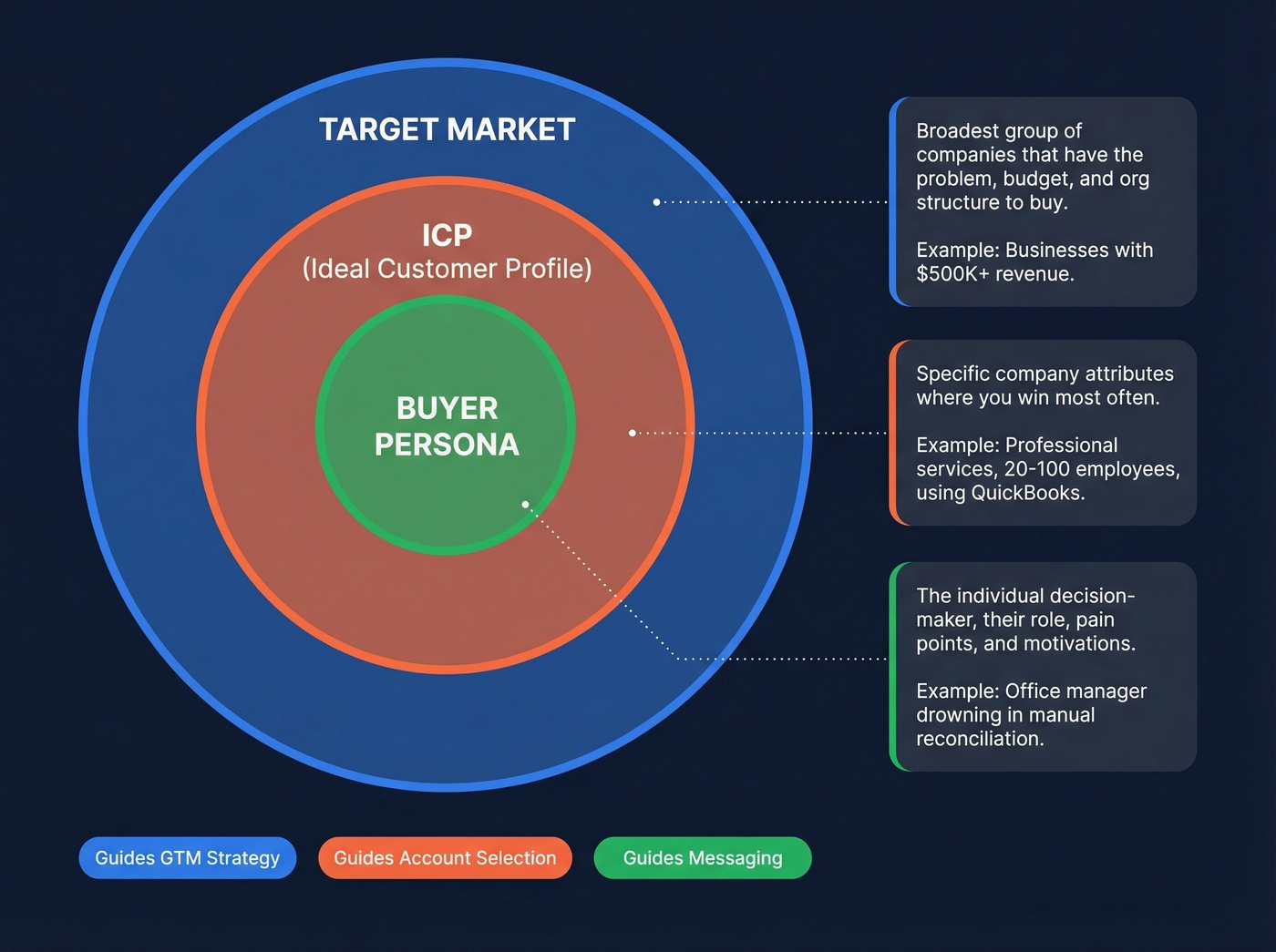
Target market is the broadest ring: the universe of companies that could buy from you. ICP narrows that to the specific company attributes where you win most often - industry, headcount, revenue, tech stack, growth stage. Buyer persona zooms to the individual: their role, motivations, pain points, and how they make decisions.
Say you sell an online bookkeeping tool. Your target market is businesses with over $500K in annual revenue. Your ICP narrows to, say, professional services firms with 20-100 employees that use QuickBooks and are outgrowing it. Your persona is the office manager or fractional CFO who's drowning in manual reconciliation every month-end.
Each layer serves a different function. Target market guides your go-to-market strategy. ICP guides your sales team's account selection. Persona guides your messaging and content. Skip a layer and you'll either go too broad - wasting budget on accounts that won't convert - or too narrow, missing pipeline you should've captured.
How to Define Your B2B Target Market
Most teams stall here. They schedule a workshop, fill a whiteboard with sticky notes, and produce a document nobody references again. Let's walk through a more rigorous approach.
Analyze Your Best Customers
Start with your CRM, not a brainstorm. Pull your top 20-30 customers by revenue, retention, and expansion. Look for patterns in industry, headcount, revenue, growth stage, and tech stack. The answers are already in your data - you just haven't looked systematically.
If you're pre-revenue, analyze the companies where your product got the strongest reaction during discovery calls. Even 10 data points beat zero.
Segment by Firmographics
Group those patterns into segments using industry, company size, geography, and growth stage. But firmographics alone aren't enough. Two 200-person SaaS companies in the same vertical can have completely different buying readiness - one just raised a Series B and is hiring aggressively, the other is in a hiring freeze. Same firmographics, wildly different likelihood to buy.
Consider a jobs-to-be-done lens alongside firmographics. Often, the "job" a customer hires your product to do cuts across traditional industry lines, which is why needs-based segmentation can outperform industry-only segmentation.
Layer in Intent Signals
This is where modern B2B targeting separates from the old playbook. Intent signals tell you which companies in your target market are actively researching solutions like yours right now. Trigger events - fundraising rounds, executive changes, tech stack shifts, headcount growth - act as buying catalysts. Contextual campaigns built on these signals can achieve 4x the response rate of standard campaigns, which is exactly why trigger-based targeting outperforms static lists.
Size with TAM/SAM/SOM
You need to know how big the opportunity actually is. TAM (Total Addressable Market) is the total revenue opportunity at 100% market share. SAM (Serviceable Addressable Market) is the slice you can actually serve given your product and geography. SOM (Serviceable Obtainable Market) is what you can realistically capture in the near term.
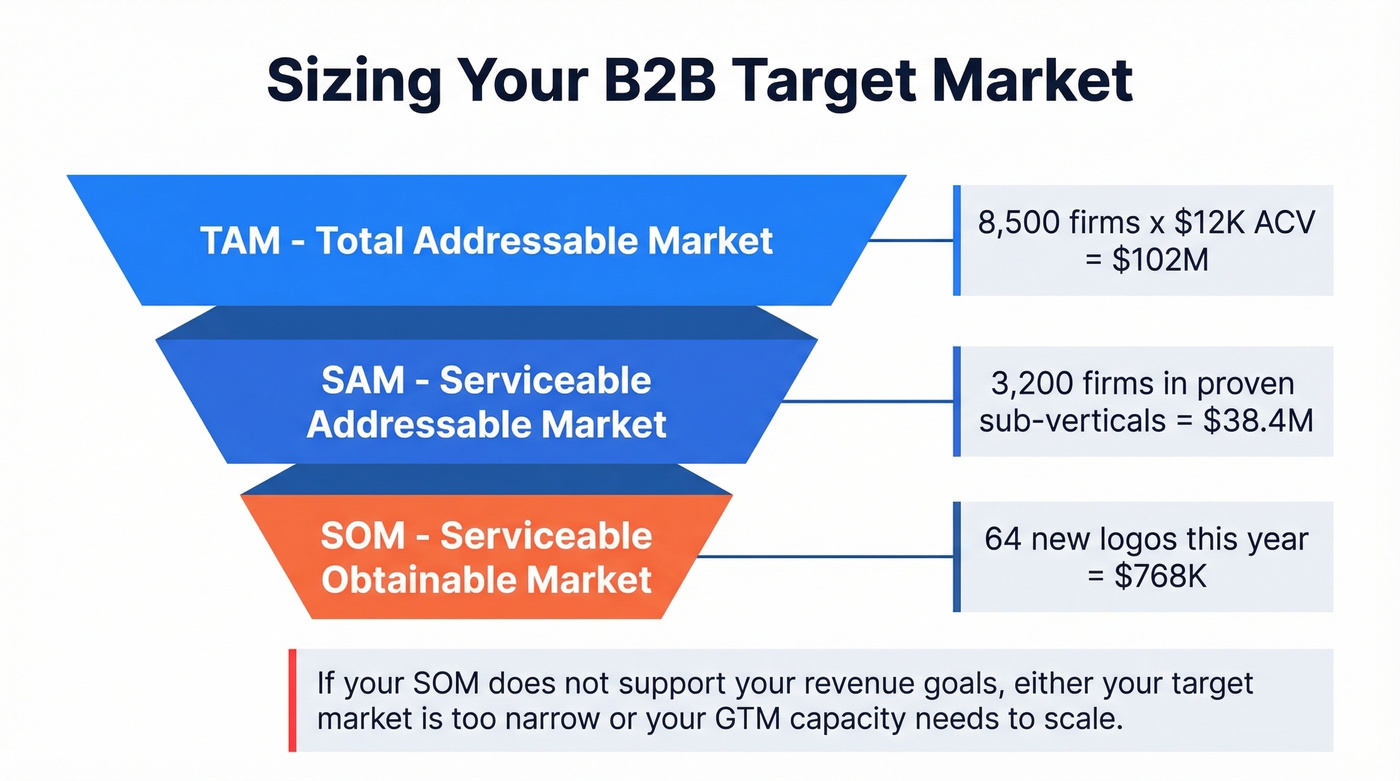
Quick example: you sell compliance software to financial services firms. If there are 8,500 firms in your target geography and your average contract value is $12K/year, that's a TAM of $102M. Your SAM - sub-verticals with proven traction - might be 3,200 firms, or $38.4M. Your SOM, based on current sales capacity, might be 64 new logos this year: $768K. If your SOM doesn't support your revenue goals, either your target market definition is too narrow or your go-to-market capacity needs to scale.
Validate with Outreach Data
Don't treat your target market definition as permanent. Run outbound against it and measure. We've found you need a minimum of about 274 prospects per segment before drawing real conclusions - that's roughly the threshold for statistical significance in outreach testing. Track reply rates, meeting rates, and win rates by segment. If one segment converts at 3x the rate of another, that's your market telling you where to focus. Revisit quarterly.

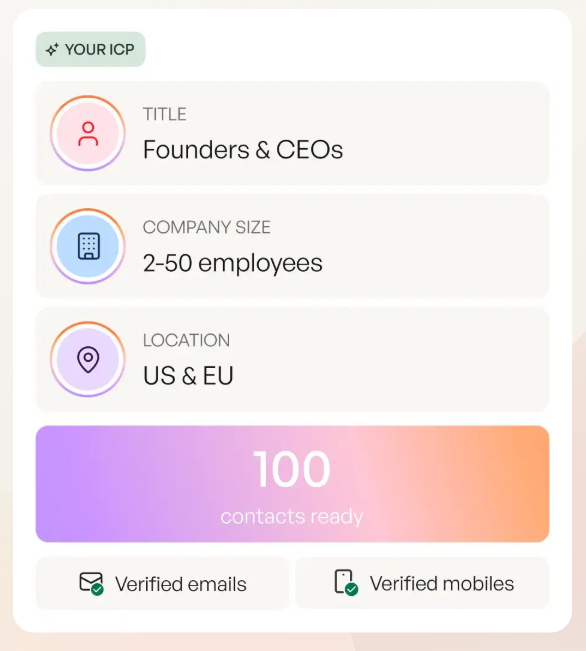
You just defined your target market. Now turn it into a pipeline-ready list. Prospeo's B2B database lets you filter 300M+ profiles by industry, headcount, revenue, tech stack, funding, and intent signals across 15,000 topics - so your TAM/SAM/SOM isn't a slide, it's a live prospect list.
Go from target market definition to verified contacts in under five minutes.
From Target Market to Pipeline
Here's the revenue math. Say your annual goal is $2.4M, your average deal size is $10K, and your win rate is 20%, right around the B2B average of 17-21%. You need 240 closed deals, which means 1,200 opportunities, which means roughly 2,400 qualified leads per year assuming a 50% lead-to-opportunity conversion rate.
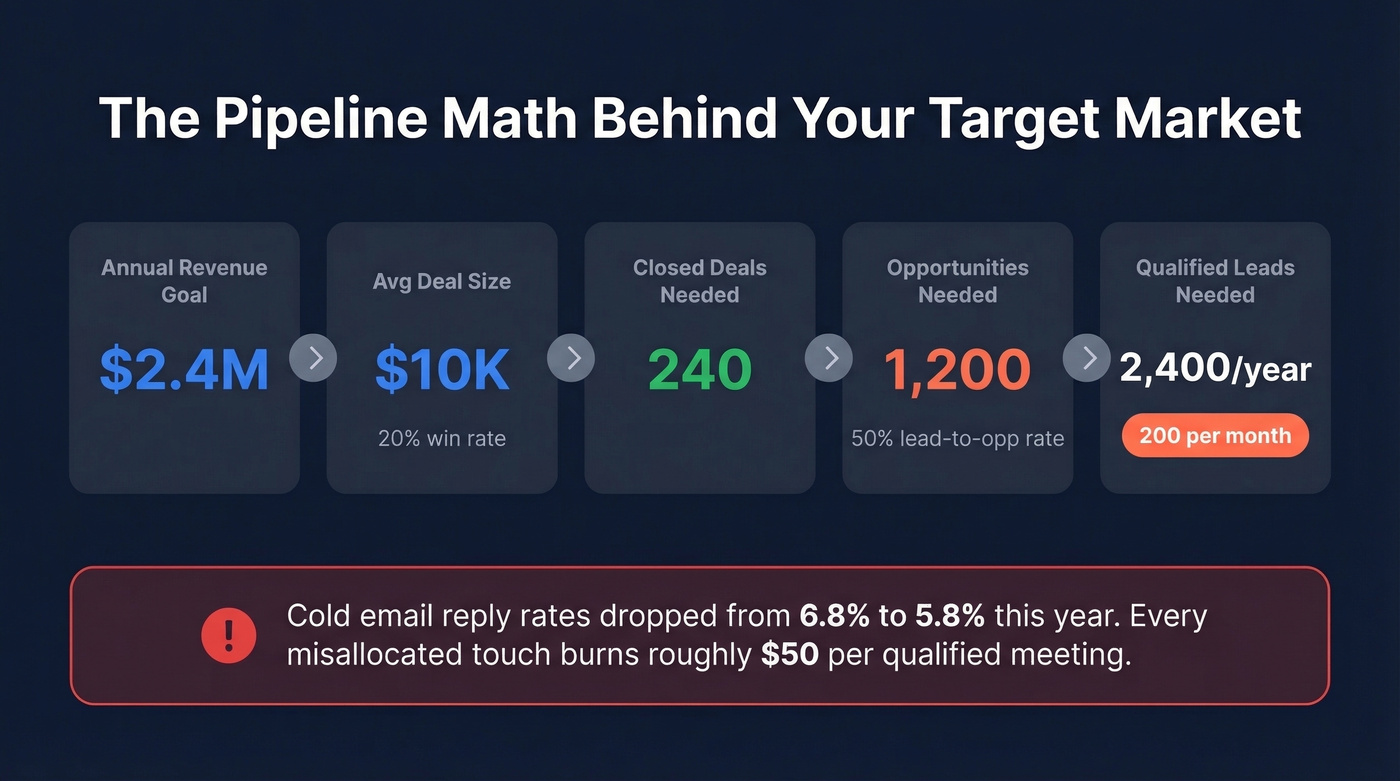
That's 200 qualified leads per month. Every month.
And cold email reply rates have declined from 6.8% to 5.8% in the past year alone - a stat that should alarm anyone running outbound. The margin for error on targeting is shrinking fast. Sending to the wrong accounts doesn't just waste time; it actively damages your domain reputation and sender score. If you're paying $50 per qualified meeting, sending to the wrong segment means burning $5K for every 100 misallocated touches.
Your B2B target market definition determines who those 2,400 leads are. Get it right and the math works. Get it wrong and no amount of volume saves you.
Mistakes That Waste Your Targeting Budget
Look, the #1 complaint about ICP work is that it's random, vague, and produces a pretty PowerPoint that nobody uses. That's not just our take - it's the practitioner sentiment on r/b2bmarketing. Companies pay agencies $30-40K for a few interviews and get back a deck with gems like "Tommy in IT doesn't like small talk and prefers Slack over email." That's not targeting. That's creative writing.
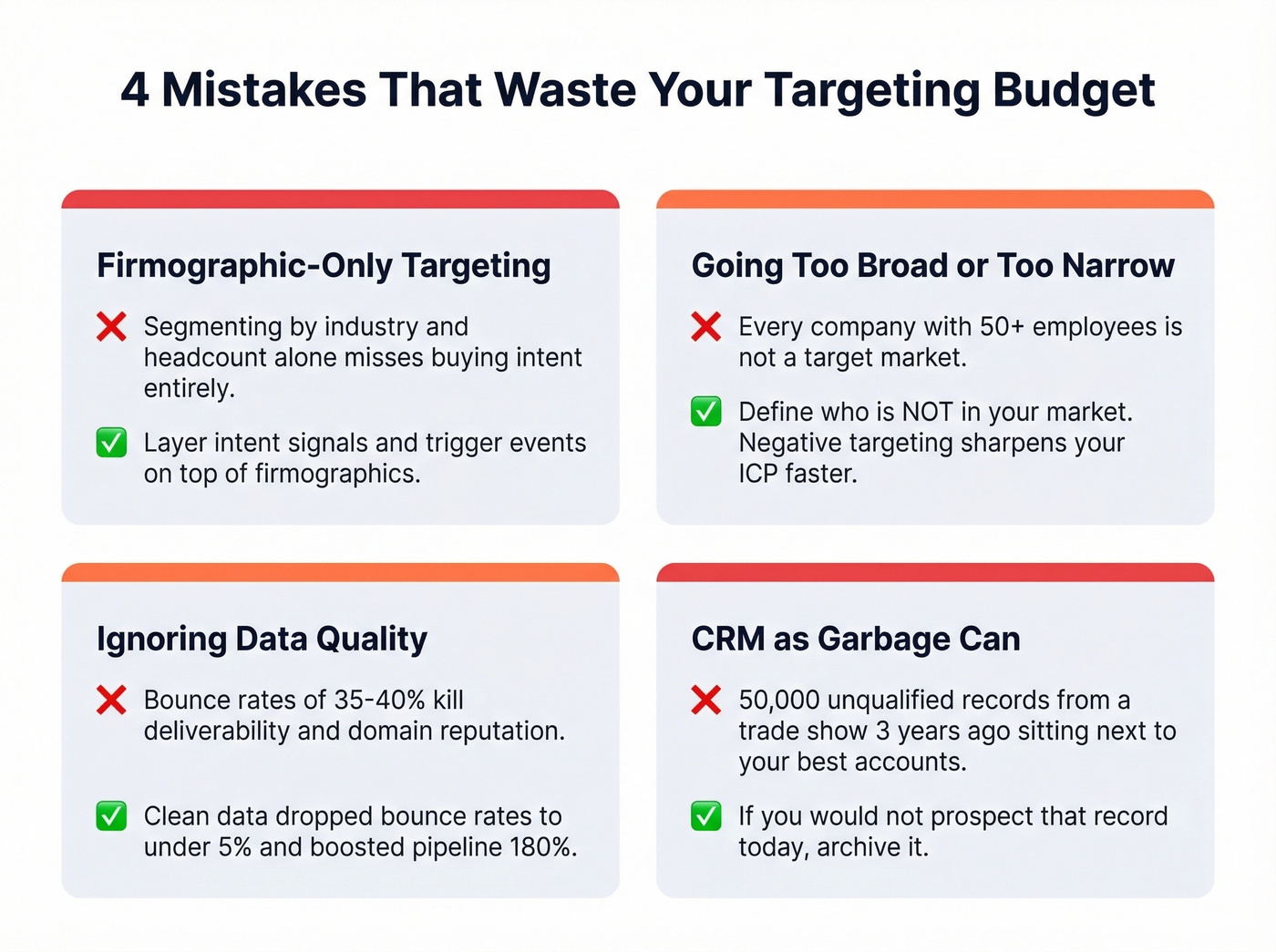
Firmographic-Only Targeting
Segmenting by industry and headcount alone misses buying intent entirely. Without intent signals, you're playing darts blindfolded. Account-based marketing practitioners figured this out years ago - static lists underperform dynamic, signal-driven targeting every time.
Going Too Broad or Too Narrow
Going too broad is the classic mistake - "our target market is every company with 50+ employees." But going too narrow creates its own problems. In niche B2B with a TAM of a few thousand to 100K accounts, lookalike audiences underperform manual list building. And if you define your persona so tightly that you can't hit platform minimums for paid campaigns, you've over-rotated.
Equally important: define who's NOT in your target market. Negative targeting - explicitly excluding company types, industries, or deal sizes where you consistently lose - sharpens your ICP faster than adding more criteria.
Ignoring Data Quality
You can nail your target market definition and still fail at execution if your contact data is garbage. We've seen teams with bounce rates of 35-40% wonder why their outbound isn't working. That's not a targeting problem; it's a data problem. Snyk saw bounce rates drop from 35-40% to under 5% after switching to Prospeo, and AE-sourced pipeline jumped 180%. The target market definition didn't change. The data quality did.
CRM as Garbage Can
Symptoms: bought lists dumped into Salesforce without qualification, no deduplication, no enrichment, no lead scoring, 50,000 unqualified records from a trade show three years ago sitting alongside your best accounts. Your CRM should reflect your target market definition - not contradict it. If you wouldn't prospect that record today, archive it.
Tools to Activate Your B2B Target Market
There are three categories of tools here, and the pricing range is enormous - free to $150K+/year. Here's the thing: if your average deal size is under $15K, you almost certainly don't need the enterprise end. A self-serve database with intent filters will outperform a six-figure platform that takes three months to implement.
B2B data platforms turn your target market definition into prospect lists. Prospeo gives you 300M+ profiles with 30+ search filters including buyer intent and technographics, 98% email accuracy on a 7-day data refresh cycle, and a free tier with 75 emails/month. Apollo offers a free tier with paid plans from ~$49-99/mo per user. Both are solid starting points, though in our experience Prospeo's verification process produces noticeably fewer bounces. If you're comparing options, start with a shortlist of sales prospecting databases.

Intent data providers layer buying signals on top of your firmographic targeting. 6sense runs $65-120K/year. Demandbase is $50-150K/year. Bombora sits at $40-100K/year. For smaller teams, VisitorQueue starts at $39/month for website visitor identification. If you want a tighter process for scoring and acting on signals, use an intent based segmentation framework. Skip the enterprise intent tools if your team is under 10 reps - the ROI math rarely works at that scale.
CRM as operational backbone. HubSpot's free CRM handles the basics. Salesforce starts at $25/user/month for Starter, but most B2B teams end up at $80-165/user/month on Professional or Enterprise tiers. The CRM isn't where targeting happens - it's where targeting gets operationalized. To keep records clean, pair it with data enrichment services and a clear lead status system.
The article says you need ~274 prospects per segment to validate your target market with outreach. Prospeo delivers those contacts at 98% email accuracy and $0.01 per email - so you can test segments fast without burning your domain on bad data.
Validate your segments with data that actually reaches real buyers.
FAQ
What's an example of a B2B target market?
A SaaS company selling compliance software might define its target market as mid-market financial services firms in the US with 100-500 employees and over $10M in annual revenue. The ICP narrows from there based on tech stack and buying signals, and buyer personas zero in on the individual stakeholders involved in the purchase.
How is a target market different from a target audience?
Your target market is the full set of companies that could buy from you. Your target audience is a narrower segment you're actively marketing to - for example, technology stakeholders at companies that haven't reviewed their compliance software in two years. Think of audience as the slice of the market you're running campaigns against right now.
How often should you revisit your B2B target market?
Quarterly at minimum. Markets shift - new competitors enter, buying committees evolve, and intent signals change. Use outreach data (reply rates, win rates, bounce rates) as your validation layer. If conversion drops across a segment you previously won in, your targeting needs recalibration, not just more volume.
What's the fastest way to build a prospect list from a target market definition?
Use a B2B data platform with firmographic and intent filters that match your target market criteria. Apply your filters - industry, headcount, revenue, technographics, buyer intent - and export verified contacts. Free tiers from tools like Prospeo (75 emails/month) and Apollo let you test before committing budget.