

What Is a Value Proposition in Sales? (And What Does It Actually Sound Like?)
You're 14 seconds into a cold call. The prospect says, "Why should I care?" And you freeze - not because you don't know your product, but because you don't have a clear, pain-anchored reason this specific person should keep listening.
That moment is exactly where your value proposition lives. Here's the uncomfortable truth: only 52% of organizations have one that actually differentiates them from competitors. The other half are winging it with some version of "we help companies save time and money." That's not a value prop. That's a placeholder.
The Quick Version
- The formula: Who you help + the pain you solve + why you're different from every other option.
- The Champion Test: Can your buyer repeat your value prop to their CFO in one sentence without you in the room? If not, it's too vague.
- The shift: Your value prop isn't something you write once and paste everywhere. In real sales, you adapt it across the deal - prospecting, discovery, demo, negotiation.
Sales Value Proposition, Defined
The term was formalized by Lanning and Michaels in a 1988 McKinsey staff paper, originally as a marketing concept. In sales, it's evolved into something far more dynamic.
A value proposition isn't your tagline. It's not your mission statement. It's the specific reason a specific buyer should choose you over doing nothing, buying from a competitor, or building it themselves.
The way you articulate value to a VP of Engineering on a cold call is completely different from how you articulate it to a CFO during negotiation. Same product, different pain, different language, different proof.
Value Prop vs. USP vs. Positioning
These three get conflated constantly, so let's untangle them.
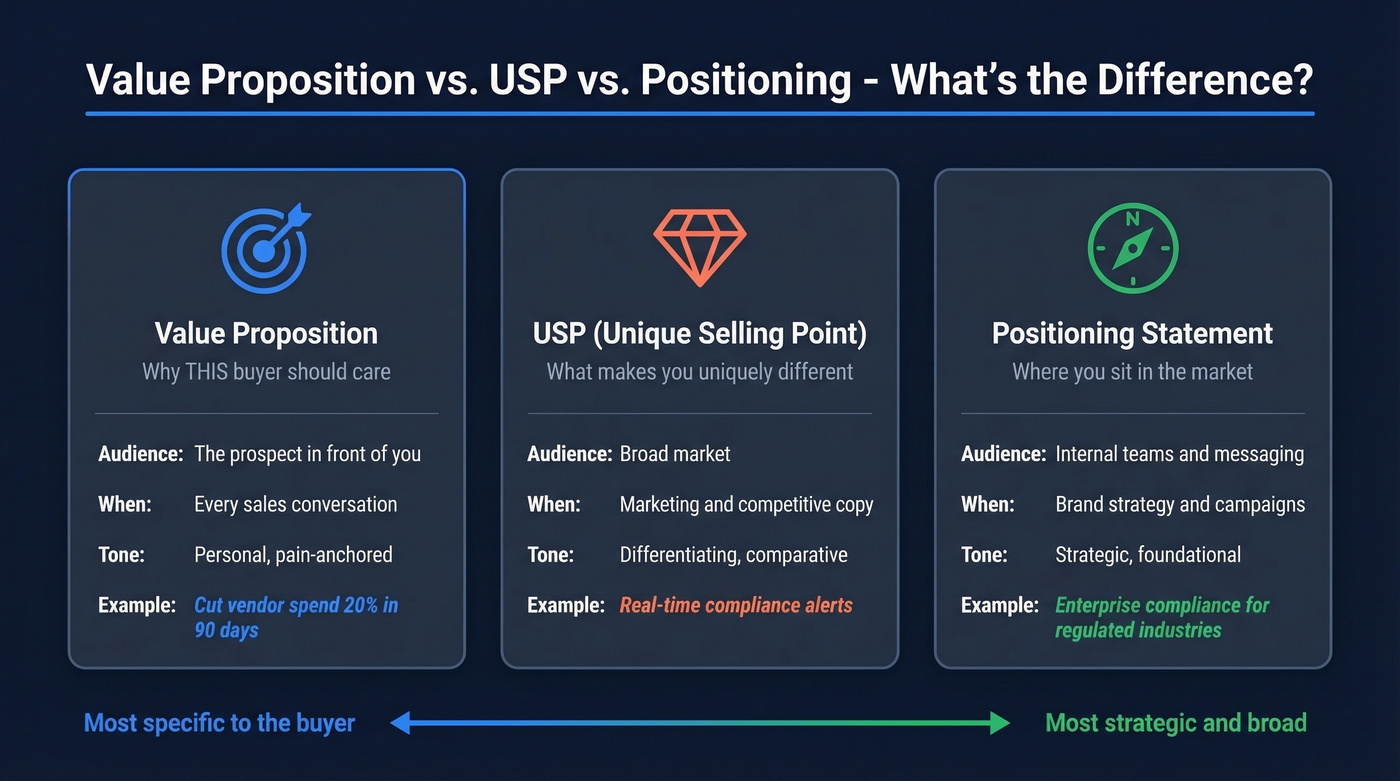
| Value Proposition | USP | Positioning Statement | |
|---|---|---|---|
| Definition | Why this buyer should care | What's uniquely different vs alternatives | Where you sit in the market |
| Audience | The prospect in front of you | Broad market | Internal teams + messaging |
| When to use | Every sales conversation | Marketing / competitive copy | Brand strategy, campaigns |
| Example | "Cut vendor spend 20% in 90 days" | "Real-time compliance alerts" | "Enterprise compliance for regulated industries" |
A value proposition is customer-facing and practical - it's the "why you, why now" a buyer can repeat internally. A USP is the unique edge you point to when comparisons get tight. A positioning statement is the strategic foundation that keeps marketing and sales aligned on how you talk about yourselves.
Why It Matters for Revenue
Companies that deliver strongly on four or more "elements of value" see 3x higher Net Promoter Scores and up to 4x revenue growth compared to companies delivering on just one.
On the buyer side, 82% of buyers accept meetings with sellers who proactively reach out - but only if the outreach is relevant. 86% of business buyers are more likely to buy from a company that understands their needs. Yet 84% of those same buyers expect reps to act as trusted advisors while 73% say most interactions feel transactional. That gap between "trusted advisor" and "transactional interaction" is exactly where your value prop lives. Close the gap, close more deals.

A sharp value proposition only works when it reaches the right person. 59% of reps don't research prospects before calling - and even more send emails that bounce. Prospeo gives you 30+ filters to find the exact persona your value prop was built for, verified emails at 98% accuracy, and intent data across 15,000 topics so you know who's actively in-market.
Stop crafting the perfect pitch for an inbox that doesn't exist.
How to Build One in 3 Steps
Step 1: Name who you help. Not "companies." A specific persona with a specific title at a specific type of company. "Mid-market SaaS CFOs managing 10+ vendor contracts" is a persona. "Business leaders" is not.
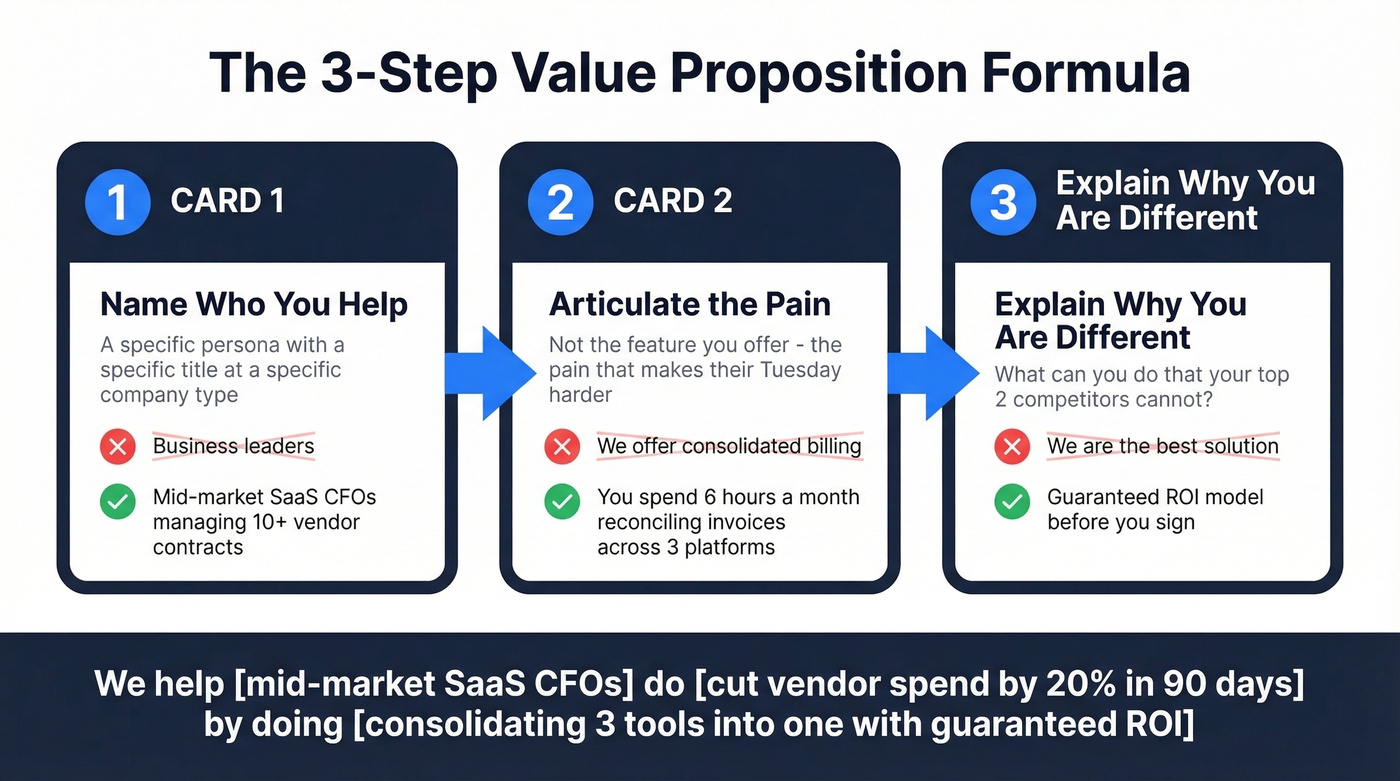
Step 2: Articulate the pain you solve. Not the feature you offer - the pain that makes their Tuesday harder. "You're spending 6 hours a month reconciling vendor invoices across three platforms" is a pain. "We offer consolidated billing" is a feature.
Step 3: Explain why you're different. What can you do that your top two competitors can't? If you can't answer that, your value prop isn't ready. Steve Blank's Customer Value Proposition formula captures this cleanly: "We help [X] do [Y] by doing [Z]."
Before: "We help companies save money on their software stack."
After: "We help mid-market SaaS CFOs cut vendor spend by 20% in 90 days by consolidating three tools into one - with a guaranteed ROI model before you sign."
For teams that want to go deeper, the Value Proposition Canvas from Strategyzer is the gold standard. Map customer jobs, pains, and gains on one side; your pain relievers and gain creators on the other.
5 Mistakes That Kill Your Value Prop
Making it about you. 90% of value propositions focus on the sales rep - "we're the leading platform," "we've been in business for 20 years." The prospect doesn't care about you. They care about their problem. Start every value prop sentence with "you" or the prospect's company name, not "we."
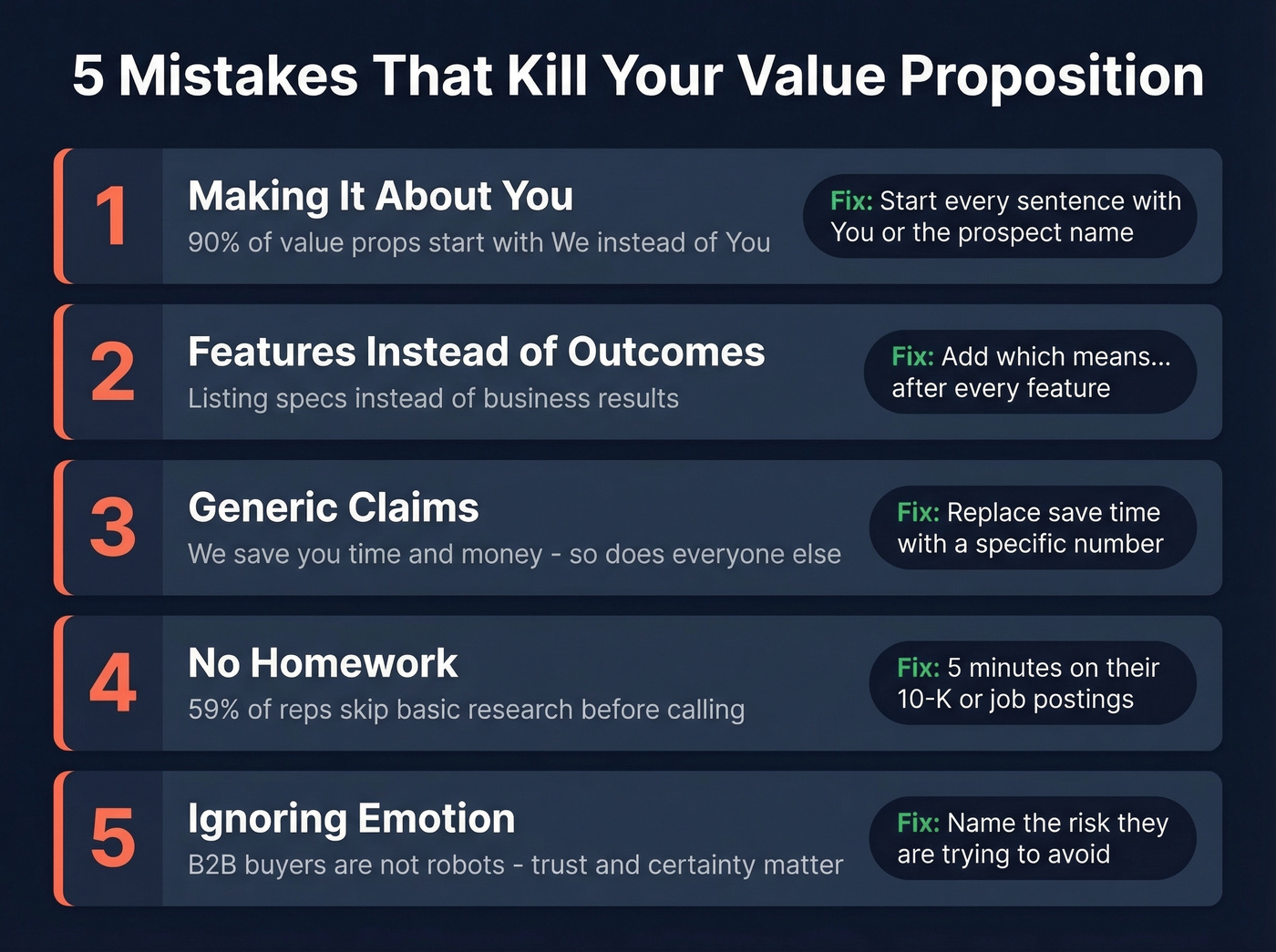
Features instead of outcomes. Listing features is the default because features feel safe. But buyers expect trusted advisors, not product spec sheets. For every feature you mention, add "which means..." and finish with a business outcome.
Generic claims. "We save you time and money" is what every competitor says. The r/salestechniques community nails this - generic claims fail because prospects hear the same thing from everyone. Replace "save time" with a specific number. "Cuts onboarding from 8 weeks to 4" beats "saves time" every single day.
No homework. 59% of buyers say most reps don't research basic information before a call. Five minutes on the prospect's 10-K, recent job postings, or tech stack before every conversation makes a real difference. Reference something specific in the first 30 seconds.
Ignoring emotion. B2B buyers aren't robots. Certainty, trust, and risk reduction drive decisions as much as ROI spreadsheets. "So you're not the one explaining to the board why the migration failed" hits differently than "reduces migration risk by 40%."
Stage-by-Stage Scripts
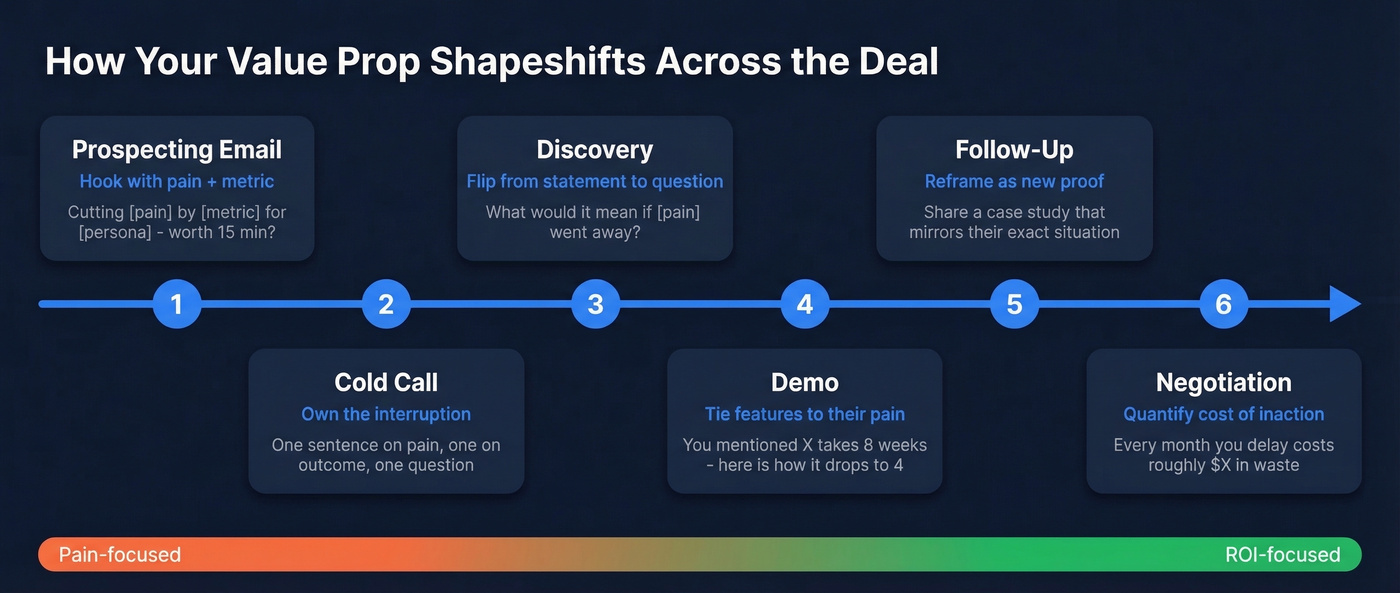
Here's the thing: most reps have a decent value prop. They just deliver the same version of it at every stage, which is the same as having no value prop at all. The message has to shapeshift.
Prospecting Email
80% of buyers prefer a personalized email to other outreach methods. Your value prop needs to land fast - subject line plus first line. "Cutting [specific pain] by [specific metric] for [specific persona] - worth 15 minutes?" None of this matters if the email bounces, though. We use Prospeo to verify emails in real time before sending, which keeps bounce rates under control and protects domain reputation.
If you want more options, start with proven email subject line patterns.
Cold Call
Own the interruption. A talk track from Highspot nails the structure: "Hi [Name], I know you weren't expecting my call. Can I get 30 seconds to see if this is worth your time?" Then deliver one sentence on the pain, one on the outcome, one question to check relevance. That's it.
If you're getting shut down early, use these cold call fixes.
Discovery Call
The value prop flips from a statement to a question. Instead of pitching, ask: "What would it mean for your team if [specific pain] went away?" Let the prospect articulate the value in their own words. That's infinitely more powerful than you saying it for them.
To tighten this stage, borrow a few discovery questions that surface real pain.
Demo
Every feature you show should tie back to a pain the prospect mentioned in discovery. If they said onboarding takes too long, show the onboarding workflow first: "You mentioned new reps take 8 weeks to ramp. Here's how that drops to 4." Skip features they didn't ask about - showing everything signals you weren't listening.
Use a simple product demo checklist to keep the story tight.
Follow-Up
In our experience, the follow-up is where most reps lose momentum. The consensus on r/sales is that "providing value" advice is too vague. What actually works: reframe your value prop as a new proof point - a case study that mirrors their situation, a relevant metric, or a note connecting their earnings call to your solution.
If you need copy you can send today, use these follow-up templates.
Negotiation
Your value prop becomes an ROI model. The conversation shifts from "why us" to "what it costs you to do nothing." Quantify the status quo: "Every month you delay, you're losing roughly $X in waste." At this stage, the message isn't about your product anymore. It's about the cost of inaction.
If you want a clean framework for this, study the anchor concept.
Before and After - 3 Rewrites
Generic to Pain-Anchored
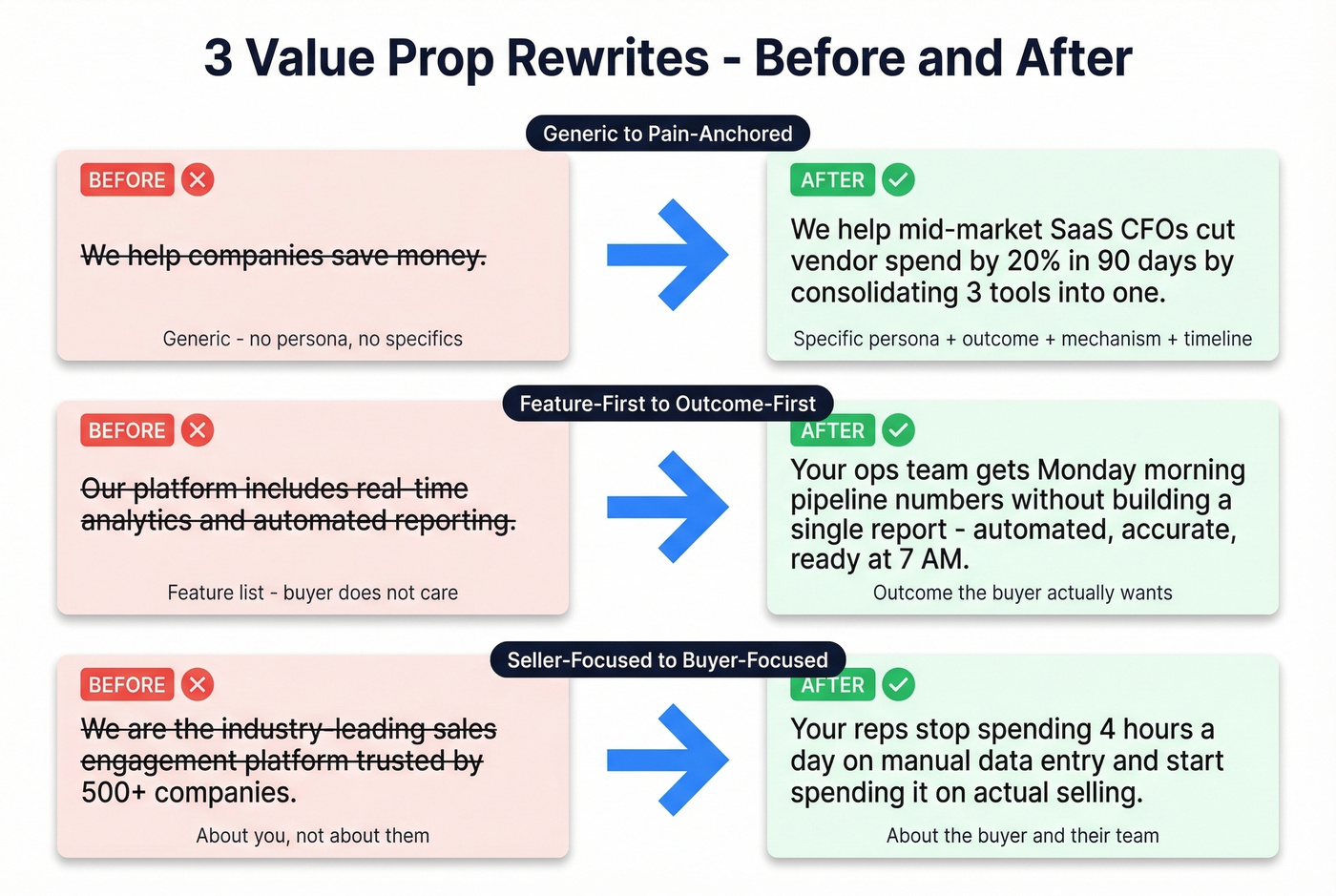
"We help companies save money."
"We help mid-market SaaS CFOs cut vendor spend by 20% in 90 days by consolidating three tools into one." Specific persona, specific outcome, specific mechanism, specific timeline.
Feature-First to Outcome-First
"Our platform includes real-time analytics and automated reporting."
"Your ops team gets Monday morning pipeline numbers without building a single report - automated, accurate, ready at 7 AM." The buyer doesn't care about the feature. They care about getting their Monday back.
Seller-Focused to Buyer-Focused
"We're the industry-leading sales engagement platform trusted by 500+ companies."
"Your reps stop spending 4 hours a day on manual data entry and start spending it on actual selling." "We're the industry leader" is about you. "Your reps stop wasting time" is about them.
The Champion Test
Your champion walks into a budget meeting. The CFO says, "Why this vendor?" Your champion pauses: "They have a really good platform." The CFO nods politely. The deal stalls for six weeks.
We've seen this pattern kill more deals than pricing objections. The problem isn't your champion's enthusiasm - it's that you gave them nothing repeatable. Can your buyer repeat your value prop to their CFO in one sentence without you in the room? If not, rewrite it until they can. This is your single most important editing tool.
FAQ
What's the difference between a value proposition and an elevator pitch?
An elevator pitch is a fixed company summary you deliver the same way every time. A value proposition changes based on who you're talking to and where they are in the deal - different pain, different proof, different language.
How long should a sales value proposition be?
One to two sentences - roughly 25 words max. If your buyer can't repeat it from memory after one hearing, cut words until they can. The Champion Test is your editing tool.
Can one company have multiple value propositions?
Yes - and it should. A VP of Engineering cares about integration speed; a CFO cares about cost reduction. Build one value prop per persona, each anchored to their specific pain and measured outcome.
How do I test whether my value proposition works?
Track two signals: do prospects agree to a next step after hearing it, and can your champion articulate it internally without coaching? If conversion to next step is below 20%, or champions go silent in committee, rewrite.
What tools help deliver a value proposition to the right prospects?
You need accurate contact data so your message reaches decision-makers. Tools like Prospeo verify emails with 98% accuracy and refresh data every 7 days, so your carefully crafted message doesn't bounce before anyone reads it.
You just learned that your value prop needs to shapeshift at every deal stage - prospecting, discovery, demo, negotiation. But personalization at scale requires accurate data. Prospeo's 300M+ profiles refresh every 7 days, so your stage-by-stage scripts land on current titles, verified emails, and direct dials with a 30% pickup rate.
Deliver the right message to the right buyer - with data you can trust.