

What Is Cold Contacting? The 2026 Guide (+ Stats)
You've sent 500 cold emails, made 200 dials, and connected on a handful of social profiles. Three replies. Before you blame your script, your timing, or your subject line - check your data. Cold contacting works in 2026, but only when the foundation is right.
The Short Version
Cold contacting is any outreach to someone who doesn't know you - calls, emails, social DMs, even physical mail. It's the broadest term in the outbound playbook, and it's often confused with cold calling, which is just one channel underneath it. Here's what matters right now:
- Multichannel sequences outperform single-channel in most outbound programs. Email warms, social builds credibility, calls convert.
- Your data quality matters more than your script. Inaccurate contact info wastes roughly 27% of a rep's selling time.
- 81% of decision-makers engage with cold outreach when it's tailored to their company. Generic blasts get ignored.
- The sweet spot is 4-7 touchpoints across channels. Most sellers give up after four calls.
Cold Contacting Defined
Cold contacting is the act of reaching out to a person or organization you've had zero prior interaction with. No previous emails, no website visits, no mutual introductions. You're starting from scratch.
The term is an umbrella. It covers cold calls, cold emails, social outreach like connection requests and DMs, and physical mail. When someone says "cold contacting," they mean the full spectrum of first-touch outreach - not just picking up the phone.
The distinction from warm contacting is straightforward: a warm contact has engaged with you before, whether they visited your site, attended a webinar, responded to a previous message, or came through a referral. A cold contact hasn't done any of that. You're reaching them based on fit, not prior interest. In practice, though, the best cold contacts aren't truly cold - reps research the prospect beforehand, making the first touch closer to a warm approach even though there's been no prior interaction.
This umbrella framing matters because strategy changes depending on the channel mix. A cold email sequence has different rules than a cold call block, and both differ from a social-first approach. The best outbound teams don't pick one. They orchestrate all of them.
Cold Contacting vs. Cold Calling
Cold calling is a subset of cold contacting, not a synonym. Same with cold emailing. Here's how the channels compare:
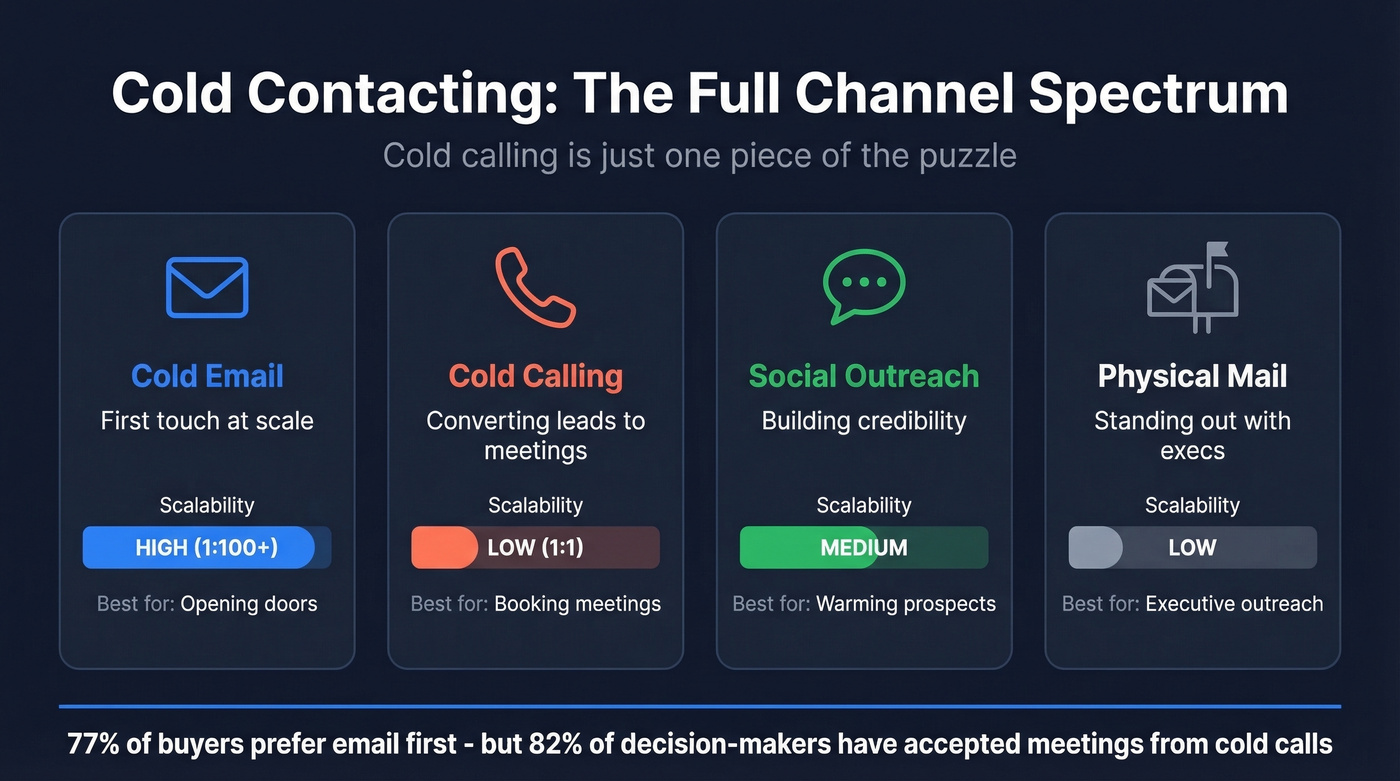
| Channel | What It Is | Best For | Scalability |
|---|---|---|---|
| Cold email | Unsolicited email to a prospect | First touch at scale | High (1:100+) |
| Cold calling | Phone call with no prior contact | Converting leads to meetings | Low (1:1, time-intensive) |
| Social outreach | Connection requests, DMs | Building credibility | Medium (semi-automated) |
| Physical mail | Direct mail to office address | Standing out with execs | Low (high cost per touch) |
About [77% of buyers prefer email](https://www.forbes.com/advisor/business/software/email-marketing-statistics-mar-26/) as their first point of contact. That doesn't mean calling is dead - 82% of decision-makers have accepted meetings from well-executed cold calls. The channels aren't competing. They're complementary.
Here's the thing: most "cold calling is dead" takes come from people selling email software, and most "email doesn't work anymore" takes come from people selling dialers. Ignore both. The data says multichannel wins, and treating outbound as a single-channel activity leaves meetings on the table.
Does It Still Work in 2026?
Short answer: yes, but the bar is higher than it was three years ago. We've run campaigns across all three channels, and the data confirms what the benchmarks suggest.
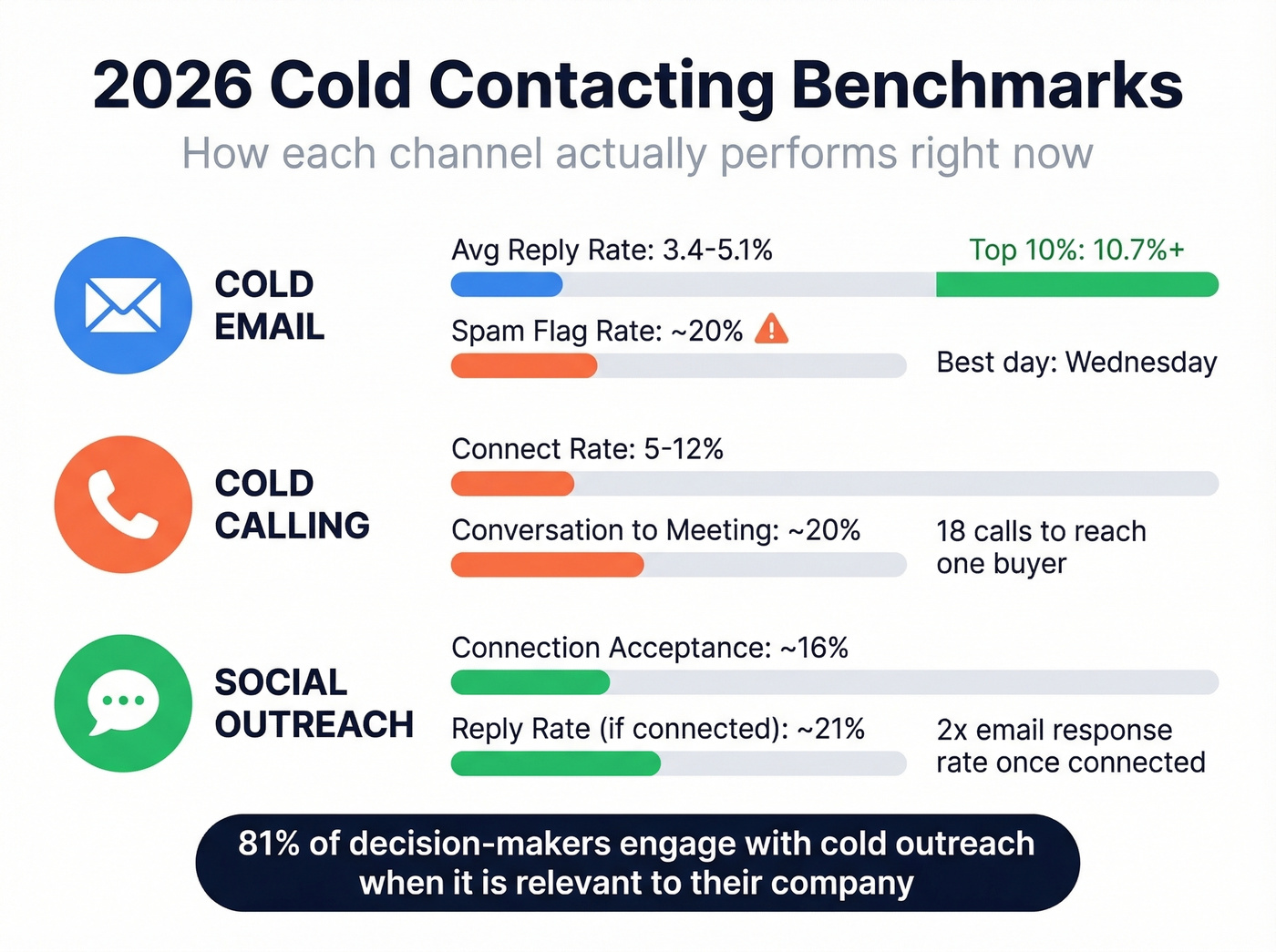
| Channel | Key Metric | Benchmark |
|---|---|---|
| Cold email | Avg reply rate | 3.4-5.1% (top 10%: 10.7%+) |
| Cold email | Spam flag rate | ~20% flagged as spam |
| Cold calling | Connect rate | 5-12% |
| Cold calling | Call-to-meeting (overall) | ~2-5% |
| Cold calling | Conversation-to-meeting | ~20% |
| Social (connection) | Acceptance rate | ~16% |
| Social (reply) | Reply rate (among accepted) | ~21% |
A few things jump out. Cold email reply rates range from 3.4% to 5.1% depending on the dataset, but elite campaigns hit 10%+ - the gap between mediocre and great is enormous. Cold calling connect rates of 5-12% mean you need volume, and it takes an average of 18 calls to connect with a buyer. Social outreach delivers roughly double the response rate compared to email once you're connected, but getting that connection accepted is the bottleneck.
81% of sales and marketing decision-makers say they'll engage with cold outreach when it's relevant to their company. The problem isn't the approach. It's that most outbound is lazy - wrong person, wrong message, wrong data.
That ~20% spam-flag rate on cold emails should alarm you. One in five cold emails gets flagged. That's not a messaging problem. That's an infrastructure and data hygiene problem.

That ~20% spam-flag rate? It starts with bad data. Prospeo's 5-step email verification and 7-day data refresh cycle keep bounce rates under 2% - the threshold this article just told you matters. At $0.01 per verified email, fixing your foundation costs less than one wasted rep hour.
Stop rewriting scripts. Start verifying your contact data.
How to Build a Multichannel Sequence
The framework is straightforward: email warms, social builds credibility, calls convert. Here's a concrete 14-day cadence that puts all three channels to work.
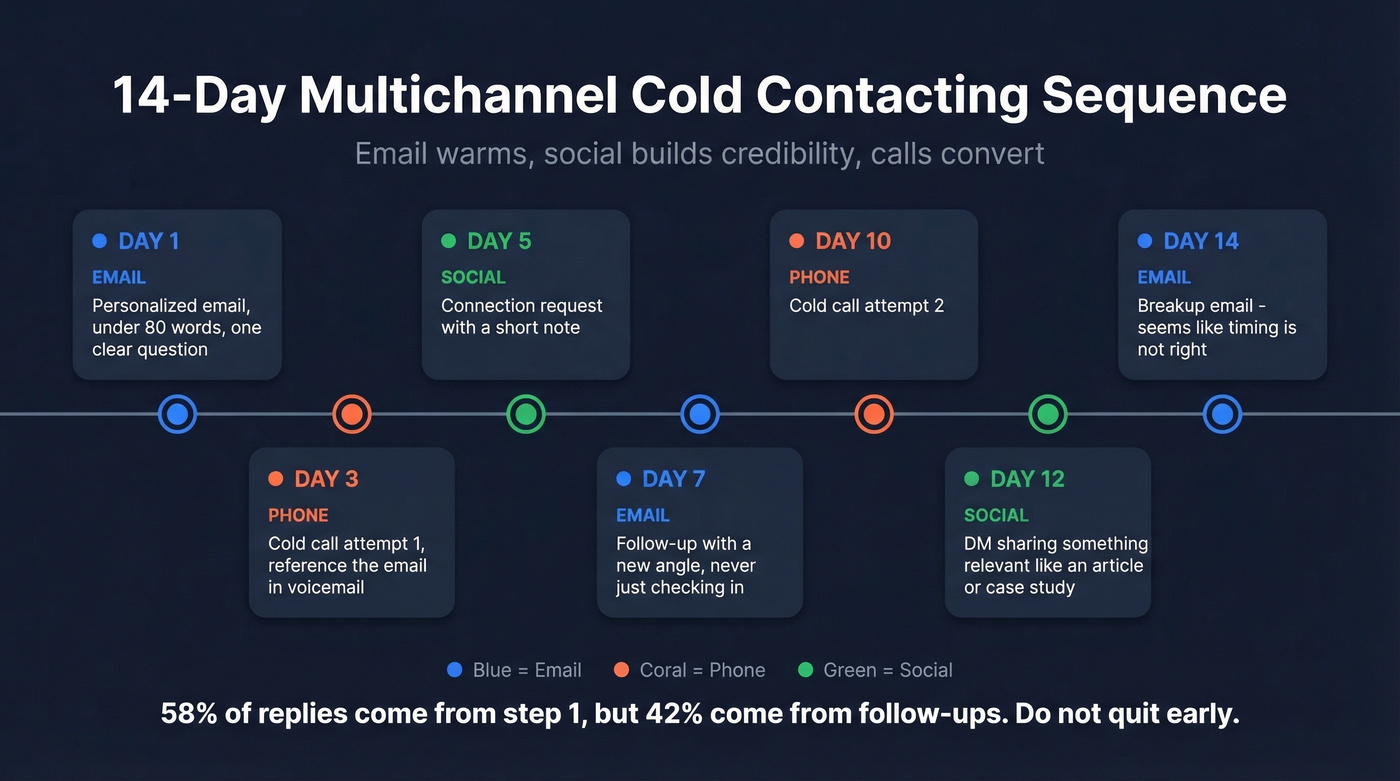
| Day | Channel | Action |
|---|---|---|
| 1 | Personalized email, under 80 words, one clear question | |
| 3 | Phone | Cold call attempt #1, voicemail referencing the email |
| 5 | Social | Connection request with a short note |
| 7 | Follow-up with a new angle (never "just checking in") | |
| 10 | Phone | Cold call attempt #2 |
| 12 | Social | DM sharing something relevant - article, case study |
| 14 | Breakup email ("Seems like timing isn't right") |
Why this structure works: 58% of replies come from step 1, but 42% come from follow-ups. Teams that quit after one or two touches leave nearly half their potential replies on the table.
Timing matters too. Tuesday and Wednesday are peak reply days for email, with Wednesday pulling the highest volume. For calls, 11 AM-1 PM is a strong window. Keep emails under 80 words - the best-performing campaigns in Instantly's 2026 dataset all stayed below that threshold.
In our experience, the breakup email on Day 14 generates more replies than any follow-up except the first touch. Something about the finality triggers a response. We don't fully understand why, but we've seen it consistently enough to trust the pattern.
One critical step before you launch: verify every email address on your list. A bounce rate above 2% means your list is the problem, not your copy.
Why Data Quality Beats Your Script
You've sent 500 cold emails and gotten 3 replies. Your instinct is to rewrite the subject line, tweak the CTA, maybe add a GIF. Stop. Check your bounce rate first.
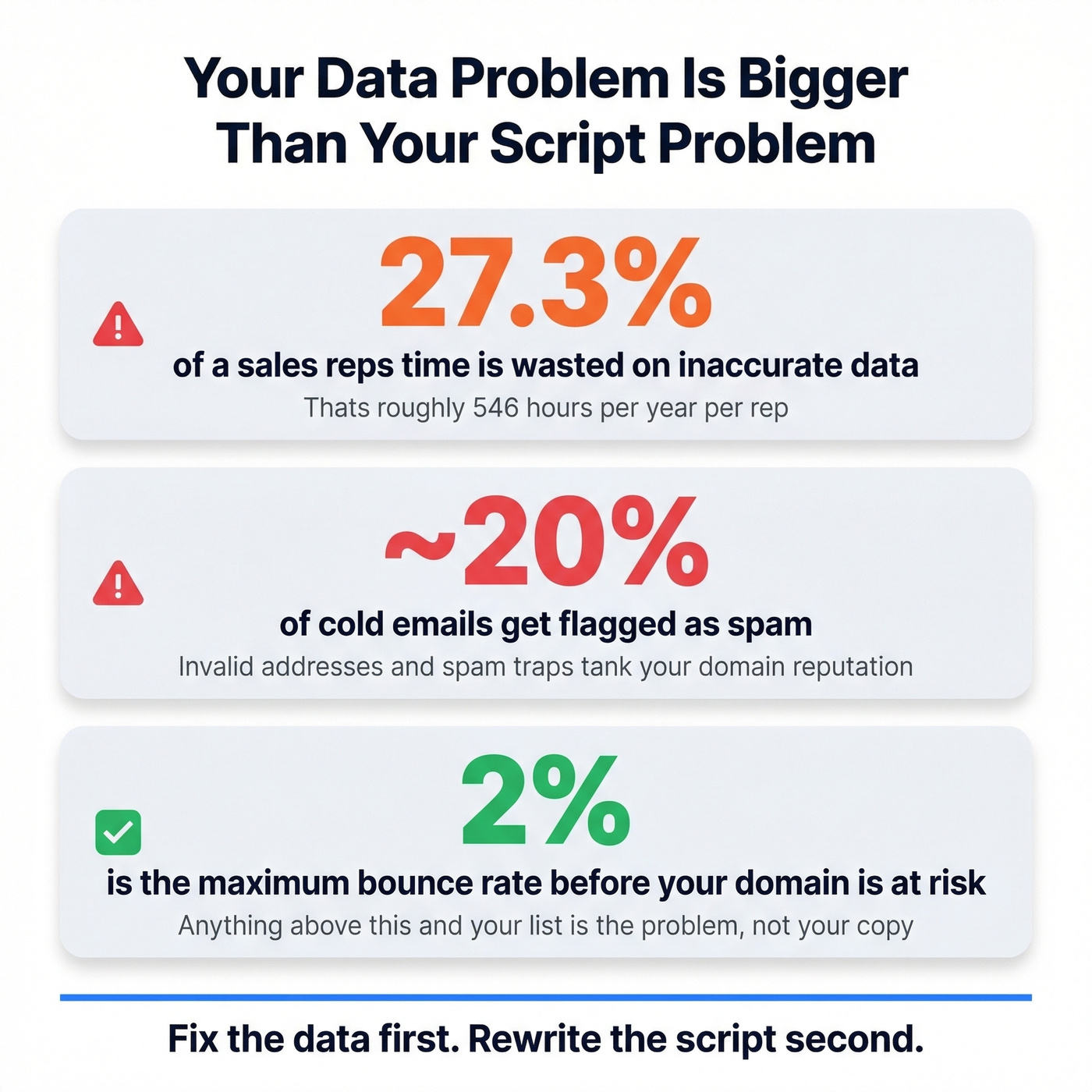
Inaccurate data wastes roughly 27.3% of a sales rep's time - about 546 hours per year chasing wrong numbers, bounced emails, and people who left the company six months ago. When ~20% of cold emails get flagged as spam, a chunk of that is driven by invalid addresses, spam traps, and honeypot emails that tank your domain reputation.
On r/MarketingMentor, a poster described doing 4-6 follow-ups after initial outreach with zero responses. The replies all pointed to targeting and data quality, not messaging. That pattern repeats across every sales subreddit we've seen.
Prospeo covers 300M+ professional profiles with 98% email accuracy, verified through a proprietary 5-step process that includes catch-all handling and spam-trap removal. The 125M+ verified mobile numbers carry a 30% pickup rate against an industry average of 10-12%. Data refreshes every 7 days versus the 6-week industry standard.
If you're building lists from scratch, data enrichment and firmographic filters are the fastest way to tighten targeting before you ever write copy.
Multichannel sequences need emails, phones, and social profiles that actually connect. Prospeo gives you all three from one platform - 143M+ verified emails at 98% accuracy, 125M+ mobile numbers with a 30% pickup rate, and 30+ filters to target the right prospects before your first touch.
Build your entire cold contacting list in minutes, not days.
Compliance Cheat Sheet
Cold contacting is legal. It's also heavily regulated - and prospects are more skeptical than ever thanks to scam calls and spoofed numbers eroding trust across every channel.
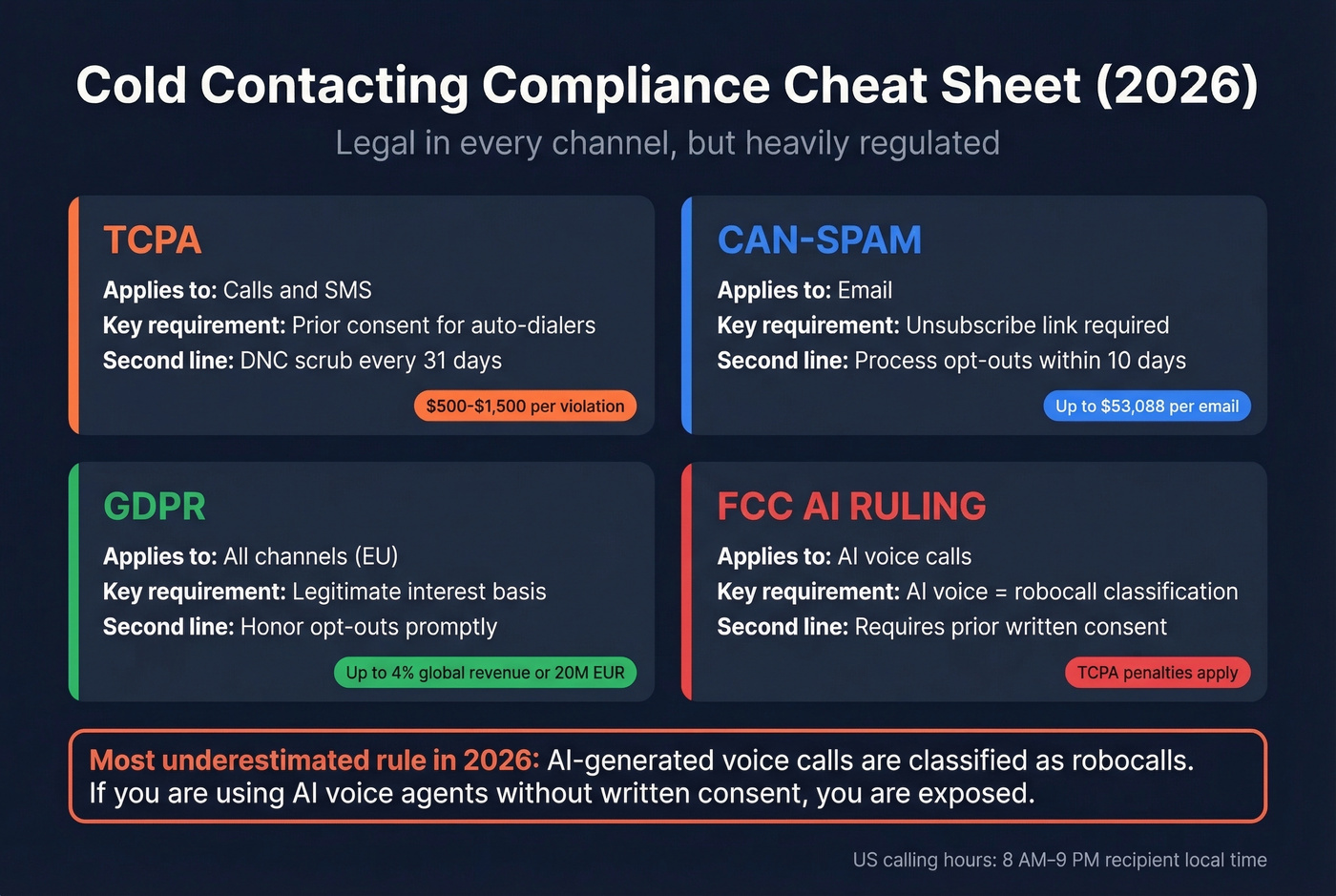
| Regulation | Applies To | Key Requirement | Penalty |
|---|---|---|---|
| TCPA | Calls, SMS | Prior consent for auto-dialers; DNC scrub every 31 days | $500-$1,500/violation |
| CAN-SPAM | Unsubscribe link; process opt-outs within 10 days | Up to $53,088/email | |
| GDPR | All channels (EU) | Legitimate interest basis; honor opt-outs | Up to 4% global revenue or EUR 20M |
| FCC AI ruling | AI voice calls | AI-generated voice = robocall; requires prior written consent | TCPA penalties apply |
Legal calling hours in the US are 8 AM-9 PM recipient local time. Some states are stricter. Scrub your call lists against the national DNC registry at least every 31 days, and honor internal DNC requests immediately - document them for five years.
The FCC's classification of AI-generated voice calls as robocalls is the regulation most teams are underestimating right now. If you're using AI voice agents for cold outreach without prior written consent, you're exposed.
Seven Mistakes That Kill Results
Not verifying your contact list before sending. Bounces above 2% destroy your domain reputation. This is the single fastest way to kill a cold email program.
Using your primary domain for cold email. Set up a separate sending domain. If it gets flagged, your main domain stays clean.
Faking familiarity. "Just following up on our conversation" when there was no conversation. As one sales rep on Reddit put it: "People don't hate cold calls. They hate being lied to and having their time wasted." That quote deserves a spot on every SDR's wall.
Sending generic, un-researched messages. If your email could apply to any company in any industry, it's going in the trash. The 81% engagement stat only applies to outreach tailored to the prospect's company.
Single-channel approach. Only calling OR only emailing leaves meetings on the table. Multichannel isn't optional anymore.
No follow-up plan. 42% of replies come from follow-ups. Quitting after one or two touches is quitting at halftime.
Ignoring compliance. No unsubscribe link, no DNC scrub, no opt-out processing. The penalties aren't theoretical - $500-$1,500 per TCPA violation adds up fast across a thousand-contact campaign.
Essential Tools
You don't need ten tools. You need four categories covered.
Data & Verification: Prospeo delivers 98% email accuracy, a 30% mobile pickup rate, and pricing at ~$0.01/lead with a free tier. For comparison, ZoomInfo runs $15K-40K/year and sits at 87% email accuracy. Apollo trails further at 79%.
If you're evaluating vendors, start with a shortlist of sales prospecting databases and sanity-check deliverability with an email bounce rate audit before you scale volume.
Email Sending: Instantly (~$30-97/mo) and Smartlead (~$39-94/mo) handle inbox rotation and warmup. lemlist (~$39-99/mo) adds multichannel sequencing with social steps built in.
CRM: HubSpot's free tier covers most early-stage teams. Salesforce ($25-300/user/mo) is the standard once you're past 10 reps.
Dialer: Any power dialer that lets reps hit 400-750 dials/day. Orum, Nooks, or PhoneBurner run $100-200/user/mo. Note that the connect-rate benchmarks above assume power or parallel dialing volume - manual dialing won't get you there.
Let's be honest: if you're spending $15K+ on data and your bounce rate is still above 5%, the tool isn't the problem. Skip the enterprise contract and test a self-serve option first.
FAQ
Is cold contacting legal?
Yes - it's regulated by TCPA (calls/SMS), CAN-SPAM (email), and GDPR (EU). Scrub DNC lists every 31 days, respect 8 AM-9 PM calling windows, include unsubscribe links in every email, and get prior written consent before using AI voice agents.
What does cold contacting mean in sales?
Cold contacting is any first-touch outreach to a prospect who has no prior relationship with you - spanning email, phone, social DMs, and direct mail. It's the foundation of outbound sales development and differs from warm outreach, where the prospect has already engaged.
How many follow-ups should I send?
Aim for 4-7 touchpoints across channels over a 14-day window. 58% of replies come from the first message, but 42% come from follow-ups - most reps quit too early and leave nearly half their potential meetings on the table.
What's the best time to cold call?
The legal window is 8 AM-9 PM in the recipient's local time zone. Within that range, 11 AM-1 PM consistently delivers the strongest connect rates. For cold email, Wednesday drives the highest reply volume according to 2026 benchmark data.
How do I get accurate contact data for outreach?
Use a verified data provider rather than scraping or buying unverified lists. Look for 98%+ email accuracy, frequent data refreshes, and a free tier so you can test quality before committing budget.