

What Is Crunchbase? Features, Pricing & Limits (2026)
Most teams sign up for Crunchbase, search a few companies, hit the paywall, and move on. That's a waste - because when you understand what Crunchbase actually does and what it doesn't, it becomes a useful piece of your prospecting stack. So what is Crunchbase, and how should you actually use it?
Crunchbase Explained
Crunchbase is a predictive company intelligence database covering 4M+ private companies, powered by live company data, AI, and market activity data from 80M+ users. It tracks funding rounds, investor relationships, acquisitions, leadership updates, and other growth signals - the kind of data that tells you which companies to target and why.
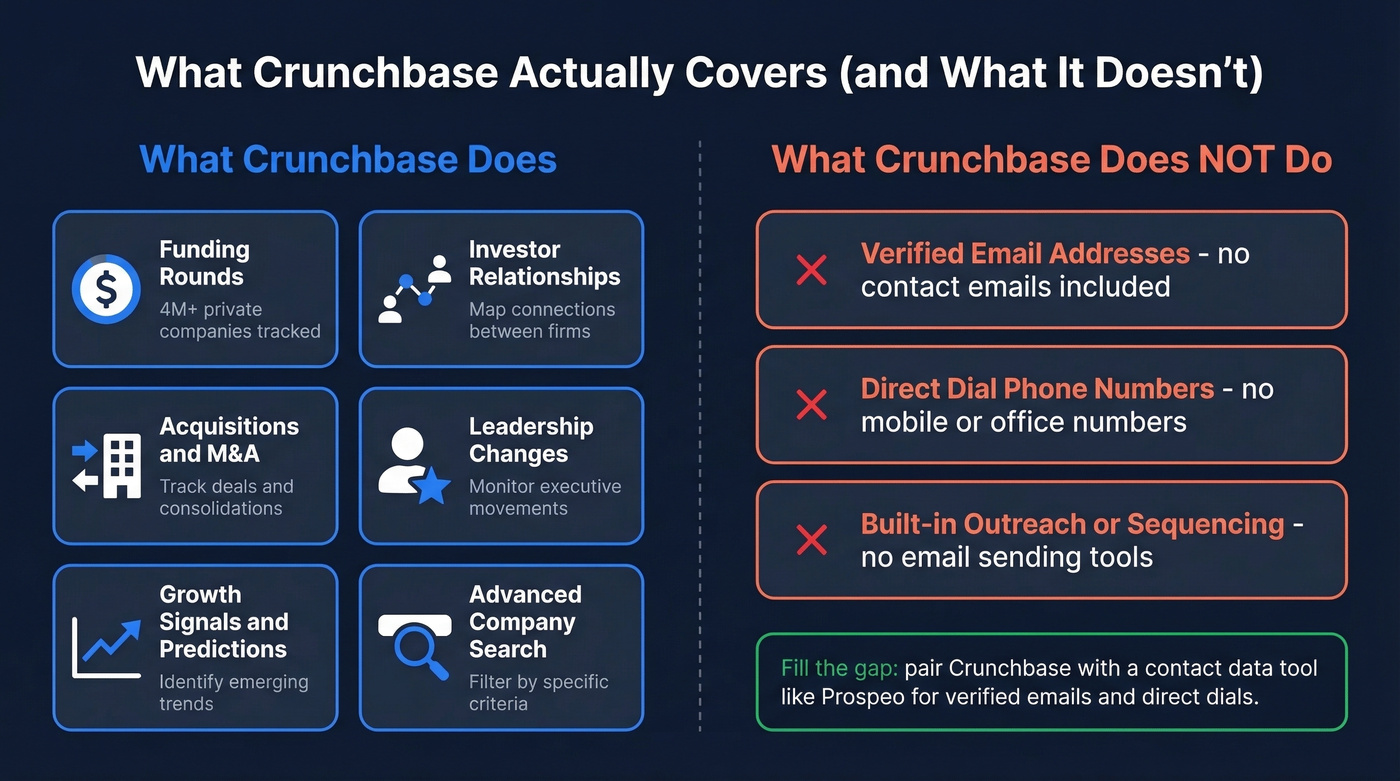
Here's the critical distinction: Crunchbase isn't a contact database. Its core product is company intelligence. If you need verified emails or direct dials, you'll use a separate tool to actually reach people at the companies you find (i.e., data enrichment).
The free tier works for basic lookups. Exports, alerts, and team workflows sit behind a paywall. Pro runs $49/mo billed annually, and for most sales teams that's the practical entry point.
Who Uses Crunchbase?
Four groups get the most value, and they use it in very different ways.
Startup founders use it for visibility and fundraising research. Investors and VCs treat it as a deal sourcing engine - filtering by funding stage, industry, and geography surfaces companies that match their thesis before a warm intro ever happens.
Sales teams use it for account-level prospecting. Funding rounds, leadership hires, and acquisition activity are buying signals that indicate budget and urgency (more on identifying buying signals). Market researchers lean on it for competitive analysis and market mapping. Tracking capital flows into a vertical, which players are consolidating, and where headcount is growing paints a picture no CRM can.
Key Features
At its core, Crunchbase is a searchable database of company profiles. Each profile aggregates firmographic data - headquarters, employee count, founding date, industry classification - alongside funding history, investor relationships, leadership teams, and acquisition records. The API exposes a large set of fields across funding, firmographics, and private market data.
The advanced search is where the platform earns its keep. You can filter by dozens of criteria: last funding date, total funding amount, employee count, location, industry, growth signals, and more. Stack these filters to build targeted account lists - say, Series B SaaS companies in North America with 50-200 employees that raised in the last 180 days (see firmographic filters).
Once you've built a list, you can save it, track it, and set alerts. Alerts notify you when companies hit milestones like new funding rounds, leadership changes, product launches, M&A, IPOs/SPACs, hiring or layoffs, web traffic changes, and event attendance. Configure daily or weekly email digests and share lists with teammates.
CRM integration is available on team plans, including Salesforce and HubSpot. The Business tier adds Predictions and Insights, an AI agent, exports up to 5,000 rows/month, plus SSO and seat management.
The newest differentiator is predictive intelligence. Crunchbase has more than 5,000 predictions confirmed by real-world events, averaging 650+ validated predictions per month, with 1,000+ validated in September 2025. These predictions are trained on market activity data from 80M+ users, direct contributions from founders and investors, government filings, thousands of partner data sources, and web data - paired with human oversight (related: B2B predictive analytics).

Crunchbase Pricing in 2026
The platform offers multiple tiers, and the feature gating between them is aggressive.
| Plan | Price | Exports | Key Features |
|---|---|---|---|
| Free | $0 | None | Basic search, limited views |
| Pro | $49/mo (annual) / $99/mo (monthly) | 2,000 rows/mo | Full search, alerts, lists |
| Business | $199/mo (annual) | 5,000 rows/mo | Predictions & Insights, CRM integration, AI agent |
| Enterprise | Custom | Custom | API access, 200 calls/min |
Pro comes with a 7-day free trial - worth testing before you commit to annual billing. The annual discount on Pro is steep ($49/mo vs $99/mo), so if you're going to use it, commit to the year.
Is Crunchbase Free?
Technically, yes. Practically, no.
The free tier lets you search and view basic company profiles, but exports and alerts are locked. It's fine for checking a single company's funding history before a call. It's not a prospecting tool at the free tier.
The real decision is between Pro and Business. Pro is the sweet spot for individual contributors. Business adds predictive intelligence, CRM integration, and bumps exports to 5,000 rows - that's where teams running account-based motions get the real value.

Crunchbase tells you which companies just raised funding. Prospeo tells you exactly how to reach the decision-makers inside them - with 143M+ verified emails at 98% accuracy and 125M+ verified mobile numbers. Export your Crunchbase list, upload the CSV, and get enriched contact data back at $0.01 per email.
Turn company intelligence into a ready-to-dial prospect list in minutes.
How Sales Teams Use It
The standard workflow follows a predictable pattern: filter, list, signal, act.
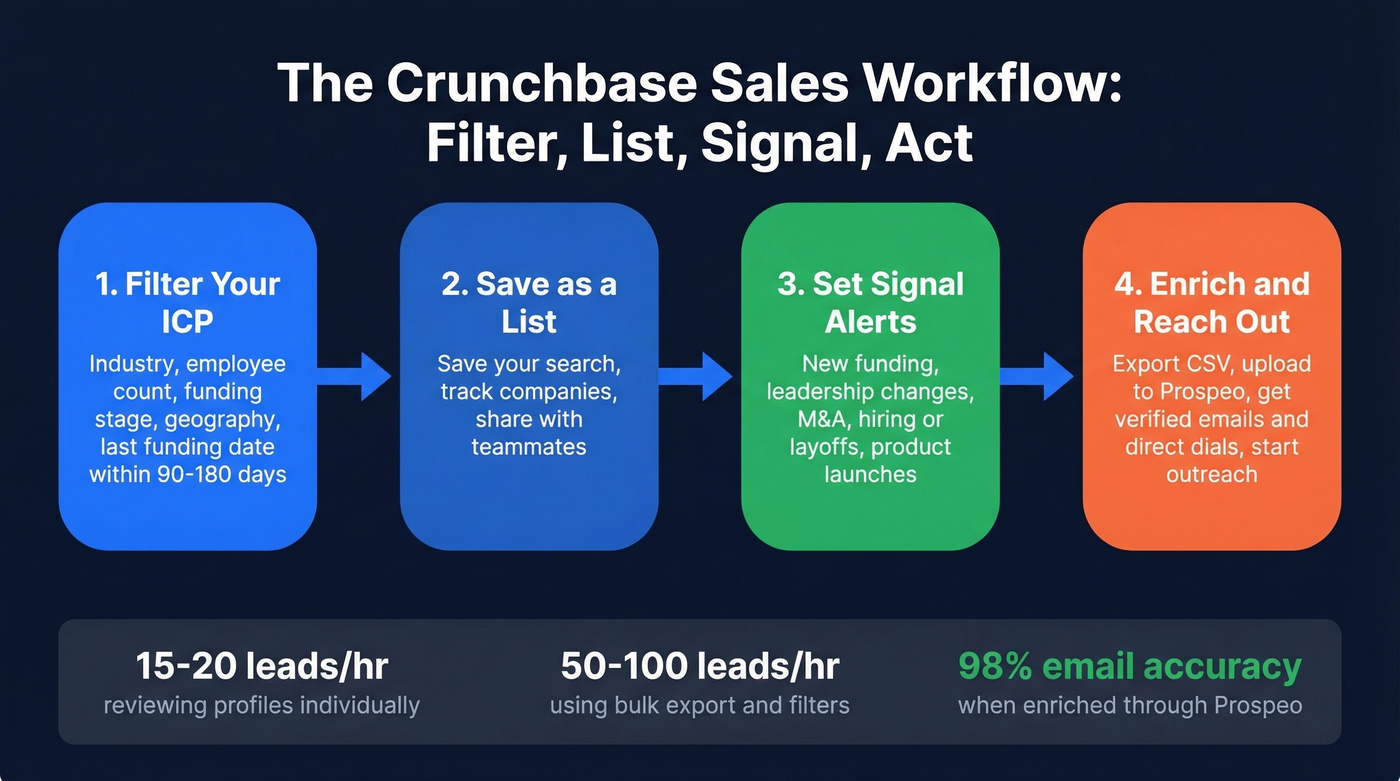
Start by building a search around your ICP. Filter by industry, employee count, funding stage, and geography. Layer in recency - last funding date within 90-180 days is a common trigger, since recently funded companies are actively spending. Save that search as a list (if you need one, use an Ideal Customer Profile template).
Next, configure alerts. Crunchbase tracks buying signals that matter for outbound: new funding rounds, leadership changes, product launches, M&A activity, IPOs/SPACs, hiring or layoffs, web traffic changes, and event attendance. Each signal indicates either budget availability or organizational change, both of which create openings for sellers.
In our testing, we got through about 15-20 leads per hour when reviewing profiles individually. Bulk export and filter workflows pushed that to 50-100 per hour, depending on how tight the criteria were.
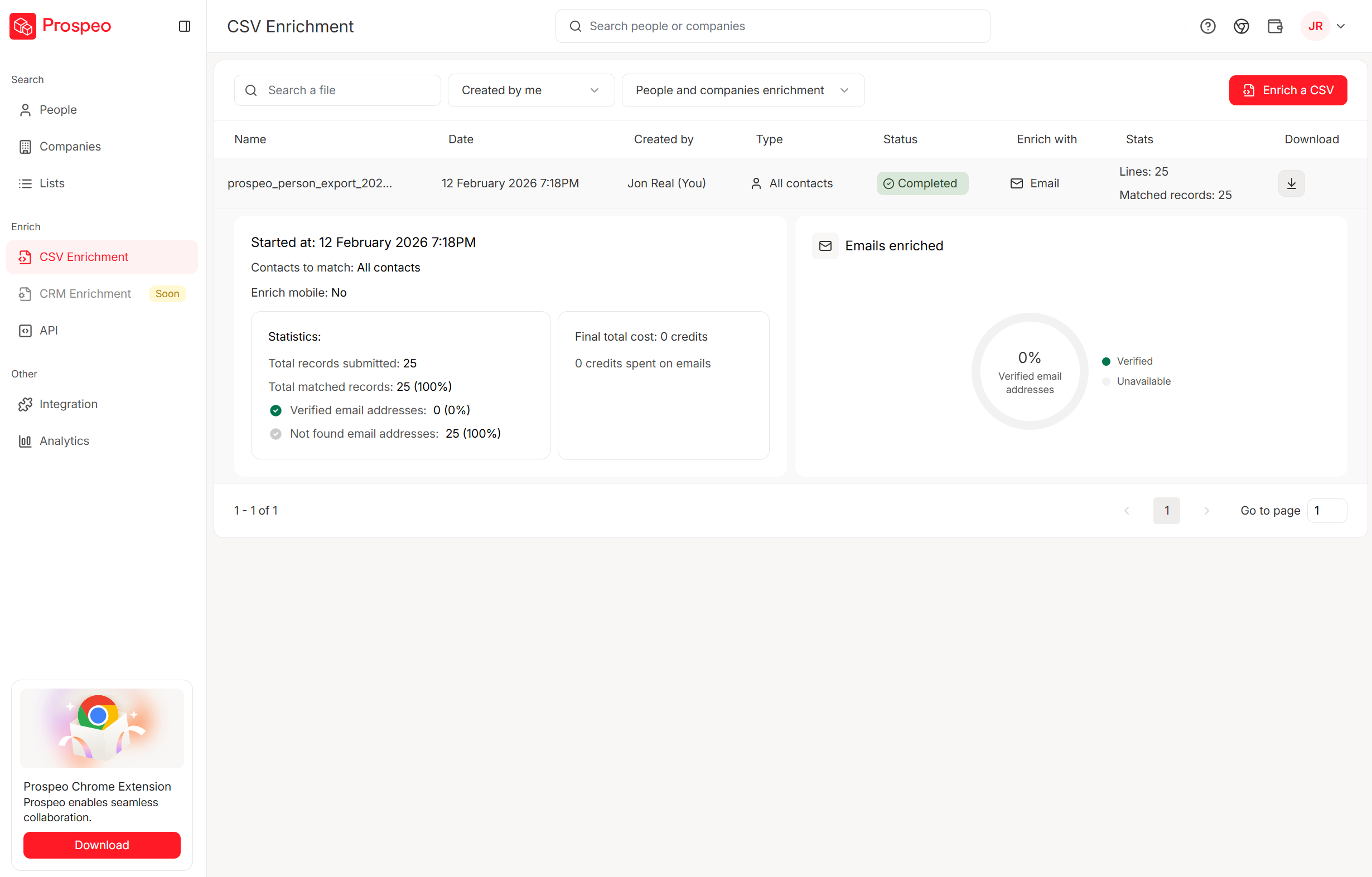
Here's the thing: the platform identifies the companies, but it doesn't give you a way to reach the people inside them with verified emails and direct dials. That's the contact data gap, and it's where most sales teams stall. Export your company list, upload the CSV into Prospeo, and enrich it against 143M+ verified emails at 98% accuracy and 125M+ verified mobile numbers. You go from "interesting companies" to a ready-to-dial prospect list in minutes.
Crunchbase's contact data gap is real - no verified emails, no direct dials. Prospeo fills it with 300M+ professional profiles refreshed every 7 days, not every 6 weeks. Teams using Prospeo book 26% more meetings than ZoomInfo users and 35% more than Apollo users, because 98% email accuracy means your outreach actually lands.
Stop finding great companies and failing to reach the people inside them.
Is Crunchbase Data Reliable?
Crunchbase's data quality is a mixed bag.
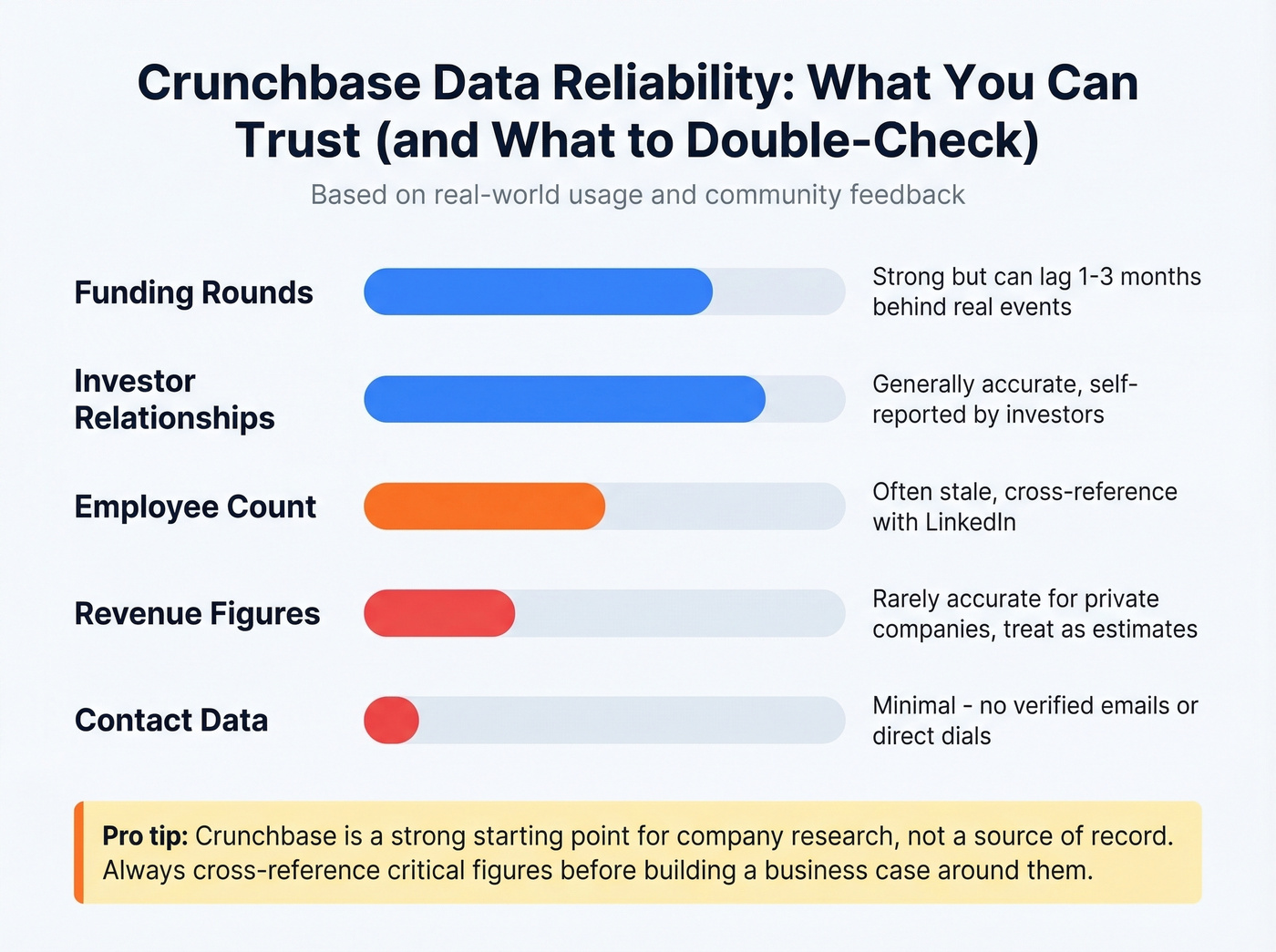
A significant portion of the data is self-reported. Founders, investors, and employees submit and update their own profiles. Crunchbase also uses AI and incorporates government filings, partner data, and web data, but the self-reported foundation means accuracy varies by company and by field. Revenue figures, employee counts, and even funding amounts can be stale or wrong.
Funding data - Crunchbase's crown jewel - can lag real-world events by 1-3 months. A round that closed in January might not appear until March. For sales teams using "recently funded" as a trigger, this lag means you're sometimes late to the party. One widely-shared critique called out "significant inaccuracies" and questioned whether the $588/year Pro subscription justified the cost.
The 2026 Data Breach
In early 2026, the hacking group ShinyHunters claimed theft of more than 2 million records from Crunchbase's corporate network. After Crunchbase refused to pay ransom, the group posted more than 400 MB of compressed files. Crunchbase confirmed the incident and engaged federal law enforcement.
Let's be honest: Crunchbase is a strong starting point for company research, not a source of record. Always cross-reference critical figures - especially funding amounts and employee counts - before building a business case around them.
Brief History
- 2007 - Launched May 17 by Michael Arrington as a TechCrunch side project
- 2010 - AOL acquires TechCrunch, and Crunchbase comes along for the ride
- 2013 - Licensing dispute: AOL challenges Pro Populi's use of the dataset, originally published under Creative Commons CC-BY
- 2015 - Spins out as an independent company, raises $8.5M
- 2017 - Launches Enterprise tier, raises $18M Series B
- 2019 - Raises $30M Series C led by Omers Ventures
- 2025 - Partners with Perplexity and Databricks; passes 5,000+ confirmed predictions
- 2026 - ShinyHunters breach confirmed
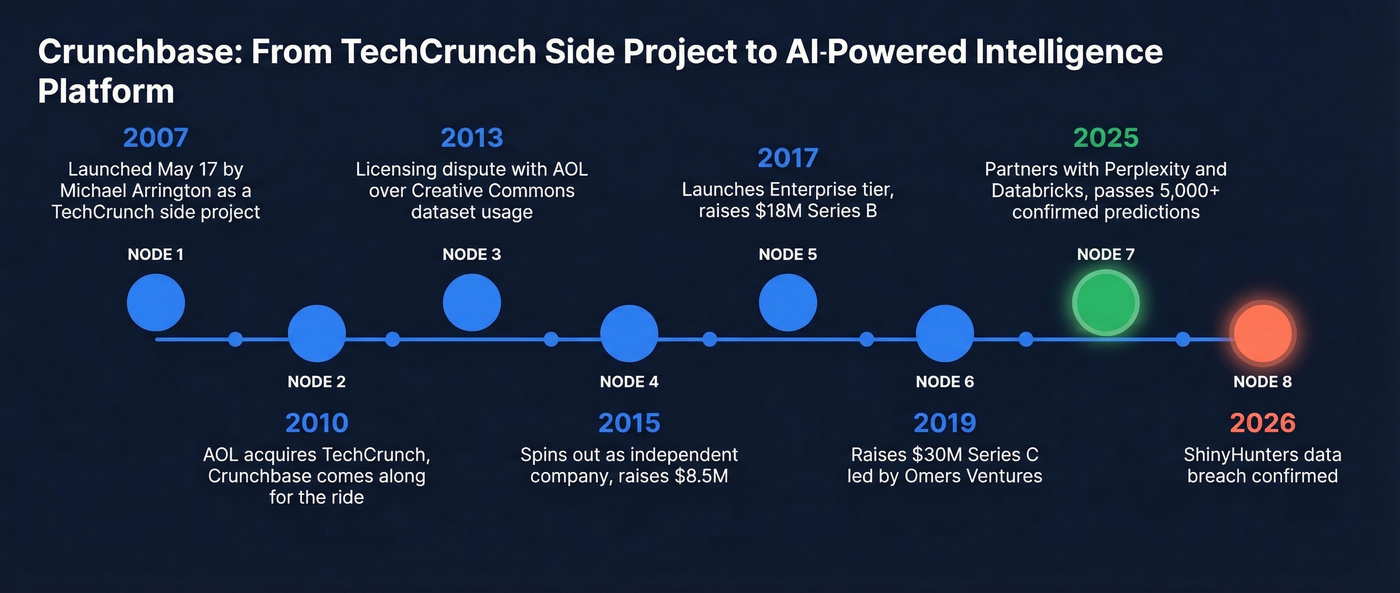
The product has come a long way from its TechCrunch wiki roots. Whether the AI-powered predictions justify the premium pricing depends on your deal flow.
Alternatives and Sites Like Crunchbase
Crunchbase doesn't exist in a vacuum. Depending on what you actually need, a different tool might be the better fit.
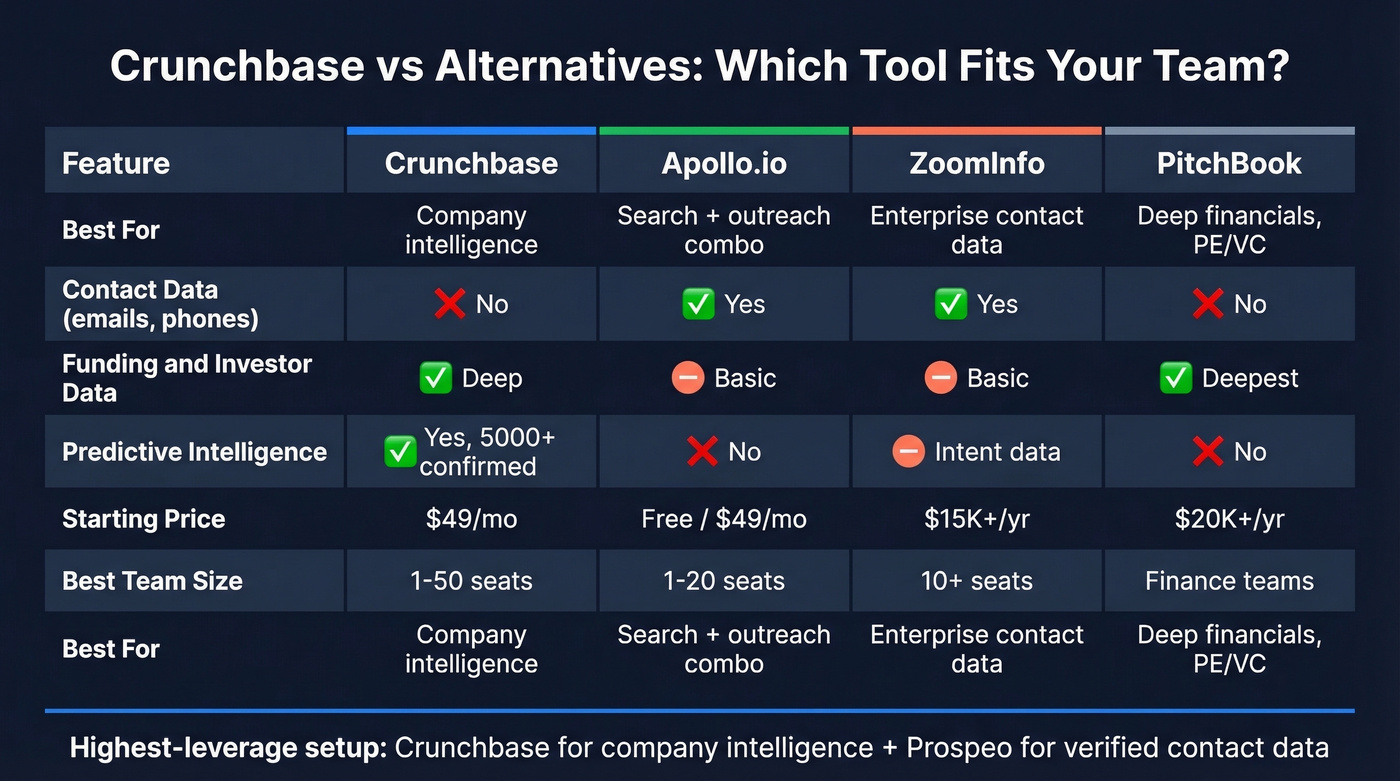
| Tool | Best For | Contact Data? | Starting Price |
|---|---|---|---|
| Apollo.io | Combined search + outreach | Yes | Free / ~$49/mo |
| Crunchbase | Company intelligence | No | $49/mo (annual) |
| ZoomInfo | Enterprise contact data | Yes | ~$15K+/yr |
| PitchBook | Deep financials/PE/VC | No | ~$20K+/yr |
If you're running deals under $15K ACV, you probably don't need Crunchbase at all. Apollo.io gives you company data and contact data in one place with built-in sequencing on a free tier. It's the closest thing to an all-in-one for SMB teams, though email accuracy doesn't match dedicated verification tools.
Skip ZoomInfo unless you're running a 10+ seat sales org with budget to match. A contract with the modules you'd actually want runs $15-40K/year. The data is deep, especially for US companies, but that's a different budget conversation entirely.
PitchBook is for a different audience altogether. If you're in PE, VC, or corporate development and need investment-grade financial data - valuations, fund performance, M&A comps - it goes deeper than Crunchbase. At $20K+/year, sales teams should look elsewhere.
We've found that the highest-leverage setup for most outbound teams is pairing Crunchbase's company intelligence with a dedicated contact data tool. Crunchbase tells you which companies to target; a tool like Prospeo gives you the verified emails and direct dials to start conversations, with a 7-day data refresh cycle versus the 4-6 week industry average.
FAQ
Is Crunchbase free to use?
The free tier exists but blocks exports, alerts, and advanced filters. For prospecting or research beyond basic lookups, Pro at $49/mo (annual) is the practical minimum. The 7-day free trial lets you test before committing.
What kind of data does Crunchbase track?
Company profiles, funding rounds, investor relationships, leadership teams, acquisitions, and growth signals for 4M+ private companies. It doesn't provide verified contact data like emails or direct dials - you'll need a separate tool for that.
How accurate is Crunchbase data?
Directional, not definitive. Funding updates can lag 1-3 months, and much of the dataset is self-reported. Cross-reference employee counts and revenue figures before making decisions based on them.
Does Crunchbase provide email addresses?
No. It's a company intelligence platform, not a verified contact database. For verified emails and mobile numbers at companies you've identified, use a dedicated tool like Prospeo's Email Finder, which covers 143M+ verified emails at 98% accuracy and 125M+ verified mobiles.
Can I export data from Crunchbase?
Pro allows 2,000 rows/month; Business allows 5,000. The free tier has no export capability. Exported CSVs can be enriched with contact data through tools like Prospeo or Apollo.