

What Is Net New? The Only Guide That Covers Every Meaning
It's the middle of a QBR. The VP of Sales says the team closed 12 net new deals. The CFO nods, then asks why net new revenue is flat. Marketing chimes in that net new pipeline is up 40%. Everyone's using the same two words, and nobody's talking about the same thing.
So what is net new, exactly? The term means something genuinely different depending on which department you sit in. The confusion isn't a vocabulary problem - it's an alignment problem. Let's fix it.
What Does Net New Mean?
Net new means something added, not something replaced. In sales, it's a new customer. In finance, it's incremental revenue after accounting for churn. In HR, it's a role that didn't exist before. The core idea across every department: genuine addition, not substitution.
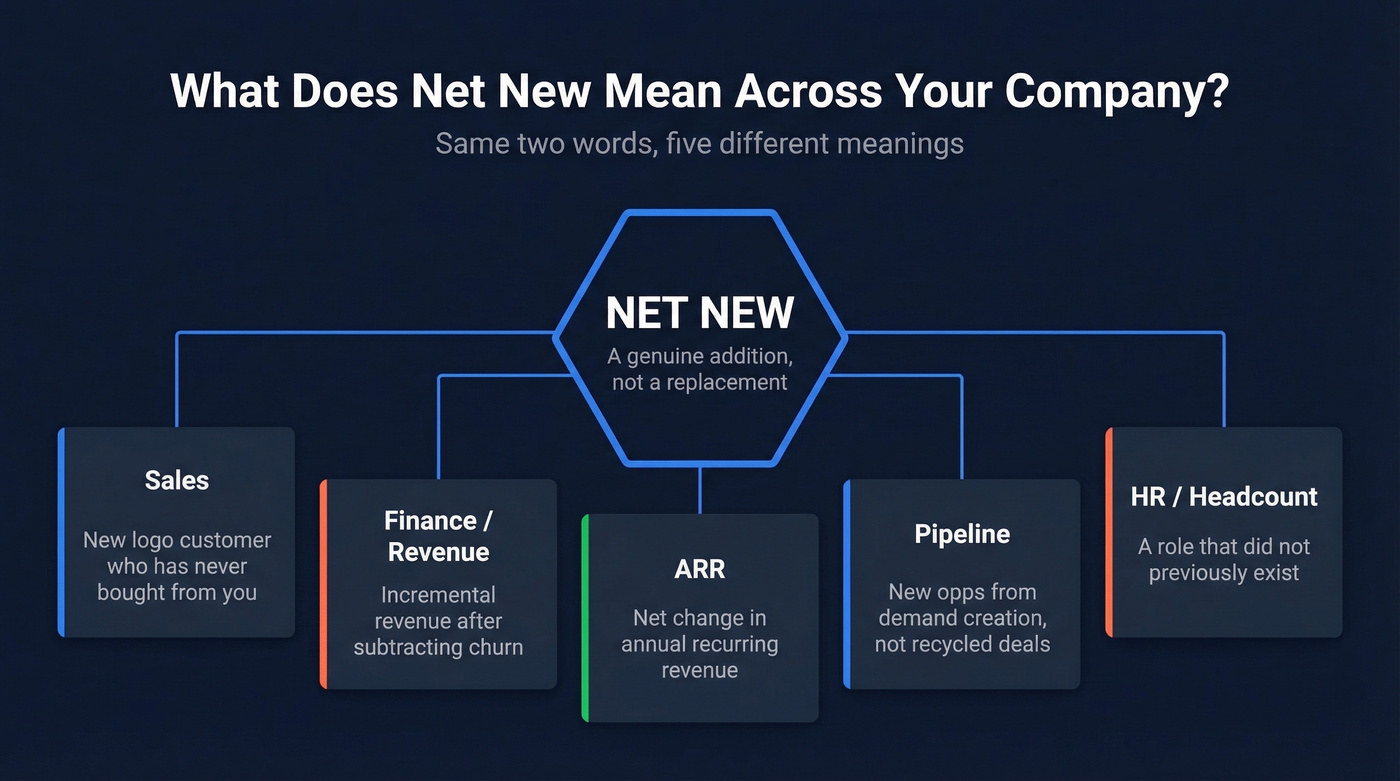
If you have 8 employees, one leaves, and you hire a replacement, you still have 8. That's not net new. If you have 8 and hire a ninth, that's net new - you've added something that wasn't there before. The simplest test: "Did this exist in any form before?" If the answer is no, it qualifies.
Here's how the term maps across functions:
| Department | What "Net New" Means | Example |
|---|---|---|
| Sales | New logo / customer | Closing a company that's never bought from you |
| Finance / Revenue | Incremental revenue after churn | $500K new + $100K expansion - $200K churn = $400K NNR |
| ARR | Net change in recurring revenue | New ARR minus contraction and churn |
| Pipeline | New opportunities from demand creation | $2M in first-time opps, excluding recycled deals |
| HR / Headcount | A role that didn't previously exist | Creating a new DevOps position vs. backfilling a departure |
Net New by Department
Net New in Sales
In sales, the term means new logos - customers who've never bought from you before. It's the prospecting-to-close acquisition motion, distinct from renewals, upsells, or account management.
The distinction matters most in comp plans. A typical structure pays 6% commission on new business versus 1% on renewals, with a combined quota around $1.3M. That spread exists for a reason: acquiring a new customer is harder and more valuable than renewing an existing one, and the comp plan should reflect that reality or reps will coast on their existing book after Q1.
Here's the thing: plenty of orgs still lump everything together and wonder why outbound activity drops. Over in r/sales, a recurring debate is whether "full-cycle" means acquisition plus book management or strictly prospect-to-close - and the answer determines whether reps are compensated for landing new business or just expected to do it alongside renewals.
Net New Revenue (NNR)
This is the metric that tells you whether your business is actually growing or just running on a treadmill.
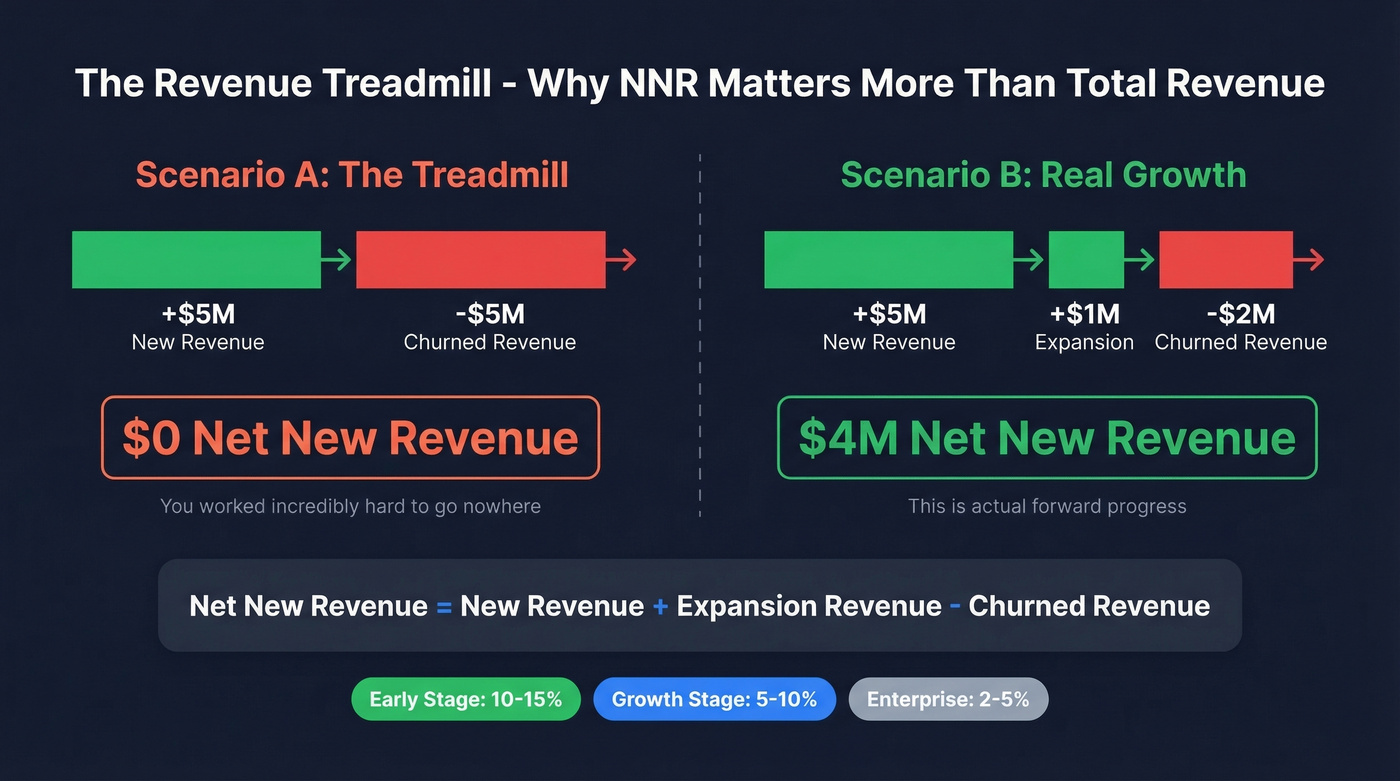
Formula:
Net New Revenue = New Revenue + Expansion Revenue - Churned Revenue
The treadmill scenario catches people off guard. Lose $5M in churn, gain $5M in new business - your total revenue looks flat, and your NNR is exactly $0. You worked incredibly hard to go nowhere. Understanding this metric is what separates leaders who spot the problem early from those who discover it at the board meeting.
Stage-based targets for monthly NNR growth:
- Early-stage SaaS: 10-15%
- Growth-stage: 5-10%
- Enterprise: 2-5%
Companies with consistently positive NNR trends command 2-4x higher valuations than peers with similar total revenue but flat or declining NNR. Investors don't just want revenue - they want proof you can add to it.
Net New ARR
Net New ARR breaks recurring revenue into five core components.
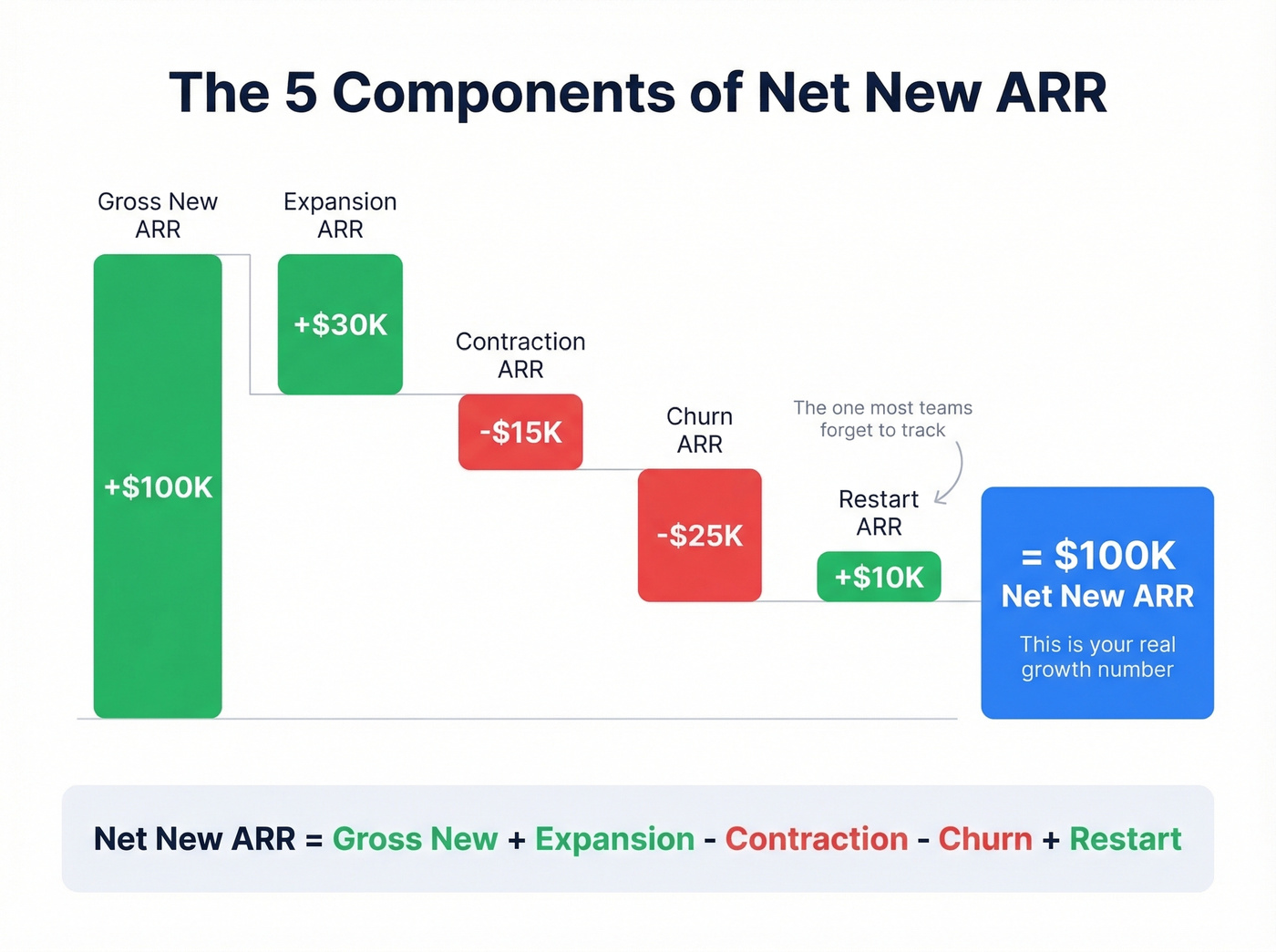
Common full formula:
[Net New ARR = Gross New ARR + Expansion ARR - Contraction ARR - Churn ARR + Restart ARR](https://equals.com/guides/saas-metrics/annual-recurring-revenue/)
That last component - Restart ARR - represents reactivated churned customers. The one most teams forget to track separately, which creates confusion about whether a returning customer counts as genuinely incremental.
A simple example: $100K in new business ARR, minus $40K in combined churn and contraction, equals $60K in net new ARR. That $60K is the real growth number. Everything else is noise.
Net New Pipeline
Net new pipeline is the total value of new sales opportunities generated through demand creation - not recycled deals, not upsell opportunities on existing accounts.
This is where sales and marketing alignment breaks down fastest. Marketing counts a $2M pipeline that includes upsell opps on existing accounts. Sales counts $800K because they only track first-time opportunities. Both numbers are "correct" by their own definitions, and neither team realizes they're measuring different things until the board meeting. We've seen this exact scenario play out at three different companies in the past year alone, and the fix is always the same: agree on the definition before you build the dashboard.
A useful heuristic: your pipeline should run 3-5x your revenue target. If you're targeting $1M in incremental revenue this quarter, you need $3-5M in genuinely new pipeline to get there.
Net New Headcount
In HR and workforce planning, the term means a role that didn't exist before - not a backfill for someone who left. Replacing a departing senior engineer is a backfill. Creating a brand-new DevOps role to support a product launch is net new headcount.
A practical tracking tip: assign a unique position ID to every role in your HRIS, and change the first character of the ID annually. Positions that carry over from last year keep their old prefix. New positions get the current year's prefix. You can spot incremental versus rollover roles at a glance without relying on managers to self-report accurately.
Net New Benchmarks (2026)
Pavilion's benchmark data paints a clear picture of where SaaS companies stand:
| Metric | Benchmark |
|---|---|
| Median growth rate | 26% |
| NRR (median) | 101% |
| CAC increase YoY | +14% |
| Existing customer share of new ARR | 40%+ (50%+ above $50M) |
| ARR per employee ($50-100M segment) | $200K |
Look, most SaaS companies over-index on expansion and under-invest in acquisition. That feels safe - until churn spikes and you have no acquisition engine to fall back on. An NRR of 101% means existing customers are barely growing faster than they're churning. If that number dips below 100%, you need a strong new-logo motion or you're shrinking.
If your average deal size sits below $10K, you almost certainly need a higher ratio of new logos to expansion revenue than the benchmarks suggest. Small-deal expansion just doesn't move the needle fast enough.

Your net new pipeline number is only as real as the contacts behind it. Bad data inflates pipeline on paper while killing it in practice - 35% bounce rates turn $2M in "net new opps" into dead weight. Prospeo delivers 98% email accuracy across 300M+ profiles, so every opportunity you create actually connects to a real buyer.
Stop padding pipeline with undeliverable contacts. Start adding real net new revenue.
New vs Net New: Why It Matters
People often use "new" and "net new" interchangeably, but the difference is critical for accurate reporting. "New" simply means something was added - a new customer, a new hire, a new deal. "Net new" accounts for what was lost in the same period. You might add 50 new customers in a quarter, but if 30 churned, your net new customer count is 20.
Raw "new" numbers feel good in a slide deck. The net figure tells you whether you're actually moving forward. Always report both, and make sure leadership understands which one they're looking at.
Common Tracking Mistakes
Counting reactivated customers as new logos without separating Restart ARR. A returning customer is incremental revenue, but it isn't the same as a first-time buyer. Track it in its own bucket.
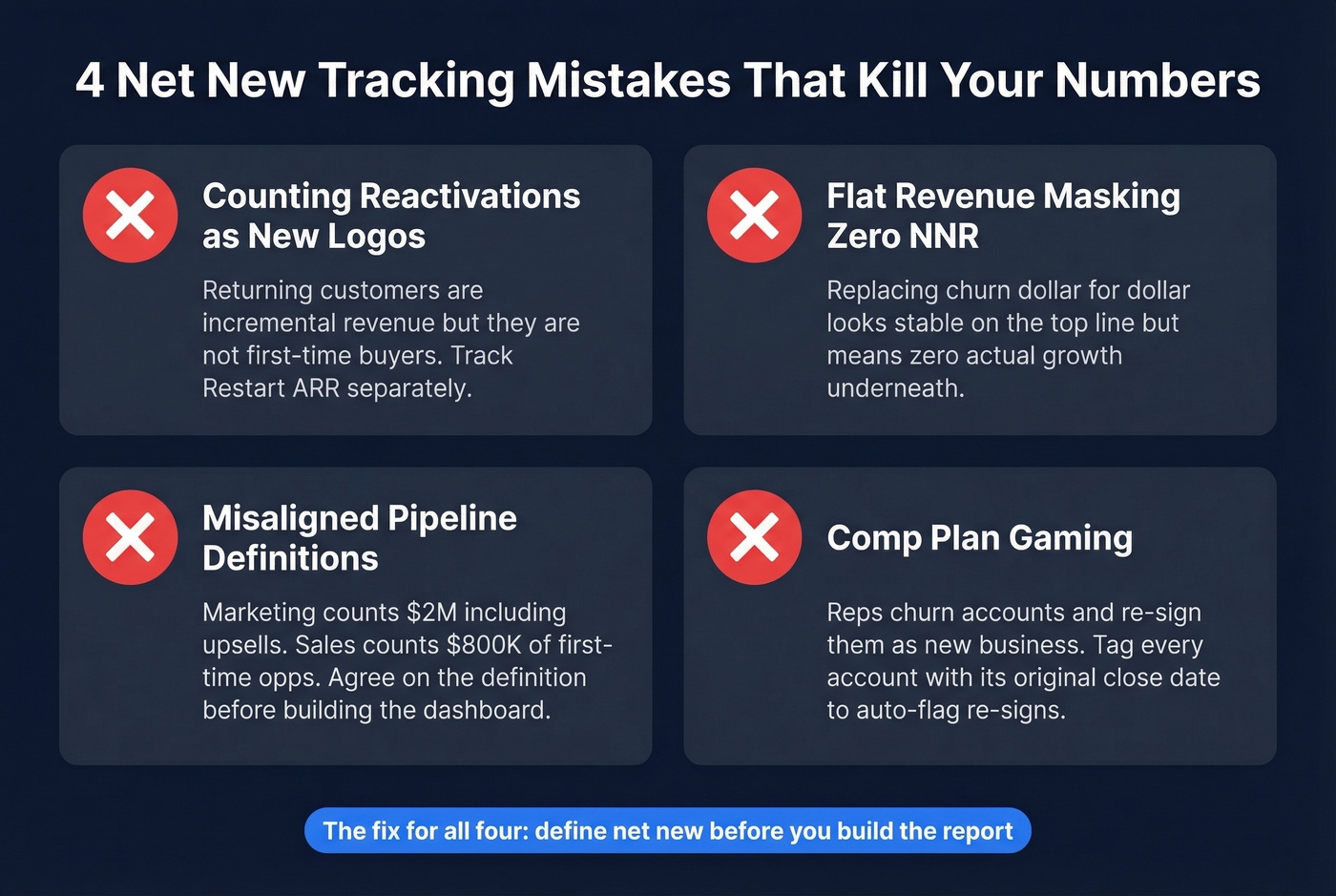
Flat total revenue masking zero NNR. The treadmill problem. If you're only watching the top-line number, you won't see that you're replacing churn dollar-for-dollar with no actual growth. (If you want a deeper breakdown, see our guide to churn analysis.)
Marketing and sales using different definitions of "net new pipeline." Align before you build the dashboard. Decide upfront whether upsell opportunities count, and document it somewhere everyone can find. This is also where RevOps typically earns its keep.
Comp plan gaming. We've seen reps churn accounts and re-sign them as "new business" to hit targets. If your CRM doesn't flag prior relationships, this will happen. Reddit threads in r/salesoperations surface this exact problem regularly - the fix is tagging every account with its original close date so re-signs are automatically flagged.
Don't Confuse These Terms
| Term | What It Means | Example |
|---|---|---|
| Net new revenue | Incremental revenue after churn | $500K new - $200K churn = $300K |
| Net revenue | Gross revenue minus discounts, returns, allowances | $100K sales - $5K refunds - $3K discounts = $92K |
| Net income | Revenue minus all expenses | Bottom-line profit |
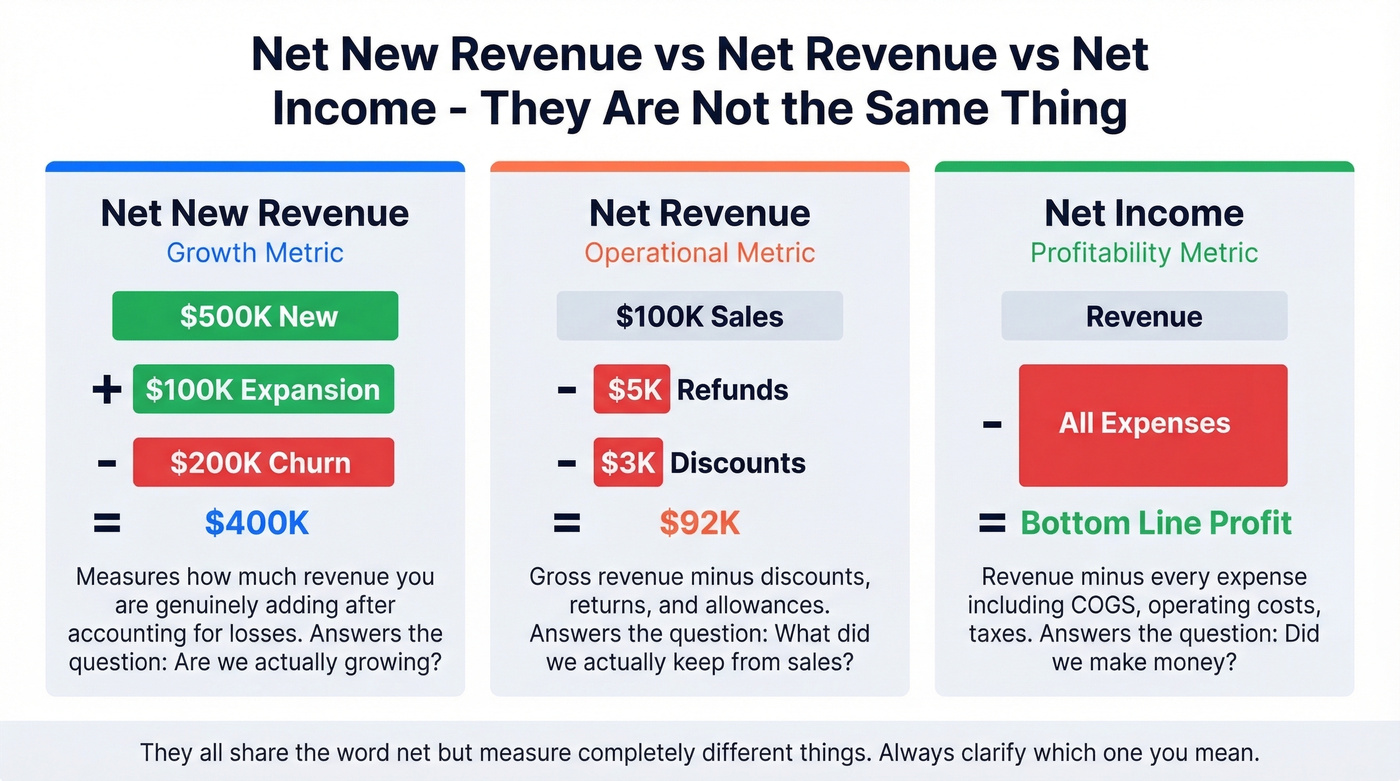
Net revenue isn't a standardized GAAP line item in the same way as revenue - it's a common operational calculation for what you actually keep after direct deductions. Net new revenue is a growth metric about what you're adding. Completely different measurements that happen to share the word "net."
One related metric worth knowing is Net Revenue Retention (NRR), calculated as (Starting MRR + Expansion MRR - Churned MRR) / Starting MRR. An NRR above 100% means your existing customers are growing faster than they're churning - which directly reduces how much new business you need to hit growth targets.
How to Grow Net New
Understanding the concept is step one. Growing it is the part that actually matters.
Define it internally. Write down what the term means at your company - for sales, for finance, for pipeline reporting - and circulate the definitions. Half of the alignment problems we see come from teams that never agreed on terms. This is also easier when you standardize sales operations metrics across teams.
Build a dedicated pipeline with accurate contact data. Growing your new-logo count means reaching accounts that have never engaged with you, which requires verified contact data for people who've never been in your CRM. Prospeo's database covers 300M+ professional profiles with 30+ search filters - buyer intent, technographics, headcount growth, funding signals - so you can build a target list of genuinely untouched accounts with 98% email accuracy. If you’re pressure-testing your outbound motion, start with proven sales prospecting techniques and a clean list via data enrichment services.

Track NNR and Net New ARR monthly, not quarterly. Quarterly reporting hides trends. By the time you see a problem in Q2 numbers, the damage started in January. Monthly tracking gives you time to react. (If you’re rebuilding your reporting, use these funnel metrics to keep the dashboard honest.)
Skip the monthly tracking advice if you're pre-revenue or under $500K ARR - at that stage, you don't have enough data points for monthly trends to mean anything. Focus on weekly pipeline activity instead, and sanity-check coverage against sales pipeline benchmarks.
If your NNR is flat because acquisition can't outpace churn, the problem isn't your reps - it's their data. Teams using Prospeo book 26% more meetings than ZoomInfo users and 35% more than Apollo, with 30+ filters to target net new logos by intent, technographics, and headcount growth.
Find your next 50 net new customers for less than the cost of one churned deal.
FAQ
Is an upsell considered net new revenue?
Expansion revenue from an existing customer is part of the NNR formula, but it isn't new-logo business. The dollars are genuinely incremental, yet they come from an existing relationship. Most sales orgs track upsells and first-time deals in separate buckets for exactly this reason - comp plans typically pay different rates on each.
Is a reactivated customer net new?
In the full Net New ARR formula, reactivated customers fall under Restart ARR - separate from Gross New ARR. Some orgs use a 2-year rule: if a customer hasn't purchased in 2+ years, they're treated as a new logo for comp purposes. The key is tracking Restart ARR separately so it doesn't inflate your new business numbers.
What's a good net new revenue target?
Early-stage SaaS companies target 10-15% monthly NNR growth; growth-stage aims for 5-10%; enterprise typically targets 2-5%. The median SaaS growth rate sits at 26% annually, with existing customers contributing 40%+ of new ARR - meaning acquisition still drives the majority of growth for companies under $50M.
How do I find net new accounts to prospect?
Use a B2B data platform with intent and firmographic filters to identify companies that have never appeared in your CRM. Filter by buyer intent, technographics, funding events, and headcount growth, then export verified emails. Even a small, focused outbound list of 50-75 contacts per week is enough to test whether your net new motion works before scaling it.
What's the difference between new and net new?
"New" counts everything added during a period regardless of losses. "Net new" subtracts what was lost - churn, attrition, contraction - from what was gained. A company that signs 100 new customers but loses 60 has 100 new customers and 40 net new customers. Reporting only the "new" number hides whether the business is actually growing.