

Who Is in the C-Suite? Every Role Explained (2026)
Most C-suite explainers list the same six roles and stop. The reality is messier - the executive suite keeps expanding, and the answer to "who is in the C-suite" looks different than it did even three years ago. Companies are adding chief-level titles faster than HR departments can write job descriptions for them.
The "C" stands for Chief. These are the highest-ranking executives in an organization, each owning a major function. Here's the traditional lineup you'll find at most midsize-to-large companies:
- CEO - Chief Executive Officer
- CFO - Chief Financial Officer
- COO - Chief Operating Officer
- CIO - Chief Information Officer
- CTO - Chief Technology Officer
- CMO - Chief Marketing Officer
- CHRO - Chief Human Resources Officer
That's the textbook version. But in 2026, roles like CAIO (Chief AI Officer), CDO (Chief Data Officer), and CSO (Chief Sustainability Officer) are showing up on org charts with increasing regularity. Let's break down what each role actually does.
Core C-Suite Roles
CEO, CFO, and COO
The CEO is the highest-ranking executive, chosen by the board and accountable for the company's overall direction. Strategy, stakeholder relationships, the public face of the organization - it all rolls up here.
If you want the broader context beyond just job descriptions, see our guide to C-suite roles and trends.
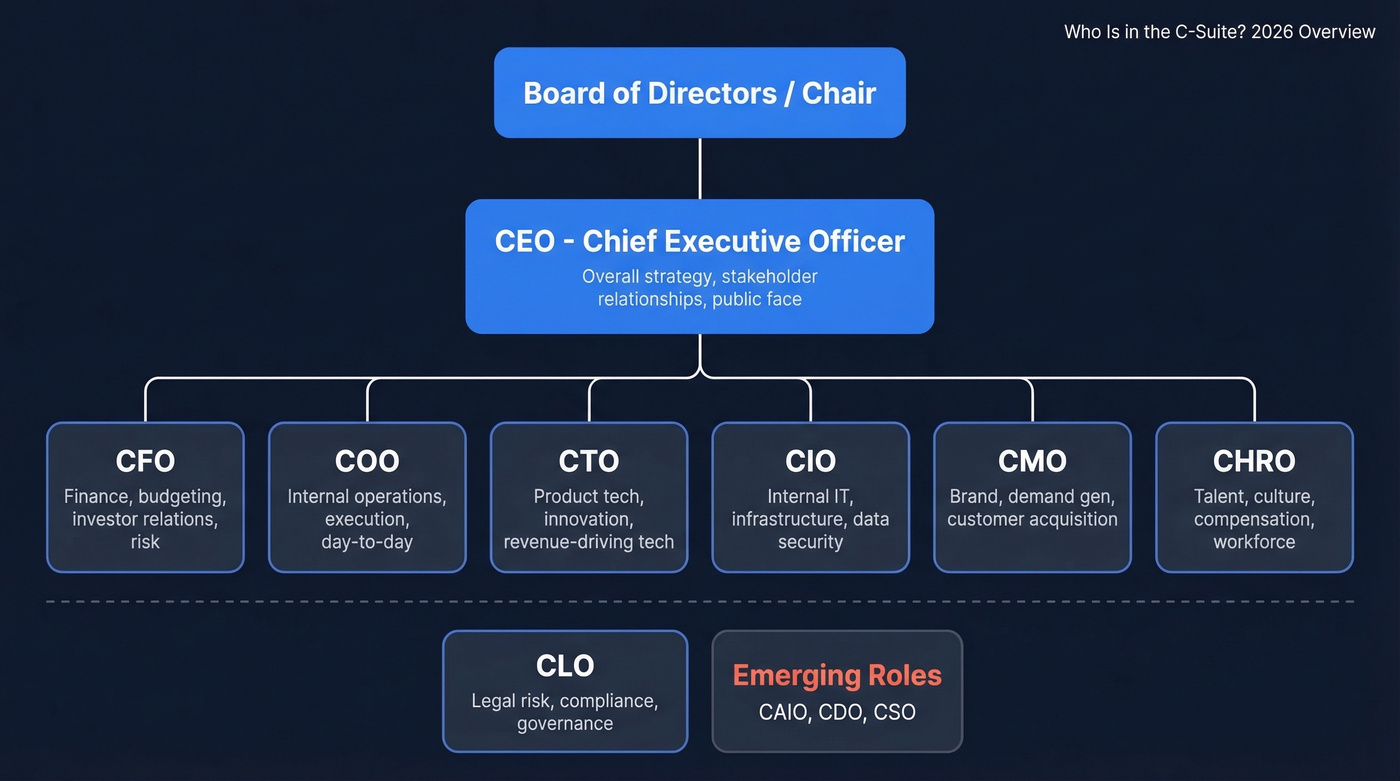
The CFO owns everything financial: budgeting, forecasting, investor relations, and risk management. CFOs earn roughly 34-39% of CEO compensation, which tells you something about the relative weight of the role. It's the most numbers-driven seat at the table, and increasingly the one boards lean on hardest during downturns.
The COO is the CEO's right-hand operator. Where the CEO tends to be externally focused - board meetings, investor calls, industry events - the COO runs the internal machine. Not every company has one. Some CEOs prefer to keep operations under their own umbrella, which works until it doesn't.
For a quick "who outranks whom" view, use this C-level hierarchy breakdown.
CIO and CTO
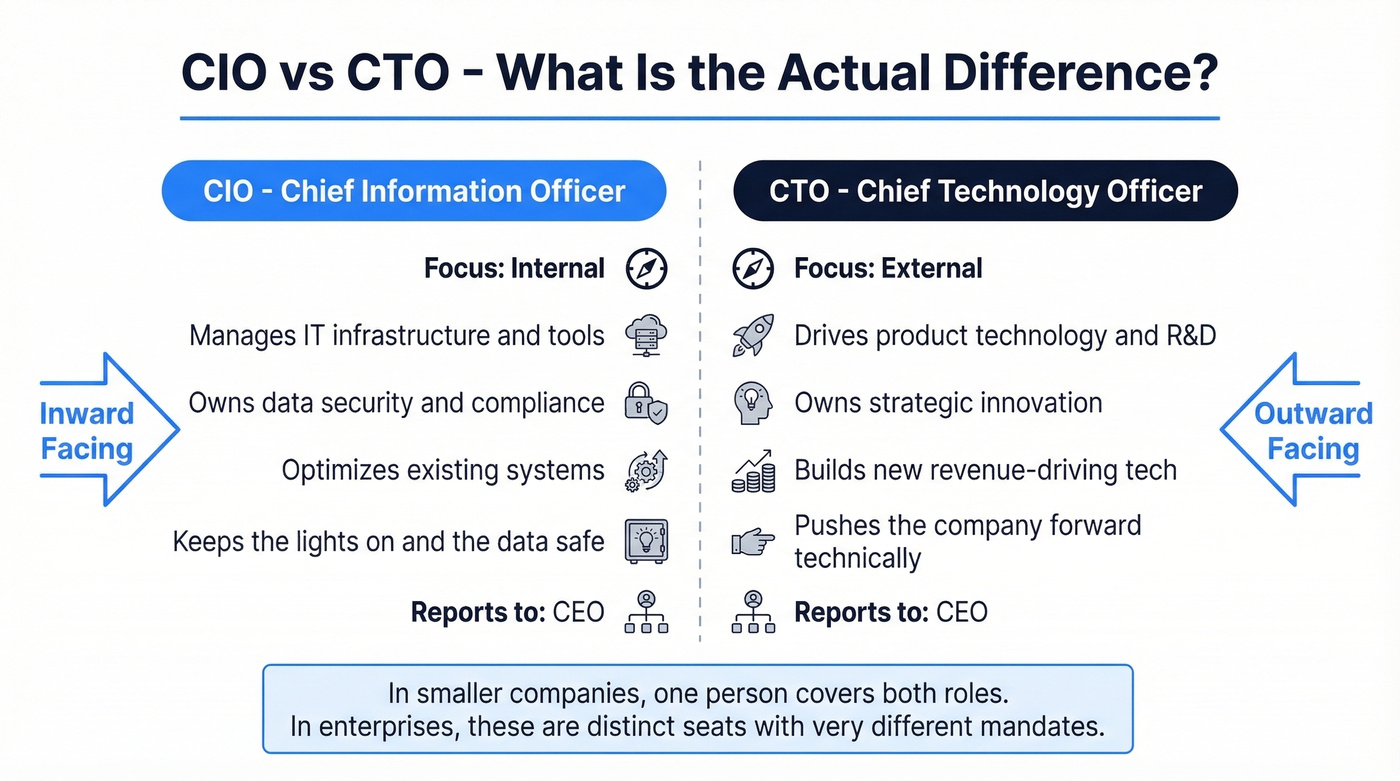
These two get confused constantly. The US Chamber of Commerce draws a clean line: the CIO manages internal technology infrastructure, tools, and data security, while the CTO focuses outward on strategic innovation, product technology, and revenue-driving tech initiatives. In smaller companies, one person covers both. In enterprises, they're distinct roles with very different mandates.
CMO, CHRO, and CLO
The CMO drives brand, demand generation, and customer acquisition strategy. (If you're mapping marketing leadership, this list of marketing job titles helps.)
The CHRO (sometimes called Chief People Officer) owns talent acquisition, culture, compensation, and workforce planning. This role has gained significant weight since 2020 as retention and remote-work policy became board-level concerns.
The CLO, or General Counsel, handles legal risk, compliance, and corporate governance. Companies preparing for IPO or operating in heavily regulated industries - fintech, healthcare, defense - often elevate legal to the C-suite. In our experience, the CLO hire is the one that gets delayed the longest and regretted the most.
Emerging C-Suite Titles in 2026
The executive suite isn't static. A Deloitte analysis of Fortune 500 C-suite composition plus 46,000 C-suite job postings (2018-2023) found that organizations are systematically adding more chief-level roles while expanding the scope of existing ones, driven primarily by technology, data, AI, and regulation.
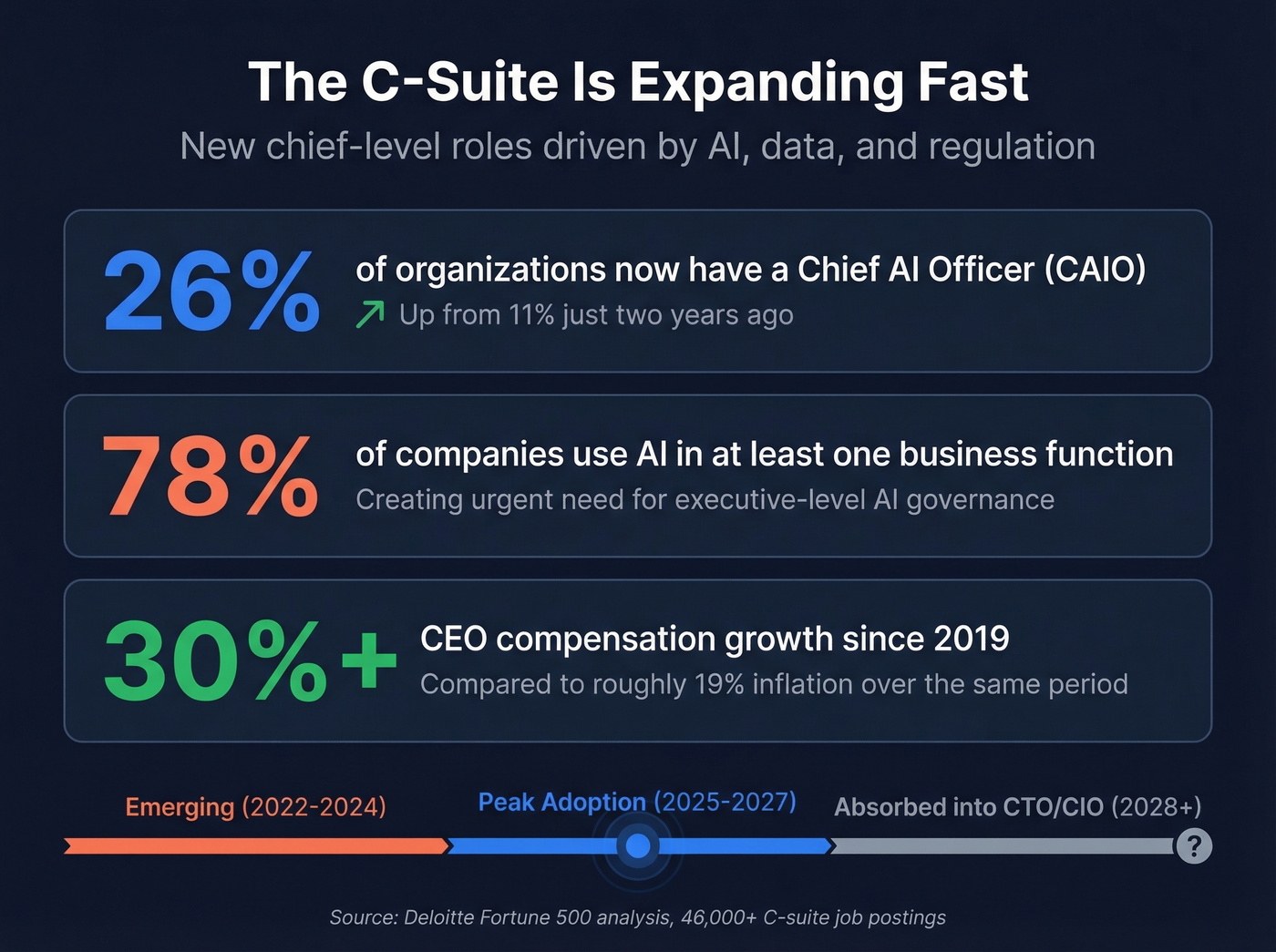
The Chief AI Officer is one of the fastest-growing titles. 26% of organizations now have a CAIO, up from 11% just two years earlier. With 78% of companies now using AI in at least one business function, the need for executive-level AI governance is obvious. UBS, for example, deployed AI-generated video avatars of its research analysts - the kind of initiative that needs executive-level ownership over strategy, ethics, and governance.
Here's the thing: the CAIO title will probably be absorbed back into the CTO or CIO role within five years at most companies. Right now it exists because AI strategy is too new and too important to bury inside an existing portfolio. But once AI becomes infrastructure rather than initiative, the standalone title will fade - just like "Chief Digital Officer" did before it.
Chief Data Officers and Chief Sustainability Officers are also increasingly common, driven by regulation and reporting requirements around data governance and ESG.
If you’re cataloging every variation (including newer chiefs), this guide to C-level titles is a useful reference.
C-Suite Salary Comparison
Executive pay has outpaced inflation significantly - CEO compensation is up 30%+ since 2019, compared to roughly 19% inflation over the same period. Russell 3000 median CEO pay rose 5.3% from 2022 to 2023 alone. Here's what the major roles pay in 2026:
| Role | Low | Average | High |
|---|---|---|---|
| CEO | $640K | $814K | $1.01M |
| CFO | $348K | $437K | $537K |
| COO | $389K | $466K | $583K |
| CCO | $476K | $635K | $887K |
| CMO | $300K | $373K | $456K |
| CRO | $291K | $337K | $406K |
| CHRO | $287K | $349K | $409K |
| CPO | $287K | $350K | $409K |
| CIO | $244K | $319K | $425K |
| CTO | $257K | $309K | $373K |
| CSO (Security) | $179K | $215K | $251K |
Base salary ranges per Search Solution Group, Feb 2026.
The CCO number surprises people, but Chief Commercial Officers at large enterprises often own both sales and partnerships - a massive P&L scope that justifies the premium.
If you need a broader list (including adjacent roles like EVP/SVP), see C-level positions.

Knowing every C-suite role is step one. Reaching them is step two. Prospeo gives you verified emails and direct dials for 300M+ professionals - including CEOs, CFOs, and every emerging title on the org chart. 98% email accuracy. 30+ filters to target by title, company size, and buyer intent.
Stop mapping the C-suite. Start emailing them at $0.01 per contact.
Where the C-Suite Fits in the Org Chart
At the top, the board (led by the Chair) oversees the company and selects the CEO. The CEO leads the C-suite, and the C-suite sets enterprise-wide strategy.
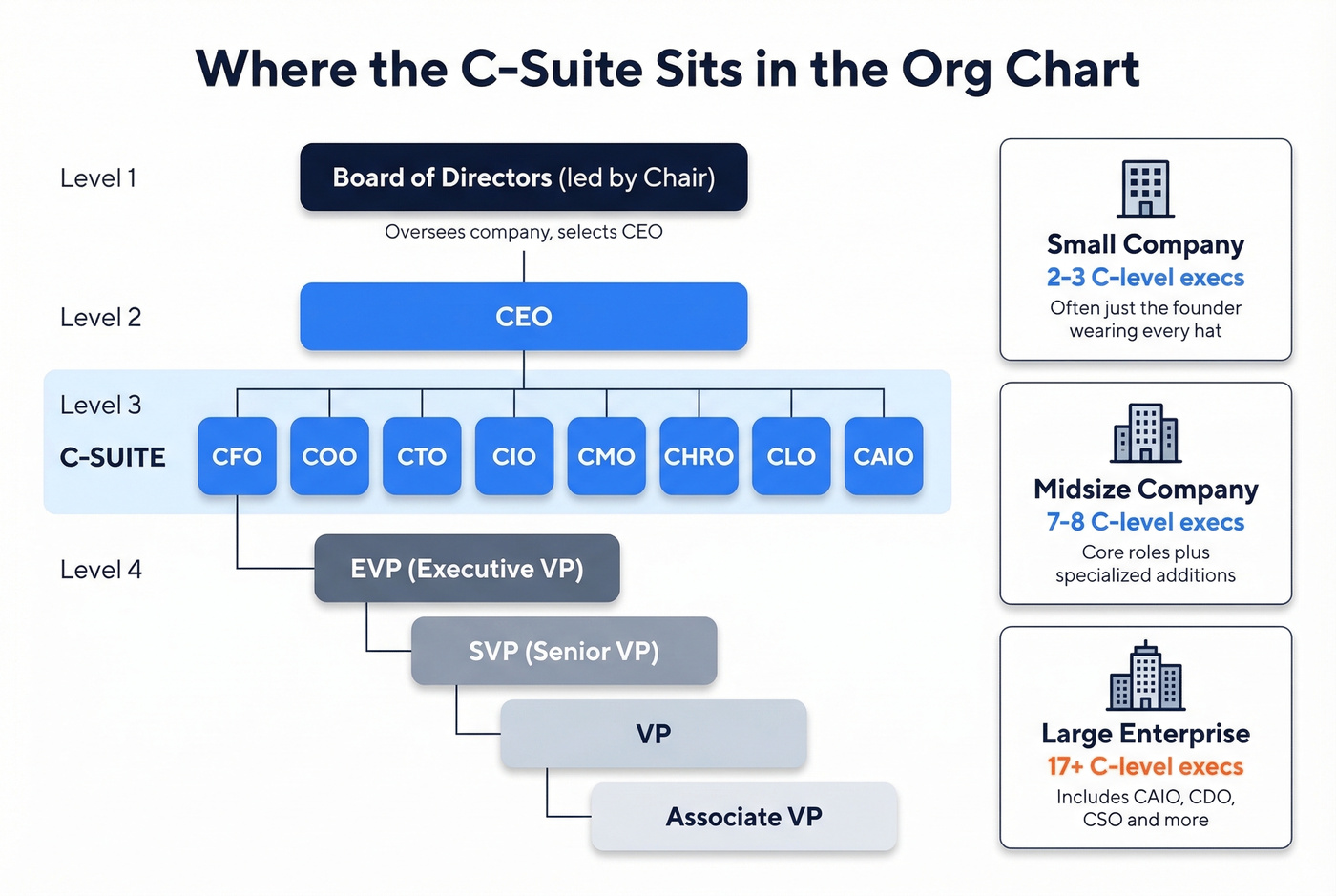
Below the C-suite, most organizations use VP tiers: EVP → SVP → VP → Associate VP.
Company size dictates how many chiefs you need. Smaller companies typically have 2-3 C-suite executives (sometimes just one founder wearing every hat). Midsize companies average 7-8. Large enterprises can have 17 or more, especially as specialized roles like CAIO and CDO become standard.
If you’re doing this for outbound, org chart mapping is the fastest way to avoid guessing.
When Companies Add C-Level Roles
The C-suite isn't about titles - it's about accountability. Companies create C-level roles when a function becomes too critical to delegate below the executive table. Common triggers:
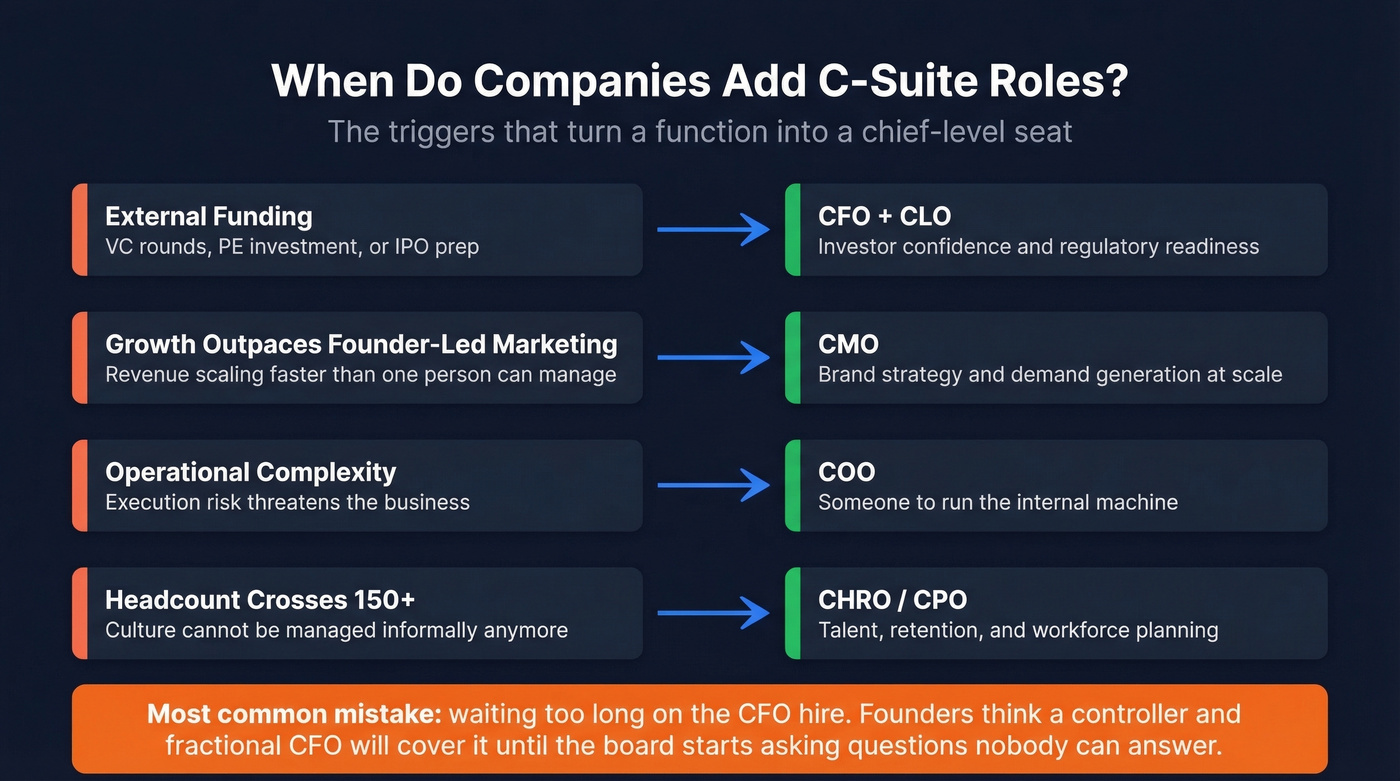
- External funding - VC rounds, PE investment, or IPO prep often trigger CFO and CLO hires for investor confidence and regulatory readiness
- Acquisition scaling - CMO gets added when growth outpaces founder-led marketing
- Operational complexity - COO when execution risk threatens the business
- Headcount growth - CHRO/CPO when headcount crosses ~150 and culture can't be managed informally
We've seen companies wait too long on the CFO hire more than any other. Founders think they can manage finances with a controller and a fractional CFO until the board starts asking questions nobody can answer. By that point, you're scrambling to hire under pressure, which means overpaying or settling.
How to Reach the C-Suite
There are roughly 313,900 chief executives in the US. Getting there follows a predictable path: functional specialist → manager → director/VP → C-level. Education matters - 46% of chief executives hold a master's degree, 32% a bachelor's. An MBA combined with a track record of leading high-impact initiatives is the most common combination.
The consensus on r/sales and r/careeradvice is that C-suite executives spend most of their time in meetings - preparing for them, sitting through them, and following up on them. Nobody gets promoted to the C-suite for being good at their job. They get promoted for demonstrating they can own an entire function's outcomes: revenue, risk, and strategic direction included.
If you’re selling into this layer, start with a dedicated C-level sales playbook (messaging, timing, and multi-threading).
For sales teams researching C-suite executives for outreach, tools like Prospeo let you filter 300M+ professional profiles by title, company size, and industry using 30+ search filters - with 98% verified email accuracy and a 7-day data refresh cycle.
If you’re choosing a data provider, compare options in our 10 Best B2B Contact Databases roundup.
Whether you're targeting the CEO, the new CAIO, or a CRO buried in a 17-person executive team, Prospeo's 30+ search filters let you zero in by exact job title, department headcount, funding stage, and intent signals across 15,000 topics. Data refreshes every 7 days - not 6 weeks - so you're never emailing someone who left the role last quarter.
Find any C-suite executive's verified contact data in seconds.
FAQ
What does the "C" in C-suite stand for?
"Chief." Every C-suite title starts with Chief - Chief Executive Officer, Chief Financial Officer, Chief Technology Officer, and so on. The term refers collectively to all chief-level executives who report directly to the board or CEO.
How many C-suite executives does a typical company have?
Small companies typically have 2-3 C-level executives, midsize firms average 7-8, and large enterprises can have 17 or more. The count depends on revenue complexity, regulatory burden, and whether specialized functions like AI or data governance warrant dedicated leadership.
What's the fastest-growing C-suite title right now?
Chief AI Officer (CAIO) is the fastest-growing title in 2026, with 26% of organizations now employing one - up from 11% two years prior. Chief Data Officer and Chief Sustainability Officer are also expanding rapidly due to regulatory and governance demands.
How do I find contact information for C-suite executives?
Use a B2B data platform to search professional profiles filtered by C-level title, company size, industry, and buyer intent. Prospeo returns verified emails (98% accuracy) and direct dials, with data refreshed every 7 days - useful for outbound teams that can't afford bounced emails burning their domain reputation.