

How to Sell to C-Level Executives (Without Getting Ignored)
Most c-level sales advice is written by people who've never sold to a CFO. You get the same recycled tips - "do more research," "be consultative," "sell the vision" - and none of it addresses why your emails bounce before an executive ever sees them.
Here's what nobody tells you: the intimidation you feel about reaching out to a CEO or CTO comes from a limiting belief about hierarchy. As one rep on r/sales put it, executives aren't above you - they're in a different stage of their career. They put on pants the same way. They check email the same way. And they ignore bad outreach the same way everyone else does.
The real gap isn't confidence. It's preparation. Executives consider fewer than one in five sales meetings valuable, which means 80%+ of the reps reaching the C-suite are wasting the executive's time and their own. This playbook exists so you're in the other 20%.
Three Pillars of Executive Outreach
Every guide on selling to the c-level tells you to "do more research." That's not wrong - it's just incomplete. Three things separate reps who book executive meetings from reps who get ignored:
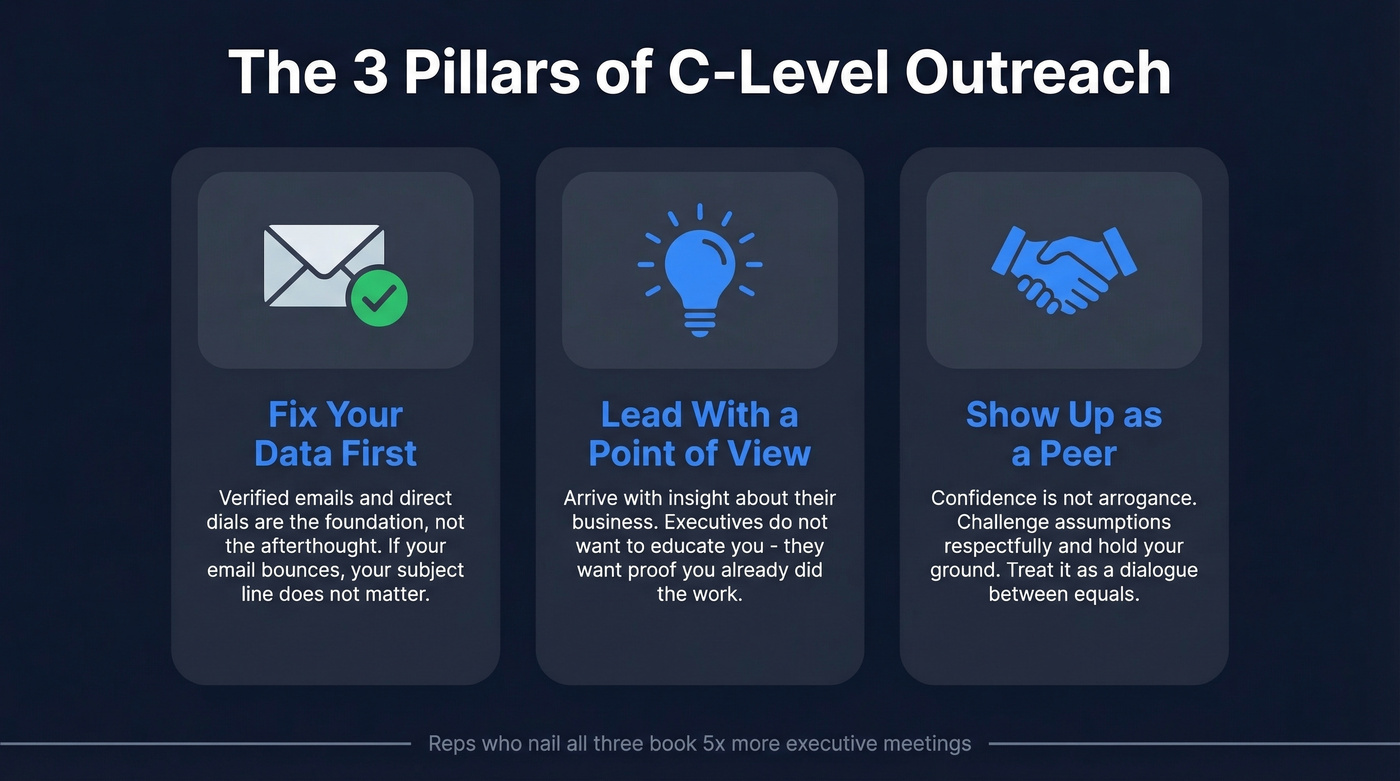
- Fix your data first. Verified executive emails and direct dials are the foundation, not the afterthought. If your email bounces, your subject line doesn't matter. (If you want a deeper system for list quality, see data enrichment.)
- Lead with a point of view, not discovery questions. Arrive with insight about their business. Executives don't want to educate you - they want to see that you've already done the work. (If your team leans on generic discovery, tighten it with better discovery questions.)
- Show up as a peer, not a supplicant. Confidence isn't arrogance. It's the ability to challenge an executive's assumptions respectfully and hold your ground when they push back. The reps who get second meetings are the ones who treat the conversation as a dialogue between equals, not an audience with royalty.
What C-Level Selling Actually Means
Selling to the c-level means targeting chief executives - CEO, CFO, CTO, CIO, COO, CMO, CRO - as the primary buyers or sponsors of a deal. These aren't just "senior contacts." They're the people who allocate budget, set strategic direction, and kill initiatives that don't align with company priorities.
47% of all B2B purchase decisions involve C-suite executives, compared to 34% for individual contributors. If you're not reaching the C-suite, you're selling to people who can recommend but can't approve. (This is also why enterprise B2B sales looks so different from mid-market.)
| Title | Full Role | Primary Focus | Where They Spend Attention |
|---|---|---|---|
| CEO | Chief Executive Officer | Strategy & growth | Board decks, investor calls, industry events |
| CFO | Chief Financial Officer | ROI & cost control | Financial reviews, budget planning, risk reports |
| COO | Chief Operating Officer | Ops & efficiency | Process metrics, vendor reviews, team output |
| CTO | Chief Technology Officer | Architecture & scale | Technical evaluations, engineering blogs, product roadmaps |
| CIO | Chief Information Officer | Transformation & IT | Analyst reports, digital transformation case studies |
| CMO | Chief Marketing Officer | Acquisition & brand | Pipeline dashboards, market research, competitive intel |
| CRO | Chief Revenue Officer | Revenue & pipeline | CRM data, win/loss analyses, sales methodology content |
Best Channels for C-Suite Outreach
The average CEO receives 120-150 emails per day. Your cold email is competing with board updates, investor requests, and internal fires. Channel selection determines whether you exist in their world at all.
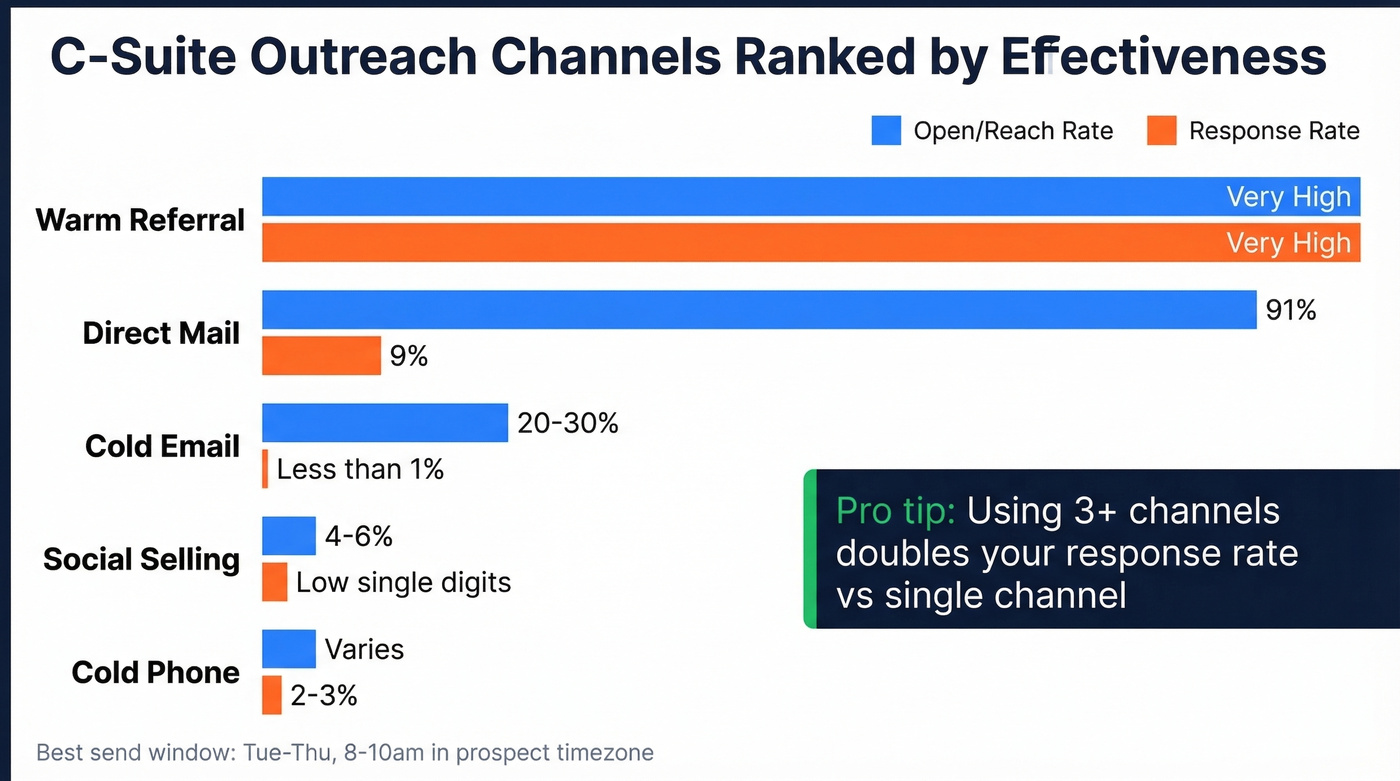
| Channel | Open/Reach Rate | Response Rate |
|---|---|---|
| Warm referral | Very high | Very high |
| Direct mail | ~91% open | ~9% response |
| 20-30% open | <1% reply | |
| Social | 4-6% | Low single digits |
| Phone | Varies | 2-3% connect |
Direct mail is the most underrated channel for reaching C-suite executives. A 91% open rate with a 9% response rate crushes every digital channel. Yet most teams ignore it because it doesn't scale as easily as email sequences. (If you want a full breakdown, see direct mail for lead generation.)
The real advantage is multi-channel. Contacting prospects via three or more channels doubles your response rate versus single-channel outreach, and 65% of B2B buyers have already made their vendor shortlist before engaging with sales. Timing matters too - Tuesday through Thursday, 8-10am in the prospect's timezone, generates 40%+ more responses. (For timing benchmarks, use best time to send cold emails.)
But none of this works if your email bounces. Bounce-heavy lists waste effort, hurt sender reputation, and make every future email harder to deliver. We've seen teams running 35-40% bounce rates on executive lists pulled from stale databases - at that point, you're actively damaging your domain. (If you need the full remediation playbook, start with email deliverability and improve sender reputation.)

Prospeo solves this at the source. With 143M+ verified emails, 98% accuracy, and a 7-day data refresh cycle, your outreach starts with contact data you can trust. The 125M+ verified mobile numbers give you a direct dial for the phone leg of your multi-channel sequence. At roughly $0.01 per verified email, the cost of verifying is negligible compared to the cost of bouncing. (If you're comparing tools, see Bouncer alternatives.)

Your executive cold email framework means nothing if the email bounces. Prospeo gives you 143M+ verified emails with 98% accuracy and catch-all domain handling - built for enterprise contacts where stale data does the most damage.
Verify your C-suite list before you hit send. It's $0.01 per email.
The Executive Cold Email Framework
Ian Koniak's five-step framework is the best structure we've found for executive cold emails. It's built around one principle: SHOW ME YOU KNOW ME.
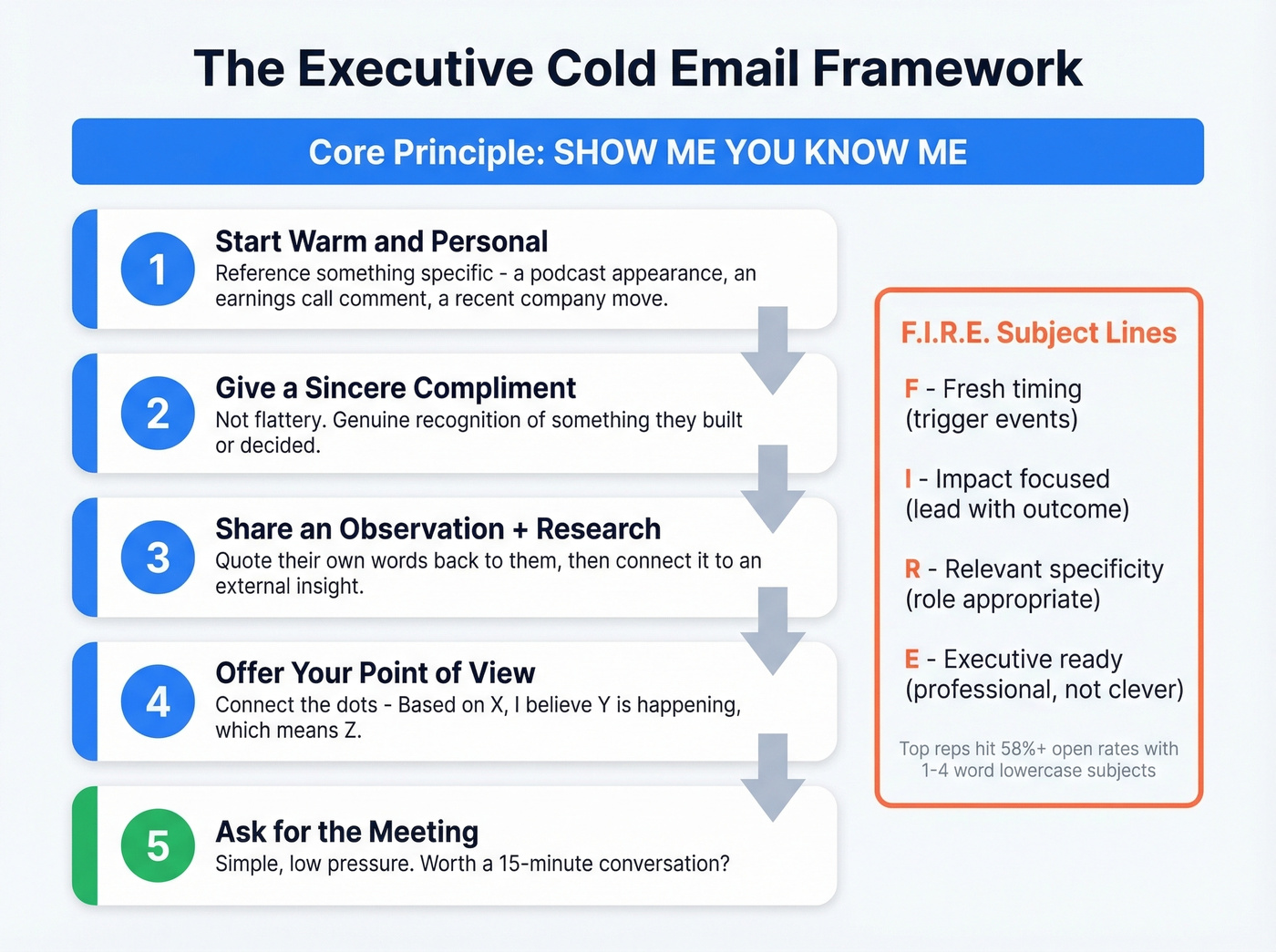
- Start warm and personal. Reference something specific - a podcast appearance, an earnings call comment, a recent company move.
- Give a sincere compliment. Not flattery. Genuine recognition of something they've built or decided.
- Share an observation + link to research. Quote their own words back to them, then connect it to an external insight.
- Offer your point of view. Connect the dots: "Based on X, I believe Y is happening, which means Z."
- Ask for the meeting. Simple, low-pressure. "Worth a 15-minute conversation?"
Now subject lines. An analysis of 85M+ cold emails found that top reps achieve 58%+ open rates - 2.1x the average. The patterns that drive those numbers: one to four words, all lowercase, zero salesy language. Phrases that sound like marketing reduce opens by up to 17.9%. (If you want swipeable options, use these cold email subject line examples.)
Use the F.I.R.E. framework for subject lines: Fresh timing (reference a trigger event without saying "congrats"), Impact focused (lead with the outcome), Relevant specificity (role and stage appropriate), and Executive ready (professional, not clever). "Q4 treasury optimization" beats "Quick question" every time.
One more thing worth flagging: run your executive list through email verification before you hit send. Catch-all domains are especially common at enterprise companies, and most generic databases don't flag them properly. This is one area where spending five minutes on verification saves you weeks of sender reputation recovery. (If you need a quick checklist, see how to check if email will bounce.)
Multi-channel C-suite outreach needs verified emails and direct dials. Prospeo delivers both - 125M+ verified mobile numbers with a 30% pickup rate, plus 30+ filters to target executives by role, intent signals, and company growth.
Reach the CFO's desk phone, not their gatekeeper's voicemail.
Role-Specific Messaging
Most advice on selling to executives treats "the executive" as a monolith. That's lazy. A CFO evaluating your product runs a completely different mental model than a CTO evaluating the same product.
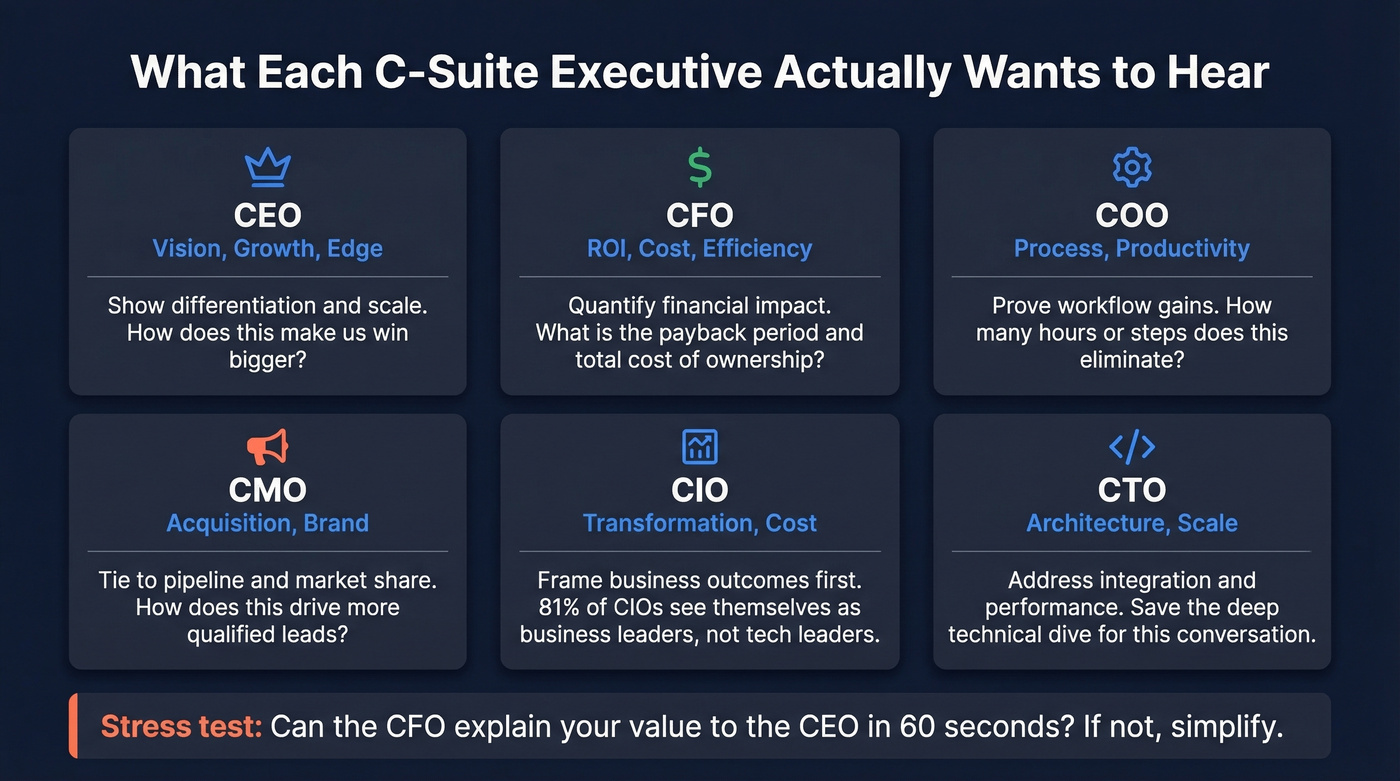
| Role | Primary Priorities | Your Message Should... |
|---|---|---|
| CEO | Vision, growth, edge | Show differentiation + scale |
| CFO | ROI, cost, efficiency | Quantify financial impact |
| COO | Process, productivity | Prove workflow gains |
| CMO | Acquisition, brand | Tie to pipeline + share |
| CIO | Transformation, cost | Frame business outcomes |
| CTO | Architecture, scale | Address integration + perf |
The CIO-CTO distinction trips up more reps than any other role confusion. I've watched sellers walk into a CIO meeting with a technical deep-dive and lose the room in 90 seconds. According to Foundry's State of the CIO report, 81% of CIOs now identify as "changemakers" leading business and technology initiatives, and 50% see themselves as business leaders first. Your CIO pitch should sound like a business case. Save the architecture deep-dive for the CTO.
Here's a stress test from pclub.io's executive selling playbook that we use constantly: can the CFO explain your value to the CEO in 60 seconds? If the answer is no, your messaging is too complex. Executives care about three things - making money, saving money, and managing risk. Everything else is a subset.
Map the Buying Committee
Even when you reach the C-suite, you're rarely selling to one person. Most enterprise deals involve six to ten stakeholders, and the real decision process looks nothing like an org chart.
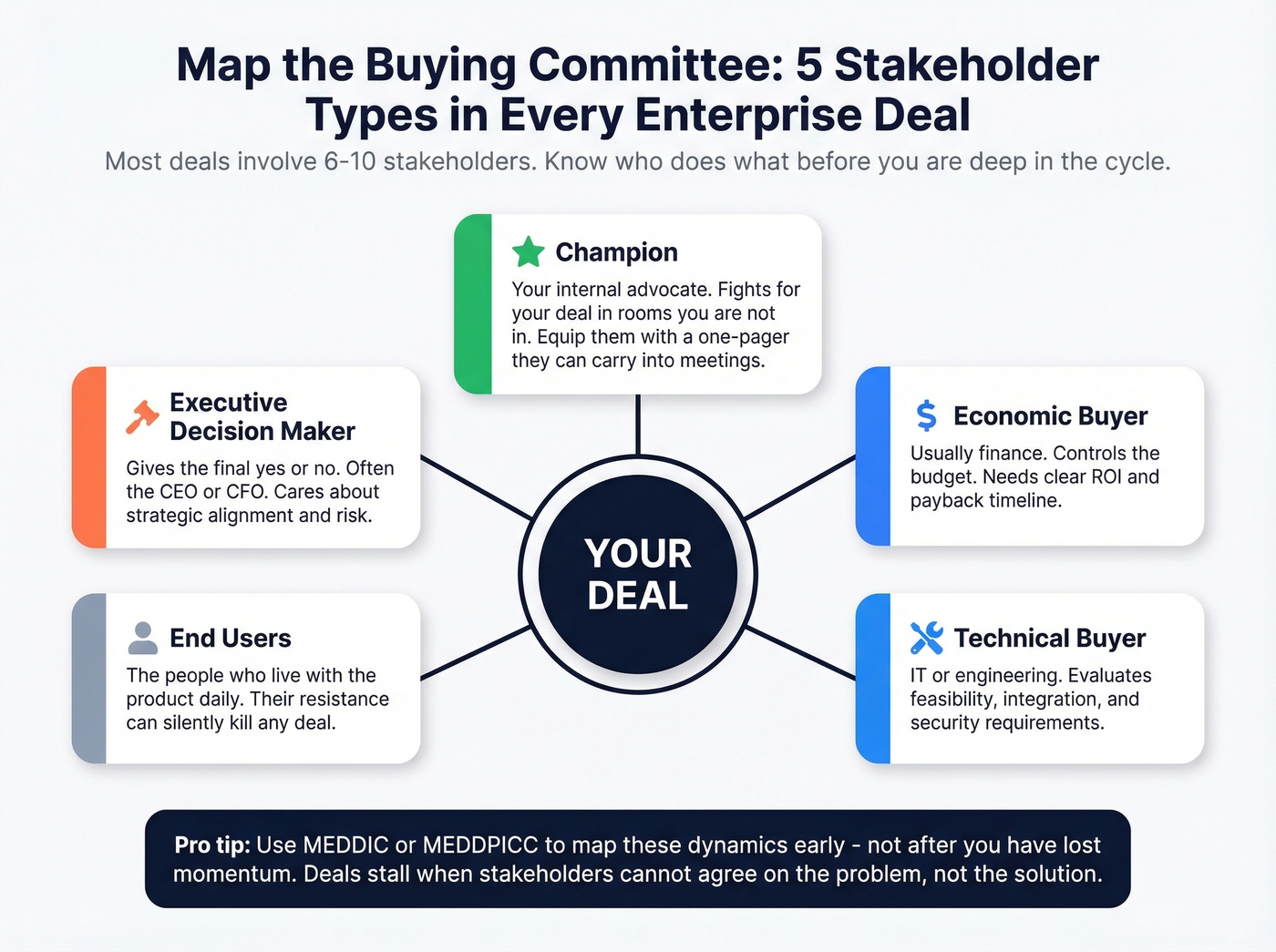
There are five decision-maker types you need to identify early. Champions are your internal advocates - the people who'll fight for your deal in rooms you're not in. Economic buyers, usually finance, control the budget. Technical buyers in IT or engineering evaluate feasibility. End users are the people who'll actually live with the product daily. And executive decision-makers give the final yes or no. (If you want a clean way to explain the split, see technical buyer vs economic buyer.)
Most deals don't stall because of price or product fit. They stall because stakeholders can't agree on what problem to solve. Frame the problem in a way that creates urgency, then equip your champion with a one-pager they can carry into internal meetings. Use MEDDIC or MEDDPICC to map these dynamics before you're deep in the sales cycle - not after you've already lost momentum. (For a tighter qualification map, use MEDDIC sales qualification.)
Mistakes That Kill Executive Deals
Look, if your deal size is under $15k, you probably don't need to sell to C-suite executives at all. A VP or director can sign that deal faster with less friction. But if you are going after executives, avoid these traps:
Being too personal too fast. Referencing vacation photos or family details feels like stalking. Stick to professional context - earnings calls, company news, industry moves.
Sounding needy. If your email reads like you need this deal more than they do, you've already lost. Executives can smell desperation in the first sentence.
Begging after a no. One thoughtful follow-up is fine. Three "just checking in" emails after a clear rejection signals low emotional intelligence. (If you need better language, see how to say just checking in professionally.)
Not taking the hint. If they've gone silent after two touches, pivot your approach or move on. There are other executives.
Giving ultimatums. "I won't take no for an answer" sounds unhinged to an executive, not confident.
Prioritizing the close over the relationship. Executives talk to each other. Burning a relationship for one deal costs you the next five, and in our experience, the referral network at the C-suite level is tighter than most reps realize.
Not recognizing poor fit. Around 50% of prospects aren't right for what you sell. Qualifying out early isn't failure - it's efficiency. Skip the C-suite entirely if you can't articulate why their specific company needs what you're offering.
Losing composure when challenged. Executives will push back, poke holes, and test your conviction. Getting defensive tells them you don't believe in what you're selling. Stay calm, acknowledge the objection, and redirect with data.
SDRs Selling to the C-Suite
A common objection inside sales orgs is that SDRs shouldn't reach out to executives. The logic sounds reasonable - junior reps lack the gravitas to hold an executive's attention.
The data tells a different story. SDRs can book executive meetings when they arrive with a researched point of view and a clear reason for the conversation, not a generic discovery request. The key shift is framing outreach around the executive's strategic priorities rather than the product's feature set. Reference a specific initiative from their latest earnings call or annual report, connect it to a trend you're seeing across their industry, and propose a focused conversation. Executives respect preparation regardless of the sender's title. (If you're building the motion, start with sales prospecting techniques and a modern SDR tool stack.)
Let's be honest - the real barrier for most SDRs isn't access or authority. It's that their managers haven't given them the research time or the messaging frameworks to show up prepared. If you're an SDR reading this, block 30 minutes before every executive outreach to study the company's recent 10-K, press releases, or podcast appearances. That investment pays for itself in response rates.
FAQ
What does C-level mean in sales?
C-level refers to "chief" executives - CEO, CFO, CTO, CIO, COO, CMO - who hold final decision-making authority over budget and strategy. Targeting these buyers as primary deal sponsors is what distinguishes c-level sales from mid-market or departmental selling.
How do you get a meeting with a C-suite executive?
The highest-converting path is a warm referral from an internal champion, which yields response rates far above any cold channel. Without one, use a multi-channel sequence combining verified email, social touches, and direct dials - with a researched point of view, not a generic pitch.
What do C-level executives care about most?
Three things: making money, saving money, and managing risk. They don't evaluate features or product roadmaps. Frame every conversation through strategic outcomes tied to revenue growth, cost reduction, or risk mitigation.
How do you find verified emails for C-suite contacts?
Use a B2B data platform with a short refresh cycle and catch-all domain verification. Prospeo refreshes records every 7 days and delivers 98% email accuracy - its 5-step verification catches spam traps and honeypots that generic databases miss.
What's the biggest mistake when selling to executives?
Leading with discovery questions like "what keeps you up at night?" signals you haven't done your homework. Arrive with a specific hypothesis about their business, then use the conversation to refine it - executives reward preparation with attention.