

How to Win Deals Faster (Without Pushing Harder)
It's Tuesday morning. You're staring at the pipeline review and the story writes itself: three deals went dark, two are stuck in legal, one never had a real champion. Your manager wants to know how you'll "accelerate" things. One of the top-voted takes on r/sales is that most advice about closing faster is garbage - and they're right, because the problem isn't pushing harder. It's removing the friction that makes deals drag.
Five levers compress deal cycles, ranked by impact: qualify out faster by measuring Time-to-Lose, respond in under five minutes, align stakeholders with a Mutual Action Plan, fix your contact data, and remove late-stage friction.
The Sales Velocity Math
Every conversation about shortening cycles should start with the sales velocity formula:
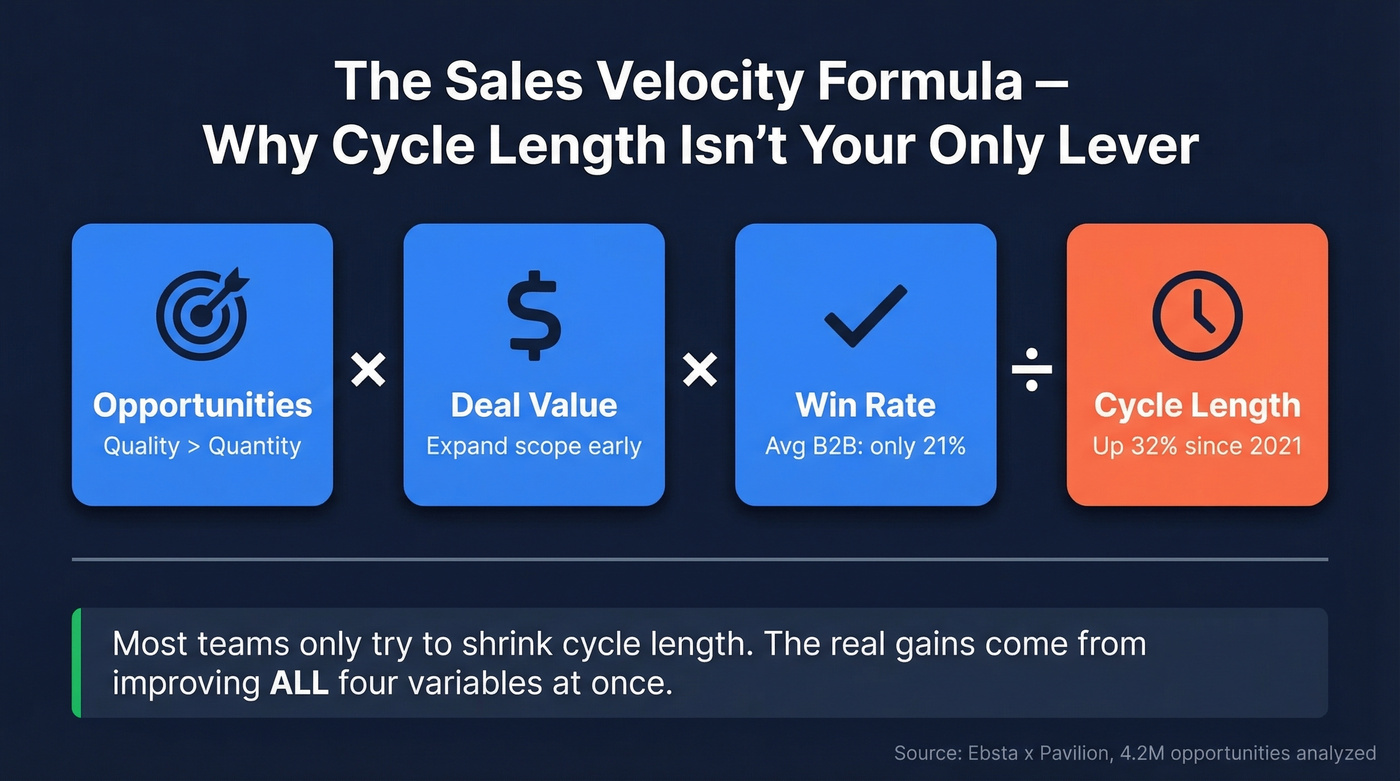
V = Opportunities x Deal Value x Win Rate / Cycle Length
Most teams obsess over cycle length - the denominator - while ignoring the numerator. The real gains come from improving win rate and opportunity quality at the same time. The average B2B win rate sits at 21% per HubSpot's 2026 Sales Trends data, which means roughly four out of five qualified deals die. An Ebsta x Pavilion analysis of 4.2M opportunities and $54B in pipeline confirmed the trend: win rates declined before stabilizing, and sales cycles have lengthened 32% since 2021, with enterprise cycles up 36%. You're fighting longer timelines with the same win rate your team had three years ago.
That math doesn't work.
The fix isn't one lever. It's five, working together. Teams that consistently close more deals don't rely on a single tactic - they stack small advantages across the entire cycle.
Five Levers That Shorten Deal Cycles
1. Qualify Out Faster
Here's the counterintuitive move: to win deals faster, you need to lose faster. A metric called Time-to-Lose sets a standard for how long an opportunity should remain open before it either moves forward or gets removed. In one VP of Sales example, time spent in discovery for deals that were lost was three times longer than for deals that were won. Reps in the fastest third for discovery time carried 48% higher win rates.
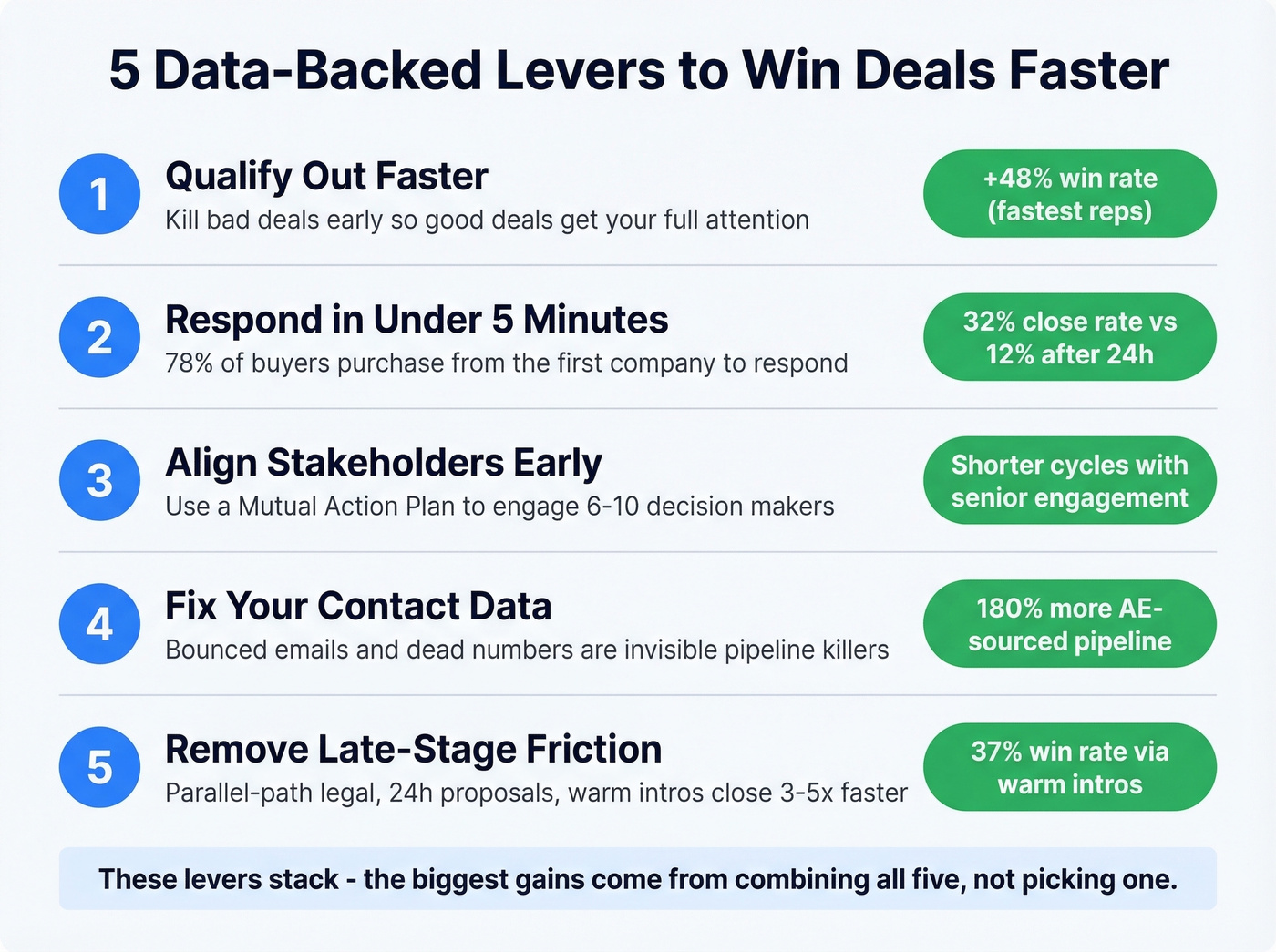
The framing from r/sales nails it: "always be disqualifying." If you're not walking away from around 30% of your pipeline, you're nurturing deals that were never real. Got invited to an RFP you didn't help shape? You're column fodder - decline or deprioritize. For SMB velocity, BANT still works. For enterprise complexity, MEDDIC forces you to find the champion and the economic buyer before you invest weeks in a technical evaluation. Either way, the goal is the same: kill bad deals early so good deals get your full attention.
2. Respond in Under Five Minutes
A 939-company study from Optif.ai measuring CRM timestamps found that leads contacted in under five minutes close at 32%. Leads contacted after 24 hours? 12%. That's a 2.6x difference from a single operational change, and 78% of buyers purchase from the first company to respond.
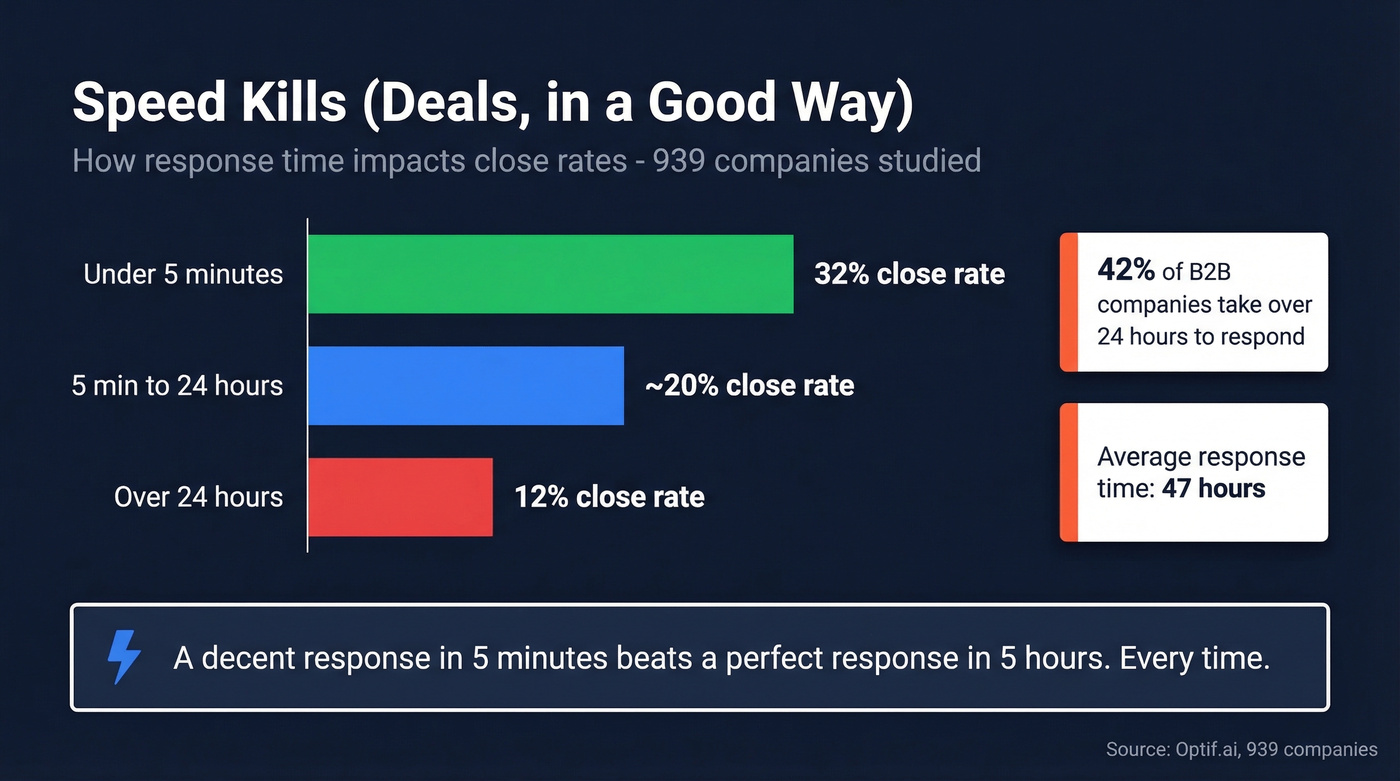
The ugly part: 42% of B2B companies take more than 24 hours to respond. The average is 47 hours. You don't need a fancy tool to fix this. Set a 15-minute first-response SLA. We've seen teams cut their average response time from 6 hours to under 15 minutes just by making that SLA visible on a dashboard and assigning ownership. Build a 48-hour follow-up cadence where every touch carries specific value - not "just checking in," but a relevant case study, a pricing comparison, or a question that advances the deal. (If you need copy you can ship today, use these sales follow-up templates.)
A decent response in five minutes beats a perfect response in five hours. Every time.
3. Align Every Stakeholder Early
The modern B2B buying group runs 6-10 people. 77% of buyers say the process is "too complex," and 95% pivot when new information surfaces. You can't control that complexity, but you can structure it.
A Mutual Action Plan is a shared document aligning seller and buyer on success criteria, next steps, owners, and due dates. Introduce it after you've confirmed shared objectives and validated budget authority with your champion. An analysis of 18,000+ sales conversations found that senior buyer engagement correlates with materially shorter cycles. The MAP is how you get those senior buyers engaged early - by tying the deal's timeline to their go-live date or fiscal deadline. You can't manufacture urgency, but you can align to urgency that already exists.
One more thing worth doing: build your pipeline stages around buyer actions (evaluation complete, security review scheduled), not internal milestones (demo done, proposal sent). Stages that mirror your process instead of theirs create phantom progress - and phantom progress is how deals die quietly. (If you're rebuilding stages, start with these sales pipeline challenges and fix the leaks first.)
4. Fix Your Contact Data
Let's be honest: this is the speed lever nobody talks about in pipeline reviews. Bad contact data doesn't show up as a line item. It shows up as invisible friction. Bounced emails waste sequence slots and hurt your domain reputation. Disconnected phone numbers burn entire call blocks. Your reps aren't slow; they're working with bad inputs. If you're seeing bounces, benchmark against a healthy email bounce rate and diagnose the root cause.
Look at what happened at Snyk. 50 AEs were prospecting 4-6 hours per week with bounce rates running 35-40%. After switching to Prospeo, bounce rates dropped under 5%, AE-sourced pipeline jumped 180%, and the team generated 200+ new opportunities per month. That data quality change unlocked speed that no methodology or coaching could have produced on its own. A 7-day data refresh cycle - compared to the 6-week industry average - means reps are always working with current contact information, not stale records that bounce or ring out. (If you're evaluating vendors, compare data enrichment services and prioritize refresh cadence + verification.)
Skip this lever if your bounce rates are already under 3%. For everyone else, it's the single fastest fix.
5. Remove Late-Stage Friction
Deals don't just stall in discovery. They die in the last mile because of operational drag.
24-hour proposal turnaround. If your proposal takes a week, you've handed the buyer a week to reconsider. Use templates. Pre-build Good/Better/Best pricing tiers so you're not custom-quoting every deal.
Decision-ready packet. Before the buyer asks, send pricing, a relevant case study, an ROI calculator, a timeline, and an onboarding plan. Remove every reason to say "let me think about it."
Parallel-path legal. Loop in legal before the verbal yes. Running procurement review alongside final negotiations keeps the deal moving instead of turning legal into a last-minute blocker. In our experience, this single change shaves 1-2 weeks off enterprise deals more reliably than anything else on this list.
Warm introductions. Referral leads close 3-5x faster than cold outreach. Known-contact deals close at a 37% win rate vs 19% cold, per Champify's data. If you're not systematically mining your network for warm paths into accounts, you're leaving the easiest speed lever on the table. (To build more warm paths, use these sales prospecting techniques and focus on signal-based outreach.)

Bad contact data is the silent deal killer. Snyk dropped bounce rates from 35% to under 5% with Prospeo's 98% accurate emails and 7-day refresh cycle - unlocking 200+ new opportunities per month. Your reps aren't slow. Their data is.
Stop losing deals to stale data. Start with 75 free verified emails.
Benchmarks at a Glance
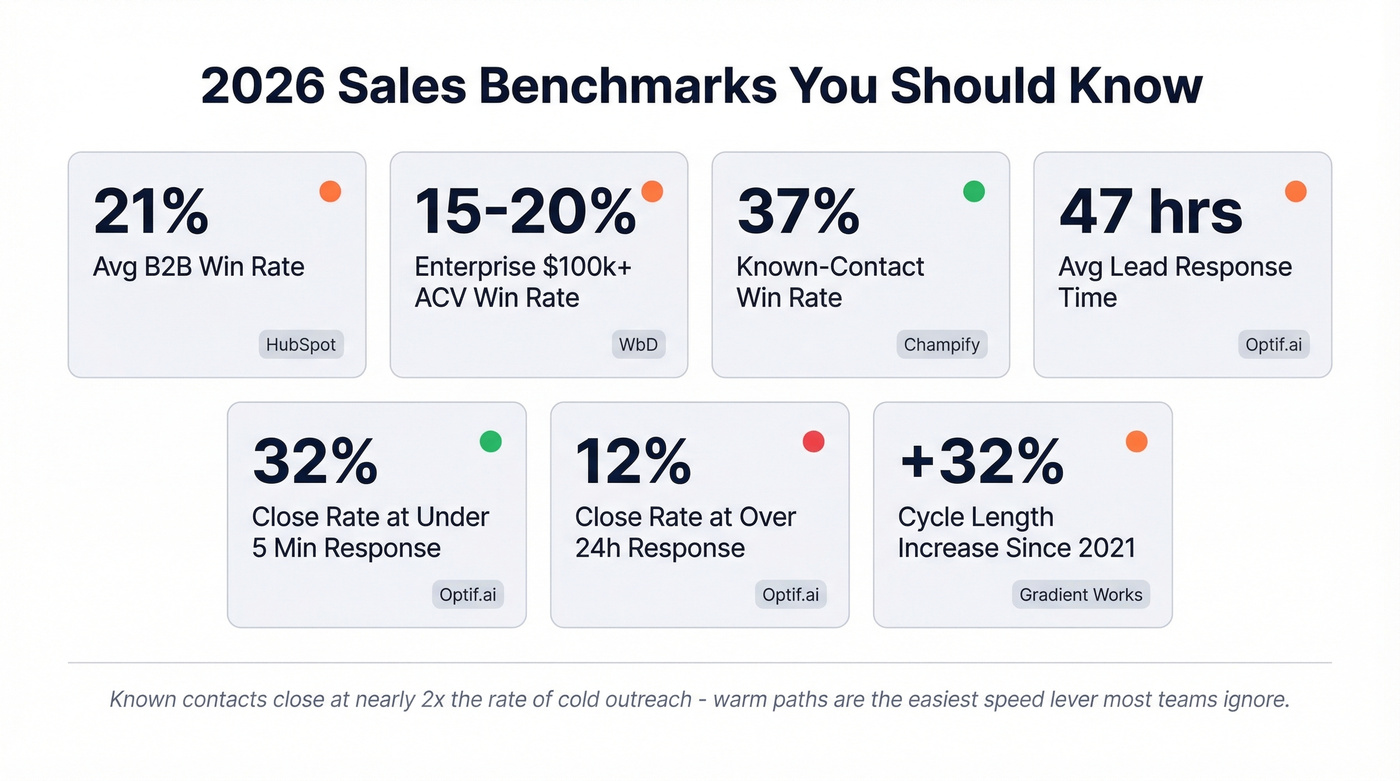
| Metric | Benchmark | Source |
|---|---|---|
| Avg B2B win rate | 21% | HubSpot |
| Enterprise $100k+ ACV win rate | 15-20% | WbD |
| Known-contact win rate | 37% | Champify |
| Avg lead response time | 47 hours | Optif.ai |
| Close rate at <5 min response | 32% | Optif.ai |
| Close rate at >24h response | 12% | Optif.ai |
| Cycle lengthening since 2021 | 32% | Gradient Works |
The Contrarian Takeaway
Hot take: most teams don't need a new sales methodology. They need fewer bad deals and cleaner data. Speed doesn't mean rushing - it means removing the things that slow you down. If you only do two things after reading this, make them these: measure Time-to-Lose and enforce a TTL standard so dead deals stop consuming your calendar, and audit your contact data accuracy so reps stop wasting hours on bounced emails and disconnected numbers. These two moves compress more cycles than any new methodology ever will. (If you want a tighter system for measuring this, track pipeline health alongside cycle time.)
Responding in five minutes means nothing if your email bounces. Prospeo delivers 143M+ verified emails at $0.01 each, refreshed every 7 days - not the 6-week industry average. That's how teams like Snyk grew AE-sourced pipeline 180%.
Every bounced email is a deal that never had a chance. Fix that today.