

Work Email Examples for Every Scenario (With Copy-Paste Templates)
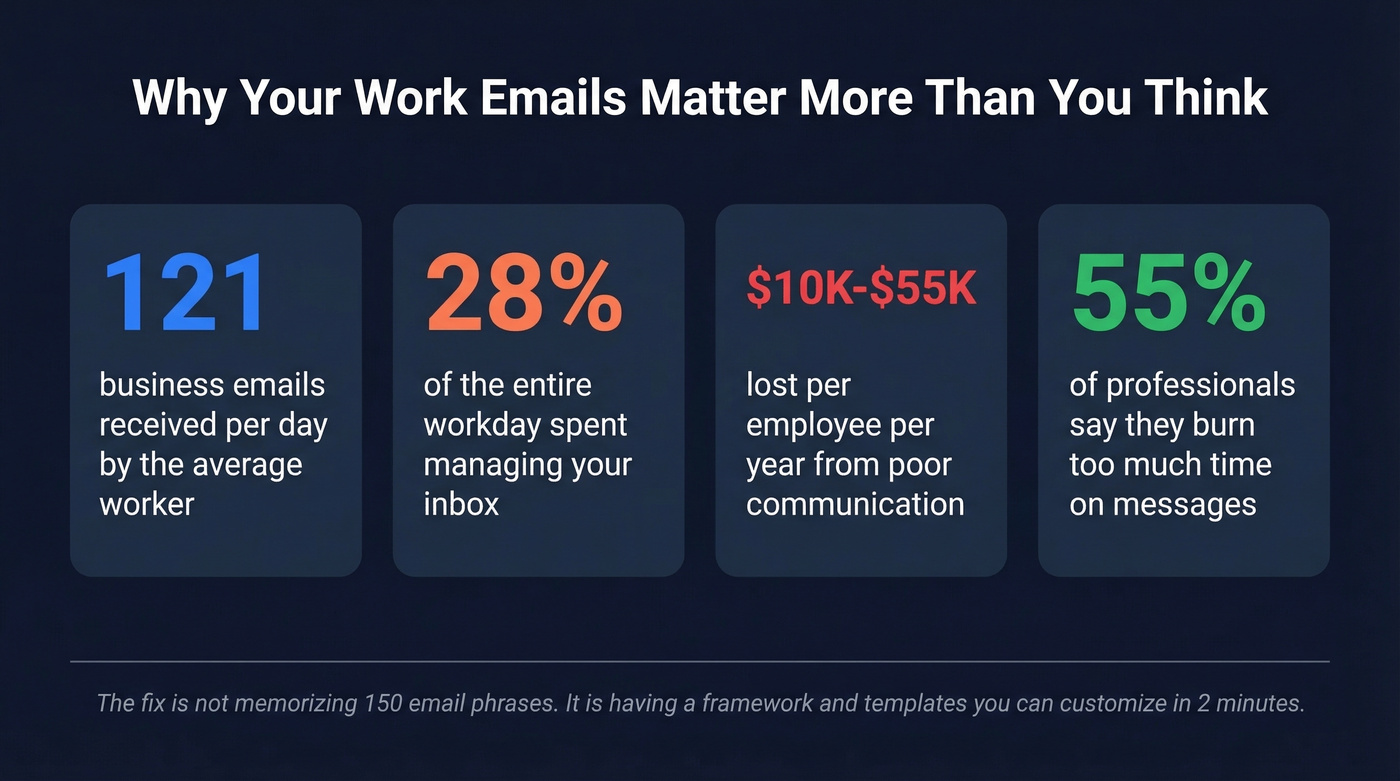
It's 8:47 AM. You've got 43 unread emails, a half-written PTO request you've been overthinking since yesterday, and a resignation letter draft that sounds like it was written by a corporate chatbot in 2008. The average office worker receives 121 business emails per day, and professionals spend roughly 28% of their entire workday managing their inboxes. That's 121 samples of your professionalism - or lack of it - landing in someone else's inbox every single day.
55% of professionals burn too much time crafting and deciphering messages. That anxiety makes sense when poor workplace communication costs $10K-$55K per employee per year in lost productivity. But the fix isn't memorizing 150 email phrases. It's having a framework and a handful of templates you can customize in under two minutes.
Every template below is copy-paste ready, with tone variants so you can adjust for your audience. Scroll to whatever scenario you're dealing with right now, grab the template, and send.
What You Need (Quick Version)
If you're in a rush, here's the map:
- A framework for every email you'll ever write - the 5 Cs (Clear, Concise, Correct, Complete, Courteous). Memorize this, skip the phrase banks.
- 25+ copy-paste templates organized by scenario - colleagues, managers, direct reports, external outreach, and the tough ones everyone dreads (saying no, escalating problems, apologizing for mistakes).
- A tone decision matrix so you stop guessing whether "Hi Sarah" or "Dear Ms. Chen" is the right call.
- 7 credibility-killing mistakes most people make without realizing it.
Professional Email Address Formats
Your email address is the first thing people see. It sets expectations before they read a single word.
| Format | Example | Best For |
|---|---|---|
| firstname.lastname | sarah.chen@acme.com | Standard corporate |
| firstinitial.lastname | s.chen@acme.com | Large orgs, common names |
| firstname | sarah@acme.com | Small teams, startups |
| Role-based | support@acme.com | Shared inboxes, departments |
| Department | hr@acme.com | HR, finance, legal |
If you're still sending work correspondence from sarahc1994@gmail.com, fix that today. Google Workspace starts at around $6/user/month for a custom domain, and the credibility jump is immediate. The consensus on r/smallbusiness is pretty clear: a custom domain is a baseline legitimacy signal, not a nice-to-have. Role-based addresses like support@ and hr@ work for shared inboxes, but individual correspondence should come from a named account. People respond to people, not departments.
Anatomy of a Professional Email
Every professional email has five components. Get these right and the content almost writes itself.
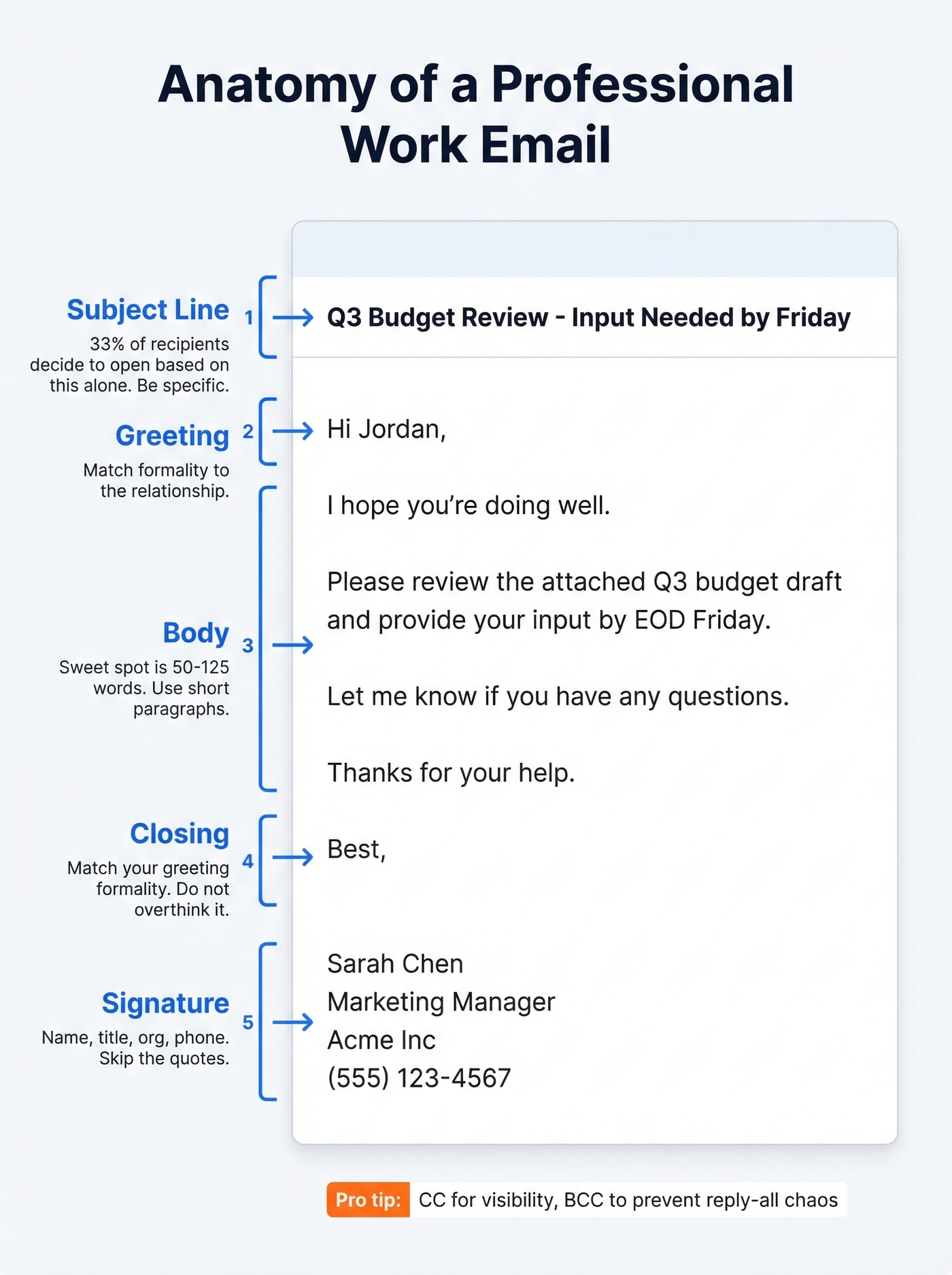
Subject line. This is your headline. 33% of recipients decide whether to open based on the subject line alone. Be specific: "Q3 Budget Review - Input Needed by Friday" beats "Quick question." Avoid ALL CAPS, excessive punctuation, and the word "Urgent" unless something is genuinely on fire. If you want more options, borrow from these subject line patterns.
Greeting. Match your formality to the relationship:
| Formality | Greeting | When to Use |
|---|---|---|
| Formal | Dear Mr./Ms. [Last Name] | First contact, senior leaders |
| Professional | Hello [First Name] | Established relationships |
| Casual | Hi [First Name] | Peers, startup culture |
| Unknown recipient | Dear [Job Title] or Hello | Can't find their name |
| Group | Hi Team / Good morning all | Team-wide updates |
Body. The sweet spot is 50-125 words. That's enough to provide context, make your ask, and include next steps - without becoming a wall of text. Use block format: left-justified, single-spaced, a blank line between paragraphs, no indentation. Keep paragraphs to 4-5 sentences max. If you're writing outreach, these emails that get responses principles help keep it tight.
Closing. "Best," "Thanks," "Regards" - pick one that matches your greeting's formality. Don't overthink this.
Signature. Name, title, organization, phone number. Pronouns are increasingly common in signatures. Skip the inspirational quotes.
One more thing: CC vs. BCC. CC people who need visibility but aren't the primary audience. BCC when you're emailing a large group and want to prevent reply-all chaos or keep recipients' addresses private.

You just nailed the email format. Now make sure it reaches the right person. Prospeo's email finder delivers 98% verified work emails from 300M+ professional profiles - so your perfectly crafted message actually lands.
Stop guessing email formats. Get verified work emails for $0.01 each.
The 5 Cs Framework
You don't need 150 phrases memorized. You need this framework and five templates you customize. We've used this internally for years, and it's the fastest way to cut email writing time in half. If you're sending at scale, pair this with an email deliverability checklist so your best copy actually lands.
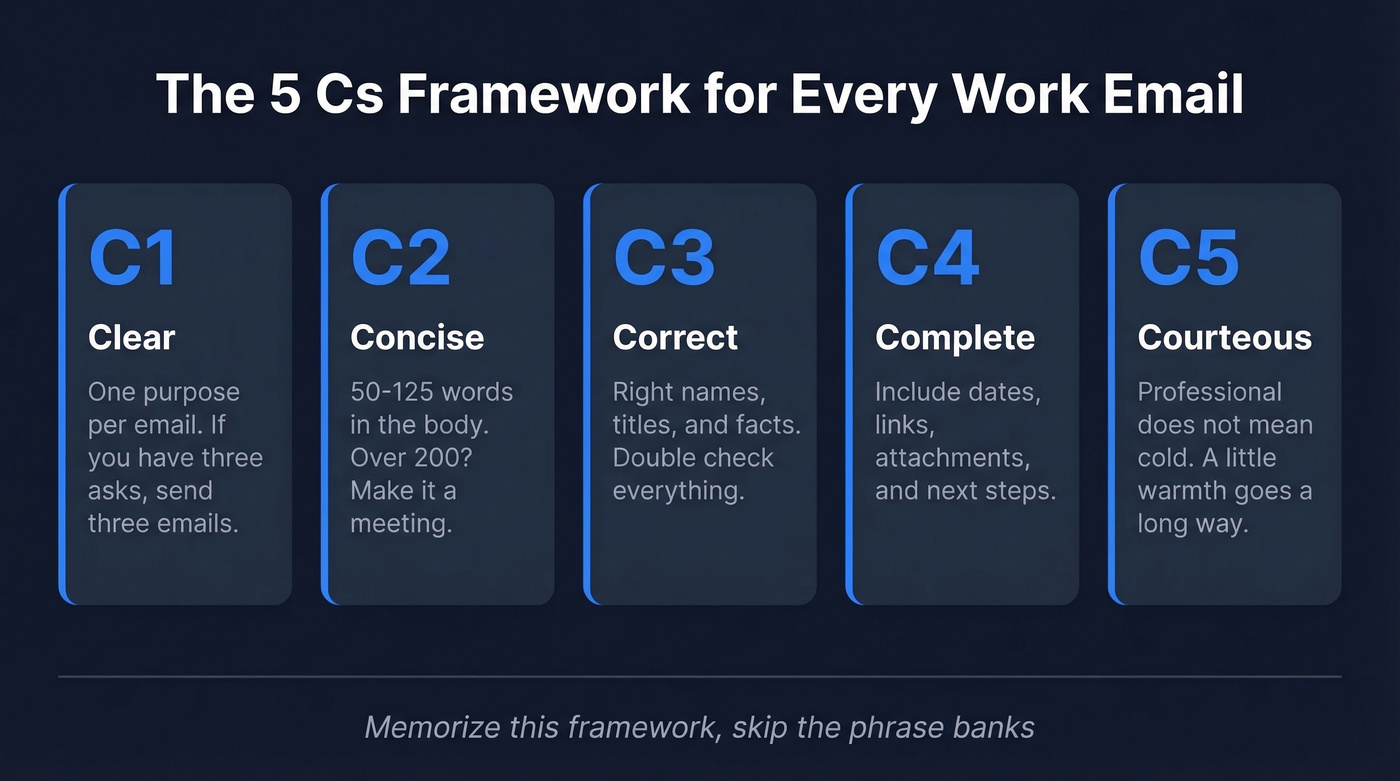
- Clear - One purpose per email. If you're asking for budget approval AND scheduling a meeting AND sharing a project update, that's three emails. "Can you approve the $12K vendor contract by Thursday?" is clear. "I wanted to touch base about a few things" isn't.
- Concise - 50-125 words for the body. If you're past 200, it should probably be a meeting or a shared doc.
- Correct - Right names, right titles, right facts. Nothing kills credibility faster than "Dear Mr. Chen" when her name is Dr. Chen.
- Complete - Include everything the reader needs to act. Dates, links, attachments, next steps. Don't make them reply just to ask "when?"
- Courteous - Professional doesn't mean cold. "I appreciate your help with this" takes three seconds and changes the entire tone.
Templates by Scenario
Emails to Colleagues
Meeting Request
Subject: Sync on Q3 Campaign - 30 min this week?
Hi Jordan,
I'd like to align on the Q3 campaign timeline before we brief the design team. Could you do 30 minutes this Thursday or Friday afternoon?
I'll send an agenda ahead of time. If neither day works, let me know what does.
Thanks, [Your Name]
Project Update
Subject: Website Redesign - Week 3 Update
Hi Team,
Quick update on the redesign project:
- Wireframes for the homepage and pricing page are finalized
- Dev handoff is scheduled for Monday, March 10
- We're still waiting on final copy for the About page - Elena, could you have that ready by Friday?
Let me know if anything's blocked on your end.
Best, [Your Name]
Asking for Help
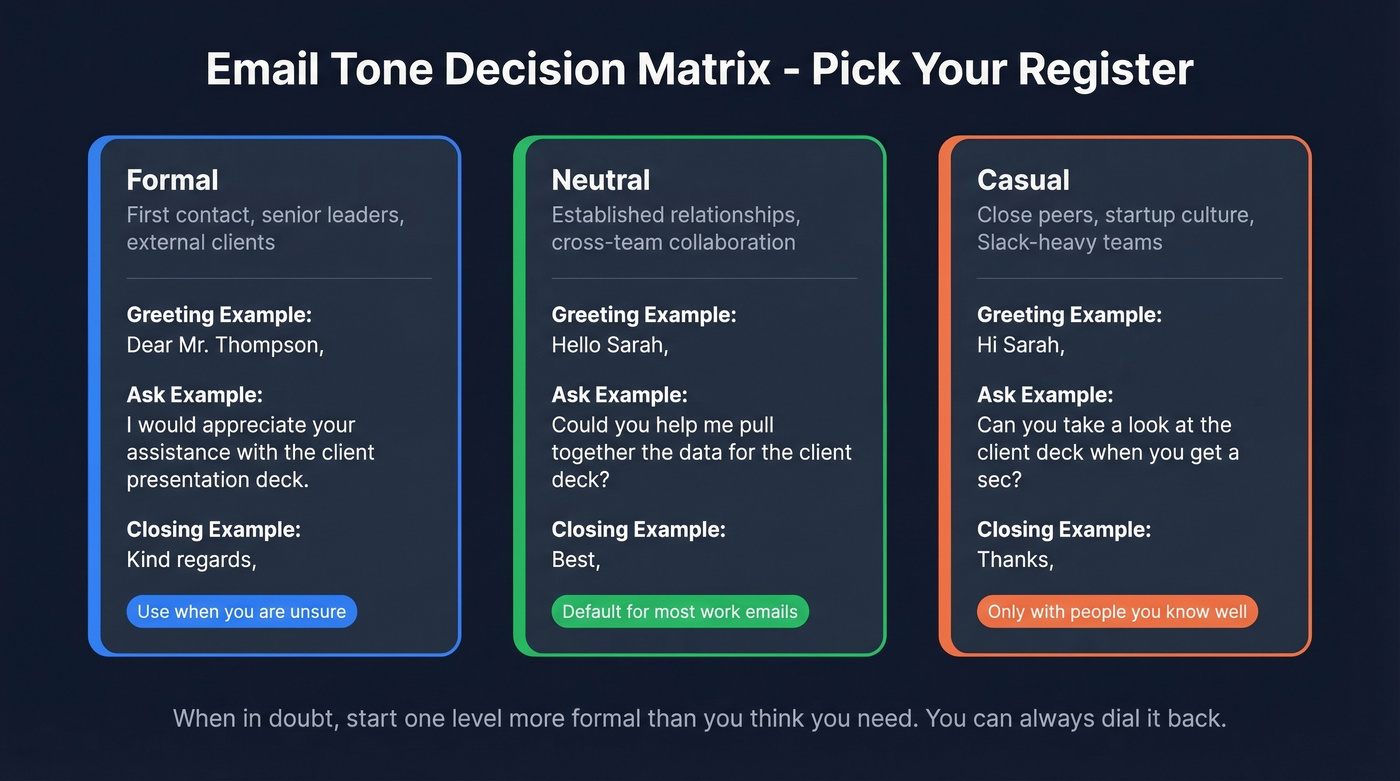
The register you choose here depends entirely on your relationship. Here's the same request at three levels:
- Formal: "I would appreciate your assistance with the client presentation deck."
- Neutral: "Could you help me pull together the data for the client deck?"
- Casual: "Can you take a look at the client deck when you get a sec?"
Subject: Need your input on the Meridian deck
Hi Priya,
I'm putting together the Meridian client presentation for next Tuesday and could use your help with the competitive analysis section. You've got the deepest knowledge of their market.
Could you review slides 8-12 and add any data points I'm missing? I'd need it by end of day Thursday to leave time for revisions.
Really appreciate it - happy to return the favor on your Northstar project.
Thanks, [Your Name]
Confirmation Email
Subject: Confirmed - Design review Thursday at 2 PM
Hi Jordan,
Confirming our design review for Thursday, March 13 at 2:00 PM in Conference Room B. I'll bring the updated wireframes and the brand guidelines doc.
If anything changes on your end, just let me know.
Thanks, [Your Name]
Recap/Summary Email
Subject: Recap - Marketing Standup 3/5
Hi Team,
Here's what we covered today:
- Blog content calendar is locked through April
- Paid campaign budget increased to $15K/month starting March 15
- Action item: Sam to share the updated UTM tracking sheet by Friday
Let me know if I missed anything.
Best, [Your Name]
Emails to Your Manager
PTO Request
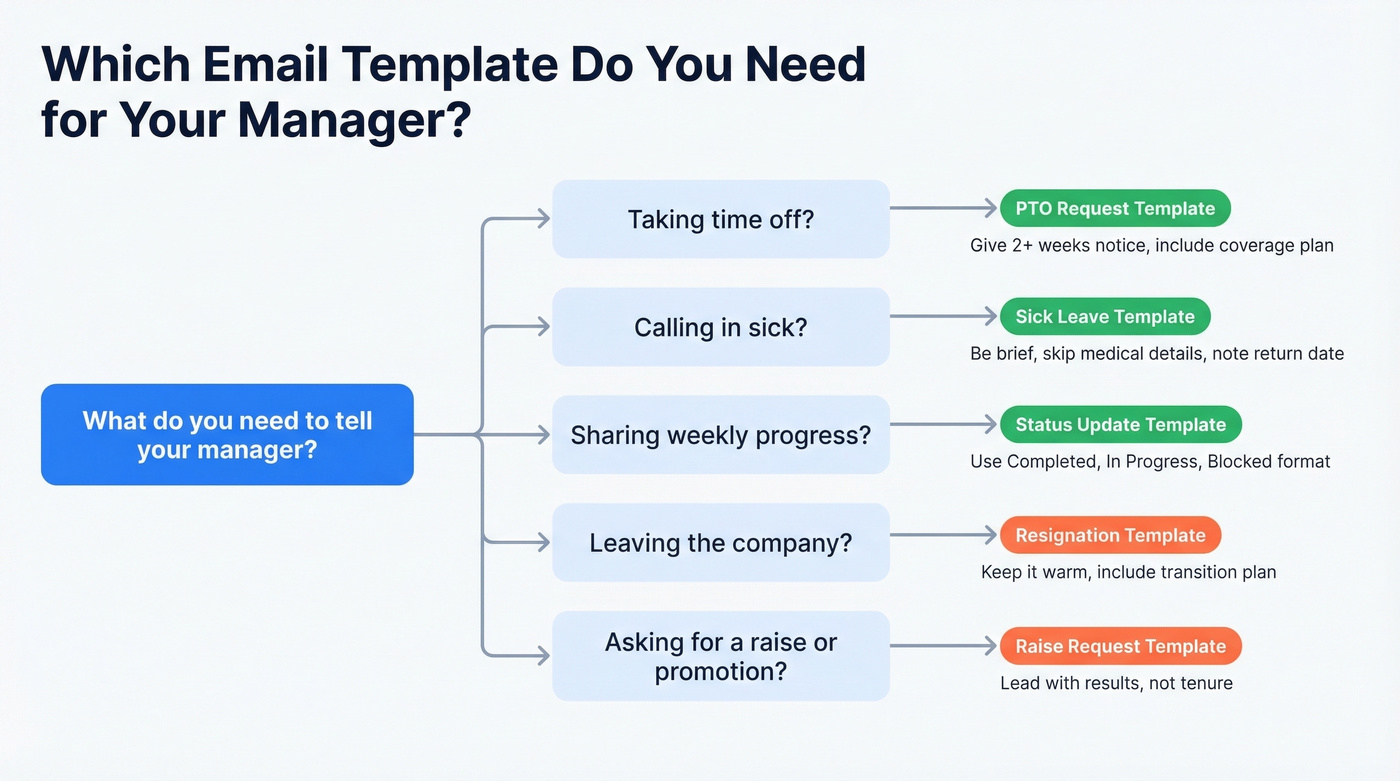
Give at least two weeks' notice for planned leave. The more notice, the higher your approval odds - especially if you include a coverage plan.
Subject: PTO Request - April 14-18
Hi Rachel,
I'd like to take PTO from Monday, April 14 through Friday, April 18. I'll make sure all deliverables for the Beacon project are completed or handed off to Marcus before I leave.
I'll set up an out-of-office reply and share a coverage doc with the team by April 11.
Please let me know if this works.
Thanks, [Your Name]
Sick Leave
Be brief, be direct, don't overshare medical details.
Simple one-day absence:
Subject: Sick Leave - [Your Name], March 6
Hi Rachel,
I'm not feeling well and need to take a sick day today. I don't have any meetings that can't be rescheduled, and I'll be reachable by email if anything urgent comes up. I expect to be back tomorrow.
Thanks, [Your Name]
Uncertain return date:
Subject: Sick Leave - [Your Name], Starting March 6
Hi Rachel,
I need to take sick leave starting today. I'm not sure yet when I'll be back, but I'll send you an update by Thursday morning.
My current tasks: the Beacon report draft is in the shared drive (80% complete), and Marcus has context on the vendor call scheduled for tomorrow.
Thanks for understanding, [Your Name]
Before a critical meeting:
Subject: URGENT: Sick Leave & Thursday Client Presentation
Hi Rachel,
I'm sick and won't be able to present to the Meridian team on Thursday. Here's what I've set up:
- Presentation deck is final - link [here]
- Marcus has agreed to present; I've briefed him on the key talking points
- Speaker notes are in the deck
I'm sorry for the timing. I'll follow up with the client after the meeting once I'm back.
[Your Name]
Status Update
Subject: Weekly Update - Content Team, Week of 3/3
Hi Rachel,
Here's where things stand:
- Completed: Blog posts for March published and promoted; email newsletter sent (22% open rate)
- In progress: Case study interviews with Acme and Beacon (drafts due 3/14)
- Blocked: Waiting on legal approval for the customer quote in the Beacon case study
No risks to flag this week. Let me know if you need anything else.
Best, [Your Name]
Resignation
Here's the thing: most resignation email templates online sound like they were generated by a compliance department. Your resignation email should sound like a human who respects the people they worked with. Keep it warm, keep it brief, and include a transition plan. If you need a clean handoff, use a handoff email template structure.
Subject: Resignation - [Your Name], Last Day April 4
Hi Rachel,
I'm writing to let you know I've decided to resign from my position. My last day will be Friday, April 4, giving two weeks from today.
I've genuinely valued my time on this team - the Meridian launch and the rebrand project were career highlights for me. I want to make the transition as smooth as possible, so I'll spend the next two weeks documenting my workflows and transitioning my accounts.
I'm happy to discuss the handoff plan whenever works for you.
Thank you for everything, [Your Name]
Emails to Direct Reports
Performance Feedback
Even constructive feedback should be future-oriented. Focus on what to do differently, not just what went wrong.
Subject: Feedback on the Beacon Presentation
Hi Alex,
Thanks for leading the Beacon presentation yesterday. Your command of the data was strong, and the client clearly trusted your expertise.
One area to develop for next time: the Q&A section ran long because a few answers went into more detail than the client needed. A good rule of thumb is to answer the question asked, pause, and let them ask a follow-up if they want more depth.
I'd love to see you lead the next client presentation too. Let's do a quick dry run beforehand so we can practice tightening the Q&A.
Best, [Your Name]
Recognition/Praise
Subject: Great work on the Q2 launch
Hi Alex,
I wanted to call out the work you did on the Q2 product launch. The campaign assets were delivered on time, the messaging was sharp, and the landing page conversion rate came in 40% above our target.
That's the kind of execution that makes the whole team look good. Thank you.
Best, [Your Name]
Deadline Reminder
Subject: Reminder - Case Study Draft Due Friday 3/7
Hi Alex,
Quick reminder that the Beacon case study draft is due this Friday. If you're running into any blockers - especially on the customer quote approval - let me know and I can help escalate.
Thanks, [Your Name]
Outreach and External Emails
Getting the tone right in external emails can increase response rates by up to 20%. A personalized, conversational approach pushes that even higher - one Woodpecker study found up to 30% higher response rates versus generic formal templates. For more outreach patterns, see these sales follow-up templates.
Cold Email Introduction
Subject: Quick question about [Company]'s content workflow
Hi Sarah,
I noticed [Company] just launched a new product line - congrats. I work with similar teams to cut their content production time by about 40% using [specific approach].
Would a 15-minute call next week make sense to see if there's a fit?
Best, [Your Name]
Before you hit send on a cold email, make sure the address is real. Repeated bounces hurt your sender reputation and inbox placement, and the damage compounds with every bad send. We've seen teams torch months of domain warming because they skipped this step. Prospeo's free tier covers 75 email verifications per month at 98% accuracy - enough to validate a targeted outreach list before you launch. If you want a deeper process, follow an email bounce rate playbook.

Knowing the right email format is step one. Finding the actual verified work email address for your prospect is step two. Prospeo gives you firstname.lastname accuracy across 143M+ verified emails - with catch-all handling and spam-trap removal built in.
Turn every professional email format into a verified, deliverable address.
Networking Follow-Up
Subject: Great meeting you at SaaStr - [topic you discussed]
Hi David,
It was great connecting at SaaStr last week. I've been thinking about your point on PLG pricing - you're right that most teams underinvest in the free-to-paid conversion flow.
I'd love to continue the conversation. Coffee or a quick call sometime in the next two weeks?
Best, [Your Name]
Client Follow-Up
Subject: Following up - proposal for [Project Name]
Hi Lisa,
Just following up on the proposal I sent last Tuesday. I know things get busy - happy to jump on a quick call if it's easier to discuss any questions live.
Is there a good time this week?
Best, [Your Name]
Job Application
Subject: Application - Senior Content Strategist, [Company Name]
Dear Hiring Team,
I'm applying for the Senior Content Strategist role posted on your careers page. I've spent the last four years building content programs for B2B SaaS companies, most recently at [Current Company] where I grew organic traffic from 15K to 120K monthly visits.
I've attached my resume and a link to my portfolio. I'd welcome the chance to discuss how I can contribute to [Company]'s content strategy.
Thank you for your consideration, [Your Name]
Interview Thank-You
Subject: Thank you - Senior Content Strategist interview
Hi Maria,
Thank you for taking the time to speak with me today. I enjoyed learning about [Company]'s plans for the content team, especially the focus on thought leadership in the enterprise segment.
Our conversation reinforced my excitement about this role. Please don't hesitate to reach out if you need any additional information.
Best regards, [Your Name]
Tough Emails Most People Dread
These are the emails people rewrite 10 times. Reddit threads about "tough business emails" consistently surface the same scenarios: saying no, escalating problems, and apologizing when you messed up. Let's break them down.
Saying No to a Request
The hardest word in professional email is "no." A clear no with an alternative is always better than a vague maybe that wastes everyone's time.
Subject: Re: Help with the April event
Hi Jordan,
Thanks for thinking of me for the April event planning. Unfortunately, I'm fully committed to the Beacon launch through the end of the month and can't take this on without something else slipping.
I'd suggest reaching out to Elena - she mentioned having bandwidth this quarter and has event experience from last year's summit.
Sorry I can't help this time.
Best, [Your Name]
Escalating a Problem to Your Boss
Subject: Issue with Meridian deliverable - need your input
Hi Rachel,
I want to flag an issue with the Meridian project before it becomes a bigger problem. The vendor missed their March 3 deadline for the data migration, and they're now estimating a 10-day delay. This puts our client demo at risk.
I've already pushed back on their timeline and requested a revised schedule. But if the delay holds, we'll need to reschedule the demo or present with partial data.
Can we discuss options tomorrow morning?
Thanks, [Your Name]
Apologizing for a Mistake
Subject: Apology - incorrect figures in yesterday's report
Hi Team,
I made an error in yesterday's Q2 revenue report - the EMEA figures were pulled from the wrong date range. I've corrected the report and attached the updated version.
I'm sorry for the confusion. I've added a validation step to my process to prevent this from happening again. Please use the attached version going forward.
Best, [Your Name]
Requesting a Deadline Extension
Subject: Request - 3-day extension on the Beacon case study
Hi Rachel,
I need to ask for a 3-day extension on the Beacon case study, moving the deadline from Friday 3/7 to Wednesday 3/12. The customer contact was out of office this week, and I wasn't able to complete the interview until today.
The draft is about 70% complete. The extension won't impact the publication date since design review isn't scheduled until 3/17.
Let me know if this works.
Thanks, [Your Name]
How to Choose the Right Tone
Formal doesn't mean stiff. "Dear Ms. Chen, I wanted to follow up on our conversation" is formal AND human. The key is matching your tone to two variables: who you're writing to and what industry you're in.
| Audience | Traditional Industry | Tech / Startup |
|---|---|---|
| Senior exec / C-suite | Formal | Professional |
| Manager / skip-level | Professional | Casual-professional |
| Peer / teammate | Professional | Casual |
| External client (new) | Formal | Professional |
| External client (established) | Professional | Casual |
When in doubt, mirror the sender. If they wrote "Hi Jordan," don't respond with "Dear Mr. Williams." We've tested both approaches internally, and mirroring the sender's formality consistently gets better responses. Etiquette experts recommend the same approach.
Here's the same request at three formality levels:
| Intent | Formal | Neutral | Casual |
|---|---|---|---|
| Request | "I would appreciate your assistance with..." | "Could you help me with..." | "Can you take a look at..." |
| Follow-up | "I am writing to follow up on..." | "Just following up on..." | "Circling back on..." |
| Decline | "I regret that I am unable to..." | "Unfortunately, I won't be able to..." | "I can't swing this one..." |
The right tone isn't about rules. It's about reading the room. A casual "Hey!" to a Fortune 500 CFO you've never met will get deleted. An overly formal "Dear Sir/Madam" to a startup founder will feel weird. Match the context, and you'll be fine.
7 Email Mistakes That Kill Credibility
Etiquette expert Jacqueline Whitmore flags these common mistakes, and we've seen every one of them cause real damage in professional settings.
Vague subject lines. "Quick question" tells the reader nothing. "Budget approval needed by Friday" tells them everything.
Wrong tone in replies. If someone writes "Dear Mr. Williams," don't reply with "Hey!" Mirror the sender's formality level until you've established a different rapport.
Skipping the greeting and closing. Jumping straight into "I need the report by Friday" reads as aggressive even if you didn't mean it that way. A two-word greeting costs you nothing.
Wrong title or pronouns. Don't guess. Look up how someone identifies themselves in their signature or profile. When in doubt, use their first name.
Not proofreading. Read your email out loud before sending - you'll catch awkward phrasing, missing words, and tone issues that your eyes skip over. For high-stakes emails, I sometimes print them out. It sounds old-school, but it works.
Sending while angry. Fill in the "To:" line last. Write the email, walk away for 20 minutes, reread it, then add the recipient. This simple habit has prevented more regrettable emails than any template ever will.
Failing to send updates when deadlines slip. If you're going to miss a deadline, say so before it passes. Acknowledge the delay, give a new ETA, and explain what happened. Silence is worse than bad news.
One more that doesn't get enough attention: sending to the wrong address or a dead inbox. For outreach at any scale, run addresses through a verification tool before sending - one bounce can hurt your deliverability for weeks. If you're troubleshooting, this guide on how to check if an email exists is a good starting point.
FAQ
How long should a work email be?
Aim for 50-125 words in the body. Shorter for simple requests, longer for project updates that need context. If you're past 200 words, consider whether a meeting or shared document would be more efficient.
Is a Gmail address professional enough?
For freelancing or personal branding, firstname.lastname@gmail.com works. For a company, get a custom domain - Google Workspace starts at around $6/user/month and instantly adds credibility. Clients notice the difference between sarah@acme.com and sarahc1994@gmail.com.
Should I use emojis in work emails?
Only with peers you have an established casual rapport with. Never in first contact, upward communication to senior leadership, or external client emails. A misplaced emoji in a formal context reads as unprofessional. When in doubt, skip them.
When should an email be a meeting instead?
If it requires back-and-forth discussion, emotional nuance, or real-time brainstorming, schedule a call. 28% of workers say many meetings should have been emails - but the reverse is also true. If your draft exceeds 300 words with multiple open questions, that's a meeting in disguise.
How do I verify email addresses before sending cold outreach?
Use a dedicated verification tool before every campaign. Repeated bounces damage your sender reputation, and the harm compounds with each bad send. Prospeo's free tier covers 75 verifications per month at 98% accuracy - enough to validate a targeted outreach list and keep your domain clean.