

The 5 Sales Steps That Actually Close Deals in 2026
84% of reps missed quota last year. The median sales cycle runs 84 days, buying committees average 7 people, and most teams still wing it with no defined stages, no exit criteria, and no benchmarks. The fix isn't a 47-slide playbook. It's mastering five sales steps, executed with discipline and backed by real numbers.
The Five Steps at a Glance
- Prospecting - Find and prioritize the right accounts.
- Qualification & Discovery - Confirm fit and uncover real pain.
- Presentation - Show how you solve their specific problem.
- Objection Handling - Address concerns without stalling.
- Closing & Follow-Up - Ask for the business and deliver on promises.
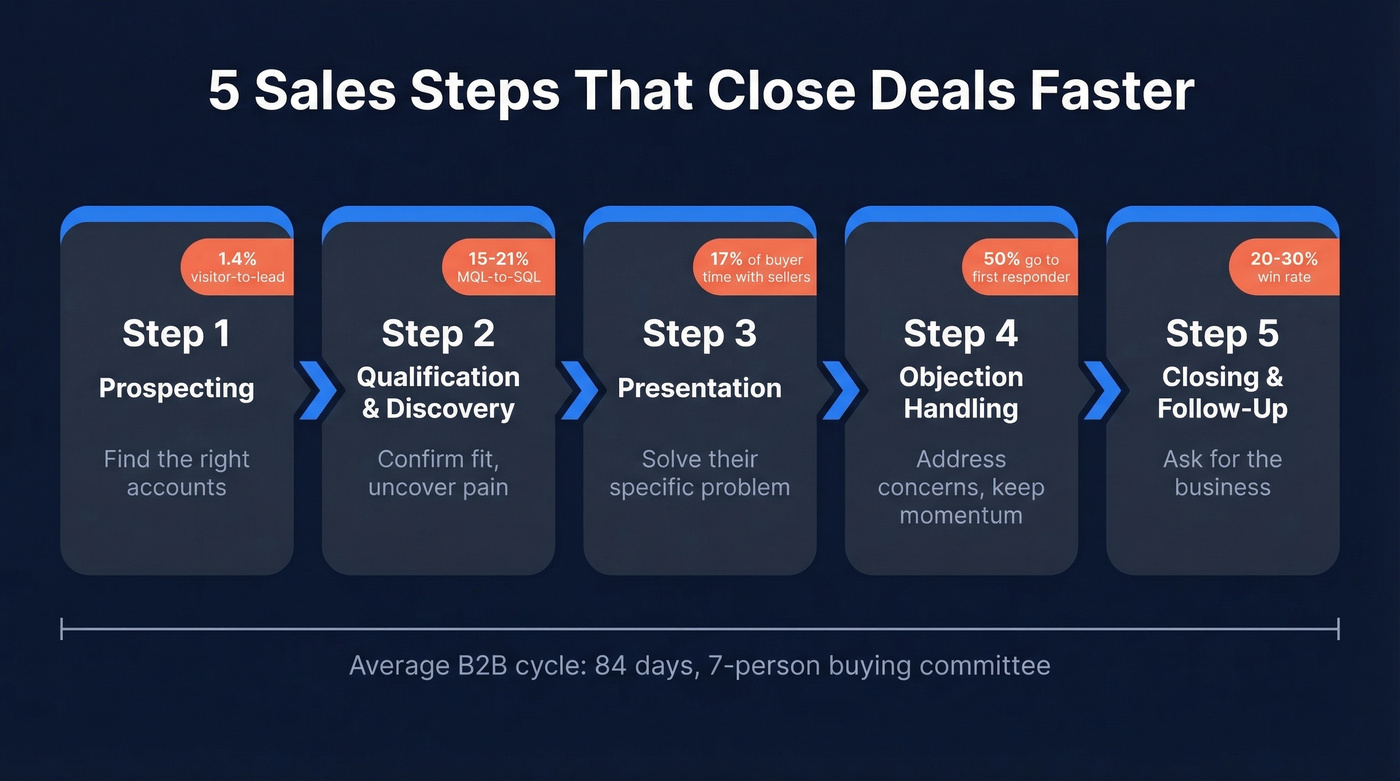
Stop adding steps. We've seen teams build 9-stage, even 15-stage processes that nobody follows. Simpler frameworks get adopted; complex ones get ignored. Five steps covers every deal from first touch to signed contract - the nuance lives inside each step, not in adding more of them.
Each of the 5 Sales Steps, Explained
Step 1 - Prospecting
Prospecting is where your pipeline lives or dies. Visitor-to-lead conversion runs just 1.4% for SMBs and 0.7% for enterprise, and with 80% of B2B interactions happening in digital channels (see B2B Sales benchmarks), you're competing for attention against every vendor in your prospect's inbox. Most deals require 5-12 touchpoints before a conversation even starts.
The biggest mistake isn't volume - it's working stale data. If 30-40% of your emails bounce, no cadence design will save you (use email bounce rate benchmarks to diagnose). Teams burn through entire domain reputations pulling contacts from databases that haven't been refreshed in months. Snyk's outbound team saw this firsthand: bounce rates sat at 35-40% before they switched to Prospeo, which runs a 7-day data refresh cycle and delivers 98% email accuracy. After the switch, bounces dropped below 5% and AE-sourced pipeline jumped 180%.

Pro tip: Define your ICP criteria before you touch a single tool (use an Ideal Customer Profile Template). If you can't articulate who you're targeting and why, you're generating activity, not pipeline.
Step 2 - Qualification & Discovery
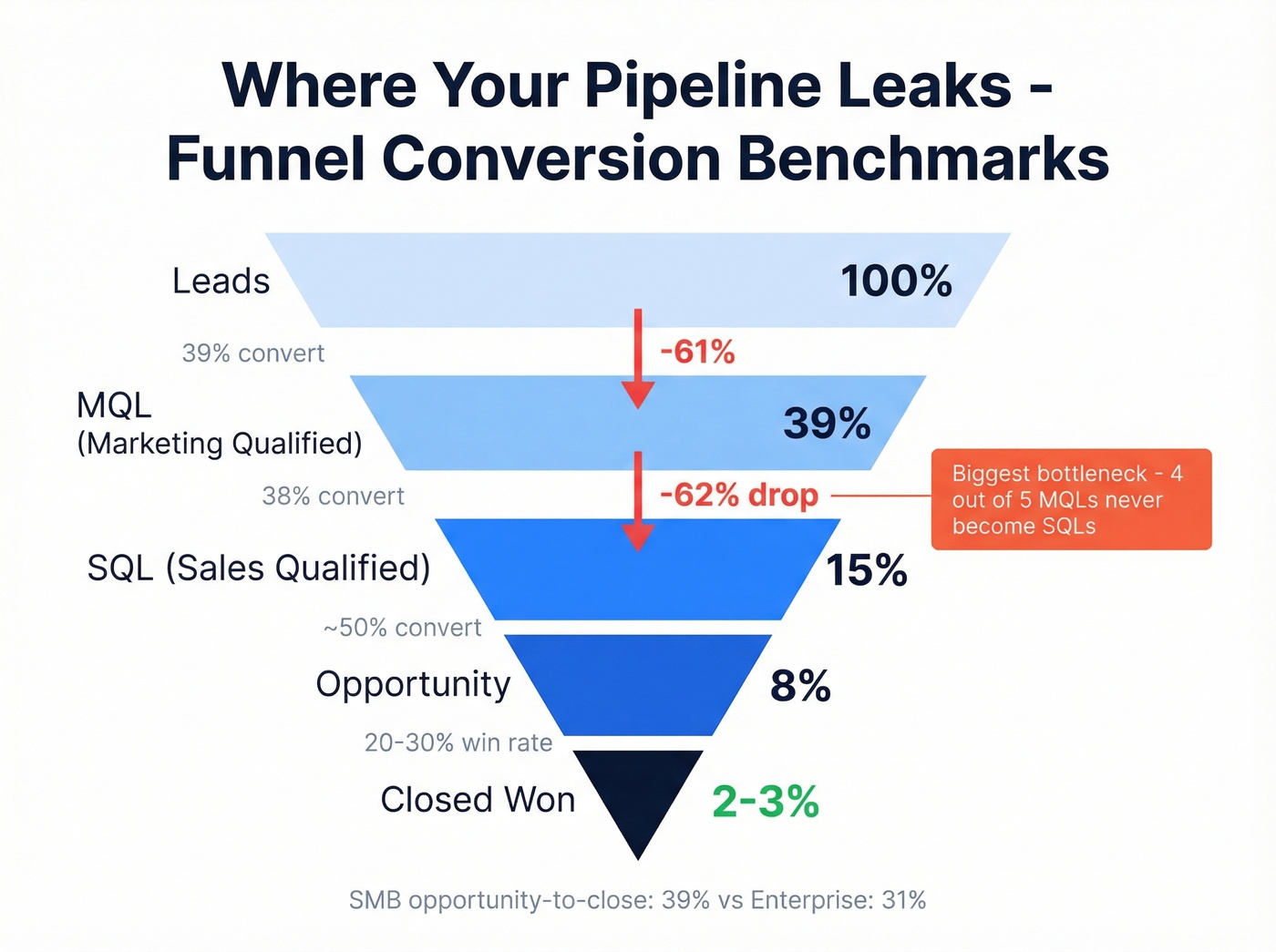
This is where most pipelines break. The MQL-to-SQL conversion bottleneck sits at just 15-21%, meaning roughly 4 out of 5 marketing-qualified leads never become sales-qualified. The full funnel tells the story: lead-to-MQL converts at 39%, MQL-to-SQL at 38%. That's a lot of leakage (track it with funnel metrics).
The best discovery framework we've encountered is the "menu of pain" approach. Instead of open-ended questions that go nowhere, present your prospect with the top 3 problems you typically solve and let them self-select. It builds credibility fast and gets you to the real conversation in minutes, not meetings.
Discovery questions worth stealing (more in our discovery questions guide):
- "Which of these three challenges is costing you the most right now?"
- "If you had to quantify the impact in time, money, or missed opportunities - what would that look like?"
- "Why now? What changed that made this a priority?"
- "Who else needs to sign off before this moves forward?"
Tailor your depth based on the power line. VPs care about strategic outcomes and budget impact. Managers care about tactical execution and daily workflow. Ask accordingly.
The moment you start presenting before you've confirmed pain, budget, and decision process, you've lost control of the deal. Listen more than you talk.
Step 3 - Presentation
Buyers spend just 17% of their buying time meeting with suppliers. The rest goes to independent research, internal discussions, and consensus-building. Your presentation window is narrow - make it count.
Let's be honest: most presentations fail not because the product is wrong, but because the rep is talking to the wrong stakeholders. If you haven't mapped the buying committee during discovery, your presentation is a coin flip. A top-performing SaaS rep on r/sales put it well - do your homework, tailor to C-suite, and build a quantifiable business case before you ever open a slide deck.
For executives, lead with ROI: "We reduced [similar company]'s sales cycle by 22 days, which translated to $1.2M in accelerated revenue." That's a language they speak. Nobody cares about your architecture diagram. (If your deck is the weak link, tighten it with sales deck storytelling.)
Step 4 - Objection Handling
Here's a stat that should change how you think about urgency: up to 50% of deals go to the first vendor to respond. And 28% of reps cite "process too long" as the number one reason prospects back out. Objections aren't the enemy. Stalling is.
The best objection handlers don't argue. They acknowledge, isolate, and redirect. "I hear you on price - let's set that aside for a second. If the ROI math works, is there anything else that would prevent us from moving forward?" That one question separates real objections from smokescreens.
Prepare for the top 5 objections you hear repeatedly and have specific, data-backed responses ready (see how to reduce sales objection rate). If you're getting blindsided by objections in late-stage deals, your discovery was incomplete - go back to Step 2. Getting into arguments is the other killer - you can win the argument and lose the deal every time.
Watch for: Discounting before you've established ROI. The moment you start cutting price, you've trained the prospect to negotiate harder on everything.
Step 5 - Closing & Follow-Up
Conversion numbers diverge sharply by segment: opportunity-to-close runs 39% for SMB but drops to 31% for enterprise. Overall win rates hover around 20-30%. Even well-qualified opportunities die at the finish line more often than not.
The single most effective closing technique isn't a technique at all - it's a mutual evaluation plan. Establish a shared timeline with your champion that maps every step from "we agree there's a fit" to "contract signed." Include legal review, security questionnaires, procurement timelines, and executive sign-off. This maps to the Customer Verifiable Outcomes framework: define buyer actions at each stage that prove the deal is progressing. When both sides commit to a plan, the close becomes a formality.
The #1 closer killer: Not asking. We've reviewed pipeline after pipeline where reps ran great discovery, delivered strong presentations, and then... waited. If you've done Steps 1-4 well, asking "Are you ready to move forward?" isn't pushy. It's professional.
If you want to systematize what happens after the call, keep sales follow-up templates ready before deals hit late stage.

Your 5 sales steps collapse at Step 1 if 35% of emails bounce. Prospeo delivers 98% email accuracy on a 7-day refresh cycle - not the 6-week industry average. Snyk's 50 AEs dropped bounce rates from 35-40% to under 5% and grew AE-sourced pipeline 180%.
Stop burning domains. Start building pipeline that converts.
Which Methodology Fits These Steps?
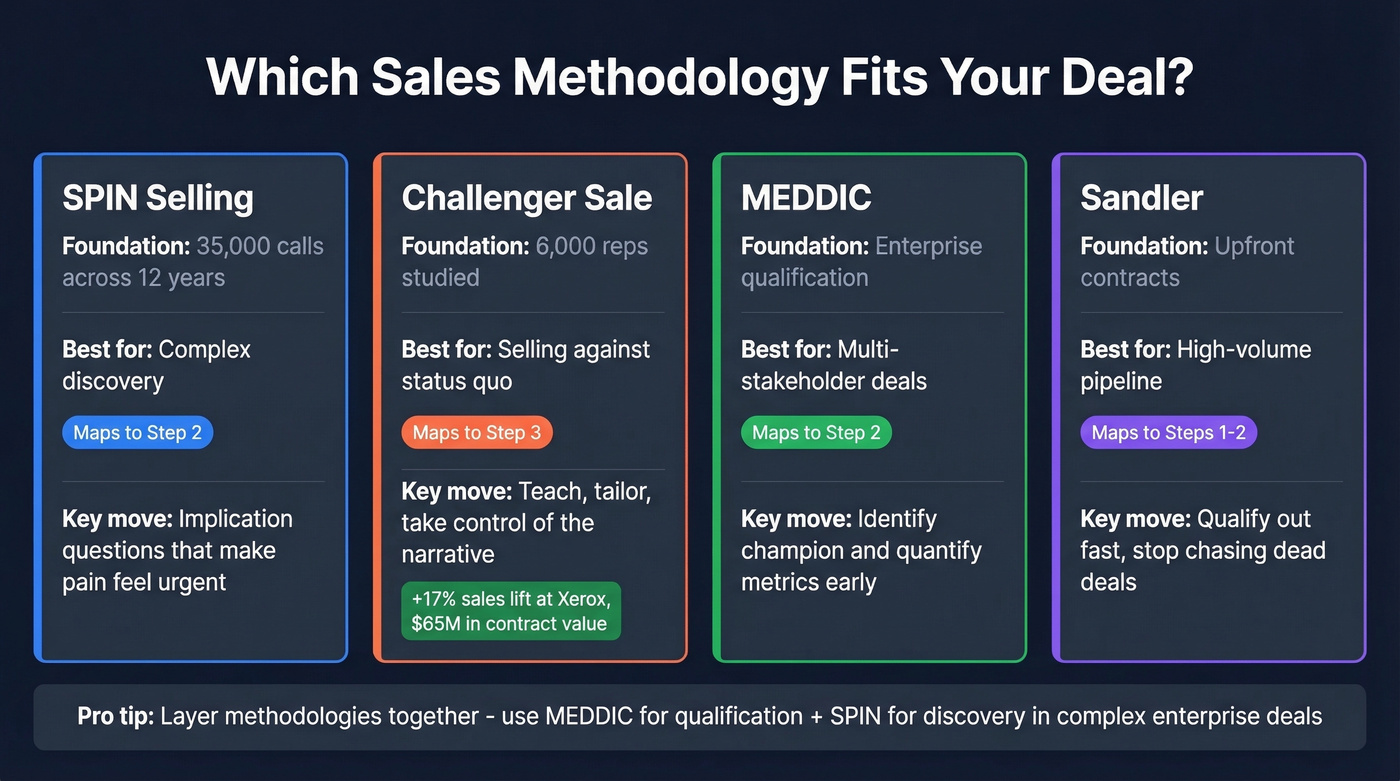
The five steps are your process. A methodology is how you execute within each step.
| Methodology | Foundation | Best For | Maps to Step | Key Move |
|---|---|---|---|---|
| SPIN | 35,000 calls, 12 years | Complex discovery | Step 2 | Implication questions |
| Challenger | 6,000 reps studied | Status quo selling | Step 3 | Teach, tailor, control |
| MEDDIC | Enterprise qualification | Multi-stakeholder deals | Step 2 | Champion + metrics |
| Sandler | Upfront contracts | High-volume pipeline | Steps 1-2 | Qualify out fast |
Xerox reported a 17% increase in sales and $65M in contract value after implementing Challenger. SPIN's research base - 35,000 calls across 20+ countries - remains the most rigorous study of what works in discovery conversations.
You don't have to pick just one. Complex B2B with multiple stakeholders? Start with MEDDIC for qualification and layer SPIN into discovery. Selling against entrenched competitors? Challenger gives you the framework to reframe the conversation entirely.
B2B vs B2C - How the Steps Change
| Dimension | B2B | B2C |
|---|---|---|
| Decision speed | Weeks to months | Minutes to days |
| Stakeholders | 7-person committee | 1-2 people |
| Deal size | 6-7 figures | Lower ticket |
| Discovery focus | ROI, process, pain | Emotion, identity, urgency |
| Closing approach | Mutual eval plan | Urgency + simplicity |
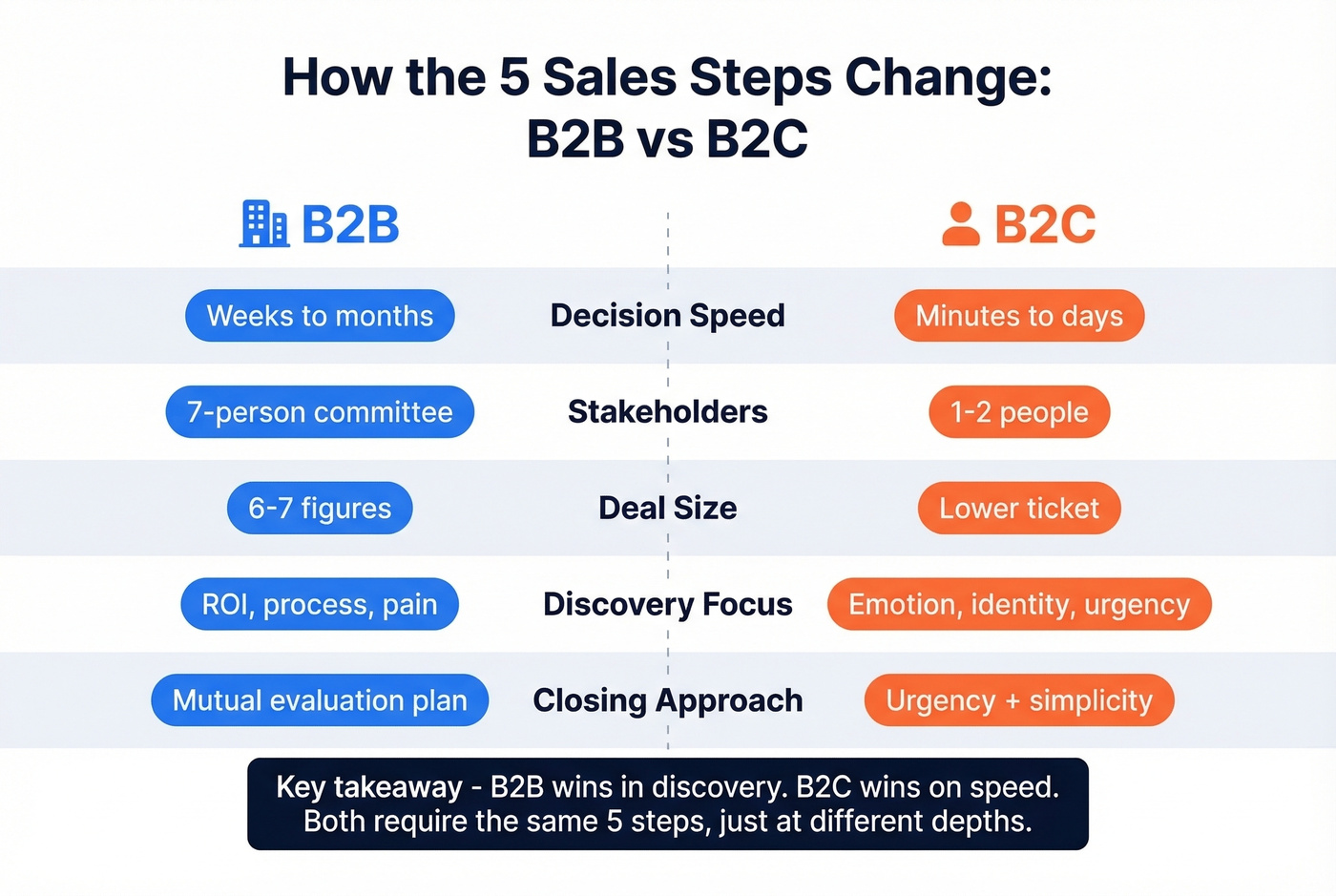
In B2B, discovery is where you win or lose - you're building a business case that survives a 7-person committee and a procurement review. B2C compresses the entire process: discovery might be a single qualifying question, the presentation is often the product itself, and closing is about removing friction.
Skip the 14-field qualification scorecard if your average deal size is under $15K. Run the five sales steps lean, invest in data quality over process complexity, and close faster than your competitors. Speed kills in sales - in a good way.
5 Sales Steps FAQ
What are the 5 sales steps?
Prospecting, qualification and discovery, presentation, objection handling, and closing with follow-up. Every deal moves through these stages - the depth at each step varies by deal complexity and buyer type.
What's the difference between a sales process and a methodology?
A sales process defines the stages a deal moves through from first contact to closed-won. A methodology is the tactical approach within each stage - SPIN guides discovery questions, Challenger shapes presentations, MEDDIC structures qualification. The process is the map; the methodology is how you drive.
How do you fix a broken prospecting step?
Start with data quality. If 30-40% of your emails bounce, no sequence design will compensate. Tools like Prospeo keep contact data current with a 7-day refresh cycle and 98% email accuracy, while 30+ search filters let you target by intent, technographics, and headcount growth before you send a single message.
Do the 5 sales steps work for small teams?
Yes - smaller teams benefit most because a clear five-step framework prevents wasted effort. Focus each step on the highest-leverage activity: verified contacts in prospecting, strict disqualification in discovery, and a mutual close plan. Teams under 10 reps often see the fastest adoption rates.
Discovery and closing mean nothing if you're reaching the wrong people. Prospeo's 30+ filters - buyer intent, technographics, job changes, headcount growth - let you build lists that match your ICP before you ever pick up the phone. At $0.01 per email, bad targeting is the only thing that's expensive.
Nail every step from prospecting to close with data you can trust.