

The ABM Direct Mail Strategy Guide Nobody Else Will Give You
You've got $15k in Q1 budget, 200 target accounts, and three weeks to prove this ABM direct mail strategy wasn't a vanity project. Most "guides" out there are thinly disguised demos for gifting platforms. This one is the playbook you can run with a printer, a spreadsheet, and ruthless follow-through.
What You Need (Quick Version)
Account-based direct mail works when three things are true: your contact data is current, your sends are triggered by real buying signals, and you measure impact at the account level - not the contact level.
Use postcards for Tier 2/3 accounts ($0.50-$1.50/piece) and dimensional mailers for Tier 1 ($25-$1,000 per prospect). Start with stalled deals, not cold accounts - that's your fastest ROI, every time. Expect around 2.8% response on postcards and 12%+ on dimensional mailers.
Skip the $10k-$50k/year gifting platform until you're past 500 sends per quarter. And verify your list first: 15-20% of B2B contacts go stale every quarter, so one in five mailers is headed to someone who already left the company.
Why Direct Mail Still Works for ABM
Physical mail gets processed differently than digital. It's more visual, more spatial, more memorable - which is exactly why it cuts through when inboxes don't.
USPS Mail Moments research shows 76% of consumers trust direct mail more than digital channels when making a purchase decision. That trust gap matters in B2B because your buyer is already numb to "quick question" emails. Direct mail delivers a 112% ROI, outperforming SMS (102%), email (93%), and paid search (88%). And 84% of consumers read direct mail immediately or the same day it arrives.
Direct mail isn't competing with digital; it's the amplifier. When you combine physical and digital touches, response rates jump 63%, and 97% of marketers say omnichannel integration improves performance. Here's our take: if your average deal size sits below five figures, you don't need fancy gifting at all - postcards plus tight follow-up will beat "swag boxes" almost every time.
2026 Response Rate Benchmarks
Response rates swing hard by format. A postcard is a volume play; a dimensional mailer is a "get the meeting" play.
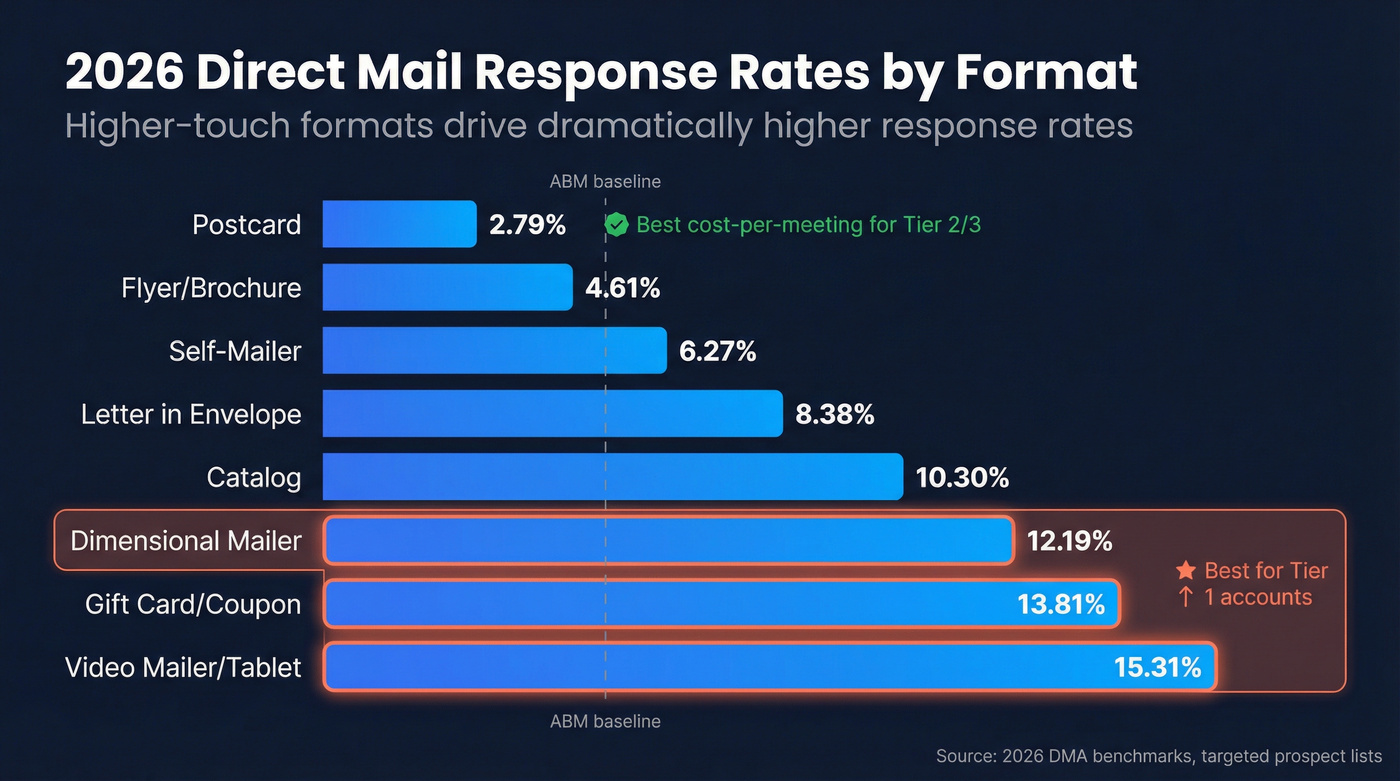
| Format | Response Rate |
|---|---|
| Postcard | 2.79% |
| Flyer/brochure | 4.61% |
| Self-mailer | 6.27% |
| Letter in envelope | 8.38% |
| Catalog | 10.30% |
| Dimensional mailer | 12.19% |
| Gift card/coupon | 13.81% |
| Video mailer/tablet | 15.31% |
These benchmarks come from campaigns where roughly 70% used targeted prospect lists. That's close to an ABM-style baseline, so the numbers translate well.
Seasonality matters more than most teams realize:
| Quarter | B2B Response Rate |
|---|---|
| Q1 | 3.89% |
| Q2 (peak) | 4.12% |
| Q3 | 3.76% |
| Q4 | 3.94% |
| Holiday season | 3.21% |
Q2 wins because budgets are live and evaluation cycles are active. The holiday dip is brutal - your mailer is fighting year-end chaos and half-empty offices.
Choosing Format by Tier
The fastest way to torch budget is treating every account like Tier 1. The fastest way to waste ABM is treating Tier 1 like Tier 3.
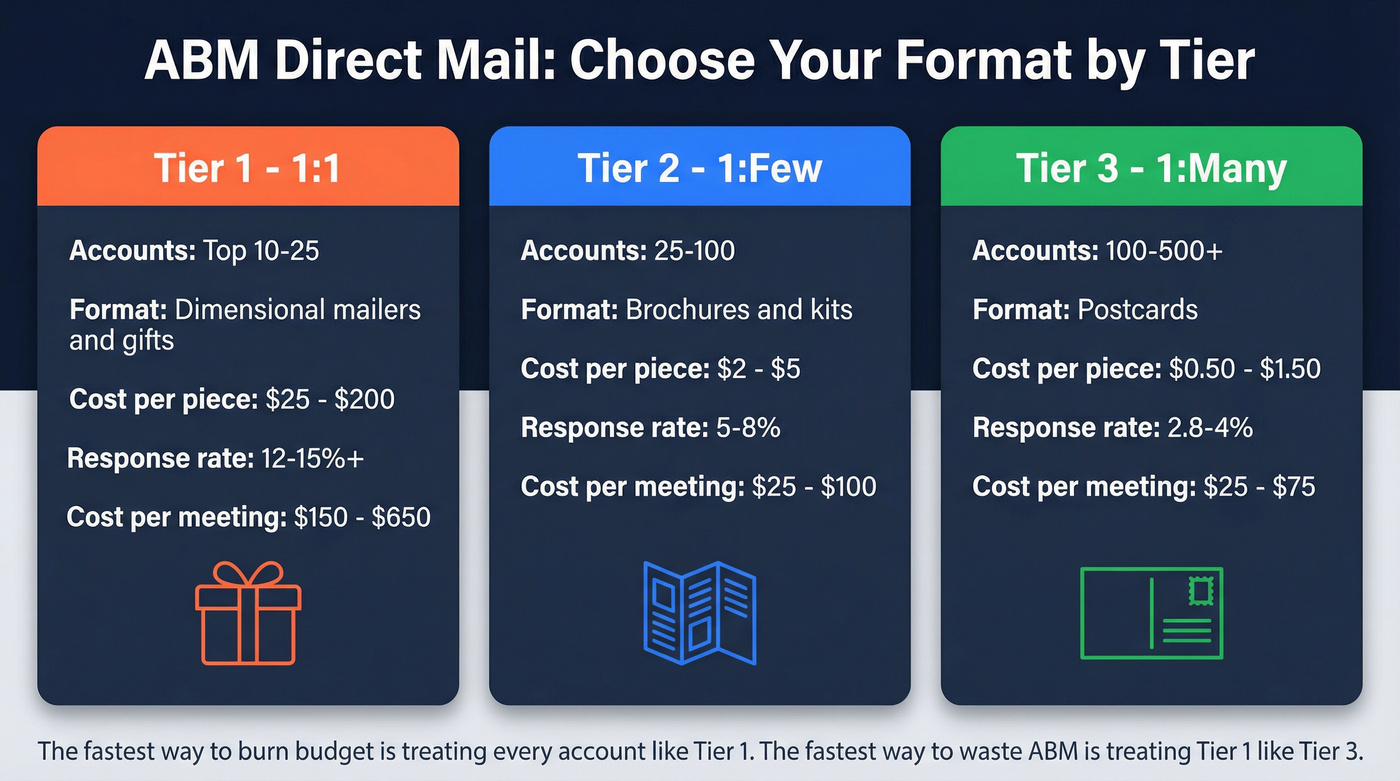
| Tier | Accounts | Format | Cost/Piece | Response Rate | Cost/Meeting |
|---|---|---|---|---|---|
| 1:1 | Top 10-25 | Dimensional/gifts | $25-$200 | 12-15%+ | $150-$650 |
| 1:Few | 25-100 | Brochures/kits | $2-$5 | 5-8% | $25-$100 |
| 1:Many | 100-500+ | Postcards | $0.50-$1.50 | ~2.8-4% | $25-$75 |
Postcards are wildly underrated. For Tier 2/3, they're the cleanest "signal-to-meeting" math you can run without a fulfillment circus. Save the premium kits for Tier 1, where one meeting can be worth a quarter's budget.
Five Trigger-Based Sends That Print Pipeline
Here's the thing: trigger-based sends are where account-based direct mail stops being "cute" and starts generating pipeline. We've tested this across enough campaigns to be blunt - batch-and-blast is just expensive spam with nicer paper.
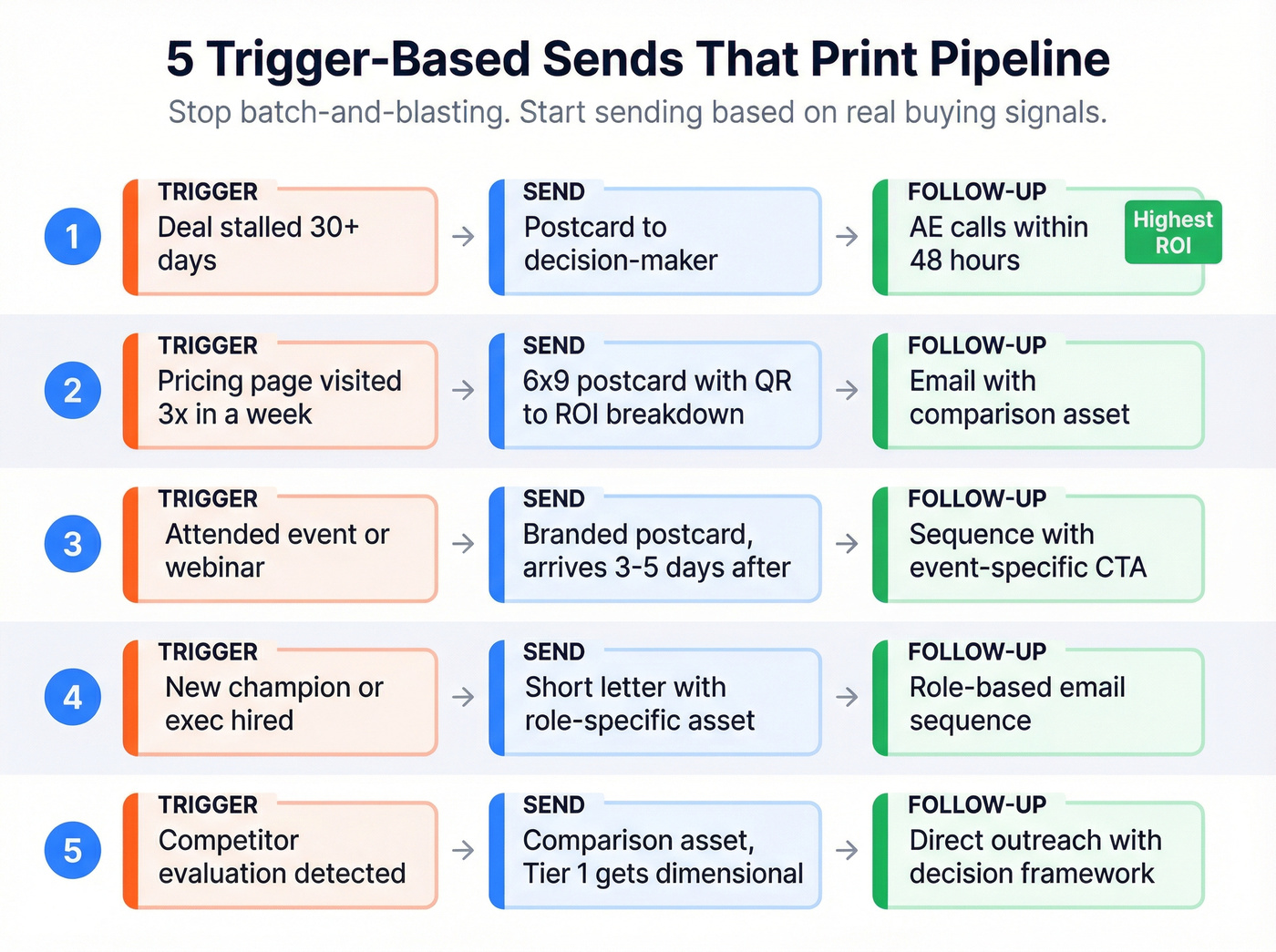
1. Stalled deal reactivation (highest ROI). When an opportunity sits untouched for 30+ days, send a simple postcard to the decision-maker and time AE outreach to land within 48 hours of delivery. Keep the CTA binary: "Worth reopening this week?" works better than "Let's schedule a call."
2. Pricing/comparison page surge. Picture this: a target account hits your pricing page three times in a week, then goes quiet. That's not curiosity - that's internal debate. Mail a 6x9 postcard that gives them a next step that feels helpful, not pushy.
Steal this postcard copy:
- Front: "Cut onboarding time by 40% in 30 days (without adding headcount)."
- Back: "Scan for the 2-page ROI breakdown + benchmarks for teams like yours." Include a QR code, the AE's direct line, and a P.S. that names their industry.
3. Post-event follow-up (timing beats creativity). Send a branded postcard so it arrives 3-5 days after the event while the interaction is still fresh. The best creative is continuity: same visual theme as the booth or webinar, one clear CTA, no product laundry list.
4. New champion or new exec hire. New leaders evaluate vendors early. Send a short letter that acknowledges the role change and offers a specific asset: "Here's what other VPs of Ops did in their first 90 days to hit the board's efficiency targets." Then follow up with a tight, role-based sequence.
5. Competitor evaluation detected. If intent signals show active competitor research, don't send "thought leadership." Send a comparison asset with a single question: "Do you want the fastest path to a decision, or the safest?" Tier 1 gets dimensional; Tier 2/3 gets postcards.

You just read that 15-20% of B2B contacts go stale every quarter. That means one in five of your direct mailers is headed to an empty desk. Prospeo enriches your ABM list with 50+ data points per contact, returns data on 83% of leads at 98% email accuracy, and refreshes everything on a 7-day cycle - so your mailers land and your AEs have verified direct dials for the follow-up call.
Clean your list before you spend a dollar on postage.
The Data Foundation
Direct mail punishes bad data immediately. Email can bounce quietly; physical mail comes back to you like a receipt for your mistakes.
If your CRM hasn't been enriched recently, you're mailing into the void. Data decay runs 15-20% per quarter, and that's before you factor in office moves, hybrid work, and role changes. We've seen teams waste 20%+ of their direct mail budget on undeliverable sends simply because they skipped verification - it's the dumbest way to burn money in this channel.
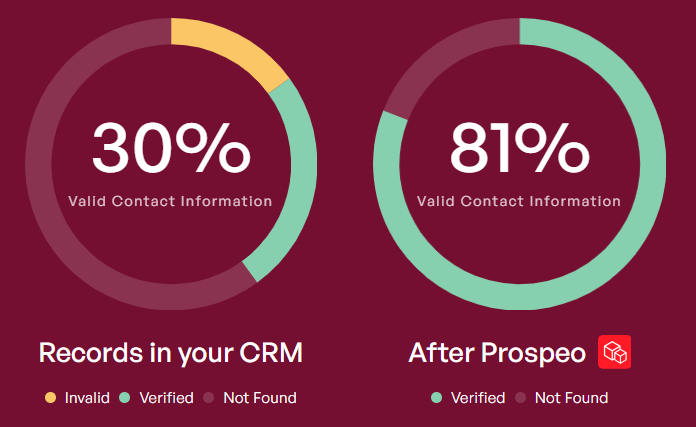
Prospeo handles this before you print. It enriches CRM and CSV lists with 50+ data points per contact and returns data on 83% of leads, with 98% email accuracy on a 7-day refresh cycle. The practical win: your mailers land, and your AEs have direct dials ready for follow-up. With 125M+ verified mobile numbers delivering a 30% pickup rate, the phone follow-up after a mailer actually connects.
For a deeper walkthrough of list hygiene, this guide is worth bookmarking: Prospeo's data enrichment overview.
What It Actually Costs
Direct mail is expensive when it's vague. It's cheap when it's targeted.
| Component | Range | Notes |
|---|---|---|
| Postcards (all-in) | $0.48-$1.45/piece | Volume-dependent |
| Targeted letters | $0.75-$2.00/piece | Includes personalization |
| Printing (color) | $0.10-$0.80/piece | |
| USPS Marketing Mail | ~$0.43/piece | Minimum 200 pieces or 50 lbs |
| USPS EDDM | ~$0.247/piece | Route-based saturation mail |
| Design | $200-$1,000 flat | Reuse templates after round one |
| Annual USPS permit | $275 |
For real-world pricing, 500 color postcards with Standard Mail can land around $0.82/piece all-in. A nice "middle tier" option is a tri-fold brochure: 2,000 pieces can run about $0.65/piece, which is perfect for 1:Few kits without jumping to dimensional costs.
One stat that keeps teams honest: DMA benchmarks put direct mail at ~2.9% response for prospect lists and ~4.4% for house lists. Email averages ~0.12%, and paid search sits around ~0.6%. That's why mail can look "expensive" per piece and still be cheap per outcome.
For current postage specifics, USPS business pricing is the source of truth.
Platform costs (when you're ready):
- Sendoso: ~$10k-$50k/year plus per-send costs.
- Postal: ~$5k-$15k/year for smaller teams, scaling with volume.
- Reachdesk: ~$10k-$25k/year, strongest when you're doing heavy gifting and want tighter control over options and breakage.
Let's be honest: under 500 sends per quarter, a platform is a distraction. Spend that money on better targeting, better creative, and tighter AE follow-up.
Build Your Strategy Step by Step
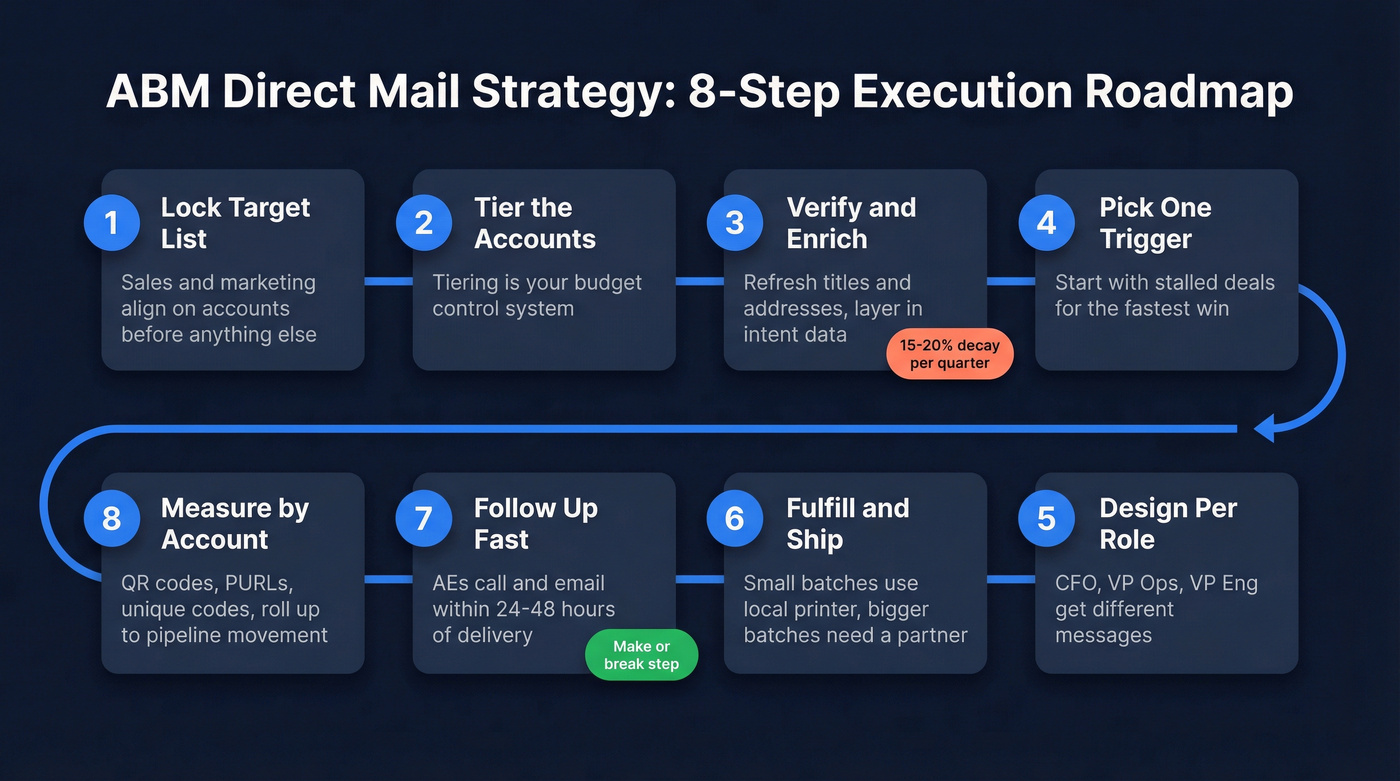
- Lock the target account list. Sales and marketing agree on the list before anyone designs anything. No alignment here, no point continuing.
- Tier the accounts. Tiering is your budget control system - treat it like one.
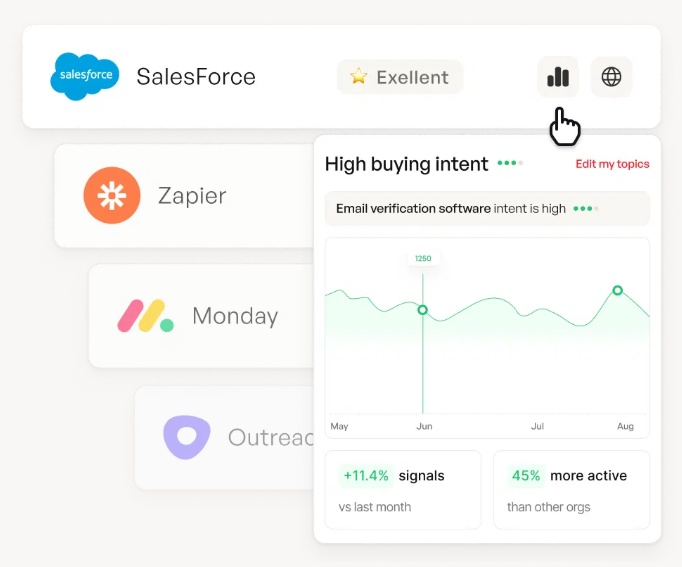
- Verify and enrich contacts. Refresh titles and addresses so you're not paying to mail ex-employees. Layer in intent data to flag which accounts are actively in-market, so you prioritize sends that hit during a live buying cycle.
- Pick one trigger to start. Stalled deals is the easiest win; run it first.
- Design one template per role. CFO, VP Ops, VP Eng should not get the same message. The more specific the copy, the higher the response.
- Fulfill and ship. Small batches can run through a local printer; bigger batches need a fulfillment partner.
- Follow up fast. AEs should call and email inside 24-48 hours of delivery. Add retargeting if you have it. In our experience, "mail + silence" is the #1 reason teams decide direct mail "doesn't work." If you need a starting point, use proven sales follow-up templates.
- Measure at the account level. Use QR codes, PURLs, and unique codes, then roll up to accounts influenced and pipeline movement - not form fills.
Case Studies That Justify the Budget
Snowflake researched 200 enterprise accounts and sent premium mailers - printed booklets or tablets with custom data visualizations. They generated $50M+ in pipeline. That's not a typo.
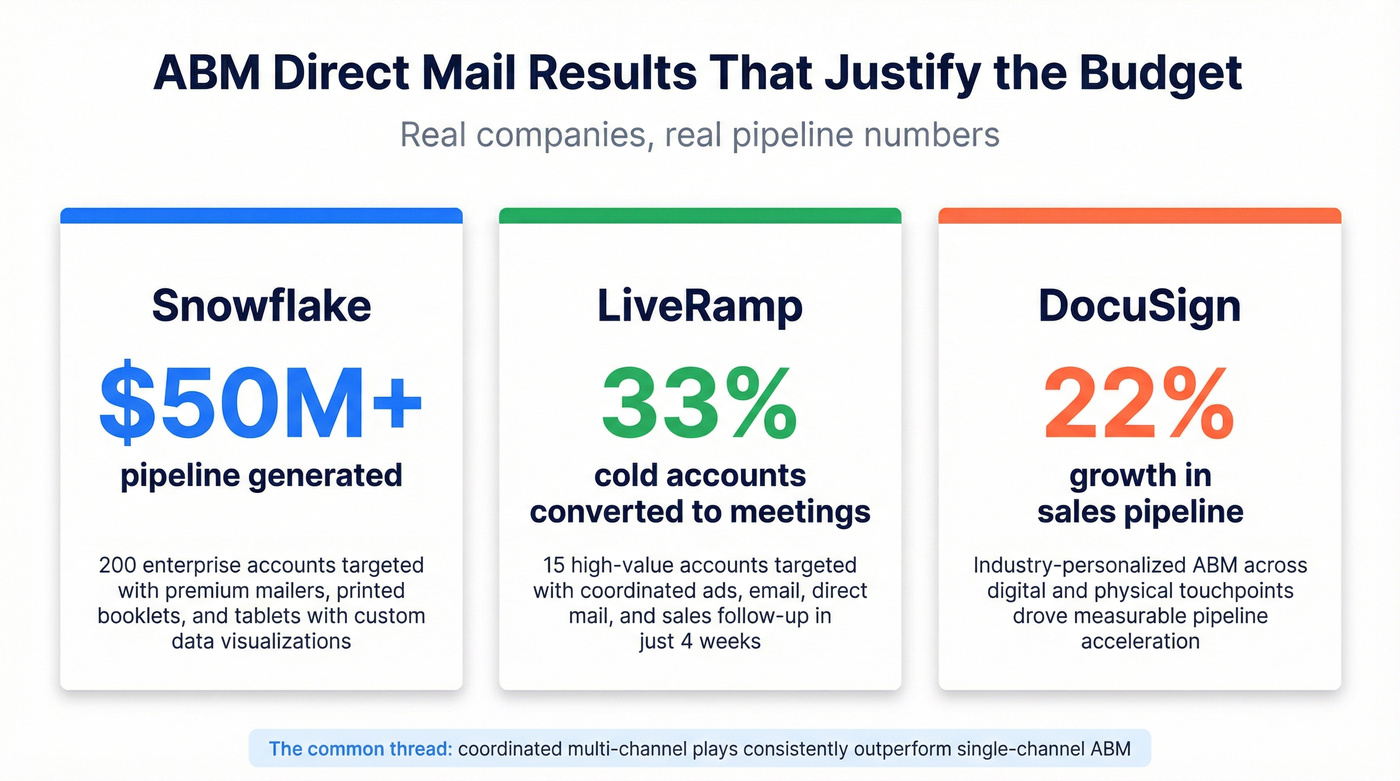
LiveRamp targeted 15 high-value accounts with coordinated ads, email, direct mail, and sales follow-up. They converted 33% of cold accounts to meetings within four weeks. The consensus on r/sales is that coordinated multi-channel plays like this consistently outperform single-channel ABM, and LiveRamp's results back that up.
DocuSign ran industry-personalized ABM across digital and physical touchpoints and drove 22% growth in sales pipeline.
Seven Mistakes That Kill ROI
- Running it like lead gen. ABM direct mail is for pipeline movement, not MQL trophies. If your team still thinks in MQLs, fix the funnel math first with a clean B2B sales funnel template.
- Fake personalization. A first name and logo isn't personalization; it's mail merge. Reference their tech stack, a recent hire, or a specific pain point. (If you want a system for this, start with personalized outreach.)
- Not telling sales what shipped. If the AE doesn't know a package is coming, your best follow-up window evaporates. Account-based sales mail only works when reps are looped in before the package lands.
- Measuring at the contact level. Cookie loss, attribution windows, lead sync failures, and CRM hygiene will lie to you. Track account influence and deal velocity instead. This is also why pipeline health matters more than vanity response rates.
- Skipping verification. Undeliverable mail is the dumbest way to burn budget. Full stop. If you’re evaluating vendors, compare data enrichment services before you commit.
- Ignoring gift policies. Many enterprises cap gifts at $25-$50. Don't send something they can't accept.
- One-and-done sending. Direct mail is a touch in a sequence, not a standalone tactic. Plan 3-5 coordinated touches across channels. If you need structure, build it like sequence management.
Skip dimensional mailers entirely if your average deal size is under $10k - the math won't work no matter how clever the creative is.
Trigger-based sends only work when you're reaching the right person at the right company. Prospeo gives you 125M+ verified mobile numbers with a 30% pickup rate - so when that dimensional mailer lands on a Tier 1 prospect's desk, your rep connects on the follow-up call instead of hitting voicemail. At $0.01 per email, your data costs less than a single postcard.
Your $200 mailer deserves a phone number that actually picks up.
Compliance Checklist
Treat compliance like part of your creative brief, not a legal afterthought. Use a documented lawful basis for processing under GDPR, keep data minimal (name, title, business address), and honor opt-outs. Set retention limits and delete on request. If you use a fulfillment partner, put DPAs in place. For intent data, account-level signals are the safer posture than person-level tracking. And before you send anything of value, check corporate gift policies - getting a gift rejected is worse than sending nothing. If you’re operationalizing triggers, use a documented process for identifying buying signals.
FAQ
What makes a good ABM direct mail strategy?
A strong ABM direct mail strategy is triggered by buying signals, tiered by account value, and measured at the account level - not the contact level. Spend $0.80 on a postcard for Tier 3 and $80 on a dimensional kit only when the account justifies it. Track pipeline influenced and deal velocity, not form fills.
What's the average response rate for direct mail in ABM?
Overall average response is 3.63%, but format drives the real number. Postcards run 2.79%, dimensional mailers hit 12.19%, and video mailers reach 15.31%. Targeted prospect lists outperform house lists at scale.
How do I keep my mailing list accurate?
Enrich and verify contacts before every send. Data decays 15-20% per quarter, so quarterly refreshes are the minimum. Pair address verification with email verification and you'll cut undeliverable waste to near zero.
Do I need a gifting platform like Sendoso?
Not until you're consistently above 500 sends per quarter. Start scrappy: printer, USPS, and tight AE follow-up. Platforms like Sendoso ($10k-$50k/year) are for scale and workflow automation, not for proving the channel works.
How do I track ABM direct mail ROI?
Use QR codes, PURLs, and unique promo codes to capture responses, then measure at the account level: accounts influenced, deals opened, pipeline created, and time-to-next-step. Contact-level attribution consistently undercounts direct mail because tracking breaks across channels.