

How to Accelerate Your Sales Cycle in 2026
Your best rep just burned 11 touches on a prospect whose email bounced on touch one. That's not a messaging problem - it's a data problem, and it added two weeks to a deal that should've closed last month. 43% of sales leaders say their cycle got longer in the past year, and 44% say losses to "no decision" are climbing. The deals aren't dying to competitors. They're dying to inertia, bad inputs, and bloated timelines.
If you want to accelerate your sales cycle, you need to fix your inputs before you optimize your messaging. Cutting your cycle from 4 months to 3 increases ARR by 46% over two years - the math alone justifies obsessing over this. Below: industry benchmarks, the sales velocity formula, and 7 strategies ranked by impact.
The Compounding Math of Cycle Time
A shorter cycle doesn't just feel better - it compounds. Common Paper modeled it with realistic assumptions ($1M acquisition budget, $20K ACV, 25% win rate): shrinking a 4-month cycle to 3 months produces 46% more ARR over two years. Cut to 2 months and you're at 143% higher ARR. That's not marginal. That's a different company trajectory.
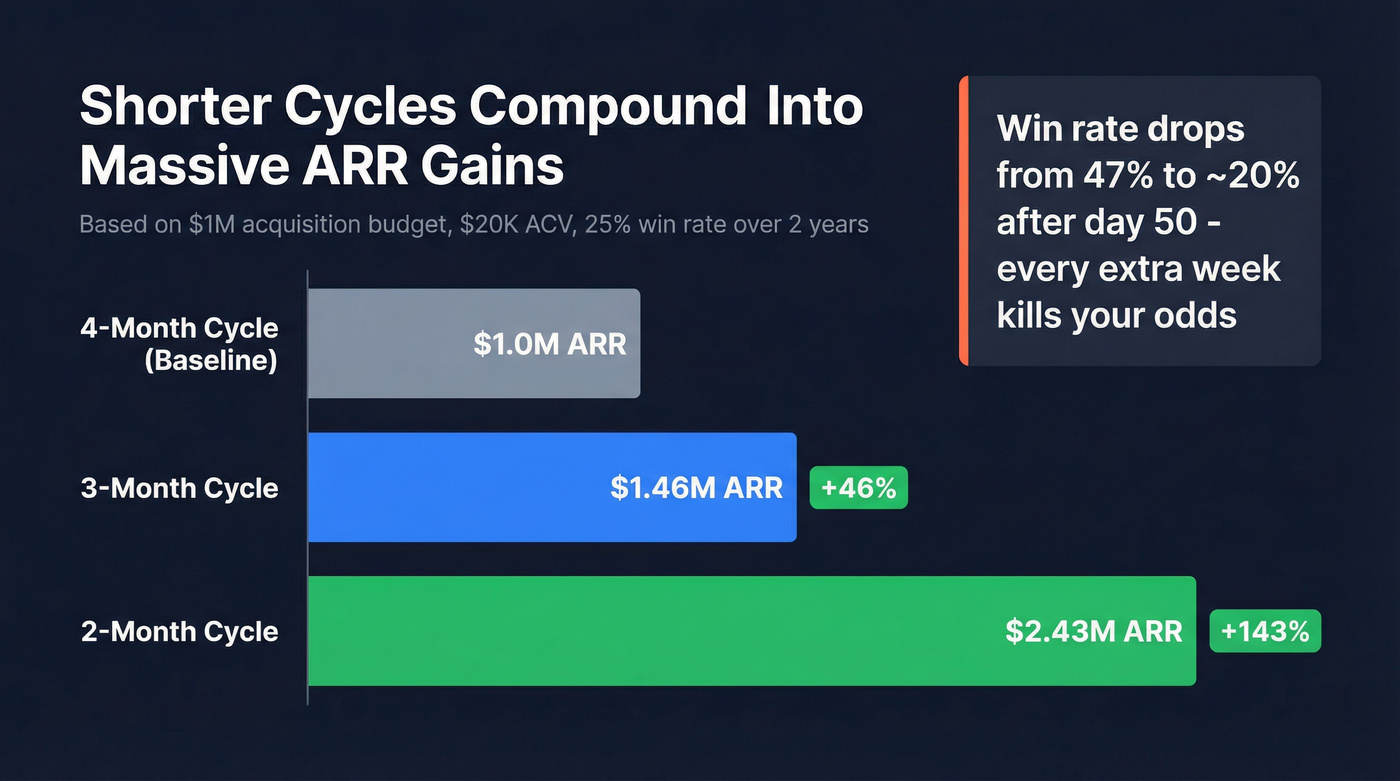
The win-rate data reinforces this. Outreach's analysis found that deals closed within 50 days carry a 47% win rate. Past 50 days, that drops to roughly 20%. Every week you add doesn't just delay revenue - it actively kills your odds of winning.
Know Your Baseline
You can't shorten what you haven't measured. These benchmarks from Focus Digital's study give you a starting point. If you need more Sales cycle benchmarks to sanity-check your segment, compare across deal size and company size too.
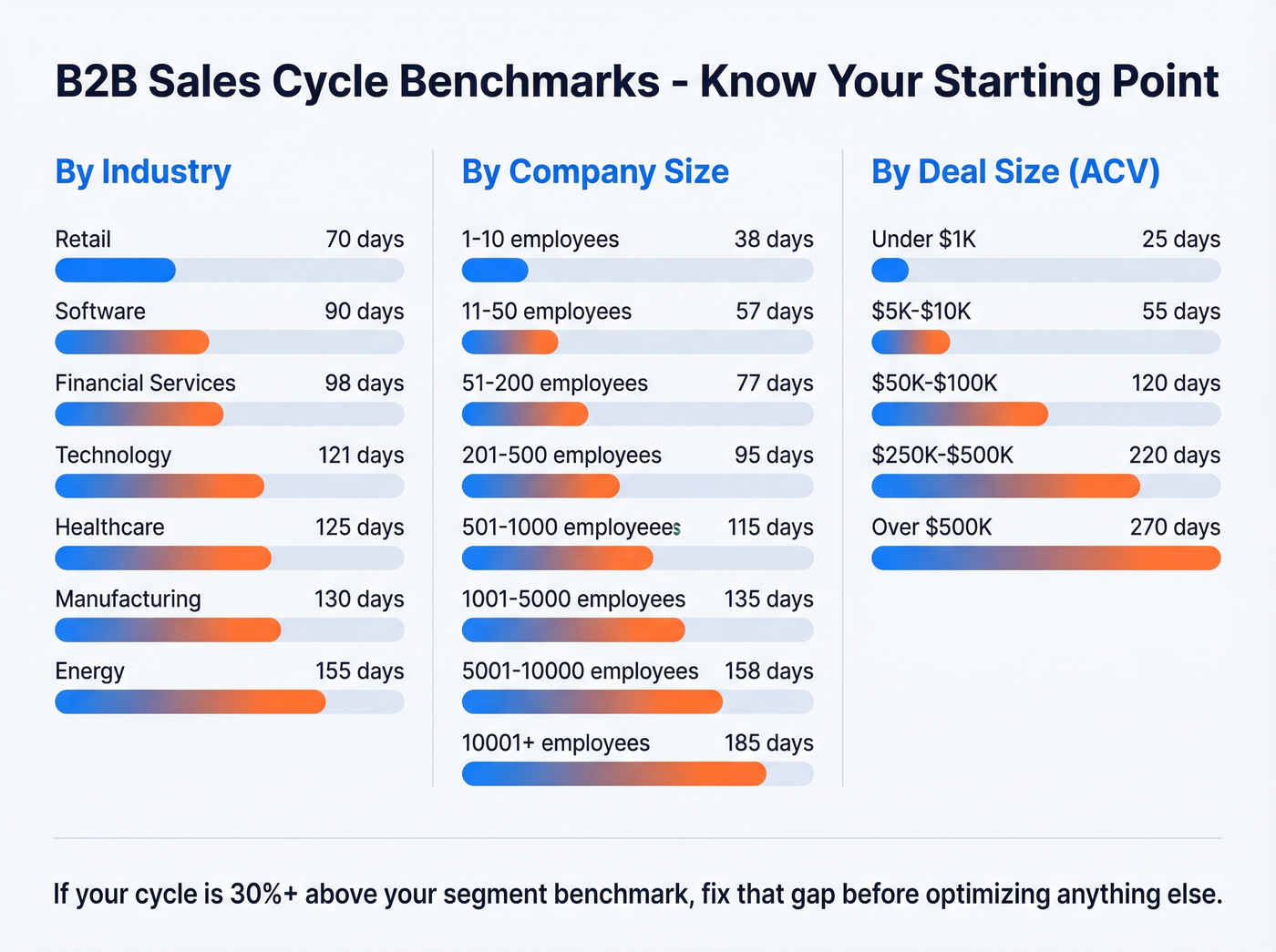
By Industry
| Industry | Avg. Days |
|---|---|
| Retail | 70 |
| Software | 90 |
| Financial Services | 98 |
| Technology | 121 |
| Healthcare | 125 |
| Manufacturing | 130 |
| Energy | 155 |
By Company Size (Prospect)
| Employees | Avg. Days |
|---|---|
| 1-10 | 38 |
| 11-50 | 57 |
| 51-200 | 77 |
| 201-500 | 95 |
| 501-1,000 | 115 |
| 1,001-5,000 | 135 |
| 5,001-10,000 | 158 |
| 10,001+ | 185 |
By Deal Size (ACV)
| ACV | Avg. Days |
|---|---|
| < $1K | 25 |
| $5K-$10K | 55 |
| $50K-$100K | 120 |
| $250K-$500K | 220 |
| > $500K | 270 |
If you're selling $50K deals into mid-market companies and your cycle runs 150+ days, that gap is worth fixing before anything else.

Bad data added 2-3 weeks to Snyk's cycle across 50 AEs. After switching to Prospeo, bounce rates dropped from 35-40% to under 5% and AE-sourced pipeline jumped 180%. With 98% email accuracy and a 7-day refresh cycle, every touch actually lands.
Stop burning touches on dead emails. Fix your data inputs first.
Measure Before You Optimize
The sales velocity formula gives you a single number to track:
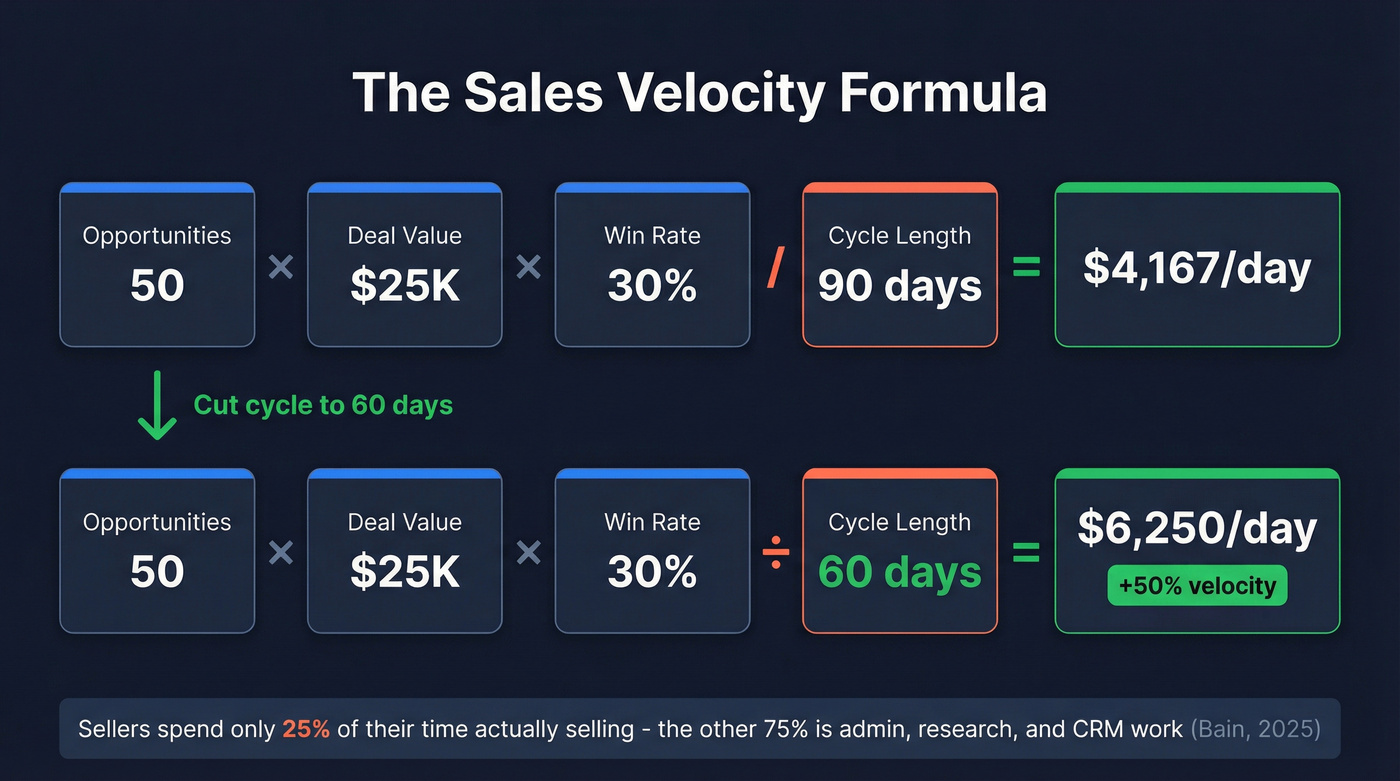
Sales Velocity = (Opportunities x Deal Value x Win Rate) / Cycle Length
A worked example: 50 qualified opportunities x $25K average deal x 30% win rate / 90-day cycle = $4,167/day in pipeline velocity. Shorten that cycle to 60 days and velocity jumps to $6,250/day - a 50% increase without touching any other variable.
Here's the thing: Bain found that sellers spend roughly 25% of their time actually selling. The other 75% goes to admin, research, internal meetings, and CRM hygiene. Every strategy below attacks either the overhead or the deal momentum - sometimes both.
If you're tightening your measurement stack, it also helps to track funnel metrics alongside velocity so you can see where deals actually slow down.
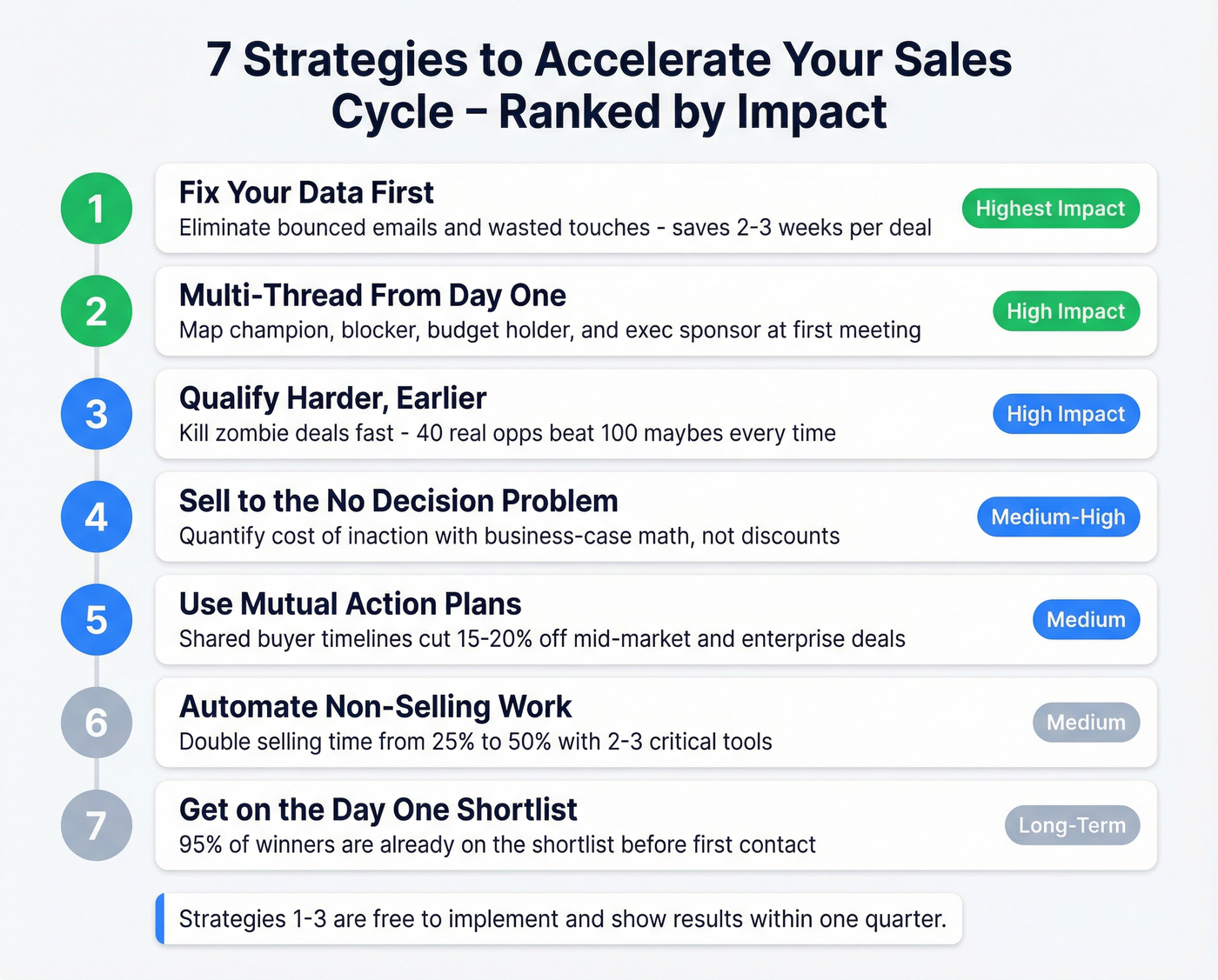
7 Strategies to Close Deals Faster
1. Fix Your Data First
Bad contact data is the silent cycle-killer. 73% of buyers actively avoid suppliers who send irrelevant outreach, and every bounced email wastes a touch in a world where it takes around 8 touches to generate a conversation. We've seen teams cut 2-3 weeks off their cycle just by eliminating bounced emails. When Snyk deployed Prospeo across 50 AEs, bounce rates dropped from 35-40% to under 5%, and AE-sourced pipeline jumped 180%.
If you want to go deeper on fixing inputs, start with data enrichment and then monitor your email bounce rate so you can prove the cycle-time impact.
2. Multi-Thread From Day One
The average B2B deal involves 10-11 stakeholders, and 80%+ of sellers have lost or stalled deals because a key contact left the company. Map your Champion, Blocker, Budget Holder, and Executive Sponsor from the first meeting. Single-threading is the fastest way to add 30 days to any deal - and it's the mistake we see most often in pipeline reviews.
This is also where account-based selling pays off: you’re building consensus, not just winning one person.
3. Qualify Harder, Earlier
Would you rather forecast 100 opportunities where half are zombies, or 40 where every one has a real shot? A 40-opportunity pipeline with tight qualification beats a bloated one every time. Deals past 50 days drop to ~20% win rate, so kill zombie deals faster. The pipeline feels smaller, but velocity goes up because you stop dragging dead weight through your forecast.
This single discipline does more to accelerate your sales cycle than any tool purchase.
If your team needs a shared framework, implement MEDDIC sales qualification so reps disqualify faster and forecast cleaner.
4. Sell to the "No Decision" Problem
Look, your biggest competitor isn't the other vendor - it's the status quo. 44% of leaders say no-decision losses increased last year. Quantify the cost of inaction: revenue lost per month of delay, cost of manual workarounds, opportunity cost of the team's time. Build urgency with business-case math, not discounts. Discounts signal desperation and train buyers to wait.
To keep deals moving, it helps to formalize identifying buying signals so reps know when to push and when to walk.
5. Use Mutual Action Plans
Before: Your champion says "we'll try to get legal review done next week." Three weeks later, nothing.
After: A shared document with buyer milestones - legal review by June 5, procurement approval by June 12, IT security assessment by June 19 - creates accountability. When the buyer co-owns the timeline, you reduce surprises in the part of the process that can eat 25-50% of the total deal duration. Reps who use mutual action plans consistently report 15-20% shorter close times on mid-market and enterprise deals.
6. Automate Non-Selling Work
If sellers spend 25% of their time selling, the right tools can double that. Don't buy 25 tools - pick two or three that cover the critical stack. In our experience, the biggest gains come from process redesign, not just automation. Automating inefficient workflows just creates faster inefficiency.
If you’re evaluating your stack, start with a shortlist of SDR tools and make sure your outreach workflows follow solid sequence management principles.
| Category | Tool | Use Case | Approx. Pricing |
|---|---|---|---|
| Data enrichment | Prospeo | Verified emails + mobiles, 98% accuracy, 7-day refresh | Free tier; ~$0.01/email |
| Sales engagement | Outreach / Instantly | Sequencing + automation | Outreach: enterprise pricing; Instantly: ~$30-100/mo |
| Conversation intel | Gong | Call coaching + deal insights | Enterprise pricing (~$100+/user/mo) |
| CRM | HubSpot / Salesforce | Pipeline management | HubSpot free tier available; paid ~$20-$30/user/mo |
7. Get on the Day One Shortlist
95% of winning vendors are already on the buyer's Day One shortlist. - 6sense Buyer Experience Report
The pre-contact favorite wins ~80% of the time. Buyers are engaging sellers 6-7 weeks earlier than last year - use intent data and buyer signals to show up before the shortlist solidifies. If you're responding to an RFP cold, you're probably already losing.
Let's be honest: if your average deal is under $25K and you're not showing up in a buyer's research phase, no amount of outbound sequencing will save your cycle time. Invest in content and intent signals before you invest in more SDRs.
Mistakes That Lengthen Your Cycle
Single-threading. One champion, one point of failure. When they leave the company, your deal dies. The consensus on r/sales is that multi-threading is the single most underrated skill in enterprise selling, and we'd agree.
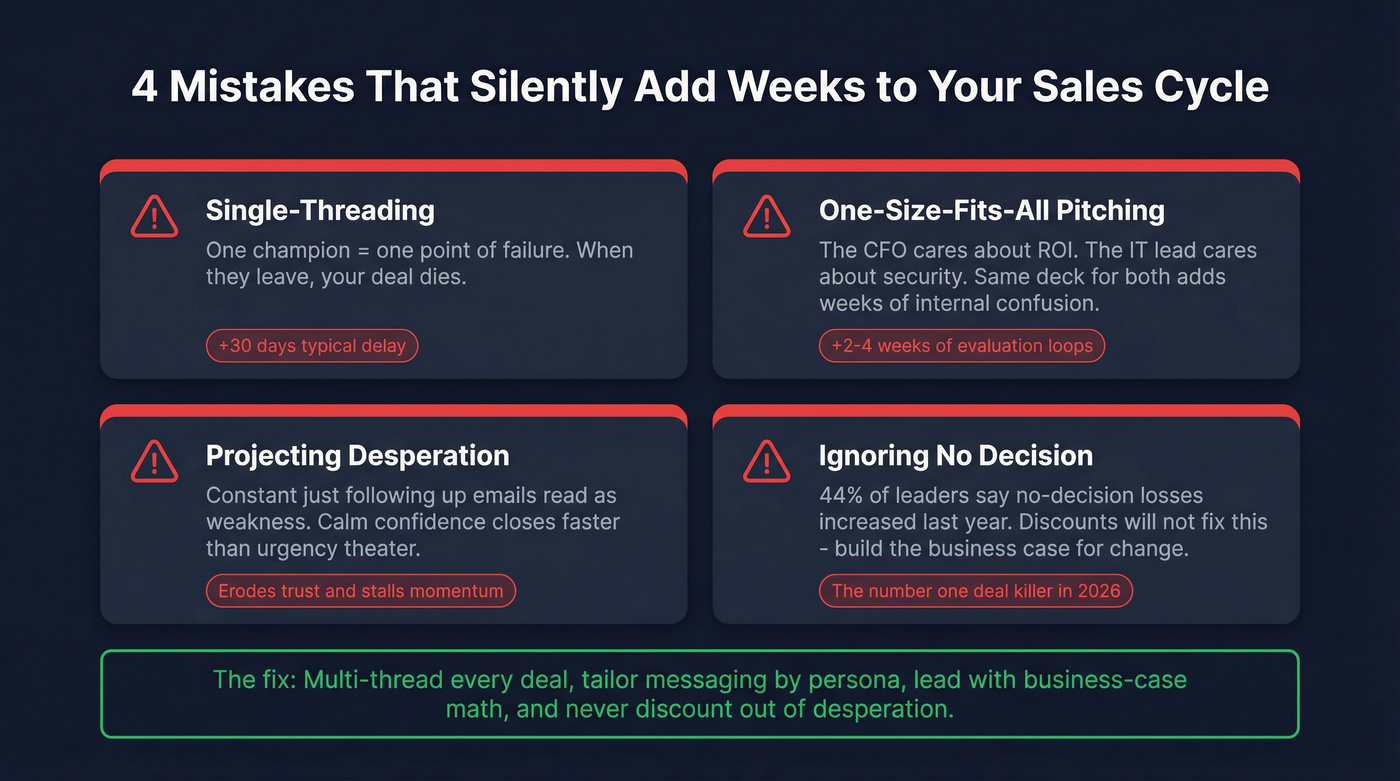
One-size-fits-all pitching. The CFO cares about ROI; the IT lead cares about security. Same deck for both adds weeks of "internal evaluation" that's really just confusion.
Projecting desperation. Constant "just following up" emails read as weakness. Calm confidence closes faster than urgency theater. If your team needs better language, use these sales follow-up templates instead of generic check-ins.
Ignoring "no decision." If you're not building the business case for change, the buyer defaults to doing nothing. Skip the discount lever entirely - it won't fix this problem.
Multi-threading requires verified contact data for every stakeholder - champion, blocker, budget holder, executive sponsor. Prospeo gives you 300M+ profiles with 30+ filters, verified emails at $0.01 each, and 125M+ direct dials so you reach the full buying committee from day one.
Reach all 10 stakeholders on the deal, not just the one who replies.
FAQ
How long is the average B2B sales cycle?
Software averages 90 days, healthcare 125, and energy 155. Deal size matters more than industry - sub-$1K deals close in ~25 days while $500K+ deals average 270 days. Use the benchmarks above to find your segment and measure against it.
How much revenue does a shorter cycle add?
Common Paper's model shows cutting a 4-month cycle to 3 months increases ARR by 46% over two years. Cut to 2 months and it's 143% higher. The impact compounds because reps recycle capacity into new deals faster, so the gains stack quarter over quarter.
What's the fastest way to accelerate a sales cycle?
Fix your contact data. Bounced emails and disconnected numbers silently waste rep time and burn cadence steps. After data quality, multi-threading and ruthless qualification deliver the next biggest gains - they're free to implement and the results show up within a single quarter.
Do mutual action plans actually shorten deals?
Yes. Procurement, legal, and security reviews consume 25-50% of total deal time. A shared timeline with named owners and firm dates creates buyer-side accountability that email follow-ups simply can't replicate.