

How to Make Google Ads Work for Account-Based Marketing
The conventional wisdom is that you can't run account-based marketing on Google Ads. That's wrong. Google Ads won't let you target companies by name the way LinkedIn or a DSP will - that's the real limitation. But with Customer Match, offline conversion imports, and value-based bidding, you can build an ABM engine on Google that optimizes toward pipeline, not form fills. We've helped teams set this up, and the playbook is more accessible than most people think.
What You Need Before Anything Else
You don't need a six-figure ABM platform to start. Three things, configured correctly:
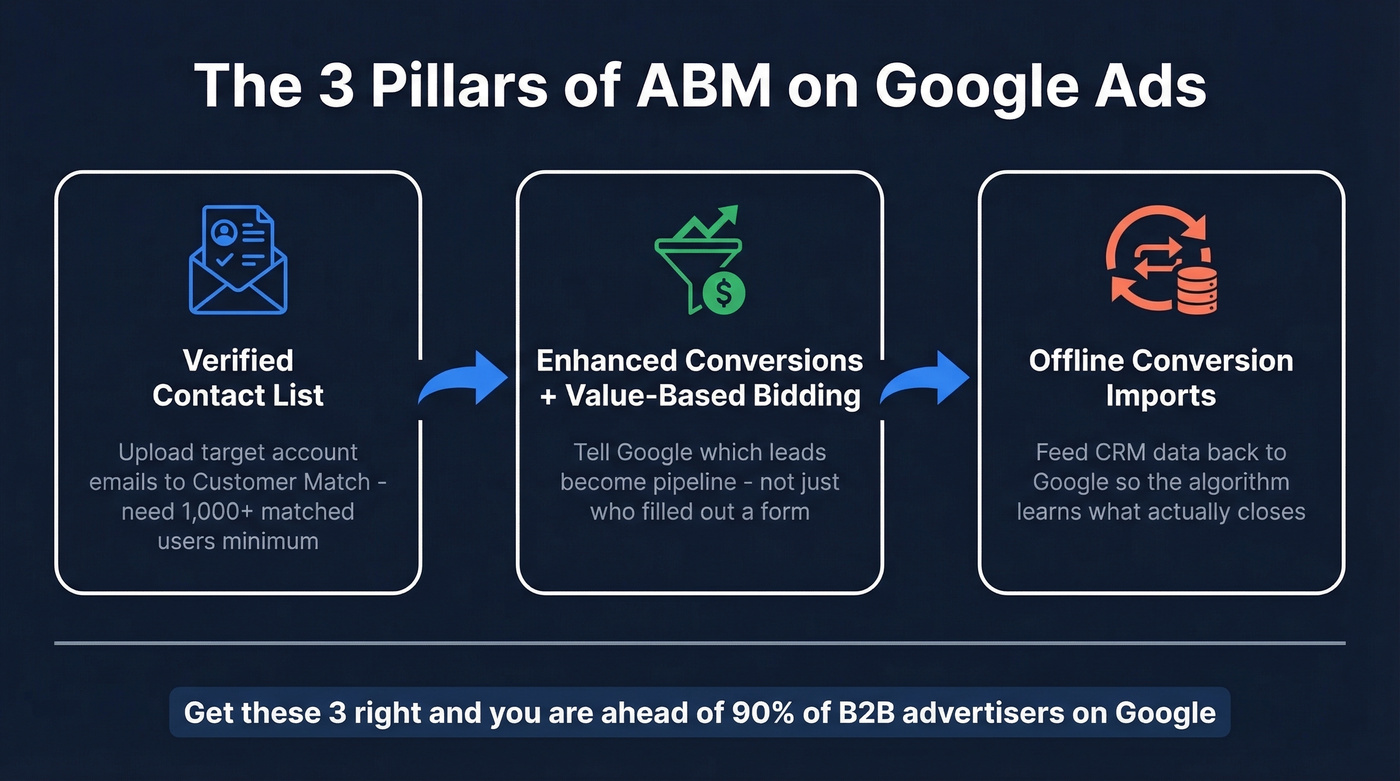
- A verified contact list from your target accounts, uploaded to Customer Match
- Enhanced Conversions for Leads + value-based bidding so Google optimizes toward pipeline, not clicks
- Offline conversion imports from your CRM, closing the feedback loop with Google's algorithm
Get these three right and you're ahead of 90% of B2B advertisers on Google.
Build Your Target Account Contact List
If your B2B list hits Customer Match and the match rate comes back around 15%, that's what happens when you're working with stale emails, personal addresses, and outdated records. Clean B2B lists often match around 30-60%. Google requires a minimum of 1,000 matched users for Search and YouTube campaigns, so bad data doesn't just hurt performance - it kills the campaign before it starts.
Your data source matters more than your ad creative here. Prospeo covers 300M+ professional profiles with 98% email accuracy on a 7-day refresh cycle, which directly translates to higher Customer Match rates. The free tier gives you 75 verified emails per month, enough to test the workflow before committing.

Google Ads Tactics for ABM Campaigns
Customer Match
Upload verified work emails from your target accounts. Here's the setup path:
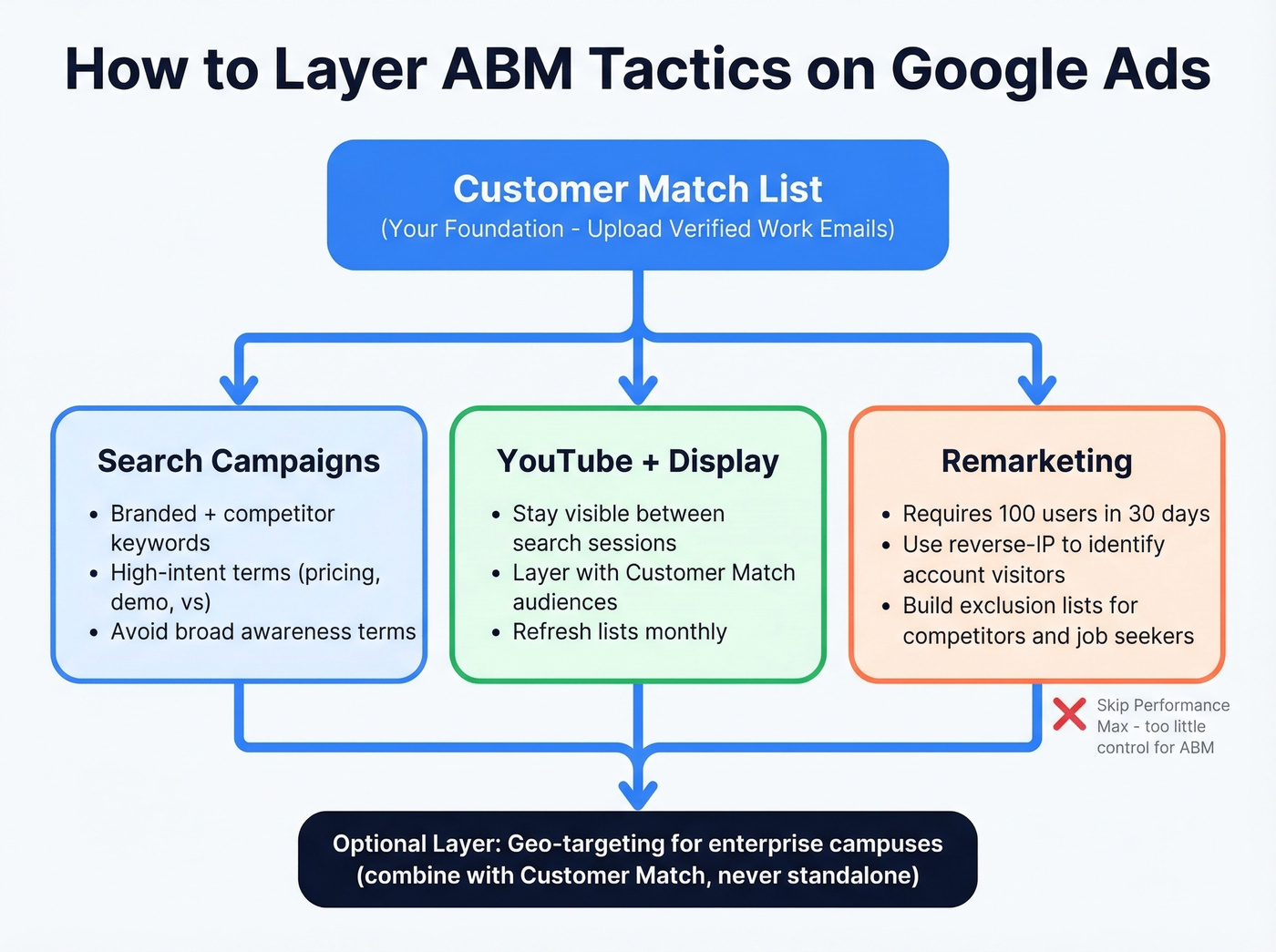
- Go to Tools & Settings > Shared Library > Audience Manager
- Click Segments > "+" > Customer list
- Name your list, select data type, upload your CSV
- Confirm the compliance checkbox and set membership duration
Prioritize work emails. Personal addresses match poorly for B2B targeting, and they dilute your audience with people browsing from home who aren't in buying mode.
Remarketing With Exclusion Audiences
Google requires at least 100 users within 30 days on a remarketing list before serving ads. Layer this with reverse-IP tools like LeadForensics to identify which target accounts visit your site. Just as important: build exclusion audiences for competitors, job seekers, and existing customers who don't need to see acquisition ads.
One B2B marketer on r/PPC described a common problem - Google Ads generated plenty of signups, but mostly from outside their target account list. Exclusion audiences are how you fix that.
Radius and Geo Targeting
Skip this if your target accounts are fully remote. But for enterprise targets with thousands of employees at a single campus, targeting office locations is blunt, cheap, and surprisingly effective as a supplementary layer. We've seen it work best when combined with Customer Match rather than run standalone. On its own, you're just carpet-bombing a zip code.
Display and YouTube for Awareness
Use Display and YouTube to stay visible between search sessions. Combine with your Customer Match audiences - don't spray impressions broadly. Similar Audiences is deprecated; Google replaced it with optimized targeting, which is less precise for ABM. Keep your Customer Match lists tight and refresh them monthly.
Keyword Strategy for ABM
Here's what most ABM guides miss: your keyword selection matters as much as your audience targeting. Prioritize branded and competitor terms, high-intent queries tied to your solution category, and "giveaway words" that signal buying intent - "pricing," "demo," "vs," "alternative to."
Avoid broad awareness keywords. They attract non-target accounts and burn budget fast. Performance Max campaigns are tempting but give you too little control over who sees your ads; stick with Search and YouTube for tight ABM targeting.

Customer Match rates live or die on email quality. Stale data gets you 15% match rates - verified data gets you 60%. Prospeo delivers 300M+ professional profiles at 98% email accuracy on a 7-day refresh cycle, so your target account lists actually clear Google's 1,000-user minimum and start serving ads.
Stop uploading dead emails. Start matching real buyers.
The Measurement Stack
This is where the real work happens. Without proper measurement, you're just running B2B lead gen and calling it ABM.
Enhanced Conversions for Leads
Enhanced Conversions for Leads bridges the gap between a form fill and what happens in your CRM. Identifiers get hashed with SHA-256 before Google receives them. If you're not running ECL in 2026, you're optimizing blind - there's no polite way to say it.
Properly configured enhanced conversions can send up to 3x more conversion feedback back to Google's algorithm, which means faster learning and better targeting over time.
Offline Conversion Imports
Capture the gclid parameter on your landing pages, store it with lead records in your CRM, and upload conversion events back to Google. GCLIDs run up to 100 characters with a 90-day validity window, and you need auto-tagging enabled.
Common failure points we've debugged: redirects stripping URL parameters, SPA route changes losing the GCLID, and cookie consent banners blocking storage before the parameter gets captured. ECL serves as backup matching when GCLID capture fails, which is why you want both running.
Value-Based Bidding
If every conversion has the same value in Google's eyes, the algorithm optimizes for volume, not quality. That's how you end up with 200 MQLs and zero pipeline. Assign differentiated values by funnel stage - MQL = $100, SQL = $900, Opportunity = $3,000, Closed Won = actual deal value. Enhanced CPC is deprecated. Use Max Conversion Value or Target ROAS instead.
If you want a clean way to standardize these stages, align them to your enterprise sales stages and keep the definitions consistent across teams.
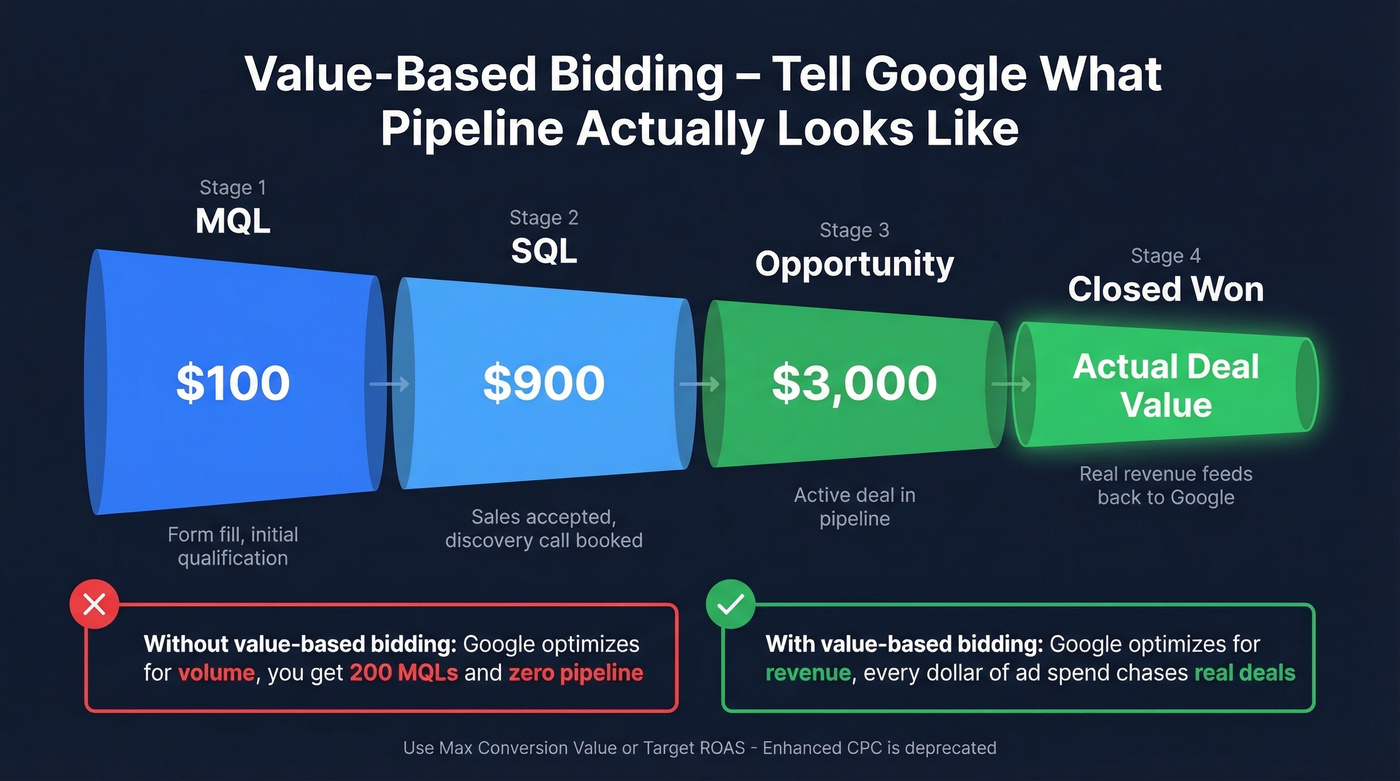
In our experience, this single change transforms Google from a lead-gen machine into a pipeline machine.
CRM Integration Paths
You need conversion data flowing from your CRM back into Google Ads. Three paths:
| Path | Cost | Complexity | Best For |
|---|---|---|---|
| Zapier | ~$25-30/mo | Low | Getting started fast |
| Native (HubSpot/Salesforce) | Included in CRM tier | Medium | Enterprise CRM teams |
| Google Ads API | Dev time | High | Custom workflows |
Start with Zapier. One agency reported a 35% drop in cost per client within two months of connecting Salesforce offline conversions to Google Ads. Graduate to native integrations once you've proven the feedback loop works.
If you're building this as a repeatable system, treat it like RevOps work, not a one-off marketing task.
Do You Need an ABM Platform?
Let's be honest: most teams don't. Customer Match + ECL + a Zapier connector gets you most of the ABM-on-Google-Ads workflow for under ~$50/month in tooling. The six-figure platforms add account-level intent signals and cross-channel orchestration - valuable at scale, but not prerequisites for getting started.
For teams running ABM across multiple channels with large budgets:
| Platform | Google Ads Integration | Annual Cost | Setup Time |
|---|---|---|---|
| Demandbase | Native B2B DSP | $100K+ | 6 wks-4 mo |
| 6sense | Via The Trade Desk | $100K+ | 2-4 months |
| Terminus | Display/web | $100K+ | 4-6 weeks |
| ZenABM | Lightweight layer | $59/mo | Days |
Demandbase is strongest for Google Search and YouTube activation specifically. ZenABM at $59/month won't require a board-level budget conversation, which makes it worth testing if you want intent signals without the enterprise commitment.
If you're comparing options, start with a shortlist of account-based marketing tools and map them to your channel mix.
Why Most ABM Ad Campaigns Fail
We've seen these patterns kill campaigns repeatedly:
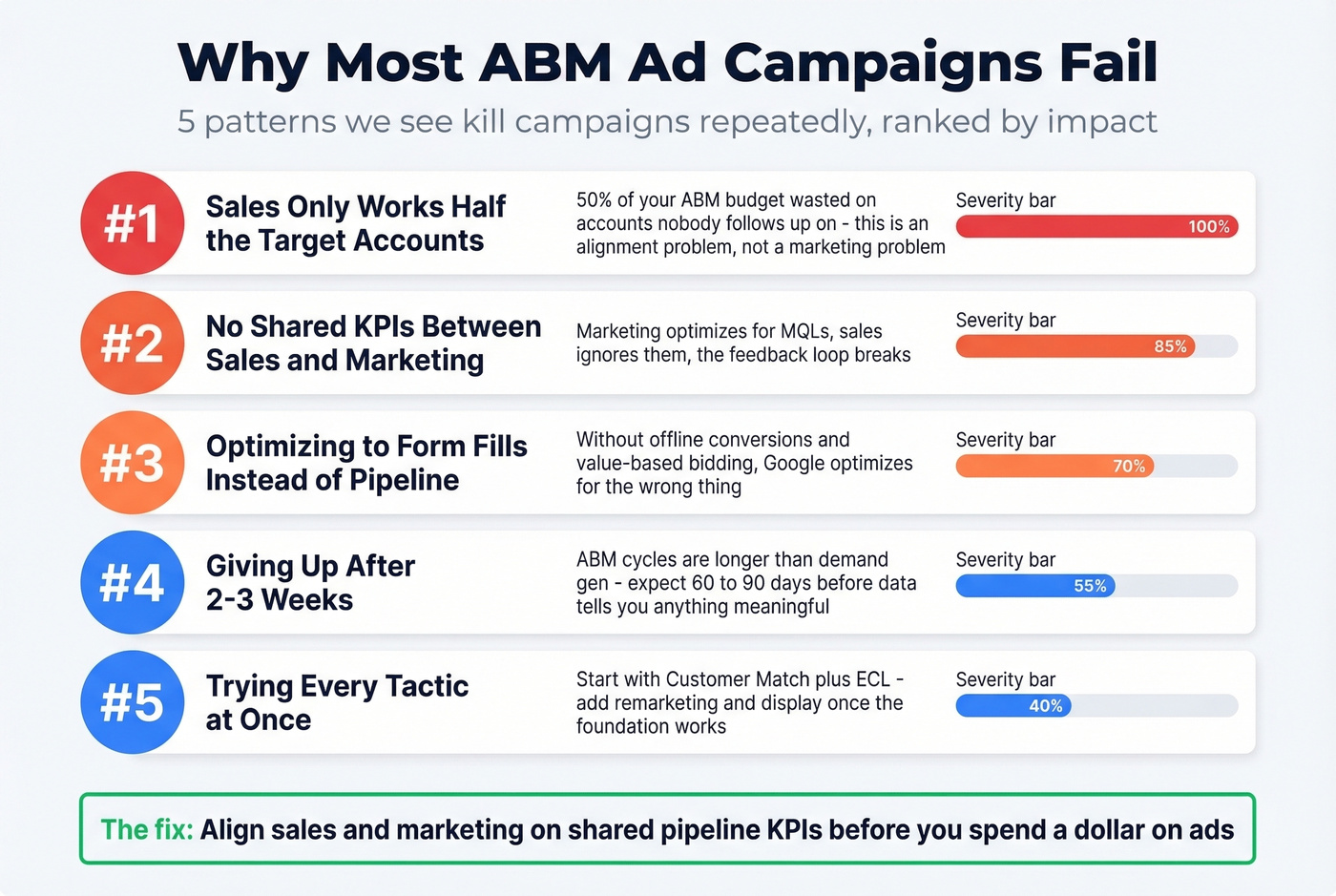
- Sales only works half the target accounts. That's 50% of your ABM budget wasted on accounts nobody follows up on. This is the number one killer, and it's not a marketing problem - it's an alignment problem.
- No shared KPIs between sales and marketing. If marketing optimizes for MQLs and sales ignores them, the feedback loop breaks. Fixing this usually starts with tighter B2B marketing and sales alignment.
- Optimizing to form fills instead of pipeline. Without offline conversions and value-based bidding, Google optimizes for the wrong thing.
- Giving up after 2-3 weeks. ABM cycles are longer than demand gen. B2B buying committees don't convert in a sprint - expect 60-90 days before the data tells you anything meaningful.
- Trying every tactic at once. Start with Customer Match + ECL. Add remarketing and display once the foundation works.
If you want more options beyond ads, pull from these account based marketing tactics and sequence them over 90 days.
You just built the full ABM-on-Google stack: Customer Match, offline conversions, value-based bidding. The one thing that breaks it all? Bad contact data from your target accounts. Prospeo's verified emails cost $0.01 each and refresh every 7 days - not every 6 weeks like the tools you're replacing.
Feed Google's algorithm clean data and watch pipeline replace MQLs.
FAQ
Can you target specific companies on Google Ads?
Not directly. Customer Match lets you upload contact lists from target accounts, and remarketing combined with reverse-IP tools identifies visitors from specific companies. Layering known contacts with site visitors approximates company-level reach - it's the closest Google Ads gets to true account targeting.
What's the minimum list size for Customer Match?
You need 1,000 matched users for Search and YouTube campaigns, and 100 users within 30 days for remarketing lists. Aim well above these minimums - lists under 2,000 contacts tend to match too few users to generate meaningful delivery.
How much does running ABM on Google Ads cost?
Google Ads has no platform fee - just ad spend. Enterprise ABM platforms run six figures annually. Customer Match, offline conversions, and Zapier at ~$25-30/month get most teams started. Pair that with a free-tier data provider for verified contact data and total tooling cost stays under $50/month before ad spend.
How do I improve my Customer Match rate for B2B lists?
Use verified work emails, not personal addresses. Data freshness matters enormously here - providers with weekly refresh cycles consistently produce 40-60% match rates on Customer Match uploads, while stale data from monthly or quarterly refresh cycles typically matches at 15-25%. That gap directly impacts how many people in your target accounts actually see your ads.