

The 7 Enterprise Sales Stages Nobody Tells You About
A RevOps lead we know ran a pipeline audit last quarter and found something predictable: every deal over $200k that died in Q4 didn't fail during discovery or demo. It failed in procurement. The security questionnaire sat unanswered for six weeks, legal redlined the DPA, and the champion who pushed it through changed jobs.
Most guides on enterprise sales stages pretend this phase doesn't exist. That's why most guides are wrong.
The average B2B sales cycle now runs 6.5 months, up from 4.9 in 2019. Buying committees average 13 stakeholders, with some reports citing up to 25, and 86% of B2B purchases stall at some point during the cycle. Many enterprise sales guides still use four-stage models. For deals at $100k+ ACV, you need seven stages - and you need to treat procurement as its own pipeline phase.
Here's the thing: most teams don't need a better sales methodology. They need to stop pretending that everything between "verbal yes" and "signed contract" is a single step.
2026 Benchmarks for Enterprise Deals
| Metric | Benchmark |
|---|---|
| $100k-$250k ACV cycle | 170 days |
| $250k-$500k ACV cycle | 220 days |
| $500k+ ACV cycle | 270 days |
| Decision-makers per deal | 6-13 (avg 13) |
| Win rates vs 2022 | Down 18% |
| Reps hitting quota | ~16% |
| Time reps spend selling | 28-30% |

A 270-day cycle for a $500k deal means your Q1 pipeline needs to be built in Q2 of the prior year. Let that sink in before you complain about pipeline coverage ratios.
The 7 Stages of an Enterprise Deal
Stage 1 - Account Targeting & Research
Enterprise selling starts before anyone picks up a phone. You're defining your ICP, building a target account list, and researching which accounts are actually worth pursuing.
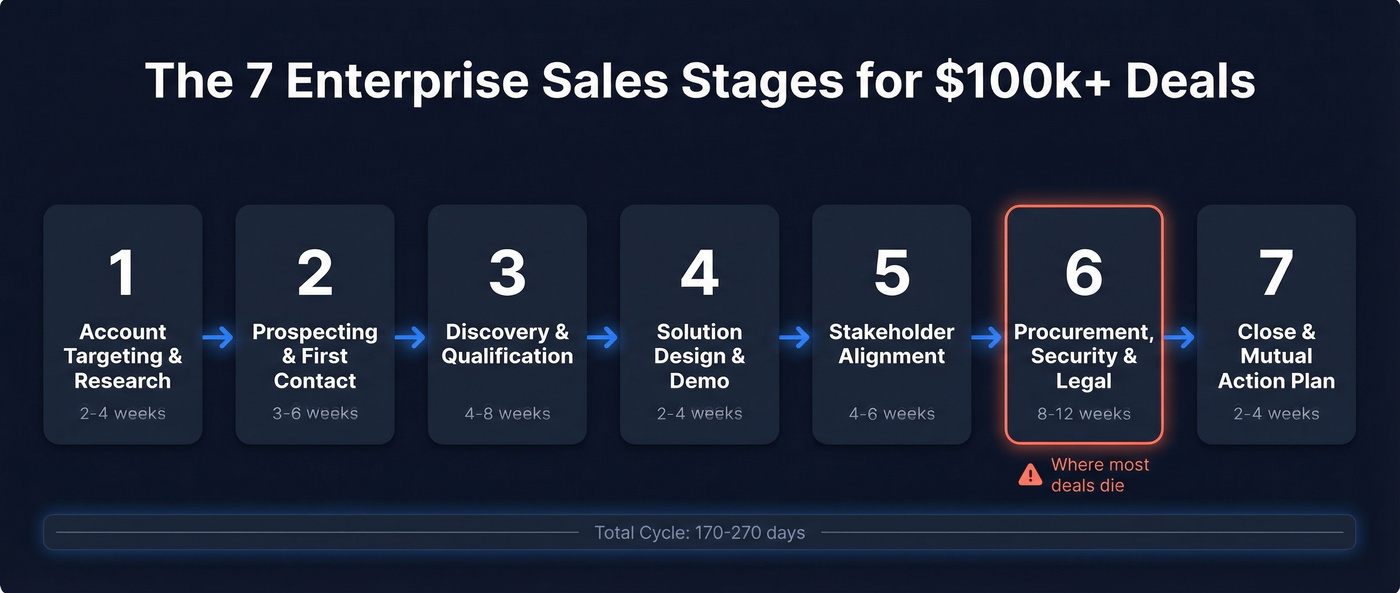
41% of buyers already have a preferred vendor before formal evaluation begins. If you're not on the shortlist before the RFP drops, you're playing catch-up against someone who's been building relationships for months.
Qualify the account before you qualify the opportunity. Vanity logos waste 6-12 months of selling time. We've seen teams burn entire quarters chasing Fortune 500 logos that were never going to buy - the account looked great on paper, but the tech stack, budget cycle, and org structure were all wrong.
Stage 2 - Prospecting & First Contact
It takes an average of 62 touches across 3+ channels to close a B2B deal. And 73% of buyers actively avoid suppliers who send irrelevant outreach.
Enterprise deals involve 6-13 stakeholders. You can't multi-thread if you only have one person's email - and single-threaded enterprise deals die. A tool like Prospeo gives you verified emails and direct dials for the full buying committee across 300M+ profiles at 98% accuracy, so you're multi-threading from day one instead of scrambling for the CFO's number three months in.

Stage 3 - Discovery & Qualification
This is where deals are won or lost, even though it doesn't feel like it at the time.
MEDDPICC - which adds Paper Process and Competition to the original MEDDIC framework - isn't a sequential checklist. It's a set of elements you evaluate continuously throughout the deal. What does it look like when it goes wrong? You skip pain quantification (the "M" in MEDDIC), can't attach a dollar figure to the problem, and the deal loses priority against every other initiative competing for budget. We've watched seven-figure deals stall for months because the champion couldn't justify the spend internally - all because discovery was shallow.
The non-negotiable: identify the Economic Buyer. If you haven't met the person with budget authority, the deal is at risk. Period.
Stage 4 - Solution Design & Demo
Buyers spend only 17% of their purchasing time meeting with vendors. Your demo window is small.
What kills deals here: 69% of buyers cite inconsistencies between what the website says and what the seller presents. If your discovery was good, your demo should be unique to each deal - not a generic product walkthrough. Skip this stage's customization and you'll feel it in Stage 5 when stakeholders start asking questions your champion can't answer.
Stage 5 - Stakeholder Alignment
| Role | What They Need |
|---|---|
| Champion | Internal ammunition, talking points |
| Economic Buyer | ROI model, payback period |
| Technical Buyer | Security docs, architecture review |
| End User | Workflow impact, ease of adoption |
| Blocker | Objections addressed preemptively |
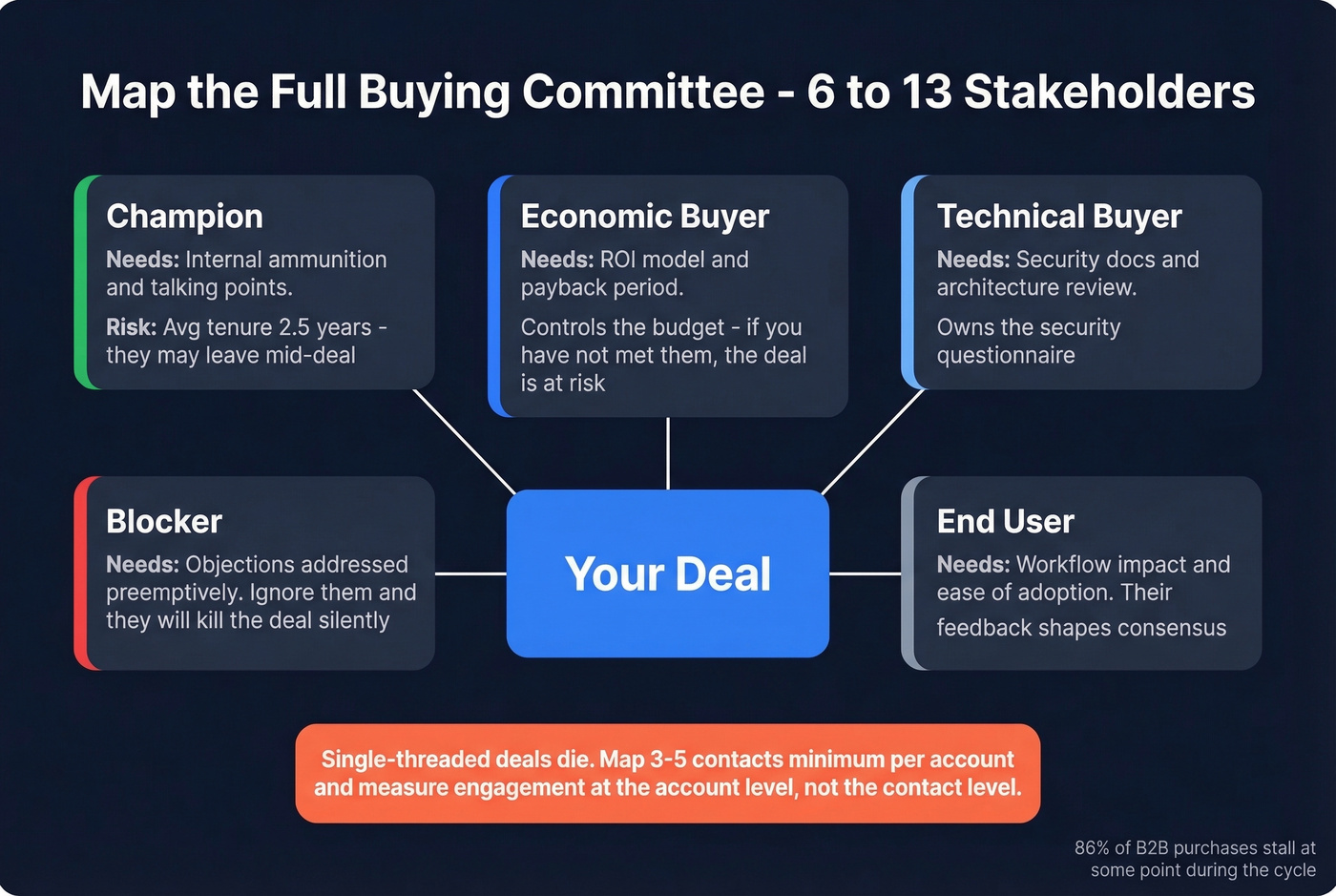
Champion tenure at the director level averages about 2.5 years. That means single-threaded deals are inherently fragile - your champion could leave, get reassigned, or lose internal influence at any point during a 6-9 month cycle. Map 3-5 contacts minimum and measure engagement at the account level, not the contact level.
If you want a clean way to structure multi-threading, this is basically team selling with a buying committee instead of a single decision-maker.
Stage 6 - Procurement, Security & Legal
This is the stage that kills deals. We've seen more pipeline evaporate here than in any other phase, and it's maddening because the buyer already said yes.
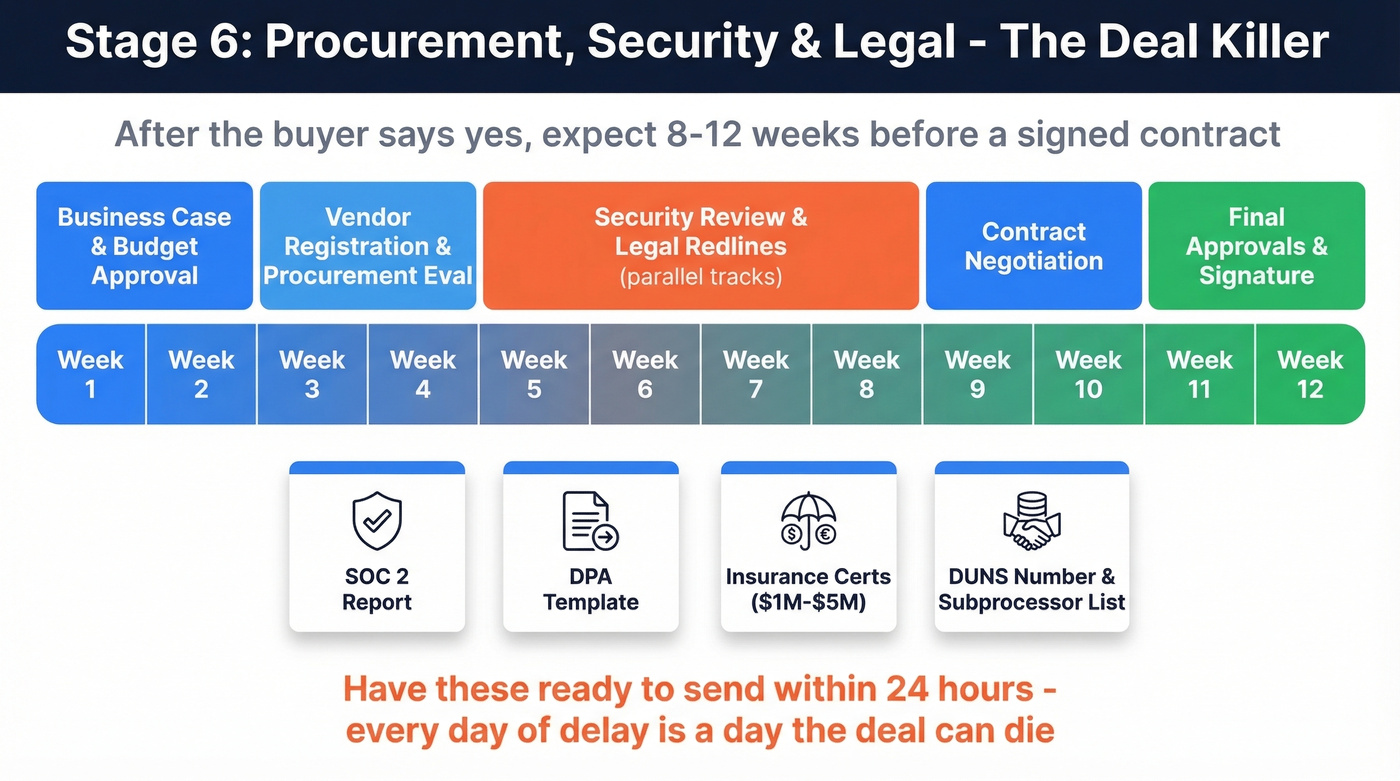
After budget approval, expect 8-12 weeks before a signed contract:
- Weeks 1-2: Business case and budget approval
- Weeks 3-4: Vendor registration and procurement evaluation
- Weeks 5-8: Security review and legal redlines (parallel)
- Weeks 9-10: Contract negotiation
- Weeks 11-12: Final approvals
Security questionnaires run 50 to 500+ questions. Buyers typically require $1M-$5M in professional liability insurance and SOC 2, GDPR, and CCPA compliance documentation. Organizations with a dedicated deal desk reduce this cycle time by 20-40%.
Your DUNS number, insurance certificates, SOC 2 report, DPA template, and subprocessor list should be ready to send within 24 hours. Every day of delay is a day the deal can die.
Stage 7 - Close & Mutual Action Plan
A Mutual Action Plan is a co-created roadmap with milestones, owners, and deadlines. Deals with MAPs show a 26% higher win rate. Yet only 45% of sellers use them consistently.
36% of sales professionals say closing is the stage they struggle with most. A MAP eliminates ambiguity and gives late-entering executives a way to get up to speed without derailing the timeline. No shared close plan means you're hoping, not selling.
If you need a tighter close framework, map this stage to your internal steps to close a sale so reps don’t improvise at the finish line.
A typical $300k SaaS deal timeline: months 1-2 prospecting and discovery, months 3-4 demos and stakeholder alignment, months 5-7 procurement and legal, month 8 close. That's 30-50 meetings total across 6-13 stakeholders.

Single-threaded enterprise deals die. Multi-threading from Stage 2 means having verified contact data for every stakeholder - champion, economic buyer, technical buyer, and blocker. Prospeo gives you 300M+ profiles with 98% email accuracy and 125M+ verified mobiles, so you're reaching the full buying committee before your competitor finds the CFO's number.
Stop losing $100k+ deals because you only had one contact.
How MEDDPICC Maps to Each Stage
| Letter | Element | Primary Stage(s) |
|---|---|---|
| M | Metrics | Discovery, Demo |
| E | Economic Buyer | Discovery, Alignment |
| D | Decision Criteria | Discovery, Demo |
| D | Decision Process | Qualification, Procurement |
| P | Paper Process | Procurement, Legal |
| I | Identify Pain | Discovery |
| C | Champion | Prospecting through Close |
| C | Competition | Targeting through Close |
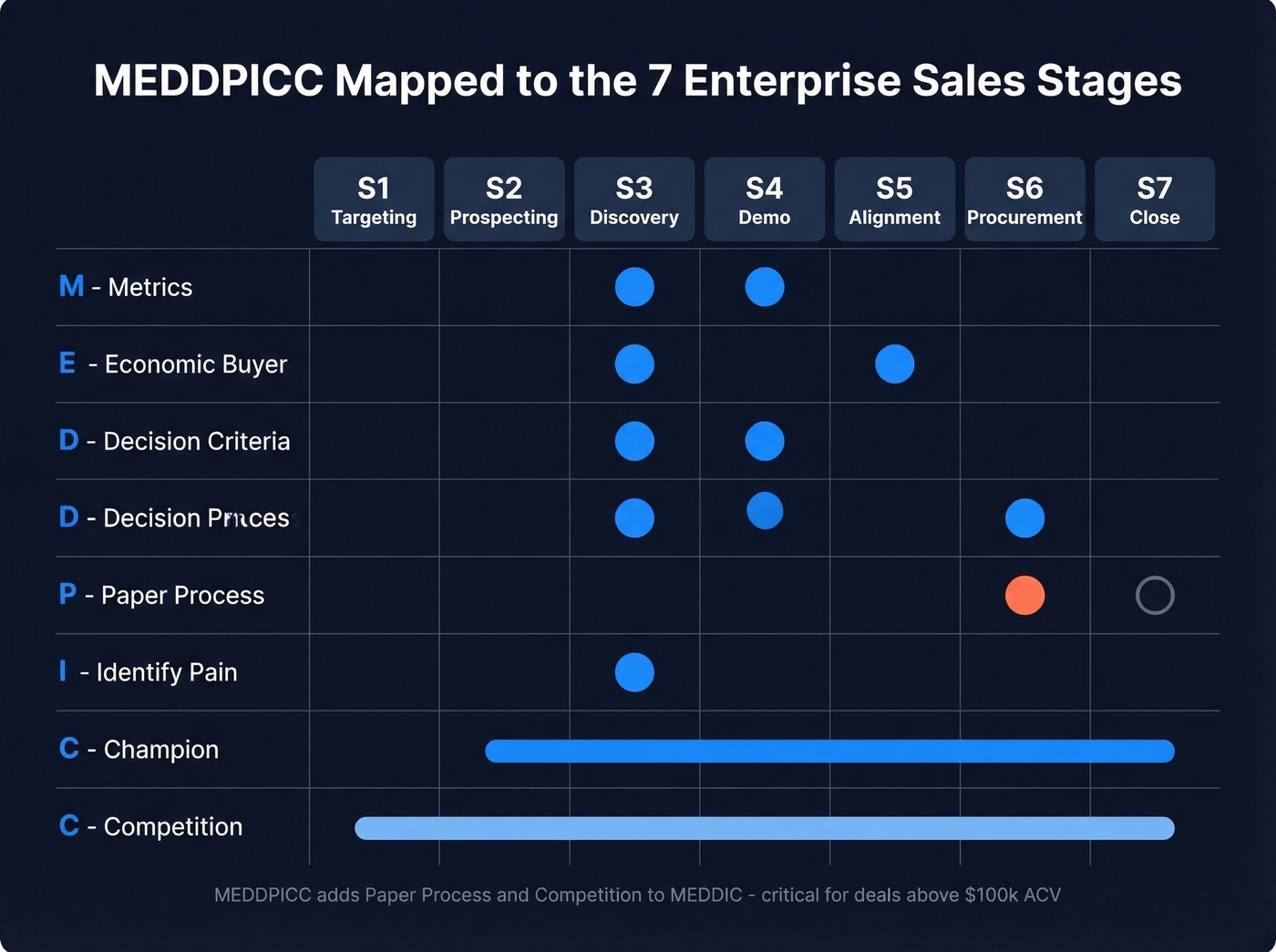
MEDDPICC beats MEDDIC for deals above $100k ACV because Paper Process forces reps to map procurement realities early, and Competition forces awareness of alternatives at every stage - including the "do nothing" alternative, which is the one that actually wins most of the time.
If you want to go deeper on the discovery side of the framework, use a dedicated set of MEDDIC discovery questions to keep qualification consistent across reps.
Building a Sales Model That Matches the Buyer
61% of B2B buyers prefer a rep-free experience. They don't want generic pitches. They want fit-for-purpose guidance that helps them make a decision.
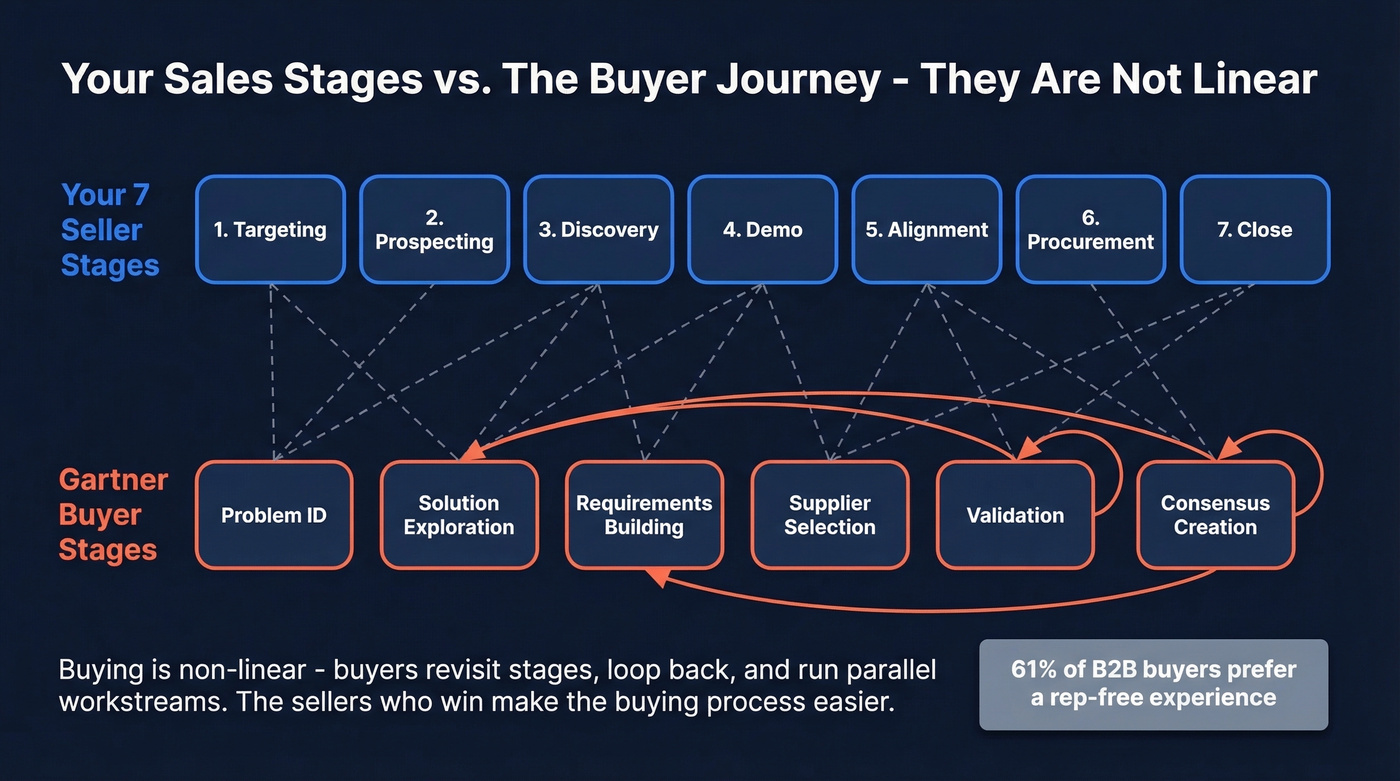
Gartner maps six buyer stages: Problem Identification, Solution Exploration, Requirements Building, Supplier Selection, Validation, and Consensus Creation. The critical insight is that buying is non-linear - buyers revisit stages, loop back, and run parallel workstreams. The sellers who win enterprise deals aren't the ones with the best pitch deck. They're the ones who make the buying process easier, who show up with the right document before the buyer asks for it, who've already mapped the procurement timeline before legal sends the first redline. That's why your enterprise sales stages need to flex around the buyer's journey rather than force a rigid sequence - the seven stages above give you structure without sacrificing adaptability.
If you’re pressure-testing your process end-to-end, run it against common sales pipeline challenges to spot where deals actually leak.
Champion turnover kills enterprise pipeline. When your single contact leaves mid-cycle, the deal dies in procurement. Prospeo's 7-day data refresh means your stakeholder maps stay current throughout a 170-270 day sales cycle - not stale like the 6-week refresh competitors offer. Map 3-5 contacts per account at $0.01 per email.
Keep your buying committee data fresh for every stage of the deal.
FAQ
How long does each enterprise sales stage take?
Total cycle ranges from 170 days at $100k ACV to 270+ days at $500k+ ACV. Discovery typically takes 4-8 weeks, solution design 2-4 weeks, stakeholder alignment 4-6 weeks, and procurement adds 8-12 weeks after budget approval. The procurement phase is where most teams underestimate - plan for it or watch deals slip quarter after quarter.
What's the difference between enterprise and mid-market sales?
SMB deals ($5k-$50k ACV) typically close in 1-3 months with one or two decision-makers. Enterprise adds formal procurement, security review, and stakeholder alignment phases across 6-13+ stakeholders over 6-18 months. The selling motion is fundamentally different - it's less about persuading one person and more about orchestrating consensus across a committee.
How many touches does it take to close an enterprise deal?
An average of 62 touches across 3+ channels. Multi-threading across the full buying committee from the start is essential - single-threaded deals are the fastest way to lose enterprise pipeline.
When should I use MEDDPICC vs MEDDIC?
For deals under $50k ACV, MEDDIC is usually sufficient. Once you're above $100k ACV, the Paper Process element in MEDDPICC becomes critical because procurement, legal, and security reviews add 8-12 weeks and introduce stakeholders who can kill a deal your champion already approved. If you're not mapping the paper process, you're flying blind through the longest phase of the cycle.