

Account Based Marketing vs Demand Generation: The Debate Is Dead
We've watched RevOps teams run account based marketing vs demand generation as separate programs for over a year - two teams, two budgets, two dashboards, zero shared pipeline metrics. When the board asks which program drove the big Q4 deal, nobody can answer. That's what happens when you treat these as competing strategies instead of connected motions.
The Decision in Three Lines
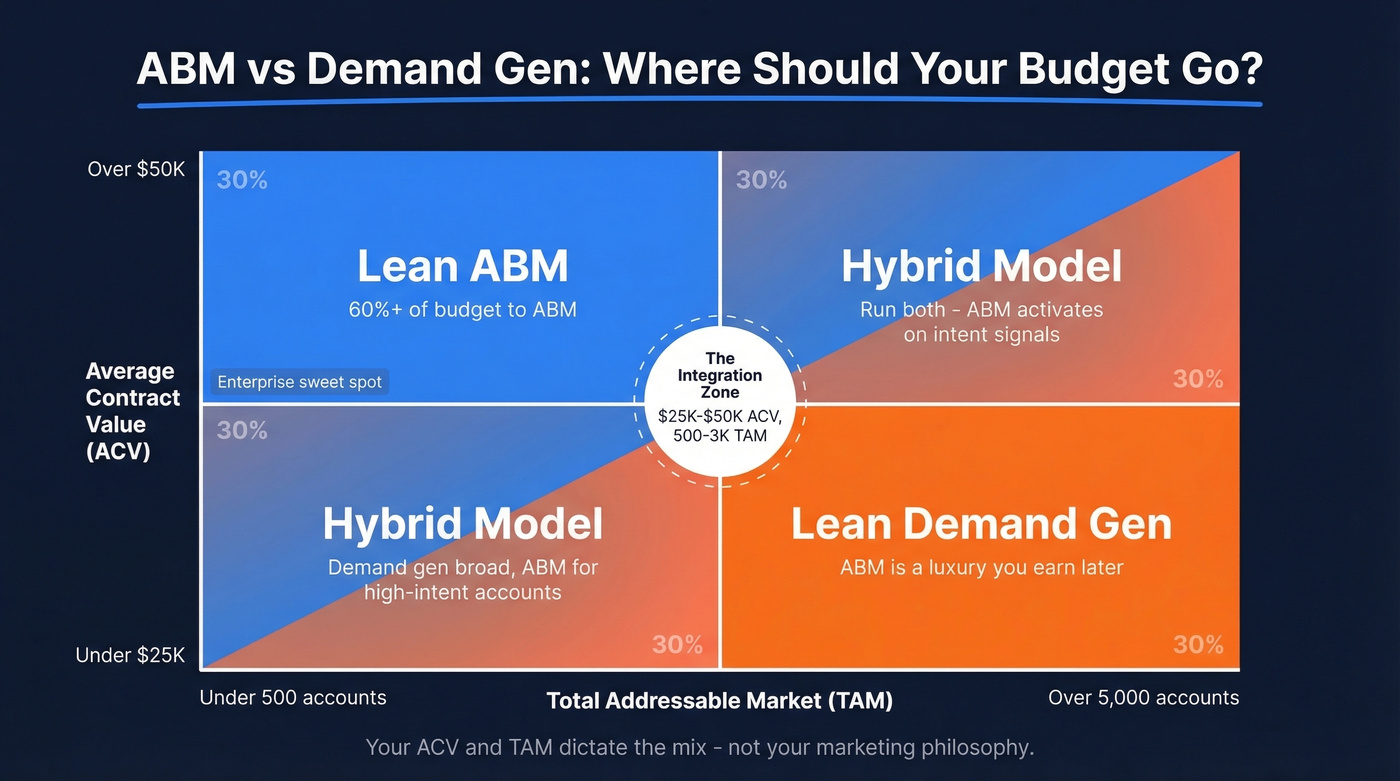
- ACV >$50K + TAM under 500 accounts - lean ABM (60%+ of budget)
- ACV under $25K + TAM over 5,000 - lean demand gen; ABM is a luxury you earn later
- In between - run both, with engagement triggers that activate ABM when accounts show buying signals
Stop Comparing, Start Integrating
71% of practitioners now run an ABM strategy, and 40% integrate it directly with demand generation. The market has moved past "which one should we pick."
One Reddit practitioner called comparing ABM to demand gen "the most useless comparison" - like comparing tires to motors. The 95:5 rule explains why you need both: at any given time, only 5% of your TAM is actively buying. Demand gen keeps you visible to the other 95%. ABM converts the 5% that's ready.
Let's be clear about something that still trips people up: demand gen isn't lead gen. It creates awareness and preference before a form fill ever happens. If you're still running these as separate line items with separate VPs, you're burning budget on both sides. The difference between ABM and demand generation is scope and precision, not purpose - both exist to create pipeline.
ABM vs Demand Gen at a Glance
| Dimension | ABM | Demand Gen |
|---|---|---|
| Audience | Named accounts (50-500) | Broad ICP segments |
| Personalization | Account/buying-group | Segment-level |
| Core metric | MQAs, account engagement, pipeline contribution | MQL, CPL, pipeline |
| Sales alignment | Required (often run in a pod model) | Loose coordination |
| Best for | ACV >$50K, small TAM | ACV <$25K, large TAM |
| Channels | Digital + human-led | Mostly digital |
| Measurement | Account pipeline + revenue | Funnel conversion |
ABM isn't monolithic. Tier 1 (1:1) is fully bespoke. Tier 2 (1:few) clusters accounts by vertical or pain point. Tier 3 (1:many) is demand gen with an account lens - and it's where most teams should start. That Tier 3 layer is essentially account-based demand generation: broad reach filtered through an account-level targeting framework.
When to Lean Which Way
Forrester's Budget Planning Survey found that while 82% of global B2B marketing decision-makers report budgets increased by 1%+, only 35% see real increases after inflation. Most teams can't afford to bet the entire budget on the wrong motion.
Your ACV and TAM dictate the mix - not your marketing philosophy.
Selling $100K+ deals to fewer than 200 accounts? ABM is your primary motion. Selling $15K deals to 10,000+ companies? Demand gen carries the load. For the $25K-$50K ACV range with 500-3,000 TAM, run demand gen broadly and activate ABM when engagement signals cross a threshold. At this mid-market tier, ABM functions as the high-intent layer within a broader demand generation engine.

Your ABM-to-demand-gen hybrid only works if contacts are real. Prospeo delivers 98% email accuracy on 300M+ profiles with a 7-day refresh cycle - so your ABM pods reach actual buyers and your demand gen campaigns don't torch your domain.
Stop burning ABM budget on bounced emails. Verify before you activate.
The Hybrid Operating Model
The practical framework is a loop, not a funnel. Demand gen generates broad engagement, accounts that cross defined thresholds get activated into ABM, and deals that stall recycle back into demand gen nurture. Think of it as a set of sliders rather than a binary switch.
If you need a clean way to define what to track, start with funnel metrics and then map them to account-level outcomes.
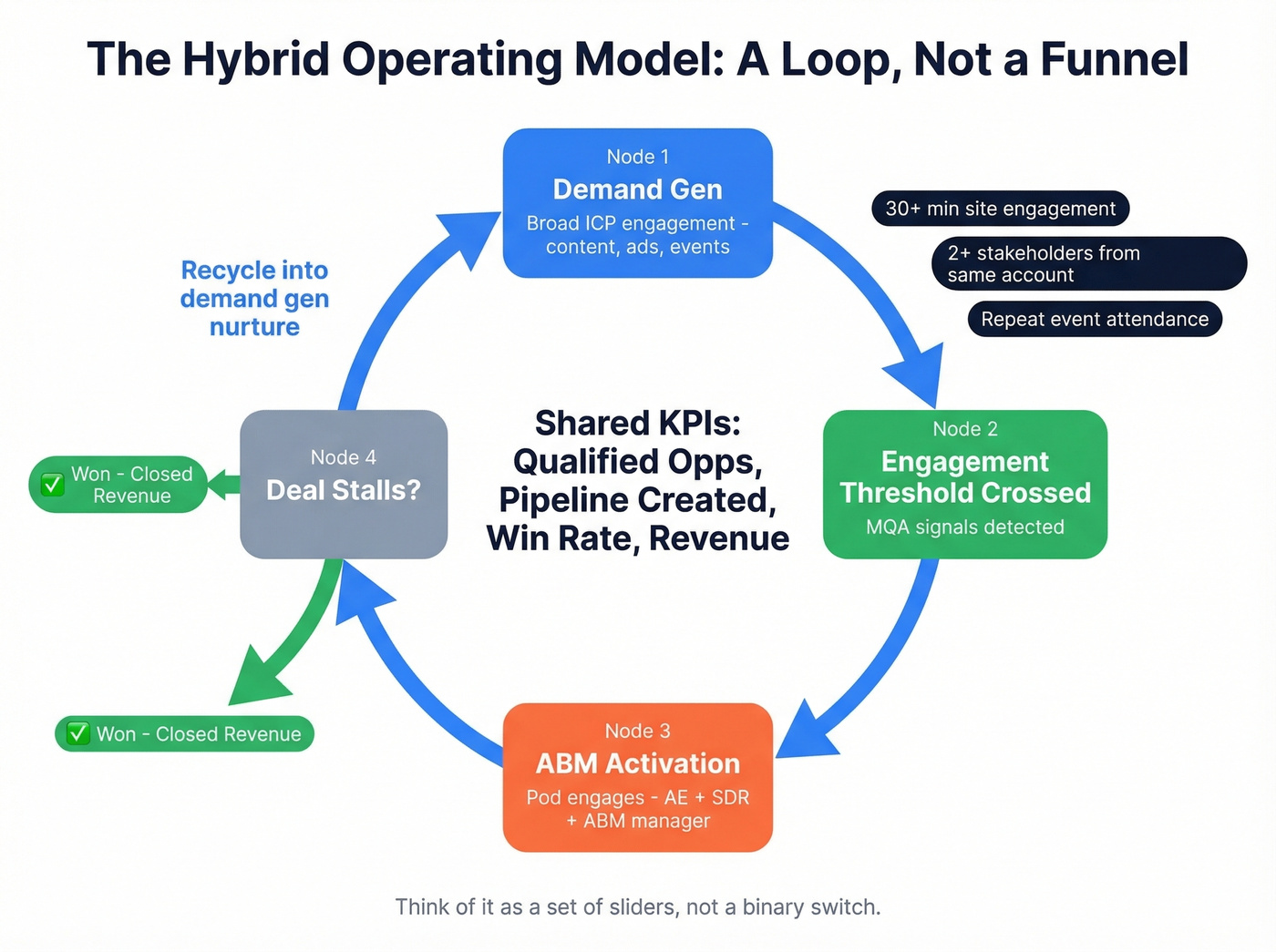
Here's the thing: a mature hybrid strategy treats these motions as a single revenue system with shared data and shared goals, not two playbooks that happen to coexist in the same Slack workspace.
Triggers that signal an account is ready for ABM activation:
- Site engagement - 30+ minutes across product, pricing, and case study pages
- Multi-stakeholder activity - two or more contacts from the same account hitting high-intent pages within a week (this is your Marketing Qualified Account)
- Event behavior - signed up for the latest webinar after attending two prior ones
Mature hybrid programs converge on shared revenue outcomes: qualified opportunities, pipeline created, win rate, and closed revenue. The MQA metric bridges individual MQLs and account-level thinking, giving both teams a shared signal.
If your team struggles to operationalize the handoff, a lightweight marketing enablement layer can keep pods aligned without adding process bloat.
Why ABM Programs Fail
The #1 failure mode isn't strategy - it's alignment. A UserGems case study documented a program where sales only worked half the target accounts after launch. Marketing wasted 50% of the ABM budget on accounts nobody was pursuing. That's not an ABM problem. That's a communication problem wearing an ABM hat.
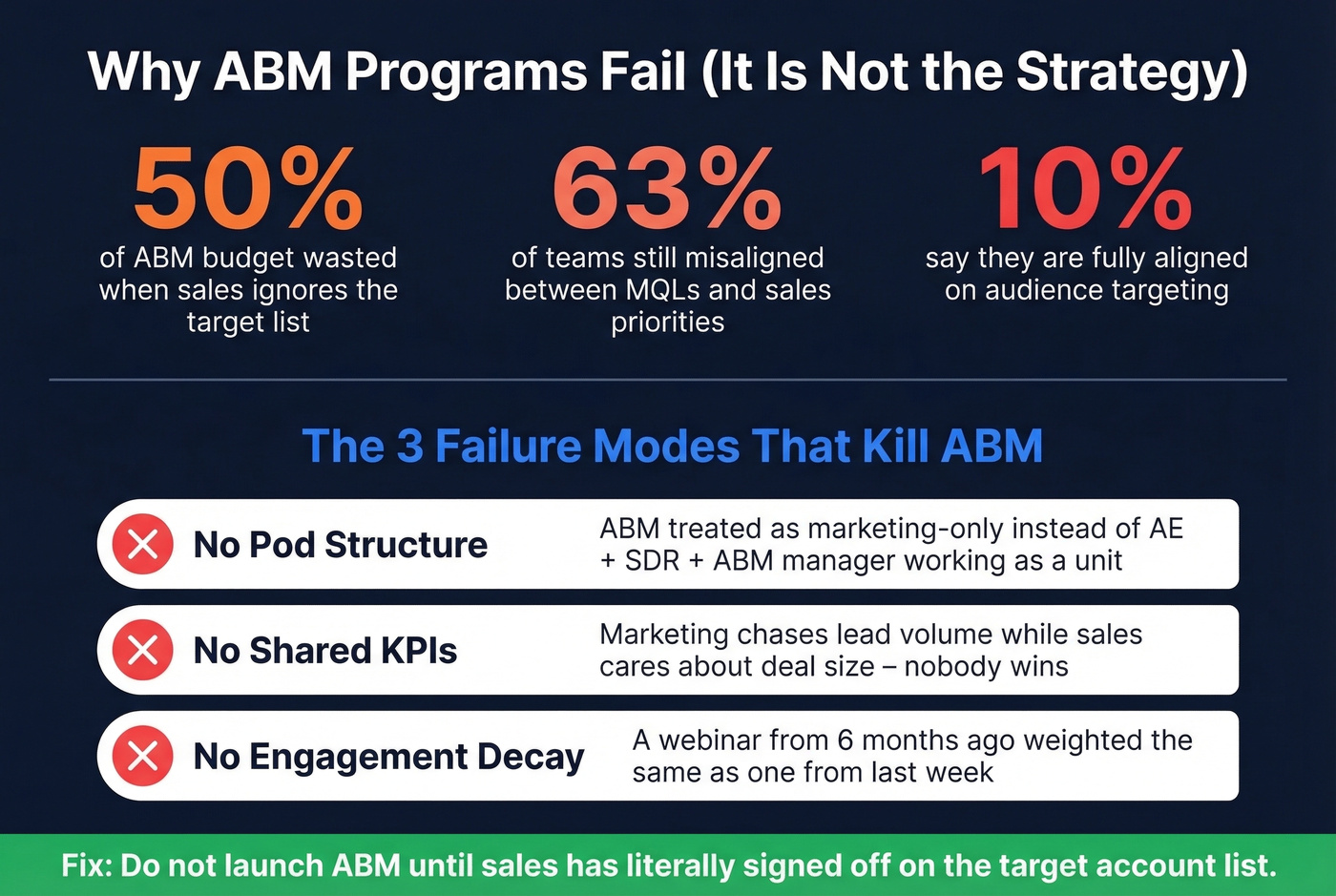
Per Influ2's Forrester-partnered research, 63% of teams still face misalignment between MQLs and sales priorities, and only 10% say they're fully aligned on audience targeting. When people frame ABM vs demand gen as a binary choice, this misalignment is usually the root cause - teams pick one motion and starve the other instead of connecting them.
Some practitioners on r/DigitalMarketing argue ABM is just good segmentation with a buzzword label. They're not entirely wrong - if your "ABM" is the same email with a company name swapped in, you're doing segmentation, not ABM. The common failure modes we see over and over:
- No pod structure - ABM treated as marketing-only instead of an AE + SDR + ABM manager unit
- No shared KPIs - marketing incentivized on lead volume while sales cares about deal size
- No engagement decay - a webinar attended six months ago shouldn't carry the same weight as one from last week
Don't launch ABM until sales has literally signed off on the target account list.
The Data Layer That Makes or Breaks Both
Both strategies collapse with bad contact data. ABM to 50 accounts where 30% of emails bounce is a dead program. Demand gen at scale with bad lists burns your domain reputation, and recovering sender reputation takes months. Whether you're running account-level plays or broad-funnel campaigns, data quality is the prerequisite that nobody wants to talk about until it's too late.
If you're seeing bounces creep up, start by benchmarking your email bounce rate and then fix the root causes in your sending stack.
Here's our hot take: if your average deal is under $10K, you probably don't need a $50K ABM platform. Enterprise platforms like Demandbase and 6sense typically run $30K-$100K+/year. Teams that skip email verification before ABM launch waste a meaningful chunk of outreach spend on bounces and deliverability fallout. Clean data matters more than fancy orchestration.
Prospeo's 98% email accuracy with a 7-day refresh cycle pairs well with Bombora intent signals across 15,000 topics to identify which accounts are actively researching your category. That's the signal that tells you when to flip the ABM switch - and it starts with a free tier at roughly $0.01 per verified email, no contracts required.
If you're building lists at scale, data enrichment services can help keep firmographics and contacts current between refresh cycles.
Enterprise ABM platforms cost $30K-$100K/year. Prospeo gives you the clean data layer both motions need - 143M+ verified emails at $0.01 each, 125M+ direct dials, and 30+ filters including buyer intent and job changes to build your target account list.
Enterprise-grade account data without the enterprise contract. Free tier included.

2026 Benchmarks Worth Knowing
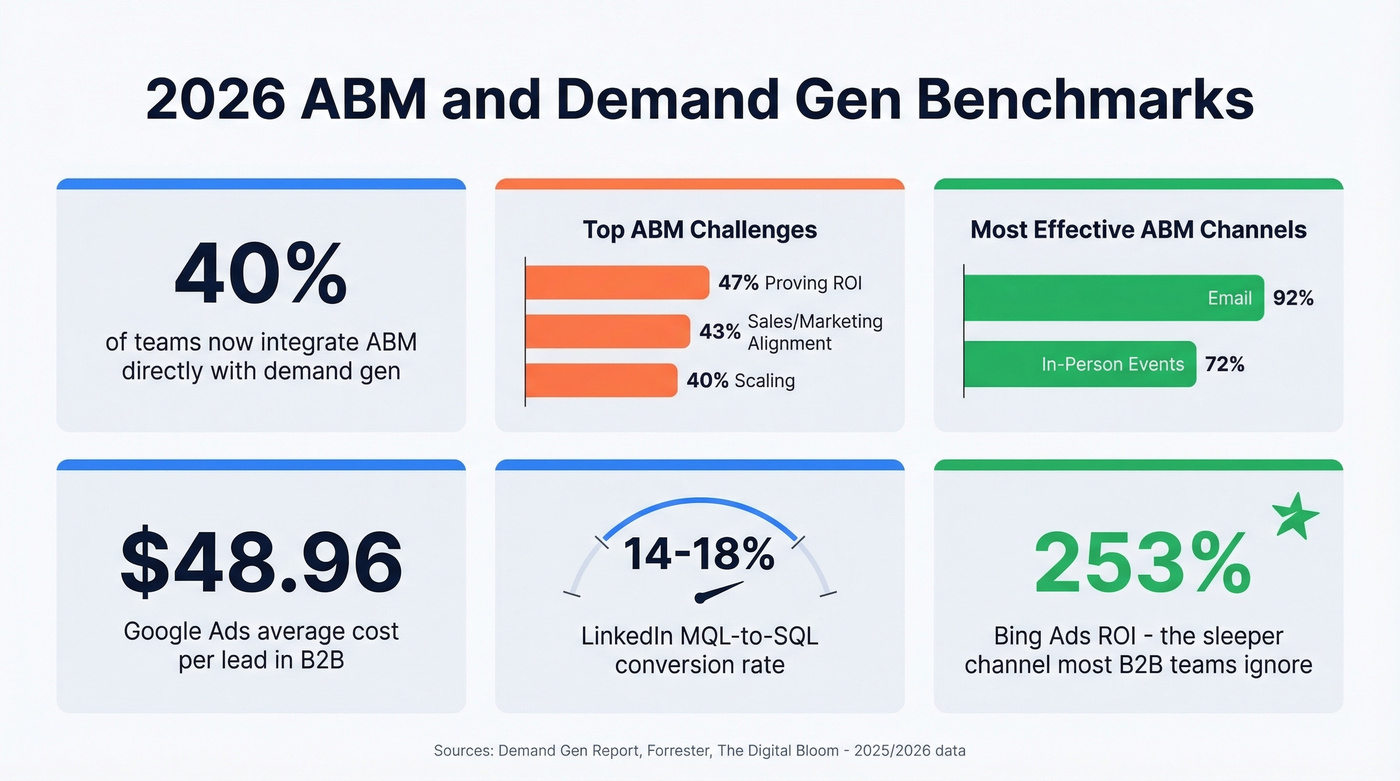
- 40% of teams now integrate ABM directly with demand gen
- Top ABM challenges: proving ROI (47%), sales/marketing alignment (43%), scaling (40%)
- Most effective ABM channels: email (92%), in-person events (72%)
- Google Ads average CPL: $48.96; LinkedIn MQL-to-SQL conversion: 14-18%
- Bing Ads delivering 253% ROI - the sleeper channel most B2B teams ignore
To pressure-test your numbers, compare against sales pipeline benchmarks and track ongoing pipeline health.
FAQ
Can small teams run ABM?
Yes, but start with Tier 3 (1:many) layered on demand gen. Full 1:1 ABM requires a dedicated pod - AE, SDR, ABM manager - that most small teams can't staff. Tier 3 lets you test account targeting without the headcount commitment. Scale up as you prove pipeline impact.
What's the first metric for a hybrid program?
Track Marketing Qualified Accounts: accounts where multiple stakeholders engage high-intent pages within a defined window. MQAs give both marketing and sales a shared warming signal and serve as the connective tissue between your demand gen and ABM motions.
How do I build a target account list with accurate contacts?
Start with ICP criteria - industry, headcount, tech stack, funding stage - then verify every email before outreach. A platform with 300M+ profiles, 98% accuracy, and a weekly refresh cycle means your list doesn't decay before your campaign launches. Free tiers let you test before committing budget.