

Account Based Marketing vs Lead Generation: What Nobody Tells You
Your VP just came back from a conference. They heard that ABM delivers "81% higher ROI" and now they want to pivot the whole go-to-market. You've got a team of four, a $40K marketing budget, and a CRM full of leads that still need working. Meanwhile, your bounce rate is creeping past 30%, which means nearly a third of your outreach - ABM or otherwise - is landing in the void.
The account based marketing vs lead generation debate isn't really about choosing one. It's about knowing which motion fits your deal size, team capacity, and data maturity right now. Get that wrong, and you'll burn budget on a strategy your org can't execute.
What You Need (Quick Version)
If your average deal is under $50K and your team is under five reps, run disciplined lead gen and layer account-based plays on your top 20 accounts. If you're selling $100K+ deals to buying committees, ABM isn't optional - it's how enterprise deals actually close. Either way, both strategies die without accurate contact data. Start with the data layer.
The Real Difference
Most "ABM" in the wild is just targeted lead gen with better branding. A practitioner on r/DigitalMarketing put it bluntly: ABM often sounds like "the bare minimum for successful B2B digital marketing" repackaged as a separate discipline. They're not wrong.
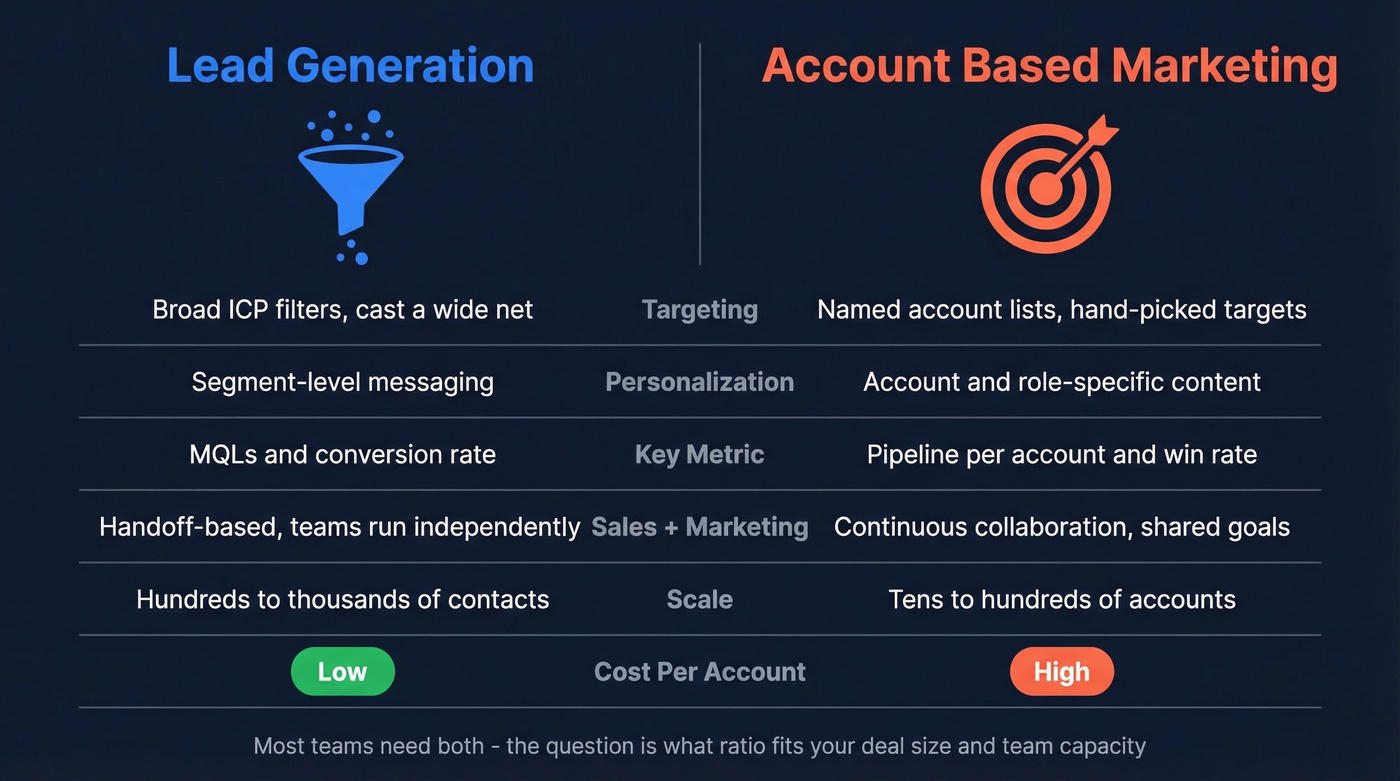
The textbook distinction is simple enough. Lead gen casts a wide net and qualifies individuals. ABM picks specific accounts and orchestrates multi-threaded engagement across the buying committee. But the real difference is organizational, not tactical - ABM requires sales and marketing to agree on target accounts, share metrics, and coordinate outreach, while lead gen lets each team run independently. That alignment piece is where most programs break.
Here's a contrarian framing worth considering: instead of starting with "which strategy should we pick," start from your revenue leaks. Where are deals stalling? Where are you losing to competitors? Where are renewals slipping? The answer to those questions tells you whether you need broader top-of-funnel volume or deeper multi-threaded engagement on specific accounts, and it's a more honest starting point than any framework.
| Dimension | Lead Generation | Account Based Marketing |
|---|---|---|
| Targeting | Broad ICP filters | Named account lists |
| Personalization | Segment-level | Account/role-level |
| Primary metric | MQLs, conversion rate | Pipeline per account, win rate |
| Sales alignment | Handoff-based | Continuous collaboration |
| Scale | Hundreds to thousands | Tens to hundreds |
| Cost per account | Low | High |
ABM itself isn't monolithic. The three tiers matter: 1:1 (full custom plays for your top 5-10 accounts), 1:few (cluster campaigns for 20-50 similar accounts), and 1:many (programmatic targeting across hundreds). Most teams claiming to "do ABM" are really doing 1:many with slightly better targeting, which is just good lead gen with a fancier label.
When Each Strategy Makes Sense
Run ABM when your average deal exceeds $100K, sales cycles run 3+ months, decisions involve 5+ stakeholders, and you have at least one dedicated marketing ops person plus a sales pod willing to coordinate. ABM is a commitment, not a campaign.
Run lead gen when you're selling sub-$50K deals, running a PLG motion, targeting SMBs with shorter cycles, or simply don't have the headcount for account-level orchestration. There's nothing wrong with disciplined lead gen. It built most of the SaaS companies you admire.
Here's the thing: if your average contract value sits below $25K, you almost certainly don't need an ABM platform. You need better data, tighter ICP definition, and faster follow-up. The urgency argument backs this up - 84% of buyers went with the first vendor that engaged them. Whether you're running ABM or lead gen, getting to the right person first matters more than which framework you use.

Whether you're running ABM or lead gen, 84% of buyers choose the first vendor to reach them. Prospeo's 7-day data refresh and 98% email accuracy mean your outreach hits real inboxes - not the void. Map entire buying committees with 30+ filters including intent data, technographics, and headcount growth.
Stop debating strategy while 30% of your emails bounce.
Why ABM Fails (And It Fails a Lot)
37% of ABM marketers struggle with budget, and 40% can't measure ROI. Those numbers from G2's ABM statistics roundup don't surprise us. We've watched teams invest six figures in ABM platforms and get less pipeline than they had before. Here are the five failure modes we see repeatedly.
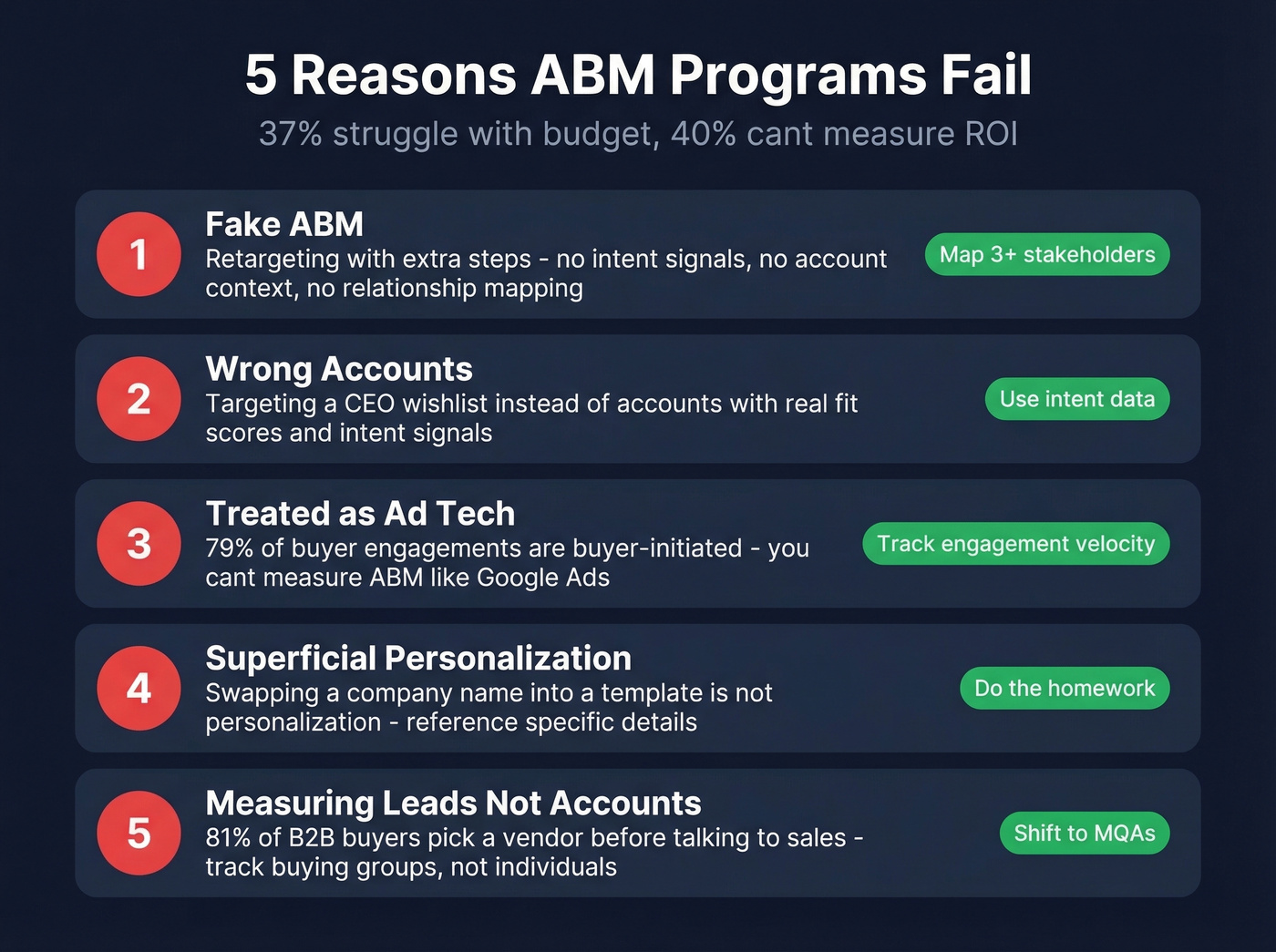
Fake ABM
An SDR on r/b2bmarketing described their company's "ABM program" perfectly: marketing runs LinkedIn ads, someone clicks or downloads a whitepaper, and the SDR gets told to cold-call them. No intent signals. No account context. No relationship mapping. That's retargeting with extra steps.
Fix: Map the full buying committee before launching any campaign. If you can't name 3+ stakeholders at the account, you're not doing ABM.
Wrong Accounts
The most common failure is targeting a wishlist instead of accounts with actual revenue potential. One team we spoke with targeted 500 logos their CEO wanted on the website. Twelve months later, zero closed. If your target account list is built on aspiration rather than fit scores, intent signals, and revenue gap analysis, you're wasting every dollar you spend on personalization.
Fix: Build your TAL from revenue gap analysis and intent data, not logo wishlists.
Treated as Ad Tech
ABM fails when it's judged purely on lead attribution. 79% of buyer engagements are buyer-initiated, meaning your ABM program influenced the deal long before anyone filled out a form. If you're measuring ABM the same way you measure Google Ads, you'll kill it before it works.
Fix: Track account engagement velocity and buying-group coverage, not just form fills.
Superficial Personalization
Swapping a company name into an email template isn't personalization. Real personalization references the account's specific tech stack, recent initiatives, or competitive pressures. If your "account-specific" content could apply to any company in the same industry, the buying committee will notice - and ignore you.
Fix: Reference at least one account-specific detail in every touchpoint: recent funding, a tech stack change, a leadership hire. Something that proves you did the homework.
Measuring Leads Instead of Accounts
The MQL model treats buying as a solo act. In reality, 81% of B2B buyers select a vendor before engaging with sales. Tracking individual leads instead of account-level engagement across the buying group means you're missing the signal entirely.
Fix: Shift to MQAs (Marketing Qualified Accounts) and measure buying-group coverage percentage per target account.
ABM Results When Done Right
When ABM works, the numbers are compelling. Demandbase's benchmark survey of 300+ marketers reported 81% higher ROI from top ABM programs compared to other marketing investments.
The case studies tell the story better than benchmarks. DocuSign built industry-personalized content experiences and saw a 60% increase in engagement, 300% rise in page views, and 22% growth in sales pipeline. LiveRamp targeted just 15 accounts with high-touch 1:1 ABM and converted 33% of cold leads to meetings within four weeks, then watched customer lifetime value increase 25x over two years.
Let's be honest, though - these are best-in-class results from well-resourced teams. The median ABM program doesn't look like this. Most teams are somewhere between "fake ABM" and "starting to see account-level signals." That's fine. The trajectory matters more than the starting point, as long as expectations match reality.
The 5-Slider GTM Framework
The best operators don't choose between ABM and lead gen. They run both on a slider, adjusting five variables based on the account tier:
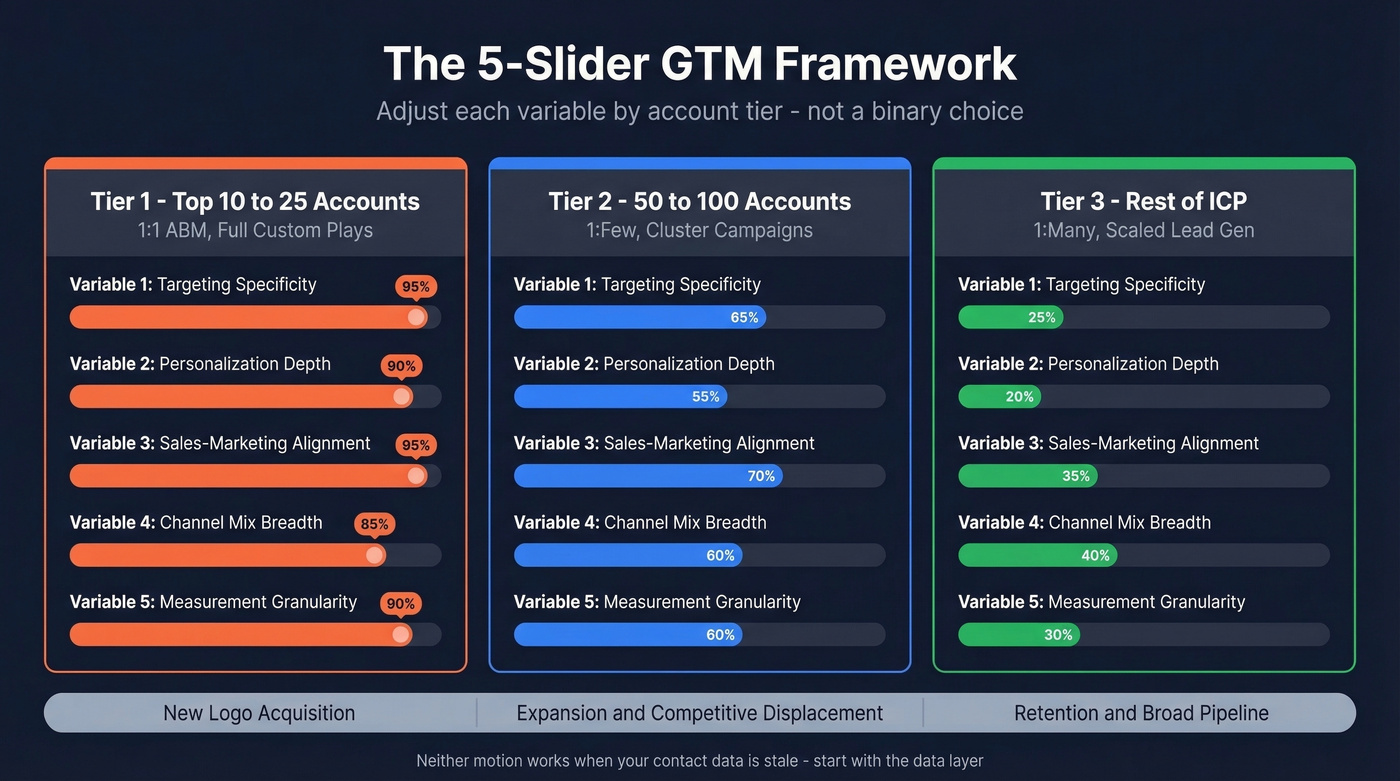
- Targeting specificity
- Personalization depth
- Sales-marketing alignment
- Channel mix
- Measurement approach
Map your revenue goals to three buckets, then assign tiers. New logo acquisition maps to Tier 1 - your top 10-25 accounts get full 1:1 treatment. Expansion and competitive displacement maps to Tier 2, where 50-100 high-fit accounts get cluster campaigns. Retention and broad pipeline maps to Tier 3, where the rest of your ICP gets scaled lead gen with account-level tracking.
The journey across these tiers follows five stages:
- Awareness - demand gen drives broad reach
- Interest - intent signals qualify and segment
- Consideration - personalized multi-channel outreach for engaged accounts
- Decision - coordinated sales-marketing plays for demos and ROI cases
- Post-sale - account-based plays for expansion and retention
Ownership shifts from marketing-heavy at the top to sales-led in the middle to shared at the bottom. The shared metrics that matter across both motions: pipeline created, MQA-to-opportunity conversion, win rate, and revenue closed. Understanding when to lean into account-based plays versus broad pipeline generation at each stage is what separates high-performing revenue teams from everyone else.
Neither strategy works when your contact data is six weeks stale. In our experience, the teams that struggle most aren't picking the wrong strategy - they're running the right strategy on garbage data.
Tools You'll Need (By Budget)
A practitioner on r/b2bmarketing called ABM tools "expensive reminders to sell to your ICP." Harsh, but not unfair. Skip the enterprise platforms entirely if you don't have a dedicated RevOps person - you'll spend $50K+ on software that collects dust.

| Budget Tier | Tool | What It Does | Expect to Pay |
|---|---|---|---|
| Enterprise | 6sense | AI/prediction-first ABM | ~$50-120K/yr |
| Enterprise | Demandbase | Buying-group + DSP | ~$40-100K/yr |
| Mid-market | RollWorks | Ad-first, lighter AI | ~$15-40K/yr |
| Mid-market | Terminus | Multi-channel ABM | ~$25-80K/yr |
| SMB/Starter | HubSpot Pro+ | ABM features built in | ~$800/mo+ |
If you're comparing data vendors and enrichment options, start with a clear view of data enrichment services and how they impact deliverability.
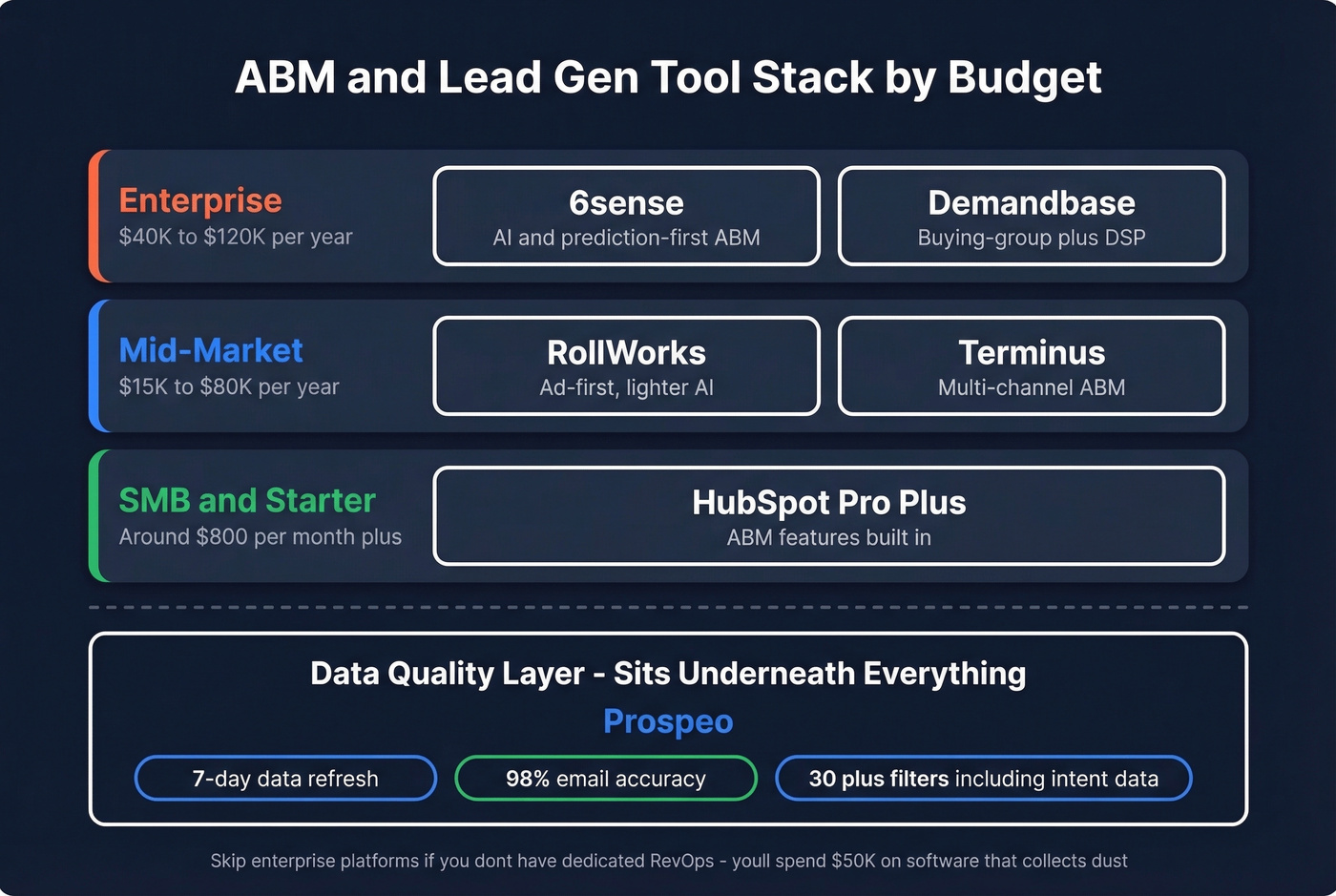
Prospeo sits underneath all of these as the data quality layer. Its 7-day refresh cycle and 98% email accuracy mean your outreach actually reaches the buying committee instead of bouncing - whether you're running a $100K 6sense deployment or a scrappy HubSpot setup.
If you're fighting bounces, fix the root cause first: email bounce rate and list hygiene.
Real ABM requires naming 3+ stakeholders per account before you launch a single campaign. Prospeo gives you 300M+ profiles with verified emails and 125M+ direct dials - so you can map the full buying committee in minutes, not weeks. Layer Bombora intent data across 15,000 topics to target accounts actually in-market.
Build your target account list from signals, not wishlists.
FAQ
Can small teams run ABM without an enterprise platform?
Yes. Start with a target account list of 10-25 accounts, use your existing CRM for tracking, and focus on personalized outreach rather than platform-driven orchestration. A free Prospeo tier (75 emails/month) plus a CRM like HubSpot gives you enough to run 1:few plays without a six-figure tool.
What's the biggest difference between MQLs and MQAs?
MQLs track individual leads; MQAs track entire accounts showing buying signals. Since 81% of B2B buyers select a vendor before talking to sales, measuring account-level engagement catches buying committees that single-lead tracking misses entirely.
How do you measure ABM ROI when cycles are long?
Track leading indicators first: account engagement scores, buying-group coverage percentage, and MQA-to-opportunity conversion rate. Lagging metrics like pipeline, revenue, and win rate take 6-12 months to materialize. Set operational benchmarks at 90 days while waiting for revenue data.
Is this a binary choice?
No. Most high-performing teams run both using a tiered approach. ABM outperforms for $100K+ deals with long sales cycles and 5+ stakeholders. Lead gen outperforms for shorter-cycle, lower-ACV motions. The 5-slider framework above lets you adjust the blend per account tier rather than picking one or the other.