

Account-Based Selling: What It Is, Why It Fails, and How to Do It Right
Only 16% of reps hit quota. Buying committees have ballooned to 25 stakeholders, average sales cycles stretch to 6.5 months, and win rates hover around 20-21%. The volume-based playbook - blast more emails, book more demos, hope something sticks - doesn't work when only 5% of your target accounts are in-market at any given time.
Account-based selling is the strategic response: stop spraying, start choosing.
ABS works best when you have higher ACV, multiple stakeholders per deal, and longer sales cycles. You need three things to start: a tiered target account list, verified contact data for every stakeholder, and a weekly operating cadence. Skip a ~$60K/year platform like 6sense until you've proven the motion with a 10-20 account crawl phase.
What Is Account-Based Selling?
This methodology treats each high-value account as a market of one. Instead of qualifying individual leads and hoping they convert, you identify the accounts most likely to buy, map every stakeholder in the buying committee, and coordinate personalized engagement across the entire deal cycle - land, expand, and retain. The ABS approach replaces reactive pipeline management with proactive, orchestrated deal execution.
The distinction from ABM is straightforward. ABS is the flip side of the ABM coin: marketing creates awareness and engagement with targeted campaigns, and sales acts on those warm signals with coordinated outreach to close and expand. They're complementary halves of the same strategy, not competing programs.
| Traditional Lead-Based | Account-Based | |
|---|---|---|
| Unit of focus | Individual lead | Entire account |
| Goal | Convert MQLs | Penetrate buying committee |
| Sales cycle | Reactive, linear | Orchestrated, multi-threaded |
| Measurement | Lead volume, MQL count | Pipeline velocity, win rate |
| Relationship | Transactional | Long-term value |
Why ABS Matters in 2026
The numbers make the case. 71% of practitioners already run some form of ABM strategy, yet only 26% have a fully scaled program - meaning most teams are still figuring this out. Teams that shifted from MQLs to buying-group-focused approaches saw a 200% increase in win rates and an 800% increase in opportunity progression, per a Forrester Summit recap by ModernB2B. Gartner data shows account-based strategies deliver a 48% higher average win rate than traditional approaches. And when you engage more than one contact per account, deals are 37% more likely to close.
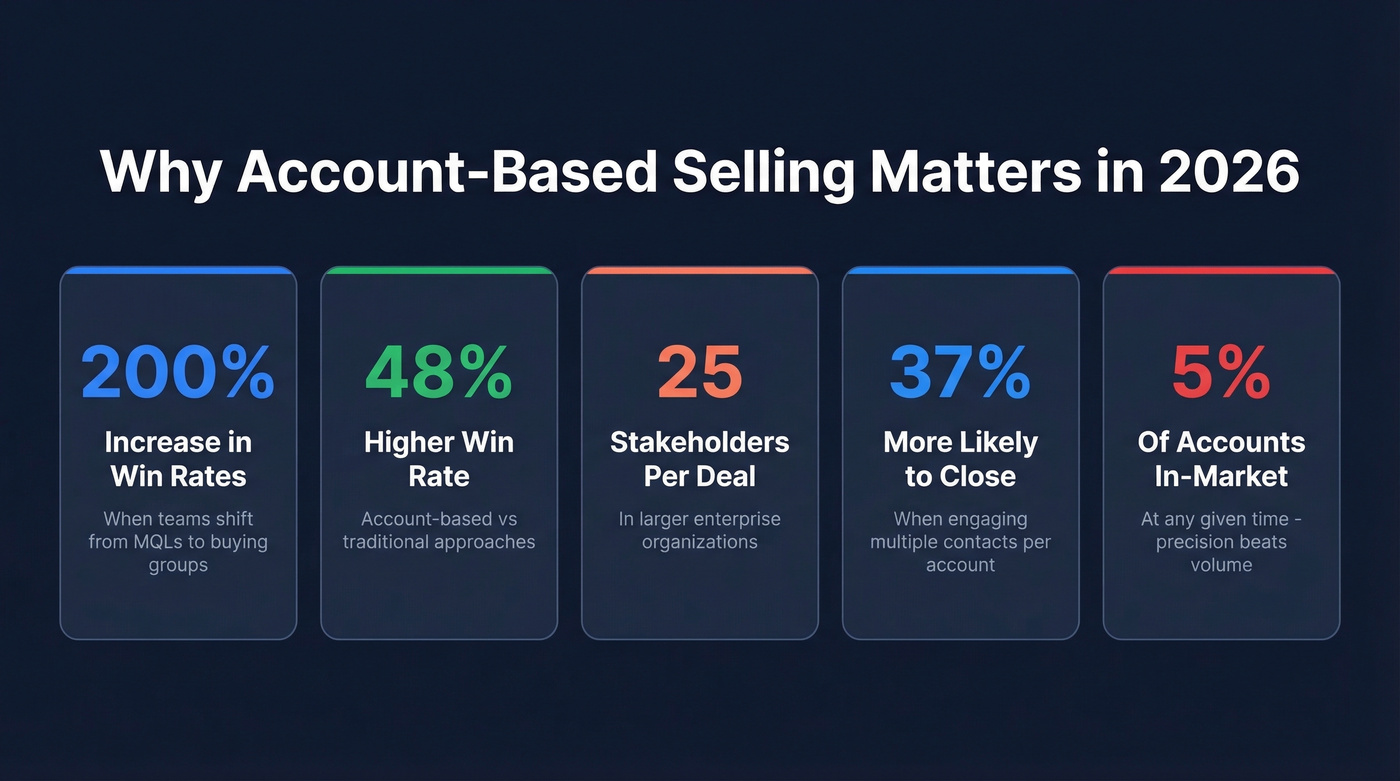
The buying committee complexity alone justifies the shift. Gartner's research shows 5-11 stakeholders across roughly five business functions for a typical enterprise deal. Kondo's report puts that number at 25 for larger organizations. You can't reach a 25-person committee with a single-threaded sales motion - which is why any serious ABS guide in 2026 starts with multi-threading, not email volume.
Here's the thing: 73% of buyers now use AI-powered search to evaluate vendors before ever talking to a rep. Reps spend only 28-30% of their time actually selling - the rest goes to CRM admin, internal meetings, and tool-hopping across an average of 10 platforms. ABS doesn't add more work. It concentrates selling time on accounts that can actually close.
When NOT to use ABS: if your average deal is under $10K, involves a single decision-maker, and closes in under 30 days, the coordination overhead will eat you alive. ABS is a precision instrument, not a volume play.
The ABS Tiering Model
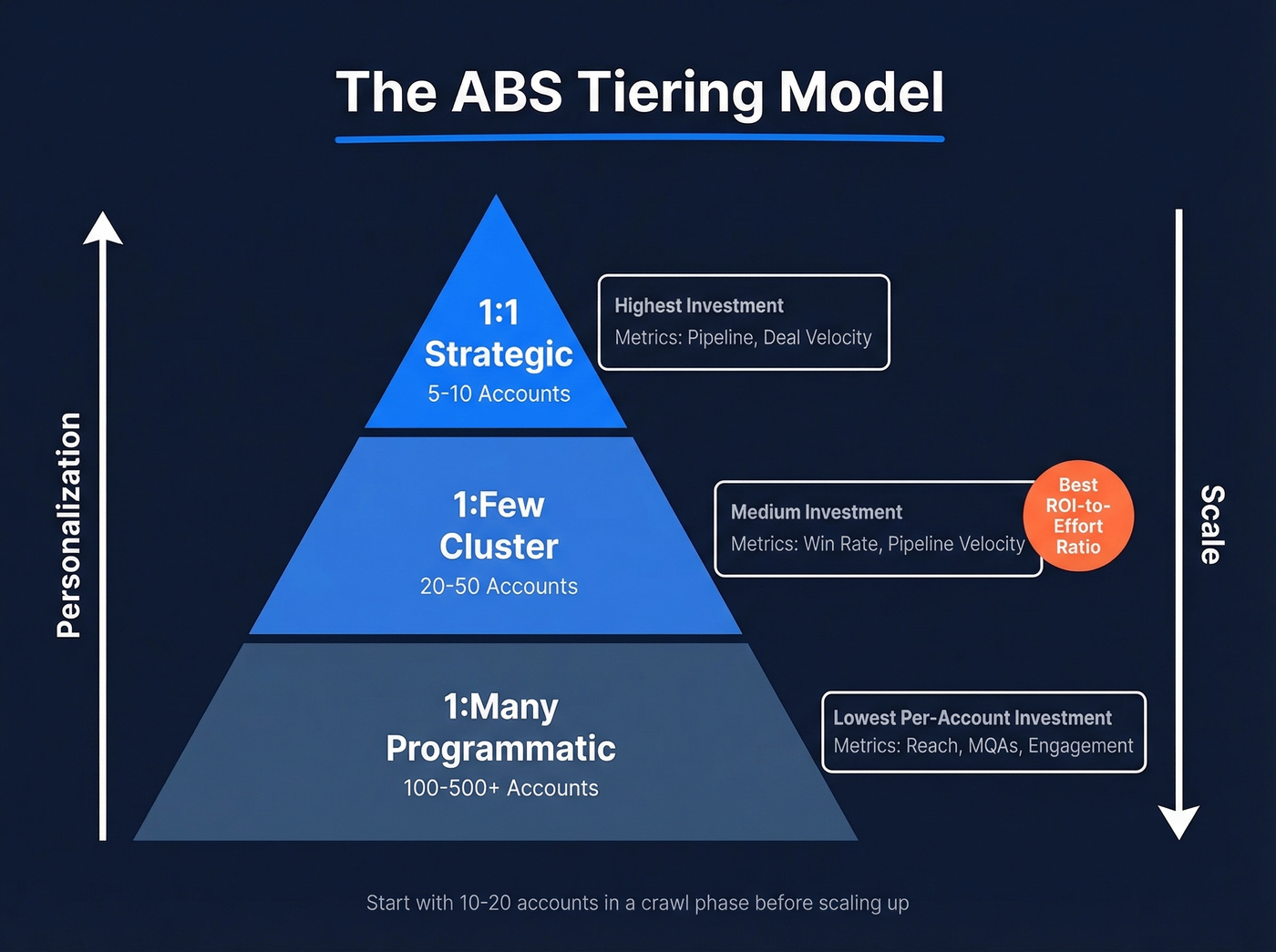
Not every account deserves the same investment. The tiering model separates disciplined programs from expensive wish lists.
1:1 Strategic
Bespoke account plans with executive sponsorship, tailored content, and custom experiences. You're building a dedicated play for each account - personalized business cases, custom ROI models, and coordinated touches from AEs, SDRs, and leadership. Reserve this for your top 5-10 targets. Measure pipeline creation and deal velocity.
1:Few Cluster
Cluster 20-50 lookalike accounts by industry, tech stack, or pain point and run semi-custom plays. This is the sweet spot for most teams - enough personalization to stand out, enough scale to justify the effort. We've seen this tier produce the best ROI-to-effort ratio across the programs our team has tracked. Measure pipeline creation, velocity, and win rate improvements against your baseline.
1:Many Programmatic
Intent signals plus automation for scalable personalization across hundreds of accounts. This is your entry point - the "crawl" phase. Use intent data to surface accounts showing buying signals, then trigger automated but relevant outreach. Metrics here emphasize reach, engagement, and MQA progression.
| Tier | Accounts | Investment | Key Metrics |
|---|---|---|---|
| 1:1 Strategic | 5-10 | Highest | Pipeline, deal velocity |
| 1:Few | 20-50 | Medium | Win rate, pipeline velocity |
| 1:Many | 100-500+ | Lowest per account | Reach, MQAs, engagement |

Your ABS tiering model is only as good as the contact data behind it. Prospeo gives you 30+ filters - buyer intent, technographics, headcount growth, funding - to build target account lists with verified emails and direct dials for every stakeholder. 98% email accuracy. 125M+ verified mobiles. $0.01 per email.
Stop multi-threading with bad data. Start closing buying committees.
How to Implement ABS Step by Step
Knowing the theory is one thing - execution is where most programs stall.
Define Your ICP
Start with firmographics like industry, revenue, and headcount, then layer in technographics and intent signals. Cross-reference with your best existing customers - the accounts that closed fastest, expanded most, and churned least. Get Sales, CS, and Product in the same room for this. Marketing shouldn't build the ICP alone.
Build Your Target Account List
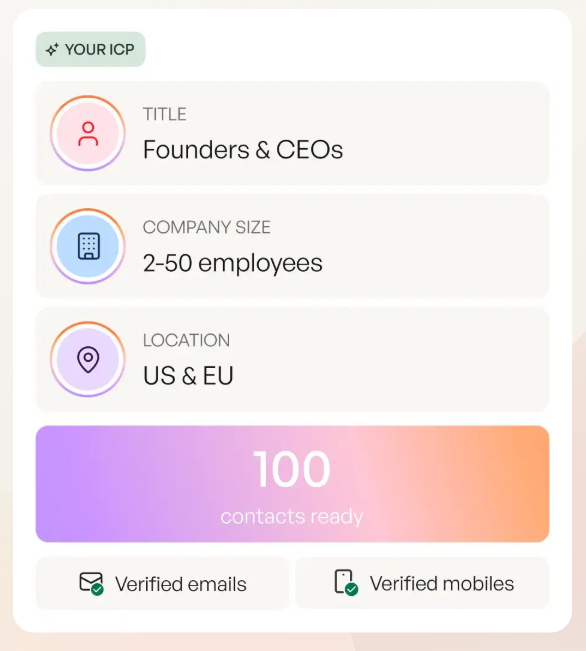
Prioritize ruthlessly. A list of 500 "ideal" accounts is just a lead list with a fancier name. Start with 10-20 accounts for your crawl phase. Use buyer intent, technographic, and firmographic filters to pull verified emails and direct dials for every stakeholder on each account. If you can't find verified contact data for at least five people at a target account, that account isn't ready for your list.
Map the Buying Committee
For each target account, identify 5-11 stakeholders across the functions that influence the deal: the economic buyer, the champion, end users, procurement, and IT/security. Don't just find names - understand their priorities.
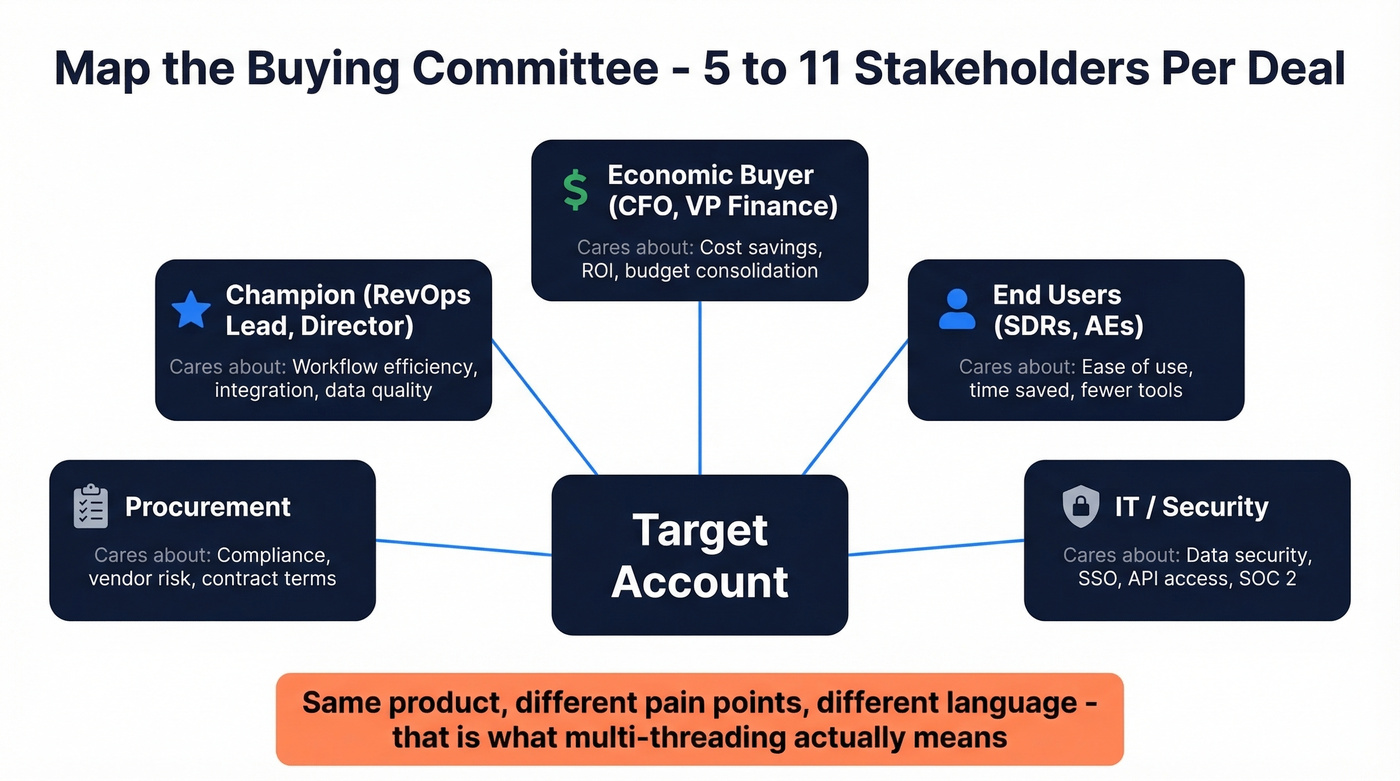
Let's break this down with an example. Pitching the same product to a CFO vs. a RevOps lead requires completely different messaging:
To a CFO: "Your team is spending $180K/year on three overlapping data tools. We consolidate that to one platform at $40K, and the data is fresher - 7-day refresh vs. the 6-week cycle you're getting now."
To a RevOps lead: "We plug directly into your Salesforce instance. Enrichment runs automatically on new records - 50+ data points, 92% match rate. Your reps stop toggling between tabs and start selling."
Same product. Different pain points. Different language. That's what multi-threading actually means.
Align Sales and Marketing
Every ABS guide tells you to "align sales and marketing" without explaining what that looks like in practice. It looks like shared KPIs.
Marketing isn't measured on MQL volume; they're measured on pipeline from target accounts. Sales isn't free to ignore marketing-sourced engagement; they commit to working every account on the list. Allocate 30-50% of marketing resources to ABM when you're targeting similar revenue contribution. Mature programs extend this coordination to CS, product, and finance - not just the sales-marketing axis. B2B programs that skip this alignment step are the ones that show up in the "failed ABM" case studies.
Execute Multi-Channel Outreach
Email is still the top ABM channel at 92%, but the inbox is increasingly broken. Layer in direct mail, in-person events (72% of top programs use them), personalized video, and warm calls to direct dials. Teams running contact-level ABM see up to a 74% increase in booked meetings and up to a 118% lift in pipeline conversion - the specificity pays for itself.
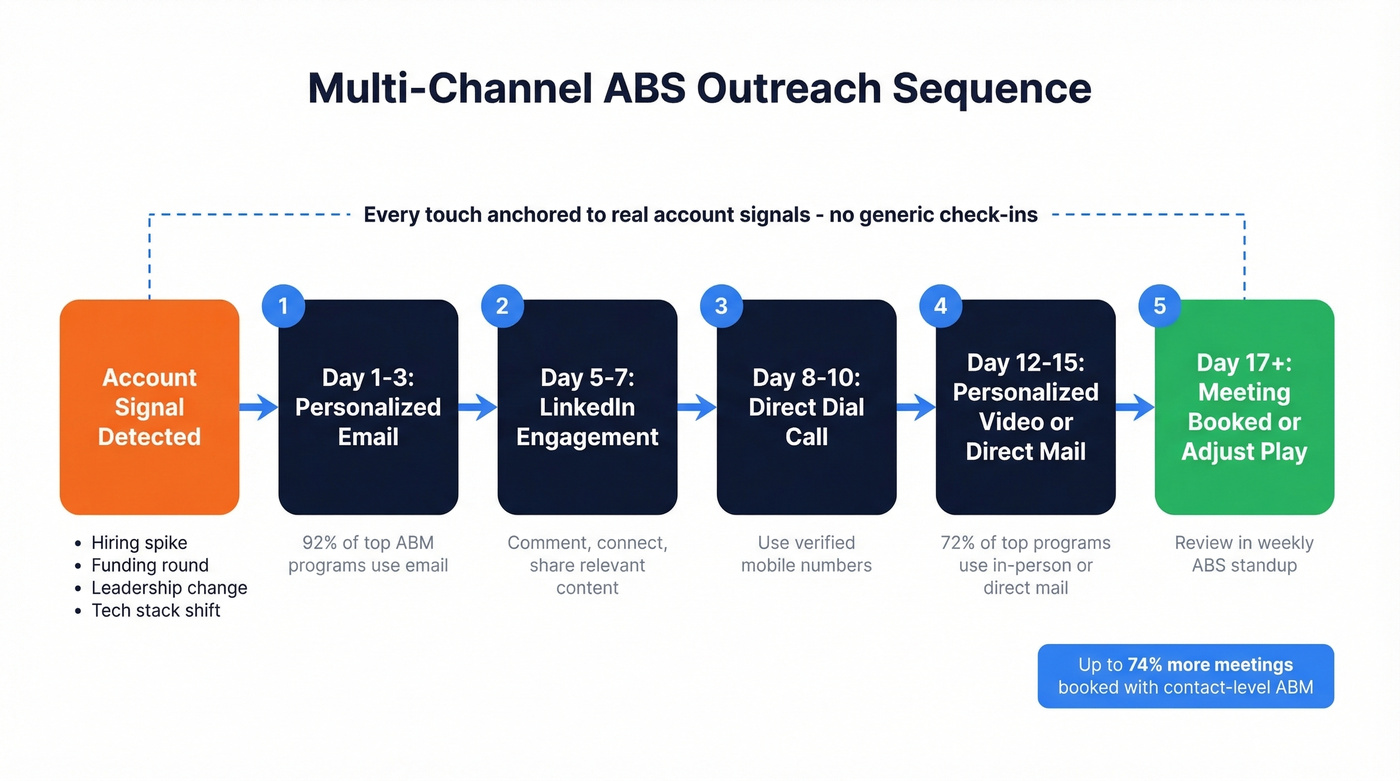
Anchor every touch to real account signals: hiring spikes, funding rounds, leadership changes, tech stack shifts. Generic "just checking in" emails don't work in a 25-stakeholder buying committee.
Run Weekly ABS Standups
The weekly standup is your reset point. Sales and marketing review each target account: what signals fired this week, which stakeholders engaged, what's blocking progress, and what plays to adjust. Without this cadence, ABS programs drift into "set it and forget it" territory - which is just lead-gen with extra steps.
The ABS Tech Stack
You don't need 10 tools. You need 3-4 good ones. For a 10-20 rep team, expect roughly $2,000-10,000+/month depending on seats and whether you add an ABM platform.
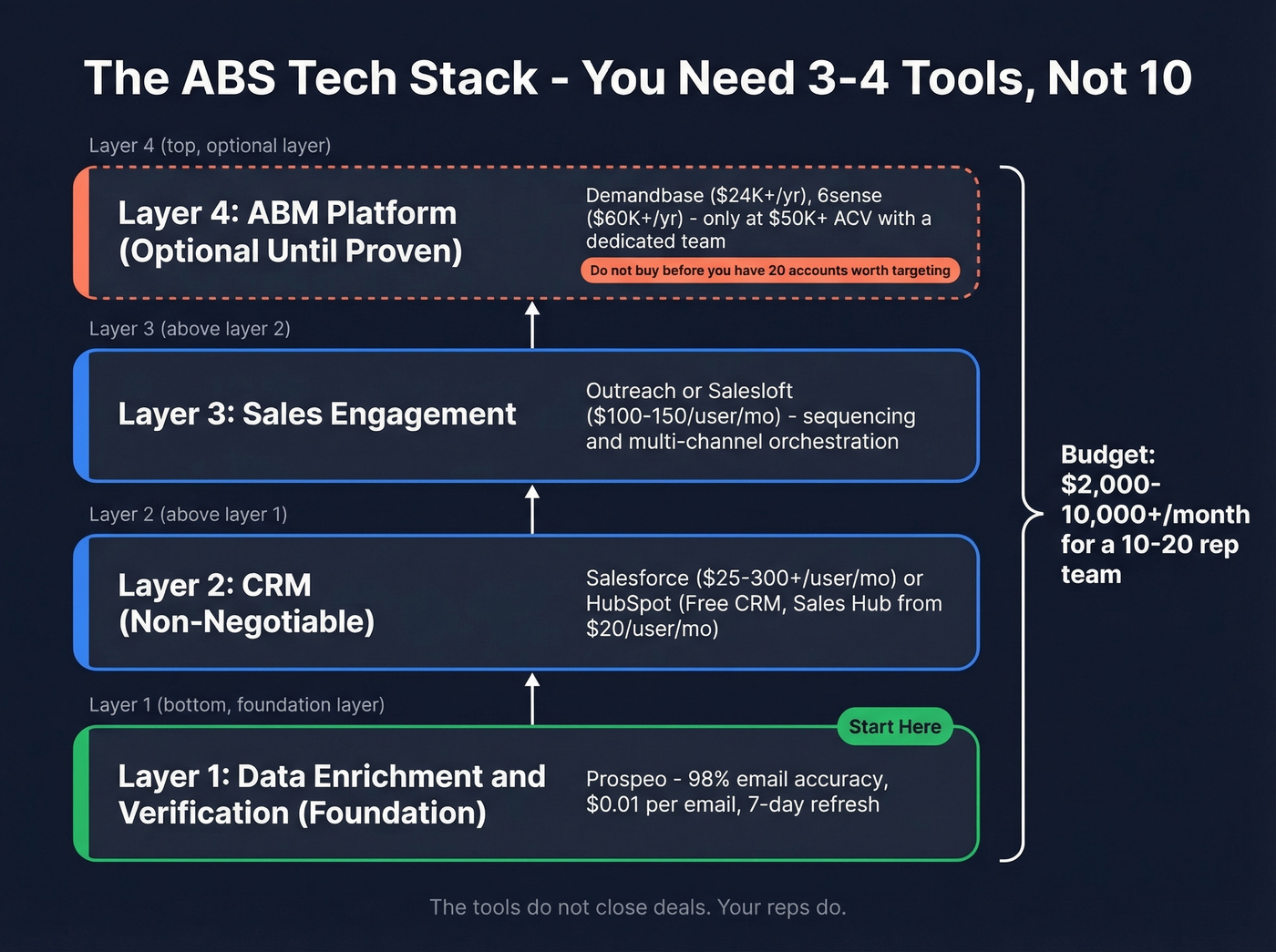
Data enrichment and verification is the foundation. Account-based execution falls apart when your systems can't match accounts cleanly - and poor data integration can drive 30-40% lower account match rates. Prospeo handles this layer with 98% email accuracy, a 7-day data refresh cycle, and intent data tracking 15,000 topics via Bombora. At roughly $0.01 per email, it's a fraction of what enterprise platforms charge. If you’re comparing vendors, start with a quick scan of data enrichment and verification options.

CRM is non-negotiable - Salesforce ($25-$300+/user/month depending on edition) or HubSpot (free CRM; Sales Hub starts around $20/user/month). If you’re standardizing your stack, it helps to review a few examples of a CRM before you commit. Sales engagement tools like Outreach or Salesloft handle sequencing and multi-channel orchestration; treat this as sequence management, not “set and forget.” ABM platforms like Demandbase or 6sense are optional until you've proven the motion and your ACV justifies the spend. We've watched teams burn ~$60K/year on 6sense before they even had 20 accounts worth targeting. Don't be that team.
| Tool | Category | Starting Price |
|---|---|---|
| Prospeo | Data & verification | Free; ~$0.01/email |
| ZoomInfo | Data & intent | ~$15K+/year |
| Salesforce Account Engagement | ABM / marketing automation | ~$1,250/month |
| RollWorks | ABM platform | ~$10K+/year |
| Demandbase | ABM platform | ~$24K+/year |
| 6sense | ABM platform | ~$60K+/year |
| Outreach | Sales engagement | ~$100-150/user/mo |
| Salesloft | Sales engagement | ~$100-150/user/mo |
Look - enterprise teams spend roughly 29% of their marketing budget on ABS programs. ABM platforms can be a major line item, and they only make sense at $50K+ ACV with a dedicated team to run them. If your average deal sits under $25K, you'll get more pipeline from accurate contact data and disciplined outreach than from any six-figure intent platform. The tools don't close deals. Your reps do.
You need verified contact data for 5-11 stakeholders per account - CFOs, RevOps leads, procurement, IT. Prospeo's database covers 300M+ profiles refreshed every 7 days, so you're never pitching with stale data. Enrich your CRM automatically with 50+ data points at a 92% match rate.
Map the full buying committee in minutes, not days.
Why ABS Programs Fail
The top challenges practitioners report tell the story: proving ROI (47%), aligning sales and marketing (43%), and scaling programs (40%). If you want a deeper checklist, compare your motion against these account-based selling best practices.
Sales only works half the accounts. UserGems documented this internally: after launching their ABM program, sales only engaged roughly half the target accounts. Marketing wasted 50% of the ABM budget on accounts nobody followed up on. The fix is uncomfortable but simple - make account coverage a tracked metric, not a suggestion.
Wrong accounts, wrong list. Marketing picks the list without sales input, or the team targets 500 accounts with resources for 50. Both kill the program. Start with 10-20 and prove the motion before scaling.
Measuring leads instead of buying groups. If your dashboard still shows MQL counts, you're running lead-gen with ABM branding. Group leads by account. Set engagement thresholds at the account level. This is also where lead scoring needs to evolve from “lead” to “account.”
Giving up too early. Average sales cycles run 6.5 months. Many programs get abandoned before a single deal has had time to close. Expect 3-6 months before meaningful pipeline impact.
Data quality as the silent killer. You can't multi-thread into a buying committee when a third of your emails bounce and half your phone numbers are disconnected. In our experience, we've run bake-offs where the "best strategy" lost because the underlying data was garbage. Fix the data layer first - start with email bounce rate and work backward.
Trying everything at once. Pipeline anxiety makes teams launch 1:1, 1:Few, and 1:Many simultaneously with no baseline. Pick one tier, run it for a quarter, measure, then expand. Implementing account-based selling as a phased rollout - not a big-bang launch - is the difference between programs that scale and programs that stall.
The consensus on r/sales and r/ABM is blunt: one practitioner called platforms like 6sense and Demandbase "expensive reminders to sell to your ICP." Harsh, but it reflects real frustration - the tools don't fix broken processes. And the AI promise hasn't materialized yet: 45% of practitioners see AI's potential for personalization, but nearly 70% find its current effectiveness limited.
KPIs to Track
Pipeline velocity measures how fast accounts move through stages. Benchmark against your current average and target 15-25% improvement. Win rate sits at 20-21% industry-wide; ABS programs should target 30%+ within the first year. Deal size should run 11-20% larger on ABS accounts than non-ABS deals.
Beyond those three, track stakeholder engagement depth (how many contacts per account are actively engaged before close), meeting-to-opportunity conversion rate, revenue per account including expansion, and account penetration rate - the percentage of target accounts where you've engaged 3+ stakeholders. Account-based selling is a CLV play, not a one-deal play. If you're not measuring expansion revenue alongside new logos, you're missing the point. To keep reporting honest, tie these to pipeline health instead of vanity activity metrics.
FAQ
What is account-based selling?
Account-based selling is a B2B methodology where reps treat each high-value target account as a market of one, mapping the full buying committee and coordinating personalized outreach across stakeholders from first touch through expansion. It replaces reactive lead qualification with proactive, orchestrated deal execution - and works best when ACV exceeds $10K and deals involve 3+ decision-makers.
What size company needs ABS?
ABS makes sense when your ACV exceeds $10K, your sales cycle runs 60+ days, and deals involve three or more stakeholders. Company size matters less than deal complexity - a 20-person startup selling six-figure contracts benefits more from ABS than a 500-person company closing $2K self-serve deals.
How long before ABS shows results?
Expect 3-6 months before meaningful pipeline impact. Start with 5-10 accounts and expand based on what you learn. Set expectations with leadership early and track leading indicators like stakeholder engagement and meeting conversion while you wait for revenue to follow.