

Account Prioritization: The Practitioner's Playbook (With a Scoring Template You'll Actually Use)
84% of reps missed quota last year. Not because they couldn't sell - because they were selling to the wrong accounts. When 69% of salespeople don't have enough pipeline to hit their number, the problem isn't effort. It's allocation.
Account prioritization is the fix. What follows is the actual template, the tier cutoffs, and the data quality layer that most guides skip entirely.
What You Need (Quick Version)
- A clear ICP definition plus the Fit x Timing quadrant to sort your accounts before you score anything.
- A simple weighted scoring model (template below) with firm tier cutoffs - not a black-box number nobody trusts.
- A data enrichment layer that keeps contacts fresh so reps can act on Tier 1 accounts immediately instead of chasing bounced emails.
What Is Account Prioritization?
It's the process of ranking your total addressable market by likelihood to buy and potential value, then allocating rep time accordingly. It's not the same thing as lead scoring - we'll get to that distinction in the FAQ.
Here's what changes depending on who's doing it. In sales, you're ranking by deal size, buying signals, and competitive positioning. In customer success, you're ranking by health scores, churn risk, and expansion potential. RevOps, sales leaders, CS teams, and ABM marketers all need this discipline, but the criteria shift. This guide focuses on the sales and ABM side, where the stakes are pipeline and revenue.
The Fit x Timing Framework
Before you build a scoring model, you need a strategic lens. The Fit x Timing quadrant from Gradient Works is the clearest framework we've found for understanding how to rank target accounts before you assign a single score.
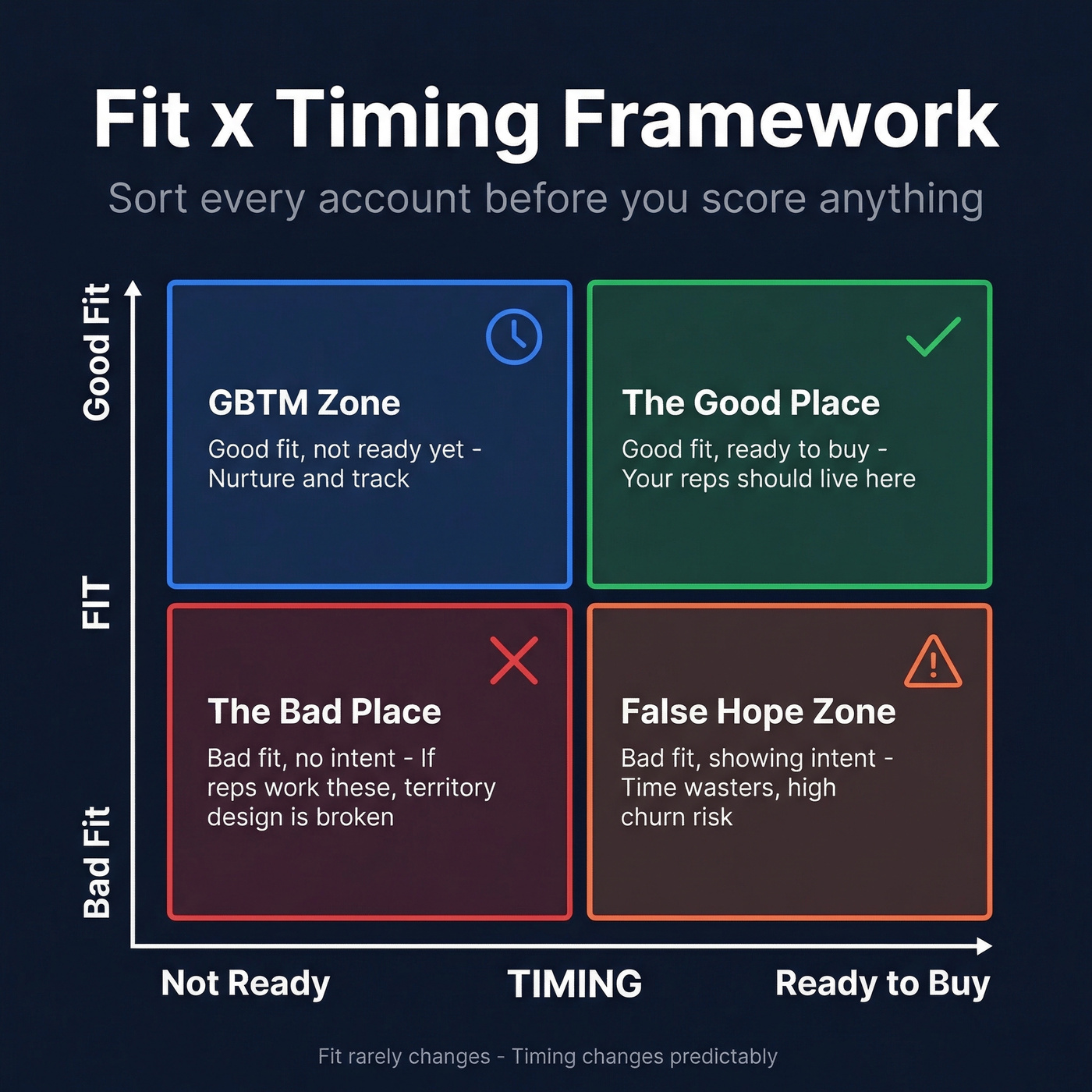
Every account lands in one of four buckets:
- The Good Place - good fit, ready to buy. This is where your reps should live. High ICP match, active buying signals, budget cycle aligned.
- GBTM (Get Back to Me) Zone - good fit, not ready yet. Track these. Nurture lightly. They'll move when timing shifts.
- False Hope Zone - bad fit, but showing intent. These accounts will waste your best reps' time. You might close some, but they churn fast and drag down NRR.
- The Bad Place - bad fit, no intent. If reps are working these, your territory design is broken.
Fit rarely changes. A 50-person logistics company doesn't suddenly become your ideal enterprise buyer. But timing changes predictably - budget cycles, contract renewals, leadership changes, funding rounds.
Up to half of sales performance can be explained by territory potential rather than rep skill. In our experience, teams that skip this Fit x Timing step end up with scoring models that look rigorous but rank the wrong accounts. Target account prioritization isn't a nice-to-have. It's the single biggest lever you can pull before coaching, enablement, or tooling.
Build Your Account Scoring Model
Once you've sorted accounts through the Fit x Timing lens, you need a repeatable scoring model. Businesses using scoring models see a 77% boost in lead generation ROI compared to those that don't.
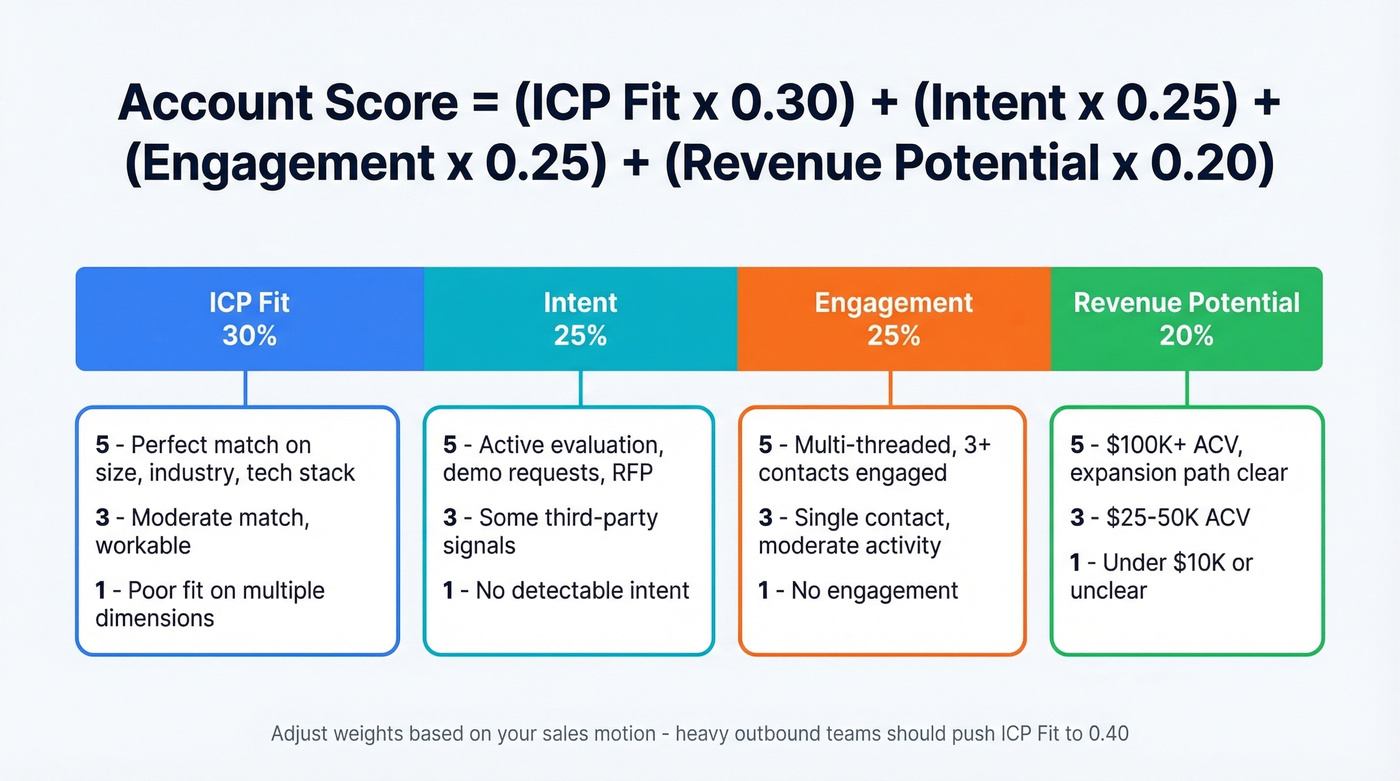
The Scoring Formula
Account Score = (ICP Fit x 0.30) + (Intent x 0.25) + (Engagement x 0.25) + (Revenue Potential x 0.20)
Each factor is scored on a 1-5 scale. The weights reflect a balanced model - adjust them based on your sales motion. Running heavy outbound with limited inbound signal? Push ICP Fit to 0.40 and drop Engagement to 0.15. Product-led with strong usage data? Flip those. Teams familiar with product prioritization frameworks like RICE or ICE can adapt the same weighted-formula logic here; the math transfers directly.
Anchor Definitions (1-5 Scale)
| Score | ICP Fit | Intent | Engagement | Revenue Potential |
|---|---|---|---|---|
| 5 | Perfect match: size, industry, tech stack, org structure | Active evaluation: pricing page visits, demo requests, RFP activity | Multi-threaded: 3+ contacts engaged across channels | $100K+ ACV, expansion path clear |
| 4 | Strong match, 1 minor gap | Topic surges + job postings aligned to your solution | 2+ contacts engaged, recent activity | $50-100K ACV |
| 3 | Moderate match, workable | Some third-party intent signals, no first-party yet | Single contact engaged, moderate activity | $25-50K ACV |
| 2 | Partial match, significant gaps | Minimal signals, general category interest | Light engagement, single touchpoint | $10-25K ACV |
| 1 | Poor fit on multiple dimensions | No detectable intent | No engagement | Under $10K or unclear |
Adjust these ACV thresholds to match your deal size - a $5K ACV business would compress the entire scale.
When to Graduate to AI Scoring
Rule-based scoring works well until you have enough historical data to train a model. If you've closed 200+ deals and have clean CRM data, predictive approaches - logistic regression, random forests - surface patterns humans miss. Pocus takes this further with explainable AI scoring that gives reps A-F grades with plain-English rationale. That's the next evolution for data-rich teams.
For everyone else, the weighted formula above will outperform gut instinct by a wide margin.
Tiering Accounts and Allocating Resources
Scoring without resource allocation is just an exercise. Think of tiering as stack ranking customers and prospects so every rep knows exactly where to spend their next hour.
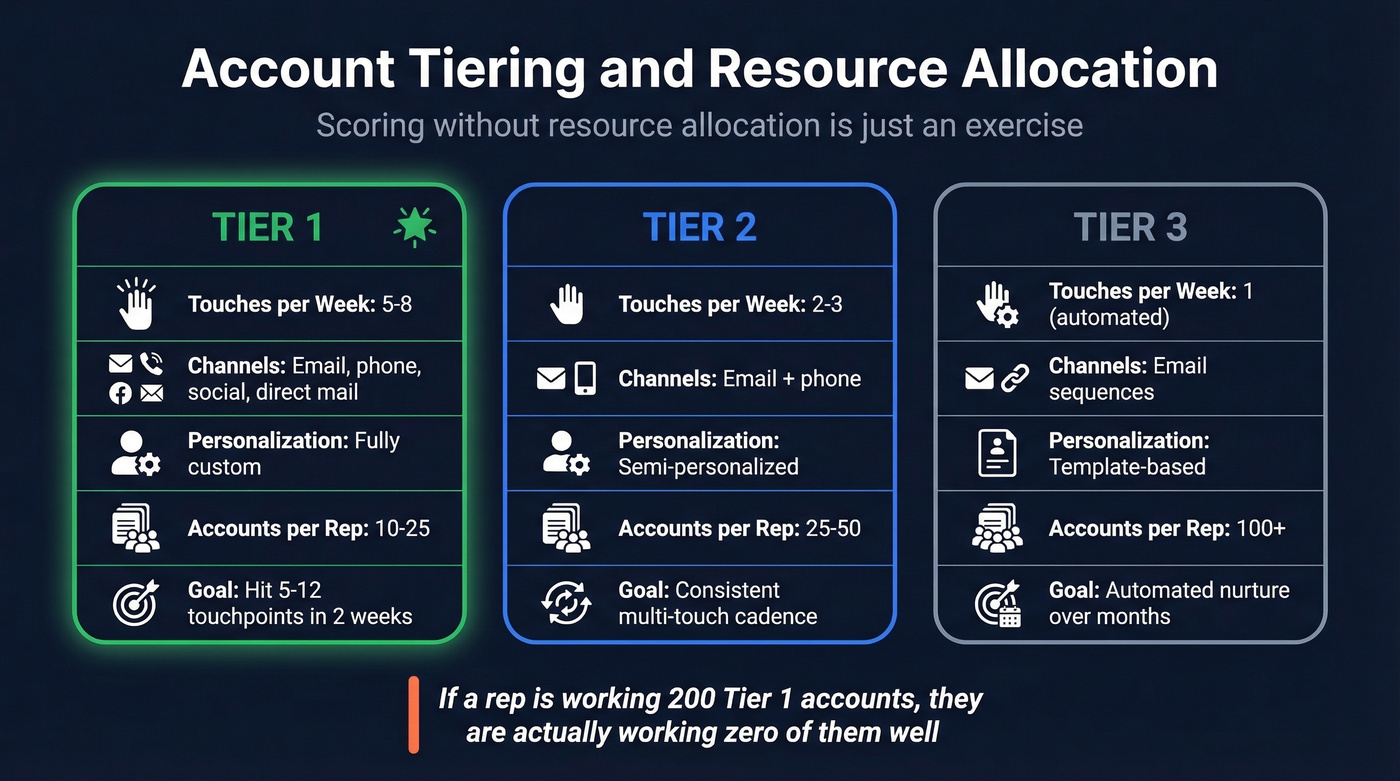
| Tier | Touches/Week | Channel Mix | Personalization | Accounts/Rep |
|---|---|---|---|---|
| Tier 1 | 5-8 | Email, phone, social, direct mail | Fully custom | 10-25 |
| Tier 2 | 2-3 | Email + phone | Semi-personalized | 25-50 |
| Tier 3 | 1 (automated) | Email sequences | Template-based | 100+ |
Most deals require 5-12 touchpoints before a meaningful conversation happens. Tier 1 accounts should hit that threshold within two weeks. Tier 3 accounts get there over months through automated sequences.
The account caps per rep are critical. If a rep is "working" 200 Tier 1 accounts, they're actually working zero of them well.
Mutiny operationalizes a similar approach with P1/P2/P3/Reserve tiers, where AEs own 1:1 outbound for a small P1 set while BDRs prospect the larger P2 pool. We've seen teams materially improve Tier 1 conversion rates just by enforcing these account caps and matching rep seniority to tier. Teams that move from gut-feel allocation to tiered, intent-driven workflows typically see a 10-30% improvement in pipeline health.

Your scoring model is only as good as the data behind it. When 35% of emails bounce, Tier 1 accounts get wasted on dead contacts. Prospeo refreshes every record every 7 days with 98% email accuracy - so when your model flags a high-priority account, reps reach real buyers immediately.
Stop prioritizing accounts you can't actually reach.
The Data Quality Problem No One Talks About
Here's a scenario we see constantly. Your top AE spent two weeks nurturing a Tier 1 account - personalized emails, custom deck, warm intro through a board connection. Then the primary contact's email bounces. She left six months ago. The phone number goes to a disconnected line. Two weeks of your best rep's time, gone.
This happens because the industry average data refresh cycle is about six weeks. By week three, your Tier 1 contact data is already decaying. Stale emails, wrong phone numbers, outdated titles - they silently destroy the ROI of every scoring model you build. And when up to 50% of sales go to the first vendor to respond, you can't respond first with bounced emails. No account penetration strategy survives contact data that's already dead on arrival.
Prospeo runs a 7-day data refresh cycle across 300M+ professional profiles, 143M+ verified emails, and 98% email accuracy. That's not a marginal improvement over the six-week industry average - it's a fundamentally different approach to data freshness. Pair it with your CRM via native integrations, and your Tier 1 accounts always have reachable contacts attached.

Intent Data: From Signal to Action
Intent data is what separates "good fit" from "good fit and ready to buy right now." You need both flavors.
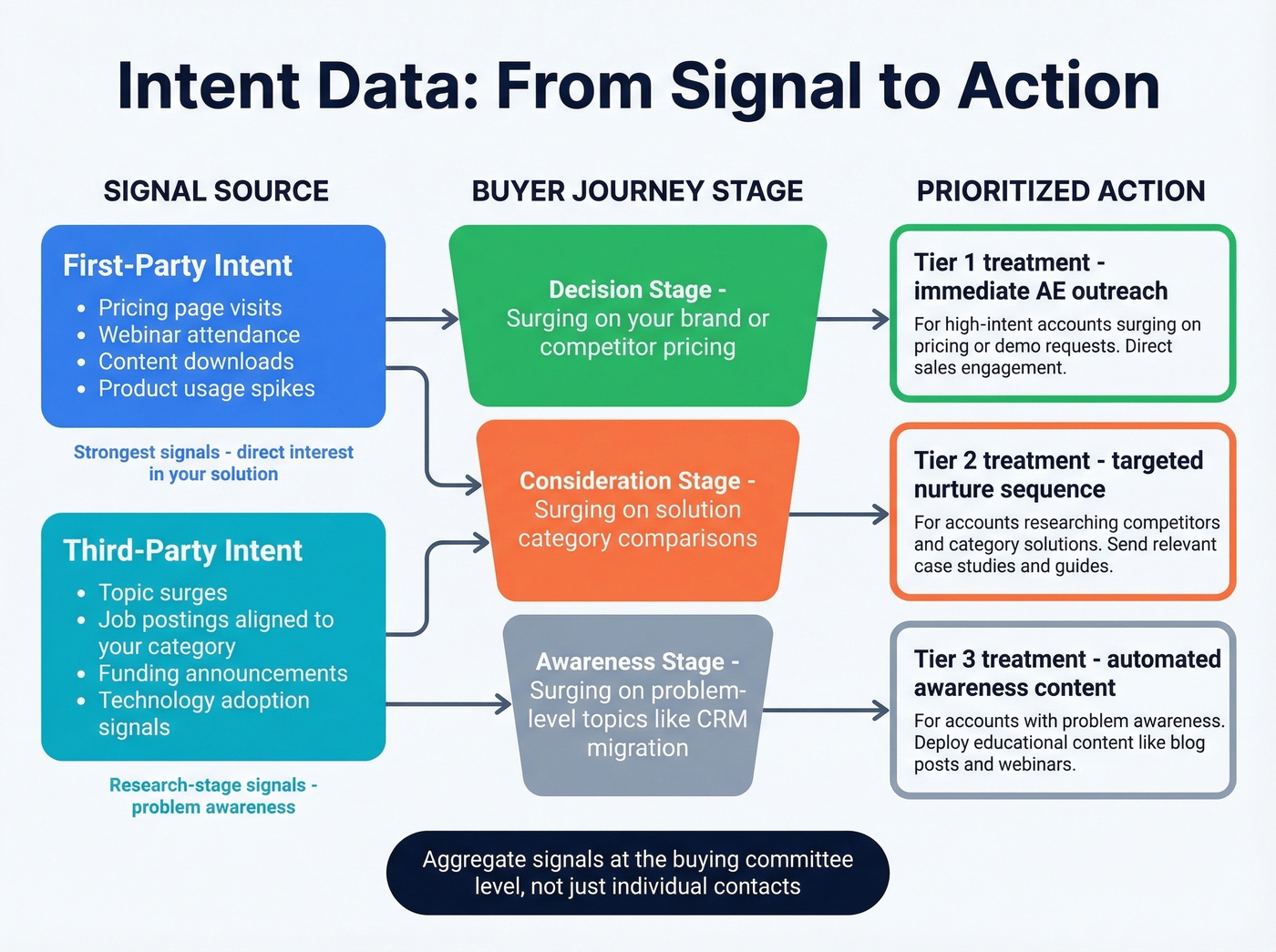
First-party intent is what happens on your turf - pricing page visits, webinar attendance, content downloads, product usage spikes. These are the strongest signals because they reflect direct interest in your solution.
Third-party intent comes from external sources - topic surges, job postings aligned to your category, funding announcements, technology adoption signals. These tell you an account is researching your problem space even if they haven't visited your site yet.
The key is mapping intent topics to buyer journey stages. An account surging on "CRM migration" is earlier in the funnel than one surging on "Salesforce vs HubSpot pricing." Aggregate signals at the buying committee level, not just individual contacts. 80% of B2B interactions now happen in digital channels, so there's more signal available than ever - the challenge is turning that signal into prioritized action, not drowning in dashboards.
Tools for Prioritizing Accounts
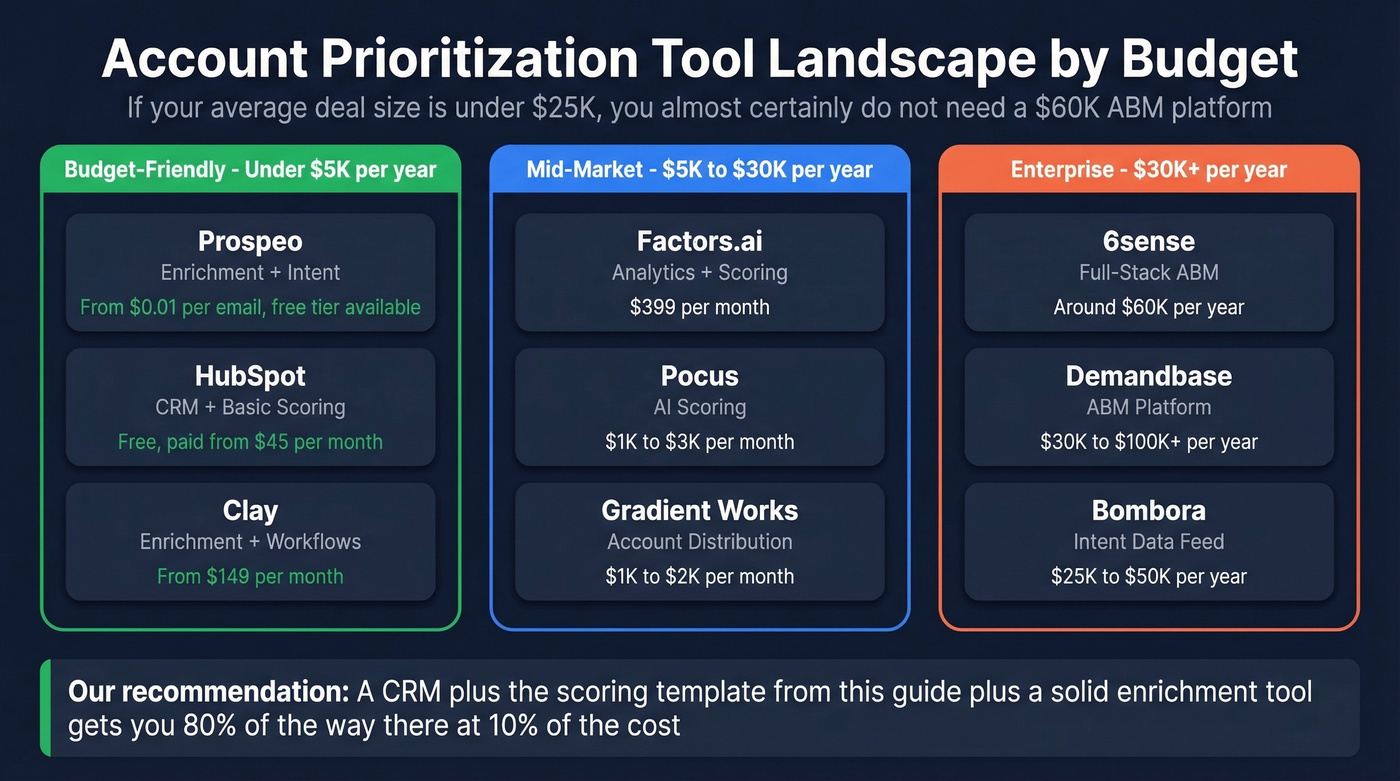
Enterprise ABM platforms run $30K-$100K+/year. You don't necessarily need one. Here's the landscape, sorted by category and budget:
| Tool | Category | Starting Price | Best For |
|---|---|---|---|
| Prospeo | Enrichment + intent | ~$0.01/email, free tier | Verified contacts + intent (15,000 topics), any budget |
| HubSpot | CRM + basic scoring | Free; paid from $45/mo | Built-in scoring for early teams |
| 6sense | ABM + intent | ~$60K/year | Enterprise full-stack ABM |
| Demandbase | ABM platform | ~$30K-$100K+/yr | Account-level ads + intent |
| Bombora | Intent data feed | ~$25K-$50K/year | Standalone intent feed |
| Clay | Enrichment + workflows | From $149/mo | Custom enrichment sequences |
| Factors.ai | Analytics + scoring | $399/month | Mid-market predictive scoring |
| Pocus | AI scoring | ~$1K-$3K/mo | PLG teams, explainable AI |
| Gradient Works | Account distribution | ~$1K-$2K/mo | Dynamic book management |
Let's be honest: if your average deal size is under $25K, you almost certainly don't need a $60K ABM platform. A CRM, the scoring template above, and a solid enrichment tool will get you 80% of the way there at 10% of the cost. Save the enterprise tooling for when you have the deal sizes to justify it.
Skip the full ABM stack if you're under 50 reps and your ACV is below $30K. You'll spend more time configuring the platform than selling.
Five Mistakes That Kill Pipeline
1. No ICP definition. You can't prioritize without knowing who you're prioritizing for. Start with firmographics, then layer in technographics and behavioral patterns from your best customers.
2. Measuring MQLs instead of account engagement. ABM isn't lead gen. Track multi-contact engagement, meetings booked, and opportunity creation - not form fills.
3. Generic content to "personalized" accounts. Swapping a company name into a template isn't personalization. Customize by industry, role, and specific challenge. Anything less and you're wasting your Tier 1 allocation.
4. Sales-marketing misalignment. When marketing runs display ads to an account while sales cold-calls the same buyer with a different message, you look disorganized. Joint account plans, shared KPIs, and a single CRM view fix this.
5. Scores without context. Ask any sales ops leader what kills their scoring model, and the answer is almost always the same: reps don't trust the scores because nobody explains the "why." A number without rationale gets ignored. Show reps the signals behind the score, or they'll revert to gut instinct within a week. The consensus on r/salesops backs this up - reps need the receipts, not just the grade.
Keep Your Model Fresh
A scoring model isn't a set-it-and-forget-it project. Timing signals decay fast - an account surging on "data migration" in January may have already signed a vendor by March.
Build a maintenance cadence: review account statuses monthly, recalibrate scoring weights quarterly, and run a full list refresh every six months. Monitor score decay closely. If Tier 1 accounts aren't converting at a meaningfully higher rate than Tier 2, your weights are off.
Here's a hard rule we use internally: if your Tier 1 conversion rate drops below 2x your Tier 2 rate for two consecutive quarters, your weights are wrong - not your reps. And remember that your data refresh cycle directly impacts scoring accuracy. A model built on contacts that are six weeks stale is making decisions on outdated information, which means your carefully calibrated scores are pointing reps at ghosts.
If you want to systematize the list refresh step, start by automating target account lists so your scoring model isn't constantly chasing outdated firmographics.
Intent signals, ICP fit, engagement scores - none of it matters if your contact data is stale. Prospeo layers 15,000 Bombora intent topics with 300M+ verified profiles and 30+ filters like funding, headcount growth, and technographics. Build your prioritization model on data that's actually current, at $0.01 per email.
Score accounts with intent data and contacts that actually connect.
FAQ
What's the difference between lead scoring and account scoring?
Lead scoring ranks individual contacts by engagement and fit. Account scoring ranks entire companies by aggregating signals across all contacts, firmographic data, and intent. For B2B with buying committees of 5-10 people, account scoring captures the full picture - individual lead scores miss the forest for the trees.
How often should I update my target account list?
Review account statuses monthly, recalibrate scoring weights quarterly, and do a full list refresh every six months. Intent signals decay fast - an account surging on "CRM migration" in January may have already signed a vendor by March. Stale lists waste your best reps' time on accounts that have already bought.
Can I build an account prioritization model without an ABM platform?
Yes. Start with your CRM, the scoring template in this guide, and a data enrichment tool for verified contacts and intent signals. You don't need a $60K/year platform to rank accounts effectively. The weighted formula above will outperform most black-box scoring tools for teams under 50 reps.
What's the best account penetration strategy for Tier 1 accounts?
Multi-thread from day one. Map the buying committee - typically 5-10 stakeholders - and engage at least three contacts across different roles before pushing for a meeting. Combine personalized email, phone, and social touches so you're not relying on a single channel or a single champion. The tiering table above gives you the cadence; a verified enrichment layer gives you reachable contact data to execute against it.