

Adapt.io vs Clodura.AI: Which B2B Data Tool Is Worth Your Budget?
Both tools have a $99/month option, both market big databases, and both have G2 review themes flagging email accuracy issues. The headline numbers - 600M+ leads here, 5,000 credits there - hide the math that actually matters: what you pay per usable, deliverable contact.
We've dug through G2 reviews, Trustpilot scores, pricing pages, and third-party tests to break this down. Reddit discussion around both tools is thin, so most of the customer voice lives on G2 and, for Clodura, Trustpilot.
Let's get into it.
30-Second Verdict
Pick Adapt.io if you're a solo SDR who values simplicity and a solid Chrome extension - and can live within tight credit limits.
Pick Clodura.AI if you want data, outreach sequences, and a dialer in one platform and you're willing to navigate confusing pricing and a steeper learning curve.
Adapt holds a 4.6/5 on G2 from 2,789 reviews while Clodura.AI sits at 4.5/5 from 301 reviews. Adapt wins on ease of use. Clodura wins on feature breadth. Neither wins on data quality.
Feature Comparison at a Glance
| Criteria | Adapt.io | Clodura.AI | Winner |
|---|---|---|---|
| G2 Rating | 4.6/5 (2,789) | 4.5/5 (301) | Adapt (more reviews, higher score) |
| Database Size | 150M+ contacts | 600M+ leads | Clodura (on paper) |
| Claimed Accuracy | ~90% | ~95% | Clodura (on paper) |
| Data Refresh | Every 14 days | Daily | Clodura (on paper) |
| Credits/Month ($99) | ~1,000 | ~5,000 | Tie (see cost-per-lead math) |
| Built-in Outreach | No | Yes (sequences + dialer) | Clodura |
| Chrome Extension | Yes | Yes | Adapt (better UX per G2) |
| Free Tier | 25 credits/mo | 100-750 credits/mo (varies) | Clodura (more generous) |
| CRM Integrations | Salesforce, Outlook, Slack | Salesforce, HubSpot, Pipedrive, Zoho, Dynamics 365 | Clodura (broader) |
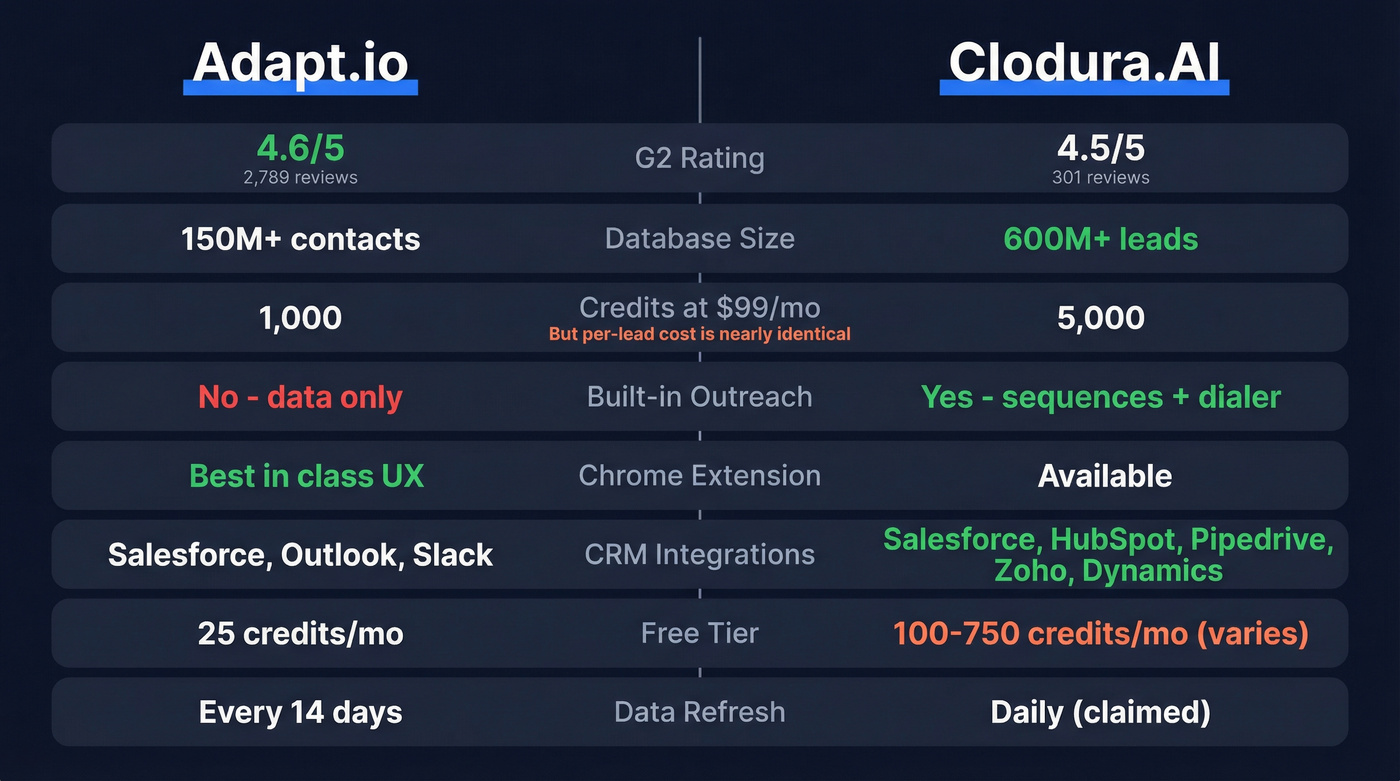
The database size gap looks dramatic - 600M vs 150M - but database size is meaningless if 5-10% of emails bounce.
Adapt.io: Simple but Credit-Starved
Use this if you want the fastest path from "I need this person's email" to having it in your clipboard. Adapt's Chrome extension is the main reason people buy it - 71 G2 mentions cite ease of use and the extension specifically.
Here's the thing, though: the credit wall is real. The loudest complaint across Adapt's G2 reviews is limited credits - 34 mentions for credit restrictions, another 24 for unexpected charges when limits are hit. On a $99/month plan, you're looking at roughly 1,000 email credits and 100 phone credits. Current tiers include Free ($0), Starter ($49), and Basic ($99), with yearly billing discounts and a 7-day free trial that doesn't require a credit card.
G2's implementation benchmarks show 4 months to implement and 16 months to ROI. For a prospecting tool, that's frustrating - a data platform should deliver value in days, not quarters. The 14 "incorrect email addresses" mentions on G2 don't help either. When your credit budget is already thin, every bounced email stings twice.
One more thing worth knowing: Adapt's G2 reviewer base skews heavily toward Asia, which likely reflects stronger data coverage in that region than in North America. If your ICP is US-based, keep that in mind.
If you're evaluating where this fits in your stack, compare it against other SDR tools and broader outbound lead generation tools.

You're comparing 1,000 credits vs 5,000 credits - but both tools have G2 reviews flagging bounced emails. Prospeo gives you 98% email accuracy through proprietary 5-step verification, at roughly $0.01 per email. No credit math tricks, no 4-month implementation window.
Stop paying for emails that bounce. Start with 75 free verified emails.
Clodura.AI: Feature-Rich With Trust Issues
Clodura takes the opposite approach. Instead of doing one thing well, it tries to be your entire outbound stack: prospecting, email sequences, a dialer, mailbox warmup, spam-score checking, org charts for 18M+ companies, and 50+ waterfall email providers plus 20+ waterfall phone providers. On G2, 73 mentions praise ease of use, and 62 cite fast lead generation. For a team that doesn't want to stitch together five tools, it's appealing on paper.
If you're building a repeatable outbound motion, it helps to align tooling with proven sales prospecting techniques and a clean lead generation workflow.
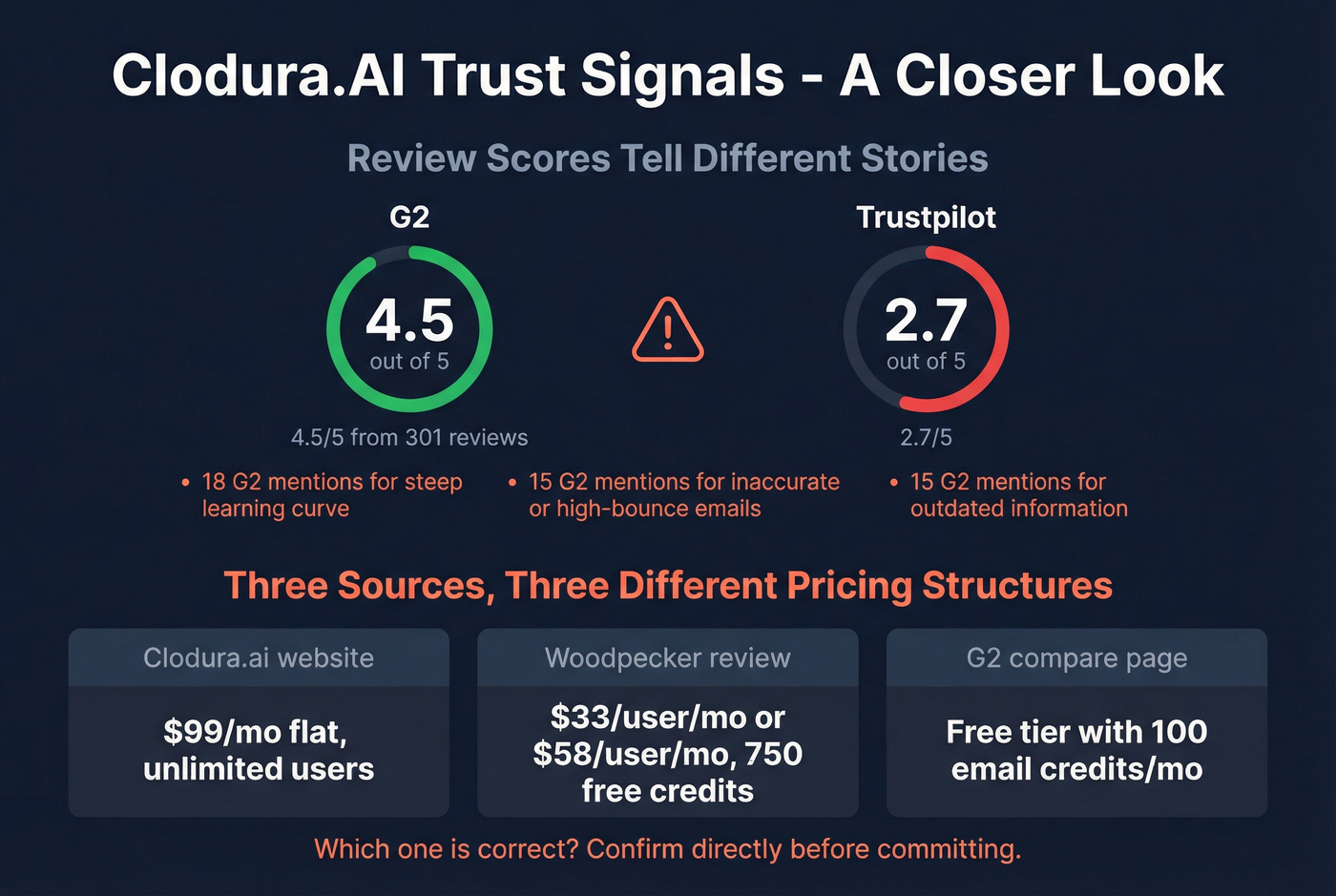
The trust signals are the problem.
Clodura's Trustpilot score is 2.7/5, with reviews alleging lifetime-deal features were reduced after purchase and data-removal requests going unanswered. On G2, 18 mentions flag a steep learning curve and 15 cite inaccurate or high-bounce email data, with another 15 calling out outdated information.
Then there's the pricing confusion. Clodura's own competitor page lists $99/month flat with unlimited users. But Woodpecker's review lists tiers at $33/user/month (Prospect) and $58/user/month (Prospect Pro), plus a free plan described as 750 email credits. G2's compare page shows a free tier with 100 email credits/month. Three sources, three different structures - not confidence-inspiring from a vendor you're trusting with outbound infrastructure.
A Sparkle.io test of 1,529 Clodura leads showed ~98% deliverability, but only when guessed emails were excluded and only verified emails were exported. That's a meaningful asterisk.
Real Cost Per Lead
If your average deal size is under $15k, neither of these tools gives you enough volume to justify the price. The headline credit gap is smaller than it looks once you do the math - and ironically, Clodura's own competitor page reveals this.
If you're trying to benchmark list economics across vendors, it can help to compare against other sales prospecting databases and B2B company data providers.
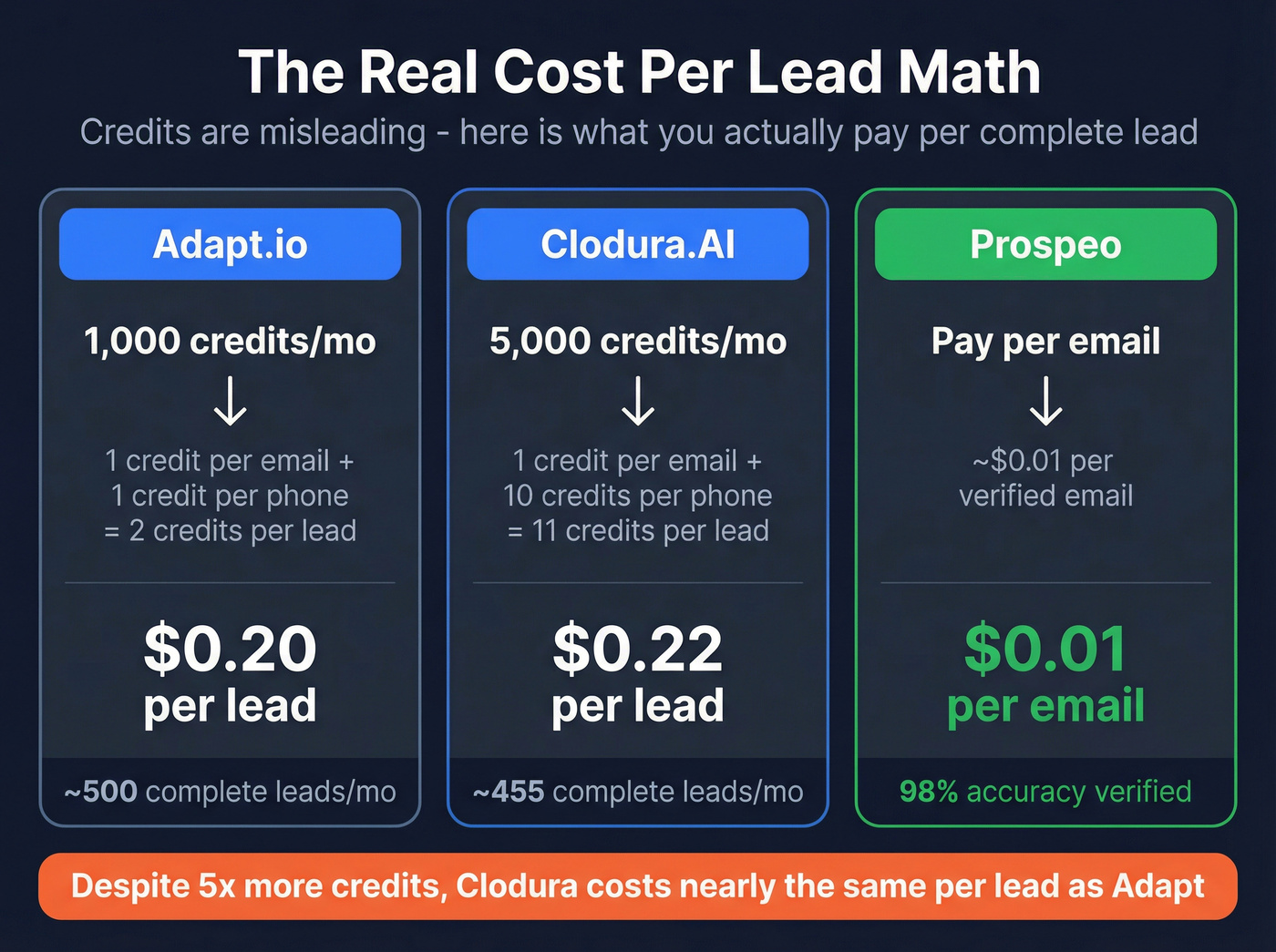
Clodura gives you 5,000 credits/month at $99. Sounds generous until you realize a full lead with a verified email and phone number costs 11 credits (1 for email, 10 for phone). That's 5,000 / 11 = roughly 455 complete leads per month, or about $0.22 per lead.
Adapt gives you 1,000 credits at $99. Emails and phones each cost 1 credit, so a full lead is 2 credits. That's 1,000 / 2 = roughly 500 leads per month, or about $0.20 per lead.
Despite Clodura advertising 5x the credits, the per-lead cost is nearly identical. The difference is that Clodura bundles outreach tools into that $99, while Adapt is data-only - you'll need Instantly, Smartlead, or Lemlist on top. For reference, Prospeo runs at roughly $0.01 per email with 10 credits per mobile number, undercutting both on pure data cost while maintaining 98% email accuracy through proprietary verification infrastructure.
If you're seeing bounces, you’ll want to track your email bounce rate and use dedicated email reputation tools to protect deliverability.

Why Data Accuracy Matters More Than Features
Both Adapt and Clodura share the same weakness: users complain about email and data accuracy. Adapt has 14 G2 mentions for incorrect email addresses. Clodura has 15 tied to inaccuracy and high bounce rates, plus another 15 for outdated information. When your outbound reputation depends on deliverability, "~90% accuracy" isn't good enough.
If you’re diagnosing deliverability issues end-to-end, use an email deliverability guide and prioritize spam trap removal before scaling volume.
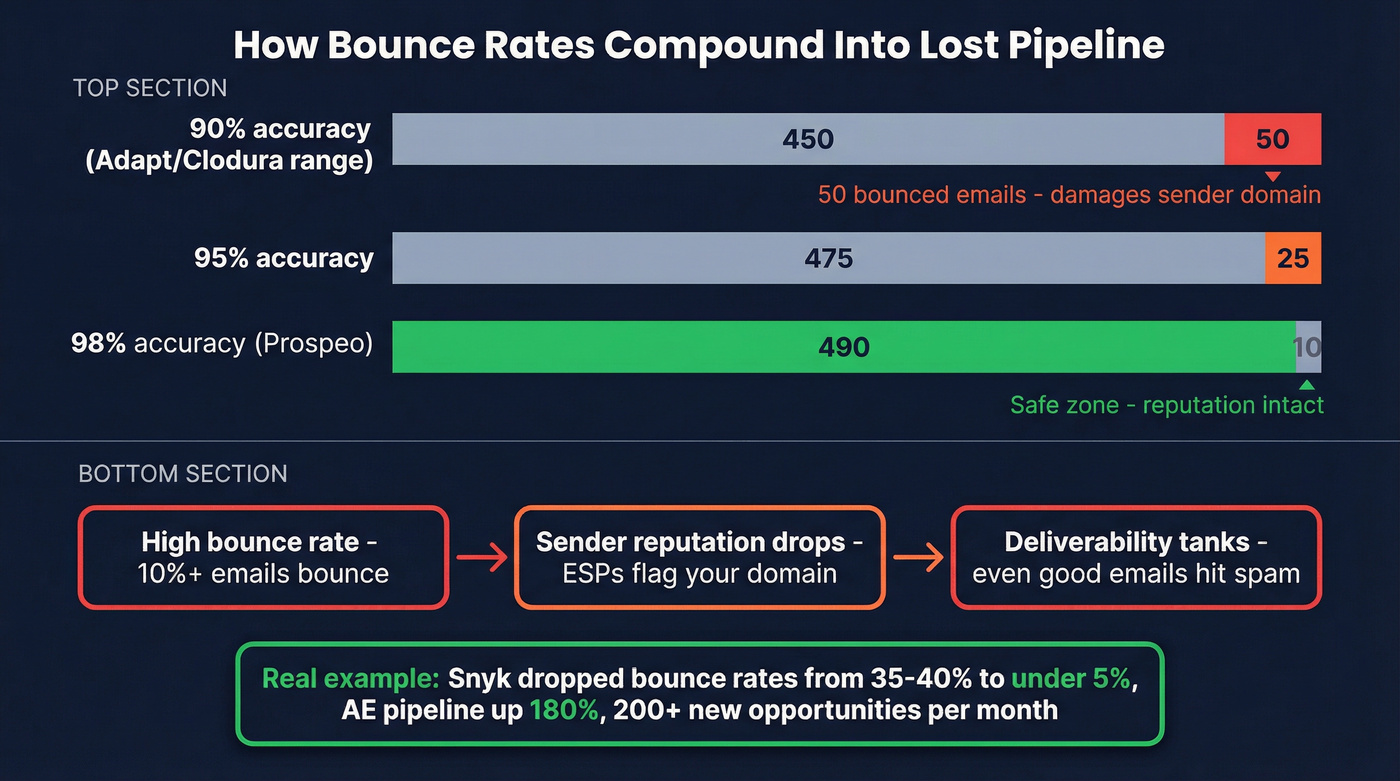
The difference between 90% and 98% accuracy compounds fast. A 10% bounce rate across 500 emails doesn't just waste 50 credits - it damages your sender reputation, which tanks deliverability on the other 450. We've seen this play out firsthand: Snyk's 50-person AE team saw bounce rates drop from 35-40% to under 5% after switching to a verification-first platform, with AE-sourced pipeline up 180% and 200+ new opportunities per month.
This is where the Adapt.io vs Clodura.AI debate misses the point entirely. Both tools compete on features and credit volume, but neither has solved the foundational problem: data that bounces costs more than data you never bought.
Adapt's 14 G2 mentions for incorrect emails and Clodura's 15 for high bounce rates point to the same problem: unverified data wrecks sender reputation. Prospeo refreshes all 300M+ profiles every 7 days - not 14, not daily-on-paper - with spam-trap removal and catch-all handling built in.
The gap between 90% and 98% accuracy is your domain reputation.
FAQ
Which has more accurate email data - Adapt or Clodura?
Neither publishes independent accuracy benchmarks. Both have accuracy complaints on G2 - 14 mentions for incorrect emails on Adapt, 15 for inaccuracy and high bounce on Clodura plus 15 for outdated info. A third-party Sparkle.io test showed ~98% deliverability for Clodura's verified exports, but only after excluding guessed emails. If accuracy is your top priority, look for tools with proprietary verification infrastructure and sub-7-day refresh cycles.
Is Clodura.AI really free?
Clodura offers a free plan, but credit limits vary wildly by source. G2 lists 100 email credits/month, while Woodpecker describes 750 email credits. Paid pricing is also inconsistent - ranging from $33/user/month to $99/month flat depending on the page. Confirm directly with Clodura before committing.
Do I need separate outreach tools with Adapt.io?
Yes. Adapt is data-only - no email sequences, no dialer, no warmup. You'll need a tool like Instantly, Smartlead, or Lemlist for outreach. Clodura bundles sequences and a dialer natively, which helps if you want one platform. Pairing a dedicated data tool with your existing outreach stack typically takes minutes through native integrations with tools like Instantly, Smartlead, Lemlist, and Clay.
What's a good alternative to both tools?
Prospeo covers 300M+ professional profiles with 143M+ verified emails and 125M+ verified mobiles. At ~$0.01 per email with a free tier of 75 emails plus 100 Chrome extension credits per month, it undercuts both on cost while delivering 98% email accuracy. No contracts, self-serve signup, and native CRM integrations with Salesforce and HubSpot.