

AI B2B Lead Generation: What Actually Works in 2026 (and What Doesn't)
A RevOps lead we know ran a three-tool bake-off last quarter. The "best" database created 4,000 duplicate contacts in Salesforce in five days. The cheapest tool had better phone connect rates. AI B2B lead generation is a $7.4B market projected to hit $16.2B by 2034, growing at 9.1% CAGR - and most of that money is being spent badly.
Here's the thing: 88% of organizations now use AI in at least one business function, but nearly two-thirds haven't scaled it beyond experiments. The gap between "we use AI" and "AI actually generates pipeline" is where most B2B teams live. Let's close it.
What You Need (Quick Version)
You don't need 10 tools. You need three layers:
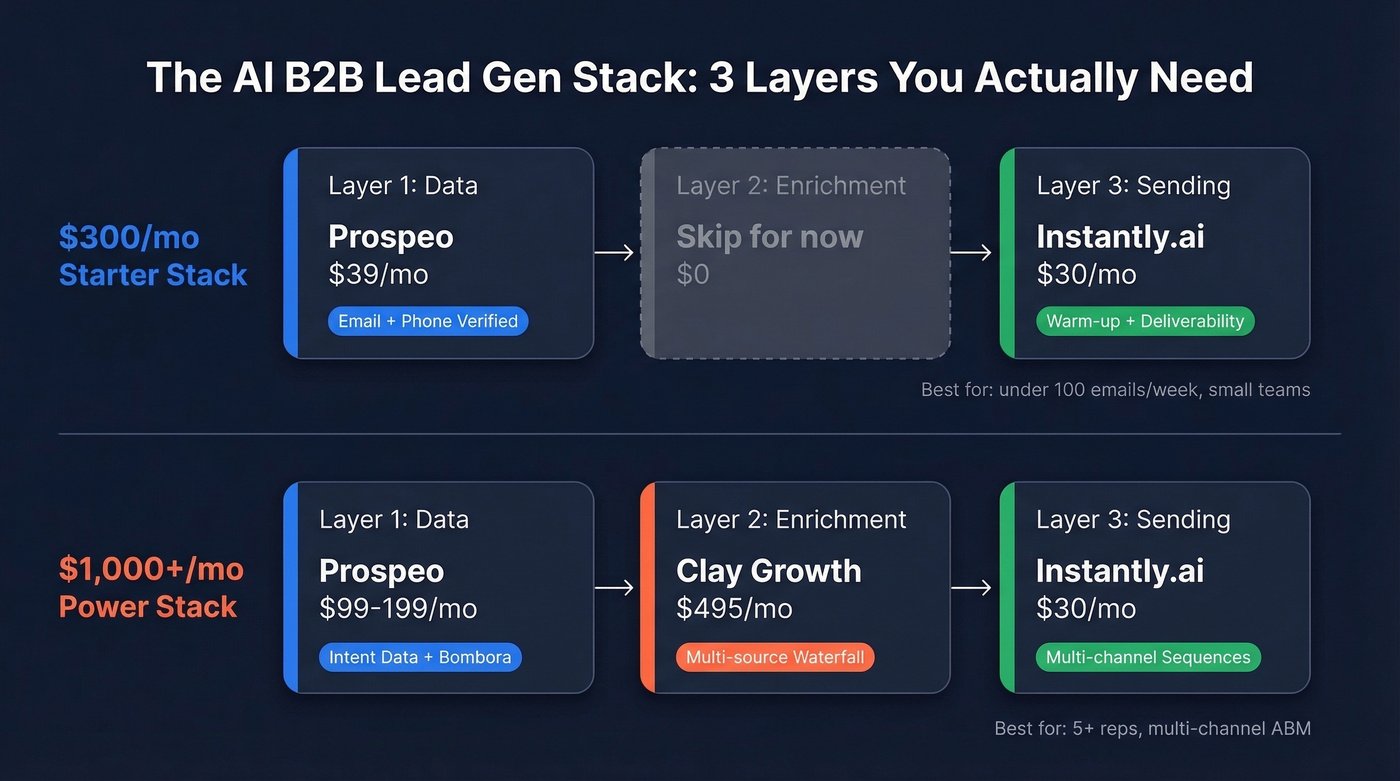
- Enrichment (if needed) - Clay: multi-source waterfall workflows
- Sending + warm-up - Instantly.ai: starts around $30/mo for infrastructure that actually lands in inboxes
The $1,000+/mo power stack: Add Clay Growth ($495/mo) for multi-source enrichment, layer in Bombora intent data, and run parallel sequences across email and phone.
If you're sending fewer than 100 emails per week, start with the $300 stack. Running multi-channel sequences across 5+ reps? You need the power stack.
What AI Lead Generation Actually Means for B2B
Strip away the buzzwords and it's straightforward. AI-driven lead generation uses machine learning and automation to find, qualify, and engage potential buyers faster than a human could manually. Everything else is implementation detail. AI does four jobs in the lead gen workflow:
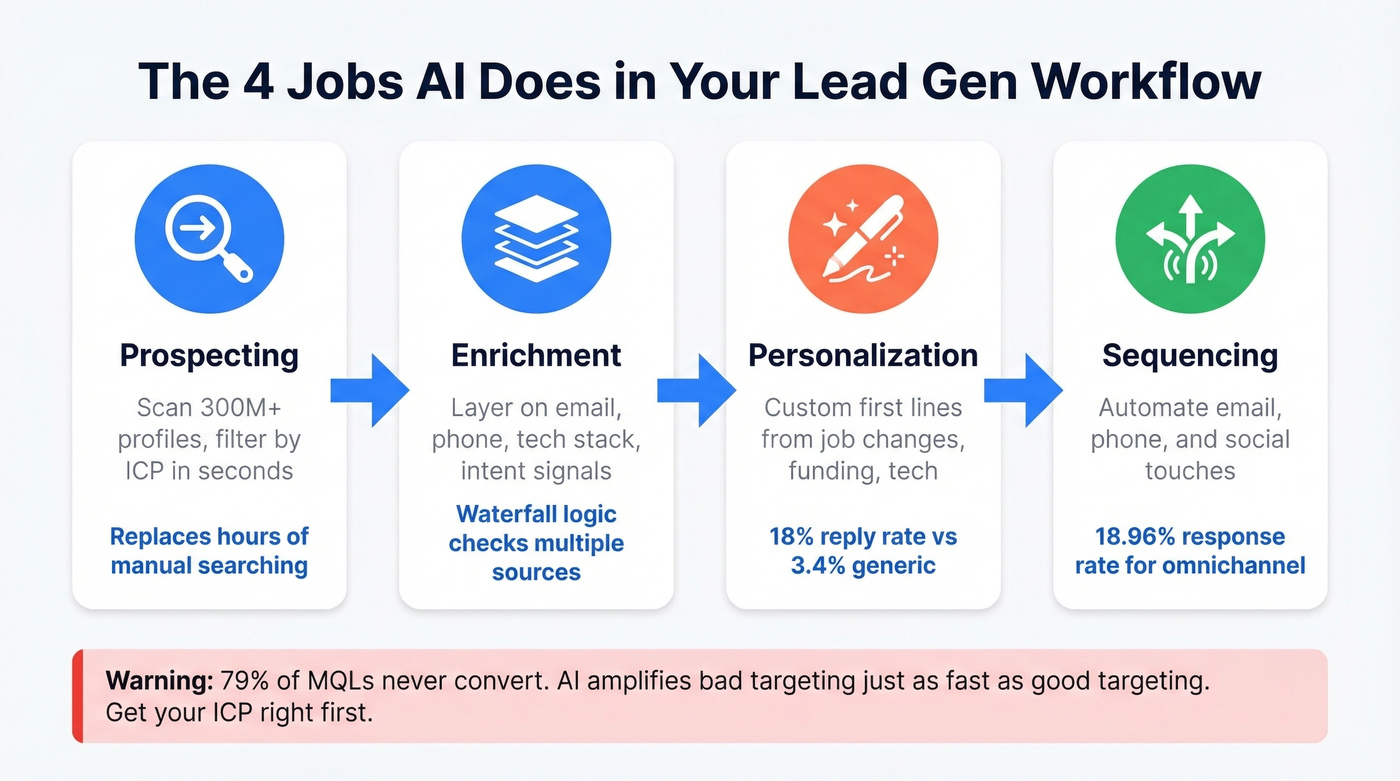
Prospecting - scanning databases, filtering by ICP criteria, surfacing accounts showing buying signals. Instead of an SDR manually searching company by company, AI filters 300M+ profiles in seconds. (If you want a deeper playbook, see B2B prospecting strategies.)
Enrichment - taking a thin record like a name and company and layering on verified email, direct dial, tech stack, funding history, and buyer intent data. Clay's waterfall approach runs a contact through multiple data sources until it finds a match, which is powerful when your ICP is narrow and a single database won't cut it. (More on the why: benefits of data enrichment.)
Personalization - generating first lines, customizing value props based on job changes, funding rounds, or tech stack signals. 62% of organizations are experimenting with AI agents in this area, and 23% are actively scaling them. (Tactics here: AI email personalization.)
Sequencing - automating multi-touch outreach across email, phone, and social. B2B buyers now use 10 channels on average (up from 5 in 2016), so single-channel outreach is dead. Omnichannel engagement hits 18.96% response rates vs 5.4% for single-channel. (Framework: multichannel sales outreach.)
The mistake most teams make is buying one tool that claims to do all four. No tool does all four well. And here's the uncomfortable truth: 79% of marketing qualified leads never convert to sales. The tools don't fix bad targeting - they amplify it.
The Three-Layer Stack
Three layers, each with a clear job. We've seen teams that separate their stack into distinct functions consistently outperform those relying on a single platform.
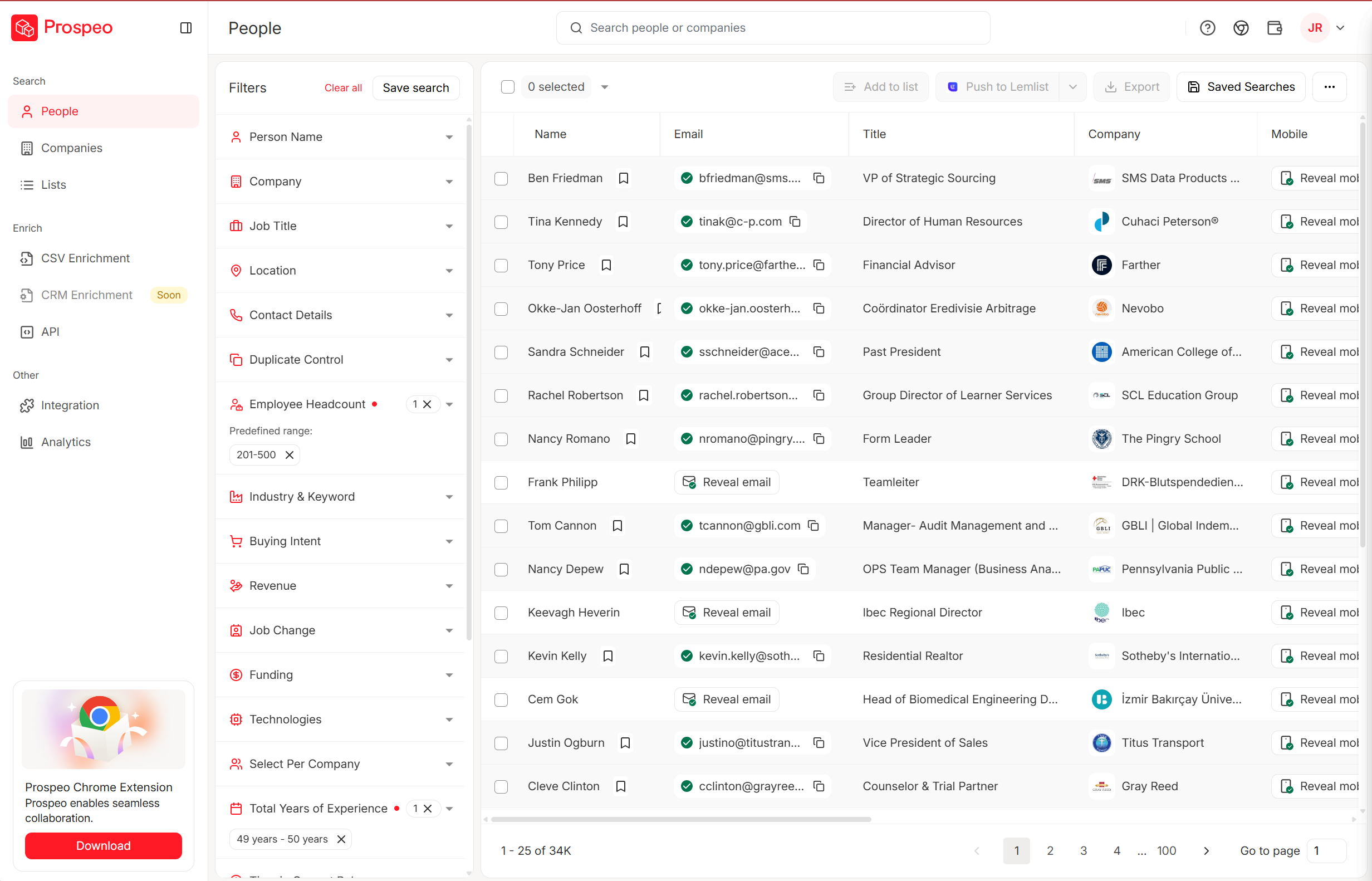
Layer 1: Data source + verification. This is your foundation. Bad data poisons everything downstream - your sequences bounce, your domain reputation tanks , and your reps waste time calling disconnected numbers. Prospeo gives you 300M+ profiles with 98% email accuracy and a 7-day refresh cycle. The free tier includes 75 verified emails per month, enough to test your workflow before spending anything. (If you're comparing vendors, start with best B2B database.)
Layer 2: Enrichment (optional but powerful). If your ICP is narrow or you need multi-source waterfall logic - checking three sales intelligence providers and taking the best match - Clay is the tool. Launch runs $185/mo and Growth is $495/mo. For teams running complex enrichment workflows, it pays for itself in data quality. (More options: best data enrichment tools.)
Layer 3: Sending infrastructure. Your sending tool handles warm-up, deliverability, and sequence execution. Instantly.ai starts around $30/mo. Don't use your data tool's built-in sending - the deliverability is almost always worse. (Related: outbound email automation.)
The key insight: signal-based personalization drives 18% reply rates vs 3.43% for generic outreach. That 5x gap comes from getting layers 1 and 2 right. If your data is stale or unverified, no amount of AI-written copy saves you.

The article says it clearly: bad data poisons everything downstream. Prospeo's 5-step verification delivers 98% email accuracy on 300M+ profiles with a 7-day refresh cycle - not the 6-week industry average. Stack Optimize built a $1M agency on it with under 3% bounce rates. At ~$0.01/email, your AI lead gen stack starts on solid ground.
Start with 75 free verified emails and see the difference clean data makes.
Best AI Tools for B2B Lead Generation
| Tool | Best For | Starting Price | Free Tier? | Credit Model |
|---|---|---|---|---|
| Apollo.io | All-in-one start | $49/user/mo | Yes (limited) | Monthly credits |
| Clay | Multi-source enrich | $185/mo | Yes (limited) | Credits + actions |
| Seamless.AI | Real-time search | ~$147/mo | Yes (50 credits) | Monthly credits |
| Instantly.ai | Email sending | ~$30/mo | No | Unlimited sends |
| B2B Rocket | AI agent outreach | ~$500-2,000/mo | No | Custom |
| Cognism | European data | ~$1,000-3,000/mo | No | Custom |
| Lindy | AI task automation | $49/mo | Yes (400 tasks) | Task-based |
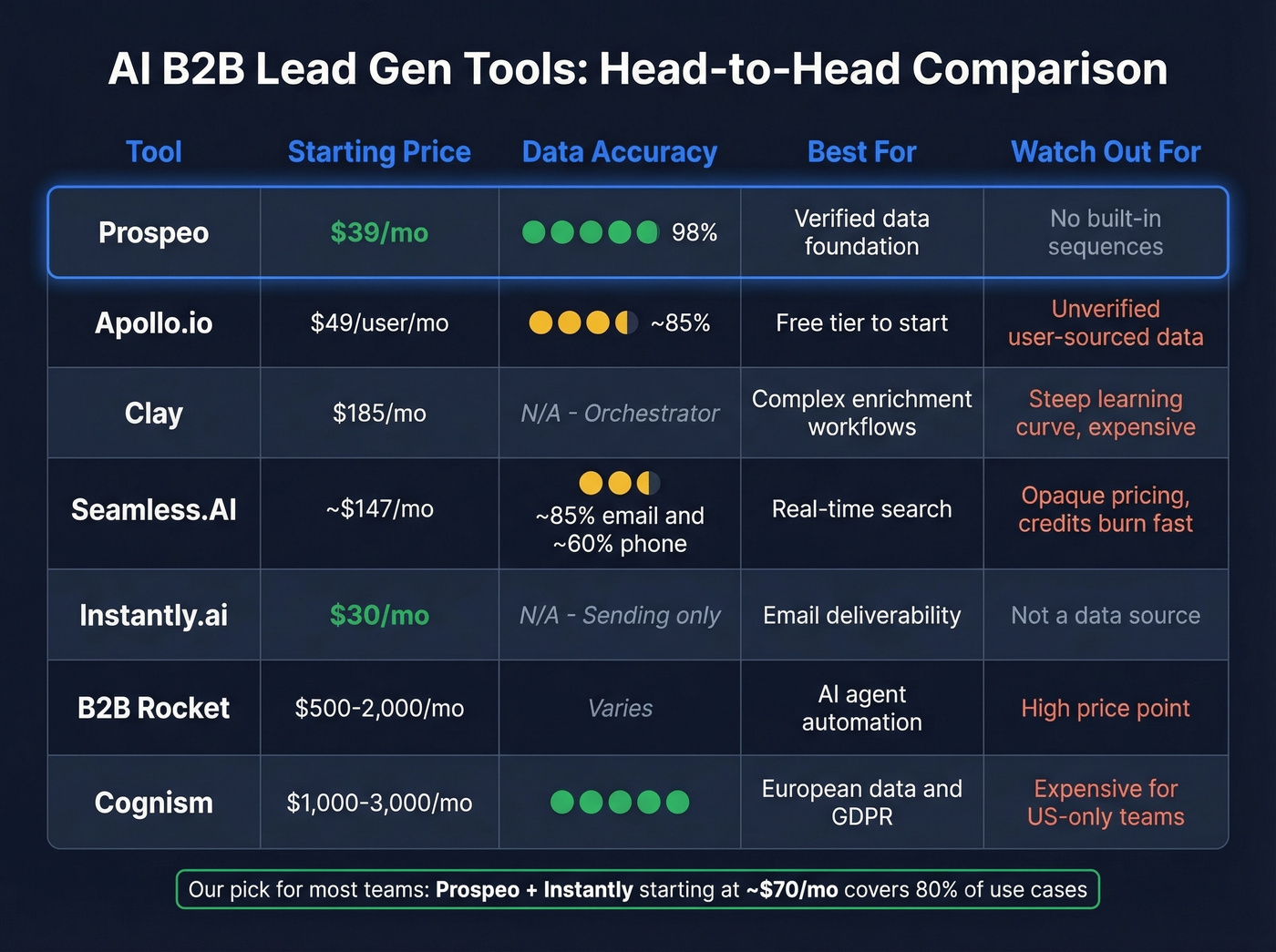
Our pick for most teams: Prospeo + Instantly (starting around $70/mo) covers 80% of use cases.
Prospeo
Use this if you care about data accuracy above all else. Prospeo's 98% email accuracy and 7-day refresh cycle aren't marketing fluff - Stack Optimize built from $0 to $1M ARR using Prospeo data with bounce rates under 3% and zero domain flags across all clients. Snyk's 50-person AE team cut bounce rates from 35% to under 5% and grew AE-sourced pipeline 180%.
The database covers 300M+ profiles with 143M+ verified emails and 125M+ verified mobile numbers with a 30% pickup rate. At roughly $0.01 per email, it's 90% cheaper than ZoomInfo per lead. The Chrome extension (40,000+ users) lets you pull verified contacts from any website in one click, and intent data powered by Bombora tracks 15,000 topics so you're reaching buyers who are actually in-market.
Skip this if you need a built-in dialer or sequence builder. Pair it with Instantly or Smartlead for sending - the native integrations handle the handoff cleanly.
Apollo.io
Use this if you're bootstrapping and need a free starting point with built-in sequences. Apollo's free tier gets you in the door, and paid plans run $49-$119/user/mo plus usage credits. It's an obvious starting point for most SMB teams.
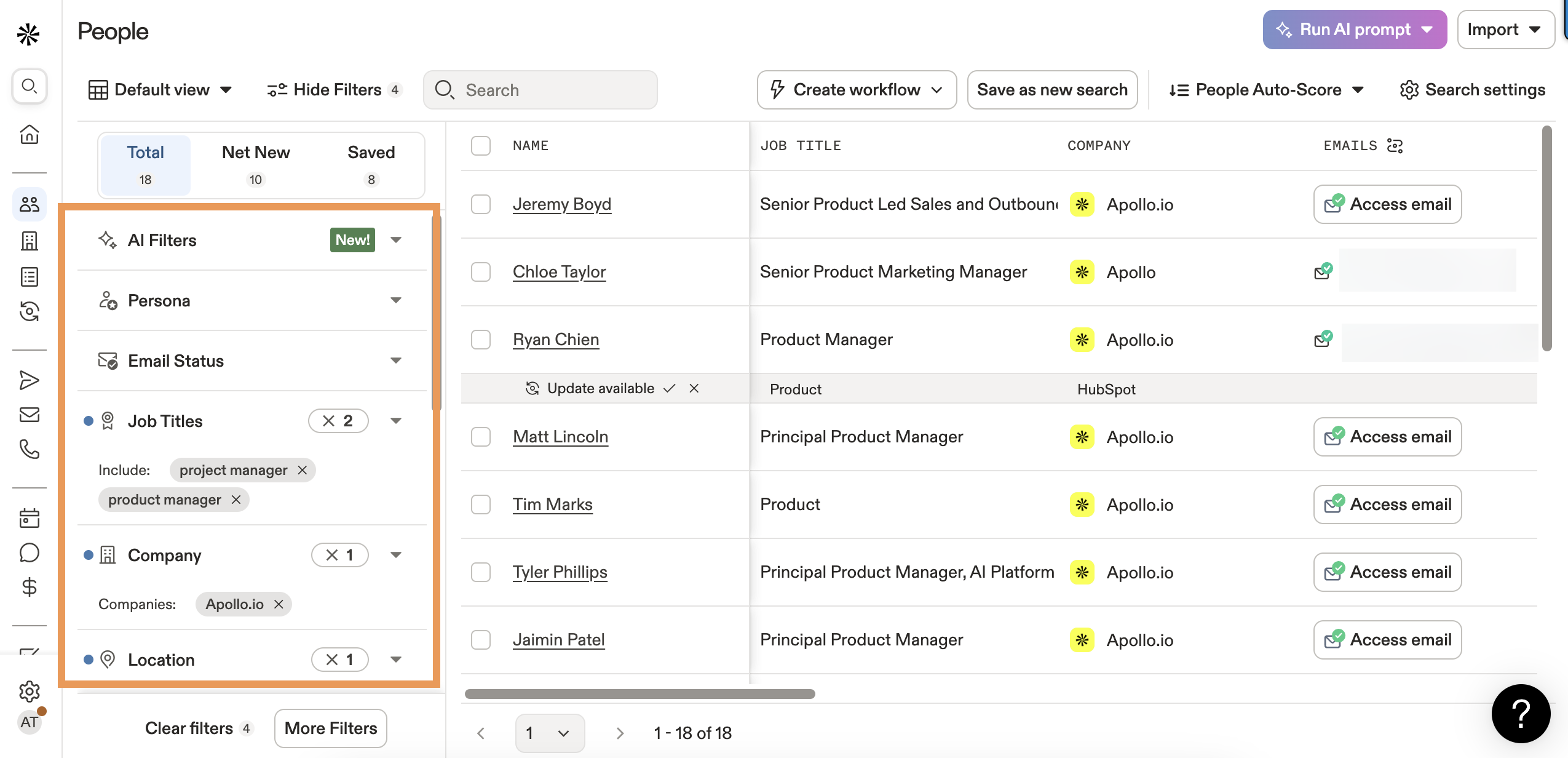
The catch: Apollo's data is populated by other users and isn't independently verified. The Reddit consensus is blunt - Apollo is a "jack of all trades, master of none" with email infrastructure that practitioners warn against. The VoIP dialer uses Twilio numbers that can get flagged as spam. Apollo also migrated to a new credit system, so two companies on the same plan can have different limits - confirm your specifics before committing. Plan to graduate to better data as you scale.
Clay
Clay's March 2026 pricing overhaul is the big story. Launch now costs $185/mo for 2,500 data credits, and Growth runs $495/mo for 6,000 data credits. The win: failed lookups are no longer charged, and CRM integrations dropped from the old $800/mo Pro tier to the $495/mo Growth plan.
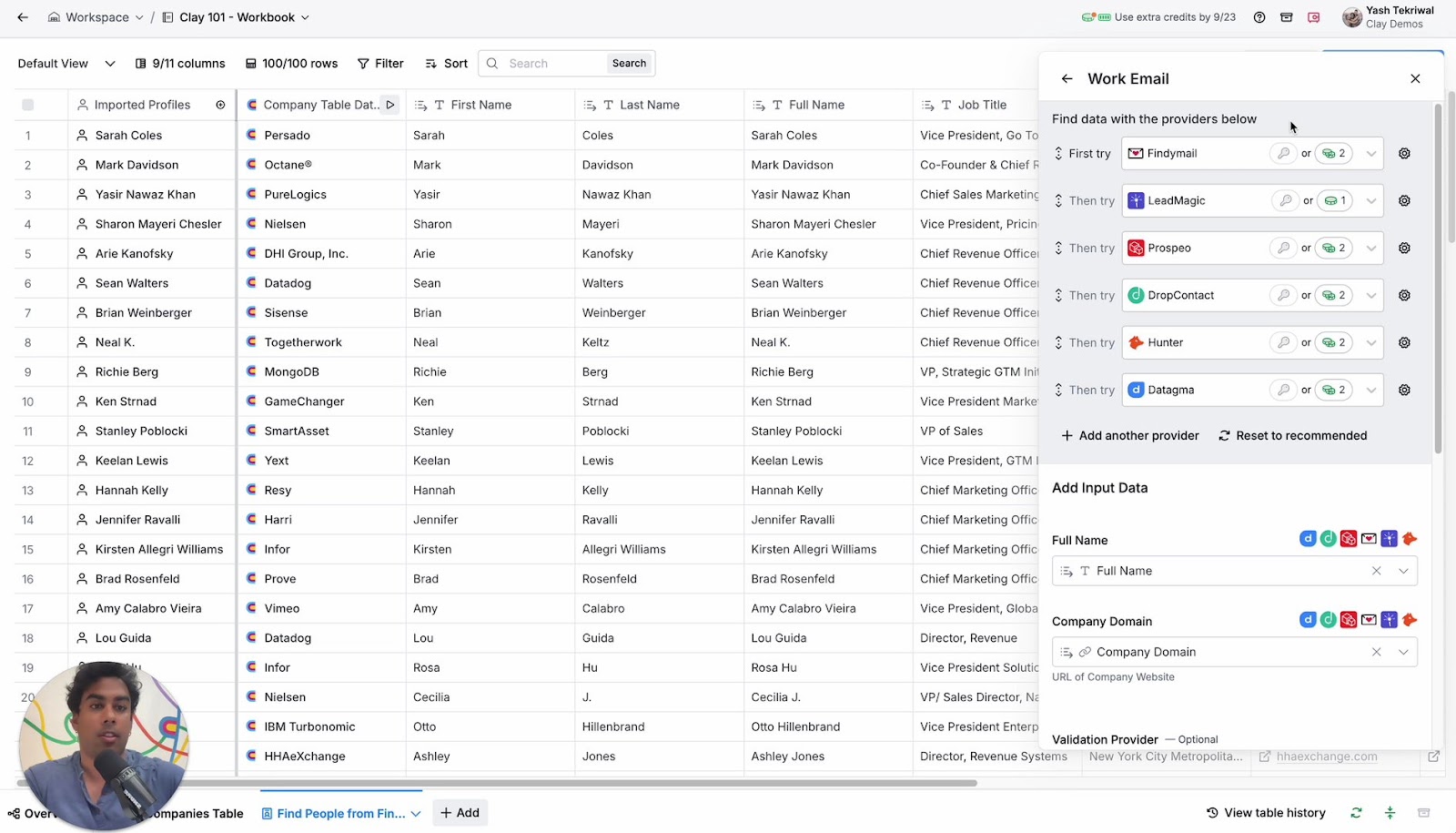
Clay is an enrichment orchestrator, not a database. You still need a data source feeding into it, and the learning curve is steep - we've watched teams spend two weeks just building their first workflow. For teams selling deals under $15k, the math rarely works. But if you're running account-based marketing with complex ICP requirements, Clay's multi-source waterfall logic is unmatched.
Seamless.AI
The pricing opacity is the first thing you'll notice. Seamless.AI doesn't publish pricing, which is frustrating. User-reported numbers vary: Basic at ~$147/mo for 250 credits, Pro often landing around ~$79-$99/user/mo with a 5-user minimum depending on the quote. They position around "real-time, verified" data with access to 1.8B+ business emails and 414M+ mobile numbers. Credits burn fast though. You pay even when the data is inaccurate, and one practitioner pegs accuracy at roughly 85% for emails and closer to 60% for phone numbers.
Instantly.ai
Instantly is a sending engine, not a data source - pair it with your data tool of choice, then push contacts into Instantly for execution. It handles warm-up, rotation, and deliverability monitoring better than any data tool's built-in sending. Starting around $30/mo, there's no reason to compromise on deliverability.
B2B Rocket
AI agent platform for autonomous outreach across email, WhatsApp, and SMS. Strong G2 ratings - 4.8/5 across 298 reviews. Expect $500-$2,000/mo depending on volume and features.
Cognism
The go-to for European data and GDPR compliance. If you're selling into EMEA, Cognism's compliance infrastructure gives it a real edge over US-centric tools. Custom pricing, typically $1,000-$3,000/mo for small teams. (If compliance is a blocker, read B2B compliance.)
Lindy
AI agent automation with a task-based pricing model. Free tier gives you 400 tasks/month, Pro runs $49/mo for 5,000 tasks. Think of it as a lighter-weight alternative to Clay for simple enrichment and outreach tasks.
Build Your AI-Powered Outbound Workflow
Five steps. No fluff.
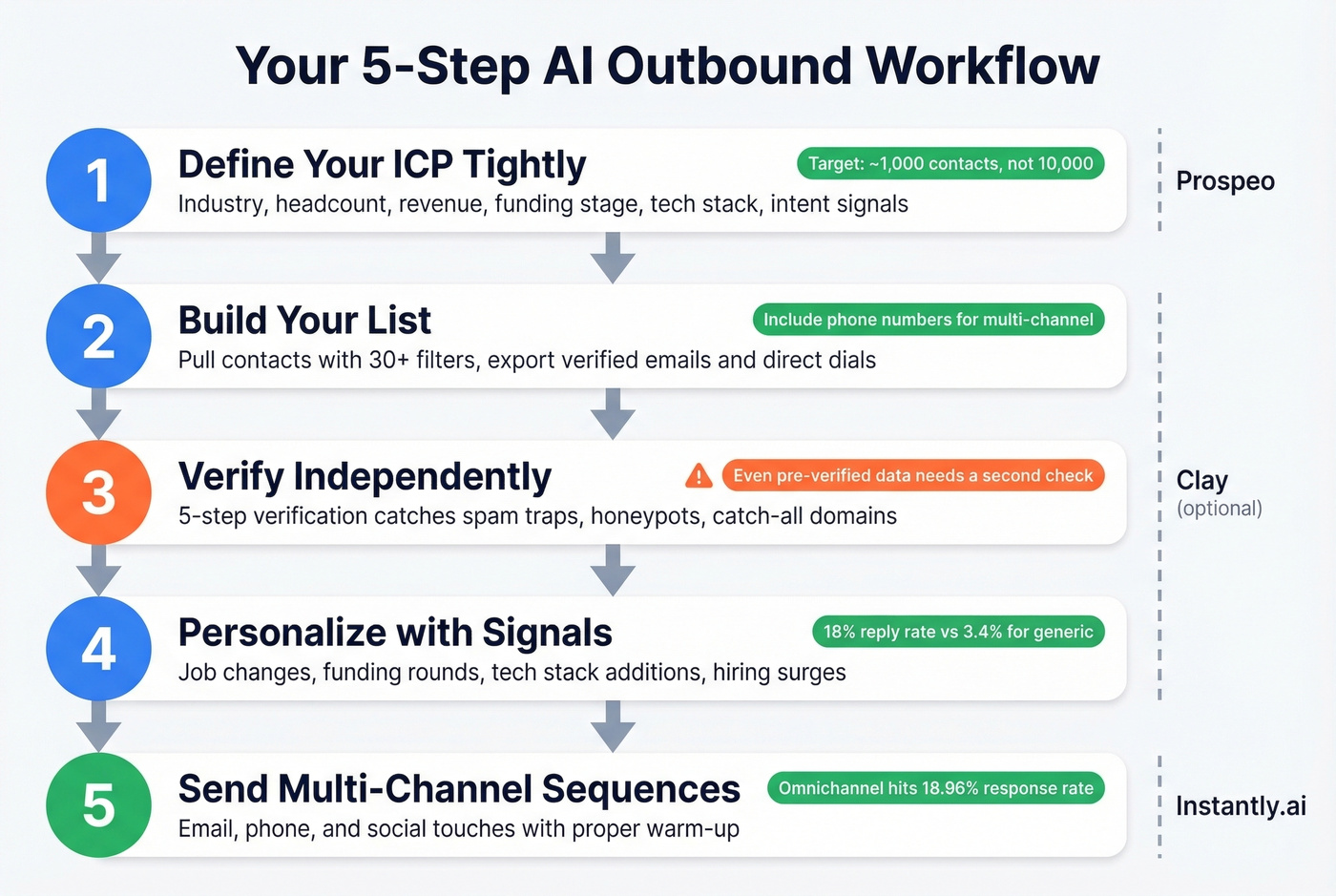
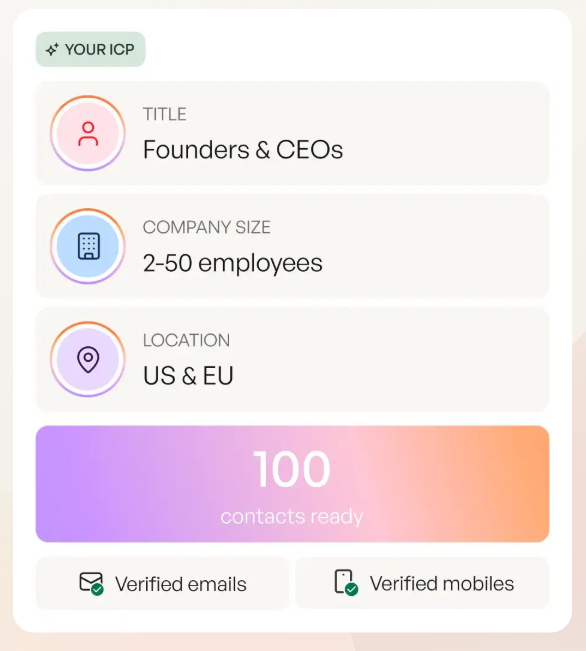
Step 1: Define your ICP tightly. Use firmographic filters like industry, headcount, revenue, and funding stage. Layer on technographic signals - what tools they use - and intent data showing what they're researching. The tighter your filter, the higher your reply rate. Aim for a list of ~1,000 contacts, not 10,000. (Template: ideal customer profile.)
Step 2: Build your list. Pull contacts from your data source using 30+ filters. Export with verified emails and direct dials. Don't skip the phone numbers - multi-channel outreach dramatically outperforms email-only.
Step 3: Verify independently. Even if your data source says emails are verified, run them through a second verifier. A 5-step verification process catches spam traps, honeypots, and catch-all domains that other tools miss. Use two verifiers if your domain reputation is critical - and it always is. (Tool shortlist: best email verifier.)
Step 4: Personalize with signals. Job changes, funding rounds, tech stack additions, hiring surges - these are your opening lines. AI can draft the copy, but the signal selection is what separates 18% reply rates from 3.43%.
Step 5: Send and measure. Warm up new domains for 3-4 weeks before scaling. The math: 30 emails/day total means 25 outreach + 5 warm-up. Best-performing emails run 50-125 words. And don't stop after one touch - 42% of replies come on follow-ups, yet 70% of reps stop after a single email.
You just read that signal-based personalization drives 18% reply rates vs 3.43% for generic outreach. That 5x gap requires data that's actually current. Prospeo refreshes every 7 days and layers Bombora intent data across 15,000 topics - so your AI sequences reach buyers who are actively in-market, not contacts who changed jobs six weeks ago.
Stop feeding stale data into your AI stack. Get verified contacts refreshed weekly.
Does AI-Driven Lead Generation Actually Work?
Deals closed within 50 days carry a 47% win rate. After that threshold, win rates drop to 20% or lower. AI-assisted reps close deals 11 days faster on average, with win rate lifts up to 10 percentage points on deals over $50K. Speed isn't a nice-to-have - it's the single biggest predictor of whether a deal closes.
45% of teams now run a hybrid AI-SDR model where AI handles research, list building, and first-touch personalization while humans handle relationship-building and complex deal navigation. Sellers using AI tools report a 90% reduction in research and personalization time. That's the difference between an SDR spending 4 hours researching 20 accounts and an AI doing it in 10 minutes.
The omnichannel numbers are equally stark. Multi-channel engagement drives 18.96% response rates vs 5.4% for single-channel, with a 9.5% year-over-year revenue increase for teams that commit to it. If you're still running email-only sequences in 2026, you're leaving pipeline on the table.
Look, if your average contract value is under $15k, you probably don't need ZoomInfo-level data or a $1,000/mo stack. A $300/mo setup with tight ICP targeting will outperform an enterprise platform that your team barely uses. The best stack is the one your reps actually adopt.
Seven Mistakes That Kill Results
1. Skipping verification. Sending to unverified lists is a domain death spiral. One bad batch can tank your sender reputation for months.
2. Trusting "verified" data at face value. Every tool says their data is verified. The consensus on r/sales and r/LeadGeneration is clear - the word "verified" means different things to different vendors. Use a second, independent verifier. The cost is negligible compared to a burned domain.
3. Over-automating outreach. AI can write 10,000 personalized emails in an hour. That doesn't mean you should send them. Spam filters are smarter than your automation. Cap daily sends, vary templates, and keep a human reviewing output quality.
4. Ignoring warm-up math. New domains need 3-4 weeks of warm-up before you scale. Reddit threads are full of teams who skipped this and landed in spam within a week. 30 emails/day total = 25 outreach + 5 warm-up. No shortcuts.
5. Using open and click trackers. This one surprises people. Tracking pixels add redirects and tracking domains that spam filters flag. Practitioners on r/LeadGeneration are emphatic - trackers will kill your deliverability. Turn them off. Measure replies instead. (If you need a safer measurement setup, see email tracking tools.)
6. No SPF/DKIM/DMARC. Authentication isn't optional anymore. Since the 2024-2025 mandates from Google and Microsoft, unauthenticated emails go straight to spam. Set up all three before sending a single outreach email. It takes 30 minutes. (Checklist: sender authentication.)
7. Stopping after one email. 42% of replies come on follow-ups. 70% of reps stop after one email. This is the easiest win in outbound - build 4-5 touch sequences minimum, spaced 3-5 days apart.
FAQ
What's the difference between AI and traditional lead generation?
AI lead generation automates prospecting, enrichment, personalization, and sequencing that traditional teams do manually. Instead of SDRs researching accounts one by one, AI compresses weeks of work into minutes with better targeting at scale. 88% of organizations now use AI in at least one business function, and that number keeps climbing.
How much does an AI lead gen stack cost per month?
A lean stack starts at ~$70/mo: Prospeo's free tier for contacts plus Instantly and HubSpot's free CRM. A mid-tier stack with paid data runs ~$300/mo. Power stacks with Clay enrichment push $1,000+/mo - still a fraction of a single ZoomInfo contract at $15-40K/year.
Can AI replace SDRs entirely?
Not yet. 45% of teams run hybrid AI-SDR models where AI handles research, list building, and first-touch outreach while humans manage relationship-building and complex negotiations. Even the most sophisticated AI-powered workflows still need human judgment for deal strategy and nuanced conversations that close six-figure deals.
What's a good cold email reply rate in 2026?
The average cold email reply rate is 3.43%. Signal-based personalization - using job changes, funding events, and intent data as triggers - pushes reply rates to 18%. The gap comes entirely from relevance and timing, not clever copywriting.
Which tool has the most accurate B2B email data?
Prospeo leads with 98% verified email accuracy and a 7-day data refresh cycle. Most competitors refresh every 4-6 weeks, meaning their "verified" emails go stale fast. The proprietary 5-step verification with spam-trap removal and catch-all handling is why teams like Stack Optimize maintain bounce rates under 3% across all clients.