

AI BDR Agents: What They Do, What They Cost, and Why Most Fail
The AI SDR market hit $4.12B in 2025 and is sprinting toward $15B by 2030. Gartner predicts 40%+ of agentic AI projects will be abandoned by end of 2027. In the AI BDR agent space specifically, annual churn runs 50-70%.
The technology works. The implementations don't.
Here's the thing: most teams buying these tools don't have a messaging problem or an AI problem - they have a data problem. Fix the data and a $50/month sequencing tool outperforms a $900/month agent with garbage inputs.
What Is an AI BDR Agent?
An AI BDR agent handles the tasks a junior BDR does manually: identifying prospects, qualifying them against your ICP, writing personalized outreach, sending multi-channel sequences, and following up until a meeting books or the lead goes cold. The "agent" framing means it operates semi-autonomously - you define the parameters, it executes.
Human BDRs currently average roughly 21 attempts per contact over 53-day cadences, multithreading across 9 individuals per account. AI is genuinely good at that repetition. 60% of BDRs already use AI tools in some capacity.
| Term | What It Means | Typical Scope |
|---|---|---|
| AI BDR | Outbound prospecting agent | Find + qualify + email |
| AI SDR | Often identical to AI BDR | Some include inbound |
| AI Sales Rep | Broader automation | Prospecting through close |
Most vendors use these terms interchangeably. Don't let naming conventions drive your buying decision - look at what the tool actually automates.
Why Most AI BDR Deployments Fail
The failure modes are predictable and preventable.
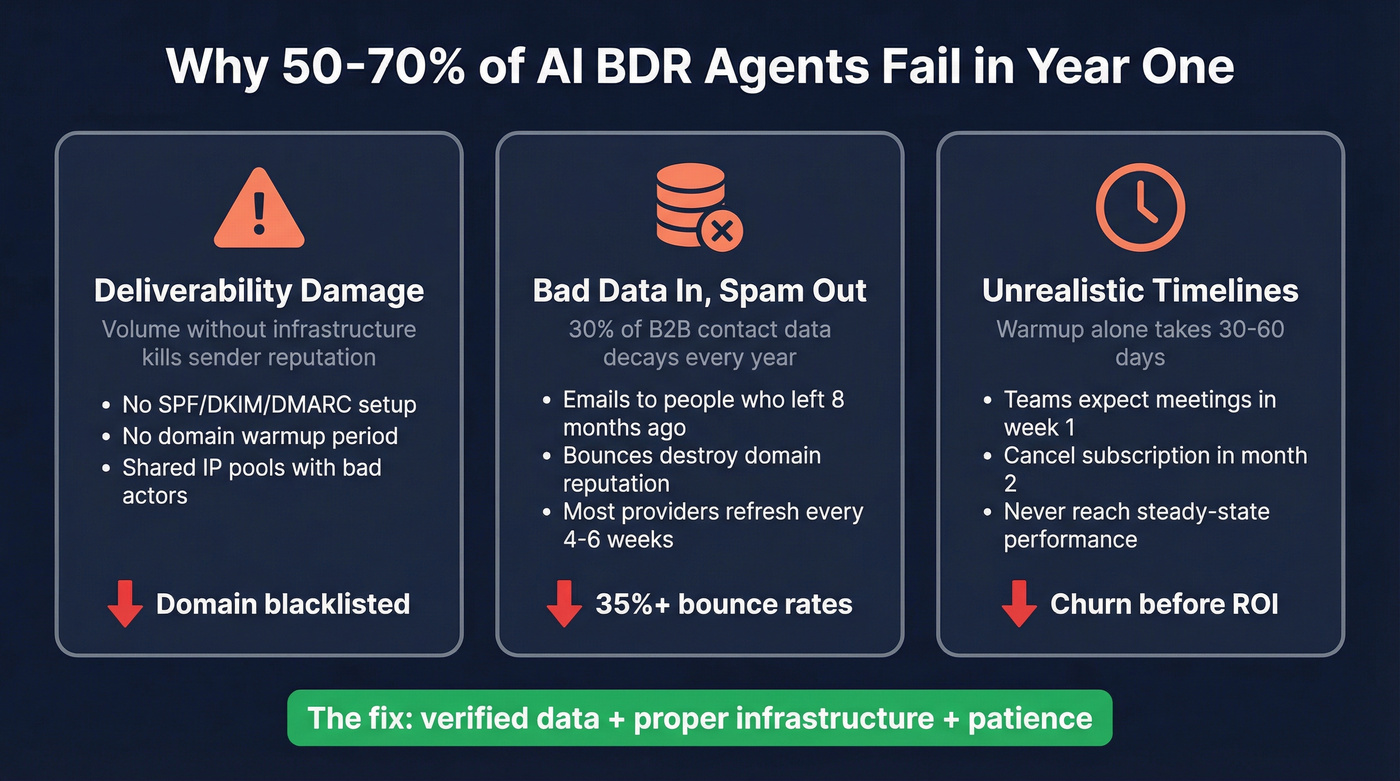
Deliverability damage
AI outbound tools send volume. Volume without proper infrastructure - SPF/DKIM/DMARC configuration, domain warmup, controlled velocity - triggers spam filters. Your sender reputation gets torched. Shared IP risk makes it worse: one bad actor on the same infrastructure poisons deliverability for everyone on that pool.
Bad data in, spam out
AI personalization is impressive until it's reaching someone who left the company eight months ago, using an email that bounces. Every bounce chips away at your domain reputation. Most data providers refresh contacts every 4-6 weeks - an eternity in B2B, where roughly 30% of contact data decays annually.
We've seen teams burn through three domains before realizing the problem wasn't their AI tool - it was the contact list feeding it. Running your list through Prospeo's real-time verification before loading it into any outbound agent catches dead emails, spam traps, and honeypots on a 7-day refresh cycle with 98% accuracy.

Unrealistic timelines
AiSDR's pricing model is unusually blunt about this: deliverability warmup takes 30-60 days, and meaningful results show up after about 6+ weeks. Teams that expect meetings in week one cancel in month two. That's not a tool failure. It's an expectations failure.

This article makes it clear: most AI BDR agents fail because of bad data, not bad AI. Prospeo refreshes every record on a 7-day cycle - not the 4-6 week industry average that causes 30% annual data decay. At 98% email accuracy and $0.01/email, cleaning your list before it hits any outbound agent is the cheapest insurance against torched domains.
Stop burning domains. Verify every email before your AI agent sends it.
Top AI BDR Agents Worth Evaluating in 2026
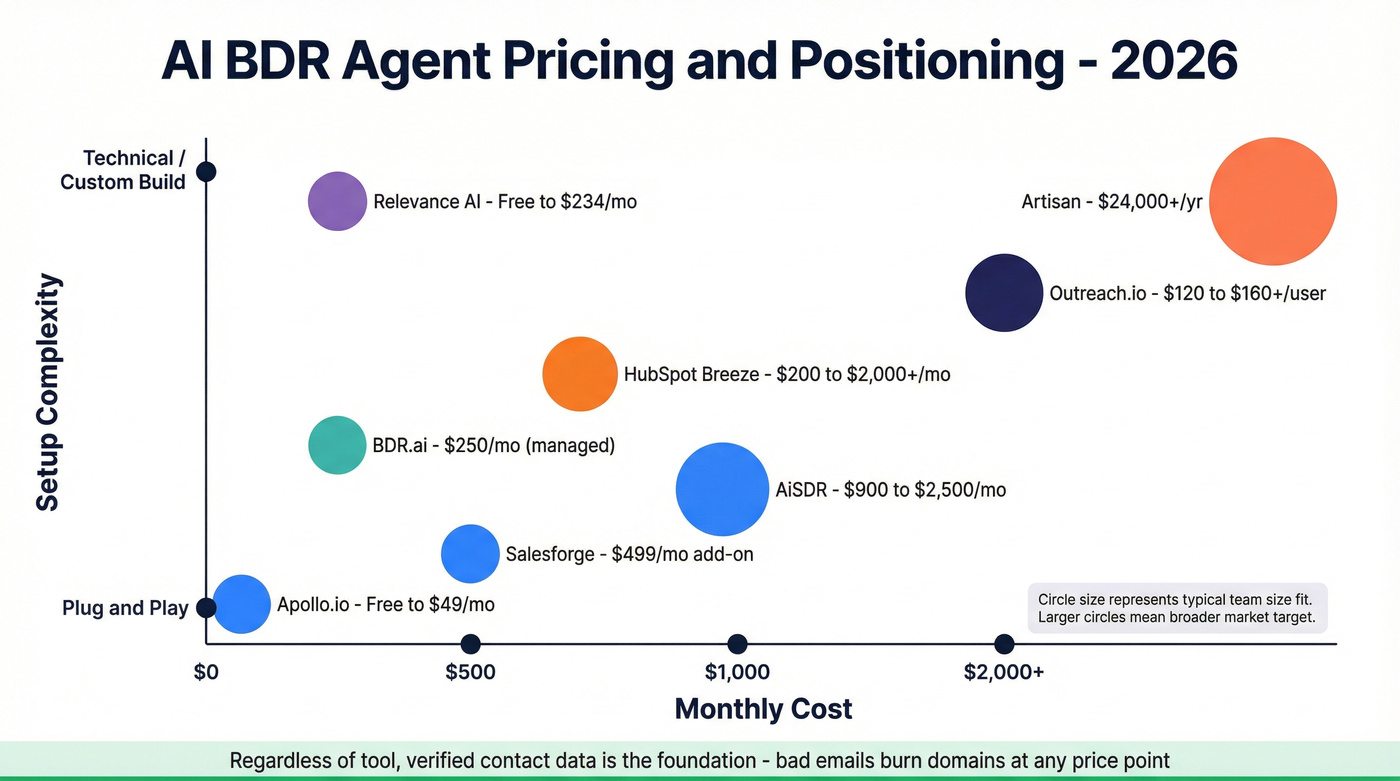
| Tool | Starting Price | Best For | Notes |
|---|---|---|---|
| AiSDR | $900/mo | Mid-market, predictable output | ~3 meetings/mo est. |
| Salesforge | $499/mo add-on | Teams already on Salesforge | Base from $48/mo |
| Relevance AI | Free (200 actions) | Technical teams, custom builds | Team plan: $234/mo |
| Apollo.io | Free; paid from $49/mo | Bootstrapped teams | Verify data separately |
| HubSpot Breeze | Credit-based | HubSpot-native orgs | $200-$2K+/mo est. |
| Outreach.io | ~$120-$160+/user | Enterprise (20+ reps) | Annual contracts |
| Artisan (Ava) | ~$24,000/yr | Enterprise with budget | 300M+ B2B contacts |
| BDR.ai | $250/mo | Managed service seekers | Consulting from $5,500/mo |
AiSDR
AiSDR is the most transparent player here. Their pricing page publishes actual meeting estimates per tier - roughly 3 meetings/month on Explore ($900/mo), roughly 11 on Grow ($2,500/mo). The platform includes mailbox creation, domain warmup, 3x bounce checks, and inbox rotation out of the box. Billed quarterly with cancel-anytime terms.
What we appreciate: they don't hide behind "results vary" disclaimers. You know what you're paying for and what to expect, which is rare in this space. The 30-60 day warmup period they disclose upfront also signals they're not trying to lock you in with inflated promises.
Salesforge (Agent Frank)
The most affordable dedicated add-on at $499/mo on top of base plans starting at $48/mo. The tradeoff: you're buying into the Salesforge ecosystem. If you're already running cold email at scale through their platform, Agent Frank is a natural extension. All-in, expect $550-$750/mo.
Relevance AI
Skip this if you want a plug-and-play solution. Relevance AI is a platform for building custom AI agents, not a pre-built bot. The free tier gives you 200 actions/month. Pricing splits into Actions and Vendor Credits - BYO API keys on paid plans mean no markup on vendor credits, and unused vendor credits roll over indefinitely while you're subscribed. Powerful for technical teams; frustrating for everyone else.
Apollo.io
Apollo's free tier makes it the default starting point for bootstrapped teams. Watch out for email accuracy, though. The consensus on r/sales and r/coldemail is that bounce rates are a persistent pain point. If you're running Apollo data through an automated outbound agent, verify it through a separate tool first - or you'll learn the deliverability lesson the expensive way.
Outreach.io
Enterprise engagement platform. Expect roughly $120-$160+/user/month on annual contracts, plus implementation fees that can hit five figures. AI prospecting features are typically sold in Professional+ tiers or as add-ons in enterprise contracts. Overkill for teams under 20 reps.
HubSpot Breeze
Hidden cost: credits reset monthly with no rollover, and overages can trigger auto-upgrades. Budget $200-$2,000+/month depending on volume. Best if you're already deep in HubSpot and don't want another vendor in your stack.
Artisan (Ava)
Premium "AI employee" with access to 300M+ B2B contacts. Custom pricing starts around $24,000/year; with a dedicated AI SDR manager, costs can exceed $80,000. Implementation takes 2-3 months. Enterprise-only.
BDR.ai
More outsourced service than software. Sales team augmentation starts at $250/mo, consulting at $5,500/mo. A Clutch review noted monthly lead generation increased 15-20% - modest but real for teams wanting a managed approach rather than another dashboard to babysit.
Before You Buy: Infrastructure Checklist
This is the part most buyers skip. Don't.
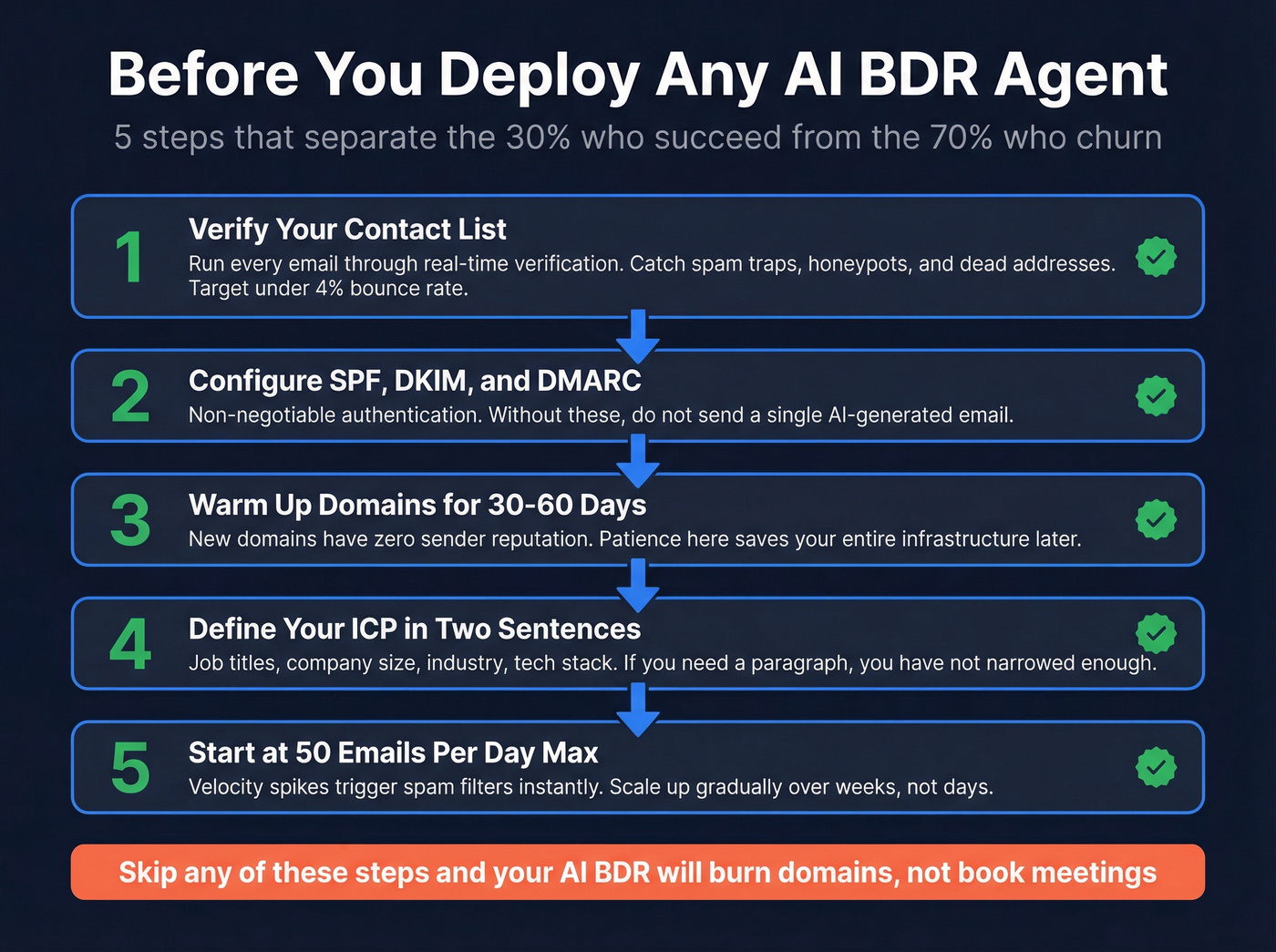
Verify your contact list. Bad data is the #1 domain killer. Run your list through real-time verification before loading it into any outbound automation. Prospeo's 5-step verification process - including catch-all handling, spam-trap removal, and honeypot filtering - keeps bounce rates under 4% for teams running high-volume outbound daily.
Configure SPF/DKIM/DMARC. Non-negotiable. If these aren't set up, don't send a single AI-generated email.
Warm up domains 30-60 days. New domains have zero sender reputation. Patience here saves your infrastructure.
Define your ICP precisely. Job titles, company size, industry, tech stack - AI can't target what you haven't defined. Two sentences should cover it. If you need a paragraph, you haven't narrowed enough.
Start at 50 emails/day max. Velocity spikes are the fastest way to trigger spam filters. Scale up gradually over weeks, not days.
Teams running AI BDR agents through Apollo, AiSDR, or any sequencer still need verified contact data underneath. Prospeo's 5-step verification catches spam traps, honeypots, and dead emails that bounce-check tools miss. One customer cut bounce rates from 35% to under 4% - and tripled pipeline in the process.
Your AI agent is only as good as the data feeding it.
Do You Actually Need One?
About 22% of sales teams have fully replaced human SDRs with AI. But 79% of BDR teams grew or maintained headcount last year - AI is augmenting, not eliminating. In our experience, the teams that succeed with an AI BDR agent spend more time on data quality than on prompt engineering.
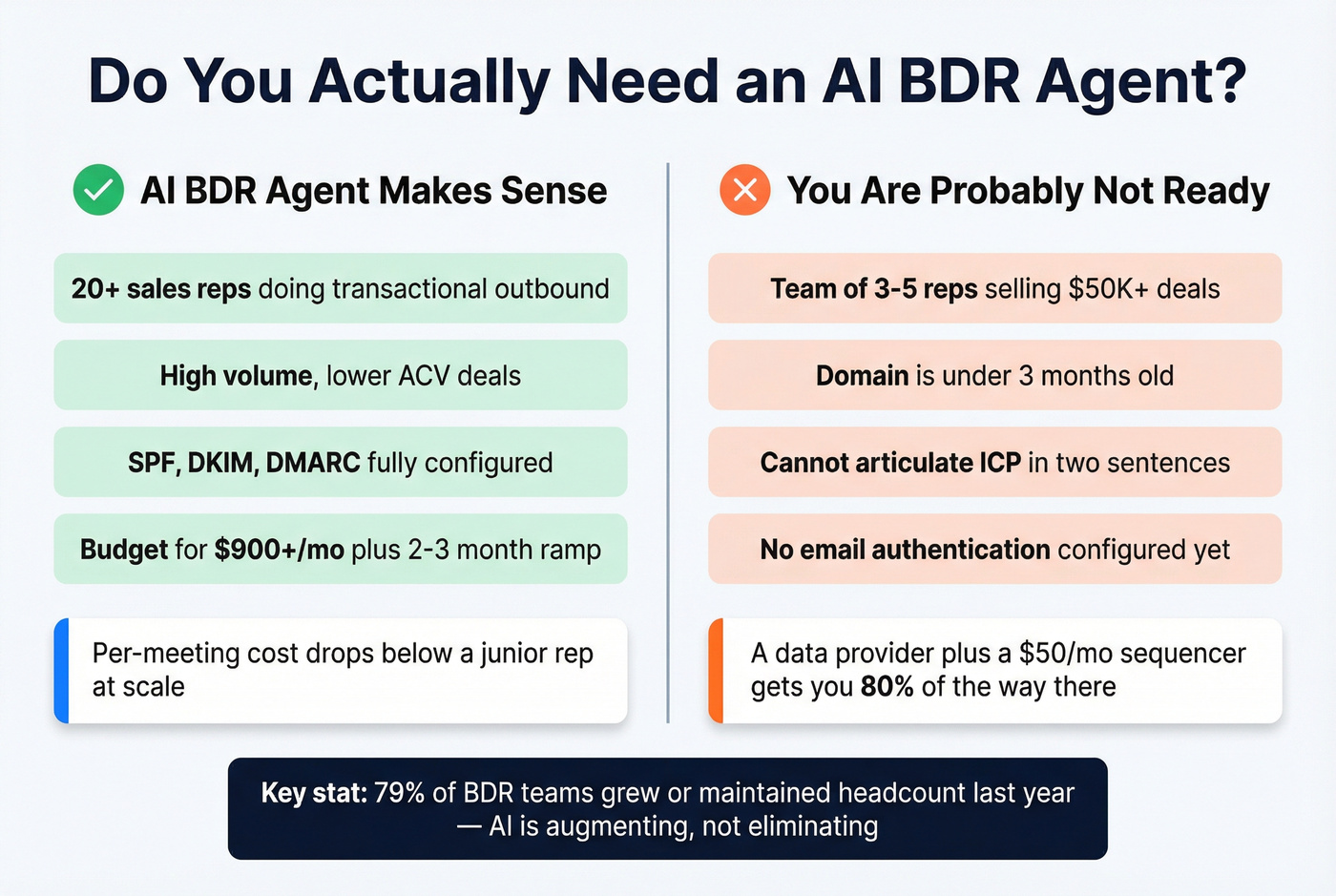
Let's be honest about the math for smaller teams. A $900+/month tool on top of your existing stack is a big line item when a data provider paired with a sequencing tool like Instantly or Lemlist gets you 80% of the way there at a fraction of the cost. Prospeo integrates natively with Instantly, Lemlist, Smartlead, and Clay, so your verified contacts flow straight into sequences without manual exports or CSV gymnastics.
For teams with 20+ reps doing transactional outbound at scale, an AI BDR agent starts making real financial sense - the per-meeting cost drops below what you'd pay a junior rep. For a 3-person team selling $50K+ deals? Your time is better spent on conversations, not configuring another automation layer.
And if you don't have SPF/DKIM/DMARC configured, your domain is under 3 months old, or you can't articulate your ICP in two sentences - you're not ready. Fix the foundation first with an email deliverability checklist and a clean list.
FAQ
How much does an AI BDR agent cost?
Most mid-market tools run $500-$2,500/month, with enterprise platforms like Artisan starting at $24,000/year. Free tiers exist through Relevance AI and Apollo but lack deliverability safeguards. Budget for 2-3 months of warmup before expecting booked meetings.
Can an AI BDR fully replace a human rep?
For about 22% of teams, yes - typically high-volume, transactional sales motions. For most, AI handles prospecting and initial outreach while humans manage nuanced conversations and objection handling. AI excels at the 21-attempt-per-contact repetition but struggles with the judgment calls that close deals.
What's the difference between an AI BDR and an AI SDR?
Functionally identical in most tools. "BDR" typically implies outbound prospecting; "SDR" can include inbound qualification. Don't let the label drive your buying decision - evaluate what the tool actually automates.
How do I prevent domain reputation damage?
Verify your contact data before sending - 98% accuracy is the floor you should demand. Then configure SPF/DKIM/DMARC and warm up new domains for 30-60 days. Most reputation failures come from skipping these basics, not from the AI itself.