

CMO Email Verification: How to Get It Right in 2026
You bought a "verified" CMO list last quarter. Half the contacts had changed roles, a third bounced, and your domain reputation took a hit that cost you two weeks of warmup. Sound familiar? The problem isn't cold email - it's that CMO email verification is harder than verifying almost any other B2B contact, and most tools aren't built for that reality.
Average CMO tenure at Fortune 500 companies sits at 4.3 years, and 65% of exiting CMOs move to similar or bigger roles - meaning the email address changes even when the person stays in your ICP. Here's what makes it worse: among Fortune 500 companies with a C-suite marketing leader, only 40% actually carry the "CMO" title. The rest use VP of Growth, Chief Brand Officer, Chief Commercial Officer, or a dozen other variants. You're not just verifying emails. You're chasing a moving target with inconsistent labeling.
What You Need (Quick Version)
- Stop buying pre-built CMO lists. Build verified contacts in real time.
- Use a tool with real-time verification and catch-all scoring.
- Re-verify before every campaign, not on a fixed schedule.
- Keep total bounces under 2%. Hard bounces under 1%.
Why CMO Emails Are Harder to Verify
Turnover is constant. A 4.3-year average tenure implies roughly 23% annual churn in the CMO seat. B2B contact data already decays 22%+ annually across all roles - CMO data decays faster. A list you built in January is already around 3-4% stale by March. (More on benchmarks in our guide to B2B contact data.)

Catch-all domains dominate. Large enterprises - exactly where CMOs work - disproportionately use catch-all email configurations. These domains accept every incoming message regardless of whether the address exists. A basic verifier returns "valid" for these, which is useless. You need a tool that scores catch-all risk, not one that just flags it. If you’re evaluating vendors, compare options in our roundup of email checker tools.
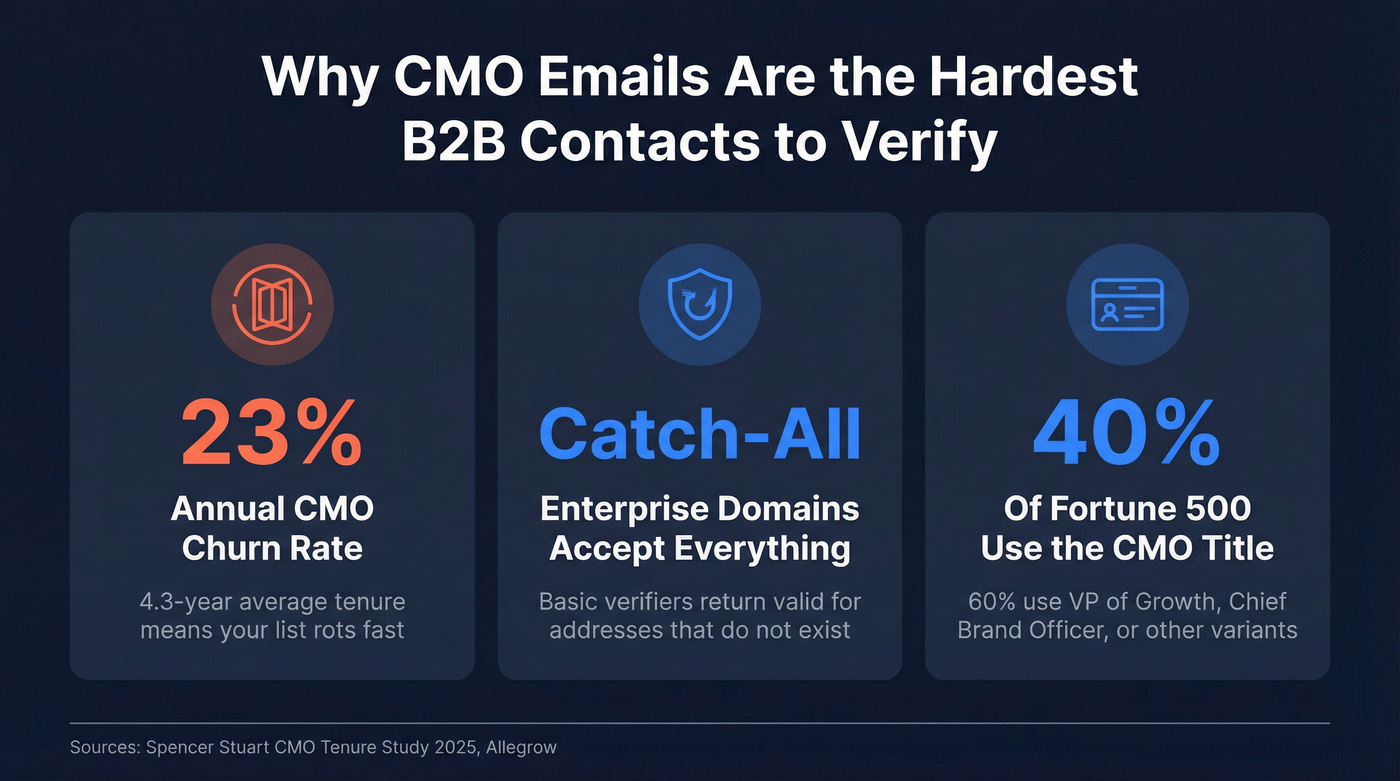
Title fragmentation hides your targets. With 34% of Fortune 500 companies lacking an enterprise-wide marketing leader entirely, your initial search is already working with incomplete data. Verifying the wrong person's email perfectly doesn't help.
The cost of getting this wrong goes beyond bounces. SDRs waste 27% of their time on bad data, costing $1,640-$2,730 monthly per rep. For CMO outreach - low volume, high stakes - every wasted touch is a missed pipeline opportunity. This is also why data quality needs to be an owned KPI, not a “nice to have.”
What Good Verification Actually Looks Like
A proper check runs five layers deep:
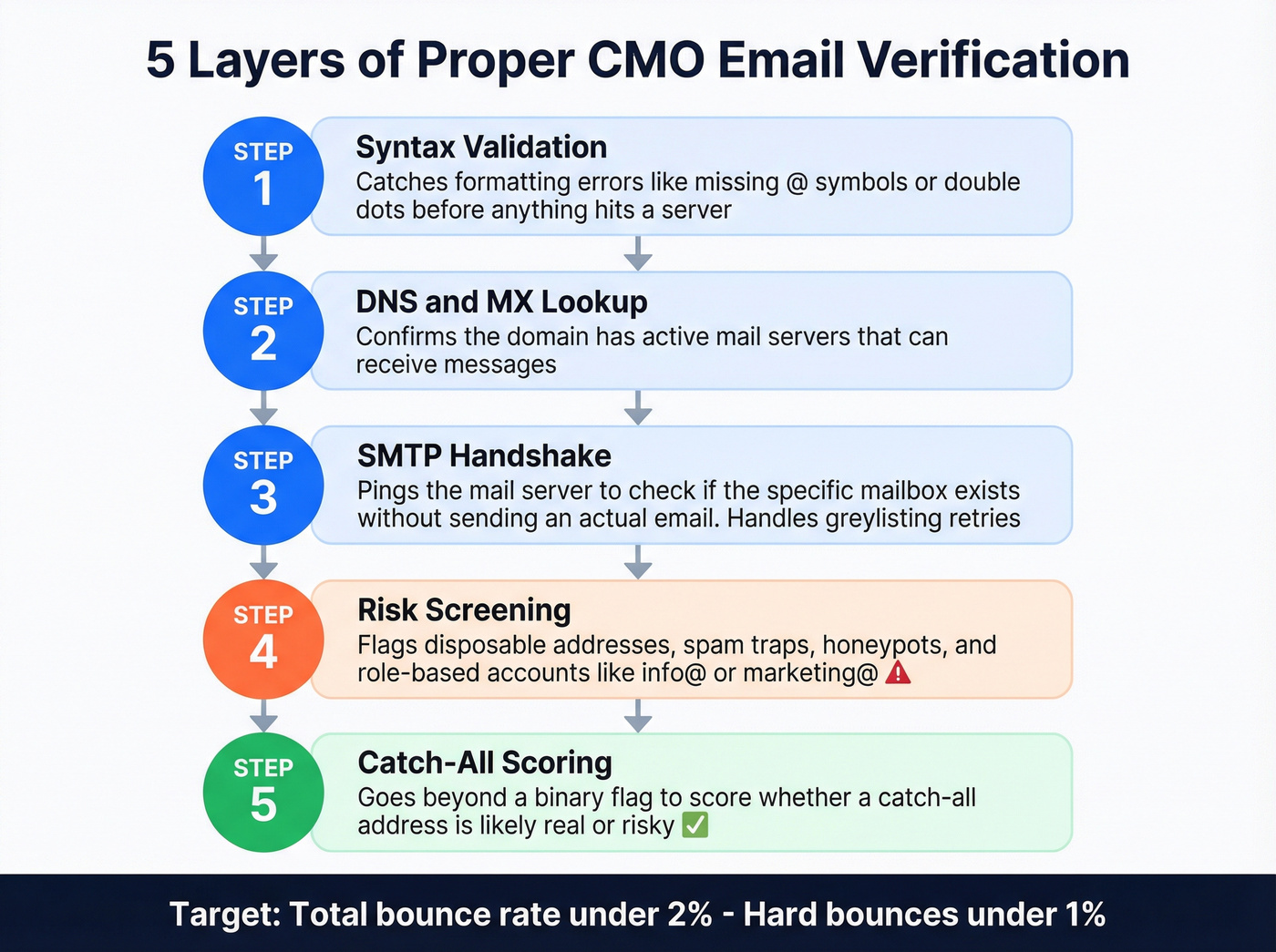
- Syntax validation - catches formatting errors before anything hits a server.
- DNS/MX lookup - confirms the domain has active mail servers.
- SMTP handshake - pings the mail server to check if the specific mailbox exists without sending an actual email. Better tools also interpret greylisting responses and retry rather than returning false negatives.
- Risk screening - flags disposable addresses, spam traps, honeypots, and role-based accounts like info@ or marketing@. (See our breakdown of invalid emails.)
- Catch-all scoring - goes beyond a binary flag to assess whether a catch-all address is likely real or risky.
Let's be honest about the state of verification accuracy. A benchmark testing 15 providers on 3,000 real business emails found the top tool hit 70.00% accuracy, with many others landing in the 60-68% range. That's a lot of room for bad data to slip through, especially when "unknown" results from catch-all domains drag scores down. If you want a deeper dive, see our guide to AI email verification.
The operational threshold is clear: keep total bounces under 2%. One bad campaign that pushes hard bounces past that mark can trigger domain blacklisting and weeks of warmup recovery. (If you’re troubleshooting, start with our hard bounce guide.)
The CMO Email Decay Calculator
Here's a framework we use internally to estimate how fast a CMO list is rotting:
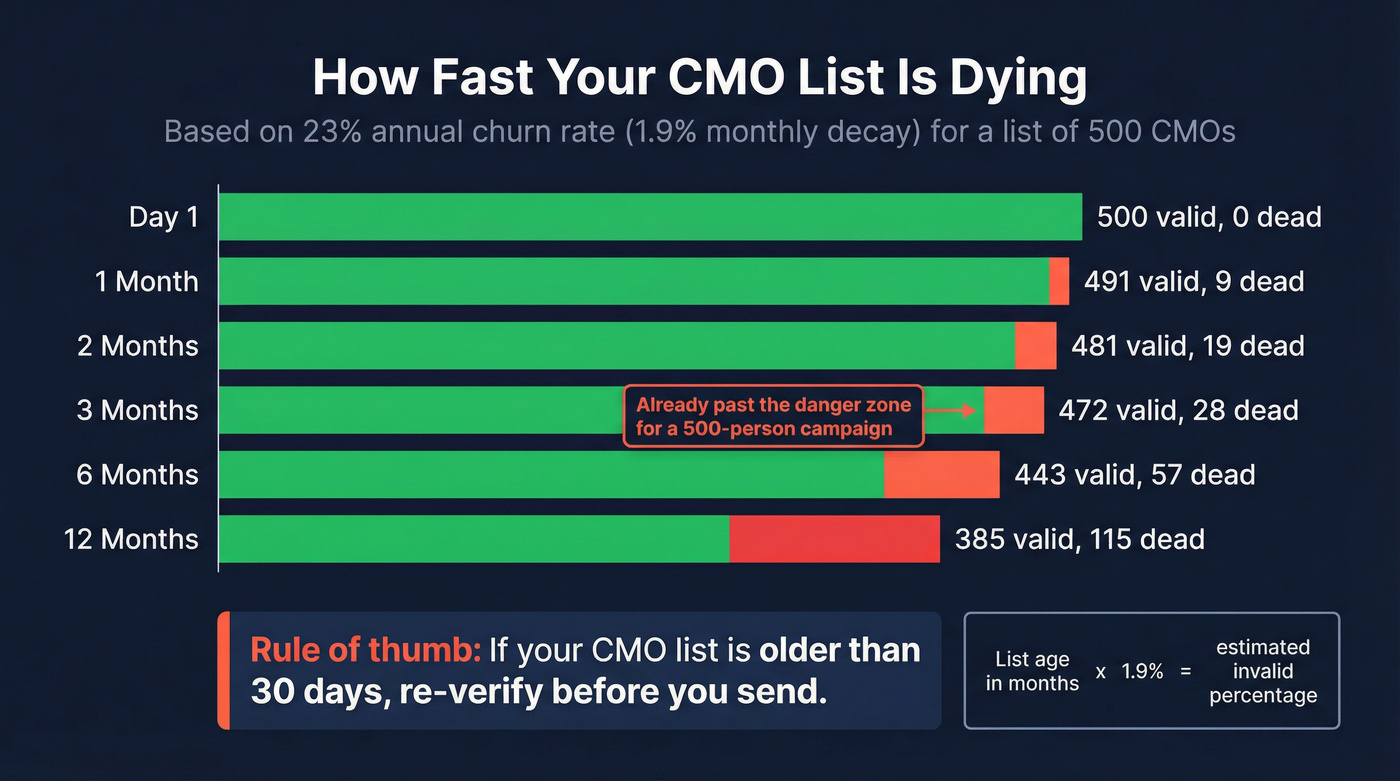
- Annual CMO churn rate: ~23% (derived from 4.3-year average tenure)
- Monthly decay rate: ~1.9%
- Your list age in months x 1.9% = estimated invalid percentage
A 3-month-old list of 500 CMOs? Roughly 29 addresses are already dead. At 6 months, you're looking at 57. We treat CMO contacts as perishable goods, not static assets. If your list is older than 30 days, re-verify before you send.

Your CMO list is rotting at ~1.9% per month. Prospeo's 7-day data refresh cycle and 5-step verification - including catch-all scoring and spam-trap removal - keep bounce rates under 2% without manual re-verification.
Stop warming up domains because your data provider refreshes every 6 weeks.
The Step-by-Step Verification Workflow
Here's the process we've seen cut bounce rates from double digits to under 2%.
Step 1: Build your list with intent signals. Don't start with a static database dump. Filter for in-market CMOs using intent data - Bombora topics, job change signals, or funding events - so you're verifying contacts worth reaching. (If you’re building this motion, start with intent signals.)
Step 2: Verify at point of export. This is where most teams go wrong. They build a list, export it, then verify days later. By then, the data's already aging. Verification should happen during export - every email running through all five layers before it hits your CSV or CRM. If you’re operationalizing this, use a CRM verify workflow.
Step 3: Segment catch-all addresses. Put catch-all results in a separate segment with lower daily send volume and monitor bounces closely. Never treat them the same as fully verified addresses.
Step 4: Re-verify before every major send. After four weeks, roughly 2% of a verified list becomes invalid. For CMO contacts, that decay is faster. Verify before each campaign, not on a quarterly schedule. If you’re scaling volume, follow email deliverability best practices.
Step 5: Monitor and prune. Any contact that bounces gets removed immediately, not recycled into the next sequence. This is a core part of CRM hygiene.
Best Tools for Verifying CMO Emails
Prospeo
Use this if you want to find and verify CMO emails in a single workflow with real-time verification, catch-all scoring, and intent data to prioritize in-market targets.
Prospeo's database covers 300M+ professional profiles with 143M+ verified emails, all refreshed on a 7-day cycle - compared to the 6-week industry average. The platform returns 30,286+ verified CMO contacts filterable by 35+ filters, including buyer intent across 15,000 Bombora topics, plus technographics and job-change signals. The 5-step verification process runs automatically on every contact, delivering 98% email accuracy. That's not a marketing number - we've seen it play out in real customer results. Meritt dropped their bounce rate from 35% to under 4% after switching, and their pipeline tripled from $100K to $300K per week.
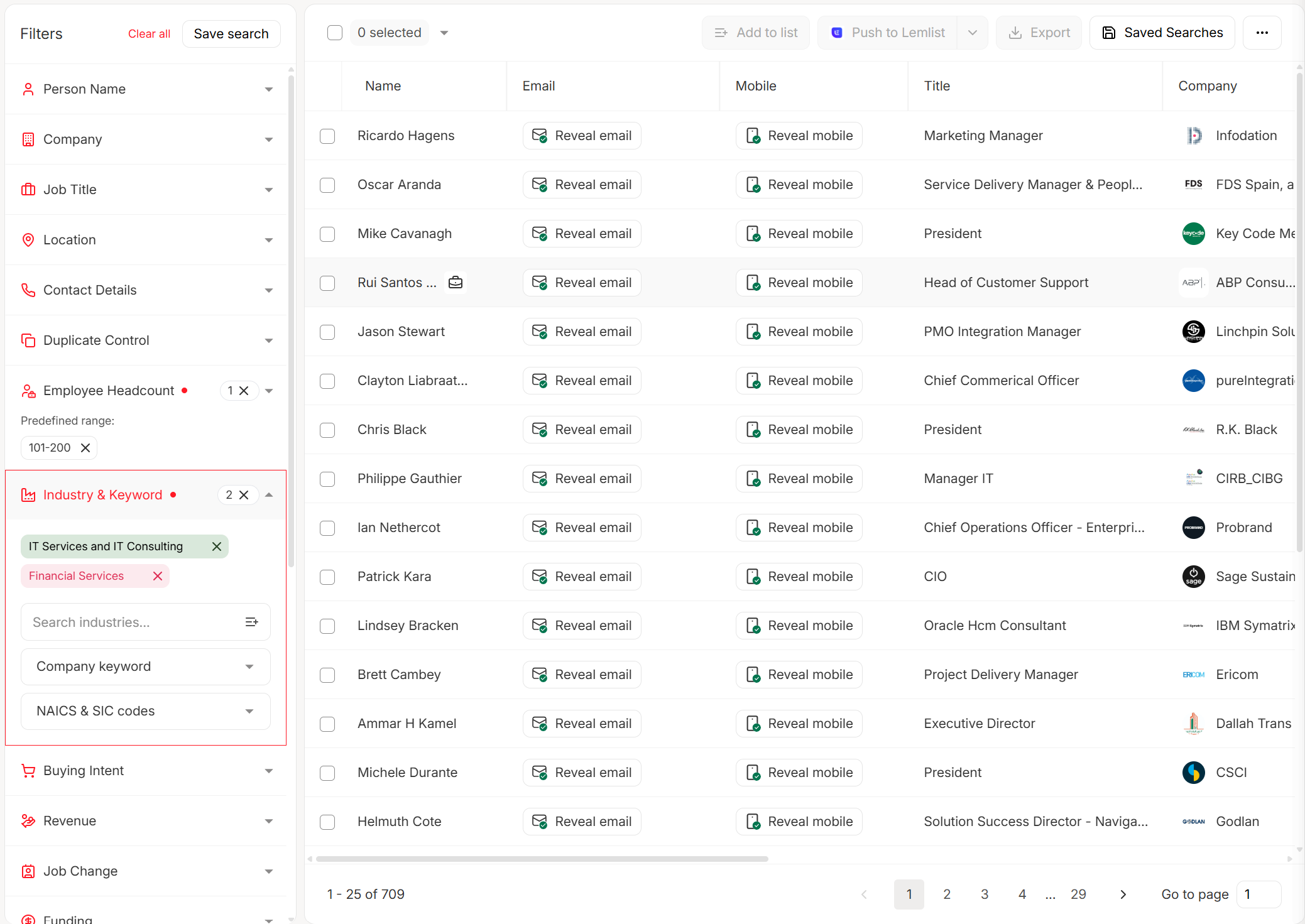
Pricing runs ~$0.01 per email. The free tier gives you 75 emails + 100 Chrome extension credits per month. No contracts, no sales calls required.
Finding the right CMO is half the battle - 40% don't even carry the title. Prospeo's 30+ filters let you target VP of Growth, Chief Brand Officer, and every title variant, then verify each email at 98% accuracy for ~$0.01 per contact.
Build, filter, and verify your CMO list in one workflow - not three tools.
Hunter
Use this if you already have CMO email addresses and need a reliable standalone verifier with transparent methodology.
Hunter ran the most comprehensive public verification benchmark available - 15 tools tested on 3,000 real emails - and ranked #1 in that test at 70.00% accuracy. Worth noting: Hunter also acknowledged a methodology bias in the dataset construction that could advantage their own tool.
Pricing starts at $34/month, with the commonly listed entry plan at $49/month for 2,000 monthly searches. Verification runs ~$24.50 per 1,000 emails. Free tier includes 50 searches per month.
Skip this if you need to find CMO emails, not just verify ones you already have.
NeverBounce
Use this if you have a large CSV of CMO contacts and need fast bulk cleaning before a campaign.
NeverBounce is a bulk list cleaning specialist - upload a file, get results fast, move on. At $8 per 1,000 verifications, it's a strong option for high-volume cleaning. It flags catch-all addresses but doesn't score them, so you'll handle that segmentation yourself.
Skip this if you need catch-all scoring or want to find emails, not just clean them.
ZeroBounce
Pay-as-you-go verification at $0.01 per email with a $20 minimum purchase. Solid for one-off list cleans before a quarterly campaign when you don't need a subscription.
Apollo
Apollo's free tier and $49/user/month starting price make it tempting as an all-in-one. But the consensus on r/sales is that Apollo's data quality for executive contacts is rough - users frequently report 20-30% bounce rates on C-suite emails. For CMO outreach where domain reputation is everything, that's a dealbreaker.
Hot take: If your average deal size is under $15k, you probably don't need CMO-level outreach at all. But if you're going after CMOs, skimping on data quality is the most expensive mistake you can make. A single blacklisted domain costs more than a year of proper verification tooling. (If you need a prevention playbook, see how to prevent email blacklisting.)
Tool Comparison
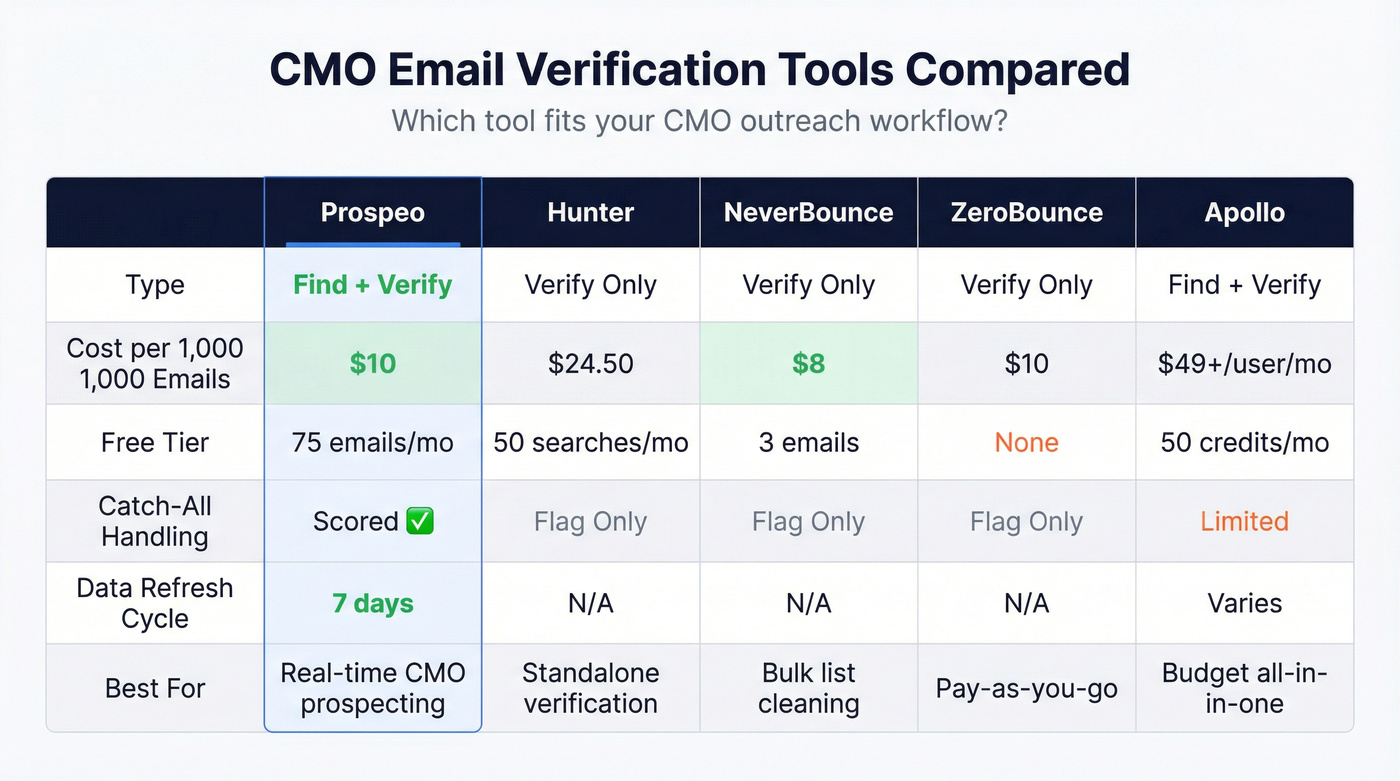
| Feature | Prospeo | Hunter | NeverBounce | ZeroBounce | Apollo |
|---|---|---|---|---|---|
| Type | Find + verify | Verify only | Verify only | Verify only | Find + verify |
| Cost / 1K Emails | ~$10 | ~$24.50 | $8 | $10 | Included ($49+/user/mo) |
| Free Tier | 75 emails/mo | 50 searches/mo | 3 emails | - | 50 credits/mo |
| Catch-All | Scored | Flag only | Flag only | Flag only | Limited |
| Best For | Real-time CMO prospecting | Standalone verification | Bulk list cleaning | Pay-as-you-go | Budget all-in-one |
For teams considering enterprise platforms: ZoomInfo runs $15,000-$45,000+/year on annual contracts only, and Cognism runs ~$22,500+/year for a 5-person team. Both require talking to sales. For verifying executive emails specifically, you're paying for a lot of platform you won't use.
Build Your List, Don't Buy One
Stop buying CMO lists. Pre-built lists decay the moment they're compiled. With CMO turnover running ~23% annually, a list that's even three months old is already degraded.
The compliance risk is real, too. GDPR requires a lawful basis for processing personal data, with cumulative fines hitting ~EUR5.88B across 2,245 enforcement actions and penalties up to EUR20M or 4% of global annual turnover. CAN-SPAM is more permissive - an opt-out model focused on how you email - but still requires honoring unsubscribes within 10 business days. CCPA/CPRA grants deletion rights regardless of where you sourced the contact. (For a practical outbound view, see GDPR for Sales and Marketing.)
The better approach: build targeted lists in real time using intent signals, verify at the point of export, and treat every contact as perishable. In our experience, teams routinely go from high bounce rates to under 2% just by making that shift. It cuts bounces by 5-10x and keeps you on the right side of every regulation.
FAQ
How often should I re-verify CMO emails?
Before every campaign. Email lists decay roughly 2% every four weeks, and CMO turnover accelerates that. A quarterly list is stale by the time you send. Treat verification as a pre-send step, not a one-time event.
What's a good bounce rate for CMO outreach?
Keep total bounces under 2% and hard bounces under 1%. One bad campaign can trigger blacklisting and cost weeks of warmup. The stakes are higher with CMOs because you're sending lower volume to higher-value contacts - each bounce hurts proportionally more.
What does "catch-all" mean for CMO emails?
A catch-all domain accepts all incoming mail whether the address exists or not. Large enterprises - where CMOs work - use these disproportionately. A verifier that returns "unknown" for catch-all domains fails exactly when you need it most. Look for tools that score catch-all risk, not just flag it.
What's a good free tool for verifying CMO emails?
Prospeo's free tier includes 75 verified emails and 100 Chrome extension credits per month - enough to test a small CMO campaign with 98% accuracy. Hunter offers 50 free searches monthly but only verifies addresses you already have, with no prospecting included.