How to Build a Sales Process That Actually Works for Your Small Business
It's Tuesday morning. You've got 50 leads from last week's trade show sitting in a spreadsheet, a phone that isn't ringing, and a vague sense that you should be "doing outreach." But where do you start? This is the reality of small business sales for most of the 33.2 million small businesses in the U.S. - 85.8% of which are one-person operations, 55% run from home. You don't have a sales team. You are the sales team.
78% of small businesses plan to grow this year. But growth without a sales process is just hope. You don't need a 50-slide playbook or a $15K-$40K/year data platform to sell effectively. You need a process, a handful of affordable tools, and the discipline to follow through.
Let's build that.
The Short Version
Before we go deep, here's what matters:
- Document your sales process - even if it's just you. Companies with a defined process are 33% more likely to be high performers, and their win rates exceed 50%.
- Fix your data before you fix your pitch. Bounced emails and dead phone numbers waste more time than bad scripts ever will. (If you want a deeper dive, start with email verification and B2B contact data decay.)
- Start with three tools max: a free CRM, a verified data source, and a scheduler. Total cost: $0 to start. (Here’s a broader B2B sales stack blueprint if you’re tempted to overbuild.)
Why Selling Is Harder in 2026
The ground has shifted under small business owners' feet, and it's not just vibes.
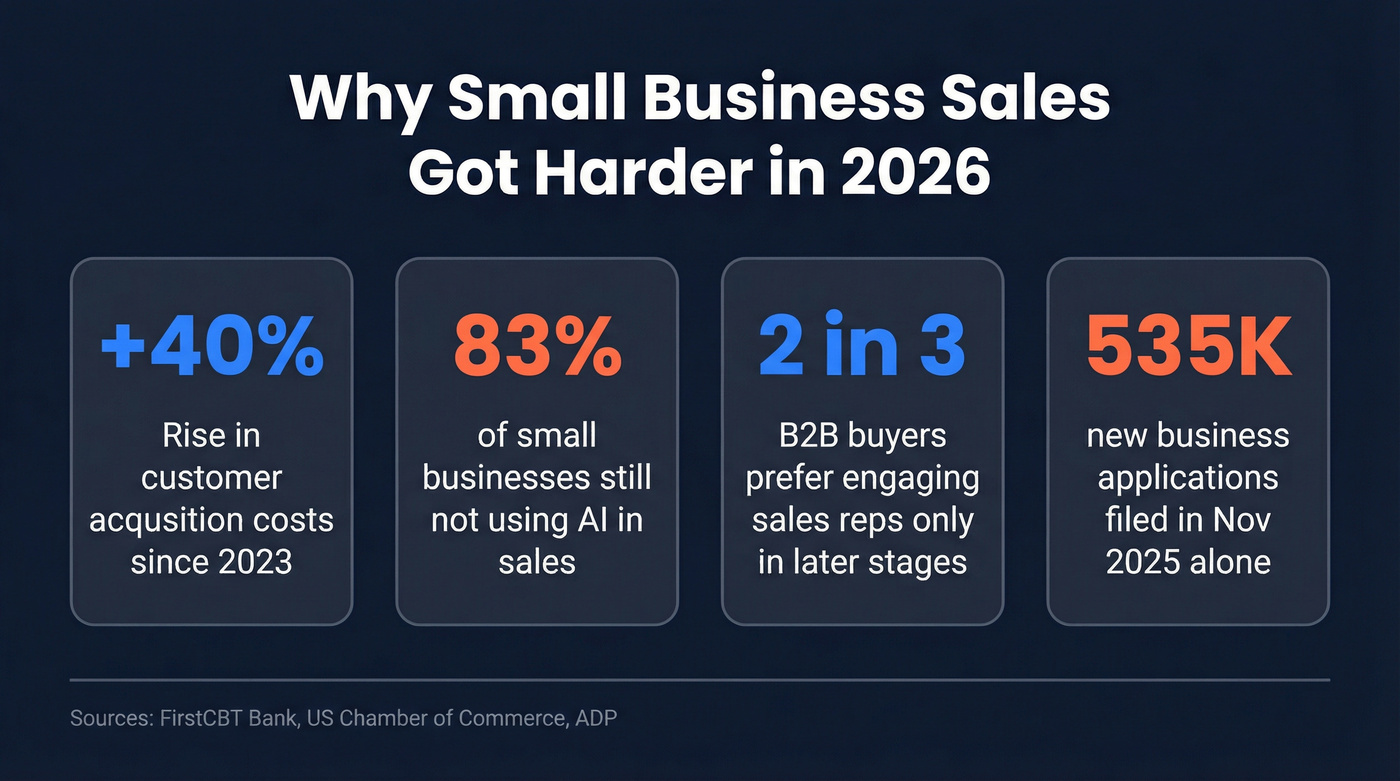
Customer acquisition costs rose roughly 40% between 2023 and 2025. If you were spending $50 to acquire a customer two years ago, you're closer to $70 now - and your margins haven't expanded to match. Companies with fewer than 50 employees shed 120,000 jobs in November 2025 alone, per ADP data. With 535,000 new business applications filed that same month, competition is intensifying while budgets shrink.
Buyers have changed too. Nearly two out of three B2B buyers now prefer engaging salespeople only in later stages of their journey - up 17 percentage points year-over-year. They're doing their own research, reading reviews, comparing pricing pages. By the time they talk to you, they've already formed an opinion. Only 5% of B2B buyers say salespeople actually exceed their expectations. That's brutal, but it also means the bar for standing out is low.
Then there's the AI gap. AI adoption across sales has skyrocketed 282% over the past two years, but 83% of small businesses aren't using AI in their operations at all. That's a widening divide between companies that automate prospecting, follow-up, and qualification - and those still copying emails from business cards into a Google Sheet. (If you want to close that gap fast, look at AI sales outreach automation and AI tools for automating sales follow-ups.)
None of this means selling as a smaller company is dead. It means the old approach - show up at a networking event, hand out cards, wait for the phone to ring - doesn't scale anymore. You need a system.
What a Sales Strategy Actually Looks Like
A sales strategy isn't a mission statement. It's a decision about how you're going to find buyers and convince them to pay you. (If you want the definitions and benchmarks, see inbound vs outbound sales.)
Inbound means attracting leads who come to you - through your website, content, referrals, or social presence. Outbound means proactively reaching prospects through cold email, calls, or direct messages. Most small businesses need both, but the mix depends on your deal size and sales cycle. A $200/month SaaS product leans inbound. A $15,000 consulting engagement requires outbound.
Don't sleep on social selling, either. Social outreach gets 42% response rates, nearly double email, making it worth testing alongside cold email - especially if your buyers are active on professional networks. (If you’re building a repeatable motion, use this social selling system.)
Salesforce's research shows 80% of customers say the experience a company provides matters as much as its products. Your sales approach is your product experience for many buyers. That's worth sitting with for a minute.
Choosing Your Methodology
| Your Average Deal | Best Methodology | Why |
|---|---|---|
| Under $500 | Value-based selling | Speed matters; lead with ROI |
| $500-$5K | Solution selling | Match features to stated problems |
| $5K+ | Consultative / SPIN | Longer cycle; deep discovery |
| Enterprise ($50K+) | Challenger / MEDDIC | Multi-stakeholder; rare for SMBs |
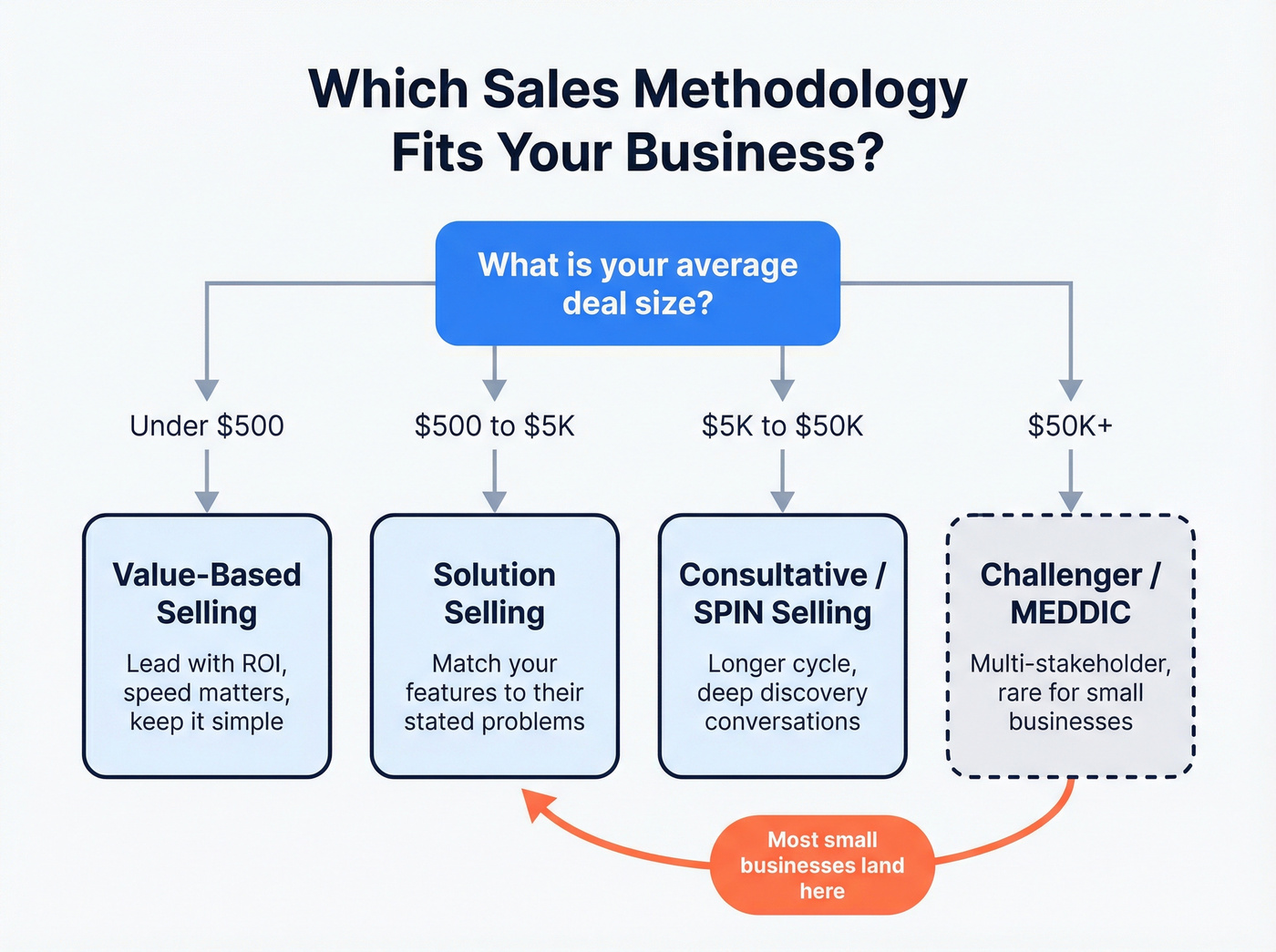
Here's the thing: if you're selling a $2,000 service, you don't need MEDDIC. You need to understand the prospect's problem, show how you solve it, and make it easy to say yes. Solution selling - matching your capabilities to their stated pain - is the sweet spot for most smaller companies.
The Zendesk sales strategy framework breaks this down well: define your goals, understand your market, build personas, then choose the methodology that fits. Skip the frameworks that require a 10-person sales ops team to implement.
Building Your Sales Process
A sales process is just a documented sequence of steps that every prospect goes through. Sounds obvious, but most owners don't have one. They have habits. Habits aren't repeatable, trainable, or measurable. (If you want examples you can copy, see these B2B sales process examples.)
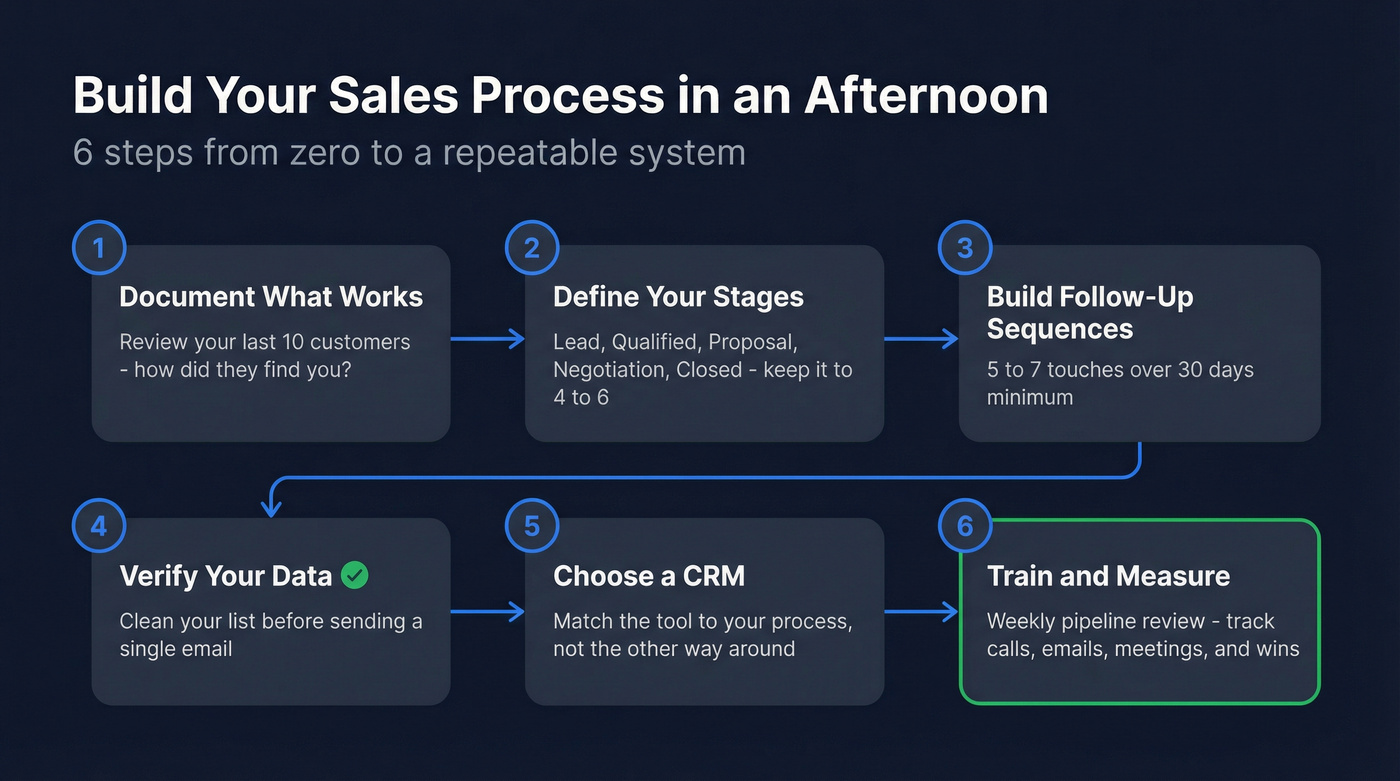
You can build yours in an afternoon. Six steps.
Step 1: Write down what's already working. Look at your last 10 customers. How did they find you? What convinced them? What almost lost them? That's your first draft. Don't invent a process from scratch - document the one that's already producing revenue.
Step 2: Define your stages. Every deal moves through stages: lead, qualified, proposal, negotiation, closed. Name yours. Keep it to 4-6 stages. More than that and you'll stop updating them.
Step 3: Build follow-up sequences. The biggest gap in small business sales isn't closing - it's follow-up. Design a multi-touch sequence for prospects who don't buy immediately. Three emails over two weeks is a minimum. Five to seven touches over 30 days is better. (Use these sales cadence examples to avoid reinventing the wheel.)
Step 4: Verify your prospect data. Before you send a single outreach email, verify your list. A tool like Prospeo catches bad addresses with real-time verification before they bounce and damage your sender reputation. At roughly $0.01 per email with a 98% accuracy rate, it's cheaper than one bounced campaign - and you're not wasting sends on dead inboxes. (More on preventing a hard bounce spiral.)
Step 5: Choose a CRM. Pick one that matches your process, not the other way around. HubSpot's free tier handles contacts, deals, and pipeline stages. That's enough for many small teams until you're running a dedicated sales operation. (If you’re comparing options, start with HubSpot vs Salesforce.)
Step 6: Train and measure. If it's just you, "train" means reviewing your own numbers weekly. If you have a team, run a 30-minute pipeline review every Monday. Track activity - calls, emails, meetings - and outcomes like proposals sent and deals closed. Companies with a defined process see win rates above 50%. Without one, you're guessing.

You just read that bad data wastes more time than bad scripts. Prospeo verifies every email through a 5-step process - 98% accuracy, $0.01 per lead, no contracts. Small businesses using Prospeo cut bounce rates from 35% to under 4% and tripled their pipeline.
Stop copying emails from business cards into a spreadsheet. Verify them first.
Creating a Sales Playbook
A sales playbook captures everything a seller needs to close deals: scripts, objection responses, process steps, and the ICP that defines who's worth pursuing. It's different from a process. The process is the what. The playbook is the how.
Why does this matter for a 3-person company? Because 4 out of 5 B2B deals are lost somewhere in the sales process, and 17% of sellers deliver 83% of revenue. The gap between your best performer and your worst isn't talent - it's consistency. A playbook closes that gap.
There's another reason. 87% of sales training is forgotten within weeks, and average salesperson tenure runs about 1.5 years. If your best rep leaves and their knowledge walks out the door, you're starting from zero. A playbook is institutional memory.
What Your Playbook Should Include
- Ideal customer profile with firmographics - industry, company size, revenue range, geography
- Buyer personas with pain points, objections, and decision criteria
- Sales process stages with clear exit criteria for each
- Email and call scripts with templates for each stage (start with an outreach email template)
- Objection-handling responses for the top 5-10 objections you hear
- Tool stack and CRM usage guidelines
- KPIs and activity targets per role
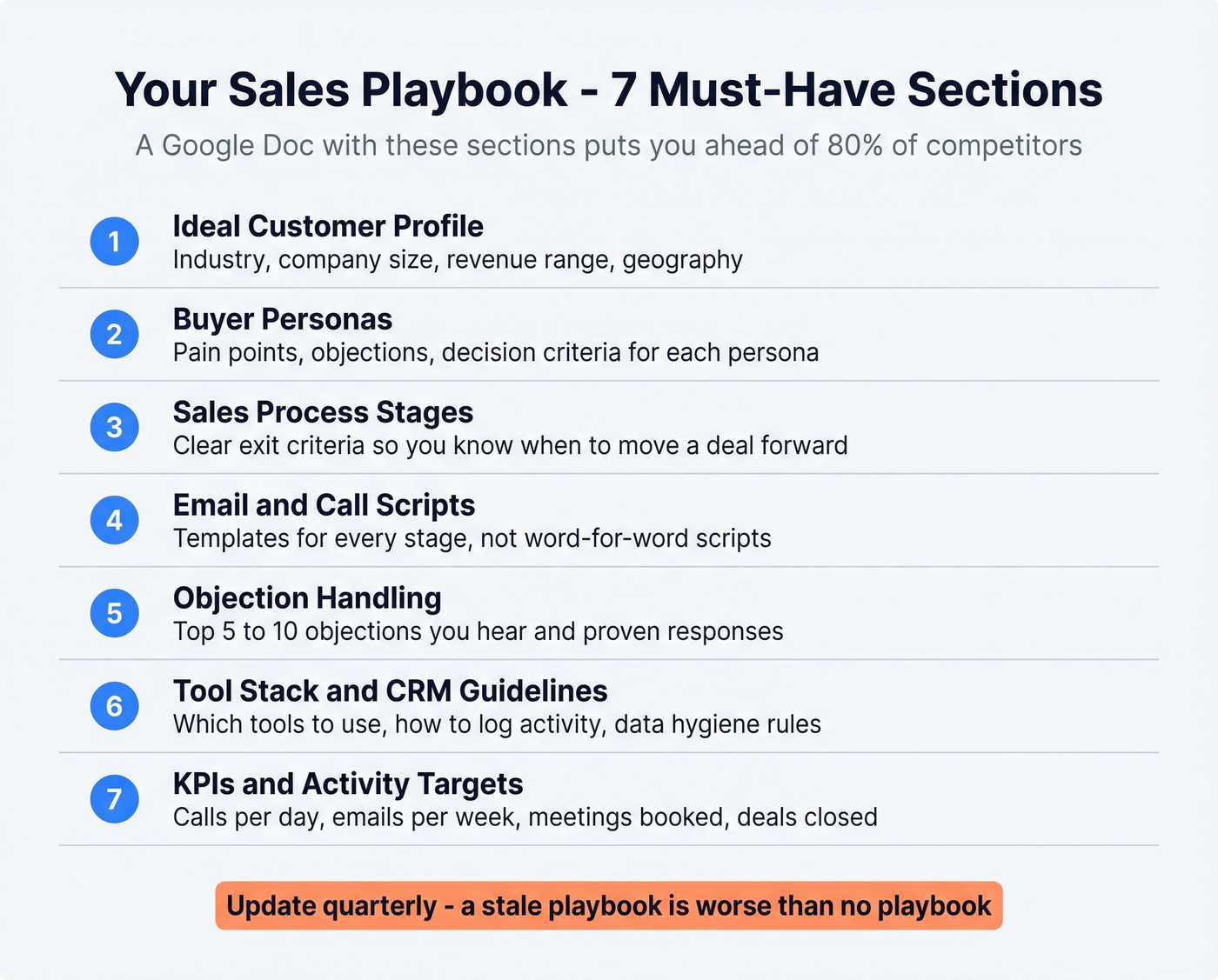
You don't need a 100-page document. A Google Doc with these seven sections, updated quarterly, puts you ahead of 80% of your competitors. Salesforce's playbook framework recommends including role-aligned "plays" - step-by-step recipes for specific scenarios like handling an inbound demo request or re-engaging a stalled deal. Even two or three of these plays make a real difference.
Mistakes That Kill Your Revenue
We've seen the same patterns sink smaller sales teams over and over. Here are the seven that do the most damage.
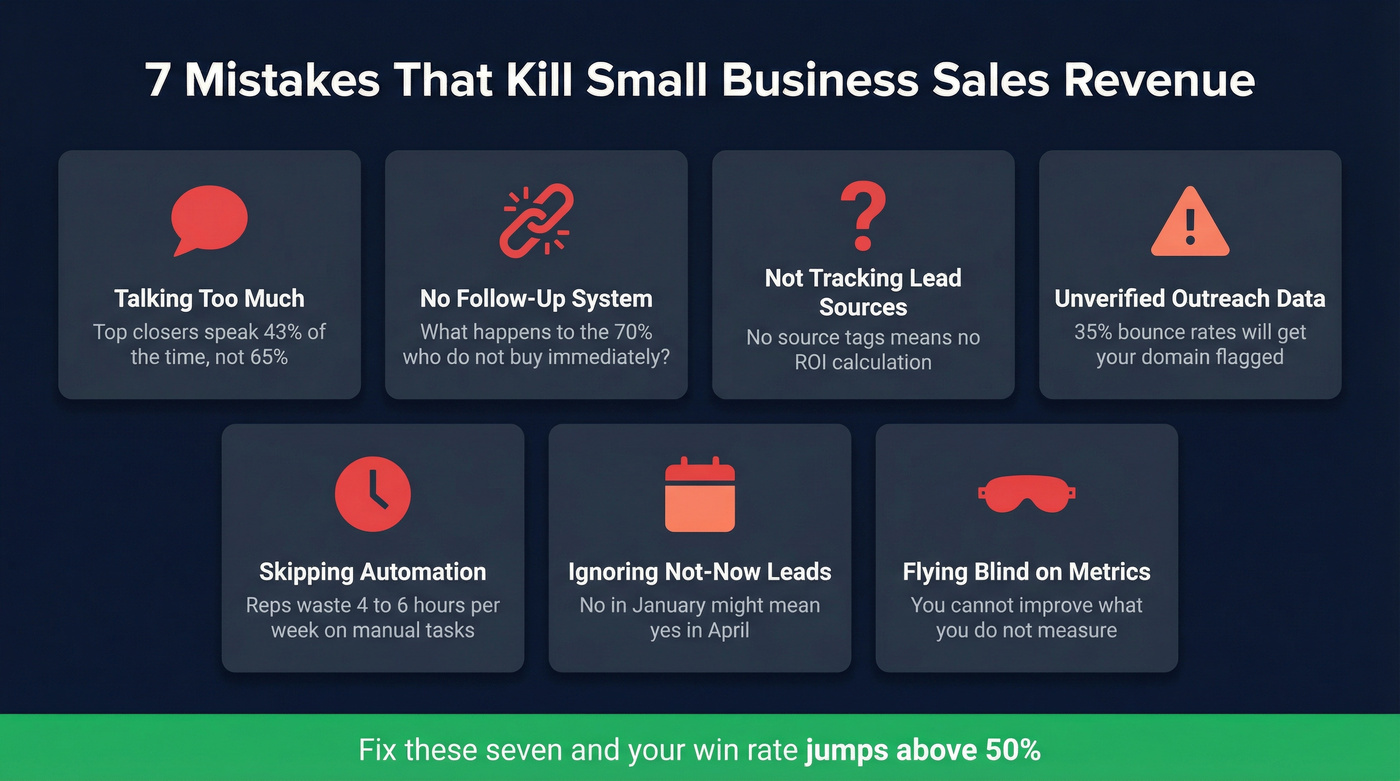
Talking too much on calls. Top-closing reps speak 43% of the time on calls. Average performers talk 65% of the time. The fix isn't complicated: ask more questions, listen to the answers, and resist the urge to pitch before you understand the problem. (Keep a bank of open-ended sales questions handy.)
No documented follow-up system. If you're converting 30% of your leads, what are you doing with the other 70%? Most owners: nothing. Those "not now" leads aren't dead - they're just not ready. Build a nurture sequence. Three emails over 30 days. A quarterly check-in. Something. The nurture gap is where revenue goes to die.
Not tracking lead sources. If you can't tell which channel produced your last 10 customers, you can't calculate CAC, you can't calculate ROI, and you can't make smart decisions about where to spend your next dollar. Tag every lead with a source. Every single one. (Here’s how to set up CRM lead source tracking.)
Sending outreach with unverified data. Your emails bounce because your data is stale. The industry average data refresh cycle is around 6 weeks. The best tools refresh weekly. In one case study we tracked, bounce rate dropped from 35% to under 4% after switching to verified data with a faster refresh cycle - and 35% bounce rates will get your domain flagged. (If you need a deliverability-first checklist, use this email deliverability checklist.)
Skipping automation for repetitive tasks. Automation saves reps 4-6 hours per week on tasks like data entry, follow-up scheduling, and lead routing. If you're manually doing any of those, you're burning time that should go toward actual selling.
Ignoring "not now" leads. A prospect who said no in January might have budget in April. Without a nurture sequence, you'll never know. Set up automated check-ins at 30, 60, and 90 days.
Flying blind on metrics. 57% of the buying journey is complete before a prospect talks to sales. If you're not measuring what happens before that first conversation - website visits, email opens, content downloads - you're missing the majority of the buyer's decision process.
Selling With the Right Tools
Look, 40% of salespeople say prospecting is the hardest part of their job. The right tools cut that effort dramatically. But "right" doesn't mean "most expensive" - it means tools that match your process and budget.
If your average deal is a few thousand dollars, you almost certainly don't need ZoomInfo-level data. Stop trying to build a 10-tool sales stack. Three tools, max, and the discipline to actually use them. HubSpot Free + a verified data source + Calendly Free = $0 to start. Even at paid tiers, many small teams can stay around $100/month. (If you’re shopping, start with these sales prospecting platforms.)
Tool Comparison
| Tool | What It Does | Starting Price | Best For |
|---|---|---|---|
| Prospeo | Verified emails, mobiles, intent | Free (75 emails/mo) | Accurate prospecting data |
| HubSpot CRM | Pipeline, deals, contacts | Free | First CRM for small teams |
| Apollo | Prospecting + sequences | $49/mo per user | Combined prospecting + email |
| Pipedrive | Visual sales pipeline | ~$14/mo per user | Sales-focused CRM |
| Hunter | Email finding + verification | Free (limited searches) | Quick one-off lookups |
| Calendly | Meeting scheduling | Free | Killing scheduling emails |
| Instantly | Cold email at scale | ~$30/mo | High-volume cold outreach |
| Zapier | Connect tools, automate | Free (limited tasks) | Gluing your stack together |
| ZoomInfo | Enterprise B2B data | $12K-$40K+/year | Enterprise teams (overkill for SMBs) |
Prospecting and Data
What makes it strong for smaller teams is the combination of enterprise-grade data with self-serve pricing. You get 30+ search filters, buyer intent powered by Bombora across 15,000 topics, technographics, job changes, headcount growth, and funding signals. You're not just finding contacts; you're finding contacts who are actively in-market. The 7-day data refresh cycle means you're not emailing someone who changed jobs six weeks ago.

The free tier - 75 emails and 100 Chrome extension credits per month, no contract - lets you validate the data quality before spending a dollar.
Apollo is the runner-up for teams that want prospecting and outreach sequences in one platform. The database covers 275M+ contacts, and the built-in email sequencer saves you from buying a separate outreach tool. At $49/month per user, it's affordable. The tradeoff: email accuracy runs lower, and the data refresh cycle is slower. For teams sending high-volume cold email, that accuracy gap compounds fast.
Hunter works well for one-off email lookups with a free tier for limited monthly searches. It's not a database you'd build campaigns from, but it's useful when you need a specific person's email address quickly. Skip it if you're doing outbound at any real volume.
CRM and Pipeline
HubSpot CRM is the default first CRM for small businesses, and for good reason. The free tier handles contacts, deals, pipeline stages, email tracking, and basic reporting without a time limit. You'll outgrow it eventually, but "eventually" might be 2-3 years for a team under 10 people. Paid plans start around $20/month when you need more automation.
Pipedrive starts around $14/month per user and offers a cleaner visual pipeline than HubSpot. It's purpose-built for sales, not marketing-first. If you find HubSpot's interface overwhelming, Pipedrive is the move.
Outreach and Automation
Instantly runs cold email campaigns at scale starting around $30/month, handling inbox rotation, warmup, and deliverability. Calendly eliminates the "when are you free?" email chain - the free tier covers basic scheduling. Zapier connects everything: push new contacts into HubSpot, trigger Slack notifications when deals move stages, auto-add meeting bookers to your CRM.
83% of small businesses aren't using AI-powered tools yet. Prospeo gives you 300M+ profiles with 30+ filters - buyer intent, funding, headcount growth - so you find the right prospects without a 10-person sales ops team or a $15K annual contract.
Enterprise-grade prospecting data at a price built for one-person sales teams.
Metrics Every Owner Should Track
You don't need a BI dashboard. You need five numbers, reviewed weekly.
| Metric | What It Tells You | SMB Benchmark |
|---|---|---|
| Close rate | % of opportunities that convert | 15-25% (inbound) |
| Lead response time | How fast you follow up | Under 5 minutes |
| CAC | Cost to acquire one customer | Varies, but track it religiously |
| Pipeline velocity | Speed deals move through stages | Shorter = healthier |
| Conversion by source | Which channels produce buyers | Referrals typically convert several times better than cold |
Lead response time is the one metric that matters most if you're only going to optimize one thing. Responding to an inbound lead within 5 minutes versus 30 minutes can be the difference between a conversation and a ghost. Most owners respond in hours. That's a fixable problem - set up notifications, assign ownership, and treat new leads like they're on fire.
Close rate tells you whether your process works. If you're below 15% on inbound leads, something's broken upstream - either your qualification is too loose or your pitch doesn't match what attracted the lead. CAC by channel tells you where to invest. Pipeline velocity tells you where deals stall. Conversion by source tells you which marketing efforts actually produce revenue, not just clicks. The consensus on r/sales is that most owners track revenue but not the source - and then wonder why they can't replicate their best months.
Track these in your CRM. Review them every Monday. Adjust quarterly.
FAQ
How do I start a sales process with no experience?
Document what's already working, even informally. Write down how your last five customers found you, what convinced them, and what almost lost them. Companies with a defined process are 33% more likely to be high performers - and the bar for "defined" is lower than you think. A simple Google Doc with stages and scripts counts.
What's the best free CRM for a small business?
HubSpot's free CRM is the most capable no-cost option, handling contacts, deals, pipeline stages, and basic email tracking without a time limit. Pipedrive is better for visual pipeline management but starts around $14/month. Either works for teams under 10.
How do I find verified contact info for prospects?
Use a B2B data platform that verifies emails and phone numbers in real time - 95%+ accuracy and a weekly data refresh cycle are the benchmarks. Prospeo's free tier gives you 75 verified emails per month to test before committing, while Hunter offers limited free lookups for one-off searches.
How much should I spend on sales tools?
Start at $0 with a free CRM, free prospecting credits, and a free scheduler. Scale to $50-$100/month once you've validated your process and need more automation. Enterprise platforms priced at $12K+/year are designed for 50-person teams - that budget is better spent on actual selling activity.
What's a realistic close rate for small business sales?
For inbound leads, 15-25% is typical. For cold outbound, 2-5% lead-to-customer is normal. The gap between those numbers is exactly why tracking lead source matters - it tells you where to invest your limited time and budget for maximum return.
Now stop reading about sales and go make some. Your Tuesday morning spreadsheet isn't going to call itself.