

The 10 Best AI BDR Automation Tools in 2026
Here's a failure mode we see constantly: the "smartest" AI agent writes beautifully personalized emails - to addresses that bounce at scale. A simpler setup, paired with a verified data layer, books more meetings faster. The lesson isn't about AI sophistication. It's about data quality.
79% of sales teams use automation tools, but only 30% hit their expected ROI. The gap isn't the sequencer or the AI copywriting - it's the contact data feeding the machine. With the AI SDR market projected to hit $15.01B by 2030 at a 29.5% CAGR, the stakes for getting this right keep climbing.
These are the 10 tools worth your time in 2026, plus the stack architecture that actually produces pipeline.
Our Picks (TL;DR)
| Pick | Tool | Why | Starting Price |
|---|---|---|---|
| Best data layer | Prospeo | 98% email accuracy, ~$0.01/lead | Free (75 emails/mo) |
| Best sequencing | Instantly | Unlimited accounts + warmup | $47/mo |
| Best AI BDR agent | AiSDR | Transparent pricing, realistic estimates | $900/mo |
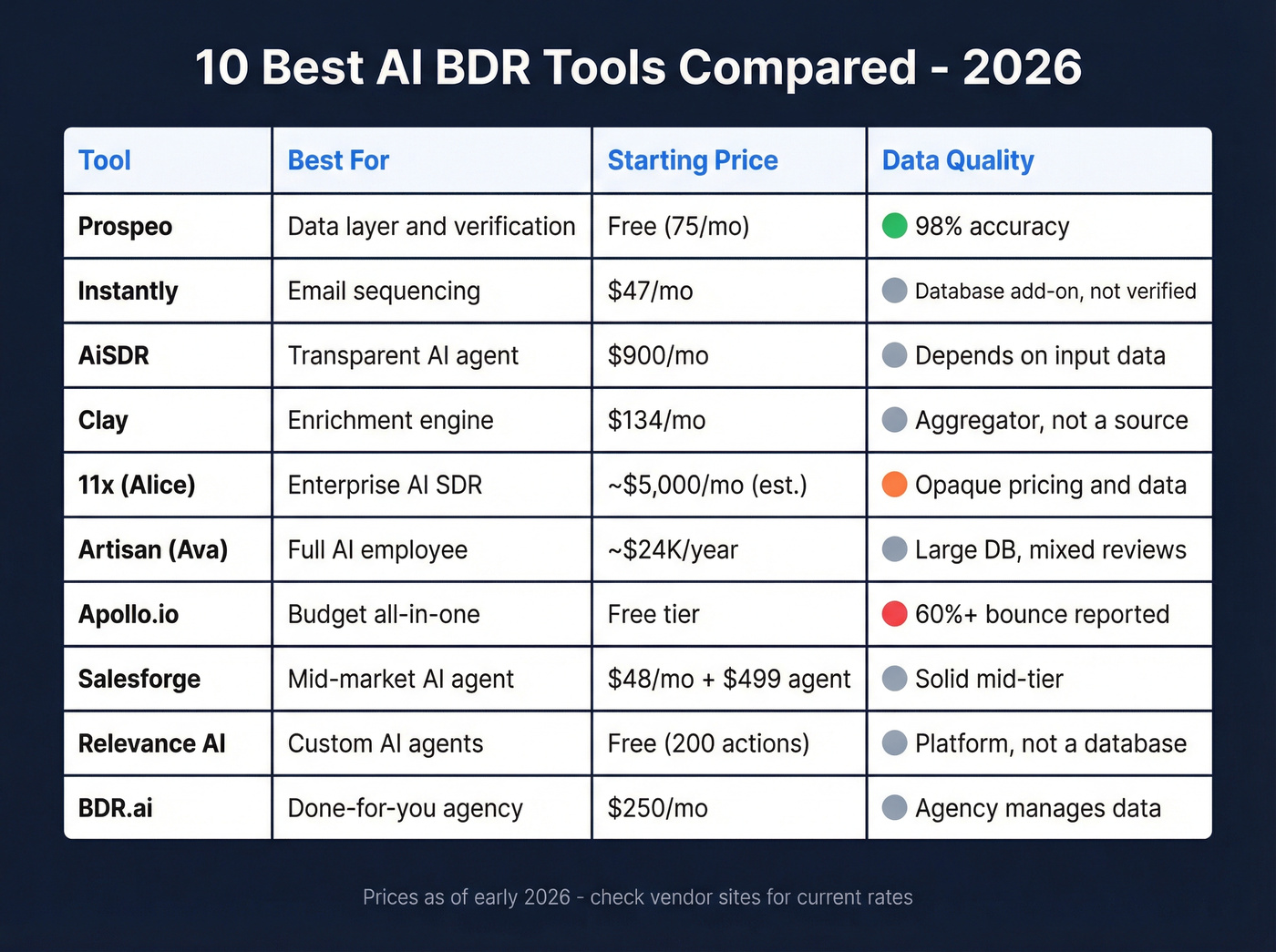
Most teams don't need a monolithic platform. They need three layers working together: verified data, smart enrichment, and reliable sequencing.
What Is an AI BDR?
An AI BDR is software that automates the top-of-funnel work a human business development rep handles - prospecting, personalized outreach, sequencing, follow-ups, and meeting booking. As Heinz Marketing frames it, these aren't robots replacing humans. They're workflow engines that handle the repetitive 80% so reps can focus on conversations that actually require judgment.
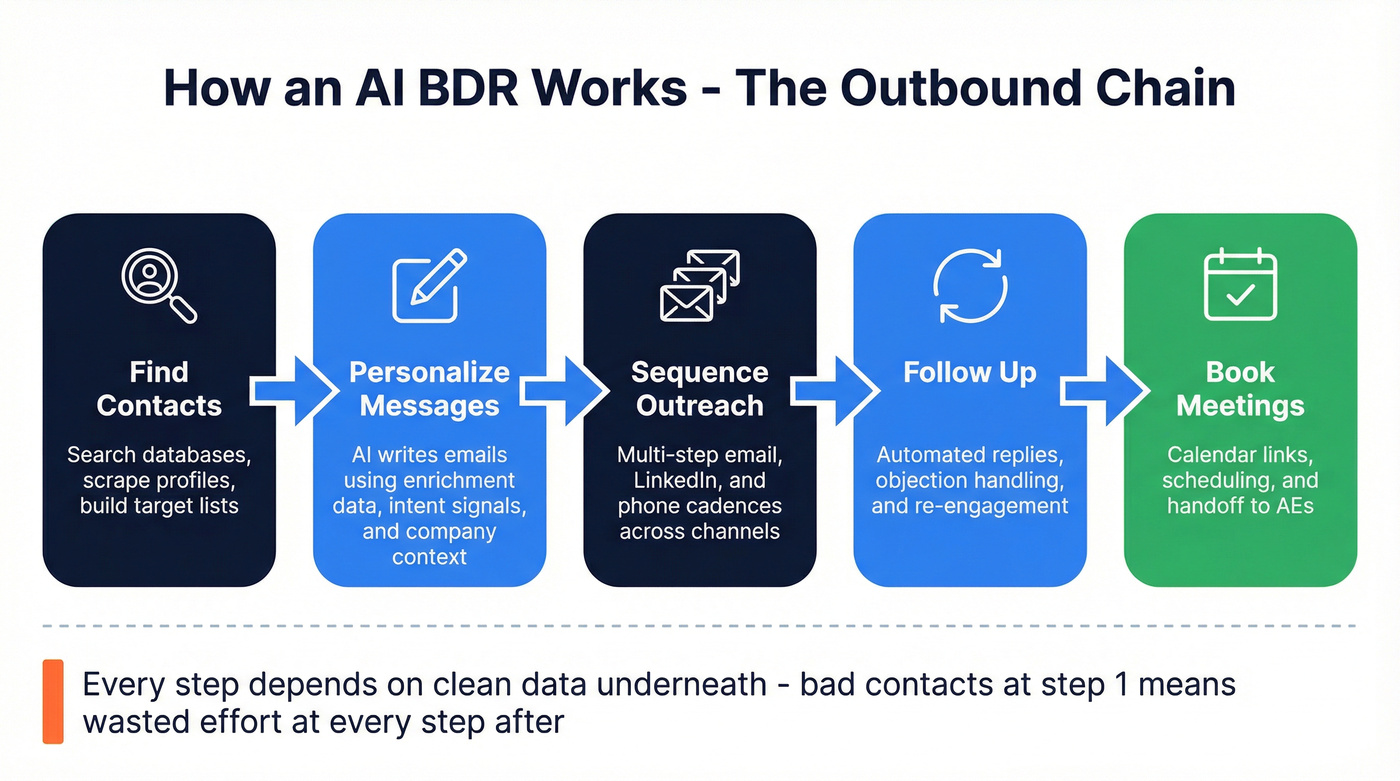
You'll see "AI BDR" and "AI SDR" used interchangeably. The distinction is mostly branding - AI BDRs tend to focus on outbound prospecting and meeting booking, while AI SDRs sometimes include inbound qualification. In practice, the tools overlap almost completely.
Every AI BDR follows the same chain: find contacts, personalize messages, sequence multi-step outreach, follow up, book meetings. Every tool in this article handles some subset of that chain. None handle all of it well without clean data underneath.
Why Most Automated Outbound Deployments Fail
The automation-ROI gap is enormous. 79% adoption, 30% ROI. That's not a technology problem - it's an implementation problem. The root cause is almost always data quality.
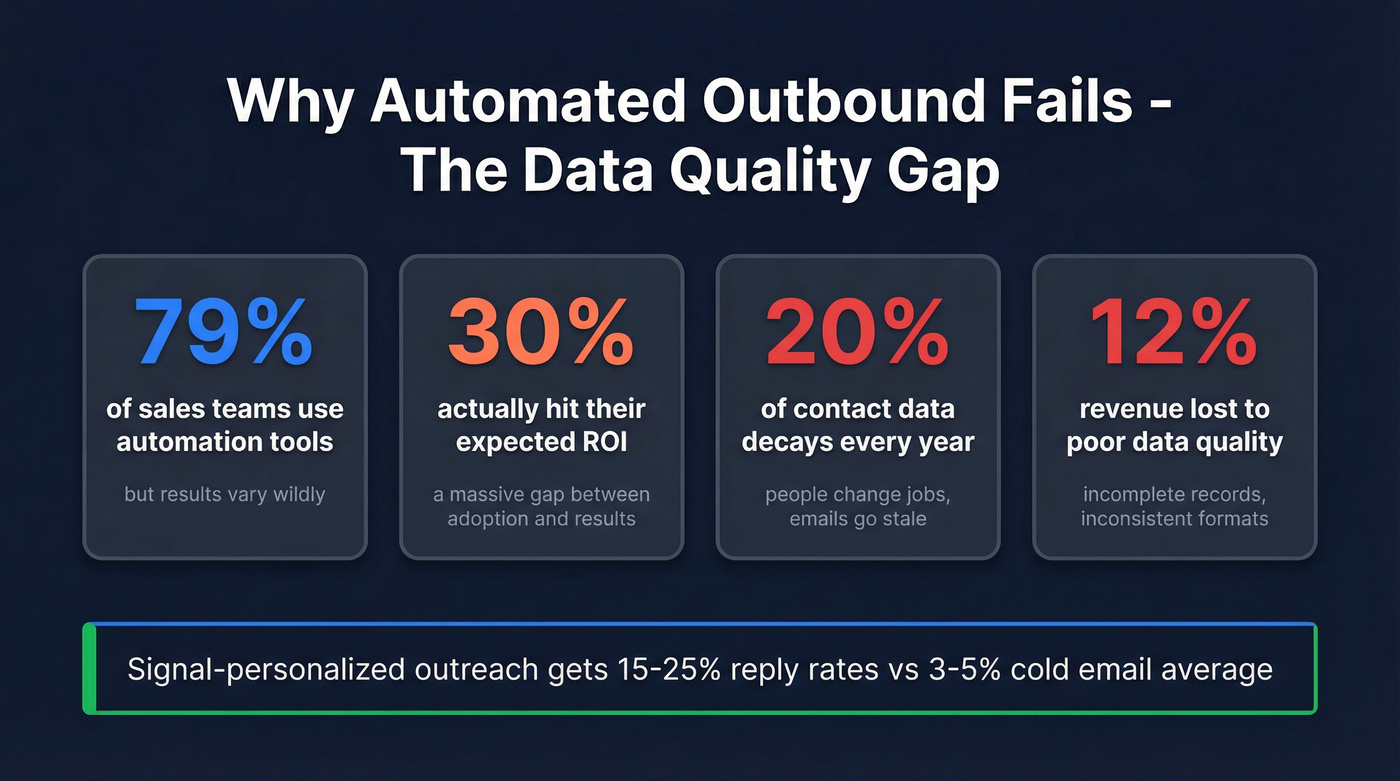
Contact data decays roughly 20% annually. People change jobs, companies get acquired, email servers get reconfigured. Feed an AI agent a list that's six months old and one in five contacts is already dead. The AI will still write a beautiful personalized email to that dead address. Your domain reputation pays the price.
The numbers get worse the deeper you look. 65% of sales professionals say they can't fully trust their organization's data - incomplete records, inconsistent formats, stale information. Poor data quality leads to an estimated 12% loss in revenue, which is a staggering number when you actually sit with it.
Signal-personalized outreach - emails triggered by intent data and enriched with real context - benchmarks at 15-25% reply rates versus the 3-5% cold email average. That gap is the difference between verified, enriched data and a stale CSV.
Warmup matters too. Domain warmup takes 30-60 days. Rush it on unverified lists, rack up bounces, and deliverability drops fast. Recovery takes months.

The 10 Best Tools for 2026
Prospeo - Best Data Layer
Every automated outbound stack needs a foundation. Prospeo's database covers 300M+ professional profiles with 143M+ verified emails and 125M+ verified mobile numbers, all refreshed on a 7-day cycle. The industry average refresh is six weeks. That gap matters enormously when you're automating outbound at scale, because stale data compounds into bounced emails, burned domains, and wasted sequencer spend.
The 5-step verification process includes catch-all handling, spam-trap removal, and honeypot filtering, delivering 98% email accuracy. For mobile numbers, the pickup rate runs 30% across all regions. The Chrome extension (40K+ users) lets reps find verified emails and phones from any website, professional profiles, or CRM in one click.

Native integrations include Instantly, Smartlead, Lemlist, Clay, HubSpot, Salesforce, Zapier, and Make, so you can push clean data straight into the rest of your stack. Intent data covers 15,000 Bombora topics, letting you prioritize prospects actively researching relevant solutions.
Here's a proof point that stuck with us: Snyk's 50-person AE team was bouncing 35-40% of emails before switching. After the switch, bounces dropped under 5%, AE-sourced pipeline jumped 180%, and they now generate 200+ new opportunities per month.
Use this if: You're running any AI BDR tool and need verified data underneath it. At ~$0.01/lead with a free tier of 75 emails/month, there's no reason not to test it.
Instantly - Best Sequencing
Instantly has become the default sequencing layer for outbound teams that care about deliverability. The killer feature is unlimited email accounts with unlimited warmup across every plan - starting at $47/mo. That's the Growth tier covering 5,000 emails per month. Hypergrowth ($97/mo) pushes to 100,000, and Light Speed ($358/mo) handles 500,000.
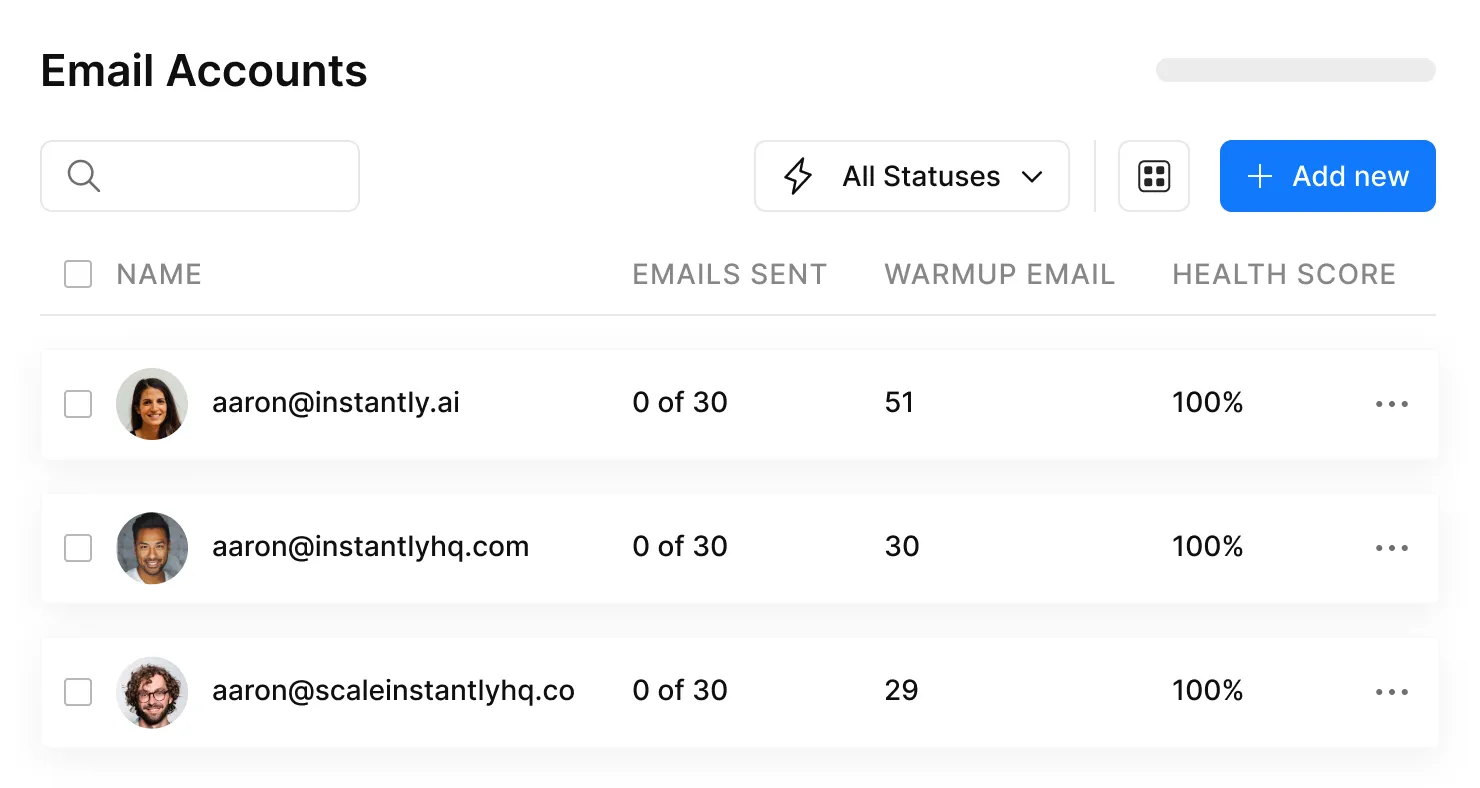
The SISR system (server and IP sharding/rotation) on higher tiers protects your domain reputation by distributing sends across infrastructure. It's the kind of deliverability engineering that used to require a dedicated ops person.
Instantly also offers a lead database add-on (SuperSearch) with 450M+ B2B leads starting at $47/mo. But let's be honest - their database is a lead-finding tool, not a verification engine. We've seen teams consistently get better results pairing Instantly's sequencing with a dedicated verification layer rather than relying on its native database alone.
Pros: Unlimited accounts/warmup, strong deliverability infrastructure, transparent pricing.
Cons: Lead database quality doesn't match dedicated verification tools. The UI can feel cluttered with multiple product lines.
AiSDR - Best Transparent Agent
AiSDR is the rare AI BDR tool that publishes real pricing with real volume estimates. The Explore plan runs $900/mo billed quarterly, with 1,200 lead search credits, 1,200 AI messages, and an estimated ~3 meetings per month. Grow is $2,500/mo with 4,500 messages and ~11 estimated meetings.

Those meeting estimates are refreshingly honest. Most vendors dodge the question entirely or promise "10x pipeline" without defining what that means. AiSDR says "expect 3 meetings a month on the starter plan" and "strongest results after ~6 weeks." That kind of transparency is rare in this space.
The 30-60 day warmup period is real - 90% of clients launch within 7 days, but deliverability needs time to mature. Meeting estimates also assume clean data input, so pair it with a solid verification layer.
Pros: Transparent pricing and volume estimates, realistic ramp expectations, quarterly billing with cancel-anytime flexibility.
Cons: The $900/mo entry point is steep for solo founders.
Clay - Best Enrichment Engine
Clay isn't a database or a sequencer - it's the enrichment and scoring layer that sits between your data source and your outbound tool. Think of it as an AI-powered spreadsheet that pulls live data from dozens of providers, scores leads, writes personalization snippets, and pushes enriched records into your sequencer or CRM.
Pricing is credit-based: Starter at $134/mo (billed yearly) with 24K credits/year, Explorer at $314/mo, Pro at $720/mo. All plans include unlimited users. The learning curve is real, but the flexibility is unmatched for teams that want custom enrichment logic.
Skip this if you want a plug-and-play solution. Clay rewards teams willing to invest in configuration. For everyone else, it'll feel like building a rocketship to send a postcard.
11x (Alice)
11x's Alice is positioned as a fully autonomous AI SDR handling prospecting, outreach, and follow-ups. Pricing isn't public. Market estimates put it around $5,000/mo for outreach to roughly 3,000 leads with up to five emails each.
Look - if a vendor won't show pricing and makes it hard to leave, that tells you something about their retention strategy. Reddit threads on r/sales consistently mention difficult contract cancellation and strict terms. For enterprise teams with budget and patience, Alice can work. For everyone else, transparent alternatives like AiSDR exist at a fraction of the cost.
Artisan (Ava)
Artisan positions Ava as a complete AI employee. The pitch: 300M+ contacts, end-to-end outbound automation, and a dedicated AI SDR manager. Pricing begins around $24K/year, but total cost can exceed $80K with the dedicated manager and full configuration. Implementation takes 2-3 months.
If you're running fewer than 50 reps, you're likely overpaying for capabilities you won't fully use.
Apollo.io - Budget All-in-One
Apollo is the obvious starting point for bootstrapped teams. Free tier gets you in the door, Basic runs $49/mo (billed annually), Professional $79/mo, and Organization $119/user/mo with a minimum of 3 users. The database is massive, and the built-in sequencer means you can prospect and send from one platform.
The tradeoff is data quality. Some users report over 60% of "verified" emails fail or bounce on Apollo-sourced lists. Apollo is great for discovery and list building, but verify those emails through a dedicated tool before you hit send.
Salesforge (Agent Frank)
Multi-channel sequencing with an AI agent add-on. Core plans run $48/mo (Pro) and $96/mo (Growth). Agent Frank adds $499/mo billed quarterly. Solid mid-market option for AI-assisted outbound without a massive annual commitment.
Relevance AI
An "AI workforce" platform priced by actions, broader than just sales development. Free tier gives 200 actions/month, Team runs $234/mo with 84K actions/year. SOC 2 Type II and GDPR compliant. Worth evaluating if you're building custom AI agents beyond sales outbound.
BDR.ai - Done-for-You
An agency model, not SaaS. Packages range from $250/mo for sales augmentation to $5,500/mo for consulting. They carry a 5.0/5 on Clutch across 7 reviews. Best for teams that want to outsource outbound entirely and don't want to manage tooling themselves.

79% of teams automate outbound but only 30% hit ROI - because the data underneath is rotten. Prospeo's 7-day refresh cycle and 98% email accuracy eliminate the bounce-rate problem that kills AI BDR deployments before they start.
Stop letting stale data waste your AI agent's best work.
Pricing Comparison
The sticker price is never the full story. Hidden costs - implementation time, the 30-60 day warmup period where you're paying but not producing, integration setup, and contract lock-in risk - can double your effective spend. A $2,000/mo platform with a 3-month implementation window costs $6,000 before it books a single meeting.
| Tool | Type | Starting Price | Mid-Tier | Model |
|---|---|---|---|---|
| Prospeo | Data/verification | Free | ~$0.01/lead | Credits |
| Instantly | Sequencing | $47/mo | $97/mo | Per-plan |
| AiSDR | AI BDR agent | $900/mo | $2,500/mo | Quarterly |
| Clay | Enrichment | $134/mo | $314/mo | Credits |
| 11x (Alice) | AI SDR agent | ~$5,000/mo | Custom | Annual contract |
| Artisan (Ava) | AI employee | ~$2,000/mo | >$80K/year | Annual |
| Apollo.io | All-in-one | Free | $79/mo | Per-user |
| Salesforge | Sequencing + AI | $48/mo | $499/mo (w/ Frank) | Monthly |
| Relevance AI | AI workforce | Free | $234/mo | Actions |
| BDR.ai | Done-for-you | $250/mo | $5,500/mo | Service |
The spread runs from free tiers to $60K+/year contracts. The question isn't "which is cheapest?" It's "which combination gives you verified data, smart personalization, and reliable delivery for your budget?"
Build Your AI BDR Automation Stack
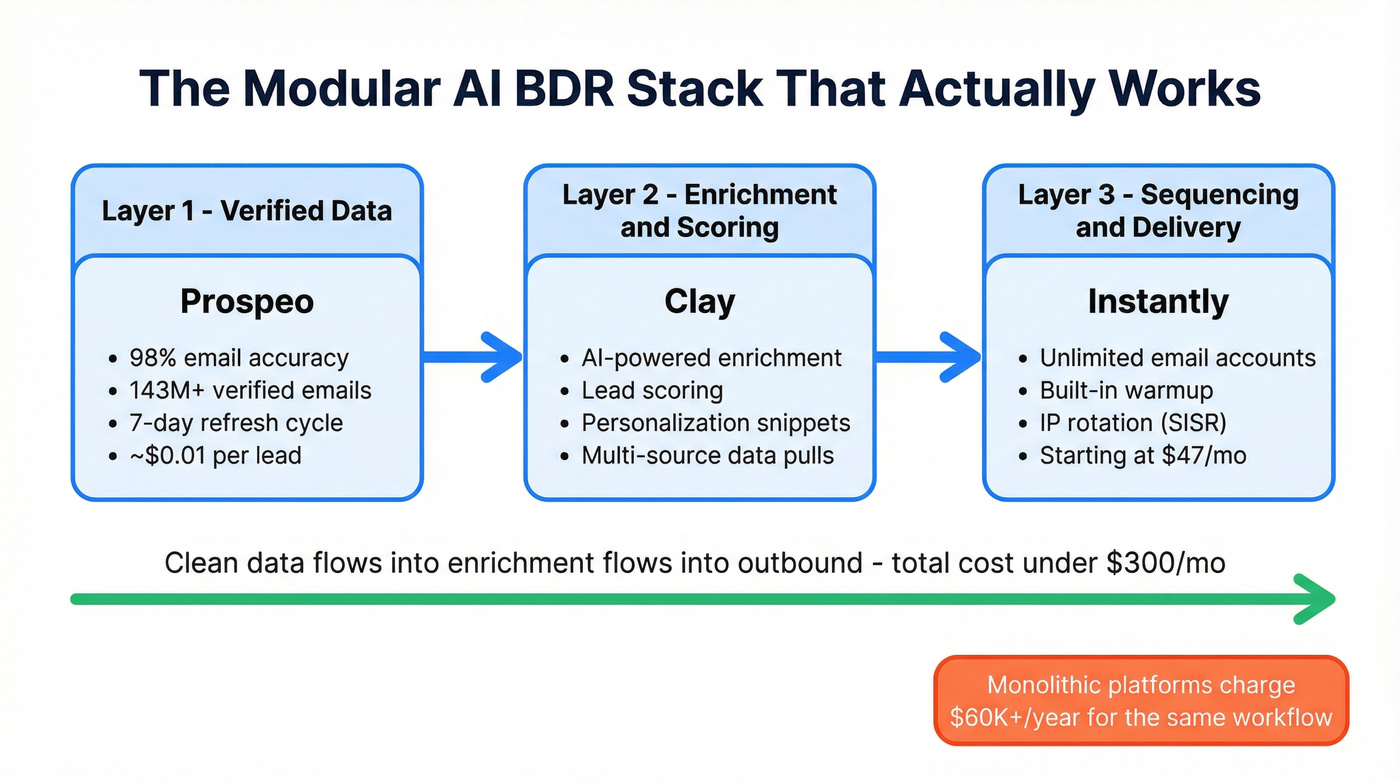
You don't need a monolithic platform. You need a stack with three layers.
Here's a ~$300/mo build that outperforms most $5,000/mo "AI employee" platforms:
Layer 1 - Verified Data. Pull verified emails and mobiles from 300M+ profiles with 30+ filters including technographics and intent topics. Native integrations push clean data directly into Instantly, Smartlead, Lemlist, or Clay. Prospeo includes a free tier (75 verified emails/month), and paid usage typically lands around $0.01 per verified email. (If you want to go deeper on verification, see AI email verification and email verification for outreach.)
Layer 2 - Enrichment. Clay ($134/mo). Score leads, enrich with firmographic and technographic data, write personalization snippets, and route records based on ICP fit. If you're building scoring rules, start with an ABM lead scoring model.
Layer 3 - Sequencing. Instantly ($47/mo). Unlimited email accounts with warmup, deliverability protection, and multi-step sequences. For the deliverability side, use an email deliverability checklist and make sure your SPF, DKIM, DMARC are correct.
Total: roughly $180+ plus your data usage. If you're new to outbound automation, start with Layer 1 + Layer 3 only. Add enrichment once you're sending 5,000+ emails/month and need more personalization depth.
Here's the thing about the "AI employees" from 11x and Artisan: they're bundling these same layers into a single product and charging 10-20x more. The bundling adds convenience but removes control. When something breaks - and something always breaks - you want to swap one layer, not rip out the whole stack.
ROI: AI Agents vs. Human SDRs
The economics are stark.
| Human SDR | AI BDR Stack | |
|---|---|---|
| Annual cost | $98K-$173K (fully loaded) | $6K-$24K |
| Ramp time | 3.2 months avg | 30-60 days |
| Attrition risk | 34-40% annual | None |
A fully-loaded human SDR costs $98K-$173K/year when you factor in salary, benefits, tools, management overhead, and office costs. A modular AI stack runs $6K-$24K/year. That's 85-95% savings on the prospecting function. And 22% of teams have already fully replaced human SDRs with AI.
Speed matters too. Average human response time to an inbound lead is 42-47 hours. AI responds in under 60 seconds. Responding within 5 minutes makes you 21x more likely to qualify the lead.
AI agents won't replace your closers. Complex deals, objection handling, and relationship building still need humans. But for the first 3-5 touches of outbound prospecting? Automation handles it better, faster, and cheaper. 81% of sales teams are already using AI in some capacity, and those teams are 1.3x more likely to see revenue growth.
Implementation Checklist
Before you flip the switch on any tool, work through this list:
- Compliance architecture. Set up consent management, suppression lists covering do-not-contact records, existing customers, and competitors. Define messaging guardrails the AI can't cross. Configure CRM write-back rules so only qualified leads get written. Build audit trails and human escalation triggers. With structured guardrails, configuration takes hours - without them, expect weeks. (If you're operating in the EU/UK, use a GDPR for sales and marketing playbook.)
- Deliverability prep. Warm up sending domains for 30-60 days minimum. Configure SPF, DKIM, and DMARC. Teams that rush warmup damage deliverability permanently. If you need a deeper guide, follow automated email warmup best practices.
- Data quality baseline. Verify your entire contact list before sending a single automated email. Set a refresh cadence - monthly at minimum, weekly for high-volume teams. (More on B2B contact data decay.)
- Realistic ramp expectations. Plan for 6 weeks before meaningful pipeline impact. The first two weeks are warmup. Weeks 3-4 are calibration. Results compound from week 5 onward.
- AI guardrails. AI can be confidently wrong. Require logging on every outbound message, build validation checks for personalization accuracy, and set up human review for edge cases. As ISACA's 2026 analysis shows, most failures are organizational - weak controls, unclear ownership - not technological.
Snyk's 50 AEs cut bounces from 35% to under 5% and grew pipeline 180% - not by switching AI tools, but by switching their data layer. At ~$0.01 per verified email, Prospeo is the cheapest upgrade that produces the biggest lift in any automated outbound stack.
Plug 300M+ verified contacts into your AI BDR stack today.
FAQ
What's the difference between an AI BDR and an AI SDR?
Functionally, almost identical. AI BDRs focus on outbound prospecting and meeting booking; AI SDRs sometimes include inbound qualification. Most vendors use the terms interchangeably - evaluate capabilities, not labels.
How much does AI BDR automation cost?
From $47/mo for sequencing-only tools to $60,000+/year for full-stack AI employees. A modular stack combining verified data, enrichment, and sequencing starts around $200/mo and often outperforms monolithic platforms costing 10-20x more.
Can an AI BDR fully replace a human SDR?
For outbound sequencing, initial qualification, and meeting booking - yes, for most use cases. For complex enterprise deals with six-figure contract values and multi-stakeholder buying committees, not yet. The strongest teams use AI for the first 3-5 touches and route qualified conversations to humans.
What's the biggest risk of automated outbound?
Bad data. Sending AI-personalized emails to invalid addresses destroys your domain reputation quickly. Email lists decay roughly 20% annually, so verification isn't optional - it's the prerequisite.
How long until an AI BDR produces results?
Expect 30-60 days for email warmup and roughly 6 weeks for meaningful pipeline impact. Teams that skip warmup or launch on unverified lists often damage deliverability early - and recovery takes months.