B2B Market Expansion Strategy: The Playbook Most Guides Won't Give You
A RevOps lead we know watched their CEO come back from a conference convinced "we need Europe." Two quarters later, they'd burned budget on hires, agencies, and events - without a repeatable way to reach the right buyers. The strategy wasn't the problem. The execution inputs were.
What You Need (Quick Version)
- Are you ready? If you don't have repeatable PMF in your current market, stop. HBR research shows only ~40% of international expansions achieve returns above 3%.
- Which market? Not the biggest TAM - the one where you have the strongest unfair advantage: reference customers, channel partners, and a use case that already clicks.
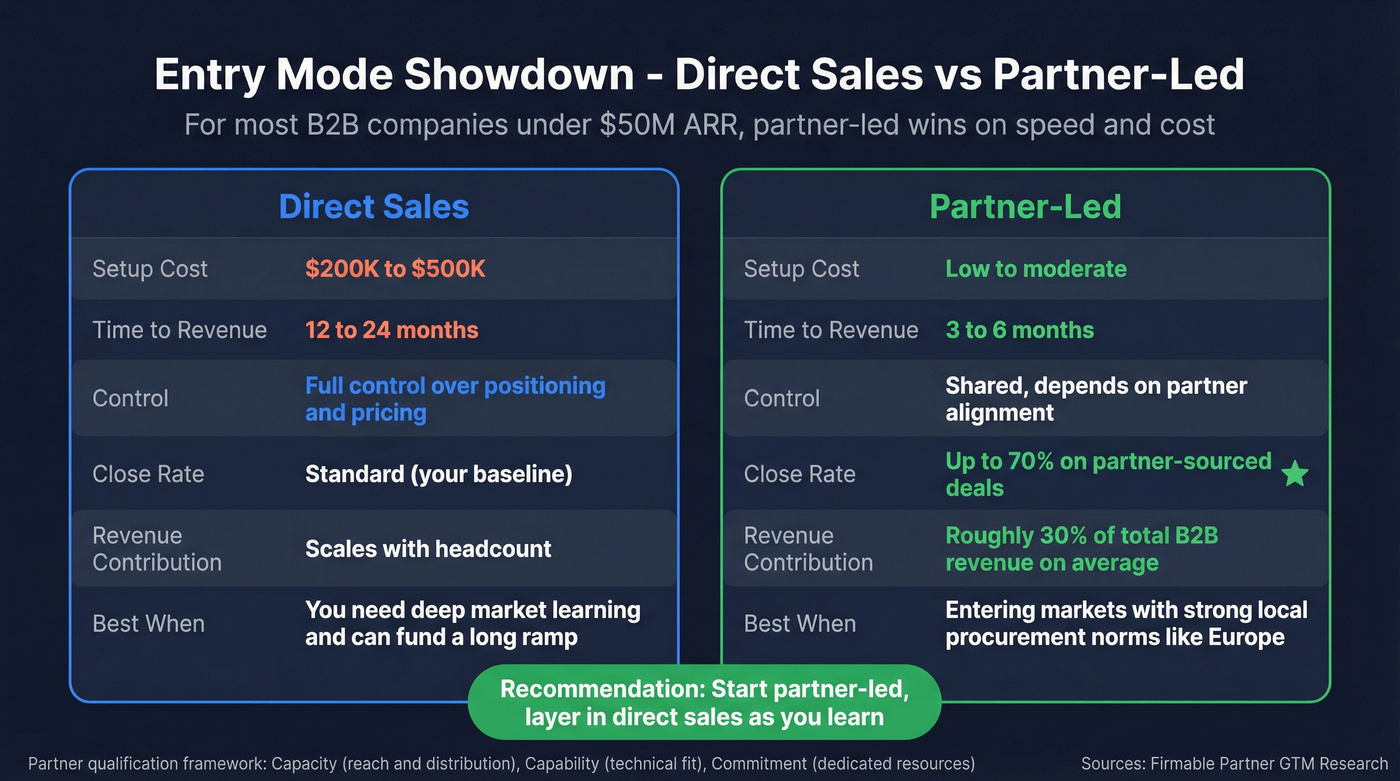
- Which entry mode? For most B2B companies under $50M ARR: partner-led first, direct sales second, acquisition distant third.
- What's the first operational step? Build a verified prospect list in your target market before anything else. Bad data kills expansion faster than bad strategy.
What Market Expansion Actually Means
B2B market expansion isn't "run more ads" or "post more content." That's a marketing strategy.
Market expansion is the decision to enter a new geography, vertical, or segment - and then redesign your GTM system so you can win there repeatedly. It touches product packaging, pricing, legal and compliance, hiring, partners, pipeline creation, and customer success. Expansion is a company-level bet with a long payback period, and the teams that treat it like a campaign usually end up with a very expensive learning experience.
Expansion Readiness Scorecard
The most common expansion trigger is emotional: the CEO comes back from a conference, hears a competitor is "crushing it in APAC," and suddenly your roadmap becomes a geography. We've seen that movie enough times to know you need a scorecard that can say "not yet" without starting a political fight.
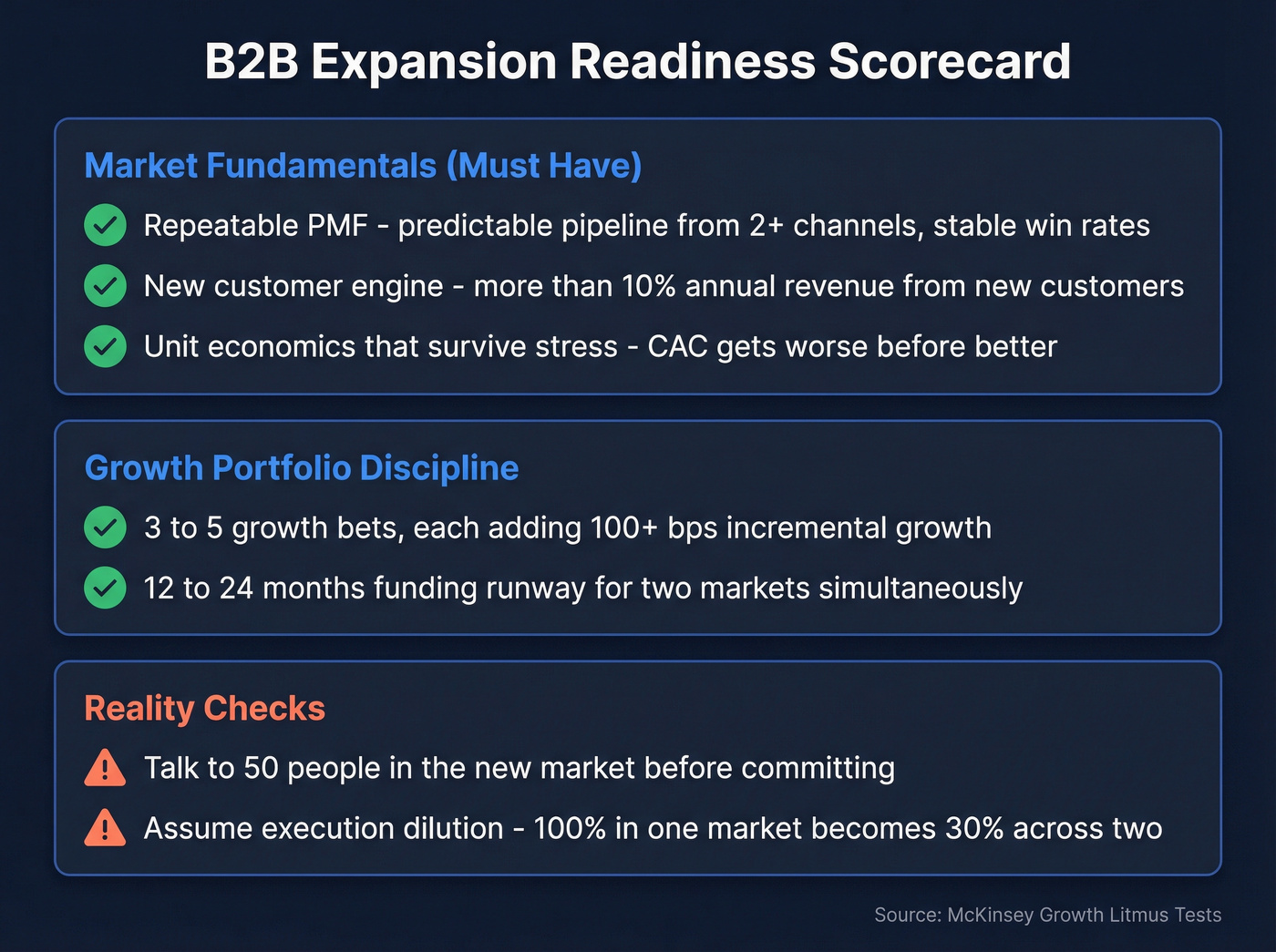
McKinsey's growth litmus tests are a good baseline because they force you to quantify readiness instead of vibe-checking it. For an average industrial company, growing 200 bps faster than the market can add 2-3 turns to EV/EBITDA, with top growers averaging ~25 bps of annual margin expansion. That's the upside - but only if you can execute.
Here's the readiness checklist we'd actually use:
Market fundamentals (don't expand without these)
- Repeatable PMF: predictable pipeline from at least 2 channels, stable win rates, and a sales cycle you can forecast.
- New-customer engine: strong growers drive >10% of annual revenue growth from new customers. If you can't do that at home, you won't do it abroad.
- Unit economics that survive stress: expansion makes CAC worse before it gets better. Plan for it.
Growth portfolio discipline
- You should have 3-5 growth bets that can each add ≥100 bps of incremental growth. Expansion is one bet, not the whole portfolio.
- You need funding runway to operate two markets for 12-24 months while the new one ramps. No runway, no expansion.
Reality checks
- Talk to 50 people in the new market before you commit: buyers, ex-buyers, partners, competitors, and a few "we chose someone else" prospects. You're hunting for deal-killers like procurement norms, security expectations, integration requirements, and pricing tolerance.
- Assume execution dilution. You're trading 100% execution in one market for something like 30% across two unless you staff it properly.
The consensus on r/sales and B2B communities is that the most common expansion regret is hiring a local sales rep before validating messaging - an expensive mistake that's hard to reverse.
Why Most Expansion Strategies Fail
Most expansions don't fail because the market is "too competitive." They fail because the company wasn't ready, and the plan was built on assumptions nobody bothered to validate.
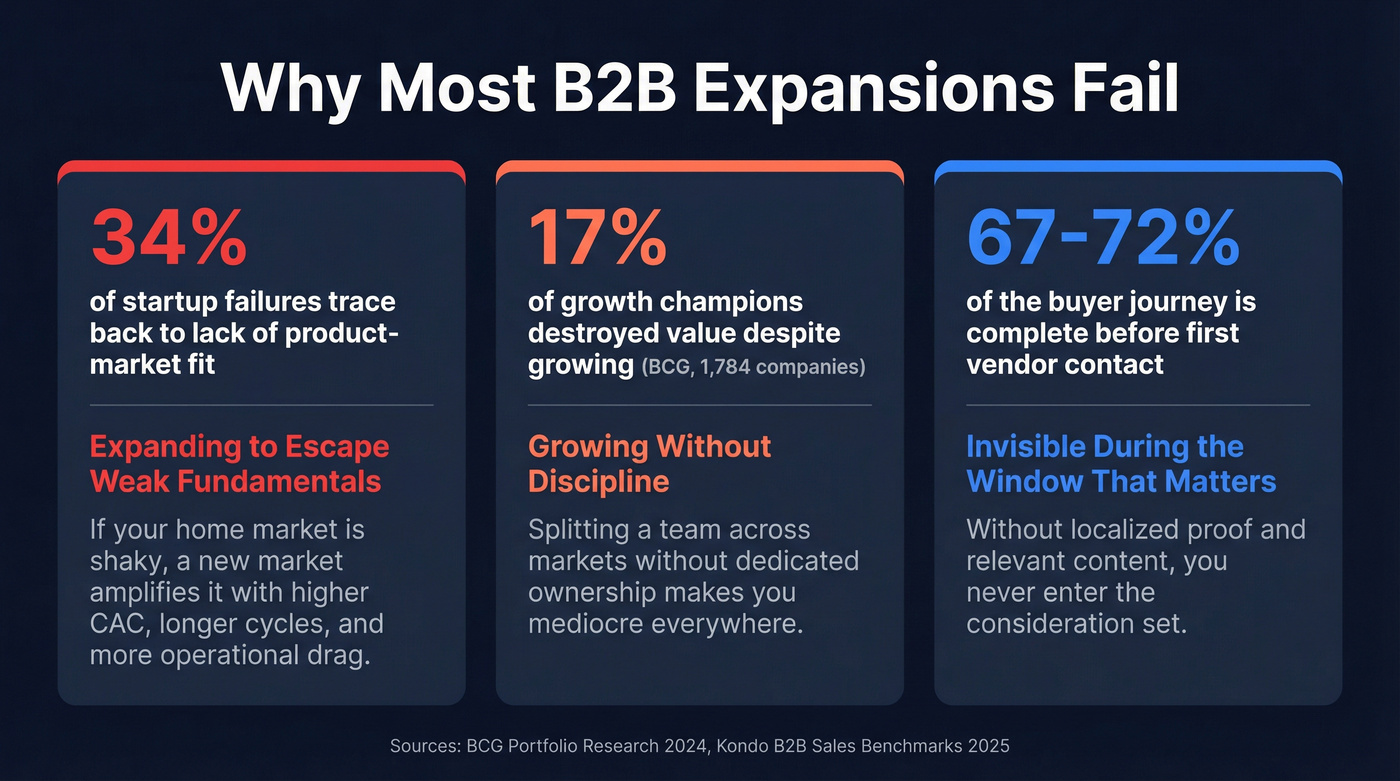
The first failure mode is expanding to escape weak fundamentals. Roughly 34% of startup failures trace back to lack of product-market fit. If your home market is shaky, a new market doesn't fix it - it amplifies it with higher CAC, longer cycles, and more operational drag. BCG's research on 1,784 companies found that even among growth champions, 17% destroyed value despite growing. Growth alone doesn't save you.
Then there's resourcing. Splitting a team across markets without dedicated ownership is how you end up mediocre everywhere. I've watched teams try to "test" a new region with one part-time AE and a contractor marketer. It creates activity, not learning.
Buyer behavior punishes lazy entry, too. By 2025, 80% of B2B sales interactions were happening in digital channels, and buyers complete ~67-72% of their journey before first vendor contact. If you don't have localized proof, relevant content, and the ability to reach the right stakeholders, you're invisible during the window that matters most.
Expanding before repeatable PMF is the most expensive mistake in B2B. It's not bold. It's just unpriced risk.
Choose Your Expansion Path
The cleanest way to avoid random expansion is to treat growth like a portfolio. McKinsey's pattern for top growers is a 70/20/10 mix: 70% core, 20% adjacencies, 10% breakout bets. Expansion usually sits in the 20% bucket.
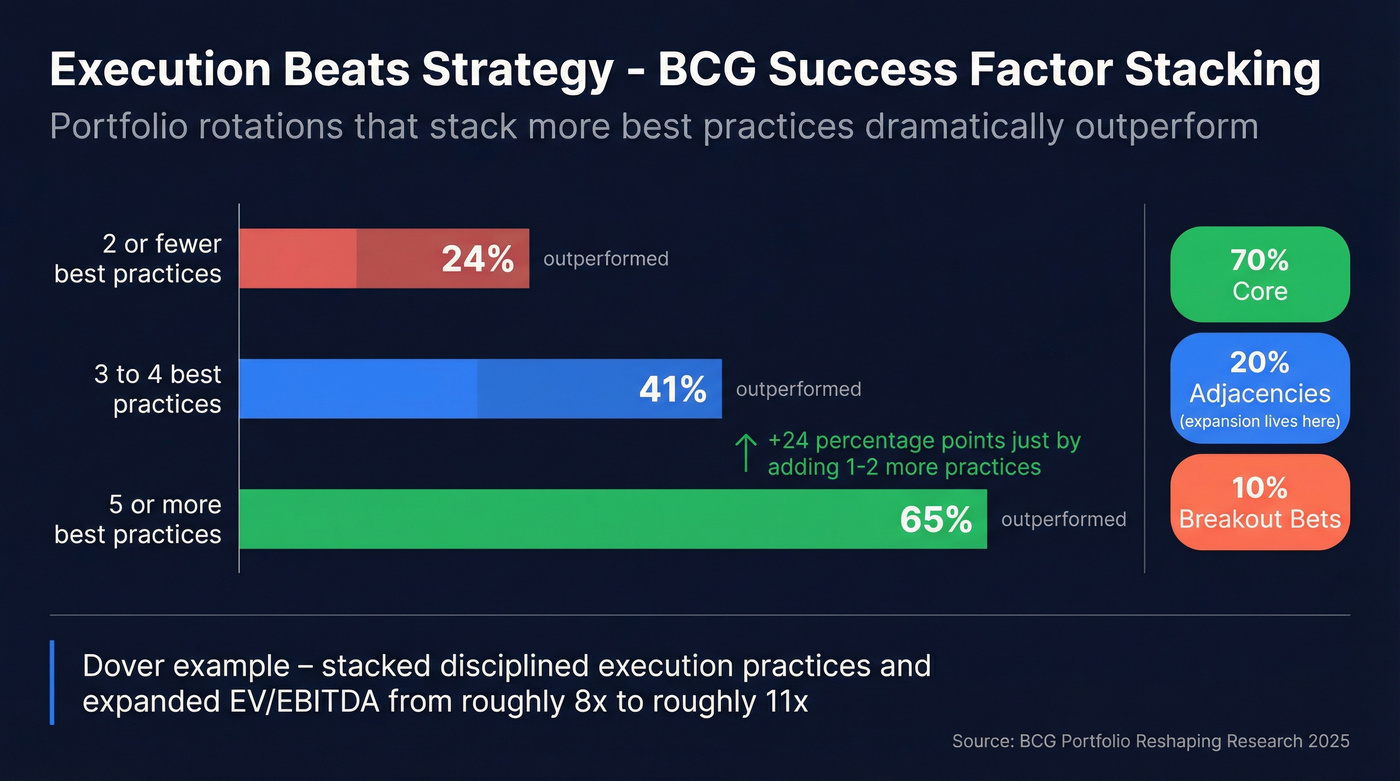
BCG's portfolio rotation research separates type of move from quality of execution, and the key insight is the one most boards miss: there's no correlation between the magnitude of the shift and performance. Execution matters more than the headline. The data on "success-factor stacking" makes this concrete - rotations with ≤2 best practices outperformed 24% of the time, with 3-4 best practices that climbed to 41%, and with ≥5 it jumped to 65%. Dover's portfolio reshaping is a good example: EV/EBITDA expanded from ~8x to ~11x not because they picked a hot market, but because they executed a disciplined rotation.
The right market isn't the biggest - it's the one where you have the strongest unfair advantage. That advantage can be reference customers buyers actually recognize, a partner ecosystem that already trusts you, a wedge use case that maps cleanly to local pain, or a product capability competitors in that market lack.
| Expansion Type | Best For | Typical Timeline | Risk Level |
|---|---|---|---|
| Geographic (new region) | Proven product, seeking volume | 12-24 months to repeatable revenue | High |
| Vertical (new industry) | Transferable use cases | 6-18 months to first wins | Medium |
| Segment (up/downmarket) | Adjacent demand signals | 6-12 months to pipeline | Medium-Low |
| Existing account expansion | Strong NRR and adoption | 3-6 months to expansion revenue | Low |
If your average deal size is under $15K, geographic expansion is almost never the right first move. The unit economics don't survive the newness tax. Go vertical or expand existing accounts instead.

The article says it clearly: bad data kills expansion faster than bad strategy. Prospeo gives you 300M+ profiles across every major market, with 30+ filters including buyer intent, technographics, and headcount growth - so you validate demand in a new region before you burn budget on hires and agencies. 98% email accuracy. 7-day data refresh. $0.01 per lead.
Talk to 50 people in your target market this week, not next quarter.
Size Your Target Market
You don't need a $50K market research report. You need 50 conversations and a TAM/SAM/SOM model you can build in a spreadsheet.
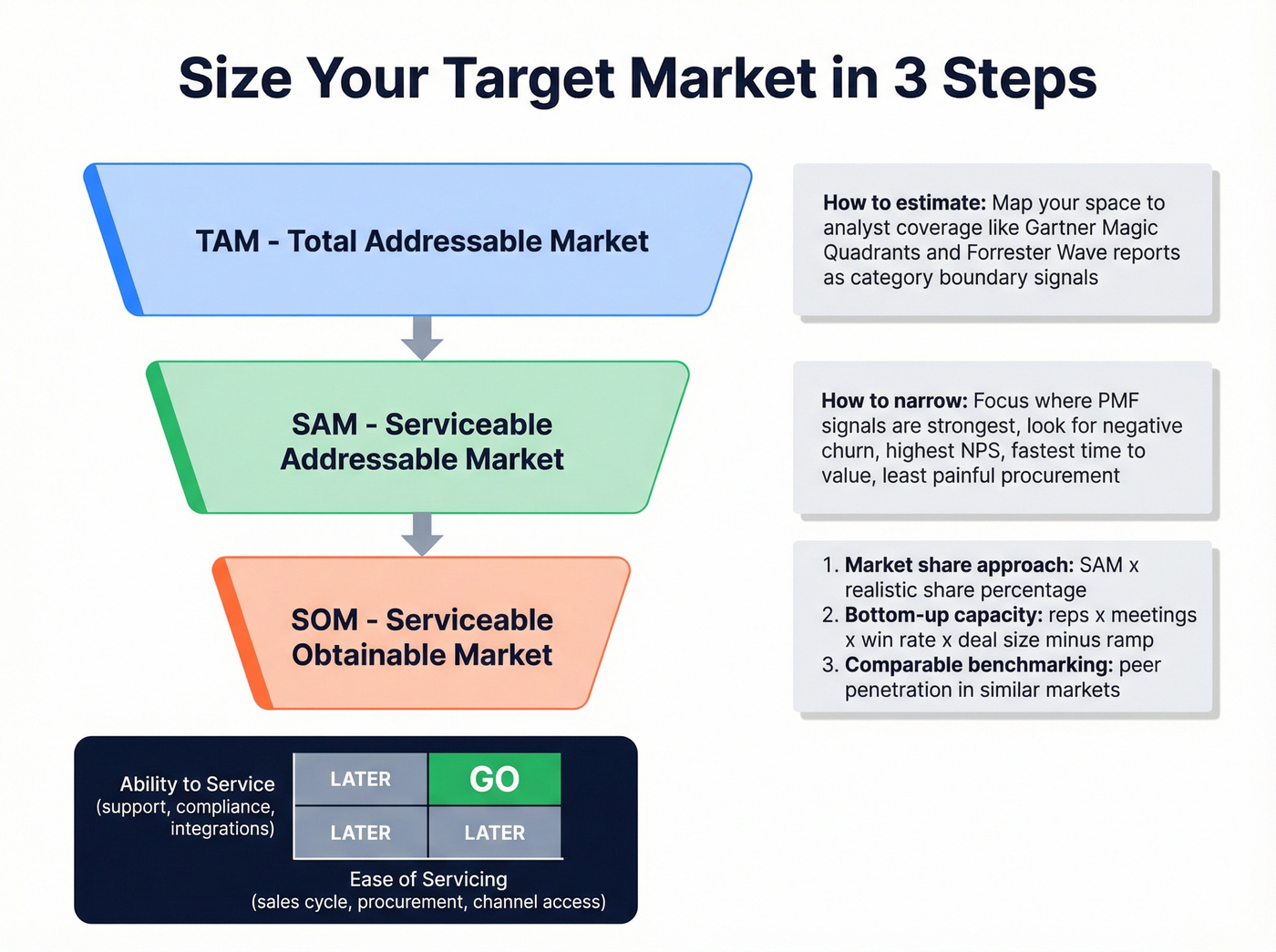
TAM is the total revenue opportunity if you owned the category. SAM is the slice you can serve given your product and constraints. SOM is what you can realistically win in a defined time window with your GTM capacity.
A practical way to build it:
- TAM: use proxies when you don't have perfect category data. One solid approach is mapping your space to analyst coverage - Gartner Magic Quadrants and Forrester Wave reports are decent category-boundary signals.
- SAM: narrow to where your PMF signals are strongest - negative churn, highest NPS, fastest time-to-value, and the least painful procurement path.
- SOM: pick a method you can defend. Market share approach: SOM = SAM x realistic share. Bottom-up capacity model: number of reps x meetings x win rate x deal size, minus ramp time. Or use comparable company benchmarking - look at peers' penetration in similar markets and back into a plausible share.
Then run a simple 2x2 prioritization matrix: ability to service (support hours, compliance, integrations, language) vs ease of servicing (sales cycle, procurement friction, channel access). The quadrant you want is high/high. Everything else is a "later" bet.
Select Your Entry Mode
Entry mode is where strategy turns into burn rate. The same market can be a great idea with partner-led entry and a terrible idea with a premature direct team.
Direct Sales
Direct sales gives you full control over positioning, pricing, and pipeline math - but it's the most expensive way to learn. For a mid-market B2B company, budget $200K-$500K for legal setup, early hires, localization, and demand gen before you see repeatable revenue.
Don't underestimate localization. 76% of consumers prefer buying with information in their own language, and localization goes well beyond translation - currency display, payment options, address formats, and cultural references all need adaptation. Companies that skip this step wonder why conversion rates in the new market are half of what they expected. Also consider "secondary markets" within your own geography, like Spanish-speaking audiences in the U.S., where localization effort is low but the addressable segment is large.
Direct entry is the right move when you need deep market learning, you can fund a 12-24 month ramp, and you're willing to build local credibility the slow way.
Partner-Led Entry
Partner-led expansion is the most underrated entry mode - and it's especially effective when expanding into European markets, where local channel partners already understand regional procurement norms, GDPR requirements, and cultural buying preferences that trip up direct-entry teams.
The benchmarks back this up: partner-sourced deals close at up to 70%, partnerships drive ~30% of total B2B revenue on average, and conversion runs ~1.3x higher than other channels.
Use the 3Cs to qualify partners:
- Capacity: do they have reach and real distribution?
- Commitment: will they actually sell, or just "list you"?
- Capability: can they implement, support, and keep customers happy?
Start deep with 2-3 partners, document what converts, then scale. Budget $50K-$150K for enablement, co-marketing, and partner ops.
Acquisition
Acquisition is the fastest time-to-market and the fastest way to light money on fire. Research on growth archetypes shows "Underdogs" spend ~45% more on M&A than average. That's a signal: M&A is a muscle, not a tactic. Skip this if you're under $50M ARR unless you've got deep pockets and real integration experience.
| Entry Mode | Cost Range | Time to Revenue | Control | Risk |
|---|---|---|---|---|
| Direct sales | $200K-$500K | 12-24 months | Full | High |
| Partner-led | $50K-$150K | 6-12 months | Shared | Medium |
| Acquisition | $1M-$10M+ | 3-6 months | Full (if integrated) | Very High |
Build Your Data Infrastructure
After you pick the market and define the ICP, the first operational bottleneck is painfully simple: finding and reaching the right decision-makers.
Buying is digital-first now. Buyers use 10 channels on average, and 33% prefer a seller-free experience. Your expansion motion can't depend on "we'll just go network locally." You need scalable targeting and clean outbound.
Here's the thing: bounce rates above 10% destroy domain reputation, and domain reputation takes months to rebuild. We've seen teams nuke a new-market launch because they blasted unverified lists and spent the next quarter wondering why replies disappeared. Meritt, a B2B sales team that switched to verified contact data, saw bounce rates drop from 35% to under 4% and pipeline triple from $100K to $300K/week. That's not better copy - that's better data hygiene. (If you're troubleshooting bounces and list quality, start with hard bounces and B2B contact data decay.)
Channel benchmarks help you prioritize where to invest early: SEO converts 51% MQL-to-SQL, email 46%, webinars 30%, PPC 26%. Expansion teams that win usually build a mixed engine, but outbound is the fastest way to validate ICP and messaging in an unfamiliar market. To make outbound repeatable, build a real prospecting workflow and track intent signals so you're not guessing.
When you're entering a new market and need verified emails and direct dials for decision-makers you've never contacted before, Prospeo's B2B database lets you search 300M+ profiles with 30+ filters - geography, industry, headcount growth, technographics, and buyer intent across 15,000 topics. Every email is verified in real time at 98% accuracy, and the database refreshes every 7 days versus a 6-week industry average. You build the list, export it, and start learning without burning your domain on bad contacts. If you're evaluating vendors, compare sales prospecting platforms and keep an email deliverability checklist handy.

Expanding into EMEA, APAC, or a new vertical? Your first operational step is a verified contact list of real decision-makers - not a CRM full of bounced emails. Prospeo's 125M+ verified mobile numbers and 143M+ verified emails span every major geography, with 30% pickup rates that actually connect your reps to buyers.
Stop staffing new markets before you can reach the right people in them.
Expand Within Existing Accounts
The cheapest market to expand into is the one you're already in. We've seen teams pour money into new-market pipeline while ignoring the easiest growth lever sitting in their CRM.
Let's be honest about what "expand" means here. It isn't "customer success being nice." It's a post-sale GTM system to retain, grow, and activate customers so renewals and expansion become predictable. The operational components are straightforward: deliver value in the first 30 days because time-to-value is the real churn driver, build customer playbooks by segment and maturity level, and run maturity-based revenue touchpoints so you're not pitching upgrades randomly. Create customer advocacy loops through references, case studies, community, and peer validation.
Measure it like a revenue motion, not a support function: NRR and gross churn, adoption and engagement, expansion revenue percentage, time-to-value, and advocacy participation. The common failure pattern is that Expand "isn't owned," isn't measured, and the GTM plan ends at closed/won.
Budget and Timeline Benchmarks
Expansion budgets get weird because teams anchor on their home-market CAC and assume it transfers. It doesn't. (If you need the math and targets, use a clean CAC LTV ratio model.)
HubSpot's compilation of FirstPageSage data puts average B2B SaaS CAC at $239, with average CPL around $84. Channel CPLs land around $70 for Google Ads and $110 for LinkedIn. A healthy LTV:CAC ratio is 3:1.
Now the part most plans forget: expect CAC to be 2-3x your established market rate for the first 6-12 months. You're paying a "newness tax" - lower conversion, weaker brand, fewer references, and more procurement friction. Teams expanding into Europe, for instance, often underestimate how GDPR consent requirements, longer procurement cycles, and multi-language support inflate early-stage costs beyond what their North American benchmarks predict. BCG's research on growth champions adds another reality check: top performers spend ~30% more on sales and marketing, and revenue growth drives 32-56% of TSR depending on horizon. You can't budget like a maintenance business and expect expansion outcomes.
Sales execution is harsher than most decks admit: 84% of reps missed quota, and average close rate is ~29%. Build a plan that survives reality, not one that assumes perfect rep productivity.
Prospecting data costs are an easy place to avoid waste. Enterprise data platforms typically run $15-40K/year. Self-serve tools like Prospeo start free and charge about $0.01 per verified email - ideal when you're testing a new market and want tight feedback loops without a five-figure commitment.
| Metric | Benchmark | New Market Adjustment |
|---|---|---|
| B2B SaaS CAC | $239 avg | 2-3x for first 6-12 months |
| CPL (Google Ads) | ~$70 | +30-50% in unfamiliar markets |
| CPL (LinkedIn) | ~$110 | +20-40% depending on geo |
| LTV:CAC ratio | 3:1 healthy | Takes 12-18 months to reach |
| Time to repeatable revenue | - | 12-24 months (direct); 6-12 (partner-led) |
FAQ
What's the difference between market expansion and market penetration?
Market expansion means entering a new geography, vertical, or segment and building a GTM system to win there repeatedly. Market penetration means increasing share in your existing market - more pipeline, higher win rates, more revenue from the same ICP and region.
How long does B2B market expansion take?
Most expansions take 6-24 months to reach repeatable revenue. Partner-led entry is fastest at 6-12 months, while direct sales usually needs 12-24 months because hiring, localization, and pipeline creation all ramp slower.
How do I build a prospect list in a new market with no contacts?
Use a B2B data platform to filter by geography, industry, company size, and buyer intent, then export decision-makers into your outbound workflow. Prospeo lets you search 300M+ profiles with 30+ filters and verifies every email in real time at 98% accuracy - useful when you can't afford bounces in an unfamiliar market.
What's a realistic budget for entering a new B2B market?
Partner-led entry costs $50K-$150K for enablement, co-marketing, and partner ops. Direct sales runs $200K-$500K including legal setup, hires, localization, and demand gen. Plan for CAC to run 2-3x higher than your home market for the first 6-12 months.
Should I expand geographically or into a new vertical first?
Pick the path where you have the strongest unfair advantage: recognizable reference customers, partner distribution, and a use case that maps to buyer pain. Use a 2x2 matrix - ability to service vs ease of servicing - and start in the high/high quadrant. For deals averaging below $15K, vertical expansion usually delivers faster ROI than geographic.