

AI CRM in 2026: What Works and What's Just Marketing
A VP of Sales signs a $50,000 AI add-on for the company's CRM. Three months later, the "predictive lead scoring" is surfacing dead accounts, the "AI-generated insights" are restating what reps already know, and the CFO wants answers. This isn't a hypothetical - it's the pattern we see when teams buy AI CRM features without understanding what they're actually getting. The uncomfortable stat: 76% of organizations admit less than half their CRM data is accurate. Feed garbage into an AI model, and you get confident-sounding garbage out.
Here's what you need to know in 2026 - what delivers ROI, what's marketing fluff, and why the unsexy problem of data quality determines whether any of it works.
Quick recommendations:
- Enterprise (50+ reps): Salesforce with Agentforce - nothing else matches the depth
- Mid-market (10-50 reps): HubSpot Professional or Zoho Enterprise
- SMB/startup (1-10 reps): Freshsales or Pipedrive
Before any of them deliver, your CRM data needs to be accurate. More on that below.
What AI Actually Means Inside a CRM
An AI CRM uses machine learning, natural language processing, and generative AI to automate data entry, predict deal outcomes, score leads, and recommend next-best actions - shifting the CRM from a system of record to a system of intelligence. That's the two-sentence definition. The reality is messier.
70% of companies now use some form of artificial intelligence in their CRM, and the average return is $8.71 for every $1 spent. But "AI-powered" has become marketing shorthand that can mean anything from genuinely intelligent sales forecasting to a rebranded automation rule with a chatbot skin. An AppReviewLab analysis estimates 60-70% of marketed AI features remain overhyped. The gap between what vendors demo and what actually works in production is still enormous.
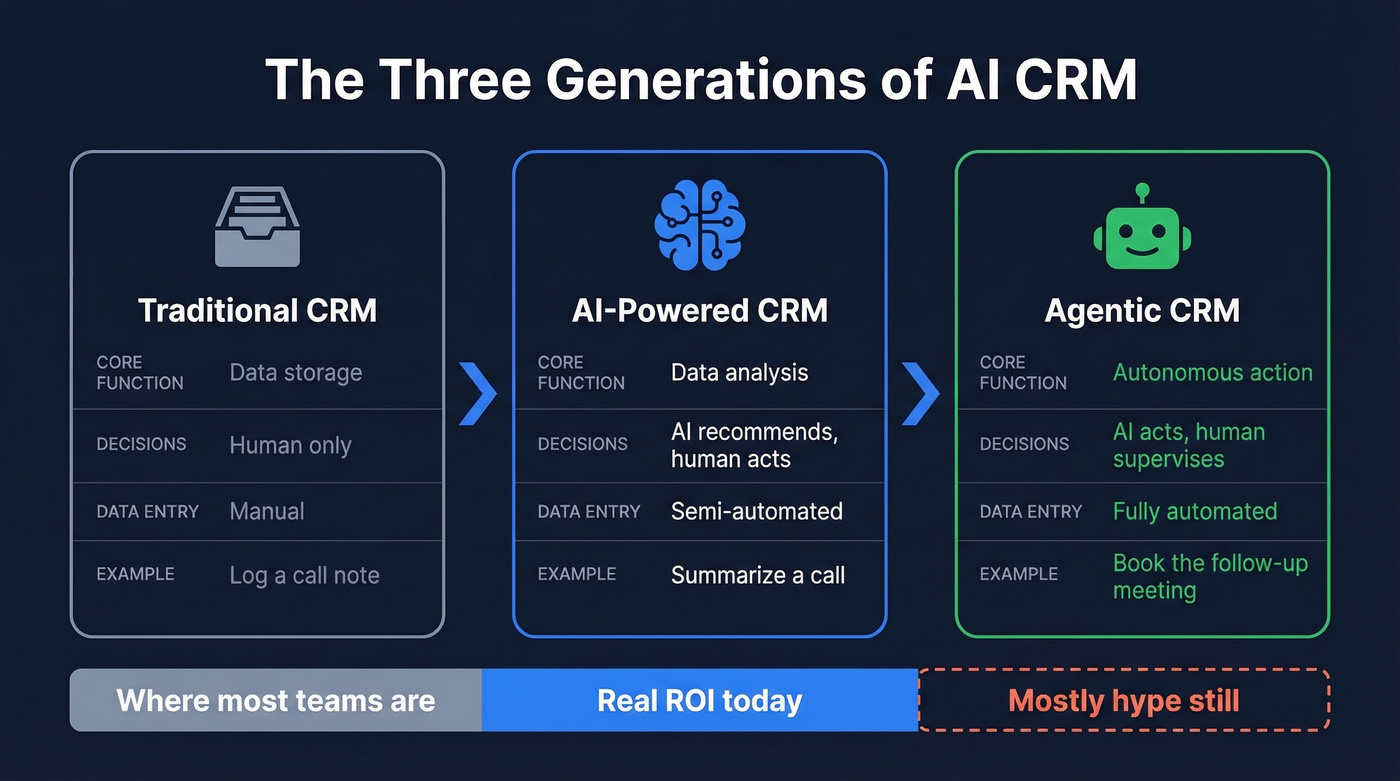
Three generations of CRM you'll encounter:
| Traditional CRM | AI-Powered CRM | Agentic CRM | |
|---|---|---|---|
| Core function | Data storage | Data analysis | Autonomous action |
| Decision-making | Human only | AI recommends, human acts | AI acts, human supervises |
| Data entry | Manual | Semi-automated | Fully automated |
| Example | Log a call note | Summarize a call | Book the follow-up meeting |
The jump from column one to column two is real and happening now. The jump to column three - where the system operates autonomously - is where most of the hype lives and where the data quality problem becomes existential.
What AI Replaces in Your CRM Today
Forget the futuristic demos. These six workflows deliver immediate, measurable ROI right now:
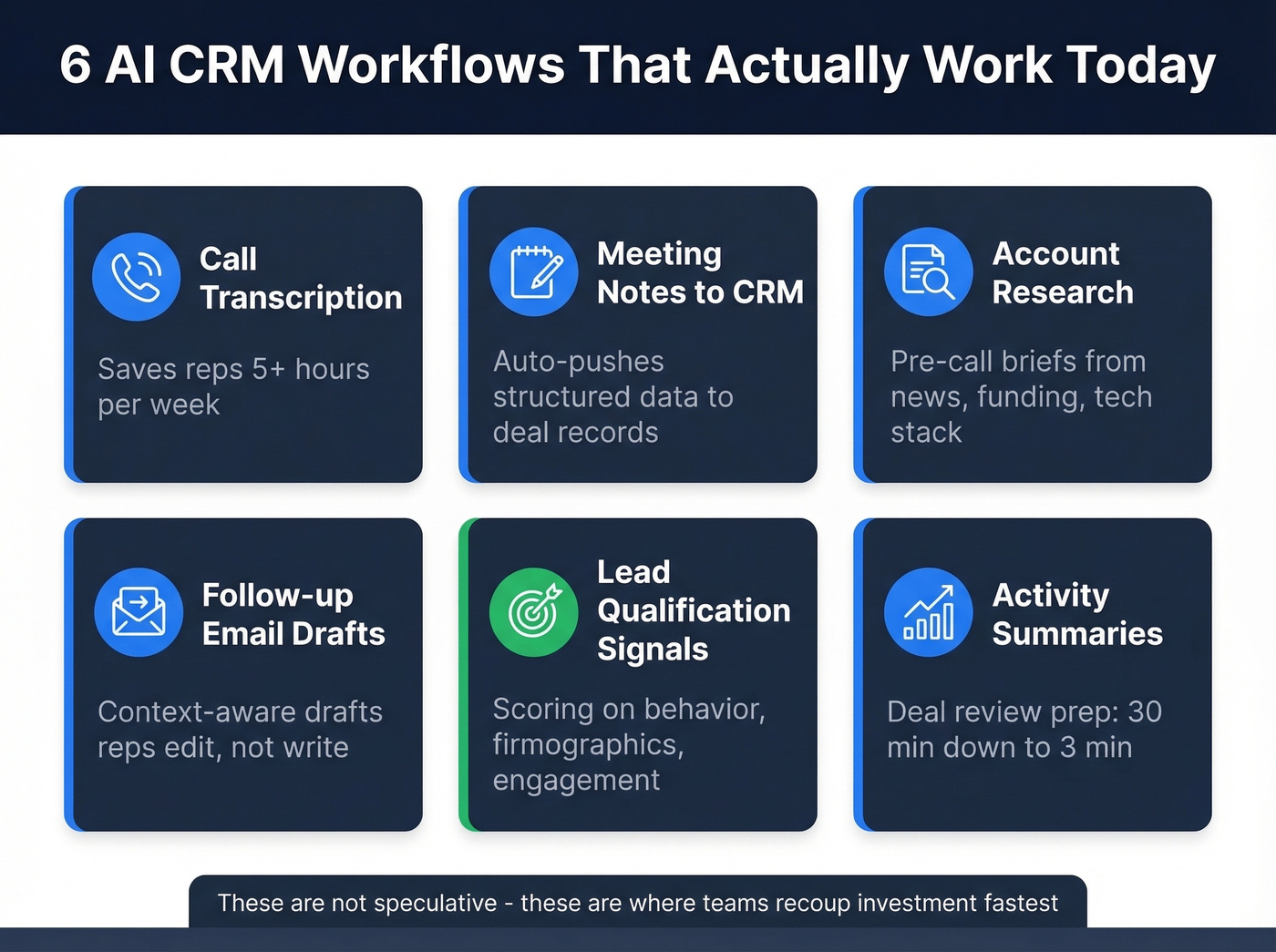
- Call transcription and summaries. Many CRMs auto-transcribe calls and pull key moments. This alone saves reps 5+ hours per week on manual CRM updates.
- Meeting notes and CRM updates. AI listens to the meeting, writes the summary, and pushes structured data into the deal record. No more "I'll update Salesforce later" (which means never).
- Prospect and account research. Pre-call briefs generated from company news, funding rounds, and tech stack signals. Useful, not magical.
- Follow-up email drafting. Context-aware drafts based on conversation history. Reps edit rather than write from scratch. (If this is a core workflow, pair it with an AI email writer that’s built for outbound.)
- Lead qualification signals. Scoring based on engagement patterns, firmographic fit, and behavioral data - not just "opened an email twice." This is where sales automation has the clearest, most immediate payoff.
- Activity summaries for managers. Deal review prep that used to take 30 minutes now takes 3. Pipeline visibility without the interrogation.
These aren't speculative. They're the workflows that show up repeatedly in real-world deployment checklists, and they're where we've seen teams recoup their investment fastest.
Quick Picks by Team Size
| Team Size | Best For | Platform | Realistic all-in range | Why |
|---|---|---|---|---|
| Enterprise (50+) | Full GTM stack | Salesforce + Agentforce | ~$150-300/user/mo all-in | Deepest AI, biggest ecosystem |
| Mid-market (10-50) | Balance of power + usability | HubSpot Pro or Zoho Enterprise | $50-100/user/mo | Strong AI without the consulting bill |
| SMB (1-10) | Fast setup, low cost | Freshsales or Pipedrive | from $9-14/user/mo | AI lead scoring that lifts conversions 15-25% without a dedicated admin |
Best Platforms Compared
Here's how they stack up before we dig into each one:
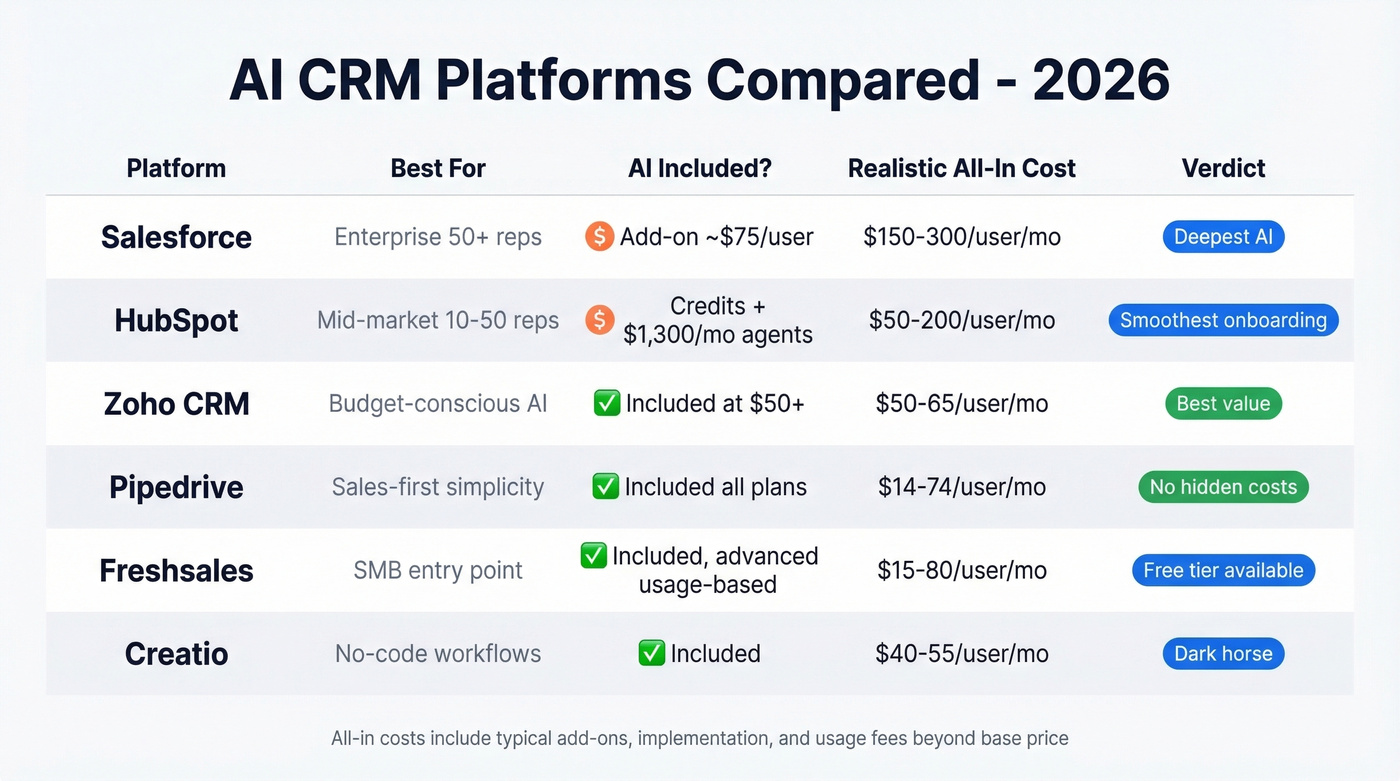
| Tool | Best For | Key AI Features | Pricing |
|---|---|---|---|
| Salesforce | Enterprise scale | Einstein, Agentforce agents | $25/user/mo base; Einstein add-ons ~$75/user |
| HubSpot | Mid-market growth | Breeze copilot + agents | Free-$75/seat/mo; agents from $1,300/mo |
| Zoho CRM | Budget-conscious AI | Zia predictions + anomaly detection | Free-$65/user/mo (AI included at $50+) |
| Pipedrive | Sales-first simplicity | AI Sales Assistant | $14-74/user/mo (AI included) |
| Freshsales | SMB entry point | Freddy AI scoring + chat | Free (3 users)-$59/user/mo |
| Creatio | No-code workflows | AI included, agentic design | $25/user/mo + $15/module |
Salesforce (Einstein + Agentforce)
Use this if you have 50+ reps, a dedicated Salesforce admin (or two), and the budget for a 3-4 month implementation. Agentforce hit $540M ARR for a reason - it's the most capable agentic intelligence layer in CRM today. The 1-800Accountant case study is telling: they cut seasonal hires by 50% by deploying Agentforce agents for tax-season support workflows.
Skip this if you're a team of 15 without a RevOps tech stack in place. The base CRM runs roughly $25-$550/user/month depending on tier, and Einstein add-ons start around $75/user/month. All-in enterprise cost commonly lands at $150-300/user/month once you factor consulting, configuration, and the 3-4 months before you see value. We've seen teams spend $15,000+ on implementation consulting before a single rep touches the platform.

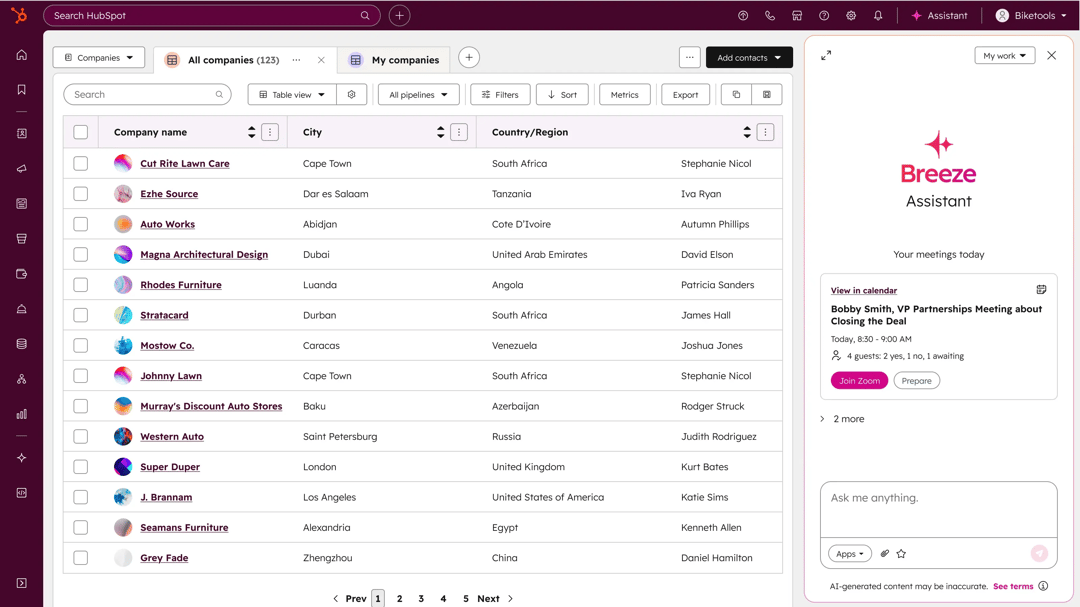
HubSpot (Breeze AI)
Use this if you want the smoothest onboarding in the category and your team is 10-50 reps. HubSpot serves 279K+ customers, and Breeze's copilot features - email drafting, meeting summaries, prospecting assistance - work well out of the box. The free tier is genuinely useful for tiny teams testing CRM intelligence for the first time.
Skip this if you need advanced AI agents without a steep price jump. Breeze requires HubSpot Credits, and free or view-only users can't access AI features. Smart CRM pricing starts at $15/seat/month (Starter), $50/seat/month (Professional), and $75/seat/month (Enterprise). Advanced AI agents start at a $1,300/month minimum. That catches a lot of mid-market teams off guard.
Zoho CRM (Zia)
Use this if you want real predictive features - anomaly detection, lead scoring, deal predictions, email sentiment analysis - without the enterprise price tag. Zoho's CRM runs from free to $65/user/month, and Zia is included on Enterprise ($50) and Ultimate ($65) tiers. For teams that need intelligence but can't justify $150+/user/month, Zoho is the obvious answer.
Skip this if you need deep third-party integrations or an ecosystem that matches Salesforce's breadth. Zoho works best when you're already in the Zoho suite. Outside that ecosystem, the integration story gets thinner.
Pipedrive
Pipedrive doesn't try to be a platform. It's a sales CRM, and it's the best at that one thing for teams that hate complexity. The AI Sales Assistant is included on paid plans starting at $14/user/month - it flags stalled deals, suggests next actions, and surfaces activity patterns without requiring any configuration. Plans run $14-74/user/month, and the AI features don't cost extra. That's increasingly rare.
Freshsales (Freddy AI)
Free plan, real CRM, no credit card. That's the Freshsales pitch, and it holds up. The free tier supports 3 users with basic CRM functionality, and paid plans at $9-59/user/month unlock Freddy AI for lead scoring, deal insights, and chatbot automation.
For a 5-person team doing basic outbound, the core AI is more than enough. For high-volume support use cases, expect usage-based costs for advanced AI interactions.
Creatio
Forget everything you know about traditional CRM architecture. Creatio is a no-code platform with CRM modules bolted on, and AI is included at no extra cost. Base pricing starts at $25/user/month (minimum 5 users) plus $15/user per module for Sales, Marketing, or Service. The agentic workflow builder lets non-technical users create AI-driven processes without developer support - and if your team lives in custom workflows and hates waiting on IT, Creatio is the dark horse worth evaluating. It won't match Salesforce's ecosystem depth, but the total cost of ownership is dramatically lower.
Quick Mentions
monday CRM starts at $12/user/month (minimum 3 seats) with AI-assisted task management. Best for teams already on monday.com who want a lightweight CRM layer.
Apollo.io blurs the line between prospecting tool and CRM. Free tier available, paid plans $49-99/user/month. Best for outbound-heavy teams who don't need a full CRM.
Microsoft Dynamics 365 runs $65-150/user/month with Copilot AI baked in. The natural fit if your org lives in Teams, Outlook, and SharePoint - but implementation complexity rivals Salesforce.

76% of orgs admit their CRM data is inaccurate - and that's exactly why AI predictions fail. Prospeo enriches your CRM with 50+ data points per contact at a 92% match rate, refreshed every 7 days. Native Salesforce and HubSpot integrations mean your AI models finally have clean data to work with.
Stop feeding your AI CRM garbage. Start with 98% accurate data.
Real Pricing Behind AI CRM
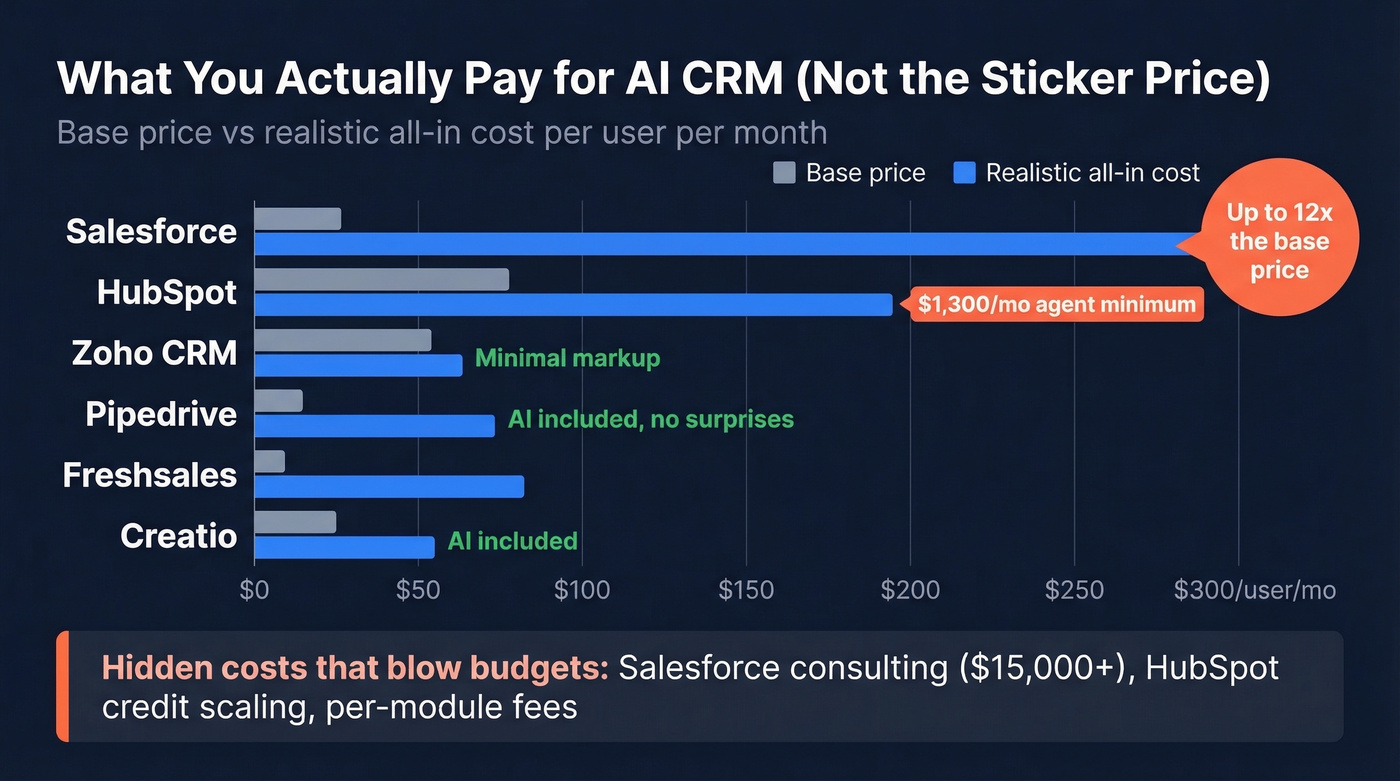
The sticker price on a CRM's pricing page is almost never what you'll pay for AI features. Here are the real numbers:
| Platform | Base Price | AI Add-On | Realistic All-In |
|---|---|---|---|
| Salesforce | $25-165/user/mo | ~$75/user | $150-300/user/mo |
| HubSpot | Free-$75/seat/mo | Credits + agents from $1,300/mo | $50-200/user/mo |
| Zoho | $14-65/user/mo | Included at $50+ | $50-65/user/mo |
| Pipedrive | $14-74/user/mo | Included | $14-74/user/mo |
| Freshsales | Free-$59/user/mo | Included; advanced usage-based | $15-80/user/mo |
| Creatio | $25/user + $15/module | Included | $40-55/user/mo |
Industry benchmarks land at roughly $15/user/month for entry-level, ~$60 for mid-tier, and $150+ for enterprise. But the hidden costs are where budgets blow up. Salesforce enterprise deployments routinely require $15,000+ in consulting before the first rep logs in. HubSpot's credit system means usage scales with cost in ways that aren't obvious from the pricing page. Even "AI included" platforms like Creatio charge per-module, so a full Sales + Marketing + Service deployment adds up fast.
The flip side: CRM can improve customer retention by up to 27%, and the average ROI is $8.71 per dollar spent. The investment pays off - but only if you budget honestly. Add 30-50% to the sticker price for implementation, training, and the inevitable "we need a consultant" moment.
The Data Quality Problem
Here's the thing most vendors won't tell you: 60% of CRM implementations fail to meet their intended goals, and the root cause is almost always data quality. 37% of organizations report direct revenue loss from poor CRM data. The average sales rep spends 5+ hours per week manually updating CRM records, and 40%+ of that information goes stale within a month.
Picture this. Your AI scores a lead as "hot" based on firmographic fit and engagement signals. The SDR calls the number on file - disconnected. Sends the follow-up email - bounces. The AI was right about the intent, but the data underneath was wrong. That's not an AI failure. It's a data failure.
The counter-example is instructive. Bruntwood, a UK commercial property firm, saw a 15% conversion rate increase after implementing an AI-powered CRM - but only after investing in clean, real-time data feeds. Clean data in, useful predictions out. Simple and hard in equal measure.

This is where CRM enrichment becomes non-negotiable. Prospeo plugs directly into Salesforce, HubSpot, and tools like Clay, Zapier, and Make - enriching CRM records with 50+ verified data points per contact at a 92% API match rate. The 7-day refresh cycle means your data doesn't go stale the way it does with tools that update roughly every six weeks. When your CRM's intelligence layer is scoring leads against 98% accurate emails and 125M+ verified mobile numbers, the predictions actually mean something.
If you want to compare options, start with the best data enrichment tools and the benefits of data enrichment before you buy another AI add-on.
Data quality isn't the only way deployments fail, though. A recurring theme in the r/salesforce and r/sales communities is teams that over-automate too fast - removing the human touch from deal stages where buyers expect personalized interaction. Another common pitfall: rolling out AI features without training reps on how to interpret and override recommendations. A lead score means nothing if your SDRs don't trust it.
And teams that deploy these tools without clear objectives - "we want AI" instead of "we want to reduce response time by 40%" - end up with expensive features nobody uses. The 56% of organizations that lack formal review processes for AI-generated outputs are playing with fire, especially as agentic capabilities expand.
Let's be honest: if your average deal size is under $15k and your team is under 10 reps, you probably don't need an AI-powered CRM at all. A well-maintained Pipedrive instance with clean data will outperform a $200/user/month Salesforce deployment running on stale records every single time. The intelligence layer is only as smart as the data underneath it.
From Copilot to Agentic CRM
The big shift in 2026 isn't "more AI features." It's the move from copilot AI (suggests actions, human executes) to agentic AI (executes actions, human supervises). A Salesforce study of CIOs found AI adoption has increased 282%, and 40% of enterprise applications will embed AI agents by year-end.
The architecture behind agentic CRM breaks into four layers:
- Perception collects and interprets signals from emails, calls, and web behavior.
- Reasoning uses LLMs and decision engines to evaluate options.
- Action executes tasks like booking meetings, updating pipeline stages, or sending follow-ups.
- Learning feeds outcomes back to improve future performance.
This will be genuinely transformative - eventually. But the #1 bottleneck for autonomous agents isn't model capability. It's trust in data. An agent that autonomously sends follow-ups based on stale contact records doesn't save time; it burns your domain reputation. And without governance frameworks (who's accountable when an agent sends the wrong message to a $500k prospect?), the risk scales with the autonomy.
The agentic future is real. It arrives only for teams whose data infrastructure and oversight processes can support it.
How to Evaluate Your Next Platform
Before you demo anything, run through this checklist:
- Data quality audit first. What percentage of your CRM records have valid emails and current job titles? If you don't know, find out before evaluating AI features. Test on clean data, not garbage. (If you need a process, start with data validation automation.)
- Unified customer timeline. Can the CRM show every touchpoint - email, call, meeting, support ticket - in one view? Recommendations are only as good as the context they draw from.
- Generative AI quality. Test the email drafting and summarization with your actual deals. Generic outputs that need heavy editing aren't saving time. (For outbound, this overlaps heavily with AI email personalization.)
- Predictive analytics depth. Does the lead scoring explain why a lead scored high? Black-box scores that reps can't interpret get ignored.
- Next-best-action specificity. "Follow up with this lead" is useless. "Call this lead's mobile between 2-4 PM based on their engagement pattern" is useful.
- Real-time sentiment and churn signals. Can the system flag deal risk from email tone shifts or meeting sentiment? This is where an intelligent CRM earns its keep.
- Implementation timeline. Expect 30-90 days for full ROI on mid-market platforms. Enterprise deployments often take 3-4 months and significant consulting.
- Total cost calculation. Base price + AI add-ons + consulting + training + credit overages. Get this number before you sign.
- Integration ecosystem. Does it connect natively to your sequencer, enrichment tools, and data warehouse? Manual exports kill adoption. (If you’re rebuilding the stack, use a CRM management system checklist.)
- Human override capabilities. Can reps easily correct or override AI recommendations? Systems that don't allow this breed distrust fast.
AI lead scoring is worthless when half your contacts have outdated emails and wrong job titles. Prospeo's 5-step verification and 7-day refresh cycle keep your CRM current - so your AI actually surfaces real buyers, not dead accounts. At $0.01 per email, it costs less than one bad forecast.
Clean data in, real predictions out. That's the only AI CRM hack that works.
FAQ
What's the difference between a traditional CRM and an AI CRM?
A traditional CRM stores and organizes customer data. An AI CRM analyzes that data to predict outcomes, automate tasks, and recommend next actions - shifting the system from recording what happened to telling reps what to do next. The practical difference shows up in lead scoring, automated follow-ups, and deal forecasting that updates in real time.
Is an AI-powered CRM worth it for small businesses?
Yes, if you pick the right tier. Freshsales and Pipedrive offer lead scoring, deal predictions, and activity suggestions starting from $9-14/user/month. SMBs see the fastest ROI from AI-scored lead prioritization, not complex agentic workflows. Teams under 10 reps should focus on data accuracy first - that's where the real leverage is.
How do I fix bad AI recommendations in my CRM?
It's almost always a data quality issue - stale, duplicated, or incomplete records produce unreliable outputs. Start by enriching contacts with a tool like Prospeo (92% match rate, 7-day refresh) or running a deduplication pass. Confidently wrong predictions are worse than no predictions at all.
How long does implementation take?
Mid-market platforms like HubSpot or Zoho deliver full ROI in 30-90 days. Enterprise deployments with Salesforce or Dynamics 365 typically require 3-4 months of configuration, data migration, and consulting. Budget for training time on top of that - reps need to trust the AI before they'll use it.
Will AI replace CRM entirely?
Not in any near-term scenario. The CRM remains the system of record where customer data, deal history, and communication logs live. AI layers intelligence on top of that foundation, automating routine tasks and surfacing insights humans would miss. The platforms evolving fastest are the ones embedding AI deeply into existing workflows rather than trying to build something entirely new.