

AI Email Follow-Up: What Works in 2026 (+ Tools)
On Reddit, the typical post-meeting follow-up workflow looks like this: copy the transcript into ChatGPT, edit out the robotic phrasing, then send something that still reads like "Just circling back." That's the state of AI email follow-up for most teams - the tool writes fast, but the output lands flat.
The problem isn't AI itself. It's the data feeding it, and how many follow-ups you send before the prospect hits "report spam."
The Short Version
- Send fewer follow-ups. A study of 16.5M cold emails found that 4+ emails in a sequence more than triples spam complaints. Two to three touches, max. (If you need a cadence, use a follow-up email sequence strategy instead of guessing.)
- Use AI for drafting, not blasting. Start in shadow mode - AI drafts, you approve. Full autonomy comes after you've validated tone and reply rates.
- Verify your contact data before automating anything. Bounces kill domain reputation faster than bad copy ever will. (Start with an email verifier before you scale.)
What 16.5M Emails Reveal About Follow-Ups
The "80% of sales require 5+ follow-ups" stat gets repeated everywhere. The actual data tells a different story.
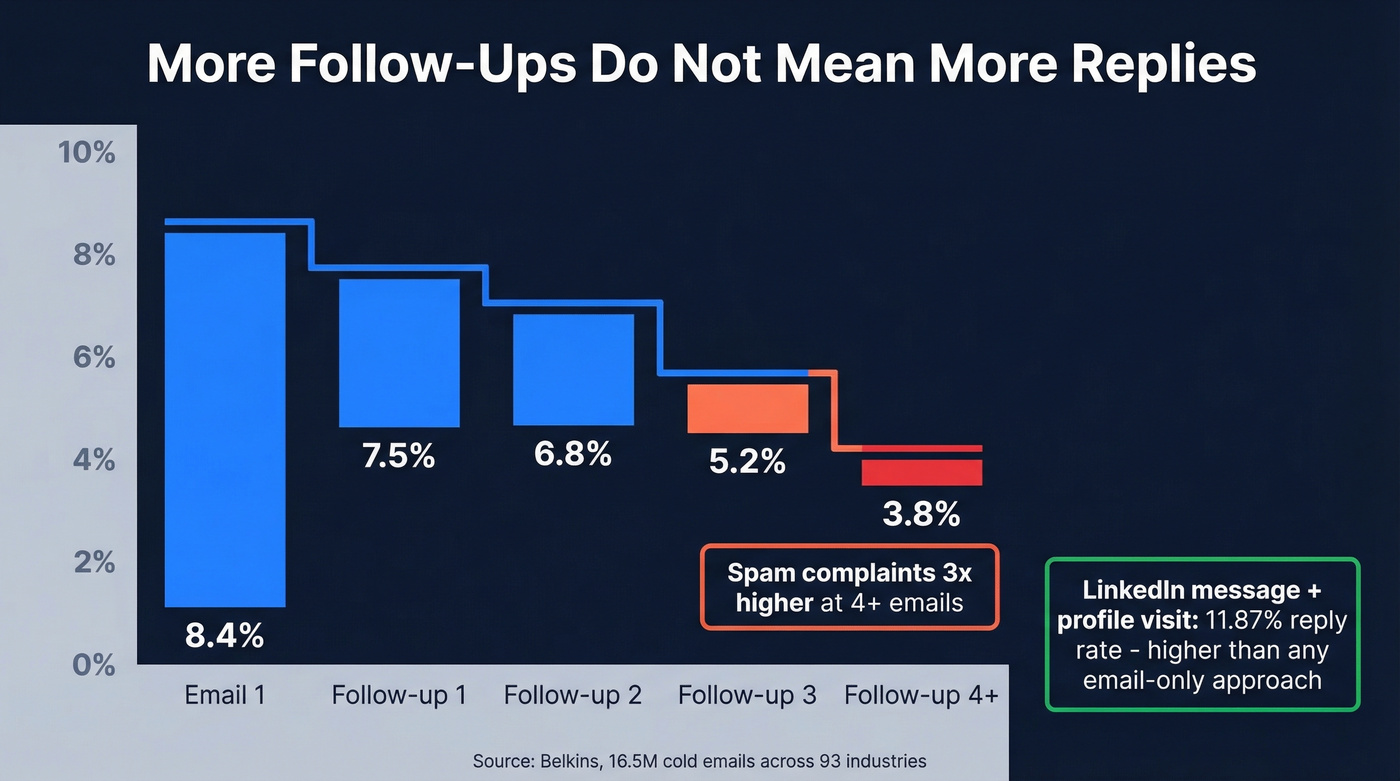
Belkins analyzed 16.5M cold emails across 93 business domains and found that the highest reply rate - 8.4% - came from the first email alone. Every additional follow-up showed declining returns. At four or more emails, unsubscribe and spam complaint rates more than tripled.
Company size changes the math dramatically. Small businesses (2-50 employees) tolerate more persistence, with reply rates around 8-9.2% through early follow-ups. Enterprise prospects ghost quickly and punish persistence. If you're selling into large orgs, two to three touches is usually the ceiling (see SMB vs Mid-Market vs Enterprise).
Here's the finding nobody's talking about: that same dataset showed LinkedIn message + profile visit combos hitting an 11.87% reply rate - higher than any email-only approach. If your automated follow-ups aren't getting replies, the channel might be the problem, not the copy (build a real multichannel sales outreach motion).
Industry matters too. Manufacturing holds steady at ~6.7% through early follow-ups. Solar spikes slightly on the first follow-up before dropping. The takeaway isn't a universal magic number - it's that more emails almost never means more replies.
Let's be honest: most teams would get better results sending two genuinely relevant follow-ups than five AI-generated ones. The data is unambiguous. If your sequence has more than three steps, you're probably training Gmail to filter you (use outbound email spam prevention basics before you add steps).
How AI-Powered Follow-Ups Actually Work
Step 0: Get your CRM data right first. AI personalization is only as good as the fields feeding it. You need clean data for lead source, persona, last touchpoint, and pipeline stage. Skip this and every AI draft will sound generic regardless of the model (this is where CRM automation software helps).
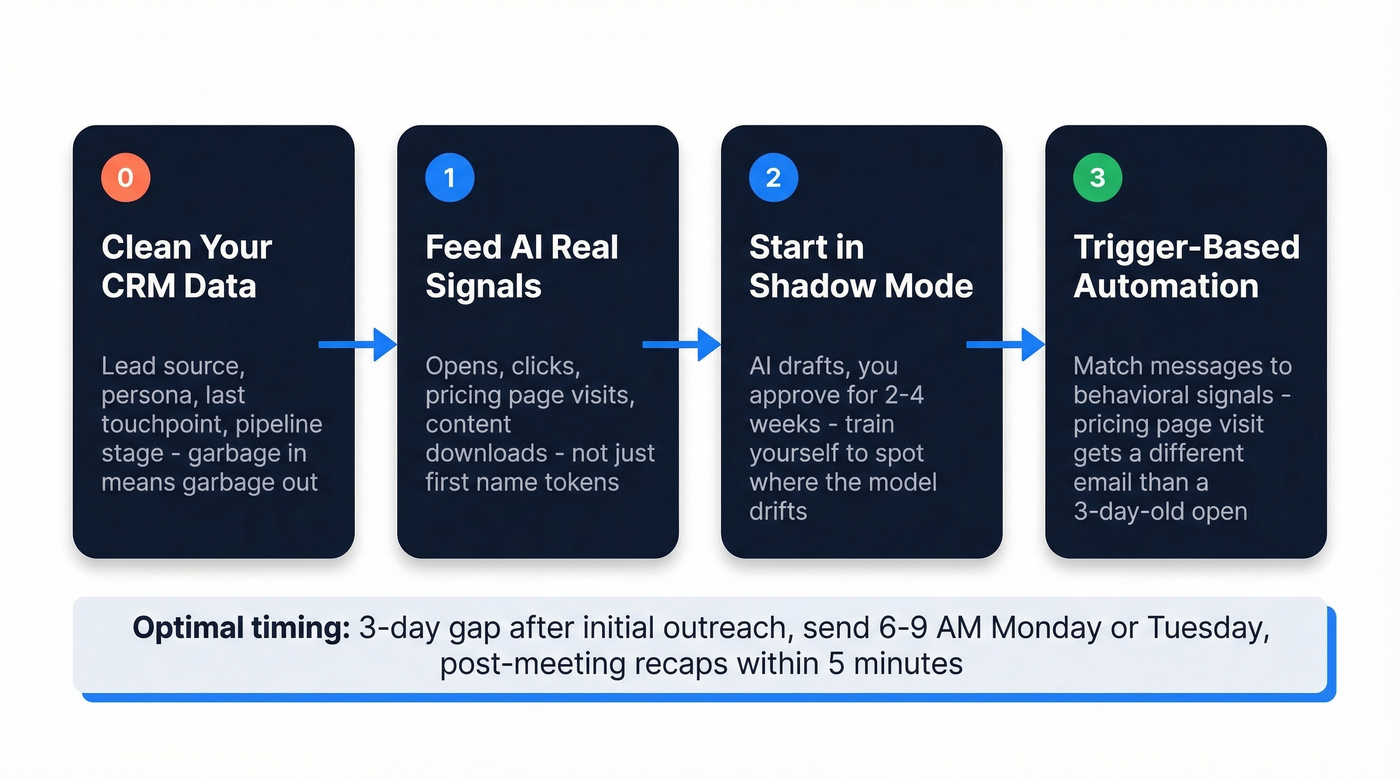
1. Feed AI real signals, not just name tokens. Generic personalization ("Hi {{first_name}}, hope you're well") is invisible to prospects now. Behavioral triggers - opens, clicks, pricing page visits, content downloads - give AI something meaningful to reference (more on AI email personalization).
2. Nail the timing. A three-day gap between initial outreach and first follow-up hits the sweet spot. Send between 6-9 a.m. on Monday or Tuesday - 23% of opens happen within the first hour. For post-meeting recaps, send within five minutes, referencing specific pain points and next steps discussed.
3. Start in shadow mode. Let AI draft every follow-up, but approve each one manually for the first 2-4 weeks. You're training yourself to spot where the model drifts - and building a feedback loop that makes full automation safer later (especially if you're using an AI email writer).
4. Use trigger-based workflows, not time-based blasts. A prospect who visited your pricing page yesterday needs a different follow-up than one who opened your initial email three days ago. Behavior-based triggers - site visits, document opens, meeting no-shows, deals untouched for 7+ days - consistently outperform calendar-based cadences. This is where automation delivers the most value: matching the right message to the right behavioral signal without you manually monitoring every lead.

Trigger-based follow-ups only work when your contact data is clean. Prospeo's 7-day refresh cycle and 5-step verification catch invalid addresses, spam traps, and honeypots before your AI sequence fires. Snyk cut bounce rates from 35-40% to under 5% - protecting the sender reputation their entire outbound motion depends on.
Stop letting bad data sabotage your AI follow-up sequences.
Deliverability and Compliance
None of this matters if your emails don't arrive.
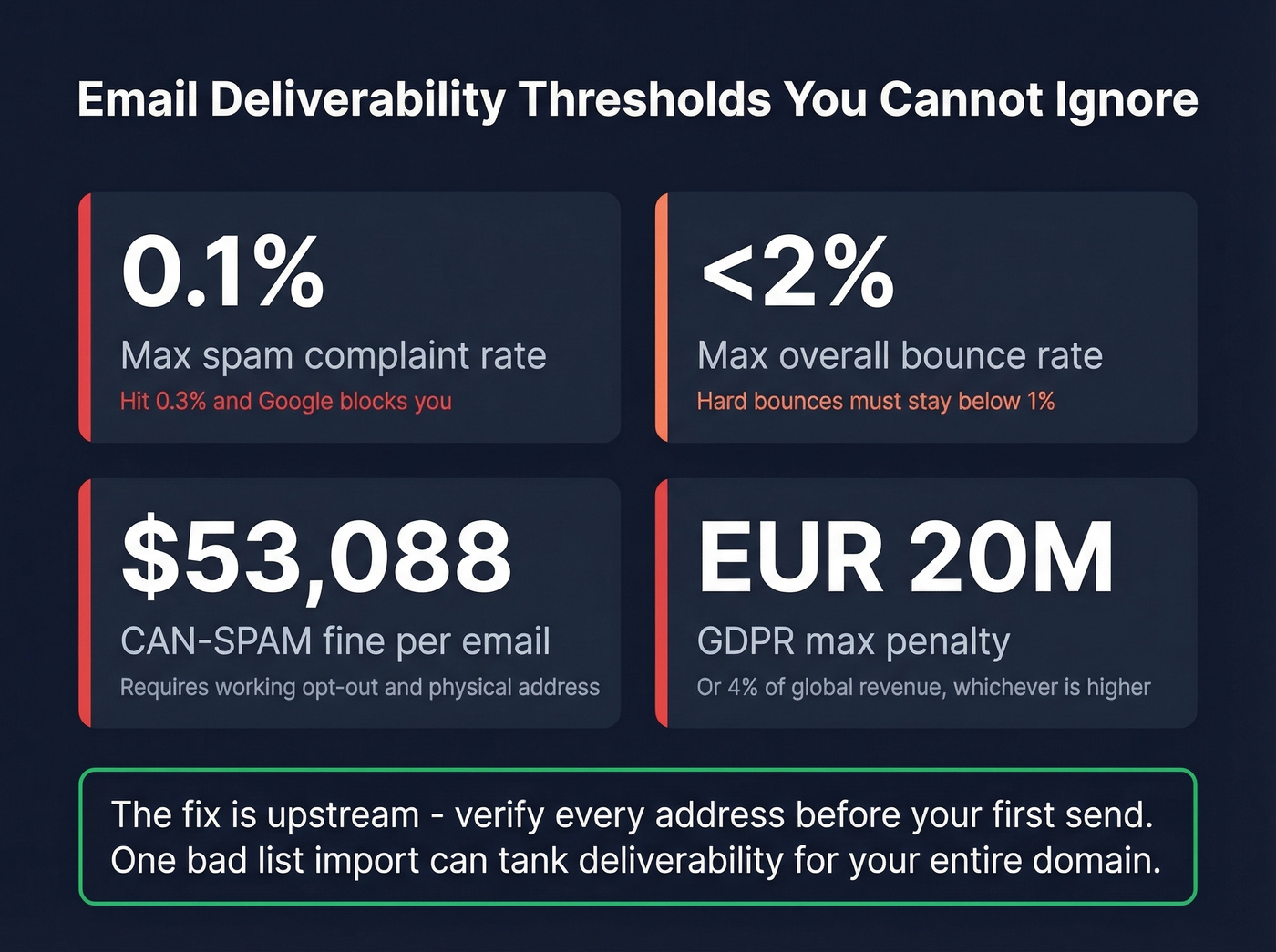
- Spam rate: Stay below 0.1% user-reported spam. Hit 0.3% and Google throttles or blocks you outright.
- Bounce rate: Under 2% overall, hard bounces below 1%. One bad list import can tank deliverability for your entire domain (run an email reputation check if performance suddenly drops).
- CAN-SPAM: Fines reach $53,088 per email. Requires functioning opt-out and physical address.
- GDPR: Penalties up to EUR 20M or 4% of global revenue. Suppressions must sync in real time (use a suppression list process).
In our experience, the teams with the worst deliverability problems aren't sending bad emails - they're sending to bad addresses. We've seen this pattern repeatedly: a team invests weeks building AI sequences, then torches their sender reputation on the first campaign because 15% of their list bounced. Prospeo catches those invalid addresses, spam traps, and honeypots through a 5-step verification process with 98% accuracy on a 7-day refresh cycle, before the first follow-up ever sends.
You just read the data: 4+ follow-ups triple spam complaints. When every email counts, you can't waste a single send on an invalid address. Prospeo delivers 98% email accuracy at $0.01/email and integrates natively with Instantly, Smartlead, and Lemlist - so verified contacts flow straight into your sequences.
Send fewer follow-ups to better addresses. Start with 75 free verified emails.
Best AI Tools for Follow-Up Emails
| Tool | Best For | Starting Price |
|---|---|---|
| Prospeo | Verified data + deliverability | Free tier (75 emails/mo) |
| Instantly | Scaled outbound cadences | $37/mo |
| Smartlead | Budget cold email + agencies | $39/mo |
| Claude | High-quality AI drafting | Free plan available |
| Fathom | Meeting-to-follow-up | Free plan available |
| Attention | AI meeting recaps + emails | Custom pricing |
| Mixmax | Gmail-native workflows | $24/mo |
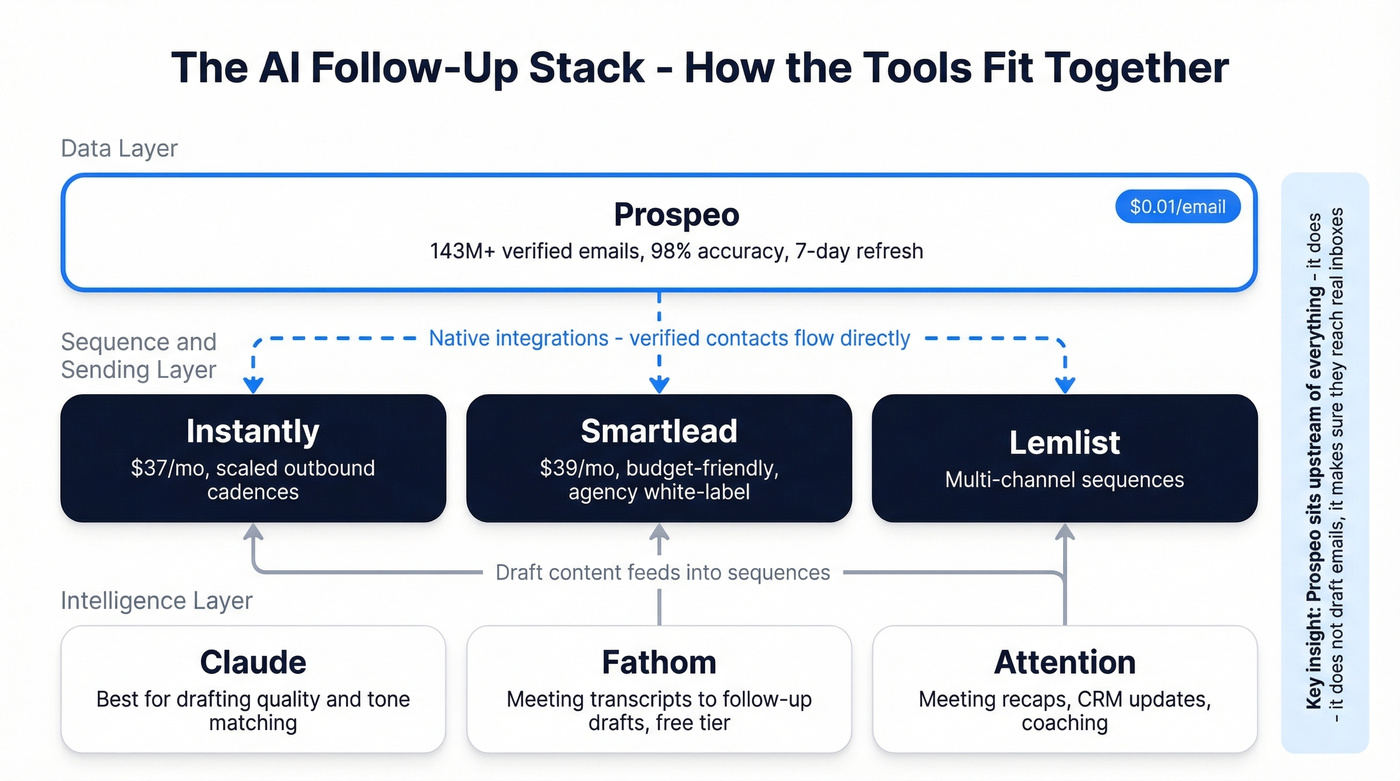
For clean data before any follow-up sends: Prospeo sits upstream of every tool on this list. It doesn't draft your emails - it makes sure they reach real inboxes. With 143M+ verified emails and native integrations with Instantly, Smartlead, and Lemlist, it plugs directly into your outbound stack. Teams like Snyk cut bounce rates from 35-40% to under 5% after switching, which directly protects the sender reputation your AI sequences depend on.
For outbound at scale: Instantly at $37/mo is strong for teams running multi-step cold email campaigns. The $47/mo Growth tier adds lead management features worth paying for (if you're comparing platforms, start with outbound email automation).
For budget-conscious teams and agencies: Smartlead at $39/mo gives you 2,000 leads and 6,000 emails - versus Instantly's Growth plan at 1,000 contacts - with white-labeling at $29/client for agencies.
For drafting quality: Many sellers prefer Claude over ChatGPT for sales email writing. Train it on your best-performing templates and the output sounds noticeably more human. I've tested both side by side, and Claude handles tone constraints better when you give it specific examples to match.
For meeting-to-email automation: Fathom and Attention turn meeting context into follow-up drafts. Attention also handles CRM field updates and coaching insights. Skip these if you don't do many live demos - they're overkill for pure cold outbound. But for teams running 10+ meetings a week, they often outperform generic sequence builders because they reference real conversation context.
Templates That Don't Sound Like AI
Post-demo follow-up:
Subject: Next step on [specific pain point discussed]
Hey [Name] - you mentioned [specific challenge from the call]. We've seen [similar company] cut that by [metric]. I attached the case study.
Worth a 15-min call Thursday to map this to your setup?
No-show recovery:
Subject: Missed you - here's what I had planned
[Name] - no worries on today. I recorded a 2-min walkthrough of what I was going to show you: [link]. If it's relevant, grab 15 minutes this week. If not, no hard feelings.
High-performing follow-ups are usually short, reference a specific moment, and ask one clear question. Claude often produces better sales drafts than ChatGPT for this - train it on your top five emails and let it match your voice rather than defaulting to its own.
FAQ
How many follow-up emails should I send?
Two to three, max. The 16.5M-email study shows 4+ emails in a sequence more than triples spam complaints. Enterprise prospects are even less tolerant - they ghost quickly and punish persistence with spam reports.
Is AI email follow-up automation worth it?
Yes, but only after you've validated messaging manually. Start in shadow mode where AI drafts and you approve, then graduate to full automation once reply rates and tone are consistent. Teams that skip manual validation tend to burn through lists and damage sender reputation.
Can AI write follow-ups that don't sound robotic?
Yes, if you train it on your own top-performing emails rather than relying on default templates. Feed Claude or ChatGPT five of your best replies, specify tone and length constraints, and use behavioral context - pricing page visits, meeting notes - instead of generic merge fields. The output improves dramatically.