

AI Lead Generation: What Actually Works in 2026 (and What Doesn't)
You sent 2,000 cold emails last Tuesday. By Wednesday morning, 180 had bounced, your domain reputation score dropped from "good" to "warning," and your next three sequences landed in spam - including the ones going to warm leads who'd actually visited your pricing page. That's not a hypothetical. We've watched it happen to teams running perfectly good playbooks on perfectly bad data.
The AI lead generation market is projected to hit $16.2B by 2034, up from $7.4B today. The tools are real. The productivity gains are real. But the gap between "AI-powered pipeline machine" and "AI-powered domain destruction" comes down to a handful of decisions most teams get wrong.
What You Need (Quick Version)
If you're short on time, here's the stack that works for most outbound teams running AI-powered prospecting:
- Sending: Instantly or Smartlead - Instantly runs ~$30-97/mo depending on volume and mailbox count.
- CRM: HubSpot free tier - handles contact management and deal tracking at zero cost.
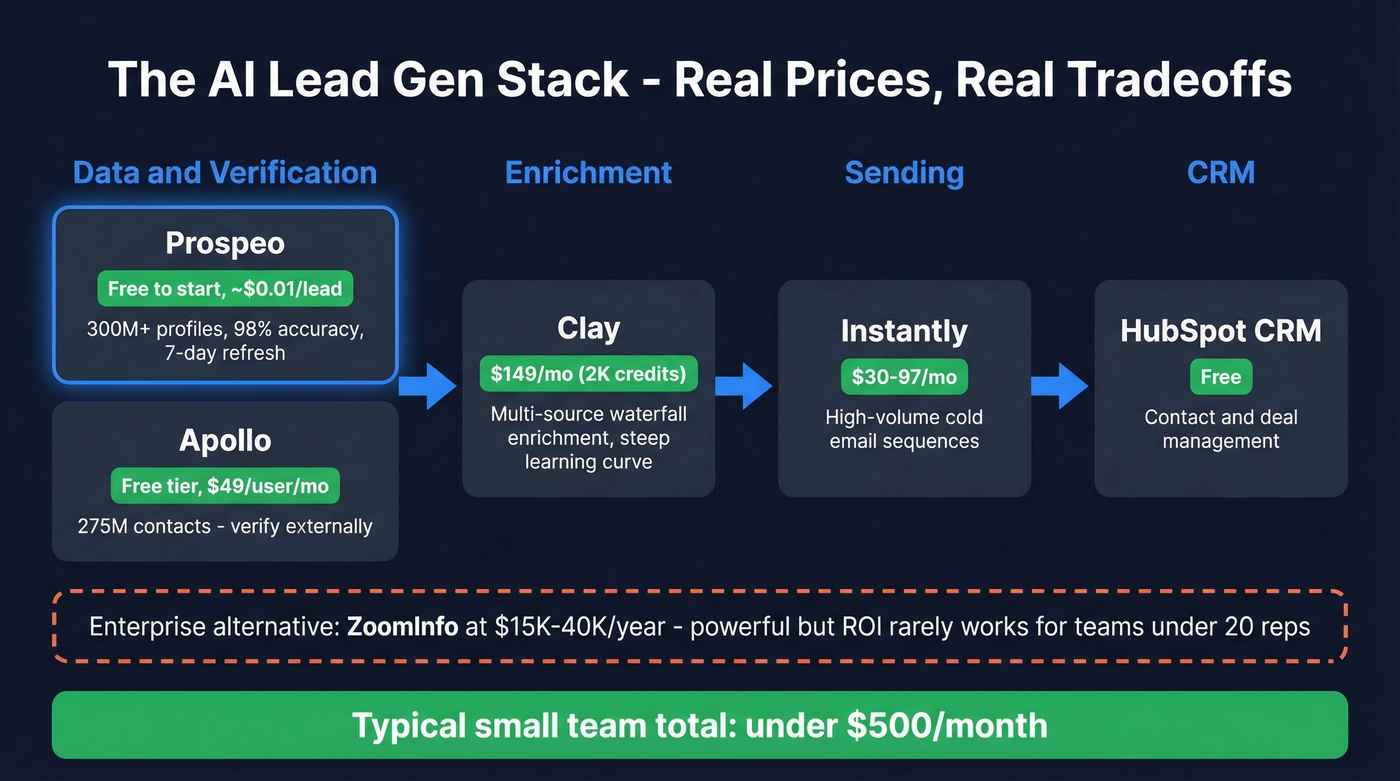
Total monthly spend: typically under $500/month for a small team. That's enough to run verified, email-first outbound sequences, and you can add phone and social touches with a dialer and your preferred social workflow.
Outreach's data shows sellers using AI tools cut research and personalization time by 90%. But that only matters if the contacts you're reaching are real people at real companies with real email addresses. Start with the data layer. Everything else is downstream.
What Is AI Lead Generation?
AI lead generation uses machine learning and automation to find, qualify, and engage potential buyers - replacing the manual grind of list building, research, and initial outreach with systems that do it faster and with better targeting. It shifts the heavy lifting from reps to algorithms so your team can focus on conversations that actually close.
The key capabilities break into four buckets: scoring to identify which leads are most likely to buy, personalization that writes relevant messages at scale, intent detection to spot buying signals before a prospect raises their hand, and qualification that routes the right leads to the right reps automatically.
If you've been running outbound for a while, you already know most of this. Skip ahead to the stack section for tool picks and pricing, or the workflow section for a step-by-step build.
Where AI-Powered Prospecting Actually Stands
Let's be honest about the hype-to-reality ratio. McKinsey's State of AI report found that 88% of organizations use AI regularly in at least one business function. That sounds impressive until you read the next line: nearly two-thirds haven't begun scaling AI across the enterprise. Only 39% attribute any EBIT impact to AI at all, and most of those report less than 5%.
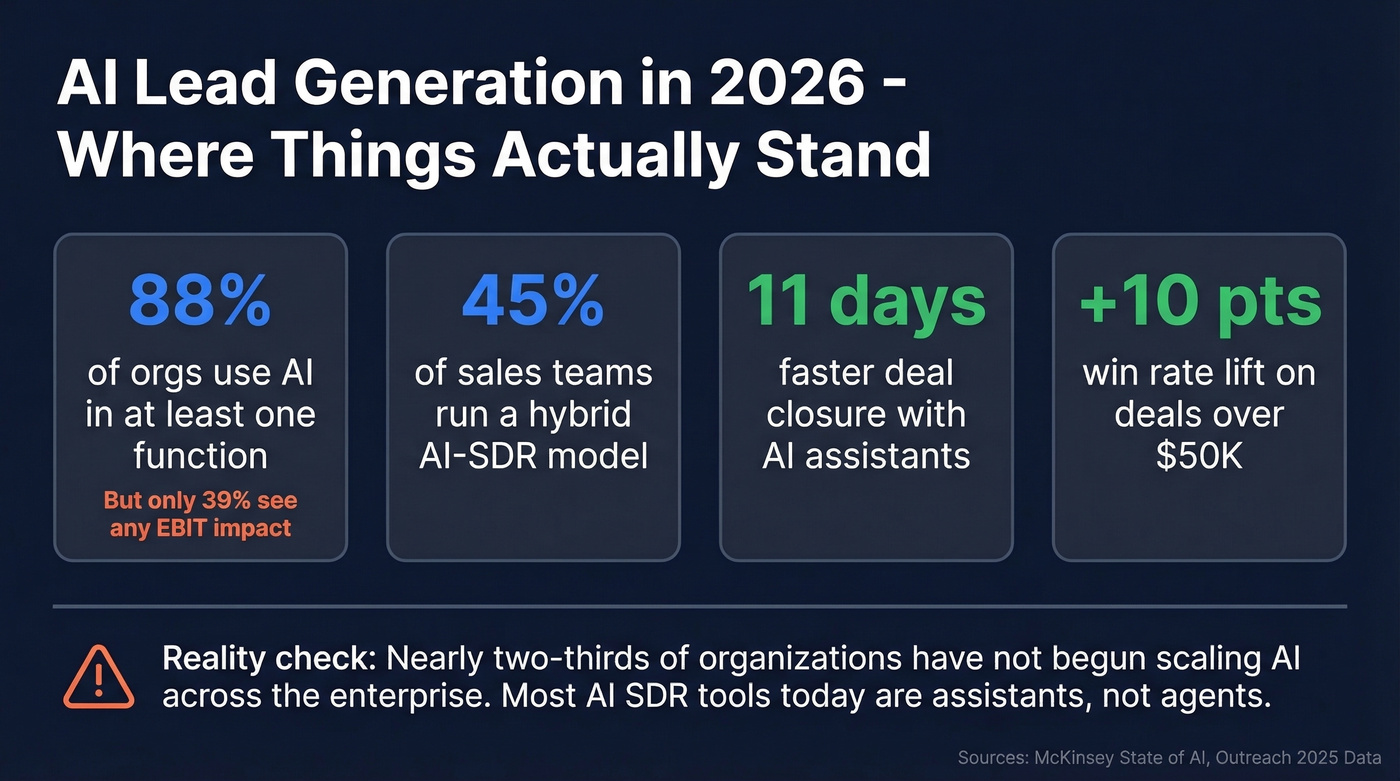
The agent hype is particularly loud right now. 62% of organizations are experimenting with AI agents, and 23% say they're scaling agentic AI in at least one function. But don't confuse AI agents - autonomous, multi-step systems - with AI assistants that handle single reactive tasks. Most "AI SDR" tools today are assistants, not agents. The distinction matters when you're evaluating what to buy.
On the sales-specific side, the numbers are more encouraging. Outreach reports that 45% of teams already run a hybrid AI-SDR model, and their AI assistant closes deals 11 days faster on average, with win rates lifting up to 10 points on deals over $50K. Opportunities closed within 50 days carry a 47% win rate compared to 20% or lower after that window. Speed matters.
Here's the take most guides won't give you: if your average deal size is under five figures, you probably don't need ZoomInfo-level data or a $50K/year tech stack. Most teams aren't seeing ROI from automated lead generation because they're scaling before they're ready. They automate a broken process and get broken results faster. The teams winning are the ones who nailed their ICP, verified their data, and proved the workflow manually before letting AI take the wheel.
5 Ways AI Enhances Lead Generation
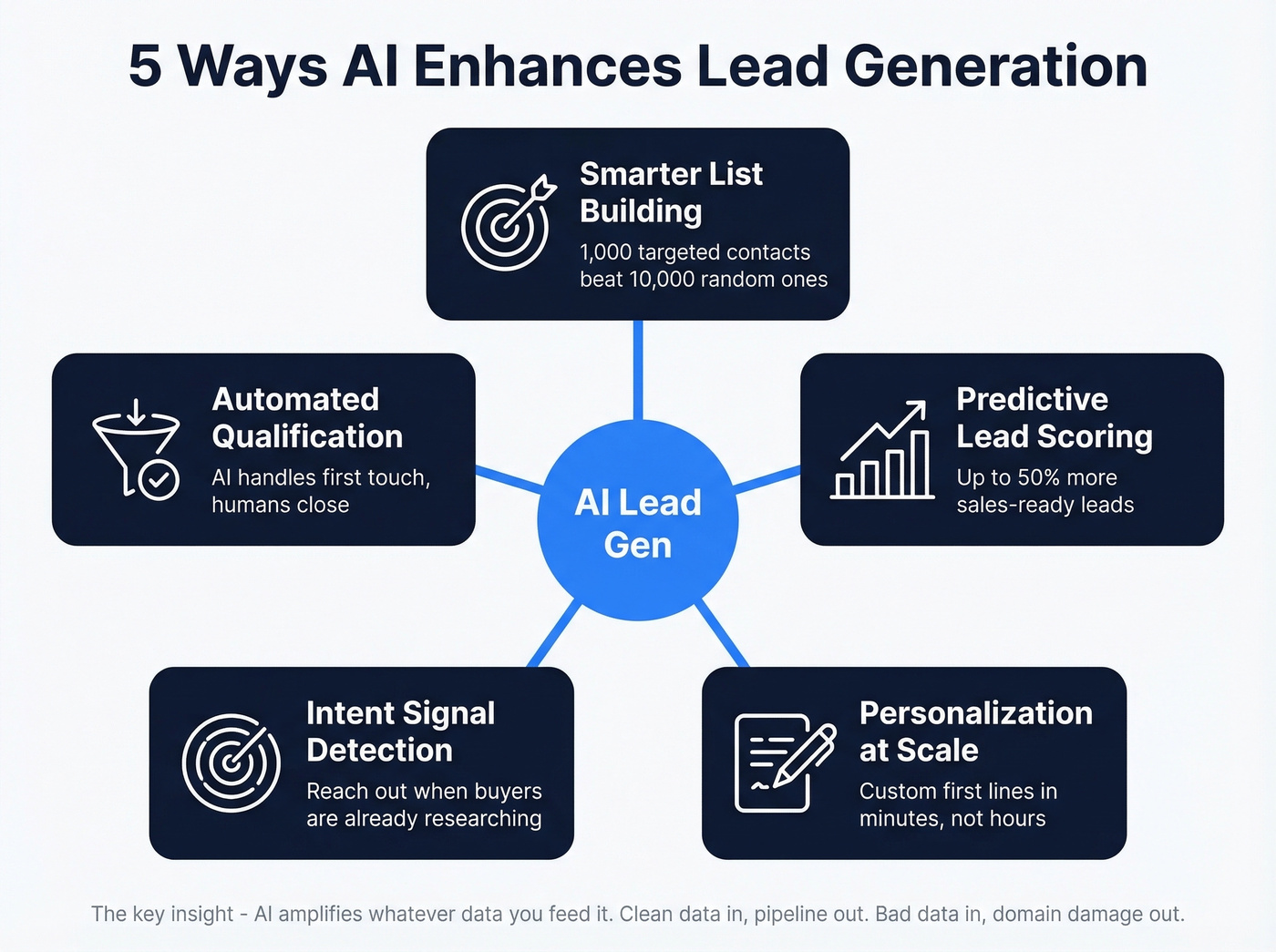
Smarter List Building
The old way: export 10,000 contacts from a database, hope 60% are accurate, and deal with the fallout. The AI way: define your ICP with granular filters - buyer intent signals, technographics, job changes, headcount growth, funding rounds - and build a list of 1,000 contacts who actually match. Smaller list. Sharper targeting. Higher conversion rates.
Predictive Lead Scoring
Not every lead deserves the same effort. AI scoring models weigh engagement signals, firmographic fit, and behavioral data to rank leads by likelihood to close. Teams using predictive scoring report up to 50% more sales-ready leads because reps stop wasting time on contacts who were never going to buy.
Personalization at Scale
Writing a custom first line for 500 prospects used to take a full day. AI tools now generate personalized openers based on a prospect's recent activity, company news, tech stack, or job changes - in minutes. The key is feeding the AI good context data. Generic personalization ("I saw your company is growing!") is worse than no personalization at all. If you want a deeper playbook, start with AI email personalization.
Intent Signal Detection
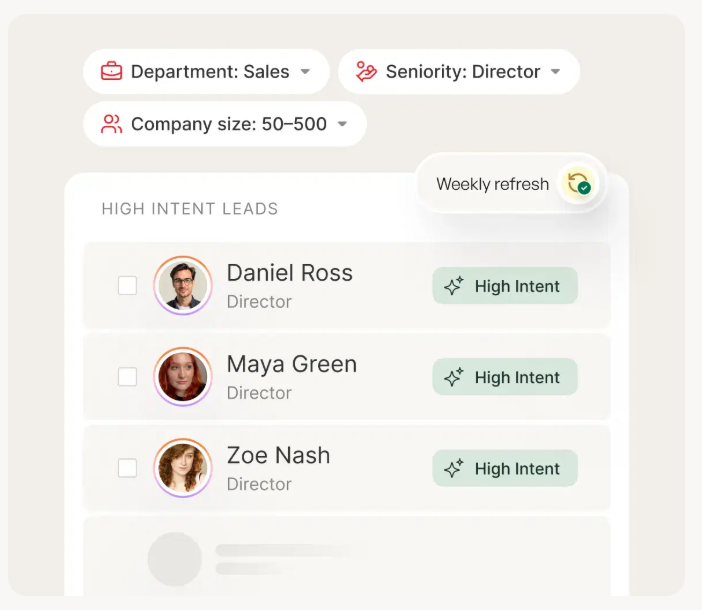
Intent data tracks which companies are actively researching topics related to your product. When a VP of Engineering at a Series B company starts reading about "API security tools" across multiple third-party sites, that's a signal worth acting on. Layering intent data onto your prospecting workflow means you're reaching out when buyers are already thinking about the problem you solve, not cold. (More on buyer intent signals if you need a framework.)
Automated Qualification
The hybrid AI-SDR model - where AI handles initial qualification and humans take over for complex conversations - is now the most common setup, with 45% of teams running some version of it. AI routes inbound leads based on fit and engagement scores, asks qualifying questions via chat or email, and flags the ones worth a rep's time.

This article makes it clear: AI lead generation fails when the data layer is broken. Prospeo gives you 300M+ profiles with 98% email accuracy, intent data across 15,000 topics, and a 7-day refresh cycle - so your AI tools have clean fuel to work with. All at ~$0.01 per lead.
Stop letting bad data turn your AI stack into a domain-burning machine.
The AI Lead Gen Stack (Real Prices)
You don't need one platform that does everything. You need 3-4 tools that integrate well.
| Tool | Category | Best For | Starting Price | Key Limitation |
|---|---|---|---|---|
| Prospeo | Data & Verification | Verified emails + mobiles | Free; ~$0.01/lead | Email + phone focused |
| Apollo | Database + Outreach | All-in-one prospecting | Free; $49/user/mo | Data needs verification |
| Clay | Enrichment + Orchestration | Multi-source workflows | $149/mo (2K credits) | Steep learning curve |
| ZoomInfo | Enterprise Data + Intent | Large sales orgs | ~$15K-40K/year | Expensive for SMBs |
| Lusha | Quick Contact Lookup | Individual prospectors | Free (40 credits); $22/mo | Smaller database |
| Instantly | Cold Email Sending | High-volume sequences | ~$30-97/mo | Email only |
| HubSpot CRM | CRM | Contact + deal mgmt | Free | Limited outbound features |
The r/sales community has strong opinions about Apollo, and they're worth hearing. Users consistently flag that Apollo's data is user-populated and the platform doesn't independently verify contacts. The consensus: always run Apollo exports through a separate verifier before sequencing. That said, 275M contacts, 60M companies, built-in email sequences, and a solid free tier make it the obvious starting point for teams that want database and sequencing in one tool.
ZoomInfo will shock you with the invoice. A mid-market contract with intent and mobile numbers runs $15K-40K/year, before you add seats or modules. It's a common enterprise choice with 300M+ professional profiles, but for teams under 20 reps, the ROI math rarely works. If you're comparing options, see our breakdown of the best B2B databases.
Clay is the power user's favorite - and Reddit practitioners keep coming back to it - but expect to invest time upfront. It pulls data from multiple sources, lets you build waterfall enrichment workflows, and connects to everything. The tradeoff is that credits burn fast and costs scale quickly. Practitioners on Reddit also mention Trigify as an emerging alternative for trigger-based prospecting, though Clay's ecosystem is far more mature. If you're evaluating vendors, start with data enrichment tools.
Lusha works for individual prospectors who need quick contact lookups without committing to a platform contract. Skip it if you're running team-scale outbound.
The Data Quality Problem
Look, AI doesn't fix bad data. It scales it. If your contact list is 70% accurate, AI will help you send bad emails to the wrong people 10x faster. Every tool in your stack amplifies whatever you feed it, and the model is only as good as the data it acts on.
The Reddit practitioner community is blunt about this. One detailed breakdown on r/sales recommends using at least two verifiers on every export and warns against trusting Apollo's built-in deliverability metrics. That poster also advises turning off open/click trackers entirely because they tank deliverability.
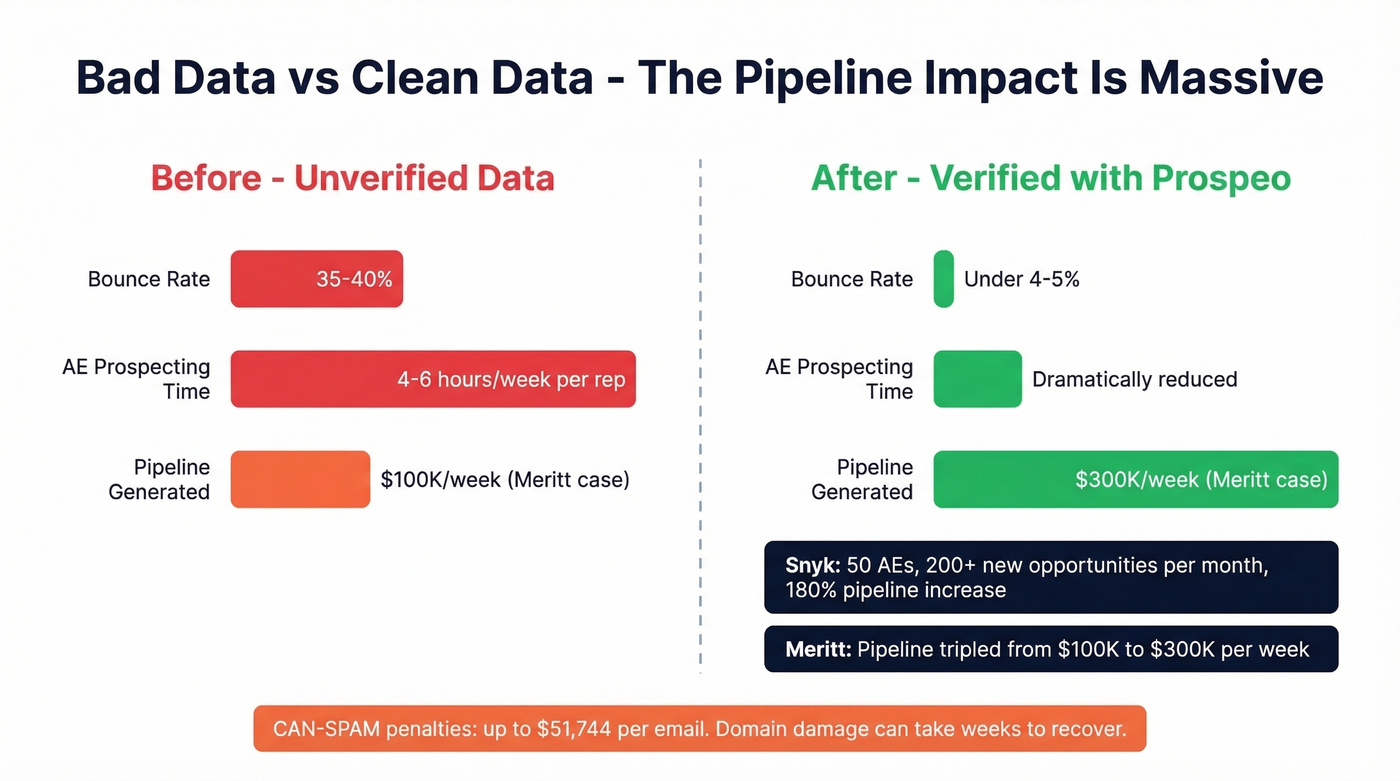
The stakes aren't just wasted effort. CAN-SPAM penalties run up to $51,744 per email. Domain reputation damage can take weeks to recover from - if it recovers at all.
We saw this play out with Snyk's sales team. Fifty AEs were prospecting 4-6 hours per week, but their bounce rate sat between 35-40%. After switching their data layer to Prospeo, bounce rates dropped under 5%, AE-sourced pipeline jumped 180%, and the team generated 200+ new opportunities per month. Meritt saw similar results - pipeline tripled from $100K to $300K per week once bounce rates dropped from 35% to under 4%. The 7-day data refresh cycle matters here; industry average is six weeks, which means most databases are serving you contacts who changed jobs last month.
If your bounce rate is above 5%, your data provider is the problem. Not your copy, not your sequences, not your sending tool. The data. If you need a diagnostic checklist, start with check bounce.
The hybrid AI-SDR model only scales when every contact in your sequence is real. Prospeo's 5-step verification, catch-all handling, and spam-trap removal keep bounce rates under 4% - the same results Snyk saw across 50 AEs generating 200+ opportunities per month.
Verified contacts in, booked meetings out. That's the entire formula.
Build Your AI Lead Gen Workflow
The principle is simple: do things that don't scale first, then automate what's repeatable. Here's the six-step workflow, followed by a phased rollout timeline.
Define Your ICP First
Skip this and everything downstream breaks. Your ICP isn't "B2B SaaS companies." It's "Series A-C SaaS companies with 50-200 employees, selling to mid-market, headquartered in North America, using HubSpot or Salesforce, with a VP of Sales or CRO who's been in role less than 12 months." The more specific your ICP, the smaller and sharper your lists - and the higher your conversion rates. If you need help tightening it, use this ideal customer profile guide.
Build a Tight List
Resist the urge to export 10,000 contacts on day one. Start with batches of around 1,000 contacts that tightly match your ICP. This is advice straight from practitioners who've burned through domains by blasting oversized lists. Use intent data and technographic filters to narrow further - you want companies actively researching problems you solve, not every company that fits a firmographic checkbox. For more list-building options, compare B2B list providers.
Verify Every Contact
Never skip this step. Run every contact through verification before it touches a sequence. The goal is a sub-3% bounce rate on every send. Catch-all handling, spam-trap removal, and honeypot filtering aren't nice-to-haves - they're the difference between inbox placement and the spam folder. If you're shopping, start with email verifier tools.
Enrich With Context
Raw contact data isn't enough for good outreach. Enrich each contact with recent company news, tech stack data, funding events, and job changes. This context fuels personalization that actually resonates. Clay excels here if you need multi-source enrichment workflows, though the cost adds up at scale. (See the benefits of data enrichment if you want the why.)
Launch Omnichannel Sequences
Email alone isn't enough. The best-performing outbound teams combine cold email, phone calls, and social touches in a single sequence. Cap phone attempts at 7 per contact - beyond that, you're annoying people, not persisting. Tools like Instantly or Smartlead handle the email side; pair with a dialer and social outreach for full coverage. B2B buyers now engage across an average of 10 channels. If you want a system for this, use a multichannel sales outreach playbook.
Measure and Iterate
Track bounce rate, reply rate, meeting rate, and pipeline generated - not vanity metrics like open rates, which are increasingly unreliable anyway. If bounce rates creep above 3%, your data is decaying. If reply rates drop, your messaging or targeting needs work. Run this loop weekly for the first 90 days.
Phased Rollout
Month 1: Manual process plus ICP validation. Send to small batches, track what converts, and refine your targeting before you automate anything.
Month 2: Automate sequences and add a second channel. Scale from 200 contacts per week to 1,000 once bounce and reply rates are stable.
Month 3: Layer in intent data and predictive scoring. This is when AI starts compounding your results instead of compounding your mistakes.
7 Mistakes That Kill AI Lead Gen
1. Skipping verification. Every unverified email is a coin flip that risks your domain. Verify before you send. Always.
2. Premature automation. If your manual outbound process doesn't generate meetings, automating it just burns through your list faster. Prove the workflow works with 200 contacts before scaling to 2,000.
3. Trusting open/click trackers. Tracking pixels and link wrapping can destroy deliverability. Many experienced practitioners turn them off entirely. Measure replies and meetings instead.
4. No ICP definition. "Everyone is our customer" means no one is your customer. Vague targeting produces vague results.
5. Ignoring domain health. Warm up new domains, rotate sending accounts, monitor blacklists, and keep daily send volume reasonable. One bad week can take a month to recover from.
6. Compliance blindness. CAN-SPAM, CPRA, GDPR - these aren't suggestions. Fines are real and enforcement is increasing. If you need a checklist, use this B2B compliance guide.
7. Tool sprawl. Buying 10 tools instead of 3-4 that integrate well creates data silos, duplicate contacts, and ops headaches. Pick a data layer, a sending layer, and a CRM. That's your foundation. Add tools only when you've maxed out what those three can do.

Compliance - Don't Skip This
AI lead generation doesn't exempt you from privacy law. The scale AI enables makes compliance more important, because violations multiply faster.
CAN-SPAM requires a valid physical address, accurate headers, clear subject lines, a working unsubscribe mechanism, and honoring opt-outs within 10 business days. Penalties run up to $51,744 per email.
CPRA applies if you have $25M+ annual revenue, process data on 100K+ consumers, or derive 50%+ of revenue from selling or sharing personal data. Penalties hit $7,500 per intentional violation - uncapped, per incident.
GDPR requires either consent or documented legitimate interest for B2B outreach to EU contacts. Use GDPR-compliant data providers and maintain clear records.
The practical takeaway: use a data provider that enforces opt-outs globally, include your physical address in every email, make unsubscribe easy, and keep records of your legitimate interest basis. This isn't optional - it's the cost of doing outbound at scale.
FAQ
How long before AI lead generation shows ROI?
Most teams see pipeline impact within 30-60 days if their ICP is defined and data is verified. Deals closed within 50 days carry a 47% win rate, so speed to first meeting matters. The biggest delay isn't the tools - it's spending weeks on setup without sending.
What's the minimum budget for an AI lead gen stack?
Under $500/month covers a small team. Prospeo's free tier provides 75 verified emails for initial testing, Instantly runs ~$30-97/mo for sending, and HubSpot's free CRM handles contact management. Scale spending only as pipeline justifies it.
Do I need a dedicated AI SDR tool?
Not yet for most teams. 45% of sales organizations use a hybrid model where AI assists human reps rather than replacing them. Start with a verified data source plus a sending platform. Add autonomous AI agents once your manual process consistently generates meetings.
What are the benefits of AI in lead generation?
Speed and precision. AI compresses research time by up to 90%, surfaces intent signals manual prospecting misses, and scores leads so reps focus on the highest-value conversations. Teams also see fewer wasted touches because targeting is tighter from the start.
How do I know if my data provider is accurate enough?
Track your bounce rate. Anything above 5% means you need a verification layer. The benchmark for reliable outbound is 98% email accuracy and sub-3% bounce rates. If you're above that threshold, test a different provider against your current source on the same list and compare results head to head.