

The Complete AI Outbound Strategy for 2026: Data, Tools, and the Math Behind It
A RevOps lead we know ran a 3-tool bake-off last quarter. The "best" AI SDR platform generated 47 meetings in four months - impressive until they realized 23% of the emails bounced, two sending domains got flagged, and the pipeline was half phantom. The bottleneck wasn't the AI. It was the data feeding it.
Salesforce's State of Sales data shows 81% of sales teams are now experimenting with or have fully implemented AI in their outbound workflows. But most AI outbound strategy failures aren't AI failures - they're data quality failures dressed up as AI problems. Bad emails burn domains. Stale contacts waste sequences. No amount of GPT-powered personalization fixes a 35% bounce rate.
What AI Outbound Actually Means Now
AI outbound isn't "ChatGPT writes my cold emails." It's a system of capabilities that automate the entire outbound motion: prospecting and signal detection surfaces accounts showing buying intent, job changes, or funding events before competitors notice; adaptive sequencing builds multi-step cadences that shift timing and channel based on prospect behavior rather than static "Day 1 email, Day 3 follow-up" playbooks.
On the personalization side, AI generates dynamic copy using hundreds of signals - company news, tech stack, hiring patterns, competitive intel. It classifies replies automatically (interested, objection, not now, wrong person) and triggers the right next step. Multi-channel orchestration coordinates email, phone, and social based on where the prospect actually engages, while behavioral analytics continuously tune messaging and targeting.
The difference is measurable. Signal-personalized outreach hits 15-25% reply rates compared to 3-5% for generic cold email. That's not a marginal improvement - it's a different category of performance entirely.
Four Pillars of AI-Driven Outbound
The old playbook - high volume, single channel, static sequences, manual SDR execution - is dead. Buyer fatigue, channel saturation, and rising CAC killed it.
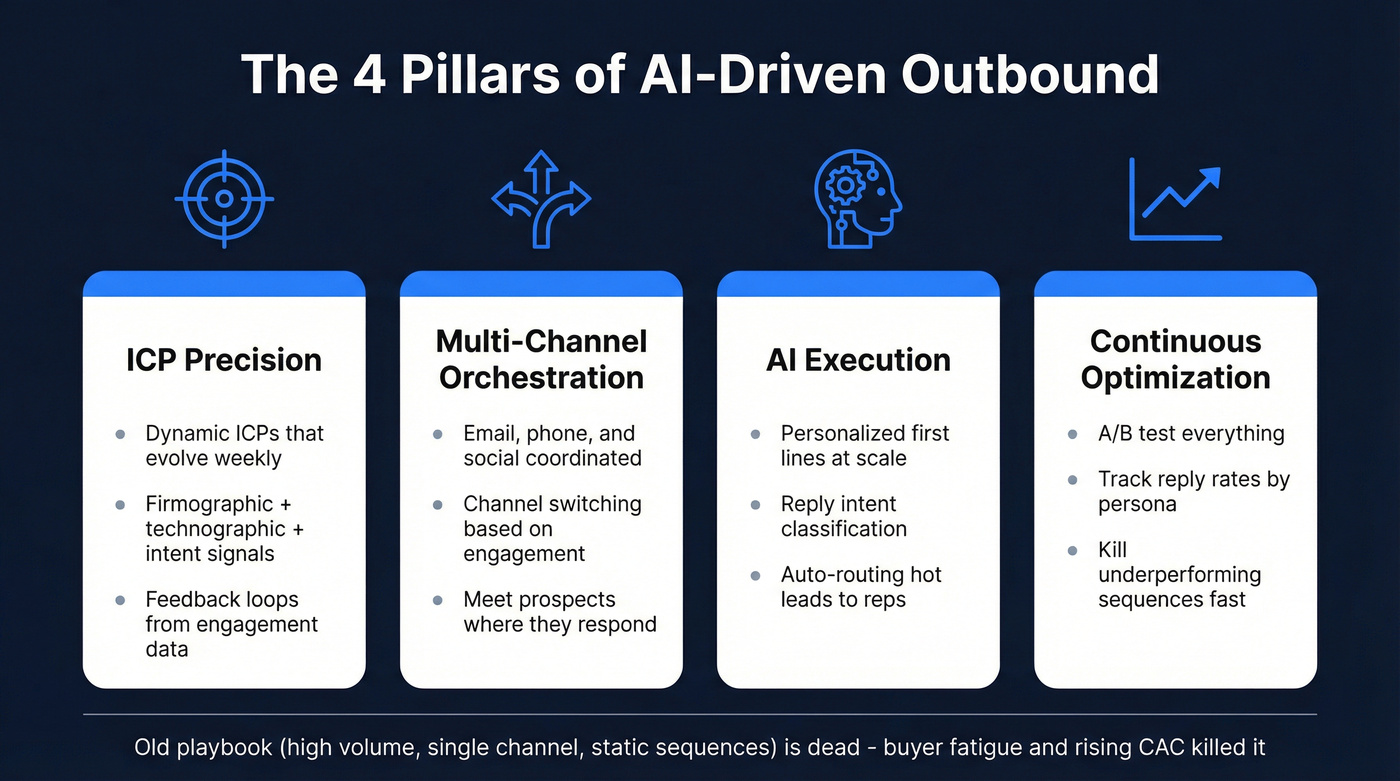
ICP Precision
Static ICPs built from last year's win data aren't enough. Dynamic ICPs evolve continuously using firmographic data, technographic signals, and intent data. AI refines targeting based on engagement patterns - which accounts open, reply, and convert - creating a feedback loop that gets sharper every week.
This is where your data platform matters most. Prospeo tracks intent across 15,000 topics via Bombora. Layer that buyer intent with 30+ search filters covering job role, headcount growth, funding stage, and technographic signals, and you're building lists that actually convert instead of lists that just look big.
Multi-Channel Orchestration
Email alone won't cut it. The best systems coordinate across email, phone, and social, switching channels based on engagement. A prospect who opens emails but never replies will often pick up a cold call. Someone who ignores calls responds to a well-timed social message.
AI Execution
AI writes personalized first lines, classifies reply intent, schedules follow-ups, and routes hot leads to reps. Here's the key distinction: AI handles volume and pattern recognition, humans handle judgment calls and relationship building.
Continuous Optimization
Teams using AI in outbound sales are 1.3x more likely to see revenue growth. But only if you're measuring and iterating. A/B test subject lines, track reply rates by persona, monitor email deliverability daily, and kill sequences that underperform.
Outbound Benchmarks Worth Knowing
Before you build anything, know what success looks like. These benchmarks come from 100+ SaaS teams:
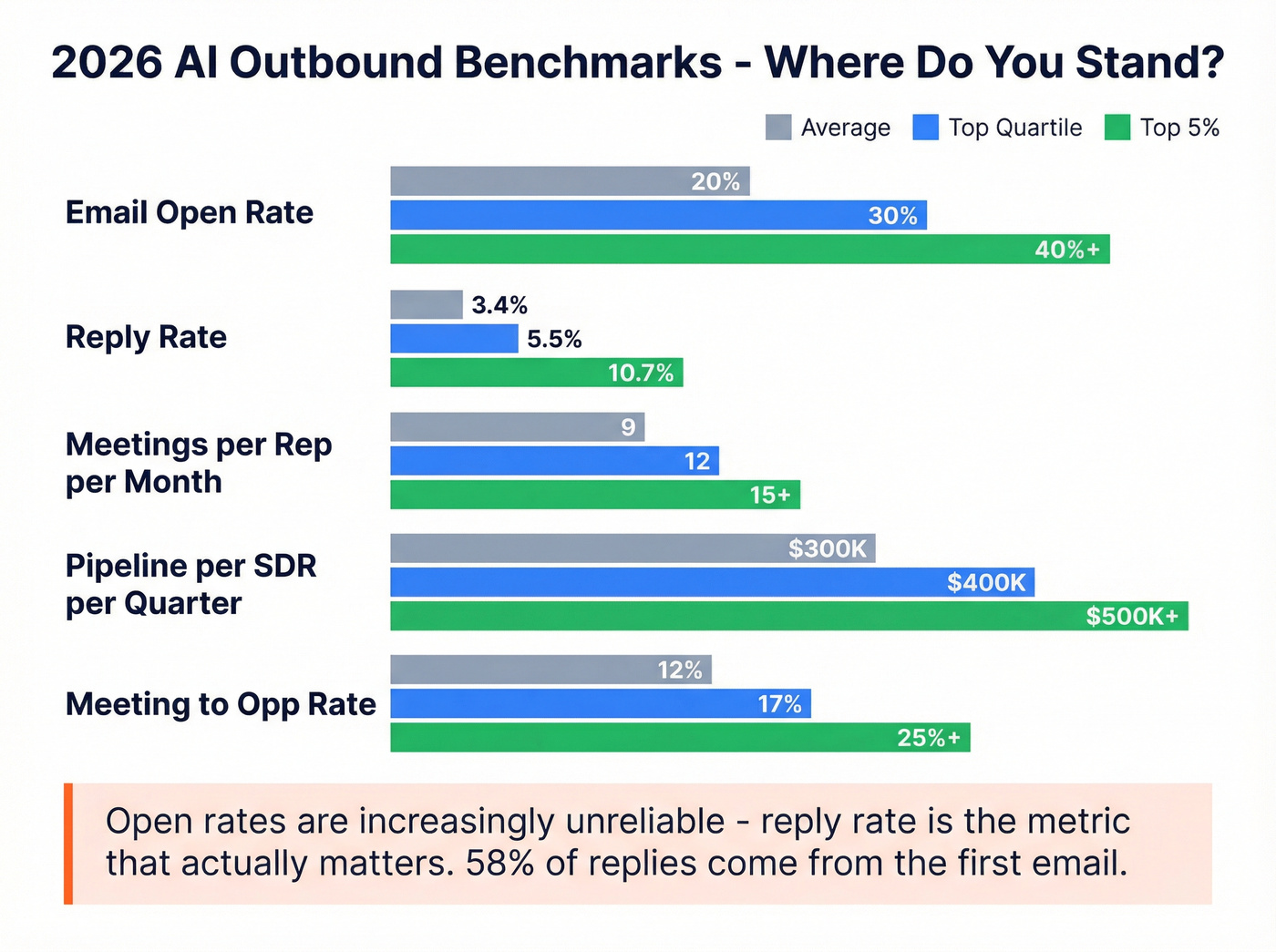
| Metric | Average | Top Quartile | Top 5% |
|---|---|---|---|
| Email open rate | 15-25% | 25-35% | 40%+ |
| Reply rate | 3.43% | 5.5% | >10.7% |
| Meetings/rep/month | 8-10 | 10-15 | 15+ |
| Pipeline/SDR/quarter | $300K | $400K | $500K+ |
| Meeting-to-opp rate | 10-15% | 15-20% | 25%+ |
Open rates are increasingly unreliable thanks to Apple Mail Privacy Protection - reply rate is the metric that actually matters. And 58% of replies come from the first email, which means your opening message carries disproportionate weight. If your first touch isn't strong, no follow-up sequence will save it.
Building the Right Tool Stack
You don't need 12 tools. You need three to four that work well together. When evaluating options, prioritize five things: multichannel execution, data strength, AI depth, CRM integration, and compliance controls.
Data and Enrichment
Everything downstream - personalization, sequencing, deliverability - depends on contact data quality. We've tested dozens of providers, and Prospeo is the strongest option for teams that prioritize accuracy over feature bloat: 300M+ professional profiles, 143M+ verified emails at 98% accuracy, 125M+ verified mobile numbers, and a 7-day data refresh cycle (the industry average is 6 weeks). At roughly $0.01 per email, it's a fraction of legacy platform pricing.

Clay ($134/mo for 2,000 credits) is powerful for custom enrichment workflows - waterfall enrichment across multiple data sources - but it's technical. You'll need someone comfortable with formulas and API logic. Apollo (free tier, Pro from $49/user/mo) covers 275M+ contacts and bundles prospecting with sequencing, making it an obvious starting point for teams wanting everything in one place, though data accuracy doesn't match dedicated platforms.
Sequencing and Sending
Instantly ($30/mo) and Smartlead ($39/mo) dominate this category. Both handle multi-inbox rotation and automated warmup. Instantly has a slight edge on UX; Smartlead is more flexible for agencies managing multiple client workspaces.
Personalization
Skip this category if your team already writes strong cold emails. For everyone else: Autobound (free tier, paid from $39/mo) pulls 400+ signals to generate email copy and is the best value here. Lavender ($29/user/mo) works more as a coaching tool - it scores emails and suggests real-time improvements. Regie.ai (~$35K/year) is enterprise-grade and priced accordingly.
| Tool | Function | Starting Price | Best For |
|---|---|---|---|
| Prospeo | Data + verification | Free / ~$39/mo | Accuracy-first teams |
| Clay | Enrichment workflows | $134/mo | Technical RevOps |
| Apollo | All-in-one prospecting | Free / $49/user/mo | SMB all-in-one |
| Instantly | Sequencing + warmup | $30/mo | Cold email at scale |
| Smartlead | Sequencing + warmup | $39/mo | Agencies |
| Autobound | AI personalization | Free / $39/mo | Signal-based copy |
| Lavender | Email coaching | $29/user/mo | Rep enablement |
Here's the thing: you can run a complete AI-powered outbound stack for under $200/month. Compare that to a fully loaded human SDR at $75K-$100K/year, and the math is hard to argue with. If your average deal size sits below $10K, you almost certainly don't need enterprise-grade tooling - this lean stack will outperform it.

Every AI outbound strategy lives or dies on data quality. Prospeo delivers 98% email accuracy, 125M+ verified mobiles, and a 7-day refresh cycle - so your AI sequences never burn domains on stale contacts. Teams using Prospeo book 35% more meetings than Apollo users.
Stop feeding your AI bad data. Fix the foundation first.
AI vs. Human SDRs - The Real Math
Let's stop pretending this is an either/or decision.
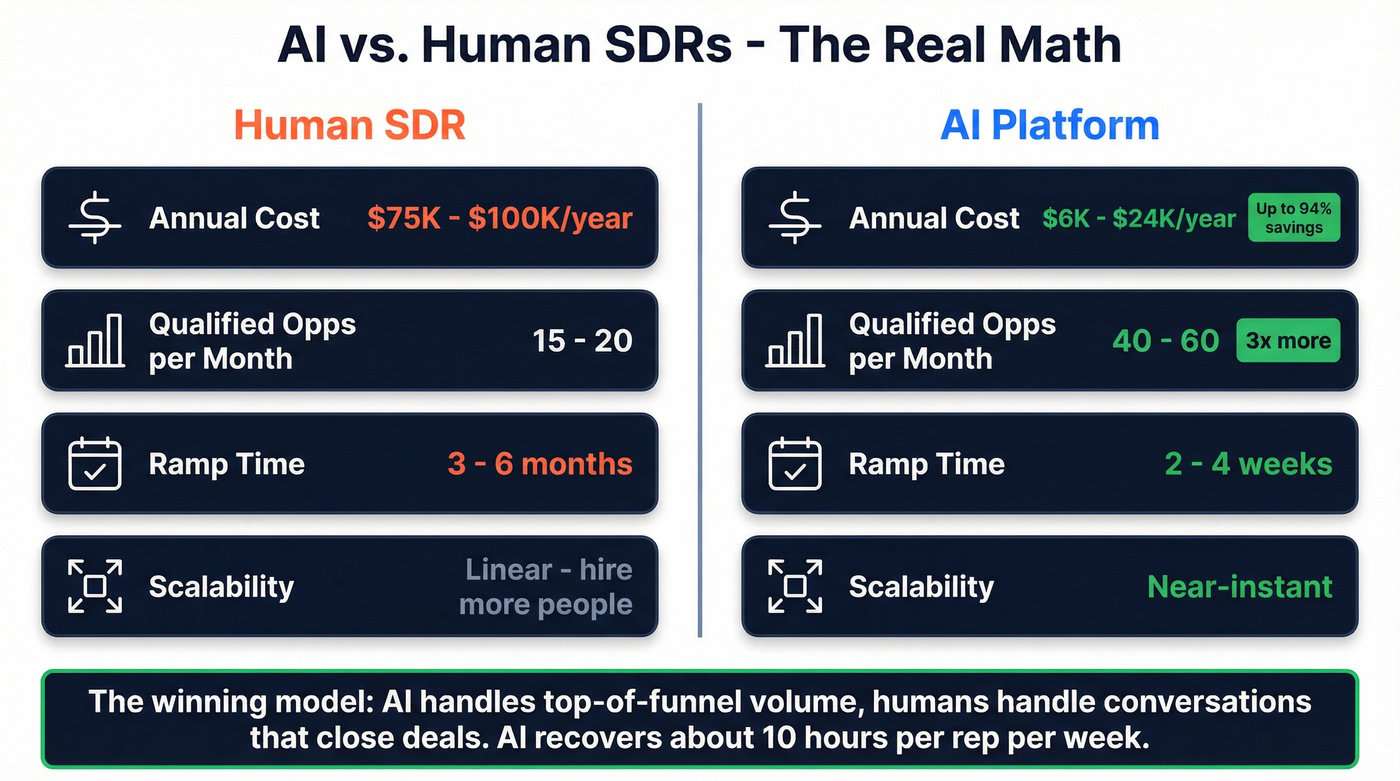
| Metric | Human SDR | AI Platform |
|---|---|---|
| Cost | $75K-$100K/year | $500-$2,000/mo |
| Qualified opps/month | 15-20 | 40-60 |
| Ramp time | 3-6 months | 2-4 weeks |
| Scalability | Linear (hire more) | Near-instant |
Twenty-two percent of teams have already fully replaced human SDRs with AI, and the AI SDR market is projected to hit $15B by 2030. A practitioner-run test of 8 AI-assisted approaches over four months, using the same 500-prospect list, showed the top three performers: ArtisanAI (14.2% response rate, $38/meeting), 11x.ai (12.8%, $29/meeting), and Clay + custom AI (11.4%, $37/meeting). Even the lowest performer generated meetings at $12 per meeting.
The most common complaint on r/sales and outbound communities isn't about the AI itself - it's about robotic-sounding copy and deliverability burn from bad data. Those are solvable problems, not AI limitations.
Outside SaaS, the pattern holds too. A 79-agent real estate brokerage using AI call coaching saw outbound calls jump 119% and generated 650-1,338% ROI over four months.
The hidden costs are real: expect 40-60 hours of data cleaning and segmentation before launch, and daily monitoring is non-negotiable. But the winning model is clear - AI handles top-of-funnel volume (research, first touch, follow-ups, reply classification) while humans handle conversations that close deals. In our experience, AI recovers roughly 10 hours per rep per week in manual prospecting and admin. That's time your closers can spend closing.
Deliverability - The Part Everyone Skips
None of the AI magic matters if your emails land in spam. Since Google, Yahoo, and Microsoft's bulk sender enforcement kicked in, the rules are non-negotiable:
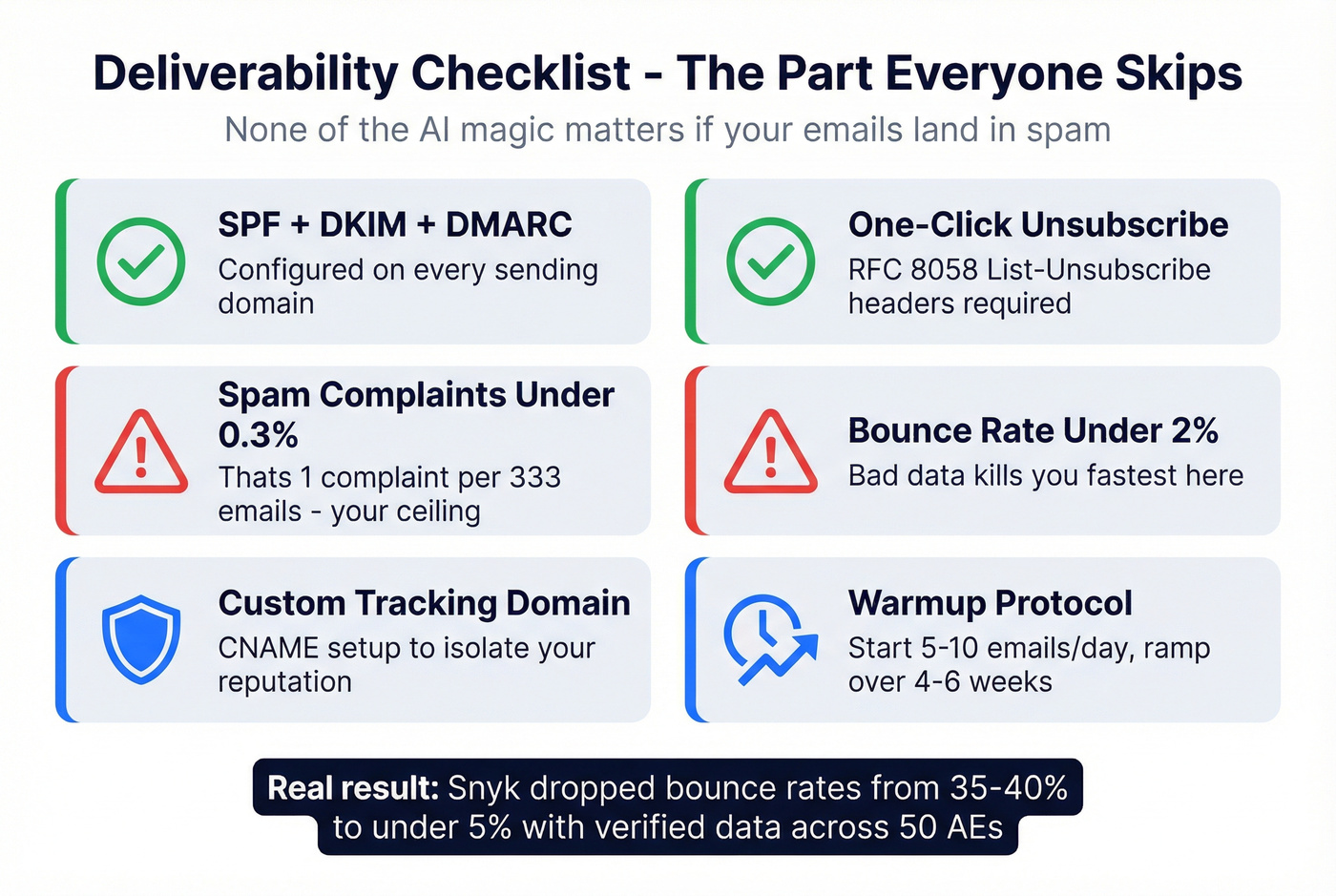
SPF + DKIM + DMARC on every sending domain, properly configured. One-click unsubscribe via RFC 8058 List-Unsubscribe headers. Spam complaints under 0.3% - one complaint per 333 emails is your ceiling. Bounce rate under 2%, which is where bad data kills you fastest. Custom tracking domain via CNAME to isolate your reputation.
Warmup protocol: start at 5-10 emails per day on new domains, ramp over 4-6 weeks. Don't scale until inbox placement tests show 80%+.
This is exactly where data quality becomes a deliverability issue. When Snyk rolled out verified data across 50 AEs, their bounce rate dropped from 35-40% to under 5%. Stack Optimize maintained 94%+ deliverability and zero domain flags across all clients. Verified data isn't a nice-to-have - it's the difference between inbox and spam folder.
Compliance in 2026
TCPA enforcement and state "mini-TCPA" rules got materially harder in the past 18 months, and most guides on automated outbound ignore this entirely.
The FCC's February 2024 ruling classified AI-generated voices as "artificial or prerecorded" under TCPA - AI voice calls require prior express written consent. TCPA litigation surged roughly 95% as of late 2025, and the Supreme Court's McLaughlin v. McKesson decision means district courts aren't bound by FCC interpretations, creating more litigation risk. Texas SB 140 expands "solicitation" to include texts with treble damages, Virginia SB 1339 requires honoring text opt-outs for 10 years and restricts outreach to 8am-9pm local time, and Connecticut, Georgia, and Maine are tightening their own rules.
Real talk: if you're scaling AI-driven outbound across multiple states, you need a compliance review - not just a checkbox in your sequencing tool.
Before you launch: SPF/DKIM/DMARC configured on all sending domains. One-click unsubscribe implemented. State-level opt-out rules reviewed for your target states.
90-Day Implementation Roadmap
Days 1-30: Foundation. Audit your existing data - how old are your contacts, and what's your current bounce rate? Clean existing lists with a verification tool before feeding them into sequencing. Set up SPF, DKIM, and DMARC . Purchase and begin warming 2-3 new sending domains. Budget 40-60 hours for this phase. It's tedious. It's also the single highest-ROI work you'll do in this entire process.
Days 31-60: Test and Learn. Launch with 100-200 test accounts. Send 5-10 emails per day per mailbox and monitor daily. Test 2-3 personalization approaches and measure which signals drive the highest response rates. Don't scale anything yet - this phase is where your pipeline generation efforts begin producing measurable data you can act on.
Days 61-90: Scale What Works. Double down on sequences and personas that hit the benchmarks above. Add channels: phone for prospects who open but don't reply, social for executives who ignore email. Increase sending volume gradually, never more than 20% per week. Measure pipeline per SDR per month against the $300K-$500K/quarter target.
FAQ
What separates AI outbound from traditional outbound?
AI outbound automates research, personalization, sequencing, and reply classification using real-time signal data - delivering 3-4x higher throughput at a fraction of the cost. Traditional outbound relies on manual SDR effort for each of those steps, capping output at 15-20 qualified opps per rep per month.
How much does an AI outbound stack cost?
A lean stack runs $150-$200/month total. Enterprise stacks with intent data and multi-channel orchestration run $2,000-$5,000/month. Compare either to a fully loaded SDR at $75K-$100K/year.
Can AI fully replace human SDRs?
Not for complex deals above $50K ACV. AI handles top-of-funnel volume brilliantly - research, first touch, follow-ups, reply sorting. Enterprise sales still need human judgment for objection handling, multi-threading, and relationship building.
What's a good reply rate for AI-powered cold email?
Average is 3.43%. Top-quartile teams hit 5.5%, and elite performers exceed 10.7%. Signal-personalized outreach using verified data consistently lands in the 15-25% range - the gap comes down to data quality and targeting precision.
How do I protect domain reputation when scaling?
Start with verified contact data (98%+ accuracy) to keep bounce rates under 2%. Configure SPF, DKIM, and DMARC on every sending domain. Warm new domains for 4-6 weeks before scaling. Pause immediately if bounce or spam complaint rates cross thresholds.
The throughline of every section above is the same: your AI outbound strategy is a data quality problem first and an AI problem second. Fix the data, and the AI works. Skip the data, and you're just burning domains faster.