

AI Prompts for Lead Generation That Actually Work
Sellers spend 71% of their time on non-selling tasks. Writing emails, researching prospects, qualifying leads - work that AI handles well when you prompt it correctly. The problem? Most "prompt lists" give you 50 disconnected templates with zero system behind them. You copy-paste one, get a mediocre output, tweak it for 20 minutes, and wonder why you bothered.
A common complaint on r/coldemail is that AI-generated emails drift in tone and lose context mid-sequence. That's not an AI problem - it's a prompting problem, and it's why most AI prompts for lead generation fail. Every other guide gives you prompts in isolation. This one chains them into a pipeline with data verification baked in.
Why Chained Prompts Beat Template Libraries
Five great prompts chained into a system beat 100 random prompts every time. We've tested dozens of prompt frameworks, and layered prompting consistently wins. Here's what actually matters:
- A prompt-writing framework so you can build your own prompts for any situation, not just copy templates
- 5-7 prompts organized by pipeline stage - ICP definition through follow-up sequences
- Verified contact data before you hit send, because bad data destroys domains faster than bad copy (see cold email lead list building)
- Basic compliance guardrails - GDPR fines can reach EUR 20M or 4% of global annual turnover, and they apply even if you aren't in the EU
How to Write Prompts That Work
Forget the "just ask ChatGPT" approach. The biggest mistake people make is treating AI like a search engine - short, vague queries expecting magic. Whether you're crafting ChatGPT prompts for lead generation or using Claude, the same four-phase structure consistently produces usable outputs.
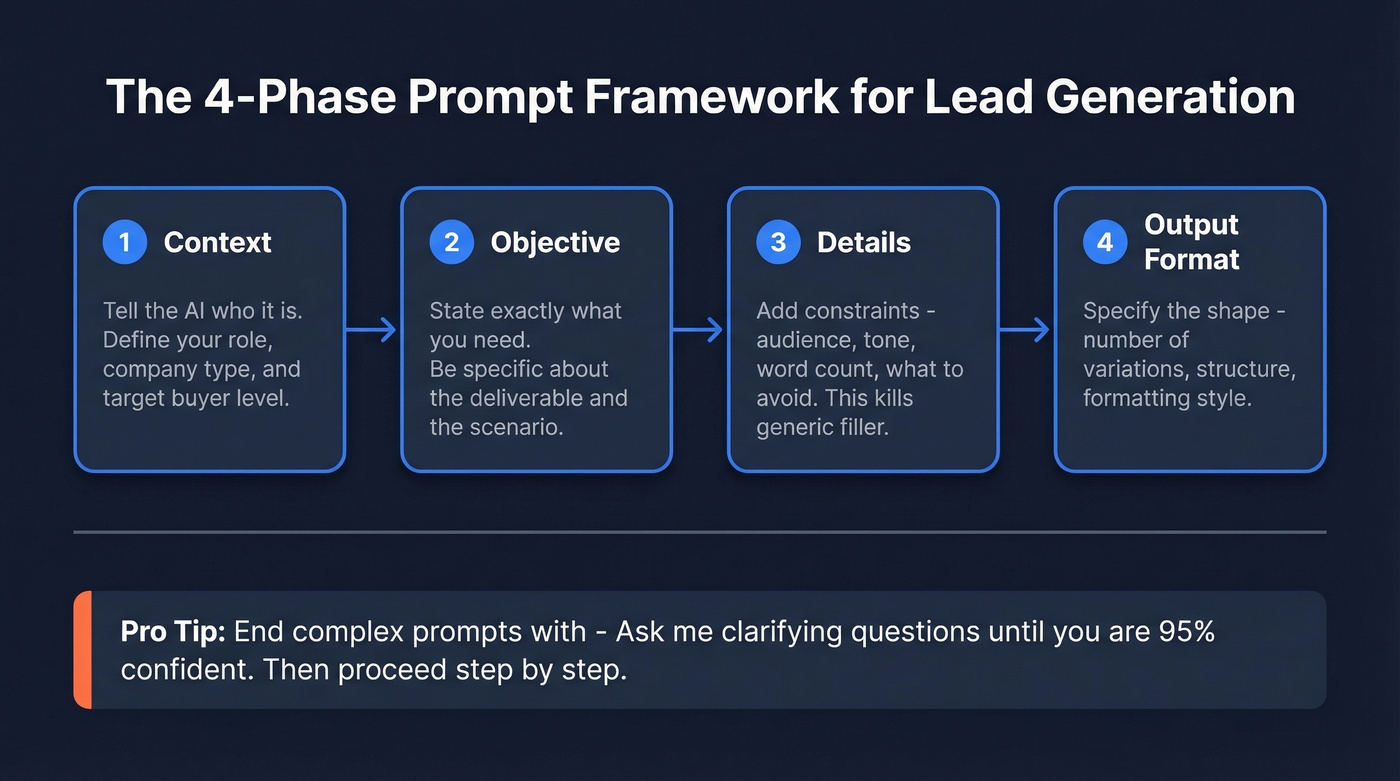
Phase 1 - Context: Tell the model who it is. "You're a senior SDR at a B2B SaaS company selling to VP-level buyers in fintech." That single sentence eliminates 80% of generic filler.
Phase 2 - Objective: State exactly what you need. "Write a cold email first-touch for a prospect who just raised Series B funding."
Phase 3 - Details: Add constraints. Audience, tone, word count, what to avoid. "Keep it under 60 words. Conversational tone. No hype words like 'revolutionary.'"
Phase 4 - Output format: Specify the shape. "Give me 3 variations. Each with a different subject line. Format as numbered list."
This maps to the 3 Cs framework that sales prompt engineers use. Other frameworks like TCREI follow the same principle - the labels change, but layered specificity is what matters.
One more trick: end every complex prompt with "Ask me clarifying questions until you're 95% confident you understand the task. Then proceed step by step." This single instruction - borrowed from a Reddit practitioner - forces the model to surface assumptions instead of guessing. It's a small change that dramatically improves output quality, especially for multi-step tasks like building qualification rubrics or writing full sequences.
Prompts by Pipeline Stage
Run all these prompts in a single thread so the model retains context from your ICP definition through follow-up sequences. Switching threads mid-pipeline is the fastest way to get generic, disconnected outputs.
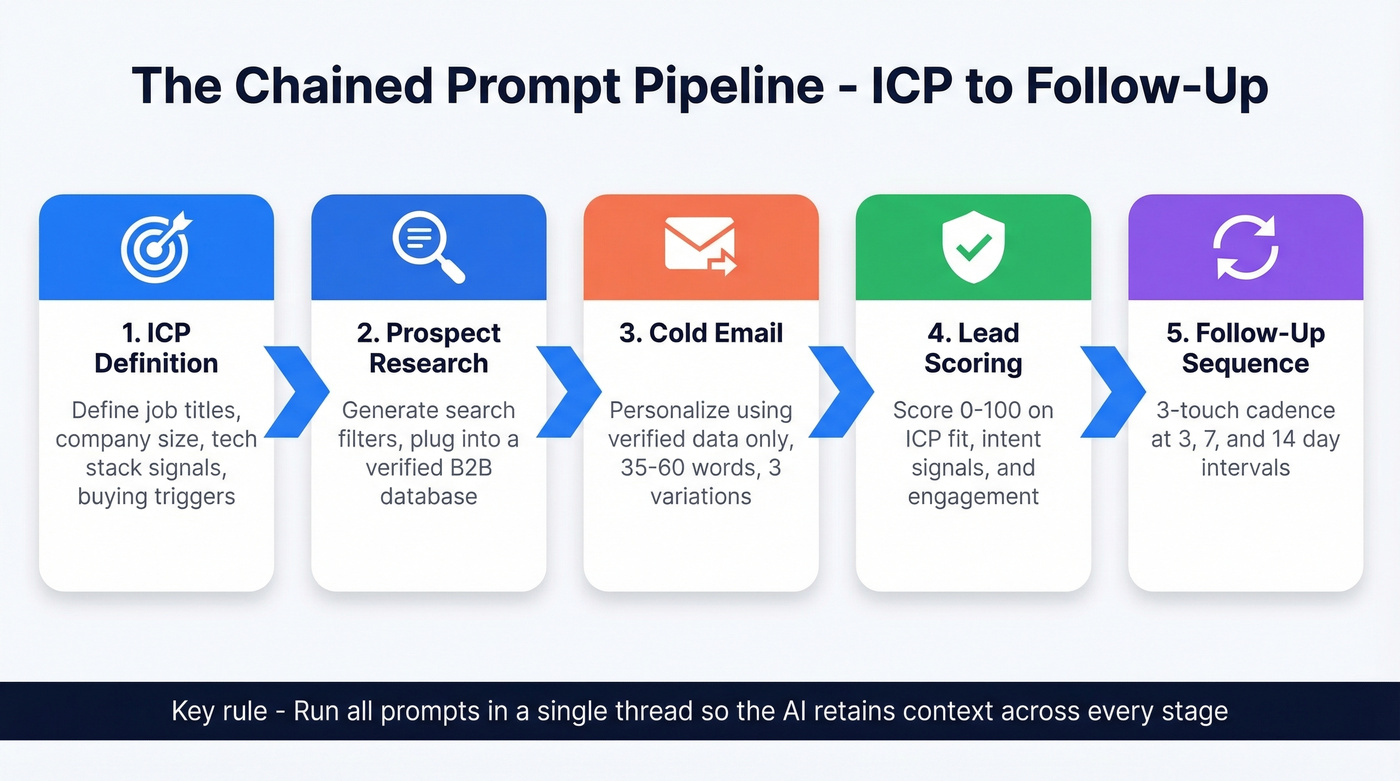
ICP & Persona Definition
Start here. Every downstream prompt depends on a sharp ICP.
Prompt: "You're a B2B growth strategist. My company sells [product] to [industry]. Our average deal size is [X]. Our best customers have [trait 1, trait 2, trait 3]. Build a detailed ICP with: job titles, company size, tech stack signals, buying triggers, and common objections. Format as a structured profile I can reference in future prompts."
This becomes your anchor document. Reference it in every subsequent prompt with "Use the ICP from our earlier conversation." Here's what a good output looks like (abbreviated):
Example output snippet: Target Title: VP of Revenue Operations | Company Size: 100-500 employees | Tech Stack Signals: Uses Salesforce + Outreach but no intent data provider | Buying Trigger: Recently posted a "Head of Demand Gen" role (signals pipeline pressure) | Top Objection: "We already have a data provider."
If your output looks nothing like this - too vague, too broad - your input was too vague. Add more detail about your best customers and re-run. (If you need a baseline, start with an ideal customer profile.)
Prospect Research & List Building
Once you've got an ICP, you need actual contacts. AI can define search criteria, but it can't source verified data on its own.
Prompt: "Based on our ICP, generate a prospect search query I can use in a B2B database. Include: target job titles (3-5), company size range, industry verticals, technographic signals (specific tools they'd use), and geographic filters. Format as a structured filter set."
Take the AI-generated filter set and plug it directly into Prospeo's database - 300M+ professional profiles with 30+ filters including buyer intent and technographics. The filter set maps almost 1:1 to the search interface, so you skip the manual translation step entirely. (If you're comparing options, see the best B2B database roundup.)
Cold Email Personalization
Token-only personalization - just swapping {{FirstName}} and {{CompanyName}} - reads robotic and triggers spam filters. Instantly's research identifies the safe patterns: use verified data only, instruct the model not to invent facts, generate variation across sends, and keep a human review step.
Here's the thing: the constraint pattern matters more than the specific words. "35-60 words, conversational, no hype" does the heavy lifting. (More examples: AI email personalization.)
Prompt: "You're an SDR writing a cold email first-touch. Use ONLY the following verified data about the prospect - do not invent or assume any facts: [Name], [Title], [Company], [Recent trigger: funding round / job change / tech adoption]. Write a 2-sentence opener (35-60 words max). Conversational tone, no hype, no buzzwords. End with a soft 15-minute meeting ask. Give me 3 variations with different subject lines (under 50 characters each)."
Subject line prompt: "Generate 5 subject lines for a cold email to [demographic]. Campaign goal: [goal]. Topic: [offer]. Constraints: under 50 characters, no ALL CAPS, no exclamation marks, no spam trigger words." (If you want more formulas, use these professional email subjects.)
Lead Qualification With Scoring
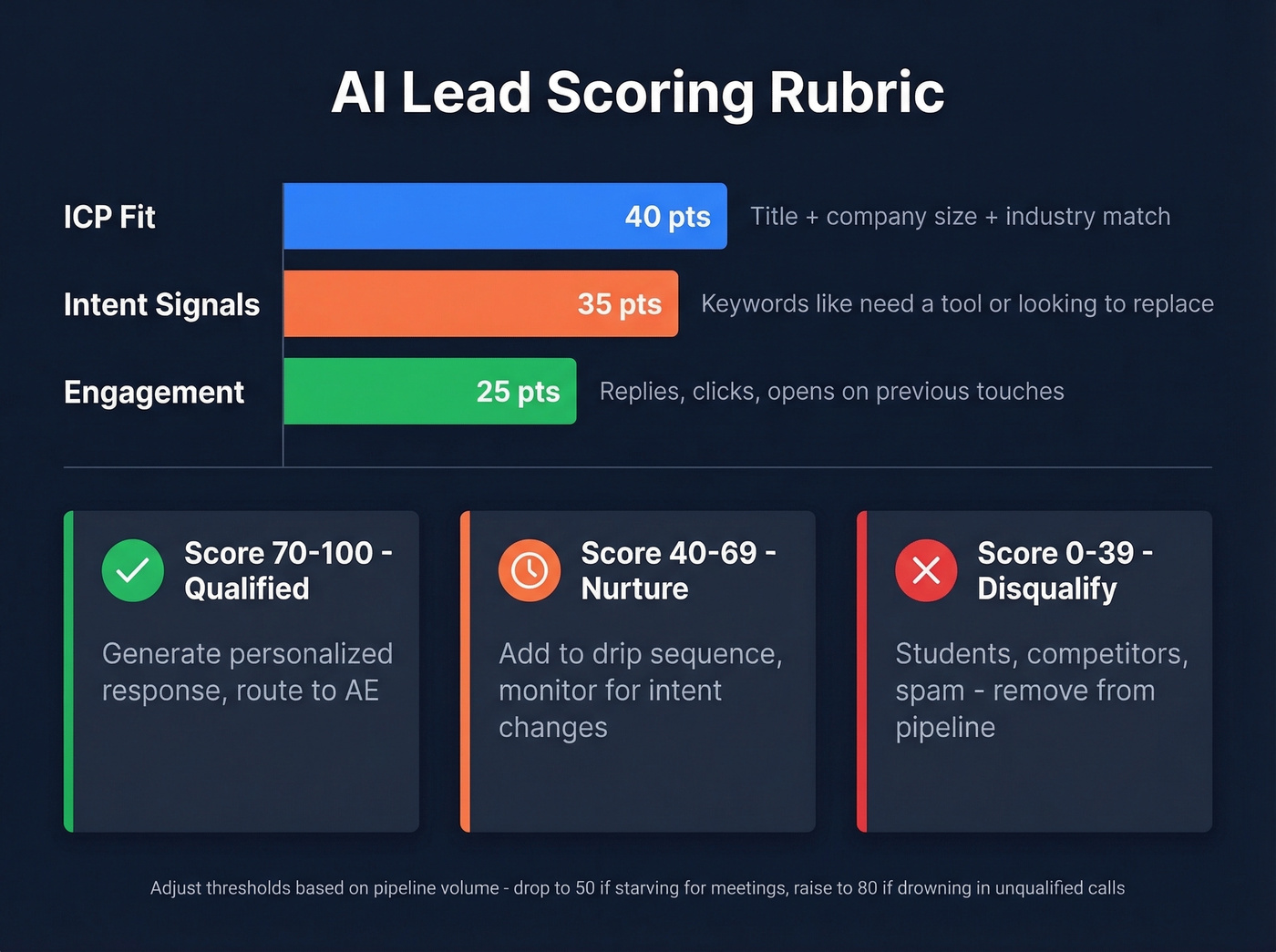
This is where most prompt lists stop - and where the real value starts. Before you write the prompt, define your scoring rubric:
| Signal | Weight | Example |
|---|---|---|
| ICP fit (title + company size + industry) | 40 points | VP Ops at 200-person SaaS company |
| Intent signals (keywords in conversation) | 35 points | "looking for a tool," "need to replace" |
| Engagement level (replies, clicks, opens) | 25 points | Replied to email 1, clicked case study link |
A structured system prompt from r/saasbuild shows how to build a qualification agent using this logic:
Prompt: "You're a lead qualification agent. Score each lead 0-100 based on: ICP fit (title, company size, industry - 40 points max), intent signals (keywords like 'need a tool,' 'looking for,' 'what do you recommend' - 35 points max), and engagement level (25 points max). Rules: disqualify immediately if the lead is a student, competitor, or spam. Confidence >= 70 = qualified, generate a 2-3 sentence response. Confidence 40-69 = nurture. Below 40 = disqualify. Output: lead name, score, reasoning, recommended action."
The gate at 70 prevents your reps from chasing low-intent leads. Starving for meetings? Drop to 50. Drowning in unqualified calls? Raise to 80. (If you want a broader framework, see outbound lead qualification.)
Follow-Up Sequences
Let's be honest: your follow-up sequence matters more than your first touch. Responding within 5 minutes makes you 100x more likely to connect vs. waiting an hour - and a pre-built sequence is the only way to move that fast at scale. (More cadence ideas: follow up email sequence strategy.)
Prompt: "Write a 3-touch follow-up sequence for a prospect who didn't reply to the initial cold email. Touch 1: 3 days after initial send, reference the original email briefly, add one new value point. Touch 2: 7 days later, share a relevant case study or stat. Touch 3: 14 days later, breakup email - short, direct, no guilt. Each touch under 50 words. Tone: helpful, not pushy. Vary sentence structure across all three."
Why these intervals? Three days is long enough that you aren't pestering, short enough that they still remember your first email. The 14-day breakup creates a natural close to the thread - and breakup emails consistently get the highest reply rates in cold outbound. We've seen this pattern hold across dozens of campaigns and thousands of sends.

You just built the perfect ICP prompt and generated a killer filter set. Now plug it into a database that actually delivers. Prospeo's 300M+ profiles with 30+ filters - including buyer intent and technographics - map directly to AI-generated search criteria. 98% email accuracy means your prompts won't go to waste on bounced sends.
Stop prompting into a void - connect prompts to verified data at $0.01/email.
Verify Before You Send
You've got the prompts. You've got the system. Now here's the step that separates campaigns that book meetings from campaigns that destroy your domain.
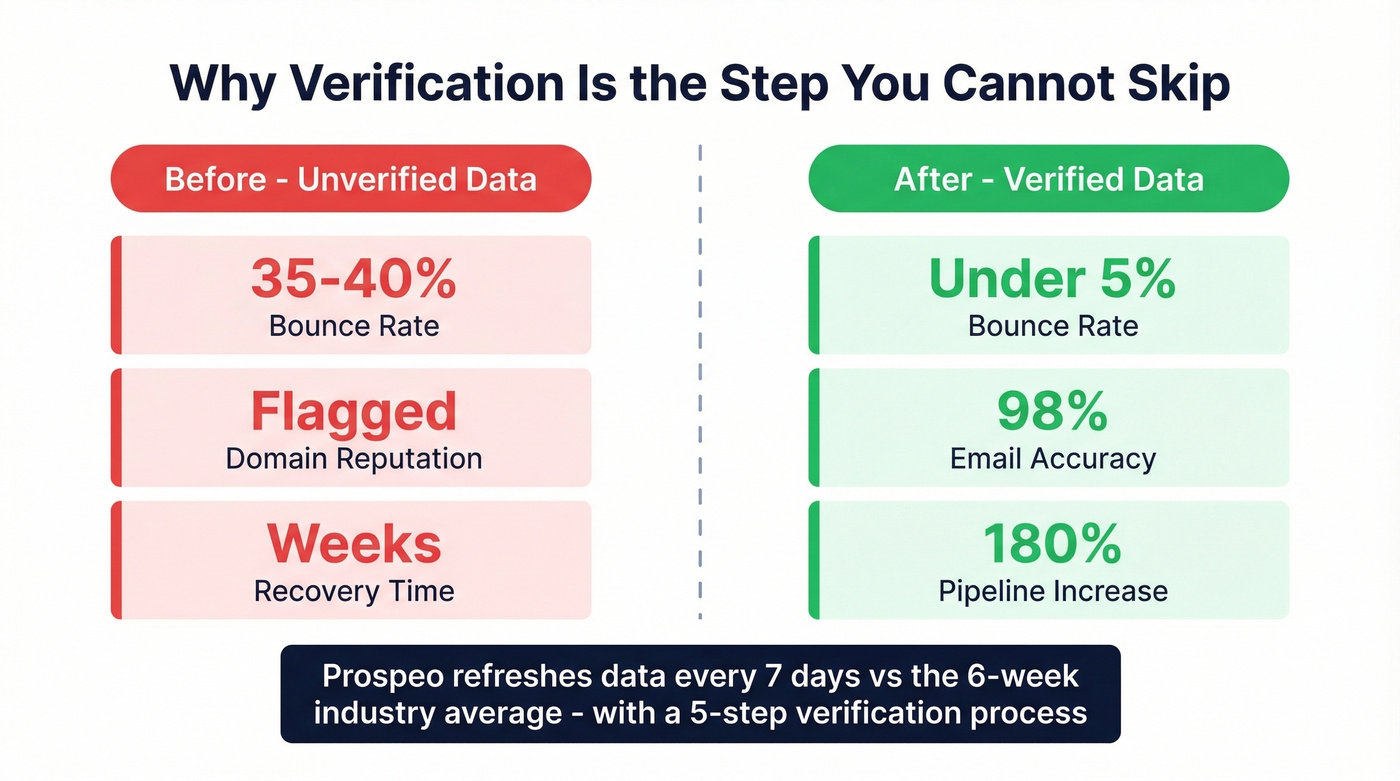
Picture this: you send 500 AI-personalized emails with beautiful copy, but 35% bounce because the data's stale. Gmail flags your domain. Your deliverability tanks for weeks. That's not hypothetical - Snyk's team saw bounce rates of 35-40% before switching to verified data, and it took significant effort to recover. After the switch, bounces dropped below 5% and their AE-sourced pipeline jumped 180%.
Google's bulk sender requirements now enforce authentication standards, complaint thresholds, and one-click unsubscribe expectations. Bad data makes compliance impossible. (If you're troubleshooting, start with an email reputation check.)
Prospeo handles this with 98% email accuracy, a 7-day data refresh cycle versus the 6-week industry average, and a 5-step verification process that catches spam traps and honeypots. The free tier gives you 75 emails per month - enough to test your first campaign without spending a dollar. (More options: best email verifier.)

The best AI prompts for lead generation don't matter if your emails never reach the inbox. (Related: inbox placement.)
AI-generated cold emails only convert when they reach real inboxes. Bad data kills deliverability faster than bad copy - one team cut their bounce rate from 35% to under 4% after switching to Prospeo. With a 7-day data refresh cycle and 5-step verification, every contact your prompts personalize actually lands.
Your prompts write the email. Prospeo makes sure someone reads it.
Compliance in 60 Seconds
Skip this section if you're only emailing US-based prospects with public business emails. For everyone else:
- GDPR fines reach EUR 20M or 4% of global annual turnover - whichever is higher. This applies even if your company isn't in the EU, as long as you're targeting EU residents.
- CAN-SPAM requires a visible opt-out mechanism in every commercial email.
- Include a one-click unsubscribe header for bulk sending. Gmail and Yahoo now expect this, and missing it hurts deliverability.
- Add a compliance check to your prompt workflow. Before generating any outreach, instruct the model: "Ensure all messaging includes an opt-out line and doesn't reference data the recipient hasn't made publicly available."
Tools to Pair With Your Prompts
| Tool | Best For | Price Range |
|---|---|---|
| ChatGPT | General prompt execution | Free - $20/mo |
| Claude | Long-context prompts & nuance | Free - $20/mo |
| Instantly | High-volume email sequences | ~$30-97/mo |
| Smartlead | Multi-mailbox rotation | ~$39-94/mo |
| Clay | Enrichment & workflow automation | ~$149-999/mo |
FAQ
Can I use free ChatGPT for these prompts?
Yes. Free ChatGPT handles every prompt in this article. GPT-4o (Plus, $20/mo) produces better outputs for complex qualification scoring, but the free tier is enough to build and run the full pipeline. The chained structure matters more than the model version.
How many prompts do I need for outbound?
Five to seven, chained in sequence: ICP definition, prospect research, personalization, qualification, and follow-up. A small set with shared context consistently outperforms a library of 100 disconnected templates. Run them in a single thread so the model remembers your ICP throughout.
What's the biggest mistake with AI-generated cold emails?
Sending to unverified contacts. A 35% bounce rate destroys your domain reputation and takes weeks to recover. Run every list through a verification tool first - Prospeo's free tier covers 75 emails/month, enough to validate your initial campaign before scaling.