

Best AI Sales Agent Software in 2026 - Real Pricing, Real Talk
A RevOps lead we know ran a three-tool AI SDR bake-off last quarter. The most expensive platform - $60K/year - generated 40% fewer qualified opportunities than a human rep making half that salary. The cheapest stack, built on clean data and a $200/month sequencer, outperformed both.
That's the AI sales agent software market right now: massive hype, real potential, and a lot of expensive lessons.
The AI SDR market is projected to hit $15B by 2030, with VCs pouring $400M+ into startups over the last two years. But here's the number nobody puts in the pitch deck: AI SDR tool churn runs 50-70% annually. More than half of buyers abandon these tools within a year.
Our Top Picks
- Best foundation layer (data accuracy): Prospeo - 98% verified email accuracy, 125M+ verified mobiles, free tier, no contracts.
- Best enrichment + workflow platform: Clay - the most flexible research and personalization tool on this list. Free tier available, paid from $185/mo.
- Best low-friction outbound: HubSpot Breeze - if you're already on HubSpot, this is the obvious first move. Starts at $15/mo per seat.
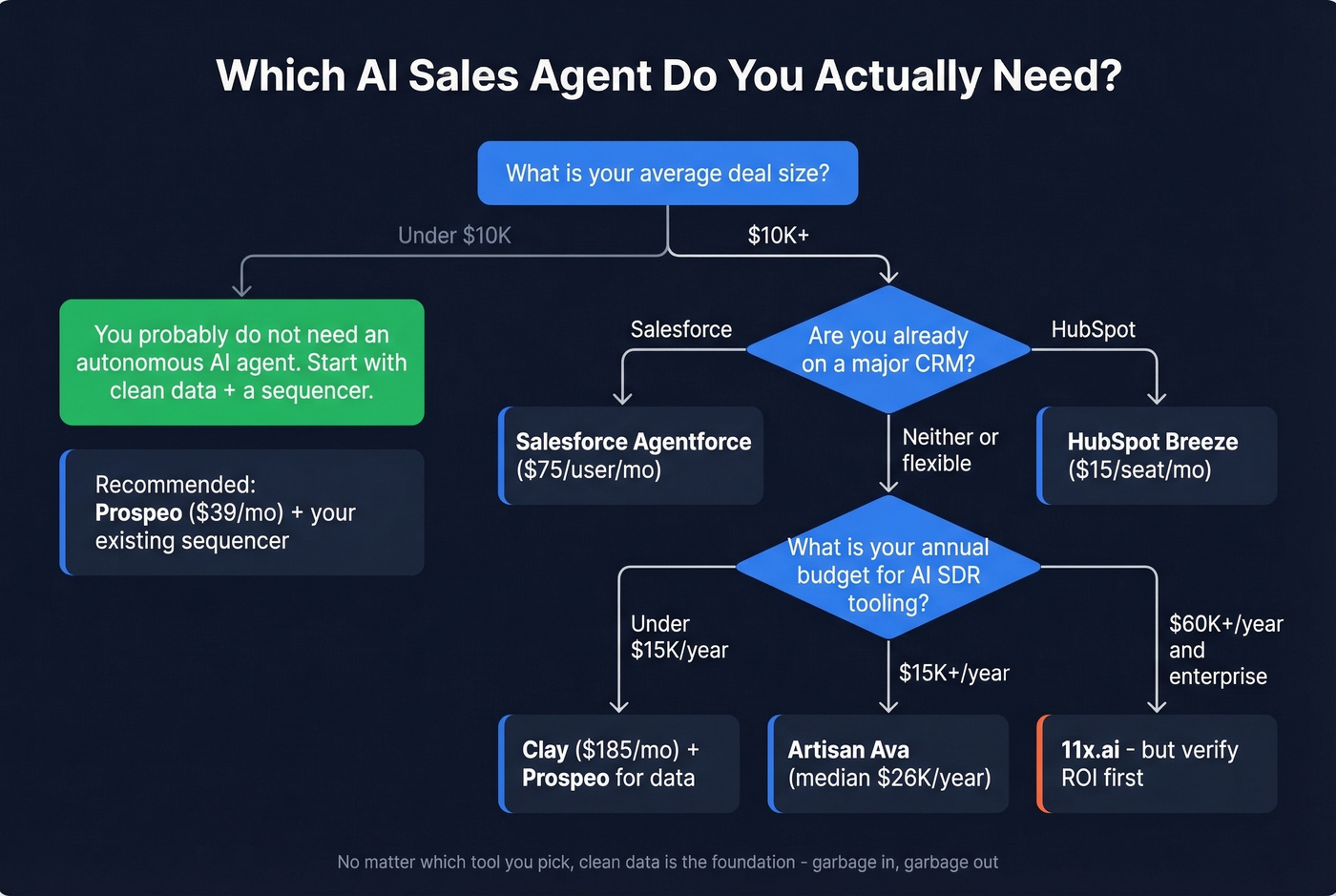
Here's the thing: most teams don't need a $50K/year AI SDR. They need clean data and a sequencer. If your average deal size sits below five figures, an autonomous AI agent is almost certainly overkill. Start with the foundation, then layer on autonomy once it works.
What AI Sales Agents Actually Are
The term "AI sales agent" covers everything from a glorified chatbot to a fully autonomous system that researches prospects, writes personalized emails, and books meetings without human input.
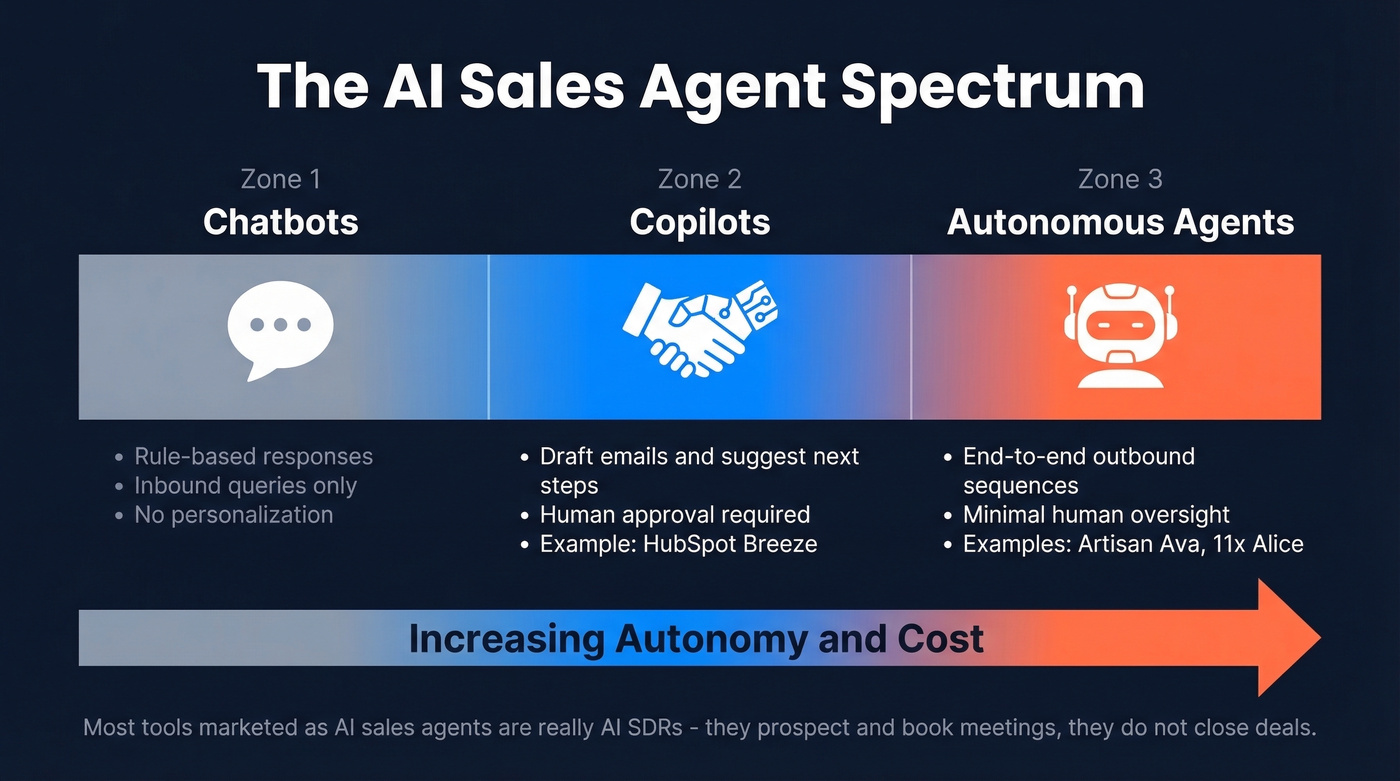
At the low end sit chatbots - rule-based responders handling inbound queries. In the middle are copilots like HubSpot Breeze that draft emails and suggest next steps but require human approval. At the top are autonomous agents like Artisan's Ava and 11x.ai's Alice, which run outbound sequences end-to-end with minimal oversight.
The typical workflow follows a predictable chain: data ingestion from your CRM and enrichment sources, prospect research using firmographic and intent signals, personalized message generation, automated sequence execution, and finally meeting booking when a prospect responds. Every link depends on the one before it. Feed bad data into step one, and nothing downstream matters.
Most tools marketed as "AI sales agents" are really AI SDRs - outbound email automation with an AI wrapper. They don't close deals or negotiate. They prospect and book meetings. That's useful, but calling it an "agent" oversells the reality. For context on how early this category is, coding agents like Cursor and Claude Code are each generating an estimated $1B+ ARR. Artisan, the highest-profile AI sales agent, sits around ~$5M ARR. On r/AI_Agents, this gap is a running joke - these tools aren't the next big thing yet. They're the next early thing.
Do AI Sales Agents Work?
Yes, with caveats. The data tells a split story.
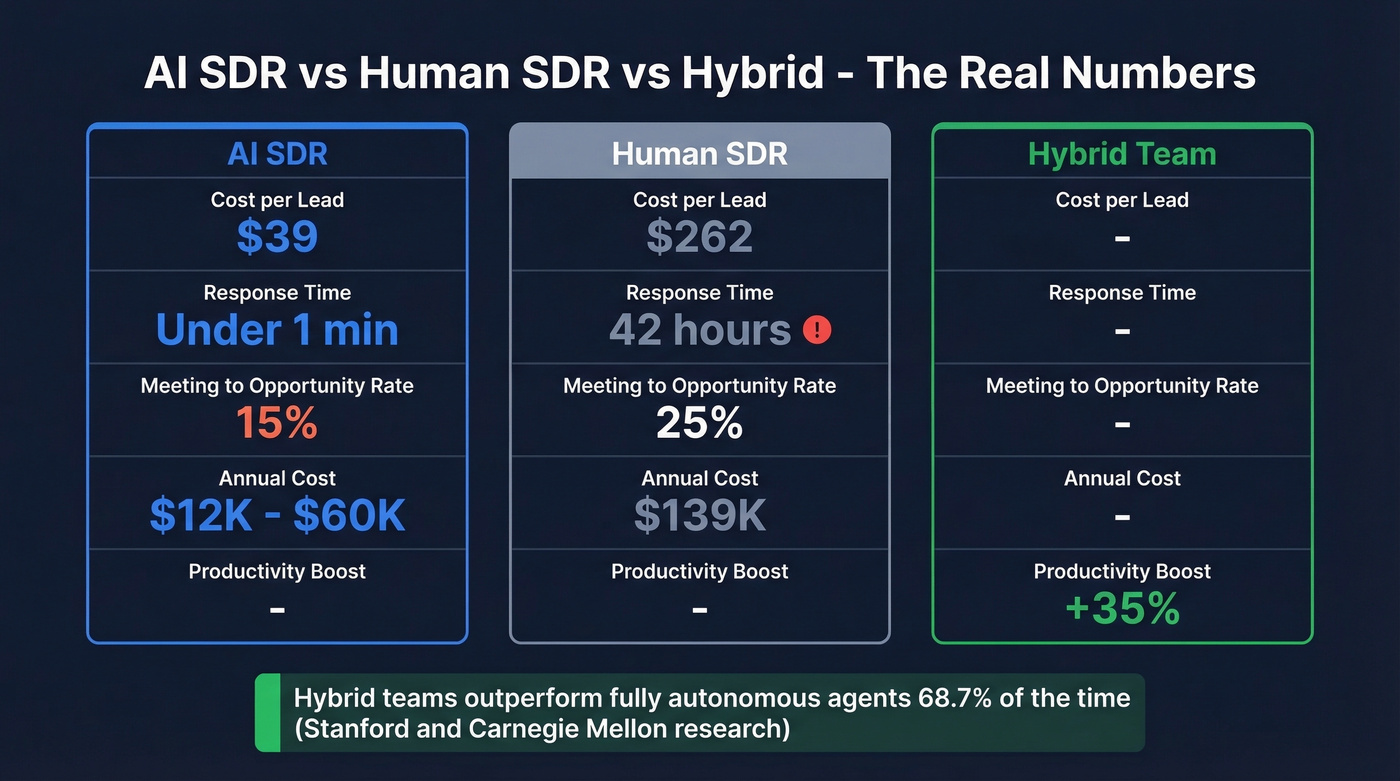
| Metric | AI SDR | Human SDR | Hybrid Team |
|---|---|---|---|
| Cost per qualified lead | ~$39 | ~$262 | - |
| Response time | <1 min | ~42 hrs | - |
| Meeting to opportunity | 15% | 25% | - |
| Annual cost | $12K-$60K | ~$139K | - |
| Productivity boost | - | - | +35% |
AI SDRs crush humans on speed and cost per lead. Sub-minute response time versus 42 hours isn't a contest. At $39 per qualified lead versus $262, the unit economics look compelling on a spreadsheet.
But look at the quality line. AI converts meetings to opportunities at 15% - humans hit 25%. That's a 40% quality gap. In one six-month experiment, a human SDR generated $147K in revenue versus $56K from AI, with a 71% meeting show rate versus 52%. When a human books a meeting, it's far more likely to become pipeline.
75% of B2B buyers now prefer a rep-free sales experience, which explains why autonomous agents have appeal despite the quality gap. Buyers want fast, low-pressure interactions, and AI delivers that.
The real winner? Hybrid teams. Stanford and Carnegie Mellon research found that hybrid human+agent teams outperform fully autonomous agents 68.7% of the time. Teams combining AI prospecting with human qualification see 35% productivity boosts and 2.5x revenue growth. The takeaway isn't "AI or human" - it's "AI and human, with clean data underneath both."

The article says it clearly: feed bad data into step one, and nothing downstream matters. Prospeo gives your AI sales agents a foundation of 300M+ profiles with 98% email accuracy, refreshed every 7 days - not every 6 weeks. At $0.01 per email, it costs less than a single failed AI sequence.
Fix the data layer before you spend $50K on an AI SDR.
10 Best AI Sales Agent Software Tools
Prospeo - Best for Data Accuracy
Use this if: You want the data layer that makes every other tool on this list actually work. Your AI agent can write the most personalized email in the world - if it bounces, none of it matters.
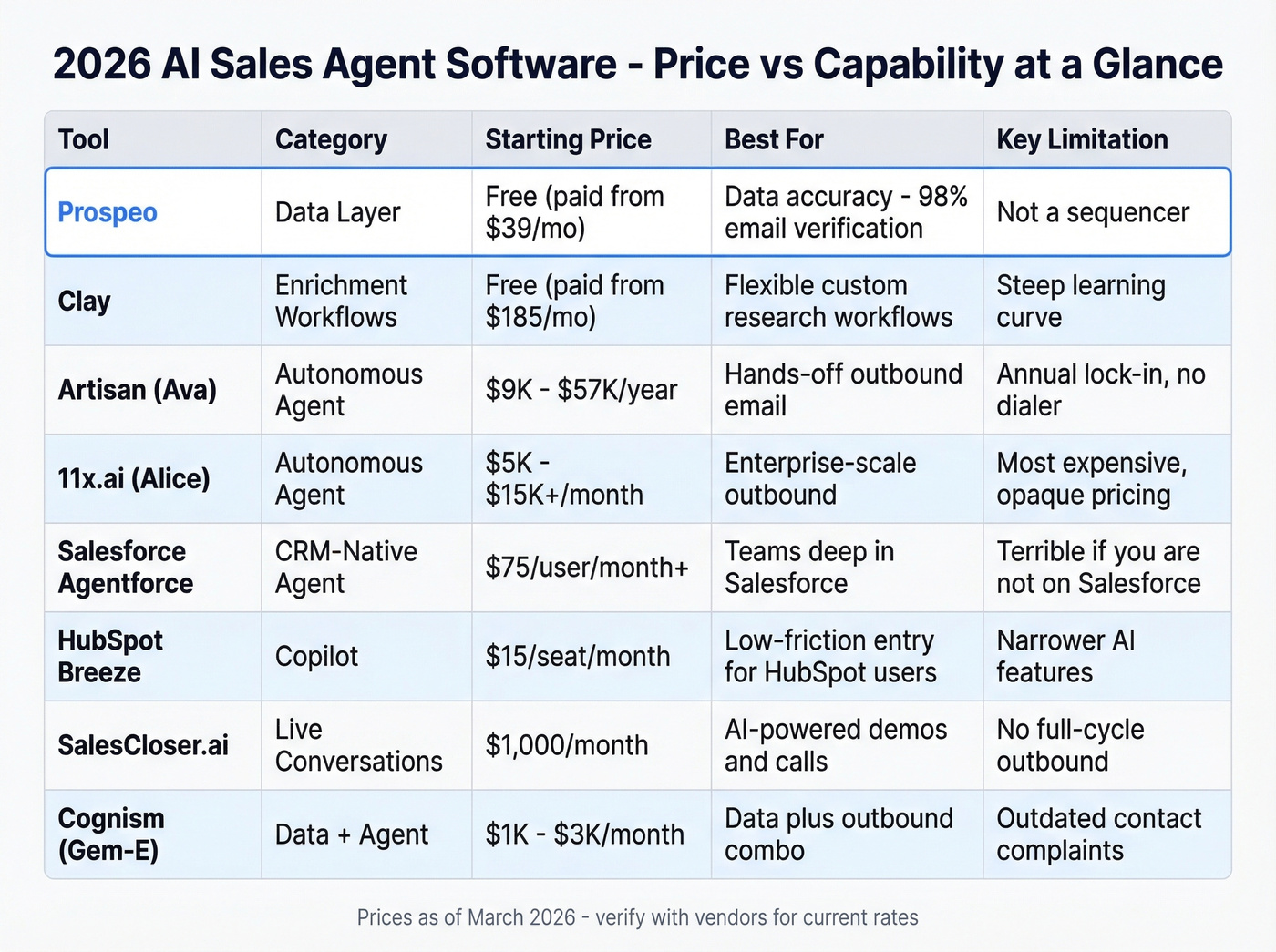
Prospeo's B2B database covers 300M+ professional profiles with 143M+ verified emails at 98% accuracy and 125M+ verified mobile numbers hitting a 30% pickup rate. The 7-day data refresh cycle is the fastest in the category - the industry average is six weeks. At $0.01 per email with a free tier of 75 emails/month, there's no contract and no sales call required.

We've seen the proof points firsthand. Snyk's 50-person AE team went from a 35-40% bounce rate to under 5%, generating 200+ new opportunities per month. Meritt tripled their pipeline from $100K to $300K per week. These aren't marginal improvements - they're the difference between a working outbound motion and a broken one.
Skip this if: You need a tool that autonomously writes and sends outbound sequences. Prospeo handles the data - pair it with a sequencer for the sending.
Clay - Best for Enrichment Workflows
Use this if: You want maximum flexibility to build custom enrichment and research workflows, and you're comfortable with a learning curve.
Clay isn't really an AI sales agent. It's a data workflow platform. But it's one of the most flexible tools for enrichment and research, and in our experience, it pairs exceptionally well with a clean data source underneath.
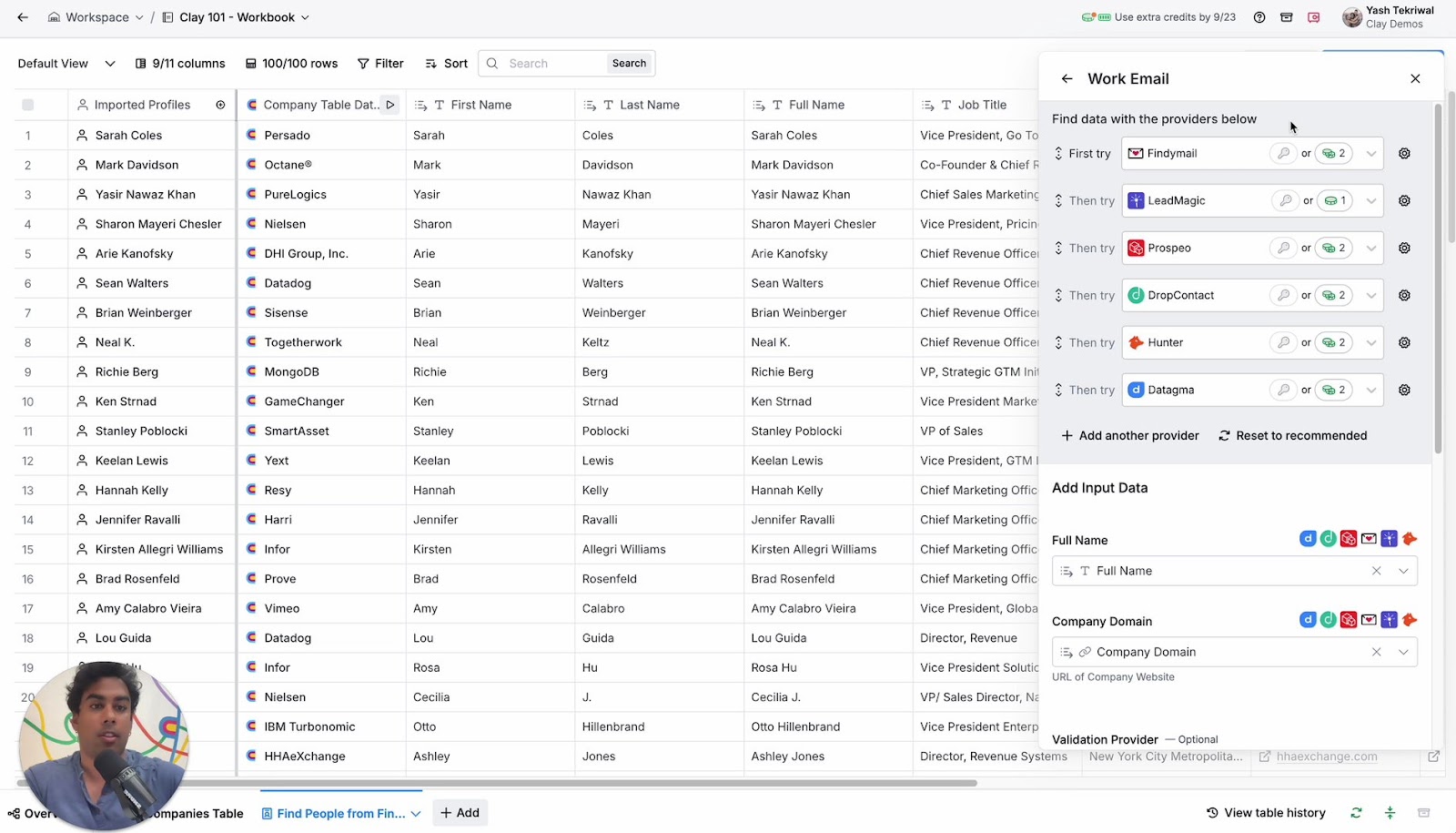
Clay's March 2026 pricing overhaul brought meaningful changes: Launch at $185/mo with 2,500 data credits, Growth at $495/mo with 6,000 credits, and a free tier with 100 credits. Data marketplace costs dropped 50-90%, and they no longer charge for failed lookups - you're not burning credits on dead ends.
Skip this if: You want a plug-and-play AI SDR that runs autonomously. Clay requires building workflows, which means time and technical comfort. It's a power tool, not an autopilot.
Artisan (Ava) - Autonomous Outbound Email
Artisan's Ava is the highest-profile AI SDR on the market. It runs on a 300M+ contact database, enriches prospects with fundraising, news, technographics, and hiring signals, and includes deliverability tooling like warmup and send-limit management.

Here's where it gets interesting. Vendr procurement data across 6 real purchases shows Artisan contracts ranging from $9,248 to $57,000/year, with a median of $26,250/year. At that median, you're paying close to what a junior SDR costs - for AI that converts meetings to opportunities at 40% lower rates than a human. The annual contract lock-in, no dialer, and no website visitor ID are real limitations.
Skip this if: Your budget is under $10K/year, you need phone outreach, or you're not ready to commit to an annual contract before seeing results.
11x.ai (Alice & Jordan) - Most Expensive, Most Opaque
11x.ai is the priciest name in AI sales agents. Pricing runs $5,000-$15,000+/month, which translates to $60K-$180K+/year, with annual commitments standard and no free trial.
The fact that 11x.ai doesn't publish pricing - while charging more than a senior SDR's salary - tells you everything about how they view their buyers. No proprietary database, no built-in dialer, and no website visitor ID. If you've got enterprise budget and enterprise patience, it's worth a demo. Otherwise, look elsewhere.
Salesforce Agentforce - For Native Teams
Salesforce's Agentforce bundles AI capabilities into the ecosystem you're probably already paying for. Einstein add-ons start at $75/user/month, with Revenue Intelligence running $220/user/month on top of your existing platform costs.
The obvious choice if you're deep in Salesforce. A terrible choice if you're not. Once your workflows, data, and reporting live in Salesforce, switching costs become astronomical - but for teams already committed, Agentforce eliminates the integration headaches that plague standalone tools.
HubSpot Breeze - Best for Existing Users
HubSpot Breeze is the lowest-friction entry point on this list. Included in Sales Hub Professional, it starts at $15/mo per seat and scales to $150/mo per seat for enterprise features. If you're already running HubSpot, Breeze adds AI-assisted email drafting, lead scoring, and prospecting without a new vendor relationship or integration project.
The tradeoff is capability depth - Breeze's AI features are narrower than standalone AI SDR tools like Artisan or 11x.ai. For most SMB and mid-market teams, that's fine. You don't need a $50K autonomous agent when a copilot inside your existing CRM handles the bulk of the work.
SalesCloser.ai - Best for Live Conversations
SalesCloser.ai occupies a unique niche: AI that handles live calls and demos, not just email sequences. At $1,000/month for one AI agent ($2,500/month for five), it integrates with Zoom and phone systems to run actual conversations.
This is genuinely different from everything else here. The limitation is scope - SalesCloser excels at demos and qualification calls but doesn't handle full-cycle outbound prospecting. A specialist, not a generalist.
Cognism (Gem-E) - Data + Agent Combo
Cognism combines its B2B database with the Gem-E AI agent for outbound workflows. G2 rates it 4.5/5 from 1,318 reviews, with praise for ease of use and CRM integrations. Pricing typically runs $1,000-$3,000/month.
The catch: G2's top complaints center on outdated contacts and incorrect phone numbers - the exact problems that undermine AI agent performance. If your AI SDR is only as good as its data, those quality gaps become your pipeline's ceiling. Worth testing a sample before committing.
If you're comparing data quality head-to-head, see our breakdown of Cognism.
Common Room - Signal-Based Selling
Common Room's RoomieAI agent focuses on signal-based selling, tracking community activity, product usage, and intent signals to trigger outreach at the right moment. Starter plans begin at $1,000/month for 2 seats, with Team plans from $2,500/month. A strong fit if your buyers are active in communities and your sales motion is product-led.
Relevance AI - Budget Agent Builder
Relevance AI lets you build custom multi-step AI agents without code. It offers a free plan, and paid plans start at $19/month. Agent workflows can cut process completion time by 60%. For teams that want to prototype a custom sales agent workflow before committing to an expensive platform, this is where to start.
Pricing Comparison
| Tool | Starting Price | Annual Range | Contract? | Free Tier? |
|---|---|---|---|---|
| Prospeo | $0.01/email | $0+ (usage-based) | No | Yes |
| Clay | $185/mo | $2,220-$5,940/yr | No | Yes |
| Relevance AI | $19/mo | $228+/yr | No | Yes |
| HubSpot Breeze | $15/mo/seat | $180-$1,800/yr per seat | No | - |
| SalesCloser.ai | $1,000/mo | $12K-$30K/yr | No | No |
| Common Room | $1,000/mo | $12K-$30K/yr | Typical | No |
| Cognism | ~$1,000/mo | $12K-$36K/yr | Typical | No |
| Artisan (Ava) | ~$770/mo | $9K-$57K/yr | Yes | No |
| Salesforce Agentforce | $75/user/mo | Varies widely | Typical | No |
| 11x.ai | ~$5,000/mo | $60K-$180K+/yr | Yes | No |
The spread is enormous - free to more than a senior hire's salary. That range alone should tell you to test before you commit.
How to Pick the Right Tool

Don't start with the flashiest tool. Start with your actual problem.
"Our emails bounce and our data is stale." Fix the foundation with verified data before you automate on top of it. No AI agent can outrun a 30% bounce rate. If you’re shopping options, start with a verified contact database and a dedicated email verifier.
"We need custom enrichment and research workflows." Clay. Build exactly the workflow you need, but feed it clean data or you're just automating garbage. If you want more options, compare the best data enrichment tools.
"We want autonomous outbound email at scale." Artisan or 11x.ai, if you've got the budget and the patience for annual contracts. Be honest about whether your deal size justifies the spend.
"We need AI to handle live calls and demos." SalesCloser.ai. Nothing else on this list does this. If phone is core to your motion, tighten fundamentals with phone sales skills.
"We're already on HubSpot or Salesforce." Breeze or Agentforce. Don't add a new vendor when your CRM already has AI built in. If you’re modernizing ops, look at CRM automation software.
Let's be real about what we'd actually recommend. If we had to pick three tools to trial first, it'd be Prospeo + Clay + HubSpot Breeze. Total cost for a small team can come in under $500/month. That stack gives you verified data, flexible enrichment, and AI-assisted outbound without a single annual contract.
Mistakes That Kill AI Agent ROI
Deploying on dirty data. Gartner predicts 60% of 2026 AI projects will be abandoned because underlying data isn't AI-ready. A 98% email accuracy rate and a 7-day refresh cycle are the minimum bar - anything less and your AI agent is automating failure.
Expecting full autonomy too soon. Hybrid human+agent teams outperform fully autonomous agents 68.7% of the time. Start with AI as a copilot, not a replacement. I've watched teams blow $40K on an autonomous agent before they even had a clean contact list - don't be that team.
Ignoring the quality gap. AI books meetings at 15% conversion to opportunity versus 25% for humans. Volume without quality is just noise in your pipeline.
Signing annual contracts before testing. With 50-70% annual churn in AI SDR tools, locking into a $26K+ annual contract before proving ROI is reckless. Insist on a pilot period or choose tools with monthly billing. Even the best AI sales agent software can't deliver if it's the wrong fit for your sales motion.
Skipping security basics. Prompt injection attacks are real. Any AI agent with access to your CRM and email needs zero-trust architecture, access controls, and audit logging. Don't give an autonomous agent the keys to your customer data without guardrails.
If you’re trying to build more pipeline with fewer tools, start with these pipeline generation ideas and a tighter RevOps tech stack.
Snyk cut their bounce rate from 35-40% to under 5% and generated 200+ new opportunities per month. Meritt tripled pipeline from $100K to $300K per week. The difference wasn't a fancier AI agent - it was verified contact data underneath. 143M+ verified emails, 125M+ verified mobiles, no contracts.
Your AI agent writes the email. Prospeo makes sure it lands.
FAQ
How much does AI sales agent software cost?
Prices range from free tiers to $180K+/year for enterprise 11x.ai contracts. Most mid-market teams spend $1,000-$5,000/month. Start with free tiers and monthly plans before committing - churn data shows most teams switch within a year.
Can AI sales agents replace human SDRs?
Not yet. AI SDRs convert meetings to opportunities at 15% versus 25% for humans, and hybrid teams outperform fully autonomous agents 68.7% of the time. Use AI for volume and speed; keep humans for qualification and relationship-building.
What's the biggest reason AI sales agents fail?
Bad data. Gartner predicts 60% of 2026 AI projects will be abandoned because underlying data isn't AI-ready. A tool with 98% accuracy and a 7-day refresh cycle solves this - if your contact list is stale, no amount of AI sophistication saves your outbound.
How do I keep AI agent emails from bouncing?
Use a verification tool with at least 95% accuracy and weekly data refreshes to clean your contact list before feeding it to any outbound platform. Target under 5% bounce rate - anything higher damages domain reputation and tanks deliverability for every future campaign.
How long until I see ROI from these tools?
Expect 2-4 months for meaningful pipeline impact. Hybrid teams see 35% productivity boosts and 2.5x revenue growth, but only with clean data and proper implementation. Matching the right platform to your team's size and deal complexity matters just as much as the data underneath it.