

The Best AI Tools for Email Marketing in 2026: Ranked by What Actually Matters
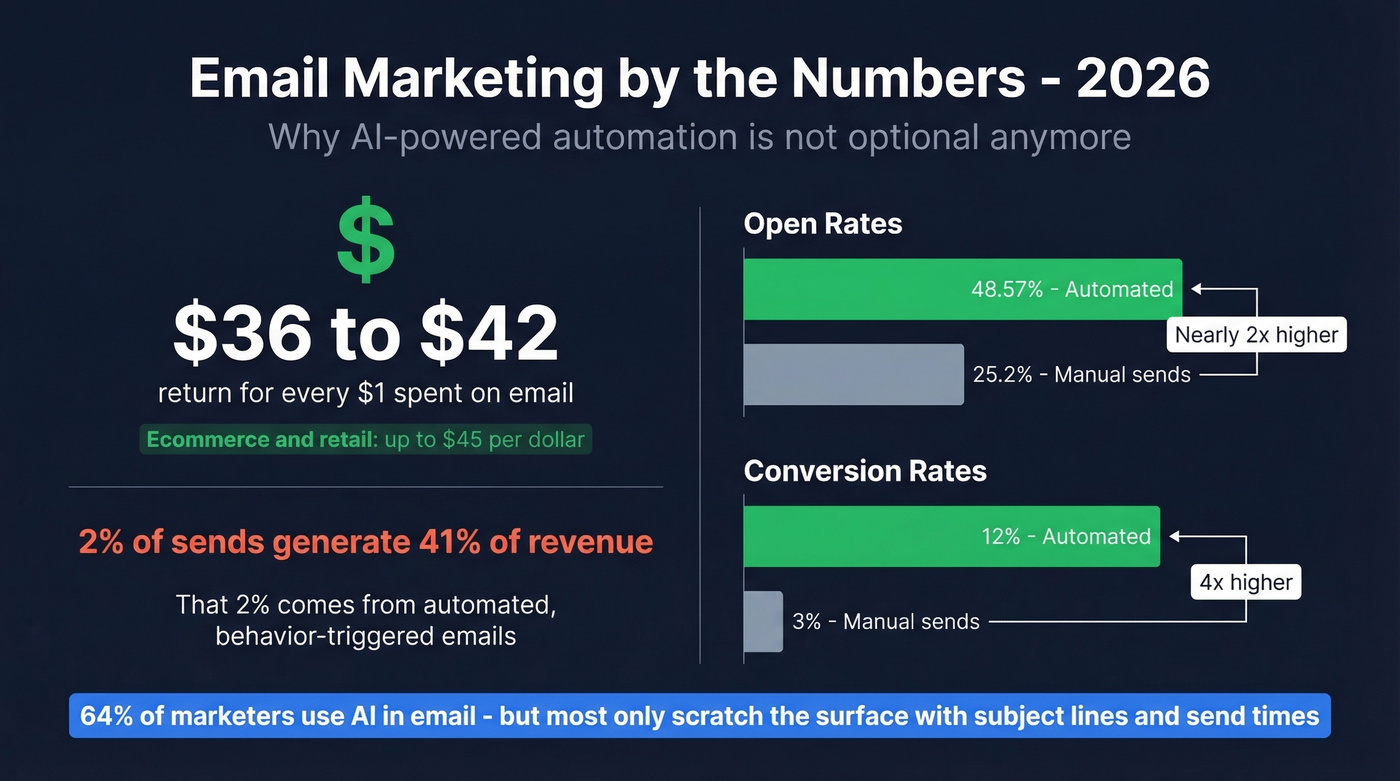
Email marketing returns $36-$42 for every $1 spent. Retail and ecommerce brands see even higher - up to $45 per dollar. But here's the number that should keep you up at night: 2% of your send volume generates 41% of your total email revenue. That revenue concentration comes from automated, behavior-triggered email, not from blasting the same newsletter to everyone.
The gap between teams using AI well and teams sending generic newsletters is widening fast. 64% of marketers now use AI in their email programs, but most only scratch the surface - a subject line generator here, a send-time toggle there. The teams winning have built AI into every layer of their stack, from the contact data they start with to the copy that hits the inbox.
Here's the thing: there's no single "AI email marketing tool." That framing is the problem with most guides. You need a stack - typically two to four tools working together. A data foundation, an ESP with native AI, and maybe a content or coaching layer on top. The tools that try to do everything usually do nothing well.
We've tested most of these platforms across client engagements and internal campaigns. What follows isn't a list of 30 tools with identical descriptions. It's the tools that actually move metrics, organized by the layer of your email stack they serve.
Our Top Picks
| Pick | Tool | Best For | Starting Price |
|---|---|---|---|
| Best data foundation | Prospeo | Verified contacts & list hygiene | Free (75 emails/mo) |
| Best overall AI ESP | ActiveCampaign | Advanced automation + AI | $15/mo |
| Best for ecommerce | Klaviyo | Shopify/WooCommerce AI | Free (250 profiles) |
| Best budget all-in-one | Brevo | Free tier + automation + SMS | Free (300 emails/day) |
| Best AI copywriting layer | Jasper | Brand-voice email content | ~$39/mo |
Most guides won't give you this take: if your average deal size stays below five figures, you probably don't need an $800/mo HubSpot plan or a 12-tool martech stack. You need two to four tools, chosen deliberately. One for data quality - because 16.9% of emails never reach the inbox. One ESP with real AI built in. And optionally, a content or coaching tool if your team writes at volume. That's the stack. Everything else is noise.
The AI Email Marketing Stack
Most "best AI email tools" articles dump 20 platforms into a flat list. That's useless. Comparing Jasper to ActiveCampaign is like comparing a copywriter to a marketing automation platform - they aren't competing.
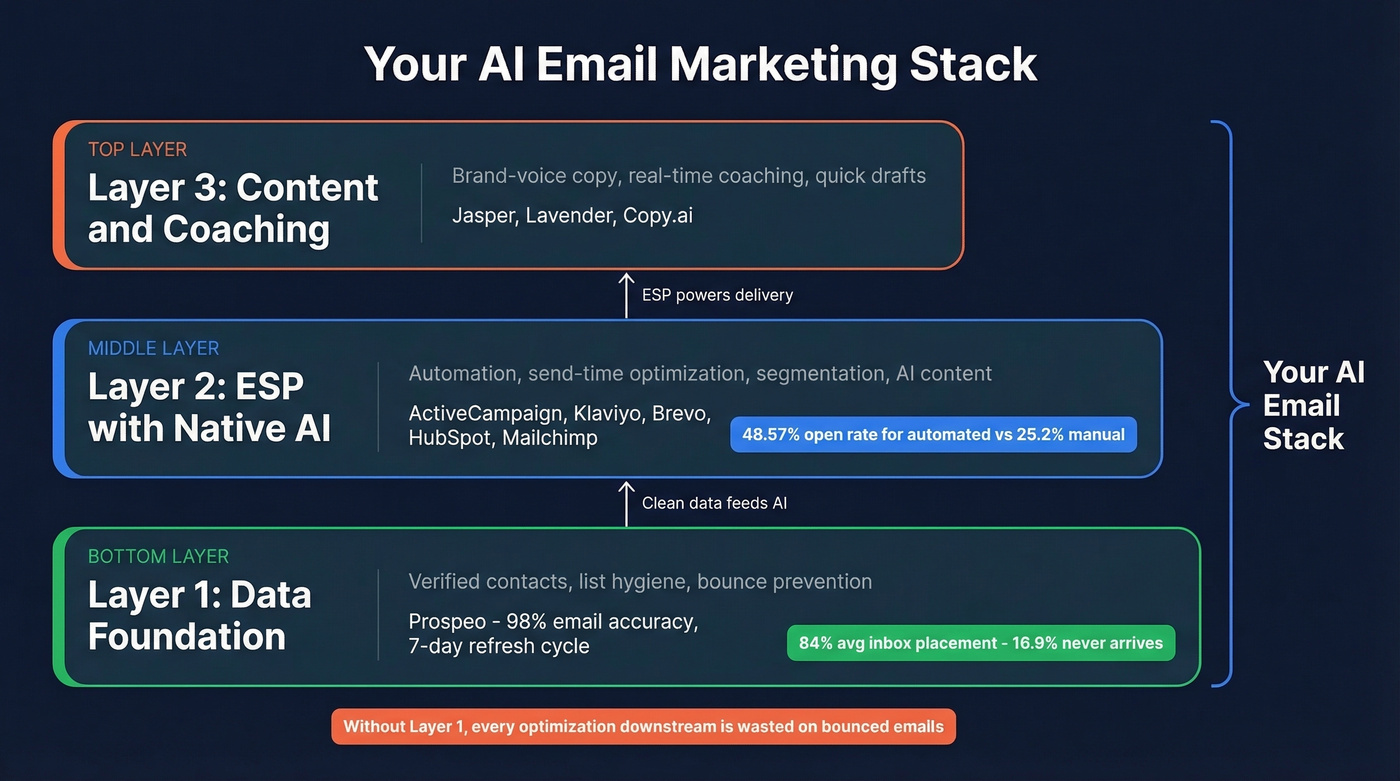
Three layers:
Layer 1: Data Foundation. Your contact data - verified emails, clean lists, accurate segmentation inputs. Without clean data, every AI optimization downstream gets wasted on emails that bounce or land in spam. (If you're building lists from scratch, see build an email list.)
Layer 2: ESP with Native AI. Your sending platform - ActiveCampaign, Klaviyo, Brevo, HubSpot, Mailchimp, and others. These handle automation, send-time optimization, segmentation, and increasingly, AI-generated content and workflows. (If you're comparing platforms, ActiveCampaign vs HubSpot is a useful starting point.)
Layer 3: Content & Coaching Tools. Bolt-on AI for writing better emails - Jasper for brand-voice copy, Lavender for real-time coaching, Copy.ai for quick drafts. These layer on top of your ESP, not instead of it. (For more options, see our AI email writer roundup.)
Some teams are adding a fourth layer - behavioral analytics tools like Amplitude or Mixpanel - to feed richer signals into their ESP's AI. Worth watching, but for most teams, three layers cover it.
The broader industry is shifting toward agentic AI in email platforms, where an autonomous agent proactively acts on your behalf rather than waiting for instructions. ActiveCampaign's Spring 2026 launch is the clearest example so far, but expect every major ESP to follow.
Why does this framework matter? Automated emails see 48.57% open rates versus 25.2% for manual sends, and conversion rates of 12% versus 3%. But automation built on dirty data doesn't just underperform - it actively damages your sender reputation. Average inbox placement sits at just 84%. The other 16.9% never reaches a human being. Layer 1 isn't optional. (If you're troubleshooting, start with inbox placement.)
Layer 1: Data Quality (The Foundation Everyone Skips)
Every email marketing guide skips this part. They jump straight to ESPs and assume your contact list is clean. It's not. If your bounce rate is above 2%, that's an immediate red flag - and most teams don't even know their real bounce rate until they've already damaged their domain reputation. (If you need a deeper fix, use an email reputation check.)
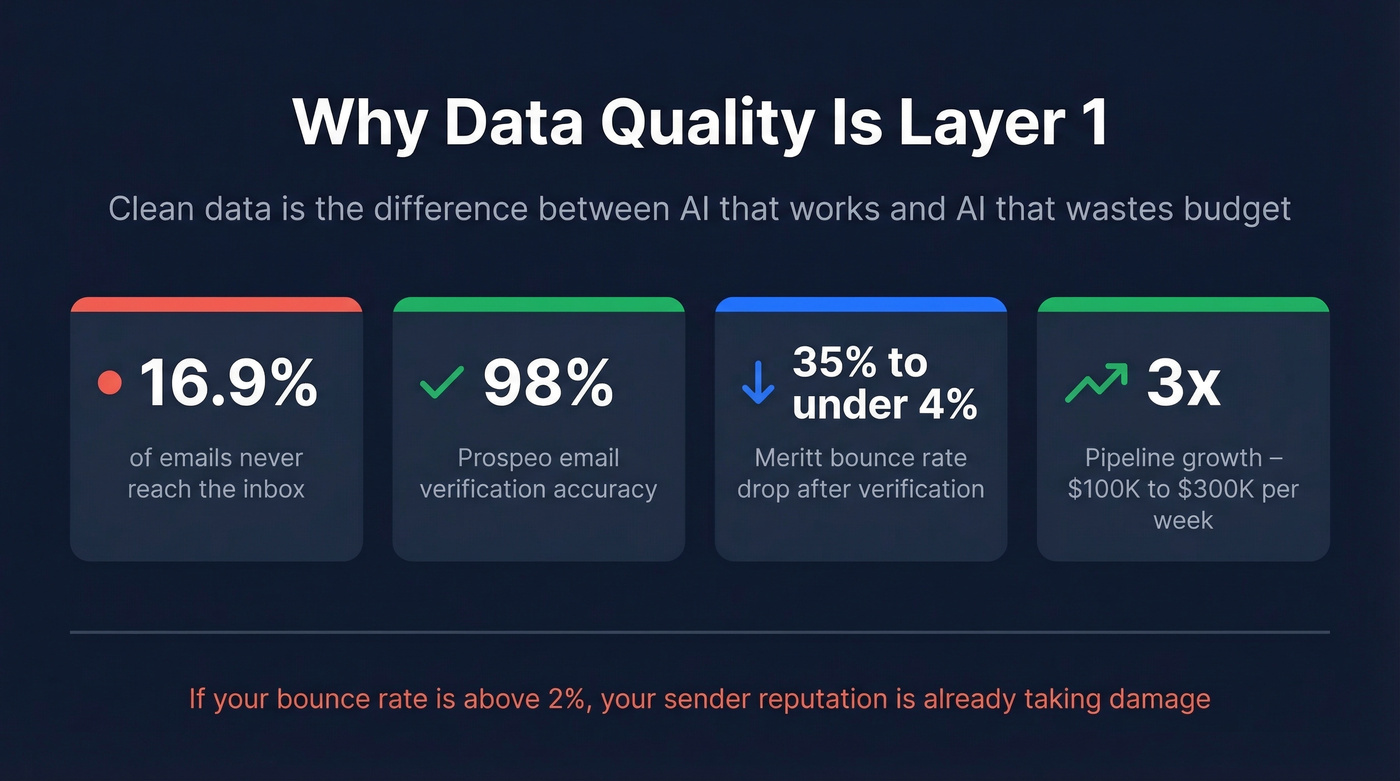
Prospeo sits at this layer. Its 5-step verification process - catch-all handling, spam-trap removal, honeypot filtering - delivers 98% email accuracy across 143M+ verified emails. What makes it particularly relevant for email marketing is the 7-day data refresh cycle. The industry average is six weeks. In that gap, people change jobs, emails go stale, and your carefully segmented list decays. Weekly refresh keeps your data current, which directly impacts deliverability.
The free tier gives you 75 verified emails per month - enough to audit a segment of your list and see the difference before committing. (If you're evaluating options, compare email verifier tools.)
One example of what clean data changes fast: Meritt tripled their pipeline from $100K to $300K/week, and their bounce rate dropped from 35% to under 4% after tightening their verification workflow.

For teams running automated sequences, pairing verified data with your ESP means your AI-optimized send times and personalized content actually reach real inboxes. The smartest subject line in the world doesn't matter if it bounces.

16.9% of emails never reach the inbox. Every AI optimization - send-time, subject lines, personalization - is wasted on bad data. Prospeo's 5-step verification delivers 98% email accuracy with a 7-day refresh cycle, so your automated sequences actually land.
Fix Layer 1 before you spend another dollar on your ESP.
Layer 2: Best AI-Powered ESPs
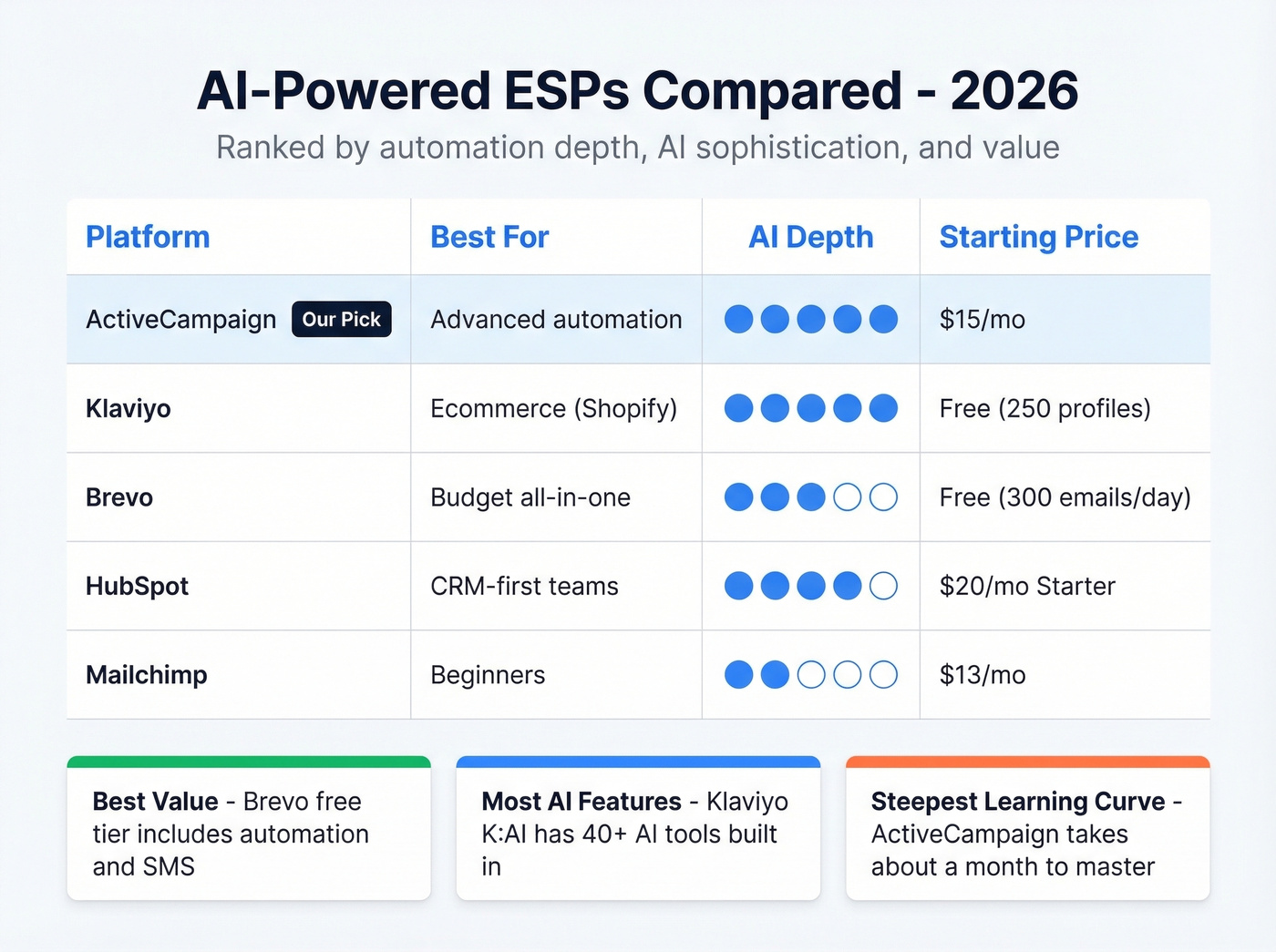
This is where most of your budget goes. Here's every ESP in this guide at a glance:
| Tool | Best For | Key AI Feature | Pricing |
|---|---|---|---|
| ActiveCampaign | Advanced automation | Predictive Sending + Agentic AI | $15/mo (14-day trial) |
| Brevo | Budget all-in-one | Best Time optimization | Free; $8.08/mo paid |
| Klaviyo | Ecommerce | K:AI (40+ features) | Free (250 profiles); from $45/mo |
| Mailchimp | Beginners | Intuit Assist | $13/mo (limited free) |
| HubSpot | CRM-first teams | Breeze AI | $20/mo Starter; $890/mo Pro |
| MailerLite | Creators/solopreneurs | AI subject lines | Free (1K subs); $9/mo paid |
| GetResponse | Webinar + email | AI content gen | Free (2,500 emails); $19/mo paid |
| Customer.io | SaaS/product-led | API-triggered flows | ~$100-$1,000+/mo |
ActiveCampaign
ActiveCampaign is our pick for teams that need serious automation depth and don't mind investing time to learn the platform. Its AI layer, Active Intelligence, goes well beyond basic send-time optimization. Predictive Sending analyzes each contact's engagement history to pick the optimal delivery window. The AI Campaign Builder generates subject lines, layouts, and copy drafts. And the plain-language automation builder lets you describe a workflow in English and get a functional automation back - a real unlock for non-technical marketers.
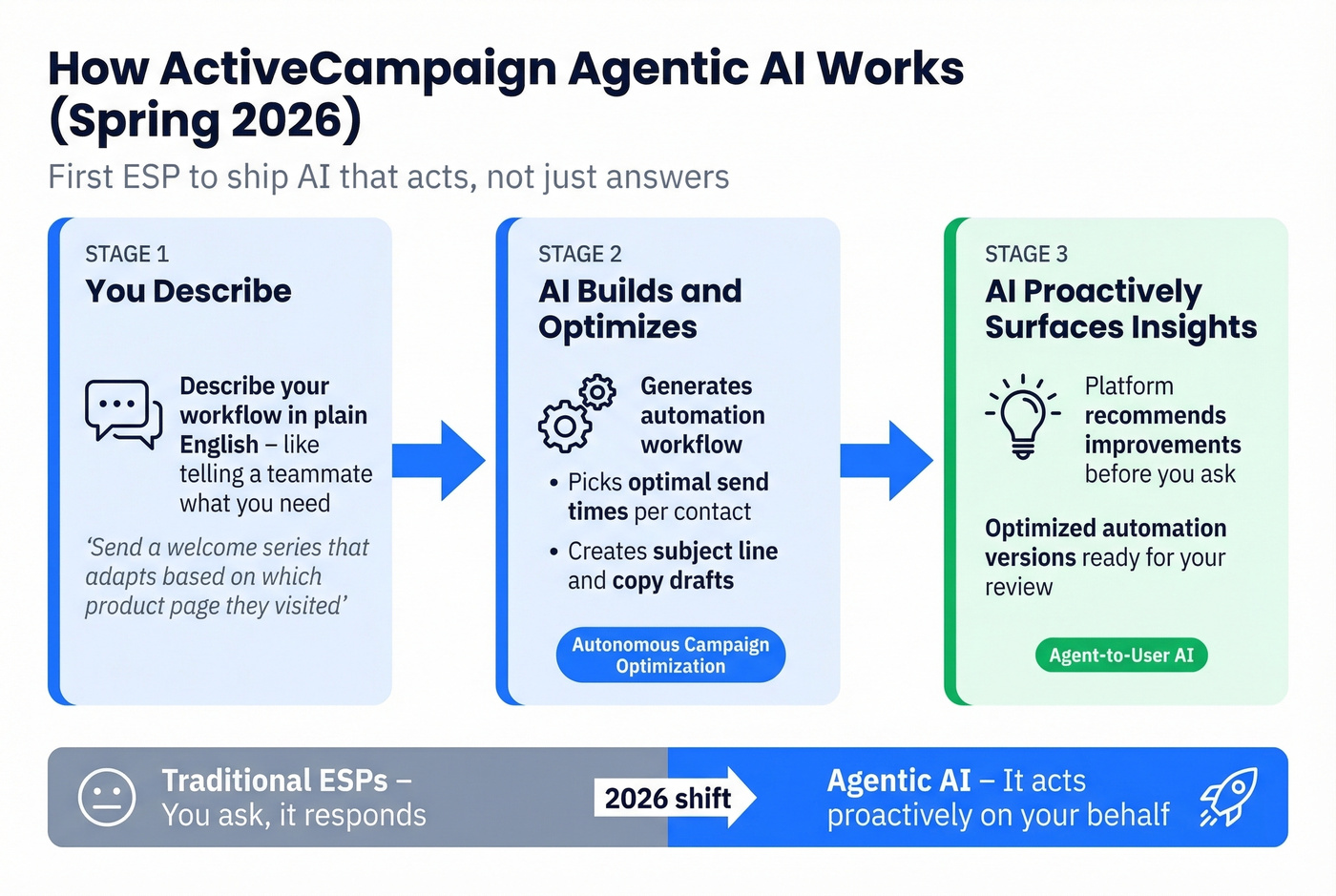
The Spring 2026 launch matters: ActiveCampaign became the first ESP to ship agent-to-user AI, where the platform proactively surfaces insights and recommendations rather than waiting for you to ask. Autonomous Campaign Optimization generates optimized versions of your automations ready for review. This isn't a gimmick - it's the direction the entire category is heading, and ActiveCampaign got there first.
Pricing starts at $15/mo for Starter. The next tiers run $49/mo (Plus), $79/mo (Pro), and $145/mo (Enterprise), scaling with contacts and features. The learning curve is real. Practitioners on r/MarketingAutomation call it "brutal." But once you're past the first month, the automation depth is hard to beat at this price point.
Use this if: You're running complex, multi-step automations with behavioral triggers and need AI that optimizes the entire workflow, not just subject lines.
Skip this if: You're a solopreneur sending a weekly newsletter. You'll never touch 80% of what you're paying for.
Brevo
Brevo serves 300,000+ users across 180 countries, and the free tier is the reason most of them started. 300 emails/day with automation included - not a teaser, but enough to run a real email program. "Best Time" send optimization picks an optimal delivery window based on previous performance. SMS is built in, not bolted on. Multichannel campaigns from one platform without stitching together three tools.
Paid plans start at just $8.08/mo. Pricing scales by email volume, not contacts, so you don't get punished for growing your list.
The tradeoffs: the email editor and templates are basic. If you care about pixel-perfect design, you'll feel the limitations. Advanced features like landing pages and detailed reporting sit behind paid tiers. AI features are improving but still lag behind ActiveCampaign and Klaviyo in sophistication.
For budget-conscious teams, Brevo is the best value in this list. The consensus on r/MarketingAutomation is that it's "probably one of the best options" for teams that need automation, SMS, and a light CRM without paying ActiveCampaign prices.
Klaviyo
If you're running a Shopify or WooCommerce store, Klaviyo isn't just the best option - it's the default for a reason. K:AI packs over 40 AI-powered features into the platform: Flows AI lets you describe automations in plain language, Segments AI builds audience groups from natural-language prompts, predicted CLV scores customers by future value, and Image Remix generates creative variations inside the editor. The ecommerce integrations are best-in-class - store events and customer behavior feed directly into segmentation, abandoned cart flows, and product recommendation engines.
The free tier covers 250 profiles and 500 emails/month - fine for testing, tight for real use. Paid plans start from $45/mo and scale with list size and channels.
If Klaviyo's pricing feels steep, Omnisend covers similar ecommerce ground at lower price points - Reddit practitioners frequently call it out as "usually cheaper than Klaviyo" with solid Shopify integration.
Use this if: You're an ecommerce brand and your revenue depends on lifecycle email. Klaviyo's AI is purpose-built for this.
Skip this if: You're B2B or SaaS. Practitioners are blunt - Klaviyo is "overpriced outside pure ecommerce," and the email editor feels dated compared to competitors.
Mailchimp
Mailchimp is the tool everyone starts with and most teams eventually outgrow. It's the easiest ESP to learn, with Intuit Assist AI generating subject lines, email copy, and campaign suggestions. Over 300 integrations mean whatever you're using, Mailchimp probably connects to it. Starts at $13/mo.
The traps are real, though. List-based pricing means if the same contact exists on two lists, you pay for them twice. The free plan doesn't include automations - not even a basic welcome email. And AI features are surface-level compared to ActiveCampaign or Klaviyo. Good for beginners, limiting for growing teams. Plan to migrate within 12-18 months if your program gets serious.
HubSpot
Let's do a reality check on HubSpot's AI email capabilities. The Breeze AI umbrella - covering Assistant, Agents, and Intelligence - sounds impressive. And the CRM-powered personalization is legitimately strong if you're already living in HubSpot's ecosystem. AI generates complete branded drafts, predicts optimal timing, and personalizes using unified CRM data.
The problem is access. The meaningful AI features live in Marketing Hub Professional at $890/mo. Mandatory onboarding runs $3,000-$7,000. Breeze credits cost $9 per 1,000 and don't roll over. Starter at $20/mo has minimal AI.
For enterprise teams already on HubSpot CRM, the AI email features are a natural extension. For everyone else, you're paying luxury prices for capabilities that ActiveCampaign delivers at a fraction of the cost.
MailerLite
MailerLite is the quiet overachiever for creators and solopreneurs. The free plan covers 1,000 subscribers and 12,000 emails/month - more generous than Mailchimp's free tier. Paid plans start at $9/mo with unlimited emails. AI subject line generation is built in, the drag-and-drop editor is clean, and the learning curve is essentially zero. It won't scale to complex multi-branch automations, but for straightforward email programs on a tight budget, it's hard to beat.
GetResponse
GetResponse carves out a niche by bundling webinars and landing pages alongside email. AI content generation handles subject lines and body copy. It offers a free tier covering 2,500 emails/month, and paid plans start at $19/mo. If your marketing strategy leans heavily on webinar funnels, GetResponse saves you from stitching together separate tools.
Customer.io
Customer.io is built for SaaS and product-led companies that need API-triggered workflows based on in-app behavior. Behavioral segmentation goes deep - event-based triggers, cohort analysis, real-time data piping. It's not for marketers who want a drag-and-drop builder; it's for teams with engineering resources who want programmatic control. Pricing is custom, typically $100-$1,000+/mo depending on volume.
Meritt cut their bounce rate from 35% to under 4% and tripled pipeline to $300K/week. The difference wasn't a better ESP - it was verified contact data. Prospeo gives you 143M+ verified emails at $0.01 each, with no contracts and no sales calls.
Start with 75 free verified emails and see what clean data does to your deliverability.
Layer 3: AI Content & Coaching
These tools don't send emails. They make the emails you send better. Think of them as the top layer of your stack - they plug into your ESP or sit alongside it, handling the creative and coaching work that AI-powered ESPs still do unevenly.
Jasper
Jasper is the most capable AI writing tool for email marketers who care about brand consistency. The brand voice controls let you train the AI on your tone, terminology, and style guidelines - so the output sounds like your brand, not like generic ChatGPT. Over 50 templates cover everything from promotional emails to re-engagement sequences. Gmail and Outlook extensions let you draft directly in your inbox.
Pricing runs ~$39-$99/mo per seat. Not cheap, but for teams producing high volumes of email copy across campaigns, the time savings are real. Jasper writes copy. It doesn't send it, segment audiences, or optimize delivery. Pair it with an ESP from Layer 2. (If you're focused on personalization, see AI email personalization.)
Lavender AI
Lavender takes a different approach - it's a coaching tool, not a content generator. It scores your emails in real time, suggests improvements to subject lines, flags readability issues, and provides data-backed recommendations on length, tone, and structure.
Pricing is transparent: free for 5 emails/month, Starter at $29/mo, Pro at $49/mo, Teams at $69/user/mo. For sales teams writing personalized outbound at scale, it's one of the highest-ROI tools in this list. For marketing teams sending automated campaigns, your ESP's AI handles most of what Lavender does - so skip Lavender unless your team is writing one-to-one emails at volume.
Copy.ai
Copy.ai offers a free tier with 2,000 words/month - enough to draft a handful of email campaigns. SOC 2 compliant, which matters for enterprise teams. Quick draft generation without the brand-voice depth of Jasper.
Grammarly
Grammarly catches what AI generators miss: grammar errors, awkward phrasing, tone inconsistencies. The free tier handles basics; paid plans add tone detection and style suggestions. Run your email copy through it before hitting send. It's a five-minute habit that prevents embarrassing mistakes.
2026 Benchmarks Worth Knowing
The numbers that should shape your strategy this year:
AI adoption: 64% of marketers use AI in email marketing. 50% use it for personalization, 41% for subject line optimization, 29% for send-time optimization.
Automation vs. manual performance: Automated emails hit 48.57% open rates versus 25.2% for manual sends. CTR: 5.4% vs 1.5%. Conversion: 12% vs 3%. Revenue per send is 4x higher for automated campaigns. These aren't marginal improvements - they're category-defining.
Scale context: 4.6B people use email globally, sending 376B emails per day. Standing out takes more than a good subject line.
The open rate caveat: Apple Mail Privacy Protection holds 50-60% of email client market share and pre-loads tracking pixels, inflating open rates across the board. If you're optimizing primarily for opens, you're optimizing for a metric that's increasingly unreliable. Click-to-open rate sits around 6.8% and is a more reliable signal. Better yet, focus on CTR, conversion, and revenue per send.
Authentication is table stakes: Gmail and Yahoo now require SPF, DKIM, and DMARC authentication, plus spam complaint rates below 0.3%. If you haven't set these up, no AI tool will save your deliverability. (Use this sender authentication guide to get it right.)
Mistakes That Kill Results
Five mistakes we see repeatedly:
Set-and-forget automation. AI makes it tempting to build a flow and walk away. Don't. Review every automated sequence every 2-4 weeks. Market conditions change, offers expire, and what worked in January can actively hurt you by March.
Ignoring data quality. Your ESP's AI can't fix bad inputs. If 16.9% of emails never reach the inbox and your bounce rate is above 2%, no amount of send-time optimization will save you. Verify your list before you automate.
Optimizing only for open rates. Apple Mail inflates them. Gmail's tabbed inbox hides them. Open rates are a vanity metric in 2026. Track clicks, conversions, and revenue attribution instead.
Poor segmentation. AI-powered personalization is only as good as the segments you feed it. "All subscribers" isn't a segment. Break your list by behavior, purchase history, engagement recency, and lifecycle stage.
Choosing the wrong tool for your use case. Klaviyo for a B2B SaaS company. HubSpot for a solopreneur. MailerLite for a 50,000-contact enterprise. Tool-market fit matters as much as feature depth.
How to Pick Your Stack
Rather than agonizing over feature matrices, pick one tool from each layer based on your situation:
Advanced automation teams: ActiveCampaign (Layer 2) + Jasper (Layer 3) + a dedicated verification tool at Layer 1. This is the stack for B2B teams running complex, multi-step sequences with behavioral triggers - ActiveCampaign handles the automation depth, verified contact data keeps your sender reputation clean, and Jasper keeps your copy on-brand at scale. Total cost for a small team: roughly $70-$150/mo.
Ecommerce brands: Klaviyo (Layer 2) handles the AI-powered lifecycle email - abandoned carts, predicted CLV, product recommendations. Layer a verification tool underneath for list hygiene, especially if you're importing contacts from multiple channels. Total cost: $45-$150/mo depending on list size.
Budget-conscious teams: Brevo (Layer 2) + Copy.ai (Layer 3). Brevo's free tier gives you 300 emails/day with automation. Copy.ai's free tier handles 2,000 words/month of email drafts. You can run a legitimate AI-powered email program for $0 until you outgrow the limits. When you do, Brevo's paid plans start at just $8.08/mo.
Look, the biggest mistake isn't picking the wrong ESP. It's skipping Layer 1 entirely and wondering why your beautifully automated, AI-optimized campaigns bounce at 8%. The best AI tools for email marketing can't compensate for bad data. Start there, then build up.
FAQ
What's the best free AI email marketing tool?
Brevo's free tier offers 300 emails/day with automation included - the most generous free ESP plan available. For AI content, Copy.ai's free plan covers 2,000 words/month. For data quality, Prospeo verifies 75 emails/month free - enough to audit a list segment before launching campaigns.
Can ChatGPT replace dedicated email marketing AI?
ChatGPT is fine for rough drafts, but it lacks brand voice controls, A/B testing integration, and send-time optimization. Use it as a starting point, then refine in Jasper or your ESP's native AI for production-quality campaigns.
How does AI improve email deliverability?
AI improves deliverability through predictive send-time optimization, engagement-based segmentation, and automated list hygiene. The prerequisite is clean data - 98% email accuracy and spam-trap removal prevent the bounces that trigger deliverability penalties in the first place.
Is AI email marketing GDPR compliant?
The AI tool itself isn't the compliance risk - your data collection and consent practices are. Choose tools with GDPR compliance built in. The real risk is using AI to personalize emails for contacts who never opted in.
Do I need a separate email verification tool?
Yes, if your ESP doesn't verify on import - and most don't beyond basic syntax checks. With 16.9% of emails never reaching the inbox industry-wide, dedicated verification before each campaign saves weeks of sender reputation recovery.