

AIDA Email Templates: 5 Ready-to-Copy Cold Emails + the Framework Behind Them
Most AIDA breakdowns give you theory. Here are five templates you can actually send - each under 80 words - plus the stage-by-stage system so you can build your own. One practitioner on r/coldemail closed $27K in two months after restructuring outreach around this framework.
What Is the AIDA Email Formula?
AIDA dates back to 1898, when ad pioneer Elias St. Elmo Lewis) outlined the four psychological stages a buyer moves through before acting. In cold email, those stages map to the anatomy of a short, high-converting message:
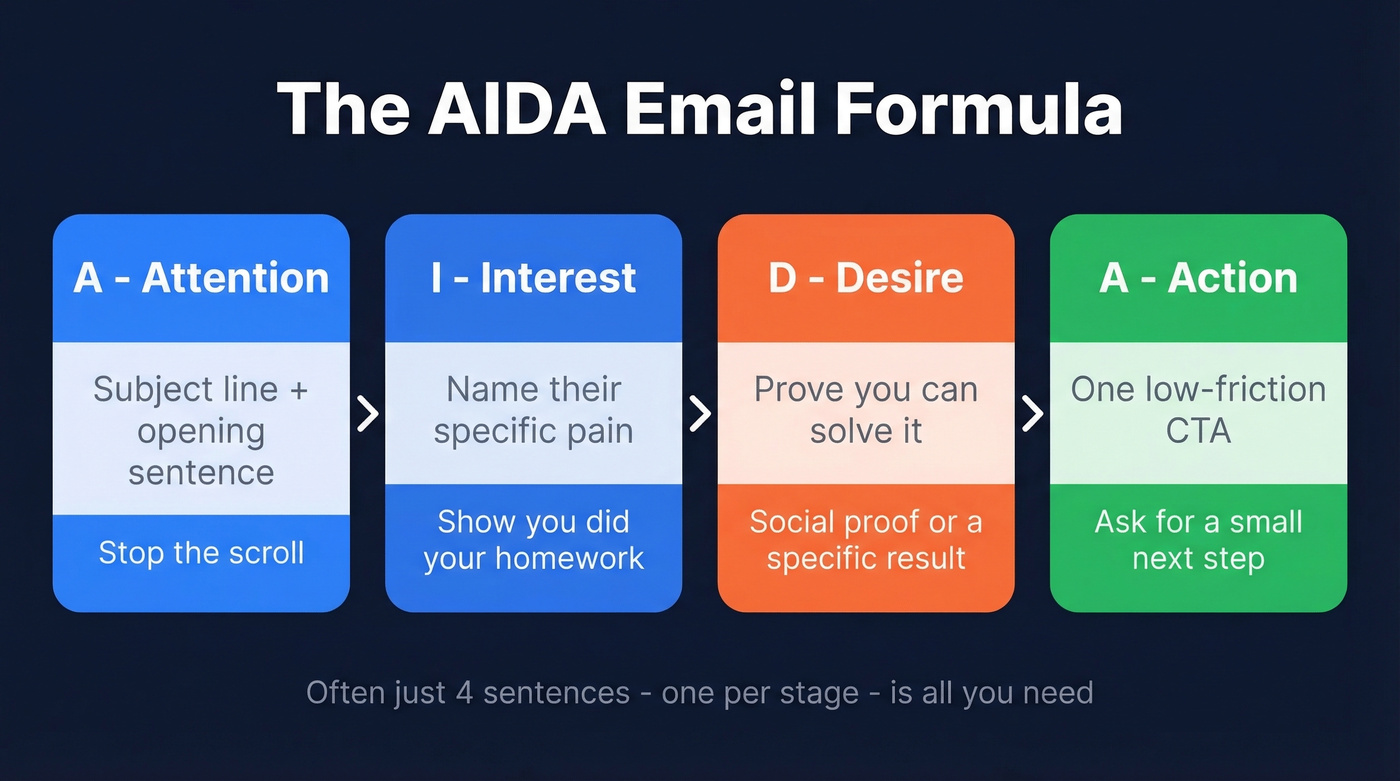
- Attention - Your subject line and opening sentence stop the scroll.
- Interest - You name a problem the reader actually has.
- Desire - You prove you can solve it with social proof or a specific result.
- Action - You ask for one small next step.
Often, four sentences is enough. Whether you're writing a single message or building a full AIDA email campaign, this structure keeps every word working toward a reply.
5 Templates You Can Copy Today
Every template stays under 80 words because top-performing cold campaigns keep emails short, per 2026 benchmark data from Instantly. Aim for subject lines under 45 characters (or pull from these subject line examples). CTAs are low-friction by design.
B2B SaaS Cold Email
Subject: Quick question about {{pain point}}
[Attention] Hi {{firstName}}, noticed {{company}} recently {{trigger event - e.g., launched a new product line, expanded into EMEA}}.
[Interest] Most {{role}} teams at that stage spend 6+ hours a week on {{specific pain}}.
[Desire] We helped {{similar company}} cut that by 40% in the first quarter.
[Action] Would it make sense to send you 2-3 ideas on how?
Teams using structured sequences like this have seen 22% more booked meetings just by tightening their format. If you're new to the AIDA formula, start here.
Agency / Services Outreach
Subject: {{company}}'s {{metric}} - idea
[Attention] Hi {{firstName}}, I looked at {{company}}'s {{public metric - like ad spend, site traffic, or their hiring page}}.
[Interest] Agencies in your space are losing 15-20% of budget to {{specific inefficiency}}.
[Desire] We helped {{similar agency/brand}} recover ${{amount}} in Q1 by fixing exactly that.
[Action] Worth a 10-minute look? Happy to share the breakdown.
The "Before vs. After" Recruiting Email
Most recruiting emails open with "I came across your profile" - the recruiting equivalent of "Dear Sir/Madam." Here's what a bad version looks like next to the AIDA version:
Bad version:
Hi {{firstName}}, I came across your profile and thought you'd be a great fit for an exciting opportunity at a fast-growing company. Let me know if you're interested!
AIDA version:
Subject: {{role}} at {{company}} - fit?
[Attention] Hi {{firstName}}, your work on {{specific project or skill}} at {{current company}} caught my eye.
[Interest] {{hiring company}} is building a {{team/initiative}} and needs someone who's done exactly that.
[Desire] The role offers {{one compelling detail - comp range, equity, remote, mission}}.
[Action] Open to hearing more, even casually?
The difference is specificity. Every line references something real about the prospect, not a vague compliment that could apply to anyone on the platform.
E-commerce / DTC Outreach
Subject: Struggling with 30% cart abandonment?
[Attention] Hi {{firstName}}, I noticed {{brand}} runs {{platform}} with a solid product catalog.
[Interest] Cart abandonment is a silent revenue leak for DTC teams once traffic starts scaling.
[Desire] We helped {{similar brand}} recover ${{amount}}/month with a 3-step flow change.
[Action] Want me to send the playbook? Two pages, no pitch.
That subject line uses the pain-point + question formula - specific enough to feel personal, broad enough to earn the open.
AIDA Follow-Up Email
42% of cold email replies come from follow-ups. The follow-up isn't optional - it's where most deals actually start. Keep it short and lead with a new hook (or borrow from these sales follow-up templates):
Subject: Re: {{original subject}}
Hi {{firstName}}, circling back on my note from Tuesday. Since then, we published a case study on {{relevant topic}} - {{one-sentence result}}. Worth 5 minutes this week?
How to Write Your Own AIDA Email
Templates get you started. But as one r/copywriting thread put it bluntly: "templates are rigid - frameworks let you think." Here's how to build your own from scratch.
Attention: Subject Lines That Get Opens
Around 43% of recipients open emails based on the subject line alone, and 69% mark messages as spam purely because of it. Keep yours under 45 characters. Five formulas that work:
- Curiosity gap: "Your competitor's Q1 strategy"
- Quick question: "Quick question about {{pain}}"
- Mutual connection: "{{name}} suggested I reach out"
- Value-first: "3 ideas for {{company}}'s {{goal}}"
- Pattern interrupt: "This isn't a sales email"
Interest: Hook With Their Problem
Name the prospect's specific pain, not their job title. "As a VP of Marketing, you probably..." is lazy. "Your team launched 4 campaigns last quarter with no attribution model" is specific and shows you did your homework. Obviously false flattery and generic personalization are the fastest way to get deleted. One sentence is enough - just make it real.
Desire: Prove You Can Solve It
In our experience, the Desire line is where most cold emails fall apart. People either skip proof entirely or dump three paragraphs of features nobody asked about. Two structures that consistently work:
- Result-led: "We helped {{similar company}} achieve {{specific metric}} in {{timeframe}}."
- Social proof: "{{X}} teams in {{their industry}} use this to {{outcome}}."
Segmented, targeted emails generate 30% more opens and 50% more clickthroughs than generic blasts. The Desire line is where that targeting pays off - match your proof to their exact situation, and the reply rate follows.
Action: Low-Friction CTAs
Here's the thing: "Book a 30-minute demo" isn't a CTA - it's a commitment. Rank your ask by friction level (and tighten your email call to action language):
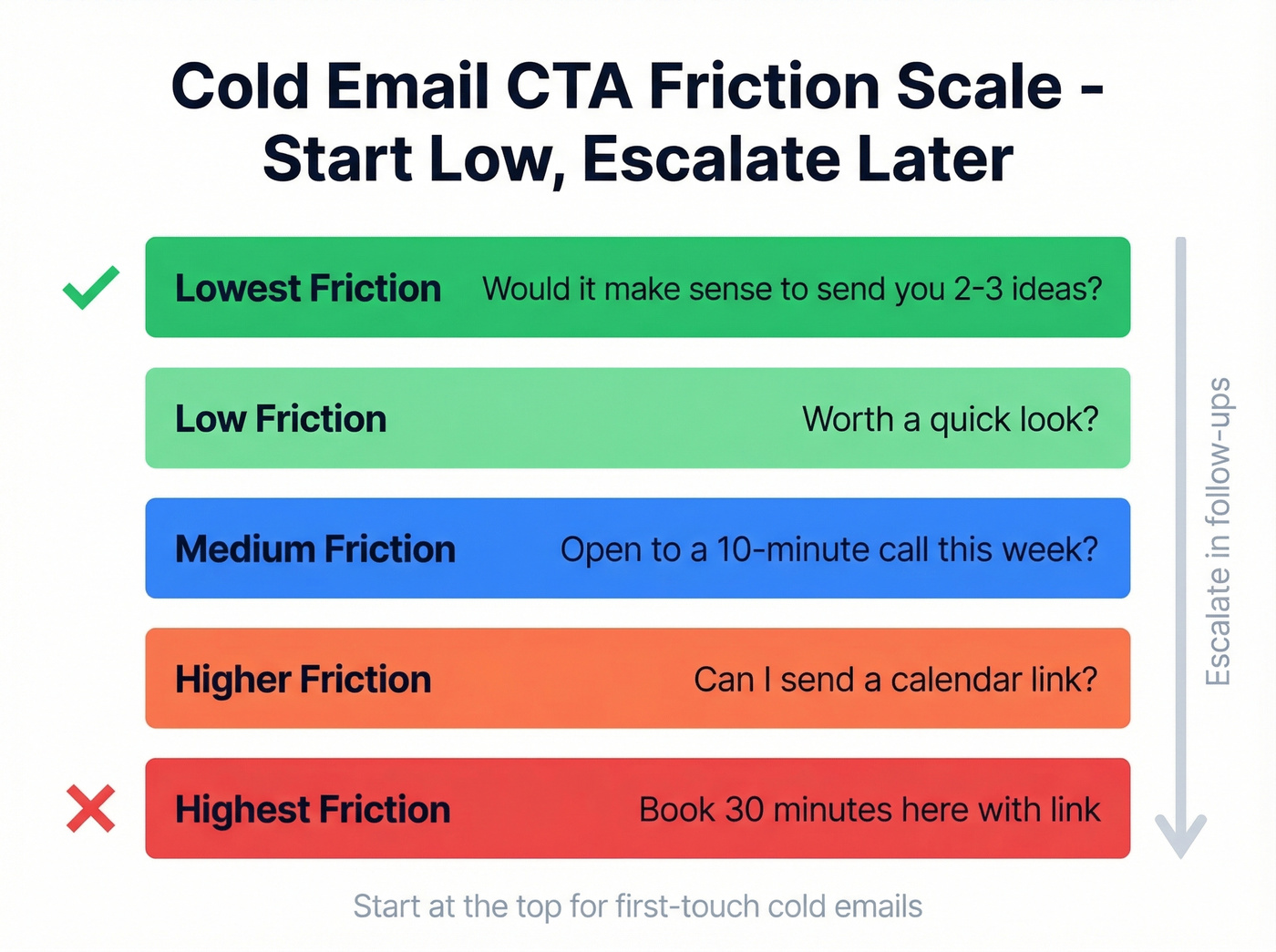
- Lowest: "Would it make sense to send you 2-3 ideas?"
- Low: "Worth a quick look?"
- Medium: "Open to a 10-minute call this week?"
- Higher: "Can I send a calendar link?"
- Highest: "Book 30 minutes here: [link]"
Start at the top. You can always escalate in follow-ups.

A perfect AIDA template sent to a bad email address is a wasted rep. Prospeo delivers 98% verified email accuracy with a 7-day refresh cycle - so your carefully crafted cold emails actually land in real inboxes, not bounce logs.
Stop perfecting copy that bounces. Start with data that connects.
AIDA vs. PAS vs. BAB
All three frameworks work for email. The difference is when to reach for each one.
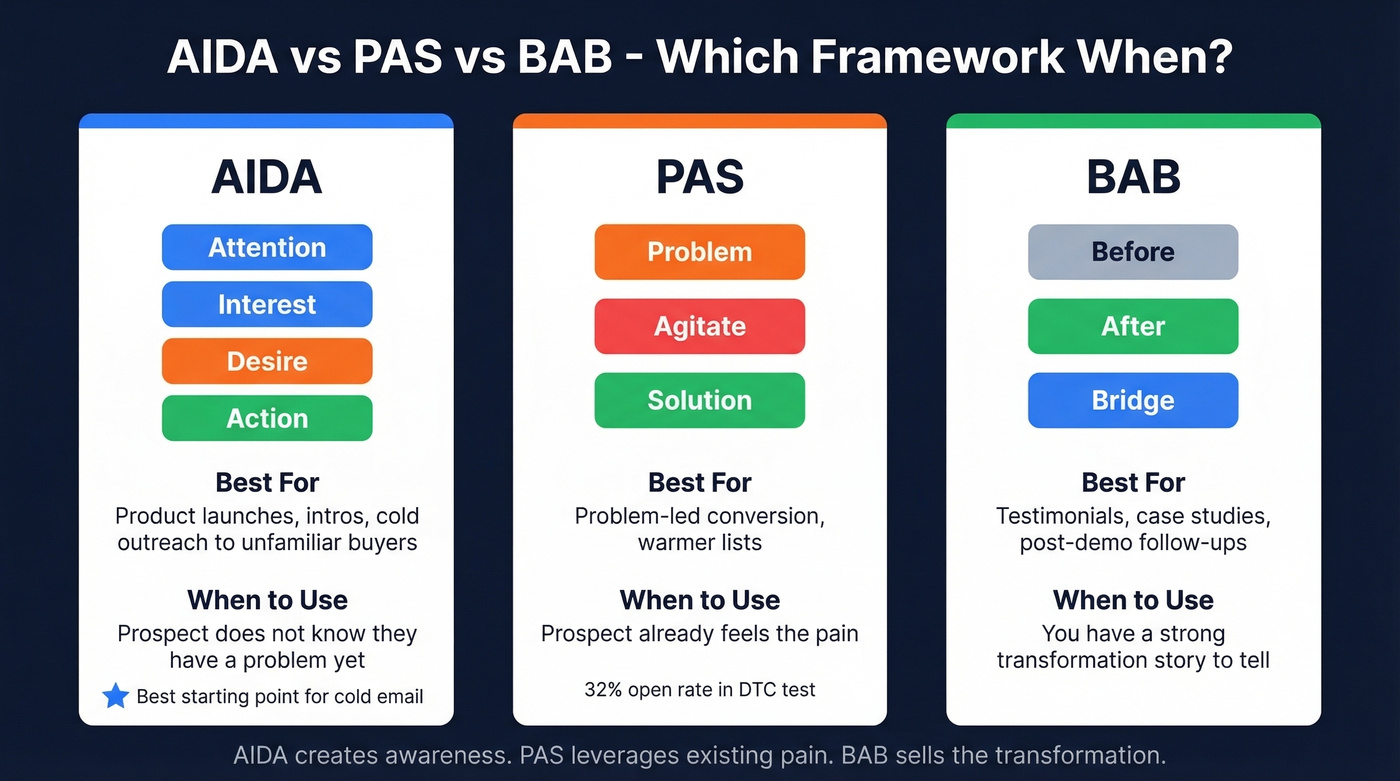
| Framework | Best for | Example email type |
|---|---|---|
| AIDA | Product launches, intros | SaaS launch to existing list |
| PAS | Problem-led conversion | Cold outreach to VP of Marketing |
| BAB | Testimonials, case studies | Post-demo follow-up with case study |
One DTC brand tested PAS for a subscription box campaign and hit a 32% open rate with 2x their average engagement. Our take: AIDA is the best starting point for cold outreach, but if your prospect already knows they have a painful problem, PAS will outperform it every time. AIDA shines when you need to create awareness. PAS shines when awareness already exists.
3 Mistakes That Kill Reply Rates
Too long. We've seen reply rates jump when teams drop their word count below 80. Four sentences - one per stage - is the target. If your email is three paragraphs, you've already lost.
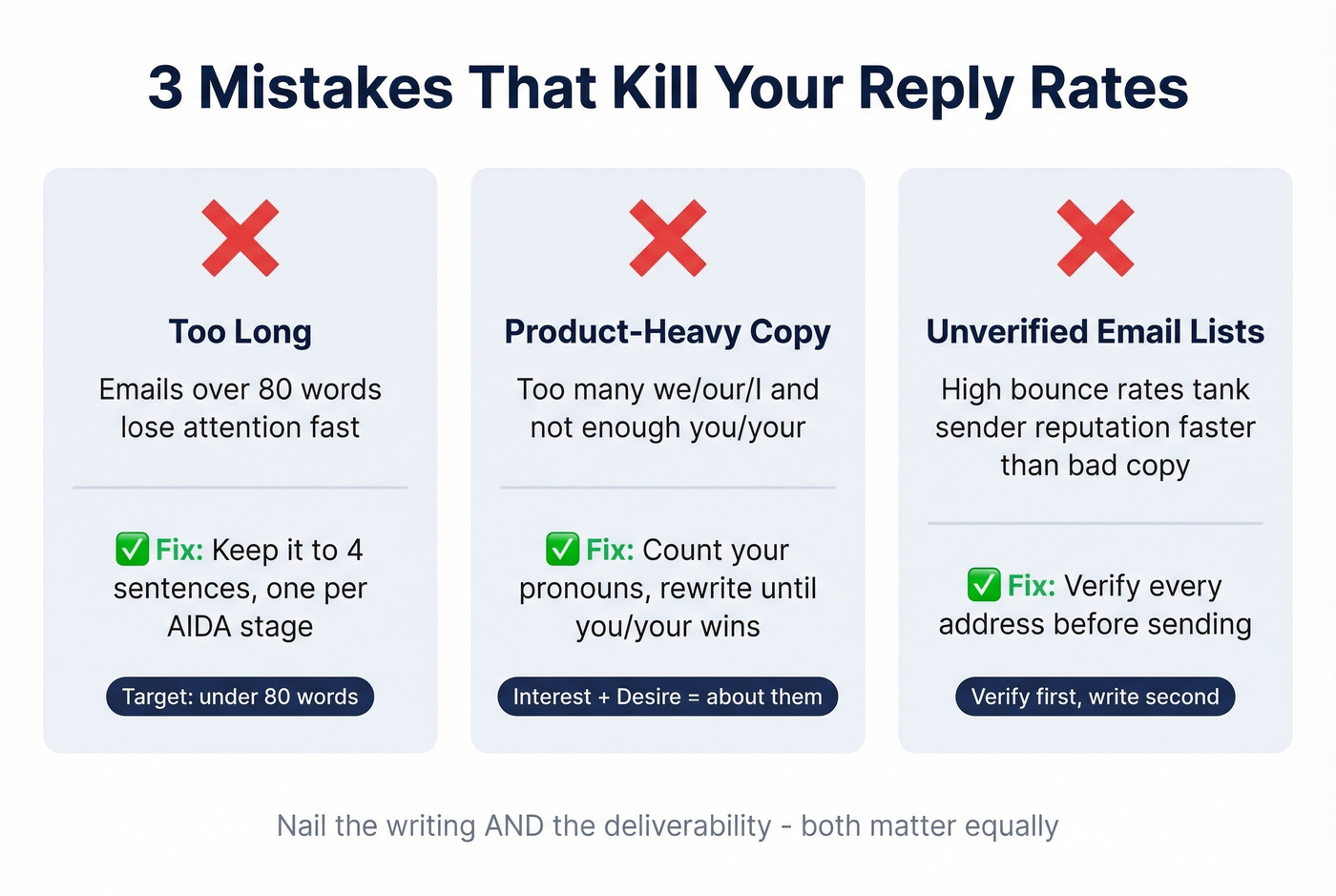
Product-heavy messaging. Count the "we/our/I" in your draft. If they outnumber "you/your," rewrite. The Interest and Desire stages should be about the prospect's world, not your feature list.
Sending to unverified lists. This one's frustrating because it has nothing to do with your writing. You can nail every word and still land in spam if half your list bounces. High bounce rates tank your sender reputation faster than bad copy ever will. Verify first, write second (here’s a deeper email deliverability guide).
Pre-Send Checklist
Before you hit send on any AIDA email:
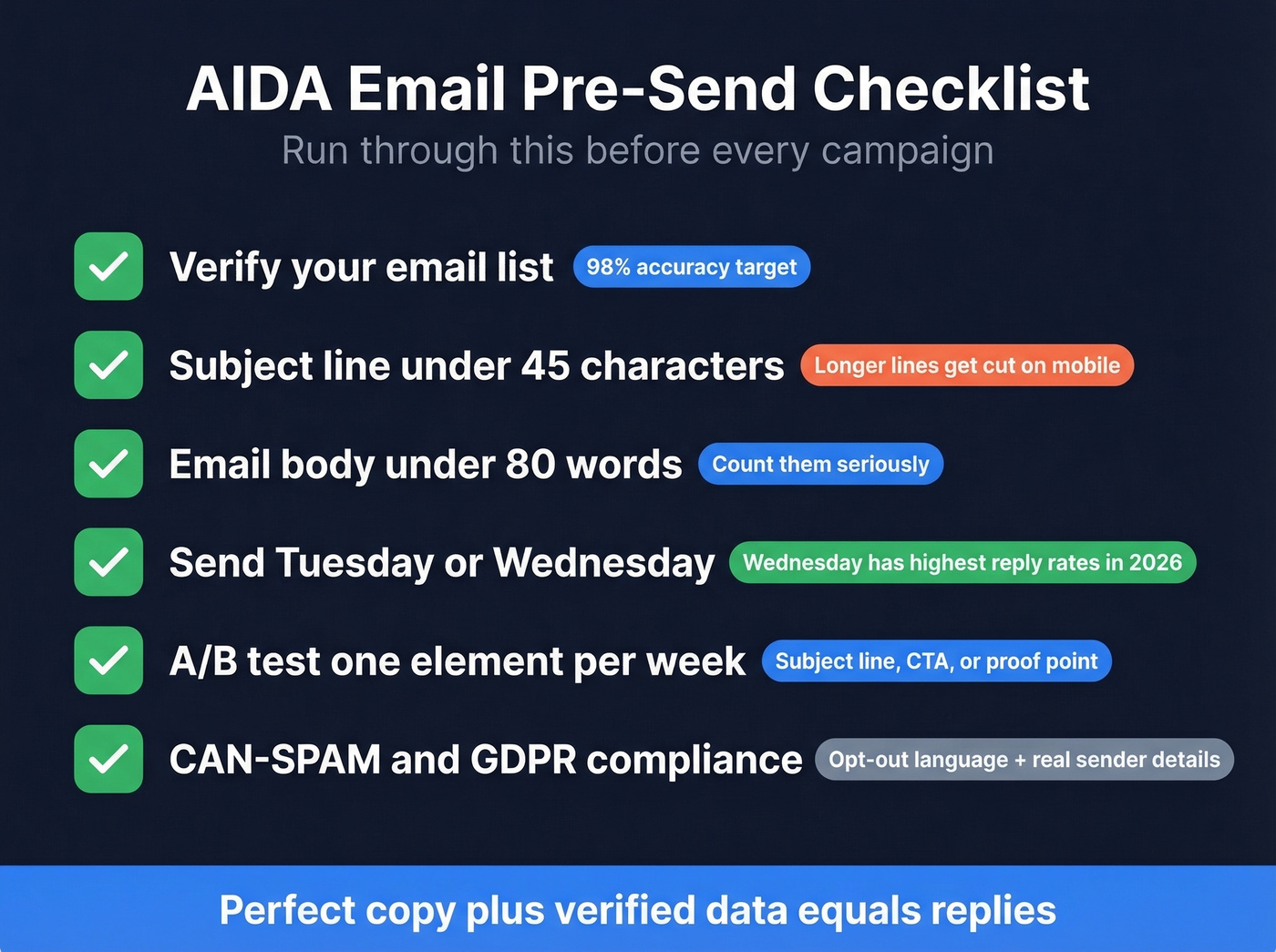
- Verify your email list. A perfectly written email means nothing if it bounces. Prospeo checks emails in real time with 98% accuracy - the free tier covers 75 emails per month, enough to validate your first campaign (see email bounce rate benchmarks and fixes).
- Subject line under 45 characters. Longer lines get truncated on mobile (use a subject line tester if you’re unsure).
- Email body under 80 words. Count them. Seriously.
- Send Tuesday-Wednesday. Wednesday shows the highest reply rates in 2026 benchmark data (more detail: best time to send cold emails).
- A/B test weekly. Swap one element at a time - subject line, CTA, or proof point.
- CAN-SPAM / GDPR compliance. Include opt-out language and your real sender details.
You just built a killer AIDA sequence. Now you need the right prospects to send it to. Prospeo's 300M+ profiles with 30+ filters - including buyer intent, job changes, and technographics - let you match your proof line to their exact situation, every time.
Target the right inbox. Your AIDA framework handles the rest.
FAQ
How long should an AIDA cold email be?
Under 80 words. Top-performing cold email campaigns in 2026 keep emails to four sentences - one per AIDA stage. Anything longer and you're competing with your own message for the reader's attention. Count your words before sending.
Does AIDA work for follow-up emails?
Yes - 42% of cold email replies come from follow-ups. Use a condensed AIDA structure: skip the full Interest stage and lead with a new Attention hook that references your first email. Keep it under 50 words.
How do I make sure my AIDA emails actually get delivered?
Verify your prospect list before sending. Real-time verification catches invalid addresses before they damage your sender reputation. Also avoid spam-trigger words in subject lines and keep daily sending volume consistent.
What's the difference between AIDA and PAS for cold email?
AIDA works best when prospects don't yet know they have a problem - it builds awareness, then desire. PAS outperforms when prospects already feel the pain. For first-touch cold outreach to unfamiliar buyers, start with AIDA. Switch to PAS for warmer lists where the problem is already top of mind.