

8 Alternatives to Cold Calling That Actually Generate Pipeline
You just wrapped a 200-dial Monday. Four conversations. One "maybe send me something." Zero meetings booked. Meanwhile, your cold email sequence booked three demos overnight while you slept. The math on cold calling has been brutal for years - a 4.82% success rate per conversation, 209 calls per appointment, and a cost-per-lead hovering between $300 and $500. There are better alternatives to cold calling, and they're backed by data.
The Quick Version
If you're replacing cold calling tomorrow, start with cold email - it's the cheapest per lead at roughly 10x less than phone. Layer in social selling for the highest per-touch engagement, and build a referral engine for the highest conversion rate by a wide margin. Before any of them work, though, you need verified contact data. Bad numbers and bounced emails kill every channel, not just cold calling.
Why Cold Calling Struggles in 2026
Cold calling's problem isn't the phone. It's the data feeding the phone.
B2B contact data decays at roughly 2.1% per month - that's 22.5% of your list going stale every year. People change jobs, get promoted, switch numbers. Sales reps lose 27.3% of their selling time to bad contact data, and across all attempts, 72% of cold calls never result in a live conversation. When the inputs are rotten, the channel looks broken, but it's the list that failed you.
And here's the stat that should change how you think about call volume: WHAM data shows 3 calls capture 93% of all conversations you'll ever have with a prospect. By call 5, you're at 98.6%. Beyond that, you're burning time and morale. If you're still cold calling, stop at 5 attempts per prospect and redirect that energy into the channels below.

This is why verification is the prerequisite for every alternative that follows. Prospeo runs real-time email and mobile verification on top of 300M+ professional profiles with a 7-day refresh cycle - 98% email accuracy and a 30% mobile pickup rate across all regions. The free tier gives you 75 email verifications per month plus 100 Chrome extension credits, enough to test whether your existing list is actually worth dialing.

Every alternative to cold calling in this article depends on one thing: verified contact data. Prospeo delivers 143M+ verified emails at 98% accuracy and 125M+ mobile numbers with a 30% pickup rate - refreshed every 7 days, not every 6 weeks. At $0.01 per email, your cost-per-lead drops from $300-$500 on cold calls to under $50 on cold email.
Start with 75 free verified emails and see what accurate data does for your pipeline.
Channel Comparison at a Glance
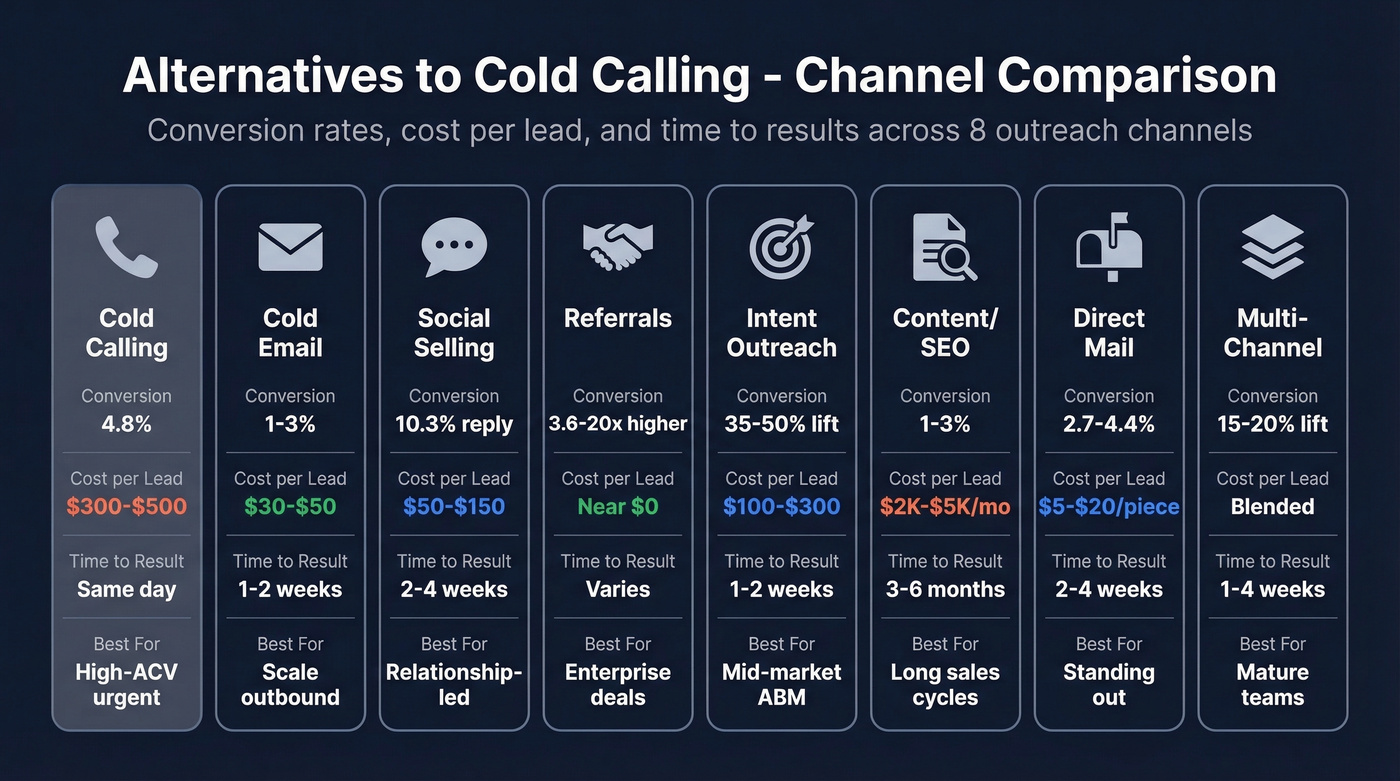
| Channel | Conversion | Cost/Lead | Time to Result | Best For |
|---|---|---|---|---|
| Cold calling | ~4.8% | $300-$500 | Same day | High-ACV, urgent |
| Cold email | 1-3% | $30-$50 | 1-2 weeks | Scale outbound |
| Social selling | 10.3% DM reply | $50-$150 | 2-4 weeks | Relationship-led |
| Referrals | 3.6-20x higher vs cold leads | Near $0 | Varies | Enterprise deals |
| Intent outreach | 35-50% lift | $100-$300 | 1-2 weeks | Mid-market ABM |
| Content/SEO | 1-3% | $2K-$5K/mo | 3-6 months | Long sales cycles |
| Direct mail | 2.7-4.4% | $5-$20/piece | 2-4 weeks | Standing out |
| Multi-channel | 15-20% lift | Blended | 1-4 weeks | Mature teams |
The 8 Best Ways to Replace Cold Calls
1. Cold Email Outreach
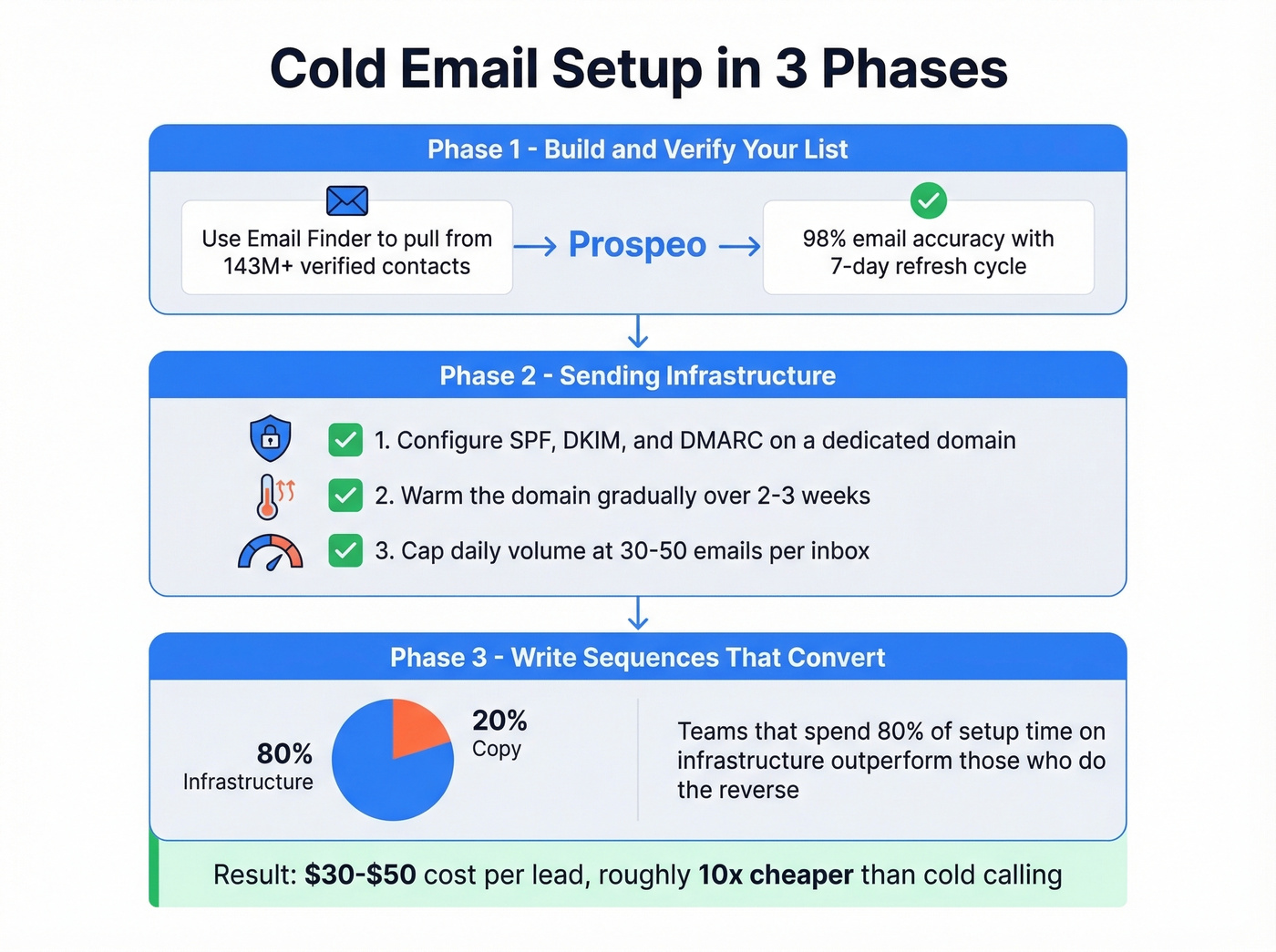
Use this if you need the cheapest path to pipeline at scale - $30-$50 per qualified lead, roughly 10x cheaper than cold calling.
Skip this if you're selling into heavily regulated industries where email compliance is a minefield, or your ICP is C-suite at Fortune 500s who've trained themselves to ignore cold inbound.
The implementation path is straightforward. First, build and verify your list. Prospeo's Email Finder pulls from 143M+ verified emails at 98% accuracy and integrates with Smartlead, Instantly, and Lemlist so you can move from list-building to sending without a bunch of manual handoffs. Second, set up your sending infrastructure:
- Configure SPF, DKIM, and DMARC records on a dedicated domain.
- Warm the domain gradually over 2-3 weeks.
- Cap daily volume at 30-50 emails per inbox.
Third, write sequences that don't read like templates. The deliverability stack matters more than the copy, but both need to be right. In our experience, teams that spend 80% of their setup time on infrastructure and 20% on copy outperform the ones who do the reverse.
If you want a faster starting point, keep a swipe file of follow-up variations and rotate them based on persona and intent.
2. Social Selling
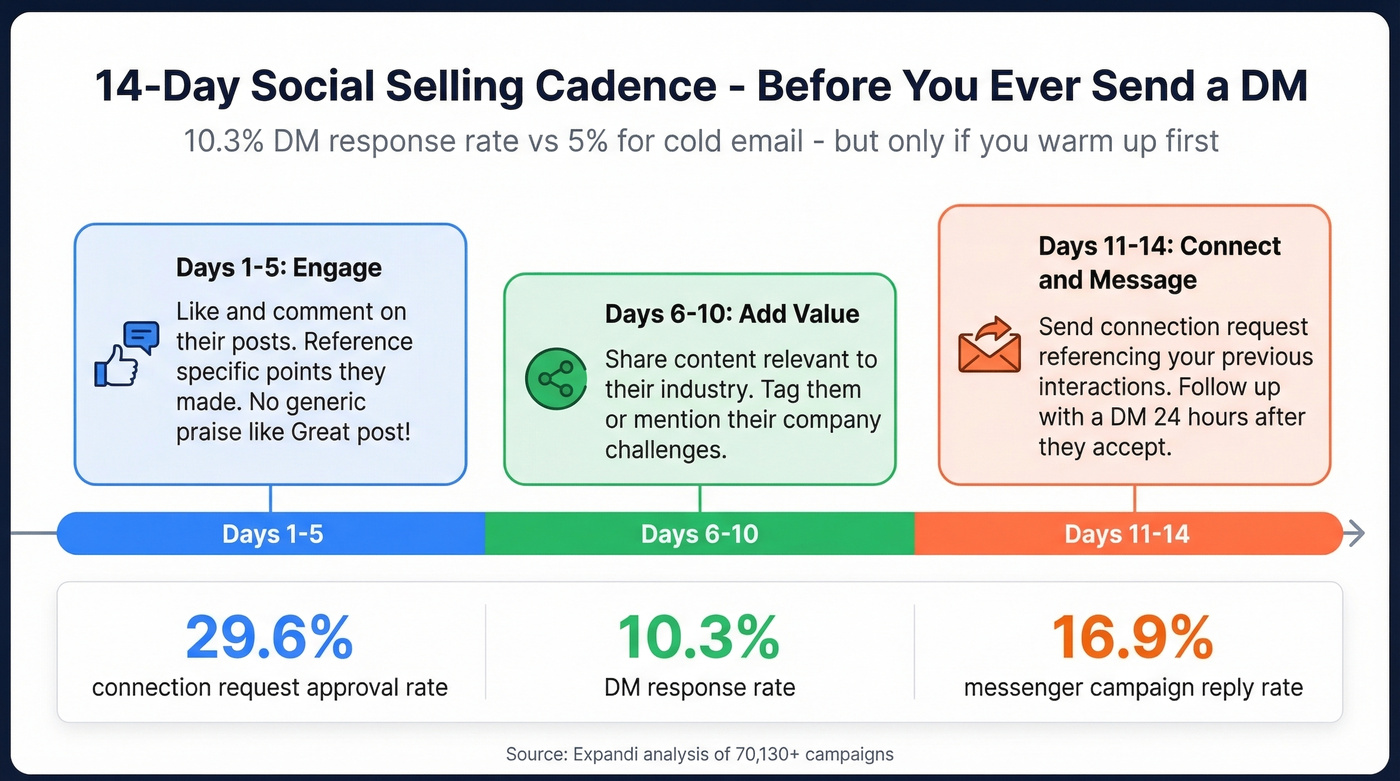
Social selling is the most underutilized cold calling alternative in B2B. An Expandi analysis of 70,130+ campaigns found a 10.3% DM response rate - roughly double cold email's average. Connection request approval sits at 29.61%, and messenger campaigns push reply rates to 16.86%.
Despite those numbers, Expandi's report notes that 90% of outbound effort still goes to email. That gap is your opportunity.
Here's a concrete 2-week engagement cadence before you ever send a DM:
- Days 1-5: Like and leave a thoughtful comment on your prospect's posts. Not "Great post!" - reference a specific point they made.
- Days 6-10: Share content relevant to their industry and tag them or mention their company's challenge.
- Days 11-14: Send the connection request with a note referencing your previous interactions. Follow up with a DM 24 hours after they accept.
The conversion happens because you've built micro-familiarity before the ask. It's slower per touch but dramatically higher quality.
3. Referrals and Warm Intros
Referrals convert 3.6-20x higher than cold leads. Companies with structured referral programs see 86% more revenue growth than those without. Referred deals close 69% faster and carry higher lifetime value.
If your average deal is under $10K, you probably don't need most of these channels - just build a referral engine and a cold email sequence. That combination alone will outperform a 10-rep cold calling floor.
The Go-to-Network framework makes referrals systematic rather than ad hoc. Map your extended network - customers, partners, employees, advisors - and identify warm paths to target accounts. The key is specificity. Instead of a vague ask, try something like:
"Hey [Name], I noticed you're connected to Sarah Chen at Acme. We help companies like Acme cut onboarding time by 40%. Would you be comfortable making an intro if I draft the email for you?"
That turns a vague favor into a two-minute task. We've seen teams build referral pipelines that outperform their entire outbound motion within a quarter.
4. Intent-Based Outreach
Most outbound is timing-blind. You're reaching out to people who won't need what you sell for another 18 months. Intent data flips that - you target buyers actively researching your category right now.
The numbers back it up: early outreach based on intent signals increases win rates by 35-50%, and 99% of companies using intent data report improved ROI. This matters because 57-70% of the buyer journey happens anonymously. By the time a prospect fills out your demo form, they've already done a dozen searches and visited three competitors.
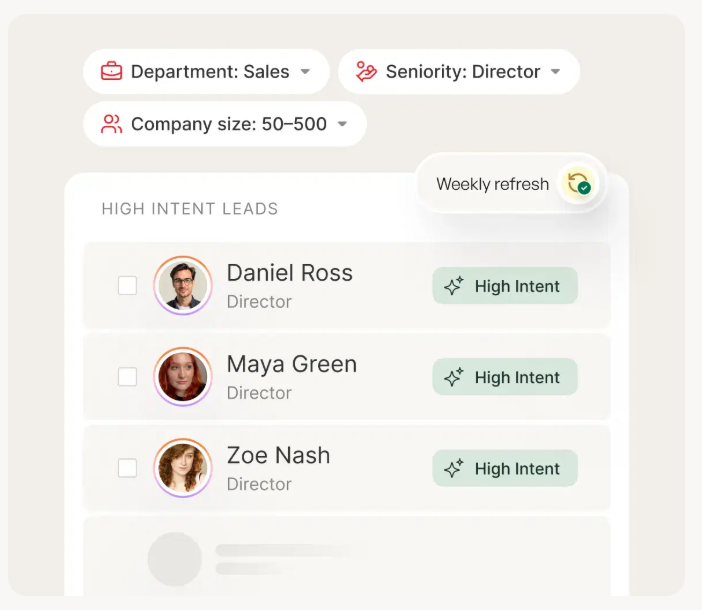
Pairing intent data with verified contact info is where this gets powerful. You identify the accounts researching your category, then reach out to the right person with a relevant message the same week their buying committee started evaluating. That turns cold outreach into warm-ish outreach - a massive difference in reply rates.
To operationalize it, set up intent based segmentation so your SDRs aren’t guessing who’s in-market.
5. Content Marketing and SEO
Content is the long game. Budget $2,000-$5,000 per month for consistent production, and don't expect pipeline impact for 3-6 months. But once it compounds, the cost-per-lead drops dramatically because organic traffic doesn't carry a per-click fee.
Start with bottom-of-funnel content. Comparison pages and "how to evaluate [your category]" guides convert 3-5x better than top-of-funnel blog posts. If your ICP researches extensively before buying - and in B2B, they almost always do - content positions you as the expert they already trust when they're ready to evaluate. The consensus on r/sales and r/b2bmarketing is that most teams over-invest in awareness content and under-invest in decision-stage content, which is exactly backwards if pipeline is the goal.
If you’re building this motion, align it to a clear lead generation workflow so content doesn’t die in “traffic” metrics.
6. Networking and Communities
Industry events, Slack communities, and niche online groups generate pipeline that doesn't feel like pipeline. The Go-to-Network concept applies here too - your next deal might come from a comment you left in a Pavilion thread or a conversation at a regional SaaS meetup.
This channel doesn't scale like email or ads. But the deals that come from genuine community relationships tend to be larger, stickier, and faster to close. Treat it as a supplement, not a primary channel. And don't overlook re-engaging lost prospects - set a 6-month cadence to circle back with deals that went dark. Circumstances change, budgets reset, and a well-timed "checking in" email to a warm contact beats 50 cold dials.
7. Direct Mail
Physical mail cuts through digital noise in a way that's almost unfair. Response rates run 2.7-4.4% compared to email's 0.6%. When every competitor is fighting for inbox attention, a well-timed package on someone's desk gets noticed.
The economics work for high-ACV deals. Spending $15-$20 per piece on a handwritten note with a relevant gift makes sense when your average deal is six figures. For lower-ticket sales, the unit economics fall apart fast - stick with email.
If you want to go deeper on execution, use a dedicated direct mail for lead generation playbook.
8. Multi-Channel Sequences
This is where everything comes together. Companies running coordinated 3-4 channel sequences see 15-20% higher conversions and 20% lower customer acquisition costs compared to single-channel outbound.
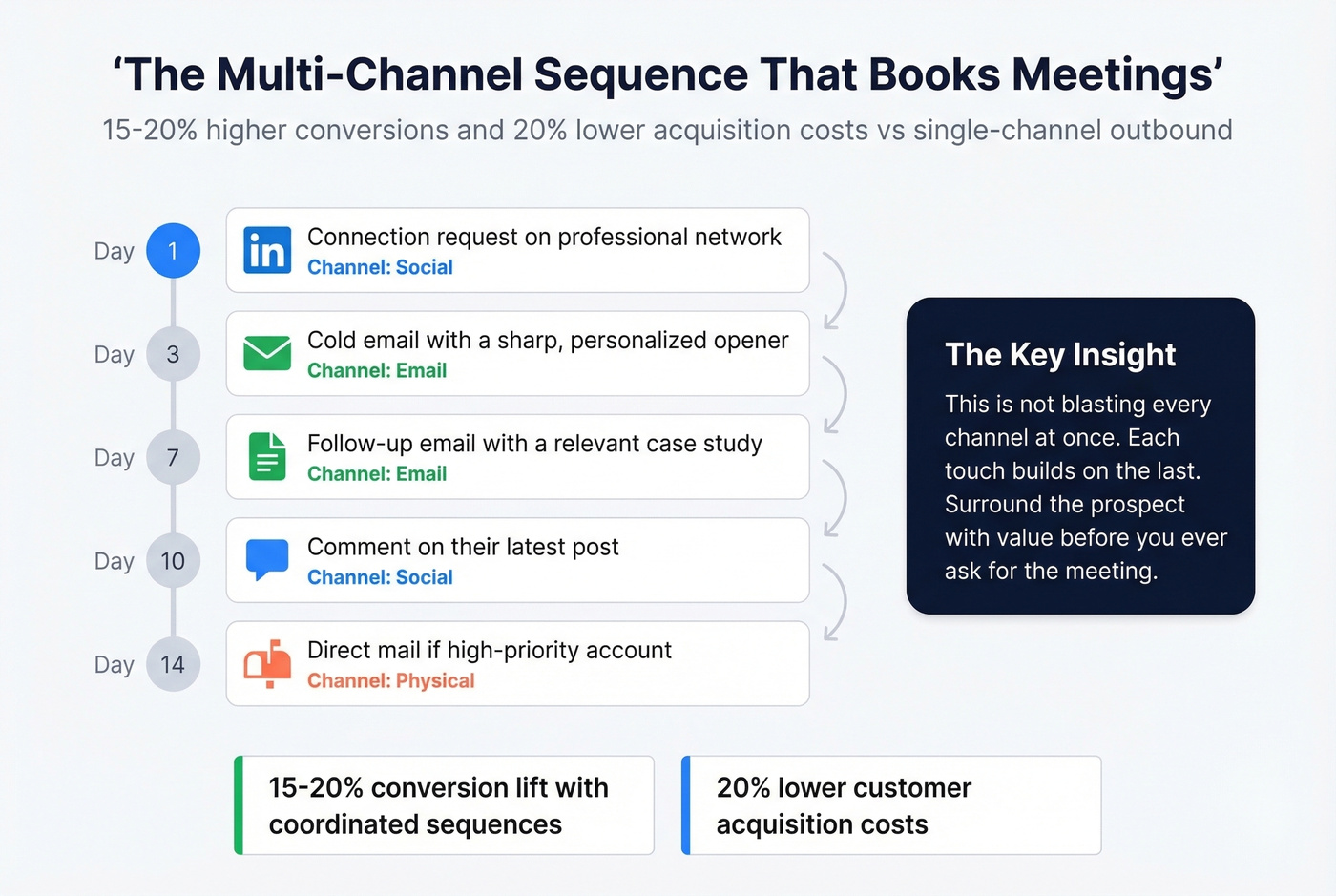
A typical sequence looks like this:
- Day 1: Connection request on a professional network.
- Day 3: Cold email with a sharp, personalized opener.
- Day 7: Follow-up email with a relevant case study.
- Day 10: Comment on their latest post.
- Day 14: Direct mail if they're a high-priority account.
The key word is coordinated. This isn't blasting every channel simultaneously - it's a choreographed sequence where each touch builds on the last. In our experience, the teams that actually hit 15-20% conversion lifts are the ones coordinating timing across channels, not just checking boxes. One SDR we spoke with described it as "surrounding the prospect with value before you ever ask for the meeting," which is a good way to think about it.
If you’re standardizing this across reps, document your sequence management rules so performance doesn’t depend on tribal knowledge.
Choosing the Right Alternative
Your team size, budget, and deal size should drive the decision.
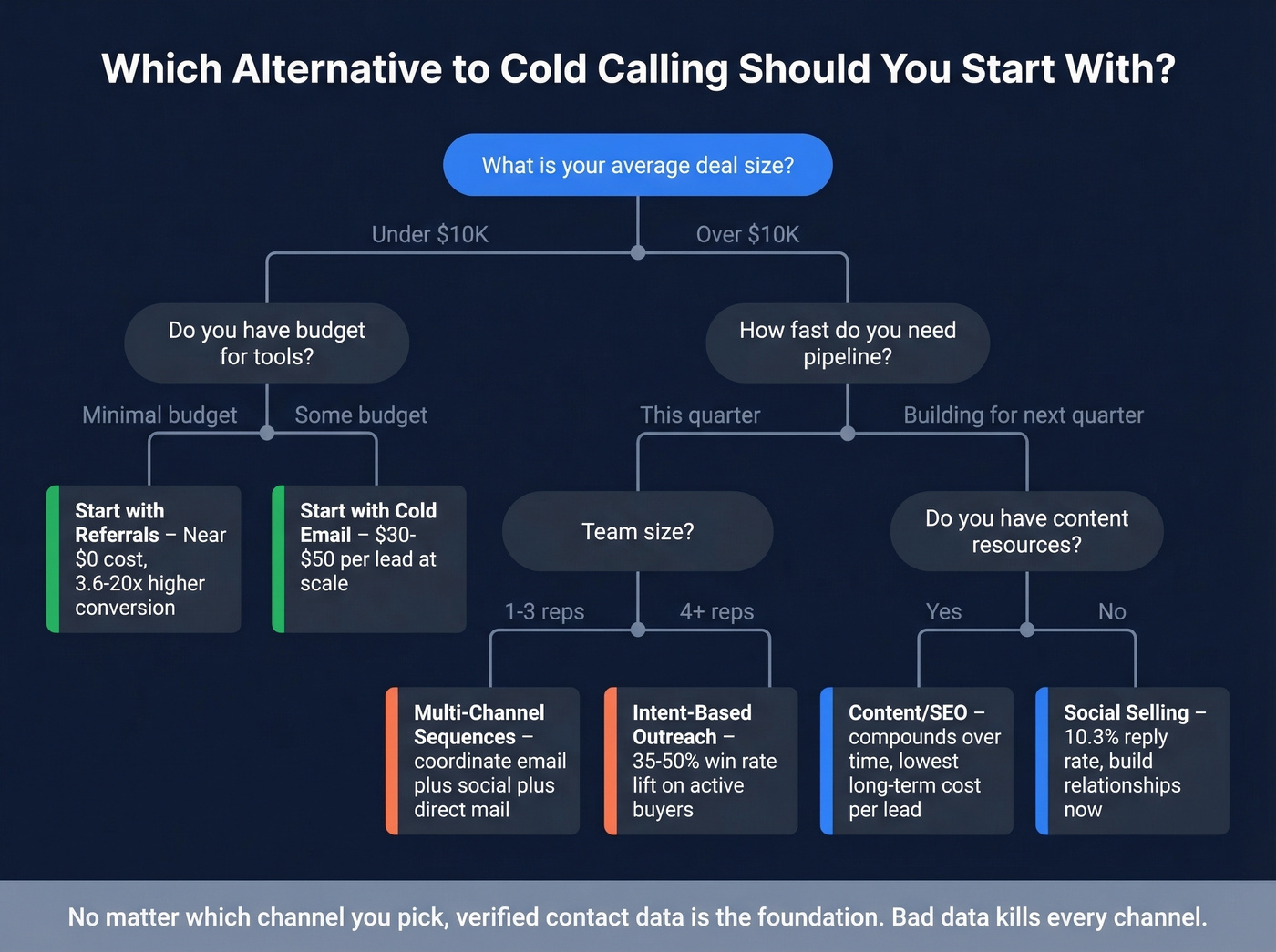
Small team, tight budget - Start with cold email and referrals. Lowest cost, highest immediate impact. Verify your list first, write 3-5 sequence variants, and ask every happy customer for one intro per quarter.
Mid-market team with 5-20 reps - Layer social selling and intent data on top of cold email. Use intent signals to prioritize accounts, social to warm them up, and email to drive the meeting.
Enterprise, high-value deals - Go multi-channel with direct mail for your top 50 accounts. Combine referrals, social selling, intent-triggered email, and physical touchpoints. The per-lead cost is higher, but so is the deal size.
Let's be honest about one thing: cold calling isn't dead, and teams that abandon the phone entirely are making a mistake. 69% of buyers say they've picked up a call from a new vendor. The highest-performing orgs use the phone as one channel in a multi-touch sequence - not as the entire strategy. The problem was never the phone itself. It was making the phone your only play.
If you’re still using calls, shift from pure cold to warm calling so the phone supports the rest of your motion.
Intent data without verified contacts is a wasted signal. Prospeo layers Bombora intent tracking across 15,000 topics on top of 300M+ professional profiles - so you reach in-market buyers the same week they start researching, with emails that actually land. Teams using Prospeo book 35% more meetings than Apollo users and 26% more than ZoomInfo.
Catch buyers while they're actively searching - not 18 months too late.
FAQ
Is cold calling actually dead?
No. Cold calling still converts at roughly 4.82% per latest WHAM data via Cognism, but it's the most expensive way to book a meeting at $300-$500 per lead. Most teams get better ROI combining cold email, social selling, and referrals while reserving the phone for high-intent prospects.
What's the cheapest way to replace cold calls?
Cold email runs $30-$50 per qualified lead - roughly 10x cheaper than cold calling. Your main costs are a sending tool ($30-$100/month) and a verified prospect list. Prospeo's free tier includes 75 email credits per month, enough to test the workflow before committing budget.
How many channels should I run at once?
Start with two or three, coordinated into a multi-channel sequence. Pick one primary outbound channel (usually cold email), layer in referrals for highest-value accounts, and verify all contact data before you start. Companies using 3-4 coordinated channels see 15-20% higher conversions than single-channel teams.