

amoCRM vs Bitrix24: Honest Comparison for 2026
The amoCRM vs Bitrix24 debate is misleading because these aren't interchangeable CRMs. amoCRM (now Kommo) is a sales tool built around messaging channels. Bitrix24 is a company operating system that happens to include a CRM. Pick the wrong one and you'll either outgrow your tool in six months or spend three weeks onboarding a platform you only need 20% of.
Quick clarification: amoCRM rebranded to Kommo in October 2022. Same platform, same team, same pricing. We'll use both names interchangeably since most people still search "amoCRM."
30-Second Verdict
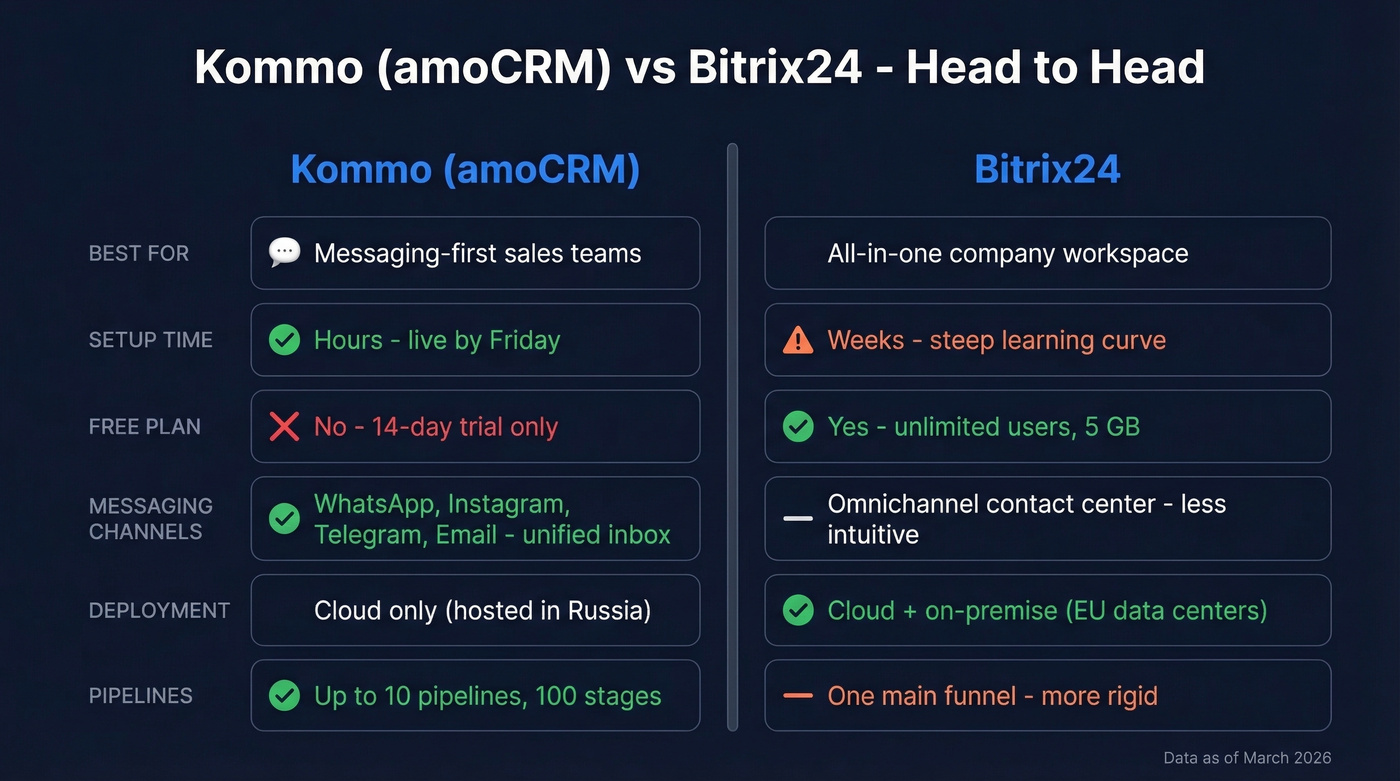
Pick Kommo (amoCRM) if you're a small sales team under 10 reps that lives in WhatsApp and Instagram DMs and needs a CRM running by Friday.
Pick Bitrix24 if you want CRM + project management + internal comms in one platform and can invest weeks in onboarding.
Quick Feature Comparison
| Kommo (amoCRM) | Bitrix24 | |
|---|---|---|
| Starting price | $15/user/mo | Free (unlimited users) |
| Free plan | No (14-day trial) | Yes - 5 GB storage |
| Capterra | 4.3/5 (194 reviews) | 4.2/5 (980 reviews) |
| G2 | Not listed | 4.1/5 (599 reviews) |
| Deployment | Cloud only | Cloud + on-premise |
| Best for | Messaging-first sales | All-in-one workspace |
Pricing by Team Size
Kommo charges per user. Bitrix24 uses tiered plans: the Free plan covers unlimited users, while paid tiers come with user limits - 5, 50, or 100 users depending on the plan. That distinction matters more as you scale.
| Team size | Kommo (Basic) | Kommo (Enterprise) | Bitrix24 |
|---|---|---|---|
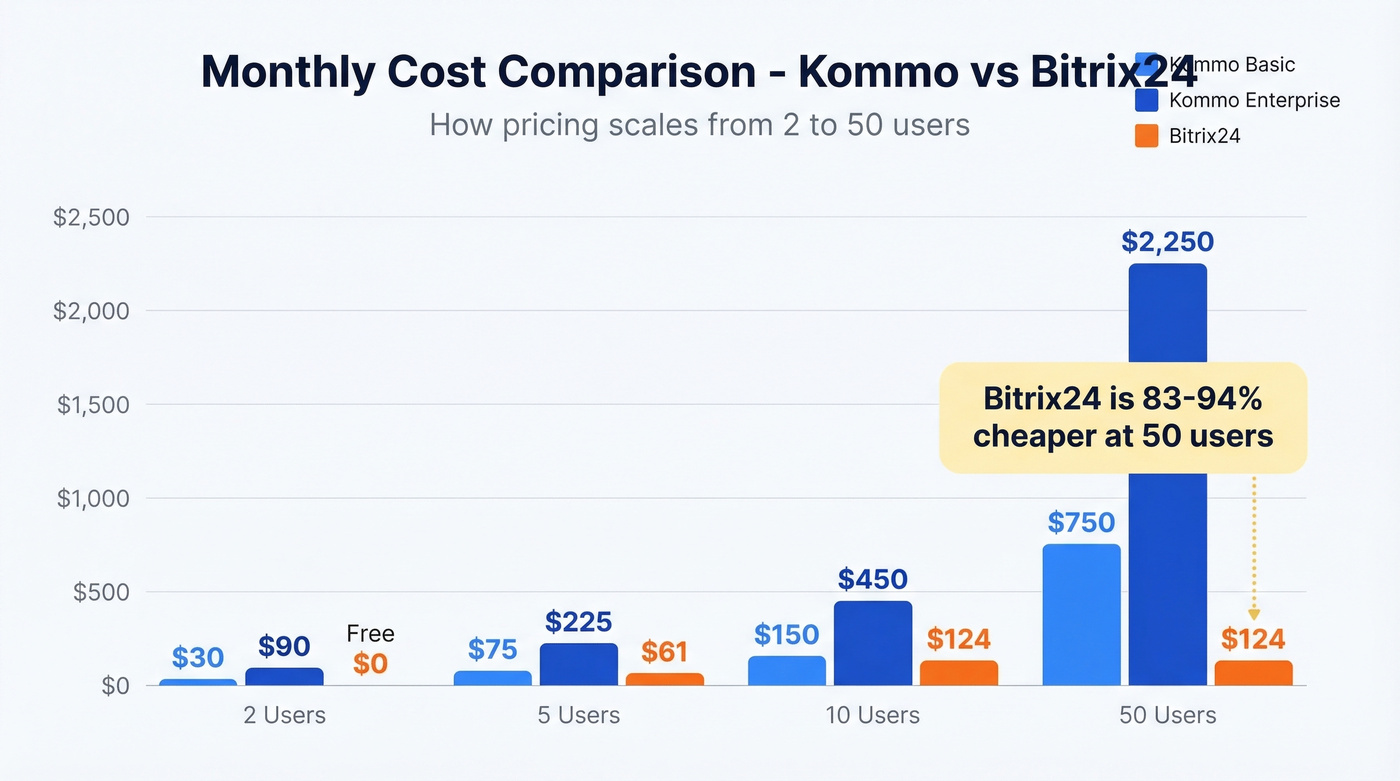
| 2 users | $30/mo | $90/mo | Free |
| 5 users | $75/mo | $225/mo | $61/mo (Basic, up to 5 users) |
| 10 users | $150/mo | $450/mo | $124/mo (Standard, up to 50 users) |
| 50 users | $750/mo | $2,250/mo | $124/mo (Standard, up to 50 users) |
You'll also see Bitrix24's entry plan listed as $49/month for 5 users on G2, while other pricing tables show $61/month for that same tier. Both numbers float around, so check Bitrix24's pricing page for the latest.
At 50 users, Bitrix24's Standard tier at $124/month is roughly 83% cheaper than Kommo Basic ($750/month) and about 94% cheaper than Kommo Enterprise ($2,250/month). That's the math that pulls larger teams toward Bitrix24 even when they don't need half its features.
Watch Kommo's hard limits on the entry tier: 5,000 contacts and companies per user, 500 open deals per user, and 100 MB of document storage per user. Those caps bite fast if you're running any volume. Higher tiers expand them (10,000-20,000 contacts per user; 1,000-3,000 open deals per user; 200-400 MB storage per user), but the per-seat cost adds up quickly.
For Russian/CIS teams, amoCRM runs RUB pricing on amocrm.ru at 599-1,699 rub/month.

Kommo caps you at 5,000 contacts per user on the entry tier. Bitrix24's free plan gives you unlimited users but zero prospecting tools. Neither CRM solves the real problem: finding verified contacts to fill your pipeline. Prospeo gives you 300M+ profiles with 98% email accuracy at $0.01/lead - then pushes them straight into your CRM via native integrations.
Pick your CRM. Let Prospeo fill it with contacts that actually convert.
Where These Two CRMs Actually Differ
Lead vs. Deal data model. This is the fundamental architectural split. Bitrix24 treats Leads as first-class entities - a lead gets qualified, then converts into a Contact, Company, or Deal. Kommo is deal-centric, with most daily activity happening in Deals and pipelines. For SMB sales teams that don't need a formal lead qualification stage, Kommo's approach is faster. For organizations with marketing-to-sales handoffs and longer qualification cycles, Bitrix24's lead entity makes more sense.
If you want a broader view of what counts as a CRM (and what doesn't), see our guide to CRMs.
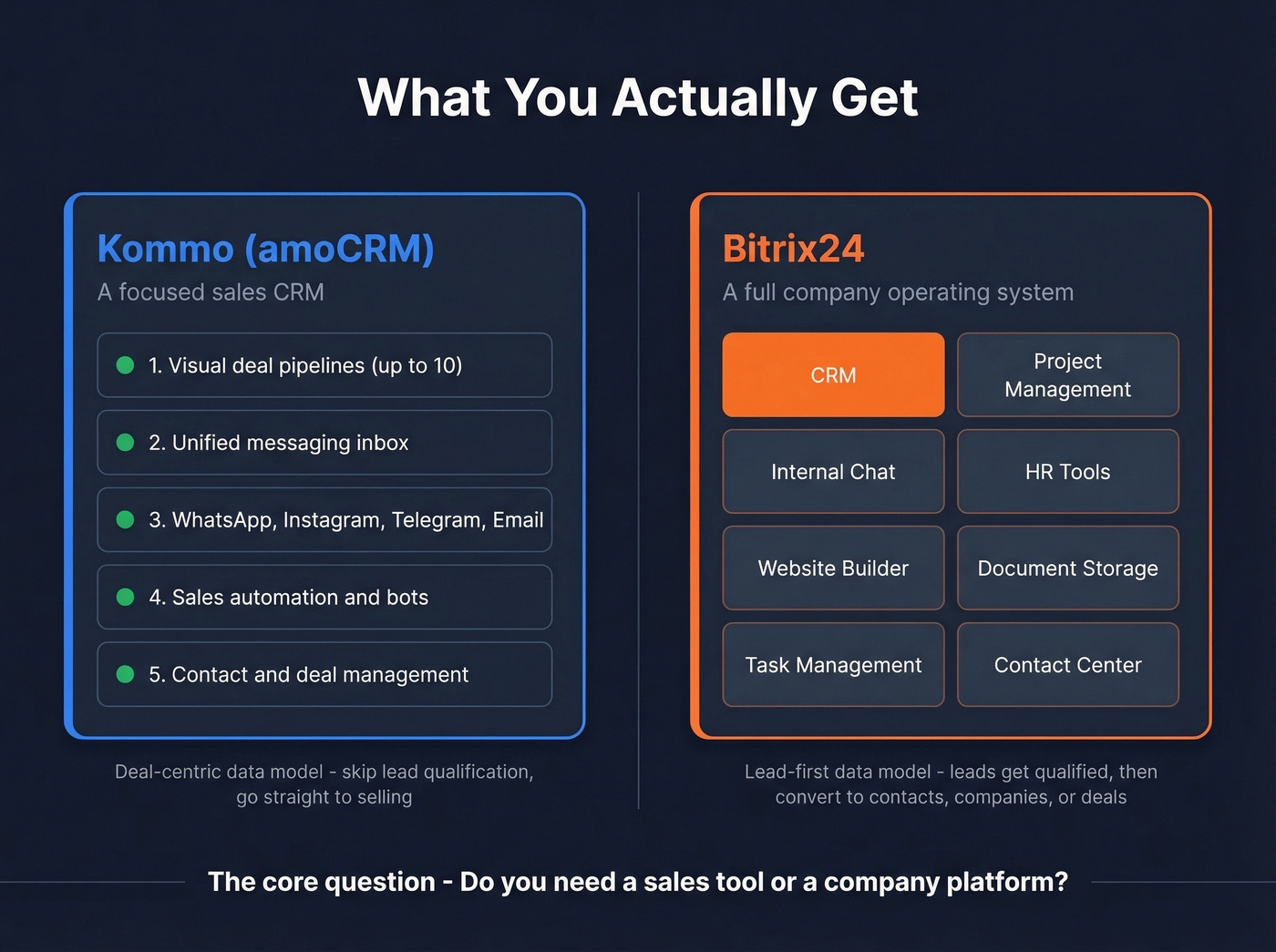
Scope. Kommo is a sales CRM. Full stop. Bitrix24 is a corporate portal where CRM sits alongside project management, internal chat, HR tools, website builders, and document storage. If you're an ops manager trying to consolidate Slack + Asana + your CRM, Bitrix24 does all three. If you just need to close deals, that breadth is clutter.
Funnel flexibility. Kommo supports up to 10 pipelines with 100 total stages - genuinely useful for teams running separate funnels for inbound, outbound, and upsell. Bitrix24 historically offers one common sales funnel. They've added "fast deals" since the September 2018 "Sydney" update to streamline simpler sales, but the core funnel architecture remains more rigid than Kommo's.
If you're building a repeatable process, it helps to map your stages to a real sales funnel model.
Messaging channels. This is Kommo's strongest card. WhatsApp, Instagram, Telegram, and email all funnel into one inbox. Bitrix24 has an omnichannel contact center too, but Kommo's implementation is tighter and more intuitive for conversational selling. If your reps spend their day in DMs, the difference is night and day.
Once the messages come in, the next bottleneck is follow-up. Use these sales follow-up templates to keep replies moving.
Deployment and data residency. Bitrix24 offers both cloud and on-premise deployment - a real advantage for teams with data sovereignty requirements. In cloud mode, Bitrix24 uses local data centers where legally required and otherwise mainly Amazon's European data centers. amoCRM is hosted in the Russian Federation. If compliance is a priority, Bitrix24 wins this one outright.
What Users Actually Say
Kommo (amoCRM) Reviews
On Capterra (4.3/5, 194 reviews), the praise centers on messaging centralization - teams love having WhatsApp, Instagram, and email in one view with automated follow-ups. The complaints cluster around limited customization and support that requires re-explaining your issue every time you follow up.
If you're evaluating alternatives, it can help to compare against other contact management software options too.
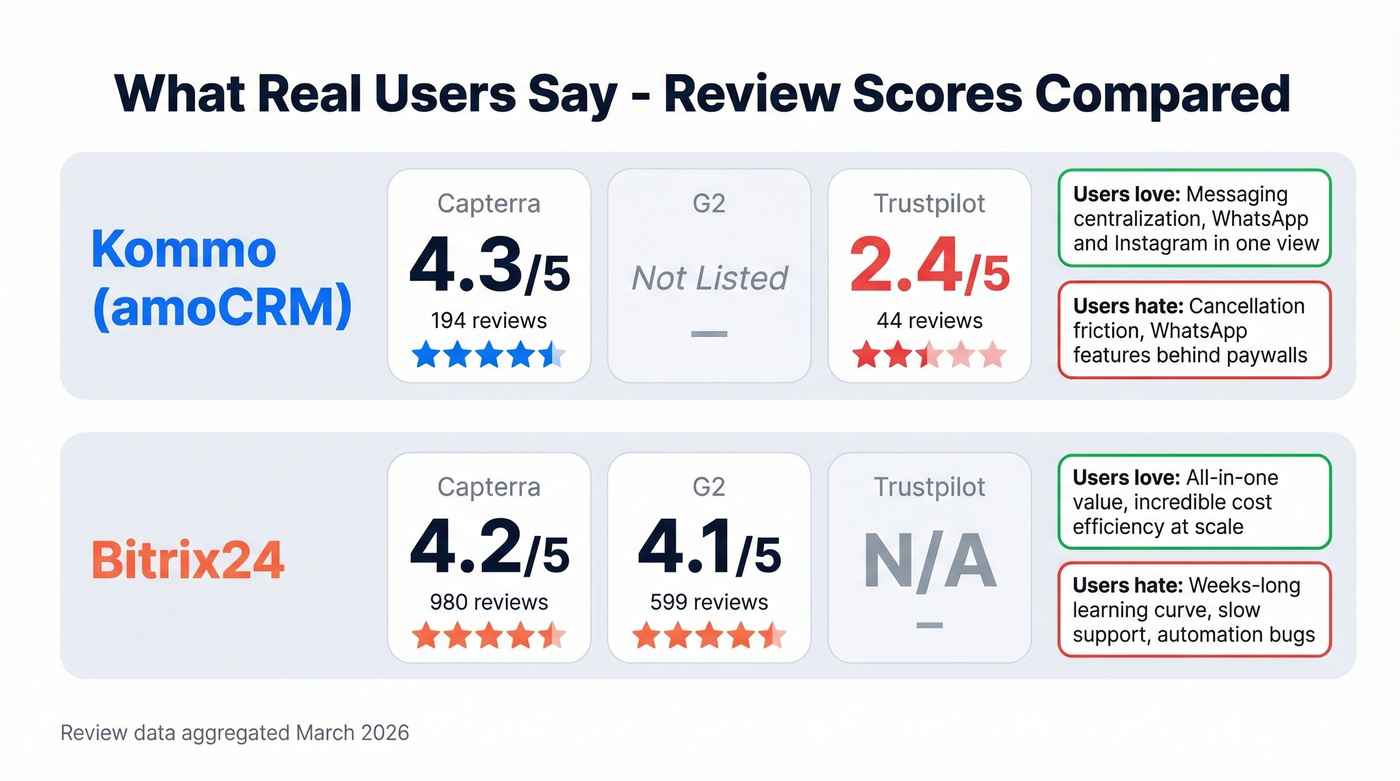
Trustpilot tells a harsher story: 2.4/5 from 44 reviews. The sample is small, but the complaints are sharp - cancellation friction, refund disputes, and a recurring gripe that basic WhatsApp functionality sits behind paywalls. That last point stings for a platform that markets itself as messaging-first.
Bitrix24 Reviews
Bitrix24's review volume is massive: 980 reviews on Capterra (4.2/5) and 599 on G2 (4.1/5). The consensus is clear on both sides.
Users love the all-in-one value and cost efficiency at scale. The universal complaint? Learning curve. "Weeks, not days" is the refrain. Support responsiveness is another sore spot - multiple reviewers describe waiting days for resolution. There's also a frustrating bug pattern where automations don't pull updated contact names or numbers, forcing manual workarounds that eat into the time you thought you were saving.
Direct head-to-head comparisons on Reddit are sparse - most threads devolve into "it depends on your use case" - which is why aggregated review data from Capterra, G2, and Trustpilot paints a clearer picture.
Our Verdict
Here's the thing: most teams agonizing over this decision are solving the wrong problem. If your average deal size is modest and your team is under 10 people, the CRM you pick matters far less than whether you have enough qualified contacts to fill it.
If you're struggling to keep pipeline full, start with these sales prospecting techniques before you switch tools.
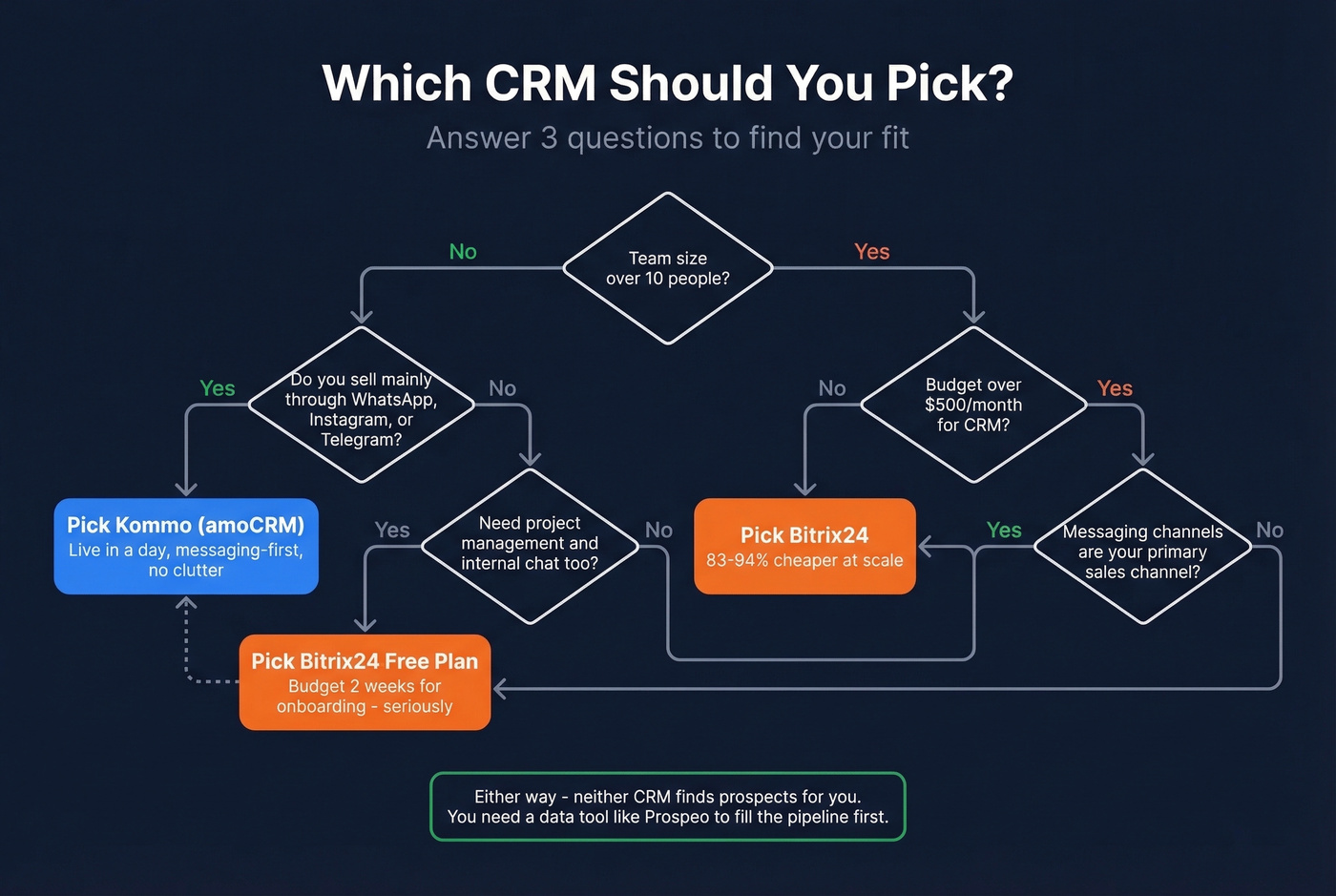
But if you've got the pipeline and need to organize it:
You're a 5-person sales team, seed-stage, selling via WhatsApp and email. You need a CRM running by Friday. Pick Kommo. You'll be live in a day, your messaging channels will be centralized, and you won't pay for project management tools you don't need.
You're an ops manager consolidating Slack, Asana, and a CRM for a 30-person team. Pick Bitrix24. We've seen teams grab the free plan, then abandon it within a month because nobody finished onboarding - so budget the first two weeks purely for setup. The learning curve is real, but the long-term cost savings at scale are hard to argue with.
If you're planning onboarding for a new rep team, a simple 30-60-90 day plan prevents a lot of churn.
The Data Gap Neither CRM Solves
Neither Kommo nor Bitrix24 helps you find prospects. They organize contacts you already have.
Prospeo fills that gap with 98% email accuracy, 125M+ verified mobile numbers, and a 7-day data refresh cycle. The free tier gives you 75 verified emails per month - enough to test whether better data actually moves your pipeline before you commit a dollar. Native integrations with Salesforce, HubSpot, Zapier, and Make mean syncing contacts into Kommo or Bitrix24 takes minutes, not hours.
To pressure-test vendors, compare categories like data enrichment services and free lead generation tools before you commit.
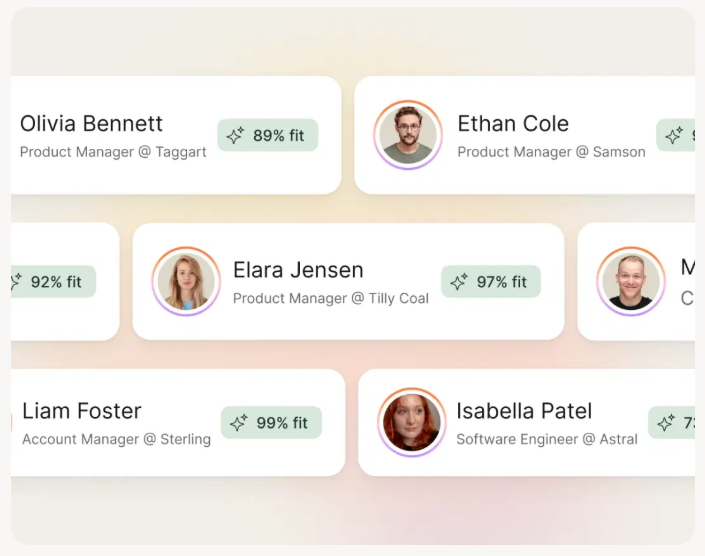
The article says it plainly: the CRM you pick matters less than whether you have enough qualified contacts to fill it. Prospeo's 30+ search filters - buyer intent, technographics, headcount growth, funding - let you build targeted lists in minutes. Data refreshes every 7 days, not 6 weeks. Works with HubSpot, Salesforce, or any CRM you choose.
Stop debating CRMs. Start filling your pipeline with verified buyers.
FAQ
Is amoCRM the same as Kommo?
Yes - amoCRM rebranded to Kommo in October 2022. Same platform, same team, same pricing. Your account URL changed from amocrm.com to kommo.com. They haven't increased pricing in over 8 years.
Does Bitrix24 have a free CRM?
Yes - Bitrix24's free plan includes CRM for unlimited users with 5 GB storage. You upgrade for more storage or advanced features, not headcount. The trade-off is a steep learning curve that Capterra reviewers consistently flag.
Which is better for small sales teams?
Kommo wins for teams under 10 reps focused on closing deals through WhatsApp, Instagram, or Telegram. Setup takes hours, not weeks. Bitrix24's free plan is tempting, but most small teams never finish onboarding its full feature set.
How do I get prospect data into either CRM?
Neither platform provides contact-finding tools. Use a B2B data platform like Prospeo to find verified emails and phone numbers, then import via CSV or sync through Zapier. The free tier gives you 75 emails per month - enough to validate the workflow before scaling up.