

Ampliz vs SignalHire: Which B2B Data Tool Deserves Your Budget?
You're about to enrich a 5,000-row CSV and finance asks what it'll cost - and whether "unlimited" actually means unlimited. That's the exact moment most teams realize they haven't done the math on their data tool. This Ampliz vs SignalHire breakdown does that math for you.
30-Second Verdict
SignalHire carries a 3.7/5 on G2 from 56 reviews. Ampliz sits at 4.2/5, but with only 7 reviews - so that rating barely qualifies as a sample size. Both tools have clear strengths and equally clear gaps.
Here's the honest breakdown:
- Pick SignalHire if you need broad ATS integrations, unlimited team seats, and a Chrome extension for recruiting workflows.
- Pick Ampliz if you're targeting APAC or healthcare and need strong filtering with bulk enrichment.
- Skip both if your biggest problem is bounced emails and stale records. Neither tool publishes a data refresh cadence, and that silence tells you everything.
Side-by-Side Comparison
| Feature | Ampliz | SignalHire | Edge |
|---|---|---|---|
| Database size | 400M+ B2B contacts (APAC Intelligence across 16 countries) | 850M+ verified profiles | SignalHire |
| Entry price | $50/mo | $69/mo | Ampliz |
| Free tier | 10 credits | 5 credits/mo (10 with extension installed) | SignalHire (more useful) |
| Credits at entry tier | 100 credits/mo | 1,000 email credits/mo | SignalHire |
| G2 rating | 4.2/5 (7 reviews) | 3.7/5 (56 reviews) | Ampliz (tiny sample) |
| Integrations | CSV export, Chrome extension (SalesBuddy) | ATS + CRM integrations + API | SignalHire |
| API | Not publicly documented | Person + Search APIs, 600 items/min | SignalHire |
| Data refresh cadence | Not disclosed | Not disclosed | Neither |
| Best for | APAC, healthcare | Recruiting, global prospecting | SignalHire (broader use) |
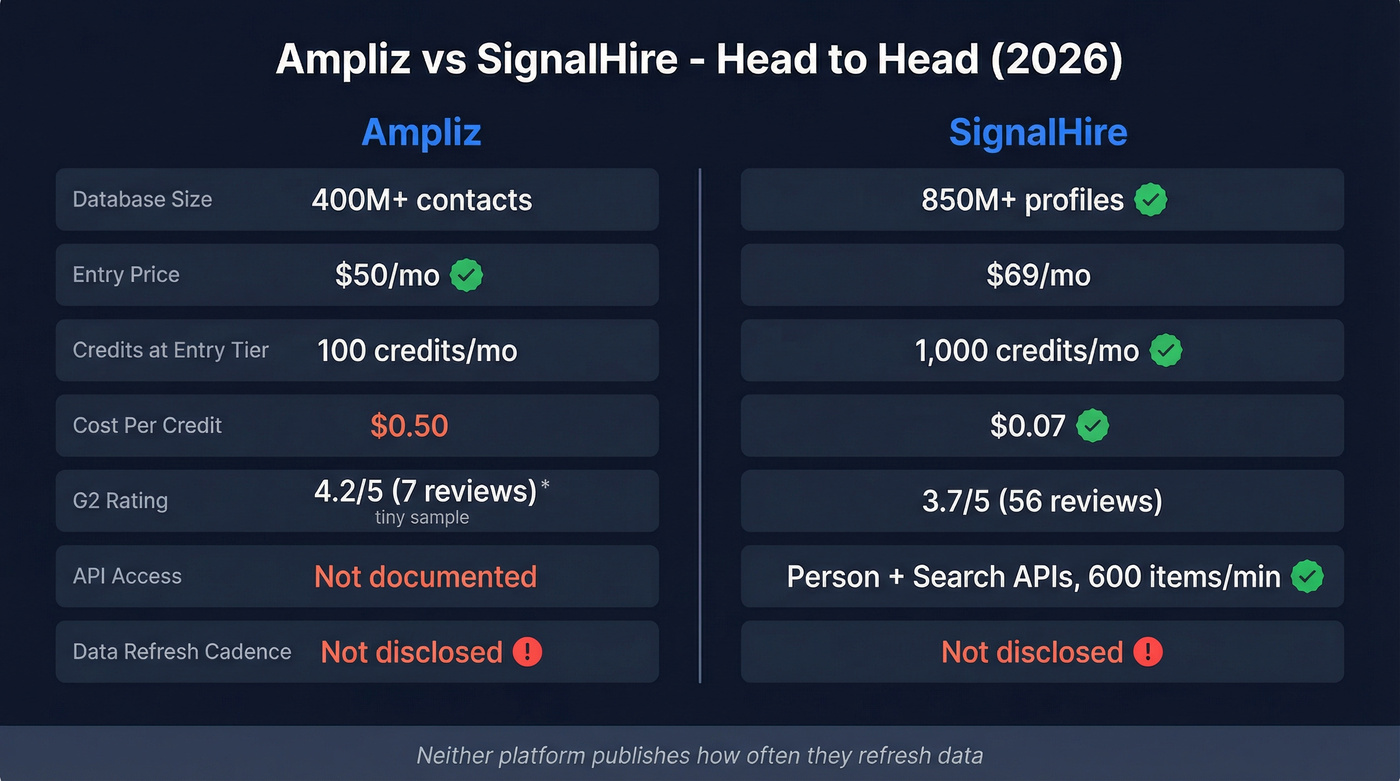
SignalHire wins on breadth - bigger database, deeper integrations, stronger API, and far more credits per dollar. Ampliz wins on depth. If your ICP lives in APAC or healthcare, its specialization and filtering are hard to beat elsewhere.
Database size is a vanity metric. What actually matters is cost per usable contact - and that depends on verification rates and refresh cadence, not how many profiles a vendor claims to have. Neither platform discloses how often they refresh records, which should make any data-driven buyer nervous.
Pricing Breakdown
Ampliz keeps it simple: a free tier with 10 credits, then $50/mo or $480/year for 100 credits and all-features access. At $0.50/credit on the monthly plan, it's not cheap per contact - but the APAC and healthcare focus can justify the premium if that's your market. We compared credit costs across both platforms, and the per-contact math diverges fast at scale.
If you're evaluating alternatives, it helps to benchmark against other data enrichment services and broader sales prospecting databases before you lock in a credit model.
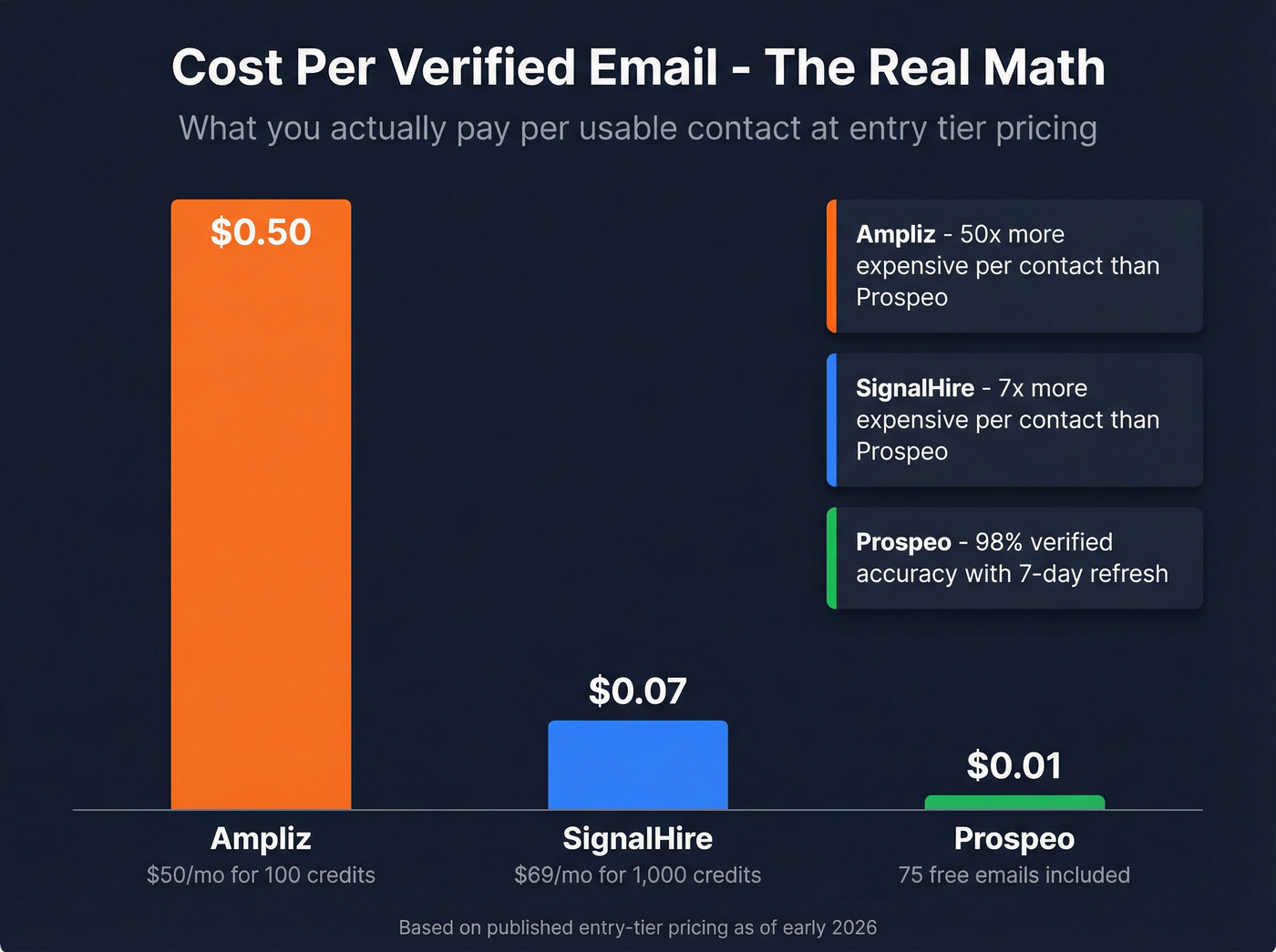
SignalHire splits pricing by data type, which gets confusing fast. There's a free plan at $0/mo with 5 credits - bump that to 10 if you install the browser extension. Paid email plans run $69/mo for 1,000 credits. Phones cost $69/mo for 435 credits. Want both? That's $139/mo for 900 credits. Annual billing drops those to $57/mo and $110/mo respectively.
Here's the thing: SignalHire advertises an "unlimited" package, but a fair-usage policy caps you at 2,000 credits per month. Calling a plan "unlimited" while capping at 2,000 credits/month wastes buyers' time. Read the fine print before you commit.
For context, Prospeo's credit-based model runs roughly $0.01/email with no contracts and a free tier of 75 emails plus 100 Chrome extension credits per month - making it significantly cheaper per verified contact than either option here.
If you're trying to pressure-test the real cost, compare it against your lead enrichment volume and your expected email bounce rate before you buy credits.

You're comparing $0.50/credit (Ampliz) and $0.07/credit (SignalHire) - but neither tells you how fresh the data is. Prospeo runs ~$0.01/email with a 7-day refresh cycle, 98% verified accuracy, and 75 free emails to prove it.
Stop paying more for data that might already be stale.
Data Quality and Freshness
SignalHire's own case studies cite 95% accuracy, with one example showing deliverability jumping from 75% to 94% after enrichment. The G2 reality is messier - reviewers flag outdated data, incomplete records, and what G2's review mining categorizes as fraudulent information. One recruiter on r/recruiting reported a phone number that traced to Alaska for a contact who'd never been there. In our testing, SignalHire's phone data was noticeably weaker outside North America.
Ampliz has similar issues on the freshness front. G2 reviewers call out outdated job titles and weaker completeness for smaller companies. The filters and verified emails get praise, but if someone changed roles three months ago, you won't know it.
Let's be real: one batch with a 15%+ bounce rate can land your domain on blocklists that take weeks to clear. That's the core problem with both platforms - and it's why a verification layer isn't optional. Any tool that won't tell you how often it refreshes data is asking you to trust blindly.
If you're sending at scale, pair your database with an email deliverability guide and a plan to improve sender reputation.
Best Use Cases
Recruiting Workflows - SignalHire
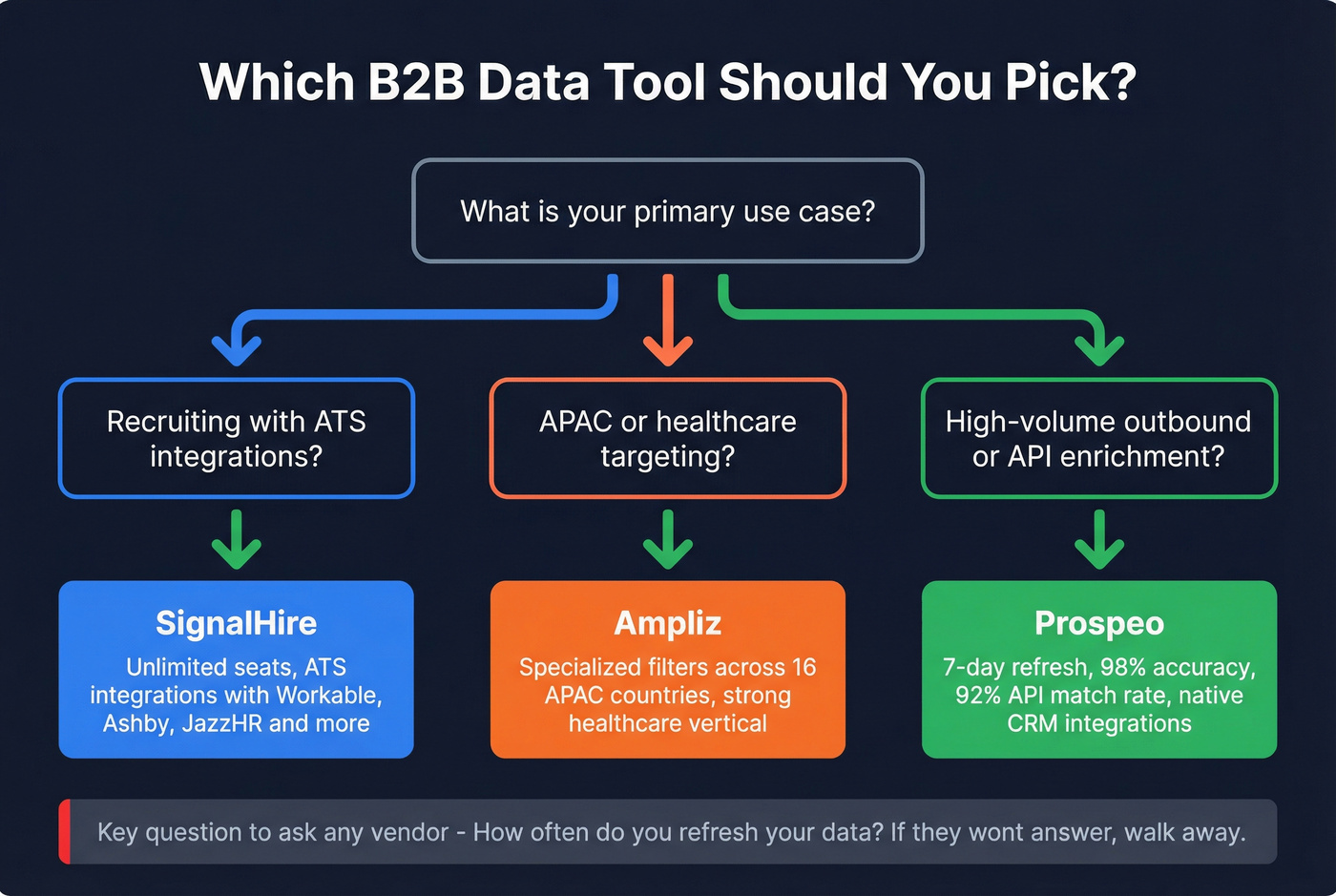
The ATS integration list is genuinely impressive: Workable, Ashby, JazzHR, Loxo, Recruitee, and a dozen more. Unlimited seats mean your whole recruiting team can use it without per-user math. If you're a staffing agency running high-volume sourcing, this is the stronger pick.
APAC or Healthcare Targeting - Ampliz
Coverage across 16 APAC countries with healthcare specialization gives it a niche that generic databases can't touch. Selling medical devices into Southeast Asia? Start here. Just plan to verify your exports before sequencing - the freshness gaps are real.
If you're building lists for outbound, it also helps to standardize your firmographic and technographic data so filters stay consistent across tools.
API-Heavy RevOps - Consider a Third Option
SignalHire's Person API handles 600 items/min with a webhook/callback workflow, which is decent. Ampliz's native integration and API surface isn't clearly documented, so most teams should assume CSV-based workflows plus its own enrichment/append capabilities. But if you're building a custom enrichment pipeline, you need data you can trust at scale - and undisclosed refresh cadences don't inspire confidence for automated workflows. Prospeo's enrichment API delivers a 92% match rate with 50+ data points per contact, refreshed every 7 days, with native integrations into Salesforce, HubSpot, Clay, Zapier, and major sequencing tools.
When Neither Tool Fits
Both Ampliz and SignalHire share the same weakness: zero transparency about data refresh cadence. If you're running outbound at any real volume, that's a dealbreaker.
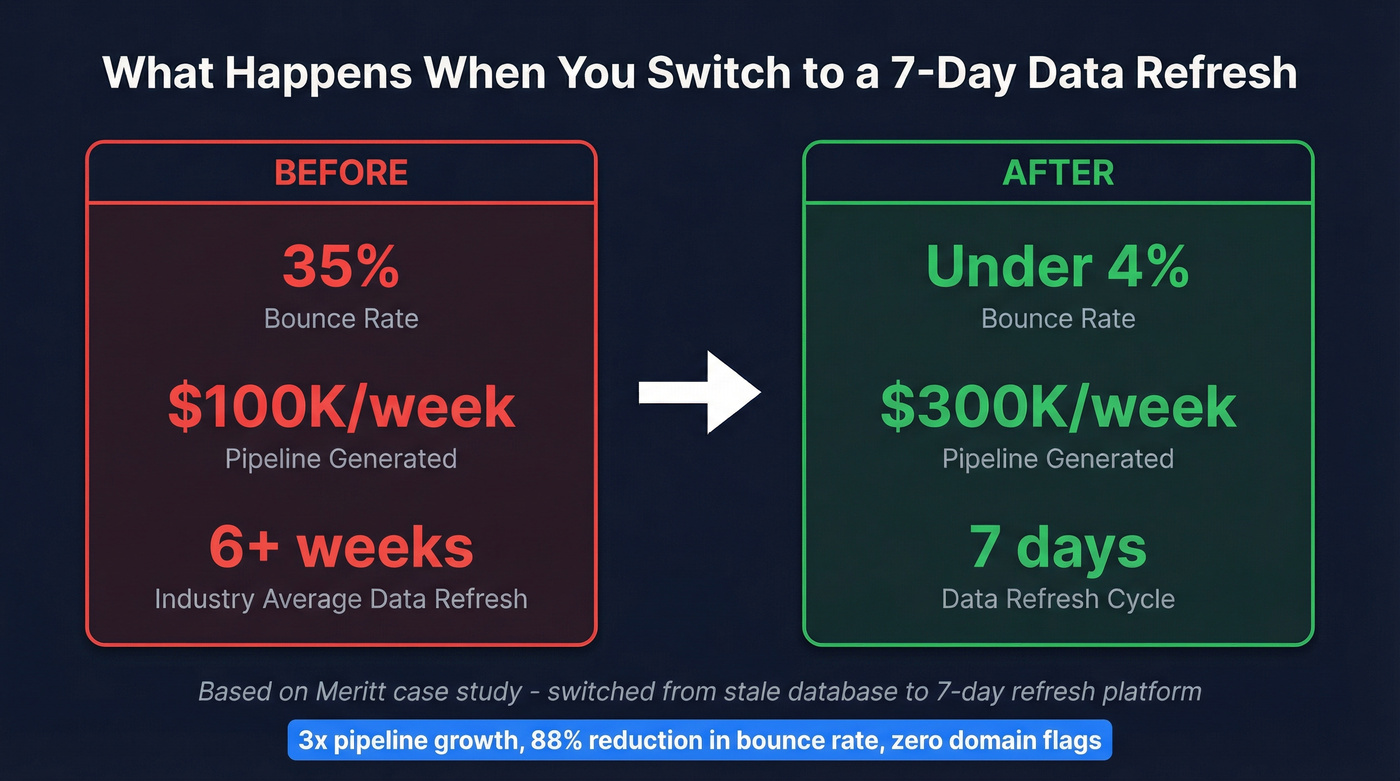
We've seen this pattern repeatedly - teams sign up for a database with impressive headline numbers, then burn through credits on contacts who changed jobs months ago. Meritt, for example, was dealing with a 35% bounce rate before switching to a platform with a 7-day refresh cycle. After the switch, their pipeline tripled from $100K to $300K/week and their bounce rate dropped below 4%. Stack Optimize built from $0 to $1M ARR while maintaining 94%+ deliverability and zero domain flags across all clients.
A 7-day data refresh cycle compared to the 6-week industry average isn't a minor difference - it's the difference between reaching real people and torching your sender reputation. The database covers 300M+ professional profiles, including 143M+ verified emails and 125M+ verified mobiles, with 98% email accuracy. Layer in 30+ search filters including buyer intent powered by Bombora, technographics, job change signals, and headcount growth, and you've got a platform that works as both a standalone database and an accuracy layer on top of whatever else you're using.
If you're tightening your outbound process, align your list-building with proven sales prospecting techniques so you’re not just buying more data - you’re using it better.

If undisclosed refresh cadences make you nervous, they should. Meritt cut their bounce rate from 35% to under 4% and tripled pipeline after switching to Prospeo's 7-day refresh cycle. The 92% API match rate handles enrichment at scale - no CSV guesswork.
Replace the guesswork with a data platform that publishes its refresh cycle.
FAQ
Is SignalHire's unlimited plan really unlimited?
No. A fair-usage policy caps you at 2,000 credits per month, even on the "unlimited" tier. Each credit equals one contact lookup returning at least one email or phone. For high-volume teams, that ceiling matters - do the math against your monthly enrichment needs before signing up.
Does Ampliz work outside APAC?
It can, but its strongest coverage and vertical depth - particularly in healthcare - is concentrated across 16 APAC countries. For truly global prospecting, you'll want to pair it with a broader tool or use a database with 300M+ profiles covering all regions.
What's the cheapest way to get verified B2B emails from these tools?
SignalHire's entry plan gives you 1,000 email credits for $69/mo ($0.07/credit). Ampliz runs $0.50/credit at its base tier. Prospeo offers 75 free verified emails per month and scales at roughly $0.01/email - making it 7-50x cheaper per verified contact than either platform.
How do I protect my sender reputation with unverified data?
Run every export through a dedicated verification layer before loading contacts into sequences. A platform with a 7-day refresh cycle catches stale records that both Ampliz and SignalHire occasionally deliver, protecting your domain before damage happens. One bad batch can land you on blocklists that take weeks to clear - and that's a problem no amount of credits can fix.