

How to Build an App Go-to-Market Strategy That Actually Works
You spent six months building the app. You launched on Tuesday. By Friday, you have 47 downloads and a Slack channel full of silence.
That's not a hypothetical - it's the default outcome. More than 60% of startups launch without a GTM strategy, and only 0.5% of mobile apps are considered successful. The gap between the 0.5% and everyone else isn't the product. It's the app go-to-market strategy behind it.
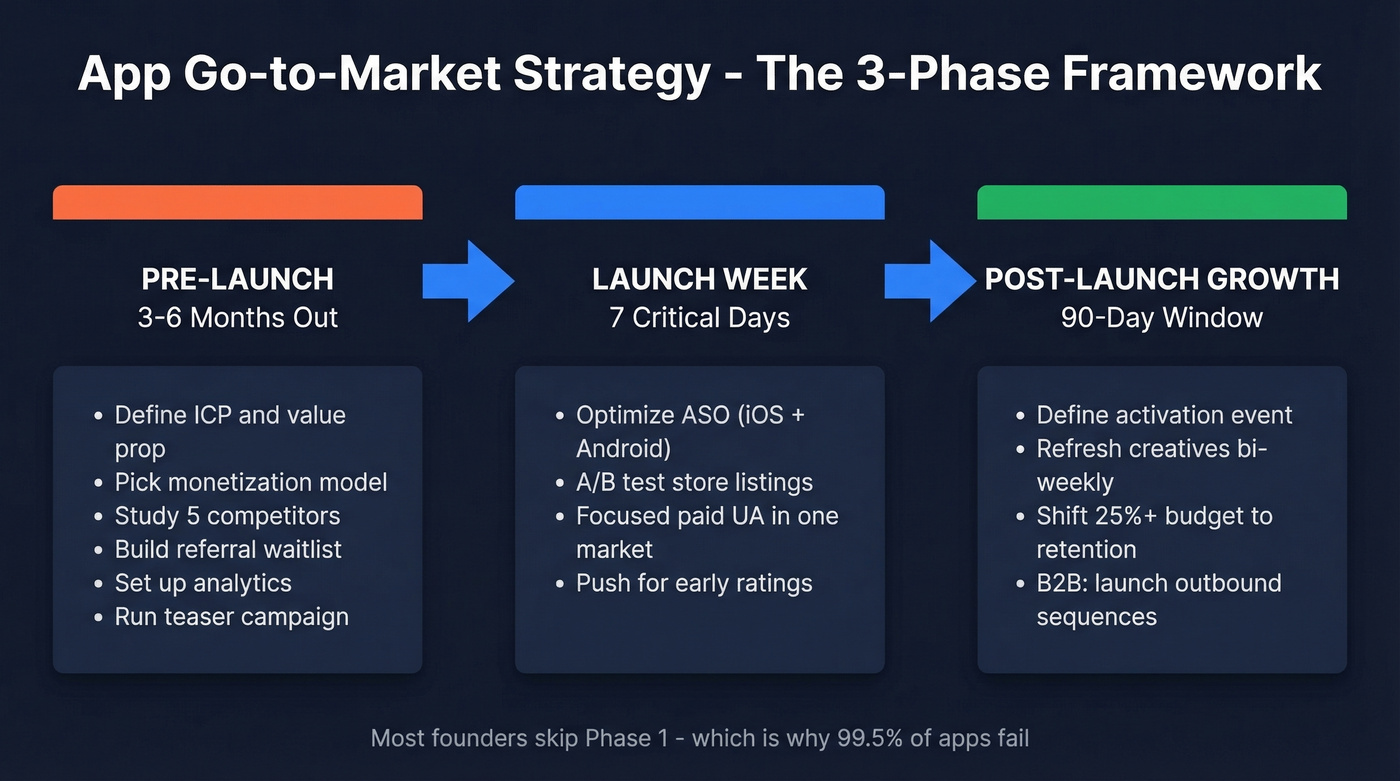
Your launch plan breaks into three phases: 3-6 months of pre-launch prep, a focused launch week, and a 90-day post-launch growth window. Most founders skip the first phase entirely, which is why the failure rate is so brutal.
Phase 1: Pre-Launch (3-6 Months Out)
This is where your GTM plan actually gets built. Everything after is execution. If you're spending $20K-$60K on a simple MVP, you can't afford to treat marketing as an afterthought.
Define your value prop and ICP. One persona, one pain point, one sentence that explains why your app exists. If you can't nail this in under 15 words, you're not ready to build a store listing, let alone run ads. If you need a tighter framework, use an ideal customer profile template and score it.
Pick your monetization model. Paid downloads are dead. Freemium and subscriptions dominate every major category. Charging $2.99 upfront means fighting the entire market's expectations - and losing.
Study your top 5 competitors' store listings. Their screenshots, review complaints, and pricing tell you exactly where to differentiate. We've found that reading one-star reviews of competitors is the single fastest way to find positioning gaps. (If you want a system for this, build a lightweight competitive intelligence loop.)
Build a waitlist with referral mechanics. Unique referral links with rewards turn passive signups into active promoters. A community of 500 genuinely engaged people is worth more than 10,000 passive emails.
Set up analytics from day one. Mixpanel or Amplitude for product analytics, AppsFlyer or Adjust for attribution. If you can't measure activation and retention at launch, you're flying blind.
Start a teaser campaign 30-60 days before launch. Drip emails, beta invites, micro-influencer seeding. Go longer than 60 days without engagement and your waitlist-to-install conversion falls off a cliff.
Phase 2: Launch Week
The first 7 days are critical. Downloads, ratings, and engagement in that window can make or break early visibility.
ASO - Your Free Acquisition Engine
65-75% of all installs come from app store search. That makes ASO the highest-leverage channel you have. But iOS and Android index differently:
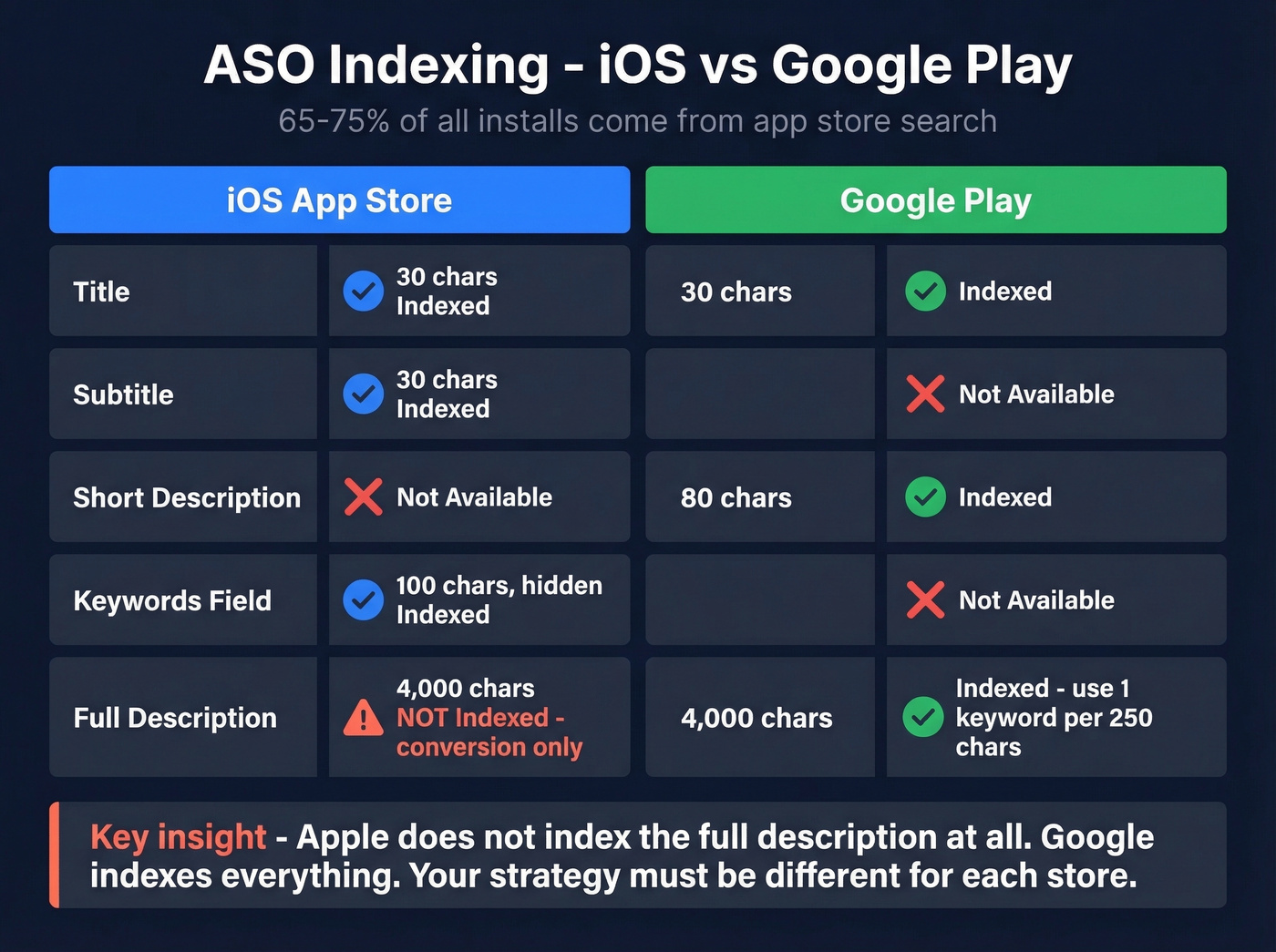
| Field | iOS (App Store) | Google Play |
|---|---|---|
| Title | 30 chars, indexed | 30 chars, indexed |
| Subtitle | 30 chars, indexed | N/A |
| Short Description | N/A | 80 chars, indexed |
| Keywords | 100 chars, hidden | N/A |
| Full Description | 4,000 chars, NOT indexed | 4,000 chars, indexed |
Here's the thing most guides miss: Apple's full description doesn't affect search rankings at all - it's purely for conversion. Google Play indexes everything, so aim for roughly one exact keyword mention per 250 characters without stuffing. Mallzee ran A/B tests across icon, title, subtitle, and screenshots and lifted their store listing conversion rate by 10%. That's free installs from the same traffic.
One overlooked tactic: if you have a mobile website, add a web-to-app banner. It's a free install channel that almost nobody uses.
Paid UA - What It Costs in 2026
70% of developers increased their paid UA budgets this year. Here's what CPIs actually look like:
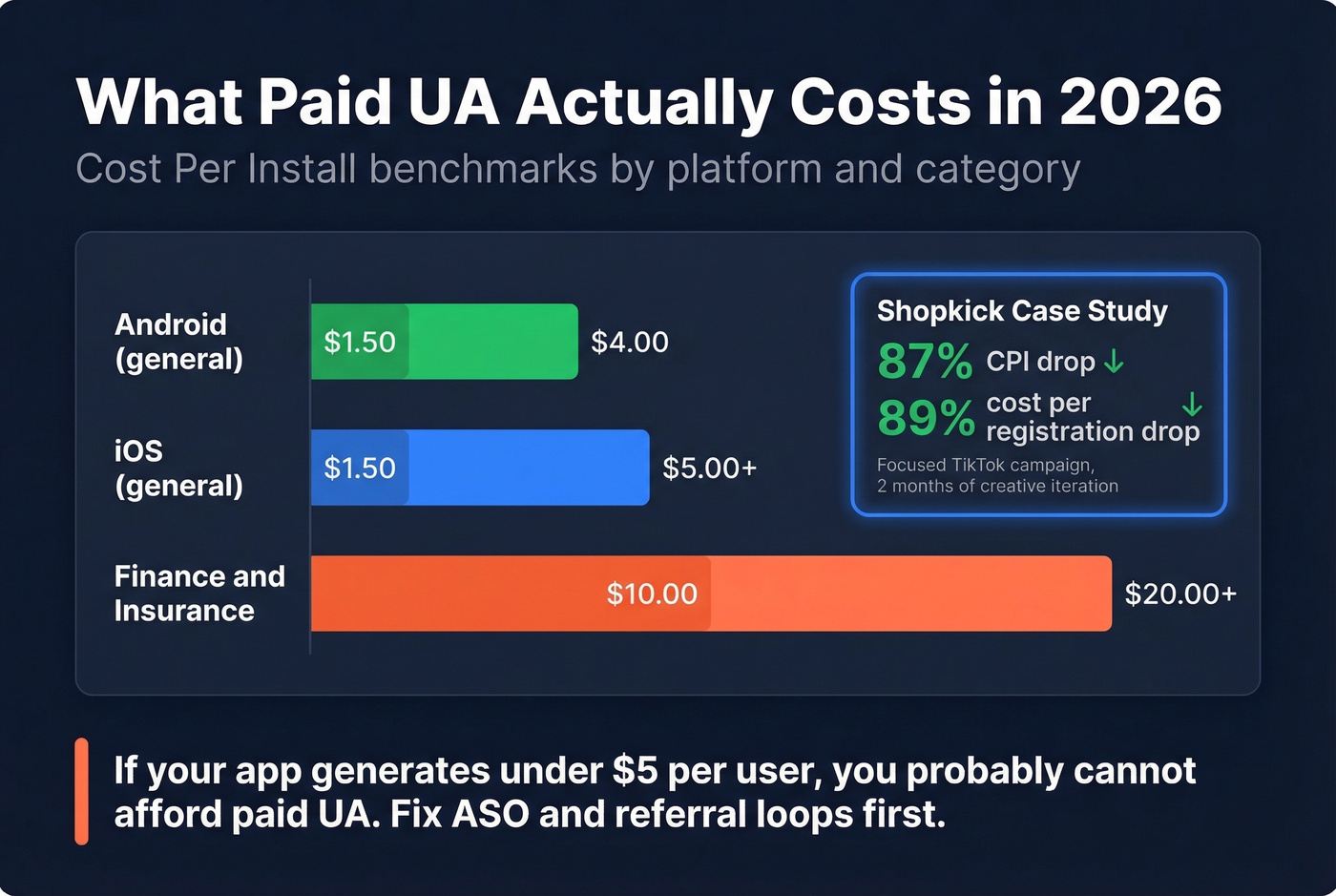
- iOS: $1.50-$5+, depending on region and category
- Android: $1.50-$4+
- High-value genres like finance and insurance: $10-$20+
Stop planning a global launch. Launch in one city or one niche. Shopkick ran a focused TikTok UA campaign and iterated creatively over two months - CPI dropped 87%, cost per registration dropped 89%. Focused iteration beats broad campaigns every single time.
If your app generates under $5 per user, you probably can't afford paid UA at all. Get your ASO and referral loops working first, then layer in paid once you have a retention curve worth scaling.
Phase 3: Post-Launch Growth
The 90 days after launch determine whether your app becomes a business or a side project.
The single most important thing you can do is define your activation event - the specific action that predicts retention. Completing a first workout. Sending a first message. Saving a first item. Users who activate in the first session retain at dramatically higher rates than those who don't. The Statsig methodology lays this out well: define the event, validate it with experiments, then cohort every user by whether they hit it.
We've seen activation rates jump when teams cut their onboarding from five steps to two. Every extra screen is a drop-off point. Let's be honest - nobody wants to answer six questions before they can use the thing they just downloaded.
On the creative side, data from 400+ mobile marketers paints a clear picture: 75% refresh ad creatives at least bi-weekly, 77% say video is their best-performing ad type, and 83.5% manage campaigns in-house. You don't need an agency. But you do need to stop running static image ads on a monthly refresh cycle.
And 43% of marketers now allocate more than 25% of their budget to retention and re-engagement - a clear signal that the industry has matured past "just get downloads." If you want to pressure-test this, run a simple churn analysis and map it to your retention loops.

Your app GTM strategy doesn't end at ASO and paid UA. If you're launching a B2B app, you need verified contact data to reach decision-makers directly. Prospeo gives you 300M+ profiles with 30+ filters - role, company size, tech stack, intent signals - so you can build a targeted outbound list in minutes, not weeks.
Stop manually hunting contacts. Start closing your first B2B app deals this week.
Metrics That Matter
| Metric | What It Measures | Why It Matters |
|---|---|---|
| CAC | Cost to acquire a customer | Unit economics baseline |
| CPI | Cost per install | Channel efficiency |
| Activation Rate | % completing key action | Predicts retention |
| D1 / D7 / D30 | Retention by day | Product-market fit signal |
| ARPU | Revenue per user | Monetization health |
| CLV | Lifetime customer value | Tells you max viable CAC |
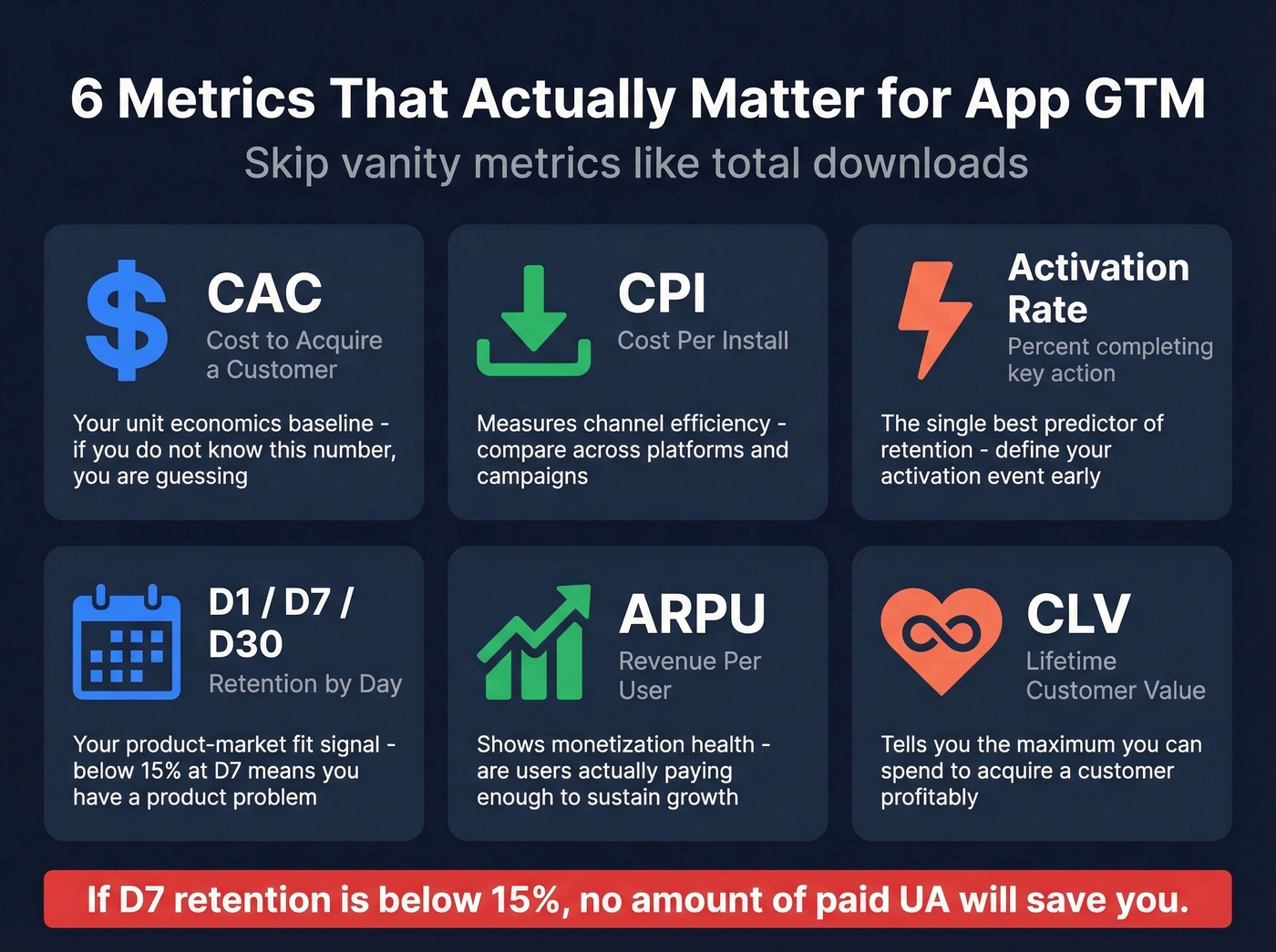
Skip vanity metrics like total downloads. If your D7 retention is below 15%, no amount of paid UA will save you - you have a product problem, not a marketing problem. (If you need a clean way to structure this, start with funnel metrics and work backward from retention.)
B2B Apps - The GTM Layer Nobody Covers
If you're building a B2B app, half your go-to-market strategy is outbound. Every consumer-focused guide ignores this. Consumer app GTM is ASO plus paid UA. B2B mobile launches add a critical layer: identifying decision-makers at target companies and getting in front of them directly.
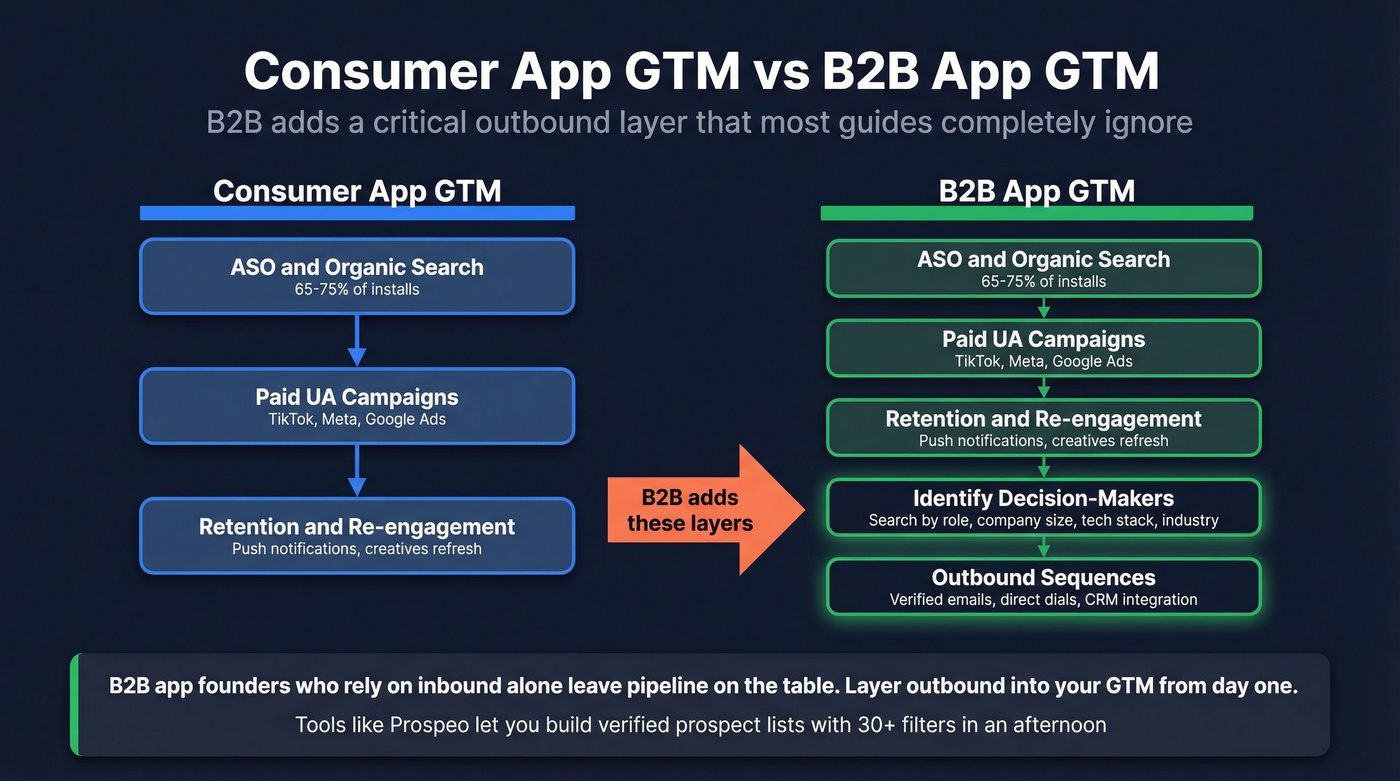
This is where verified prospect data becomes essential. Tools like Prospeo let you search by role, company size, industry, or tech stack using 30+ filters, then export a clean list of verified emails and direct dials straight into your sequencer. Our team has watched B2B app founders burn weeks manually hunting contacts on professional profiles when they could build a targeted list in an afternoon and start testing messaging the same day. If you're building this motion, borrow proven sales prospecting techniques and pair them with a tight B2B cold email sequence.
B2B app founders who rely on inbound alone leave pipeline on the table. With Prospeo, you get 98% email accuracy, 125M+ verified mobile numbers, and direct CRM integrations - everything you need to layer outbound into your go-to-market strategy at $0.01 per email. No contracts, no sales calls.
Build your outbound launch list in an afternoon - not a quarter.
Your 2026 Launch Checklist
Pre-Launch (3-6 months)
- Define value prop and ICP
- Choose monetization model
- Set up analytics stack
- Build waitlist with referral mechanics
- Launch teaser campaign 30-60 days out
Launch Week
- Optimize ASO for both iOS and Android
- A/B test store listing elements
- Activate paid UA in one focused market
- Push for ratings from waitlist cohort
Post-Launch (90 days)
- Define and validate your activation event
- Refresh creatives bi-weekly with video
- Shift 25%+ of budget toward retention
- For B2B: build verified prospect lists and launch outbound sequences
A solid app go-to-market strategy isn't a single launch day event. It's a 6-month arc from pre-launch positioning through post-launch retention. Nail the phases in order, measure what matters, and resist the urge to scale paid channels before your activation and retention numbers prove the product works. If you want a broader framework to compare against, see our go-to-market strategy guide.