

Attio vs HubSpot: The Honest 2026 Comparison
You just opened the HubSpot renewal email. $14,400 for your 10-person team - and that's before the Marketing Hub line item your CMO added in Q3. The CFO wants to know why you're paying for a "customer platform" when reps mostly use the search bar and sequences. Meanwhile, half your team keeps tagging you in Slack threads about Attio.
If you're weighing Attio vs HubSpot, here's how to actually think about this decision - and why the feature checklist approach will lead you astray.
30-Second Verdict
Choose Attio if you're an outbound-first team under 20 people who values flexibility and modern UX over breadth. You'll pay less per seat and get flexible objects on every plan, but you'll build a tool stack around it.
Choose HubSpot if you're running inbound plus outbound with 50+ people and need marketing, sales, and service aligned in one platform. You'll pay more, but you'll consolidate.
Skip both if your real problem is bad contact data. Neither CRM fixes a list where 30% of emails bounce. Verify what you actually have before migrating anything (and benchmark your email bounce rate first).
GTM Motion Matters More Than Features
The core difference isn't features. It's philosophy.
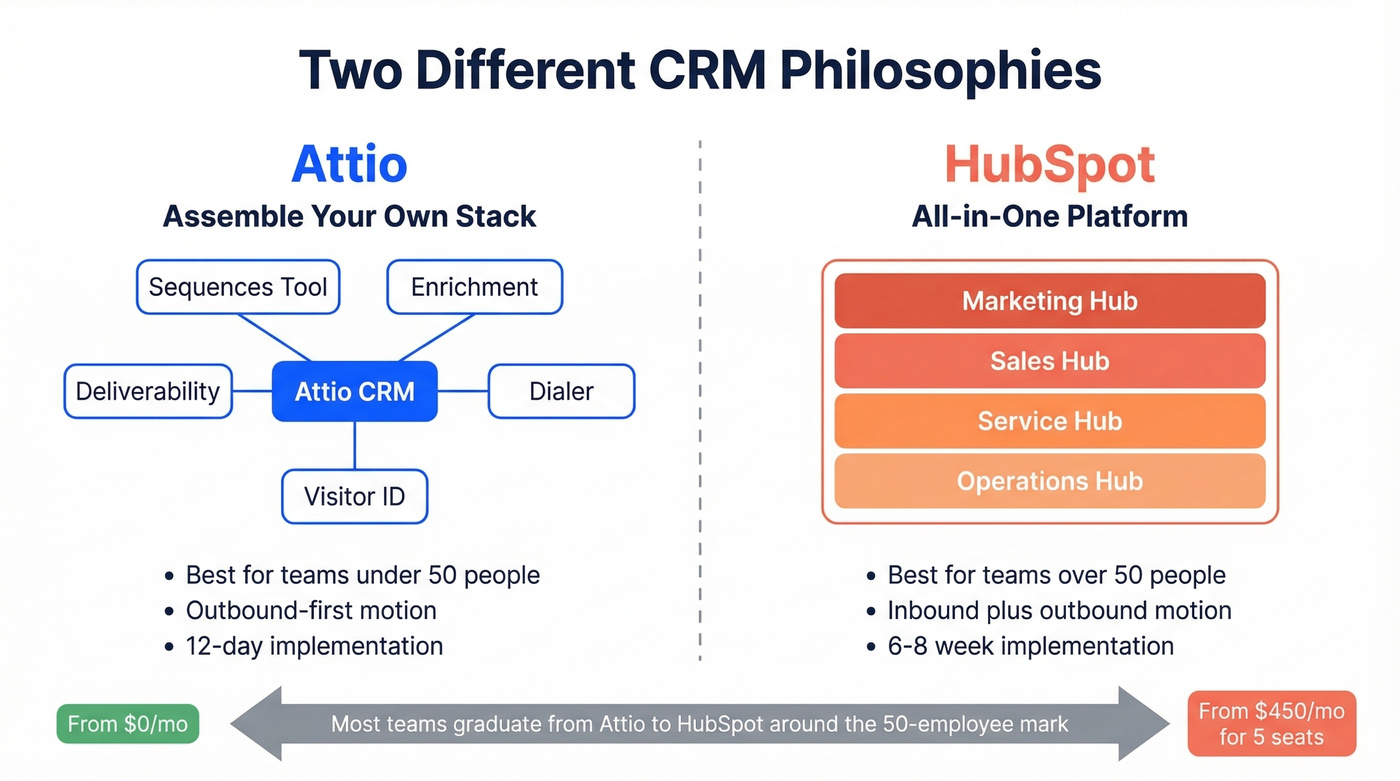
Attio is a flexible CRM without marketing overhead. It gives you flexible objects, clean automations, and a modern interface - and teams typically plug in their own enrichment and dialing tools. Think of it as a CRM for people who want to assemble their own stack.
HubSpot is a marketing platform that evolved into a CRM. It started with inbound - forms, landing pages, email nurture - and bolted on Sales Hub, Service Hub, and Operations Hub over time. The strength is cross-functional alignment. The cost is complexity (especially if you haven't nailed your go-to-market strategy yet).
The practical threshold most practitioners cite: teams under ~50 employees and $5M ARR tend to thrive on Attio. Past that, the need for marketing-sales-service alignment usually pushes you toward HubSpot or Salesforce. That's not a rule - it's a pattern we've seen play out repeatedly.
Feature Comparison
| Category | Attio | HubSpot Sales Hub | Edge |
|---|---|---|---|
| Custom / Flexible Objects | Included across plans (Free: 3; Plus: 5; Pro: 12; Enterprise: unlimited) | Requires Operations Hub Professional ($800+/mo) | Attio |
| Pipeline Mgmt | Drag-and-drop, custom stages | Pre-built templates, forecasting built-in | HubSpot |
| Sequences | Included across tiers (basic) | Tiered by plan (more robust) | HubSpot |
| Automation | Workflows included across tiers | Available, tiered by hub/tier | Attio |
| Reporting | 3-100+ reports by tier | Advanced analytics at Pro+ | HubSpot |
| Integrations | 86 | 2,000+ | HubSpot |
| G2 Ease of Use | 8.6 | 8.7 | Tie |
| G2 Product Direction | 9.4 | 8.7 | Attio |
| G2 Rating (Mar 2026) | 4.4/5 (281 reviews) | 4.4/5 (13,564 reviews) | Tie |
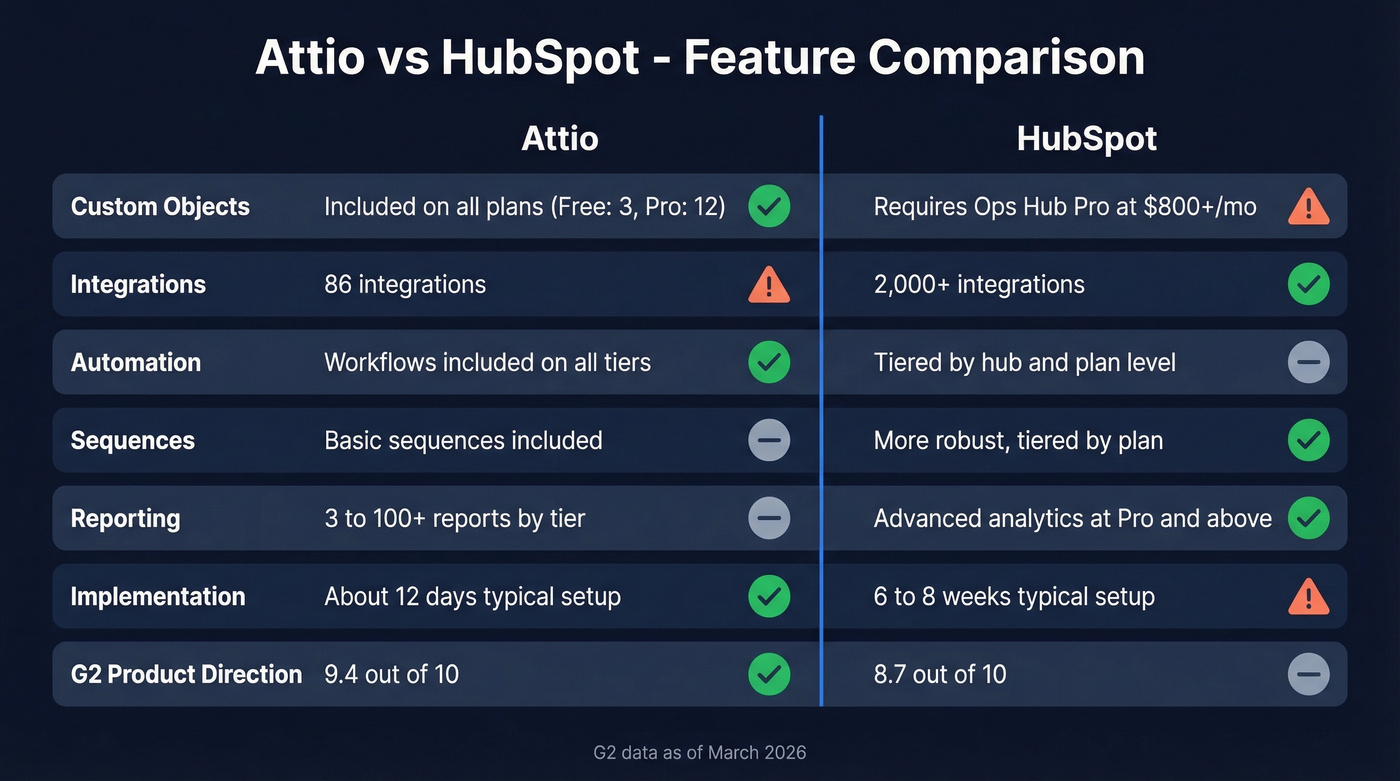
Attio's Product Direction score of 9.4 vs HubSpot's 8.7 is the number that matters most here. Users believe Attio is building toward something better. HubSpot's advantage is ecosystem maturity - with 2,000+ integrations vs Attio's 86, you're far less likely to hit a "we don't integrate with that" wall.
Custom objects deserve special attention. Attio's data model is object-based, and its plan limits are generous even on Free (up to 3 workspace objects). HubSpot gates custom objects behind Operations Hub Professional at ~$800/mo. If your data model doesn't fit neatly into Contacts, Companies, and Deals, this alone can swing the decision (and it's worth sanity-checking against a few examples of a CRM setups).
Reporting is where HubSpot pulls ahead for larger teams. Attio caps reports at 3 on Free and 100 on Pro, which works fine for a 10-person sales team tracking pipeline velocity. But if your VP of Sales wants custom dashboards with forecasting accuracy trends and rep-level attribution, HubSpot's reporting depth is meaningfully stronger (this is where dedicated sales forecasting solutions can also help).
Implementation speed favors Attio significantly. Typical implementation runs about 12 days for Attio vs 6-8 weeks for HubSpot. That's not just a time difference - it's a cost difference in consultant hours and lost productivity.
Pricing Breakdown
Attio Pricing
| Plan | Price | Records | Objects | Emails/mo |
|---|---|---|---|---|
| Free | $0 | 50K | 3 | 200 |
| Plus | $36/mo ($29 annual) | 250K | 5 | 1,000 |
| Pro | $86/mo ($69 annual) | 1M | 12 | Unlimited |
| Enterprise | Custom | Custom | Unlimited | Unlimited |
The $29 vs $36 confusion you'll see everywhere is simply monthly vs annual billing - Attio's pricing page shows a 20% discount for annual commitments. The Free tier is genuinely usable for up to 3 seats, making it a real trial environment rather than a glorified demo.
Why HubSpot Pricing Is Confusing
Here's the thing about HubSpot pricing: it's driven by seats, credits, and a rule that trips up nearly every buyer. If you mix Starter and Professional products, your Core Seats get priced at the highest subscription level. Adding one Professional Hub reprices your entire seat base.
Sales Hub Professional runs ~$90/seat/month with a mandatory $1,500 onboarding fee. Marketing Hub Professional starts around $800/mo for 2,000 contacts and scales to ~$3,600/mo at 50,000 contacts.
Then there's the credit system. HubSpot bundles credits for AI features and automation actions - 500 on Starter, 3,000 on Professional, 5,000 on Enterprise. Teams that lean heavily on automated workflows burn through these faster than expected, and overages add up. The "Starter + Professional mix" trap catches teams who start cheap on Starter, add one Pro hub, and watch their bill double overnight.
Real Cost by Team Size
| Scenario | Attio (annual) | HubSpot |
|---|---|---|
| 5-person sales | ~$145/mo | ~$450/mo + $1,500 onboarding |
| 10-person outbound | ~$690/mo + $1.1K-5.2K add-ons | ~$1,100-1,500/mo |
| 25-person inbound+outbound | ~$1,725/mo + add-ons | ~$3,000-5,000/mo |
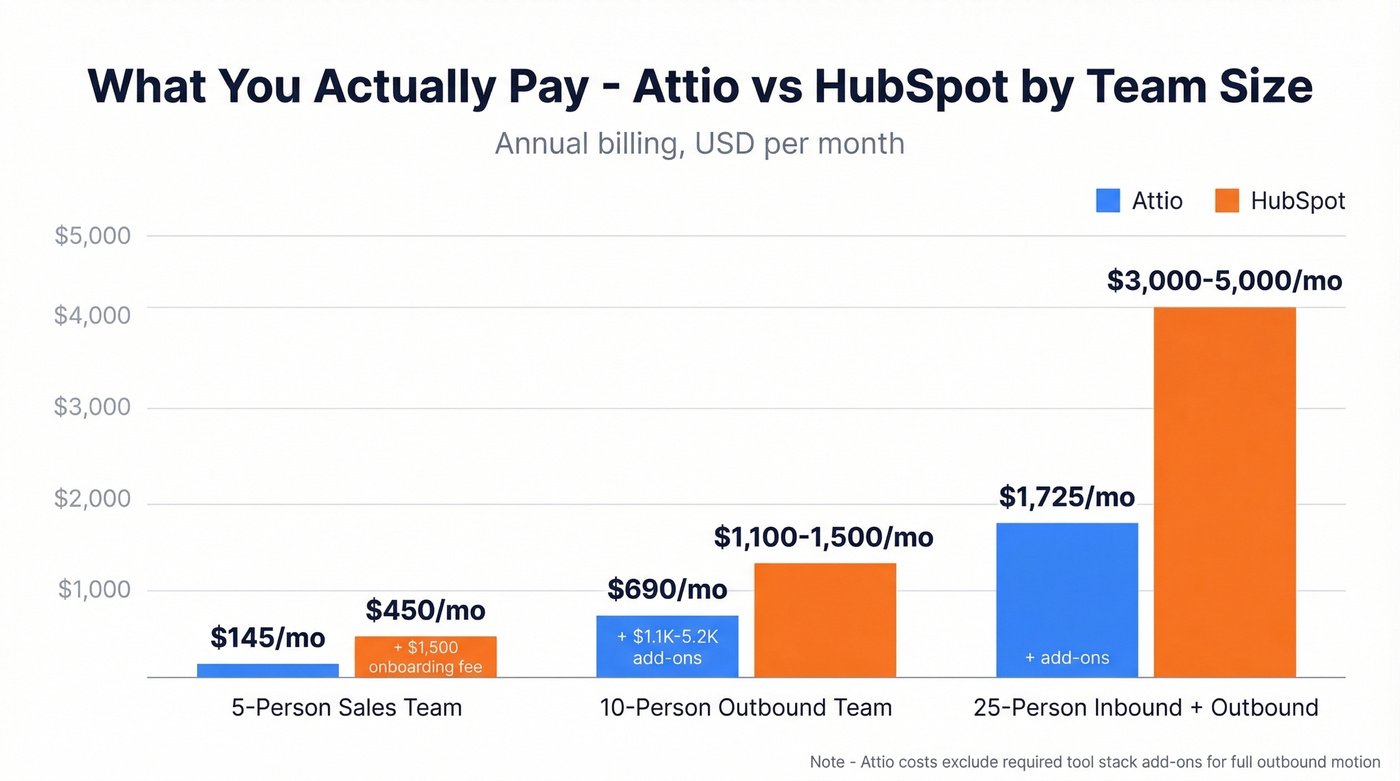
For the 5-person team, Attio is roughly a third of HubSpot's cost. That gap narrows fast at 10 seats once you factor in the tool stack Attio requires for a full outbound motion (see our breakdown of outbound lead generation tools if you're mapping the stack).

You're comparing CRMs, but the real cost is bad data inside them. Teams spend $1,100-5,200/mo on Attio add-ons for enrichment alone. Prospeo gives you 98% verified emails at $0.01 each - with 50+ data points per contact and direct CRM enrichment for both HubSpot and Salesforce.
Clean your data before you migrate it. Your new CRM will thank you.
Hidden Costs Nobody Mentions
Attio's per-seat pricing looks clean until you build the stack around it. Attio does include native sequences across tiers, which handles basic outbound cadences. But most serious outbound teams outgrow them quickly - Attio's sequences lack the multi-channel orchestration, A/B testing, and deliverability controls you get from dedicated tools. A 10-person outbound team on Attio typically adds:
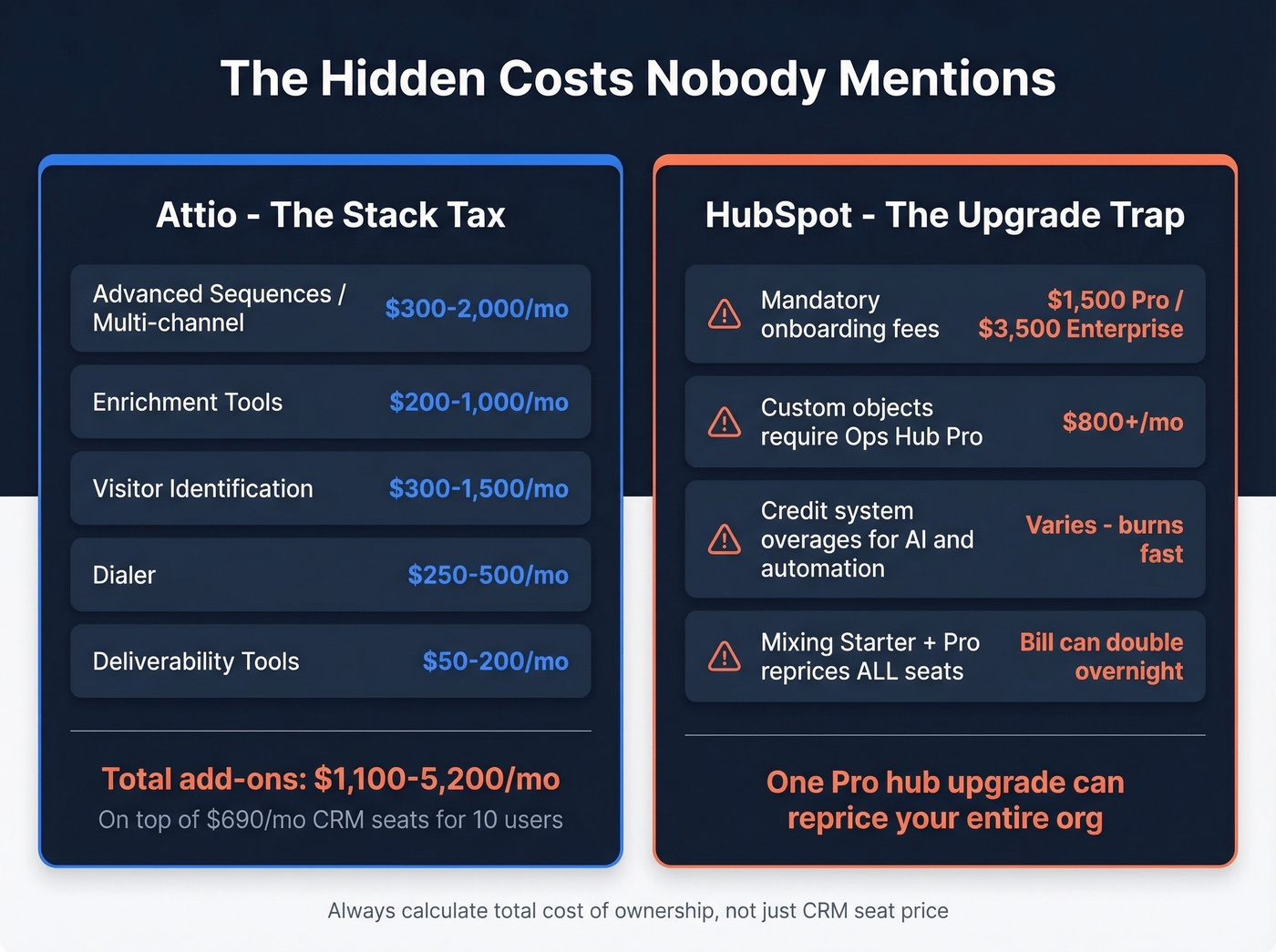
- Advanced sequences/multi-channel: $300-2,000/mo
- Enrichment: $200-1,000/mo (compare data enrichment services before you commit)
- Visitor identification: $300-1,500/mo
- Dialer: $250-500/mo
- Deliverability tools: $50-200/mo (pair this with an email deliverability guide if you're scaling volume)
That's $1,100-5,200/mo in potential add-ons on top of your CRM seats, depending on how much you need beyond Attio's built-in capabilities.
HubSpot's hidden costs are different but equally painful. Mandatory onboarding fees ($1,500 for Pro, $3,500 for Enterprise) hit you upfront. Custom objects require Operations Hub Professional at $800+/mo. And the highest-tier pricing rule means one ambitious marketing hire who needs Professional features can reprice every seat in the org.
What Real Users Say
Both CRMs sit at 4.4/5 on G2, but context matters. HubSpot has 13,564 reviews to Attio's 281. Attio's user base skews heavily SMB - 219 of 281 reviewers are from companies under 50 employees. And 93% of Attio reviews are 4 or 5 stars, which signals genuine satisfaction rather than hype.
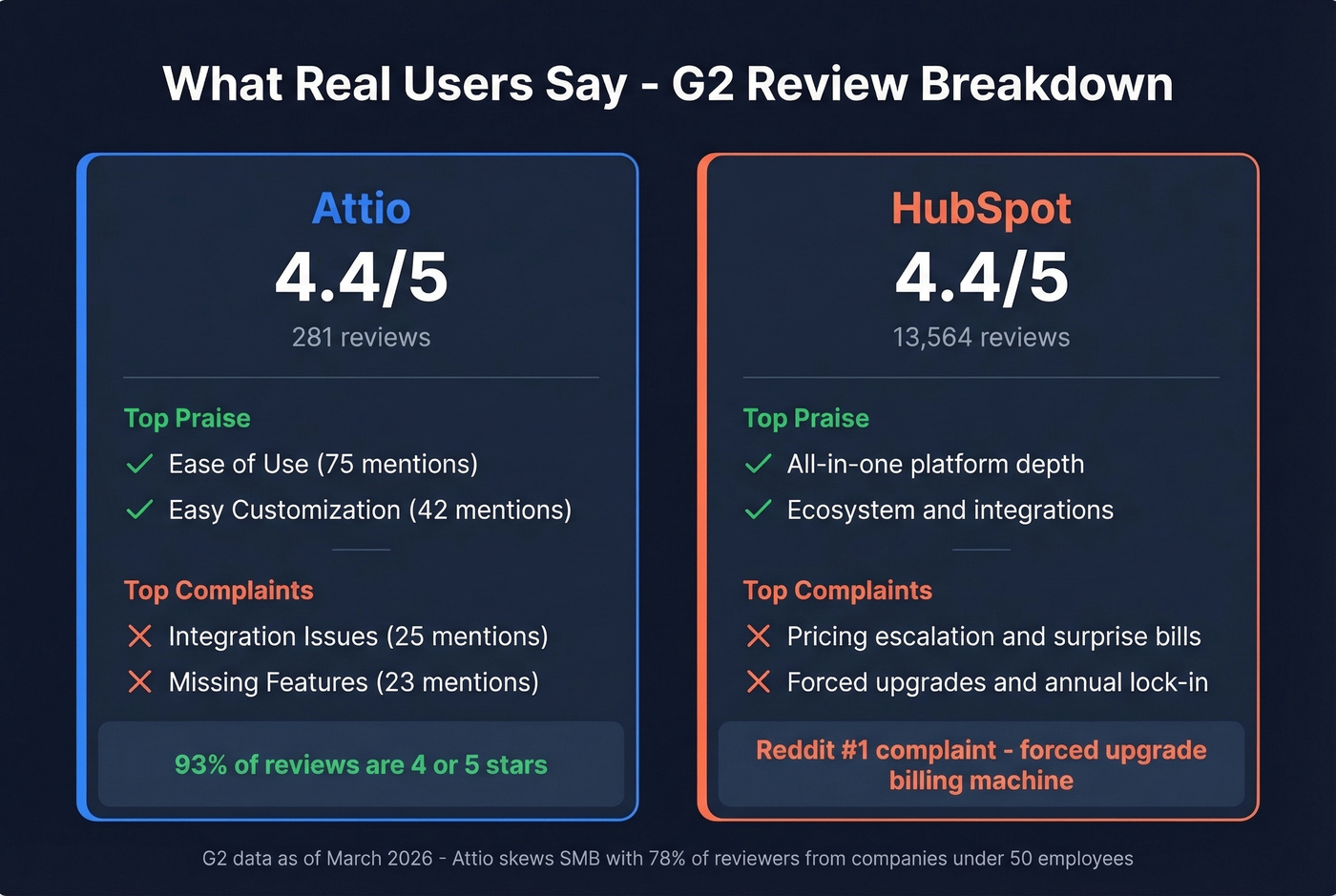
Attio's top praise centers on Ease of Use (75 mentions) and Easy Customization (42 mentions). The object-based data model and automation builder consistently get called out as best-in-class for the price. The top complaints: Integration Issues (25 mentions) and Missing Features (23 mentions). One user on r/b2bmarketing flagged specific gaps - no unified inbox, no forms, no visual pipeline in their experience, and migration headaches.
HubSpot's Reddit sentiment is rougher. The #1 complaint across r/hubspot threads is pricing escalation. One user described it as a "forced upgrade billing machine." Another described signing up for what appeared to be monthly billing only to discover a year-long commitment - and pointed to Apollo (starts at ~$49/user/mo) as a more adaptive alternative for sequences. Apollo's strength is combining a contact database with built-in sequencing, which makes it a legitimate option for teams whose primary need is outbound automation rather than a full CRM. That said, Apollo's data accuracy doesn't match dedicated enrichment tools, and its CRM functionality is thin compared to either Attio or HubSpot.
Let's be honest: HubSpot is still the best all-in-one GTM platform for mid-market companies. But "all-in-one" is a trap if you only use 30% of it. Most teams under 50 people are paying for marketing automation they barely touch. If your average deal size is under $15K and your motion is outbound-first, you almost certainly don't need HubSpot-level infrastructure.
The Data Problem Neither CRM Solves
You can pick the perfect CRM and still fail if you import 10,000 contacts and 3,000 of them bounce. We've seen this firsthand - teams spend weeks evaluating CRMs, migrate everything over, and then realize their pipeline numbers are fiction because the underlying data is stale. Contact data decays roughly 30% per year. People change jobs, companies rebrand, emails go dead.
Neither Attio nor HubSpot replaces a dedicated enrichment and verification layer. Whichever CRM you choose, the data layer underneath it matters more than most teams realize. Prospeo automates this with a 7-day refresh cycle and 98% email accuracy across 143M+ verified addresses, keeping records current without manual cleanup (if you're auditing your list, start with how to check if an email exists).
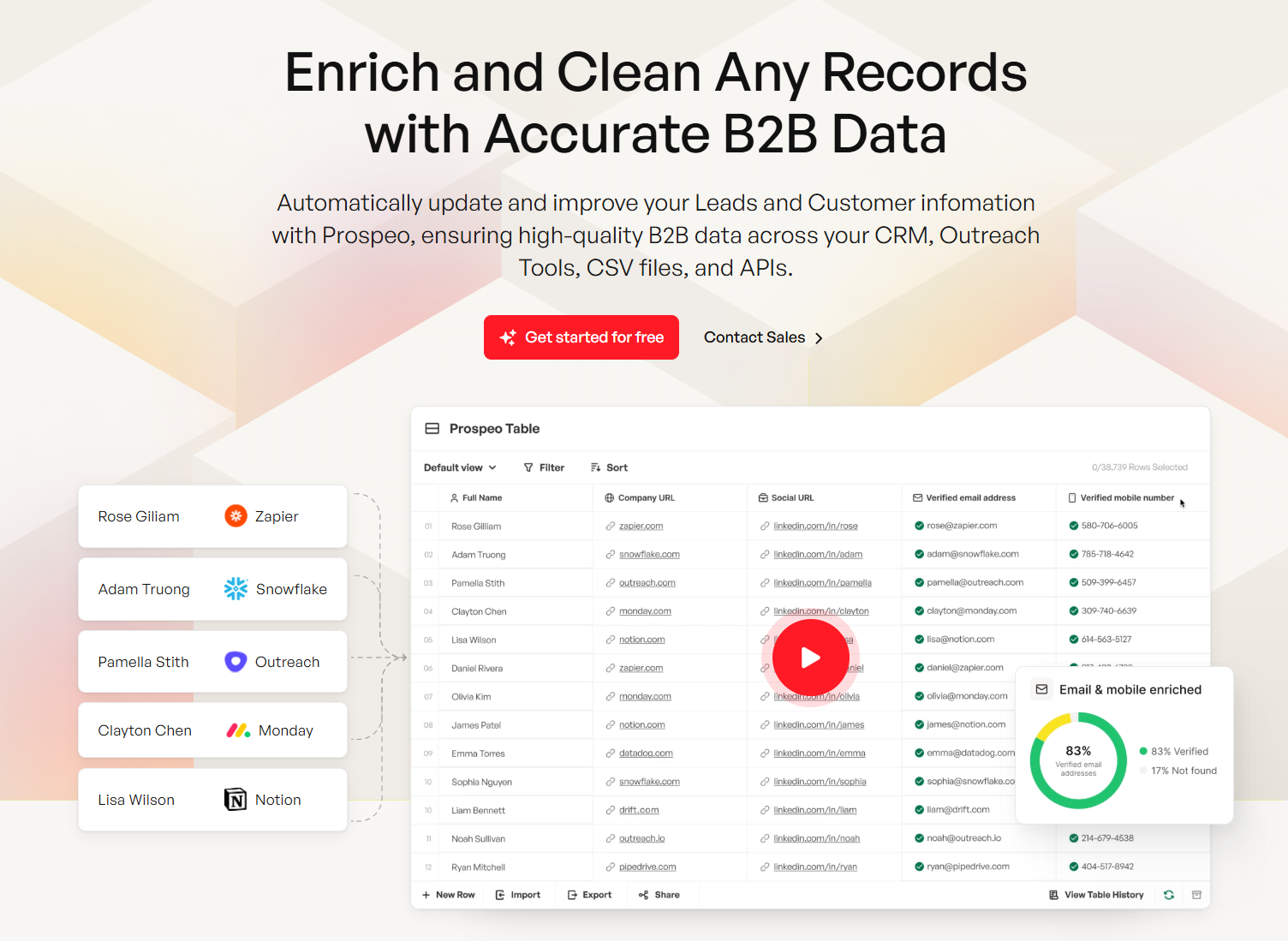
That enrichment line item in your Attio stack? Prospeo replaces it. 300M+ profiles, 125M+ verified mobiles, and a 7-day refresh cycle - so the contacts in your CRM are never stale. Native integrations with HubSpot, Salesforce, Clay, and Zapier mean zero workflow disruption.
Stop paying $1,000/mo for enrichment tools that bounce at 30%.
Decision Framework
Attio makes sense for outbound-first teams under 20 people who value flexibility and don't mind assembling their own tool stack. You want flexible objects without paying $800+/mo extra, you can live with 86 integrations and Zapier for the rest, and you'd rather have a fast, modern interface than a feature you'll use twice a year. Many teams start on Attio and migrate to HubSpot at the 50-employee mark - plan your data model with that graduation path in mind.
Choose HubSpot if you run inbound plus outbound with 50+ people, need marketing, sales, and service in one platform, want 2,000+ integrations out of the box, have budget for Professional tiers and onboarding fees, and prioritize ecosystem maturity over modern UX.
Choose neither yet if your real bottleneck is data quality, not CRM features. If more than 15% of your contact list bounces, or you haven't defined your GTM motion clearly enough to know which CRM shape fits, fix those problems first. The CRM decision gets much clearer after that (use a simple ideal customer profile to keep the migration scoped).
For teams past 200 people who need CPQ, territory management, and deep customization, Salesforce (starts at ~$25/user/mo for Sales Cloud, though enterprise deployments typically run $150+/user/mo with add-ons) is the next conversation - not Attio or HubSpot.
FAQ
Can Attio replace HubSpot for marketing automation?
No. Attio has no marketing hub, forms, landing pages, or email nurture workflows. If inbound lead generation is core to your GTM motion, HubSpot remains the stronger choice - Attio is purpose-built for sales, not demand gen.
How long does migration from HubSpot to Attio take?
Expect about 14 business days: 2-3 days for data migration, the rest for rebuilding workflows and training. Attio implementation averages 12 days vs 6-8 weeks for a comparable HubSpot setup.
Is Attio really cheaper than HubSpot?
Per seat, significantly - roughly a third of the cost at 5 users. But outbound teams typically add $1,100-5,200/month in tools for enrichment, dialing, and deliverability. At 10+ seats, HubSpot's bundled approach can actually be more cost-efficient.
How do I keep CRM data accurate after migrating?
Use a dedicated enrichment tool to verify emails and enrich contacts before and after migration. Contact data decays ~30% annually regardless of CRM. Prospeo's 7-day refresh cycle and 98% email accuracy automate this - 75 free credits to start, no card required.
When should I switch from Attio to HubSpot?
Most practitioners cite ~50 employees or $5M ARR as the inflection point where cross-functional alignment demands an all-in-one platform. Below that threshold, Attio's flexibility and lower cost usually win.