

How to Build a B2B Buyer Persona That Actually Gets Used
You've seen "Marketing Mary." She's 34, drinks oat milk, listens to podcasts, and has a golden retriever named Scout. She's also completely useless for selling enterprise software. The dirty secret of B2B buyer persona work is that 42% of companies don't even survey their customers - so most personas are fiction dressed up in a Google Doc that nobody opens after the workshop ends.
That's not a persona problem. It's a process problem.
The Framework (Quick Version)
If you're short on time, here's what matters:
- Build around jobs and buying committees, not demographics. A VP of Engineering's age doesn't predict their purchase behavior. Their career risk tolerance does.
- Interview 10-15 real buyers per segment - fans, detractors, and the lukewarm middle. No interviews, no persona. Period.
- Turn the persona into a filtered prospect list. If your persona lives in a slide deck and never becomes a search filter, it's decoration.
What Is a B2B Buyer Persona?
A B2B buyer persona is a research-backed profile of an individual decision-maker within your target accounts. It captures their role, motivations, fears, decision criteria, and information habits - everything you need to craft messaging that actually resonates. In practical terms, think of it as the bridge between your ideal customer profile and the messaging your sales team delivers in real conversations.
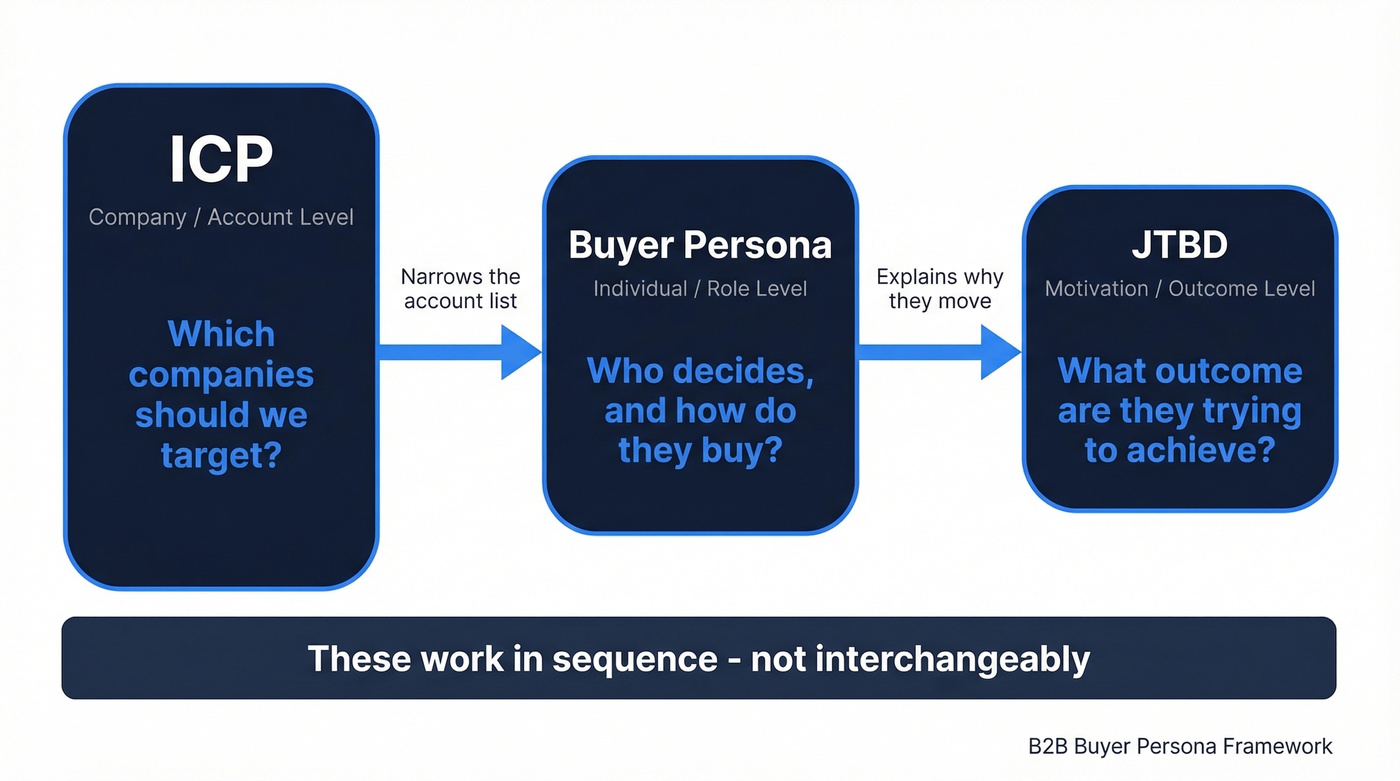
The confusion starts when teams conflate three distinct concepts. Here's how they layer:
| Concept | Level | Core Question |
|---|---|---|
| ICP | Company/account | Which companies should we target? |
| Buyer Persona | Individual/role | Who decides, and how do they buy? |
| JTBD | Motivation/outcome | What outcome are they trying to achieve? |
Your ICP narrows the account list. Your persona shapes the messaging. Your JTBD explains why they'll actually move. You need all three, and they work in sequence - not interchangeably.
Here's the thing: demographic criteria are relevant for only about 15% of B2B purchasing decisions. That stat alone should kill the "Marketing Mary is 34 and lives in Austin" approach. What matters is what the buyer is trying to accomplish, what's blocking them, and who else in the organization has veto power.
Why Your Personas Need a 2026 Update
The buyer your team profiled in 2023 doesn't exist anymore. The way B2B buyers research, evaluate, and purchase has shifted dramatically, and if your personas don't reflect that, your messaging is aimed at a ghost.
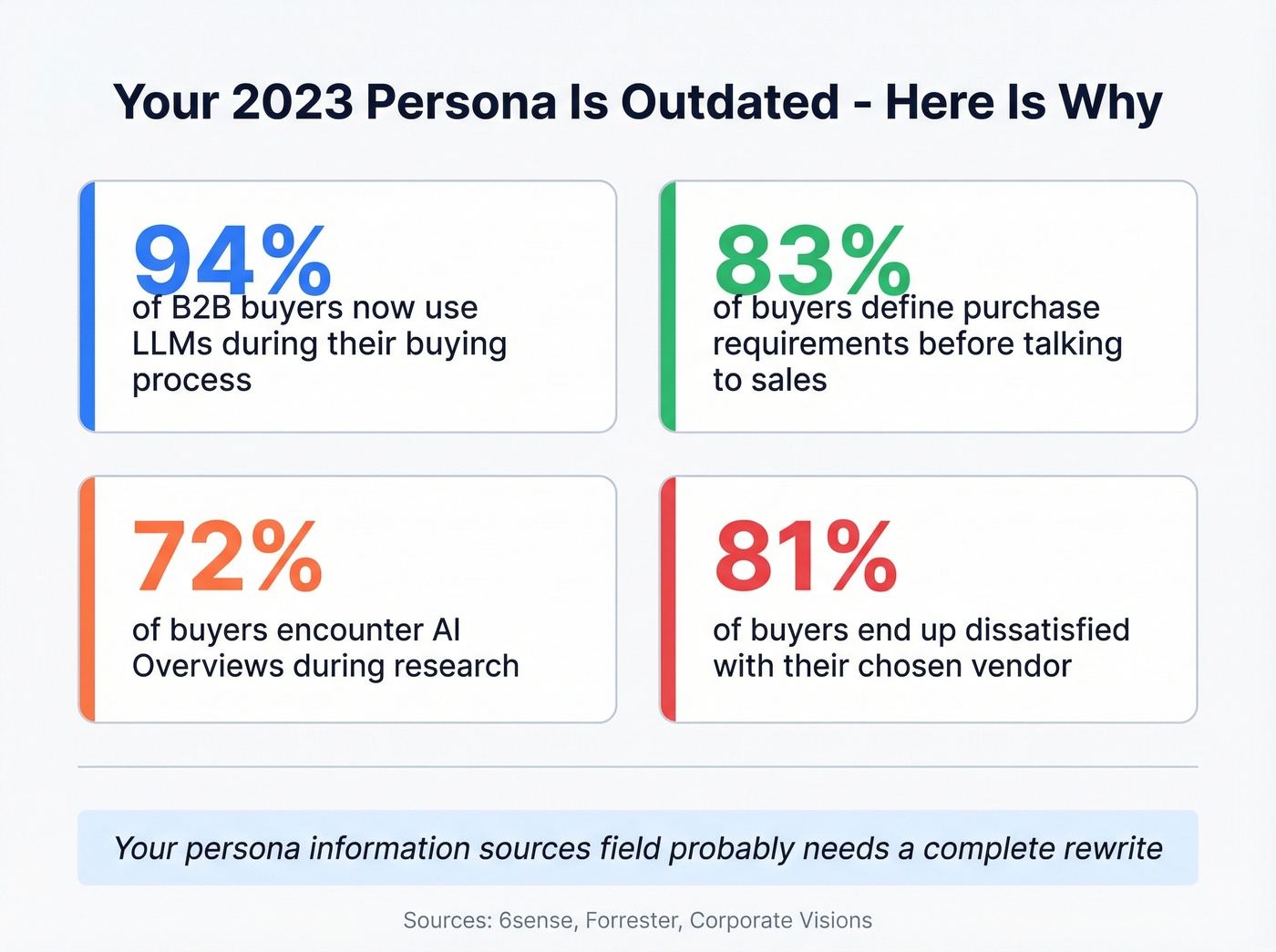
Consider the numbers: 94% of B2B buyers now use LLMs during their buying process, per 6sense research compiled by Corporate Visions. Between 2024 and 2025, average sales cycles compressed from 11.3 months to 10.1 months - and the trend hasn't reversed. Buyers define their purchase requirements 83% of the time before they ever talk to a salesperson. 72% of buyers encounter AI Overviews in their research, meaning your persona's "information sources" field probably needs a complete rewrite.
And 81% of buyers end up dissatisfied with their chosen vendor, per Forrester. That's partly because vendors never understood what the buyer actually needed. A well-researched customer persona is your insurance policy against being one of those vendors.
Your 2023 persona might say "reads Gartner reports and attends Dreamforce." Your 2026 persona should say "prompts Claude for vendor comparisons, checks G2 reviews on mobile, and has already built a shortlist before your SDR's first touch." The buying committee hasn't shrunk - it's gotten faster and more self-directed.
Hot take: If your average deal size is under $15k, you probably don't need a 10-page persona document. You need a one-page decision profile and a filtered prospect list. The companies obsessing over persona aesthetics are usually the ones avoiding the harder work of actually talking to buyers.

Your persona shouldn't live in a slide deck. Prospeo's 30+ search filters - buyer intent, technographics, job changes, headcount growth, funding - let you turn every persona field into a filtered list of 300M+ verified contacts. 98% email accuracy means your outreach actually lands.
Stop decorating personas. Start building prospect lists from them.
How to Build a Persona That Works
Map the Buying Committee First
You don't sell to individuals in B2B. You sell to committees. The average B2B purchase involves 13 stakeholders, with 89% of buying decisions crossing multiple departments. Gartner puts the core buying group at 6-10 decision-makers, each bringing 4-5 pieces of independent research to the table.
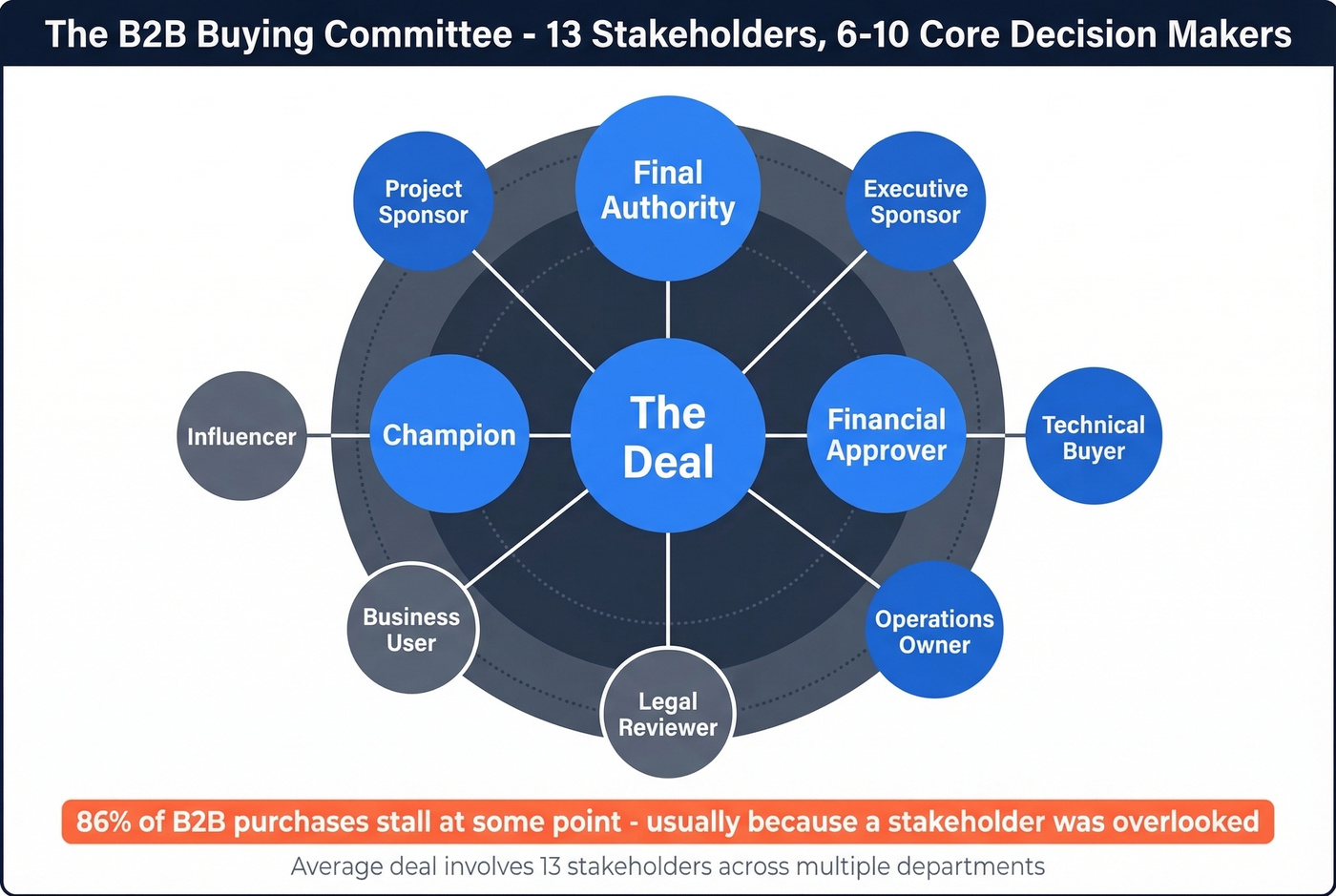
That's a lot of opinions to align. It also explains why 86% of B2B purchases stall at some point. Before you write a single persona, map the committee:
| Role | Function |
|---|---|
| Project Sponsor | Owns the initiative |
| Champion | Internal advocate |
| Executive Sponsor | Strategic alignment |
| Financial Approver | Budget authority |
| Technical Buyer | Evaluates fit |
| Operations/Process Owner | Workflow impact |
| Business User | Day-to-day user |
| Legal Reviewer | Compliance/risk |
| Influencer | Shapes opinion |
| Final Authority | Signs the deal |
Not every deal involves all ten. But if you're only building a persona for the "decision-maker" and ignoring the technical buyer who'll torpedo the deal in week six, you're setting your team up to lose. Accounting for each stakeholder's unique concerns and decision criteria is what separates useful persona work from decorative.
Build Around Jobs, Not Job Titles
Jobs-to-be-done theory gets thrown around loosely, but in persona development it's genuinely the most useful lens. A "job" isn't a task - it's the ideal state the buyer is trying to reach. The progress from where they are to where they want to be, including the emotional dimension.
That emotional piece matters more than most B2B marketers admit. Google and CEB found that B2B purchasers are roughly 50% more likely to buy when they see personal or emotional value - career advancement, reduced anxiety, credibility with their boss. Your persona needs to capture that.
Adele Revella's 5 Rings of Buying Insight gives you a practical framework: Priority Initiatives (why they're buying now), Success Factors (what good looks like), Perceived Barriers (what makes them hesitate), Buyer's Journey (how they evaluate), and Decision Criteria (how they choose). Build your persona around these five rings and you'll produce something sales can actually use - not a demographic snapshot that tells reps nothing about how to run a deal.
Research: Fans, Enemies, and the Meh Middle
No amount of desk research replaces talking to actual buyers. We've seen teams spend weeks building AI-generated personas that completely missed the #1 objection their buyers raise on every demo call. The consensus on r/b2bmarketing is blunt: if you didn't talk to buyers, you don't have a persona. The fix is simple - pick up the phone.
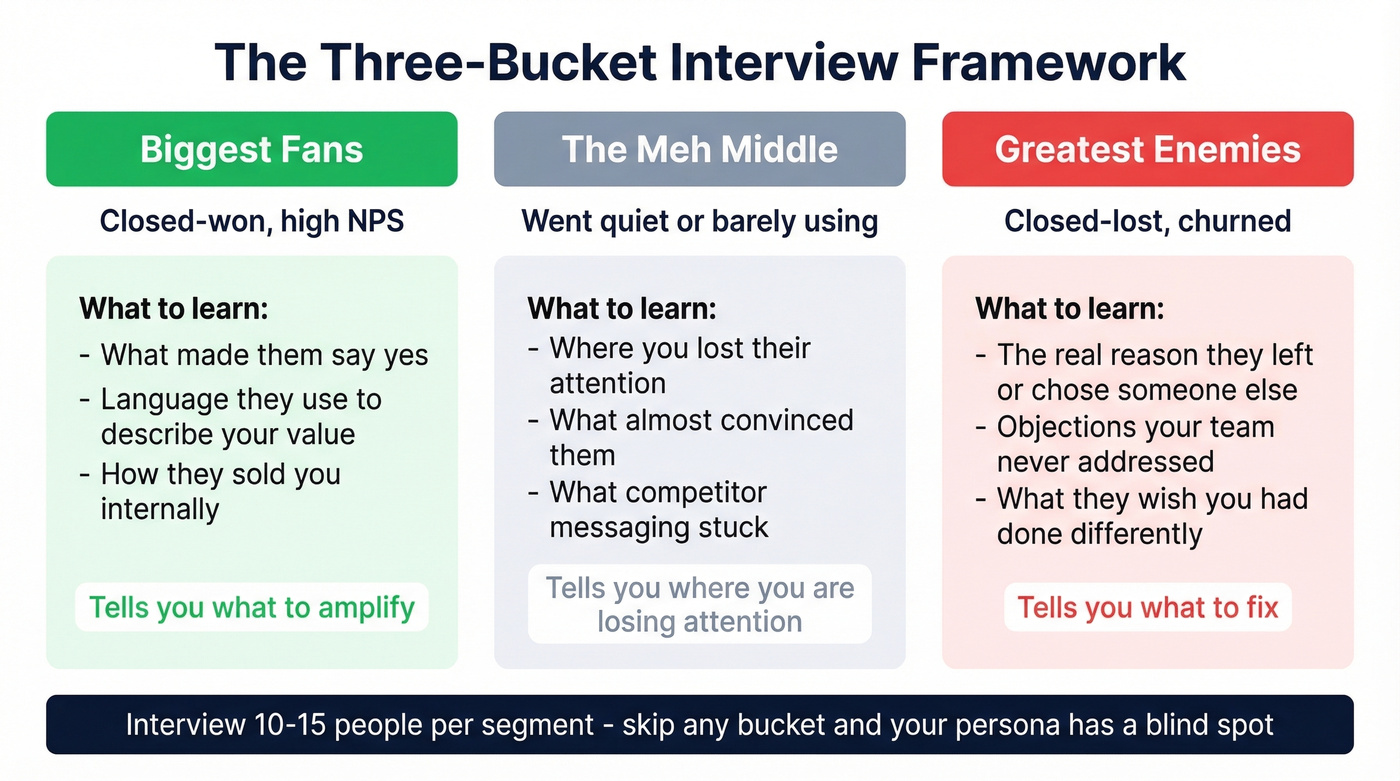
Here's the interview plan that works:
- Segment your interviewees into three buckets - biggest fans (closed-won, high NPS), greatest enemies (closed-lost, churned), and the lukewarm middle (evaluated but went quiet, or bought but barely use the product).
- Interview 10-15 people per segment. For homogeneous markets, 8-10 interviews reveal the patterns. For broader markets, aim for around 30 total across segments.
- Ask open-ended questions and follow up with "why." Don't ask "Was price important?" Ask "Walk me through how you made the final decision." Then ask why three more times.
- Record and transcribe everything. The gold is in the exact language buyers use - their words become your copy, your objection-handling scripts, your ad headlines.
The fans tell you what to amplify. The enemies tell you what to fix. The middle tells you where you're losing attention. Skip any bucket and your persona has a blind spot.
Use AI to Accelerate, Not Replace
AI is genuinely useful for persona work - in specific, bounded ways. It's great for expanding job title lists adjacent to a known buyer role, generating first-draft interview questions, and building a persona template structure so you're not starting from scratch. You can also create a "persona prompt" - a role constraint that tells the LLM to respond as your buyer would, useful for pressure-testing messaging before launch. Automation can reduce marketing labor costs by 20-30%, and persona scaffolding is a perfect use case.
Where AI falls short: motivations, fears, and the emotional undercurrents that drive B2B decisions. Hallucination is still a real problem, and an LLM confidently inventing your buyer's top objection is worse than having no persona at all. Use AI to accelerate the scaffolding. Use human interviews for the substance.
Filled-Out Persona Template
Here's what a working B2B buyer persona looks like - not a demographic sketch, but a decision-making profile. This example targets a VP of Revenue Operations at a mid-market SaaS company. Skip the stock photo headshot. It introduces unconscious bias and adds nothing.
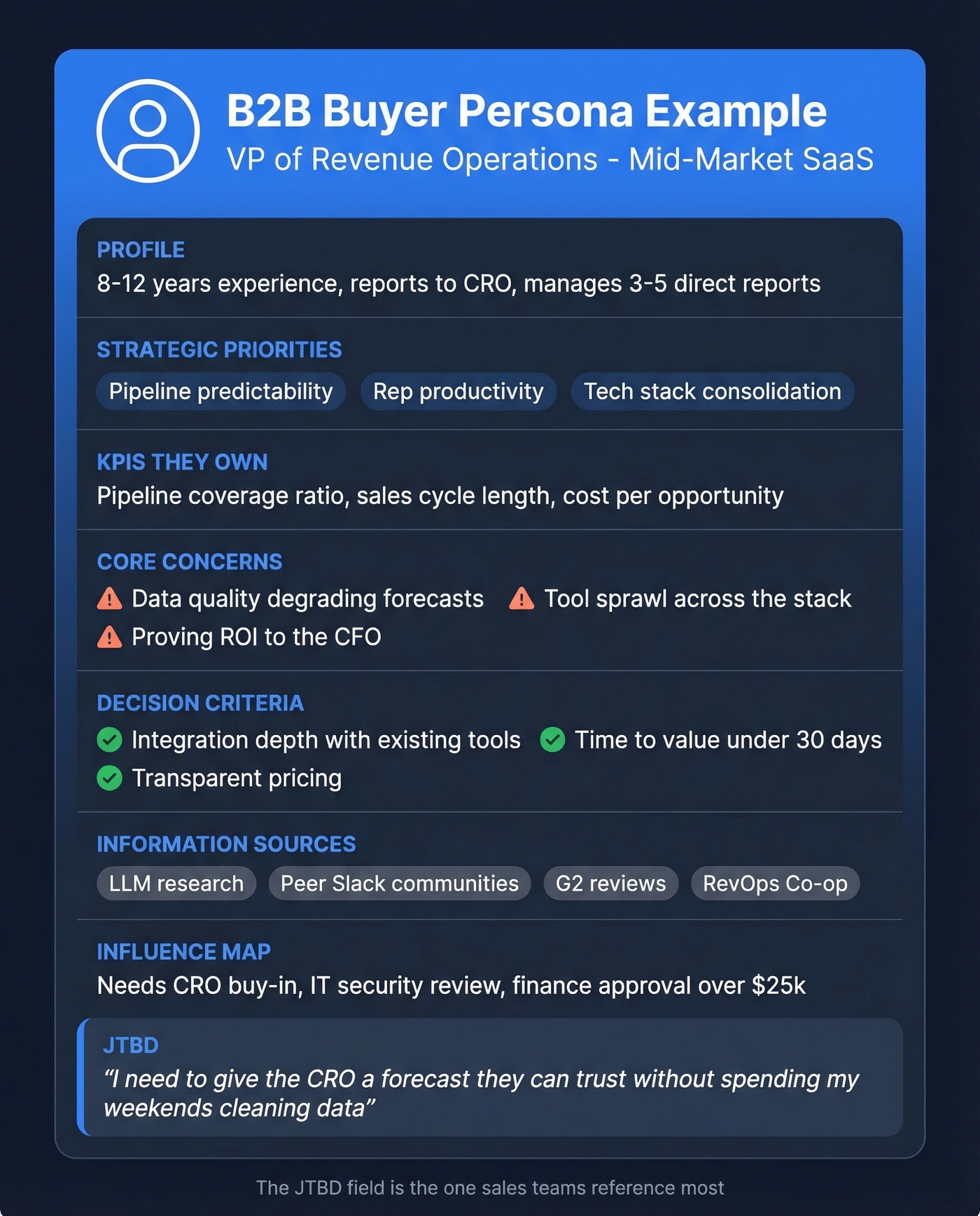
| Field | Example |
|---|---|
| Profile | VP RevOps, 8-12 yrs experience, reports to CRO, manages 3-5 direct reports |
| Strategic Priorities | Pipeline predictability, rep productivity, tech stack consolidation |
| KPIs | Pipeline coverage ratio, sales cycle length, cost per opportunity |
| Core Concerns | Data quality degrading forecasts, tool sprawl, proving ROI to CFO |
| Decision Criteria | Integration depth, time-to-value under 30 days, transparent pricing |
| Information Sources | LLM research, peer Slack communities, G2 reviews, RevOps Co-op |
| Communication Prefs | Short emails, async demos, hates cold calls before 10am |
| Influence Map | Needs CRO buy-in, IT security review, finance approval over $25k |
| JTBD | "I need to give the CRO a forecast they can trust without spending my weekends cleaning data" |
In our experience, the JTBD field is the one sales teams reference most - it's the line that shows up in call prep notes and shapes how reps open discovery calls.
82% of top-performing B2B marketers say role-specific audience understanding is central to their success, and persona-designed websites are 2-5x more effective at converting visitors. The template above directly shapes your landing pages, email sequences, and sales scripts.
The Negative Persona - Who NOT to Target
Every persona project should include at least one negative persona - a profile of the buyer you explicitly don't want. This saves your team from chasing deals that'll never close and protects your sender reputation from irrelevant outreach.
Disqualification signals to codify:
- Wrong company size - too small to afford your product, or too large to implement without enterprise features you don't have
- No budget authority - individual contributors who'll champion internally but can't get procurement moving
- Tech stack incompatibility - they run infrastructure your product doesn't integrate with
- Industries you don't serve - regulated verticals where your compliance story doesn't hold up
- Chronic tire-kickers - companies that evaluate everything and buy nothing (you know the type)
Write the negative persona with the same rigor as your positive ones. Share it with SDRs. It's the fastest way to improve lead quality without changing your top-of-funnel volume.
From Persona to Prospect List
Here's where every persona guide stops - and where the actual work begins. You've defined who to target. Now you need to find them.
The persona attributes you just built - job title, industry, company size, tech stack, strategic priorities - map directly to database filters. That VP of RevOps at a mid-market SaaS company running HubSpot? That's not an abstract profile anymore. It's a search query.
Prospeo's B2B database covers 300M+ professional profiles with 30+ search filters including technographics, buyer intent tracking 15,000 topics via Bombora, and job change signals. Translate each persona attribute into a filter, export a verified contact list with 98% email accuracy refreshed every seven days, and start sequencing. The persona stops being a document and starts being a workflow.

Mapping a 13-person buying committee is useless if you can't find their direct contact data. Prospeo gives you verified emails and 125M+ mobile numbers for every stakeholder - from the technical buyer to the financial approver - at $0.01 per email with a 7-day data refresh.
Reach the entire buying committee, not just the champion.
Seven Mistakes That Kill Personas
Too many personas. Start with one to three. Too many too early creates noise, not clarity.
Demographics first. Leading with age, gender, and hobbies instead of JTBD and decision criteria produces personas that look pretty and tell you nothing useful.
Marketing silo. If sales, CS, and product never see the persona, it's a marketing exercise, not a business tool. Pin the persona to your CRM dashboard. Include it in new-hire onboarding. Some teams print persona cards for deal review meetings - anything that keeps the profile in front of the people making daily decisions about messaging and positioning.
No negative persona. Without explicit disqualification criteria, your SDRs will chase anyone with a pulse and a matching job title.
No update cadence. Buyer behavior shifts fast - 94% of buyers use LLMs now. Review personas quarterly, refresh annually at minimum. Set a calendar reminder: quick validation every quarter, full rebuild every 12-18 months.
No decision-making insights. A persona without purchase criteria, perceived barriers, and influence mapping is a character sketch, not a sales tool.
Fairytale creation. Look, we've all been in the workshop where someone says "I think our buyer cares about..." and everyone nods along. Personas built without customer interviews are fiction. They collect dust because they deserve to.
FAQ
How many buyer personas does a B2B company need?
Start with one to three - your primary buyer and the person most likely to block the deal. With buying committees averaging 13 stakeholders, you'll expand over time, but two well-researched personas beat eight fictional ones every time.
What's the difference between an ICP and a buyer persona?
An ICP defines the company you target - industry, size, revenue, tech stack. A buyer persona defines the individual within that company: their role, goals, fears, and decision criteria. You need both. The ICP narrows accounts; the persona shapes messaging.
How often should I update my B2B buyer persona?
Run a quick validation every quarter and a full rebuild every 12-18 months. With 94% of buyers now using LLMs for research, information sources and evaluation habits shift fast. Outdated personas produce outdated messaging.
How do I turn a persona into actual leads?
Map your persona's attributes - job title, industry, company size, tech stack, intent signals - to filters in a prospecting database. Export verified contacts, then start sequencing. The persona is the strategy; the prospect list is the execution.