

B2B Cold Calling in 2026: Benchmarks, Scripts, and the System That Books Meetings
Your rep made 400 dials last week. Twelve people picked up. One meeting booked. Before you rewrite the script, ask a different question: were those even real phone numbers?
Analysis of 204,000+ cold calls confirms that B2B cold calling works - but only when the system behind it does. The math is unforgiving, and most teams losing at outbound phone outreach are losing before the first ring.
What You Need (Quick Version)
- The math: A 2.3% average success rate and ~18 dials per live conversation means volume matters, but only if you're reaching real people.
- When to call: Tuesday through Thursday, 10-11am or 2-3pm local time.
- The #1 lever most teams ignore: Data quality. Bad numbers, not bad scripts, kill connect rates. Fifteen to twenty percent of your list goes stale every quarter.
- Minimum stack: Verified direct dials, a dialer, and a CRM. Everything else is optional until these three are locked in.
Benchmarks Worth Knowing
Let's ground this in real numbers. Multiple published datasets - including 204K calls analyzed by Cognism and 1.4M outbound calls tracked by ZoomInfo - converge on similar ranges.
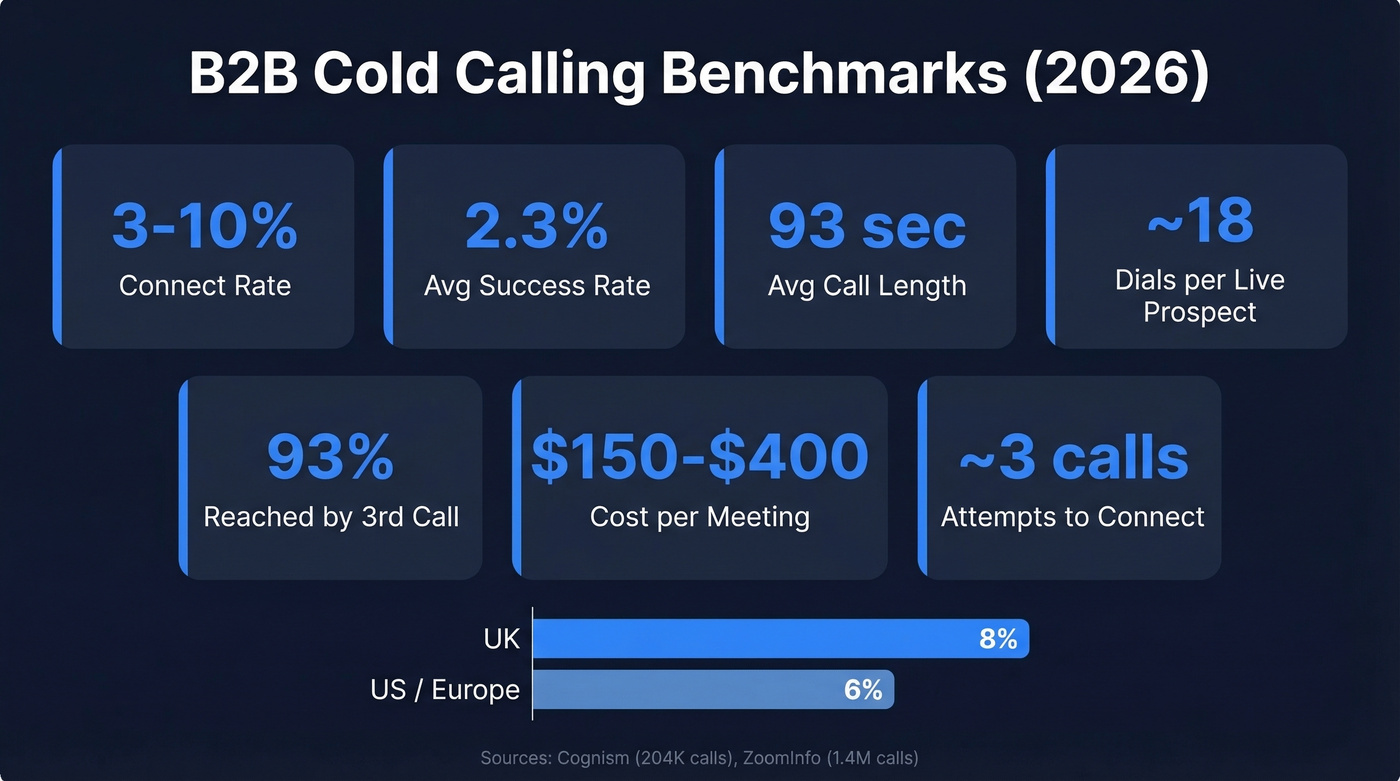
| Metric | Benchmark |
|---|---|
| Connect rate | 3-10% |
| Success rate | 2.3% avg |
| Avg call length | 93 seconds |
| Attempts to connect | ~3 calls |
| Reached by 3rd call | 93% |
| Cost per meeting | $150-$400 |
| Dials per live prospect | ~18 |
Regional success rates vary: UK teams average around 8%, while US and Europe hover around 6%. If your team sells internationally, adjust expectations accordingly.
That 93-second average call length tells you something important. Most conversations are short. You don't need a 10-minute pitch - you need a 90-second framework that earns a second conversation.
Before the Call
When to Dial
Tuesday and Wednesday alone produced 44% of total demos in one major analysis. Thursday rounds out the top three. Call analysis across 200K+ dials narrows the windows further: 10-11am and 2-3pm are the sweet spots, while 7-9am, lunch, and 5pm commute hours are dead zones.
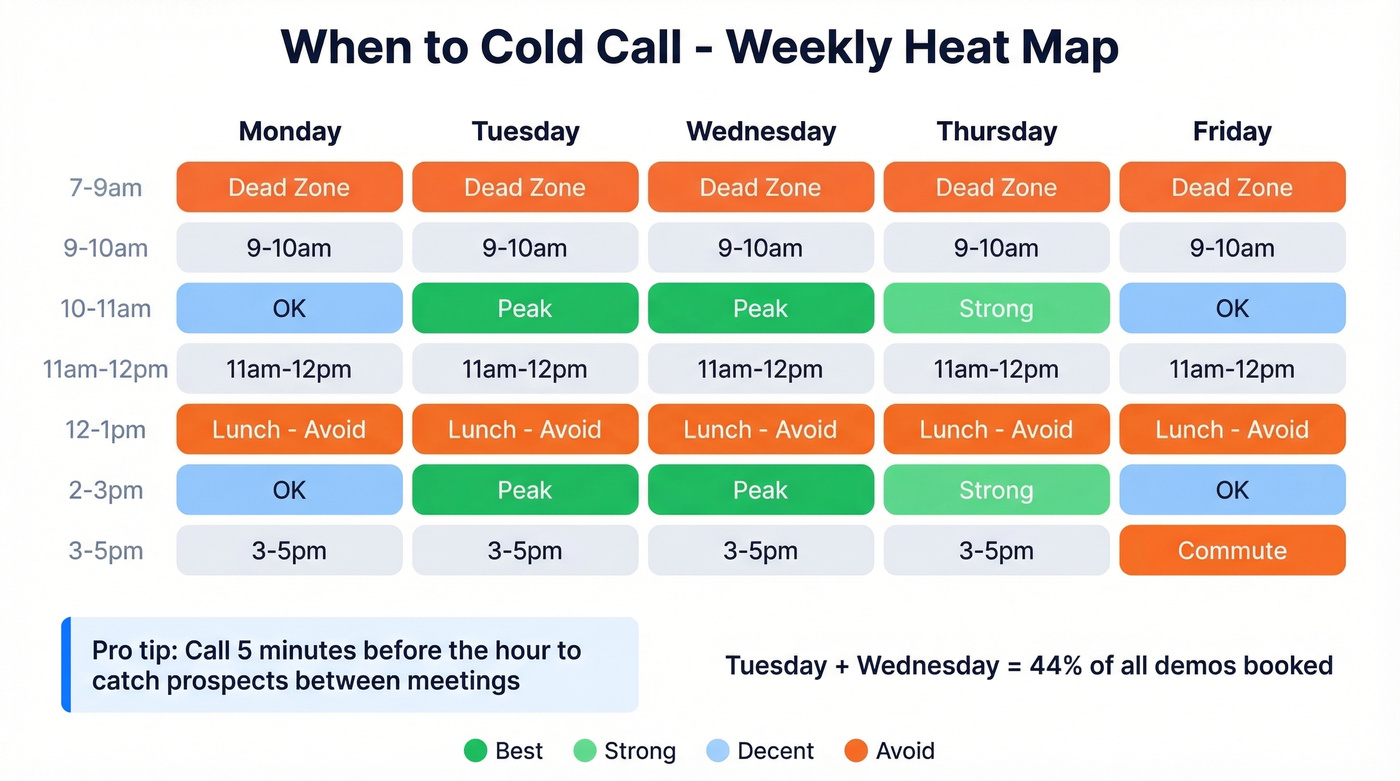
One heuristic we've found useful: call five minutes before the hour. Most meetings run on 30-minute blocks, so you're catching prospects in that brief gap between calls. Friday isn't great for booking, but it's underrated for building rapport - prospects are more relaxed, and a casual conversation can set up a Monday follow-up.
Default to mobile numbers. With hybrid work still the norm, office lines are increasingly unreliable. Teams that prioritize verified cell numbers over switchboards see meaningfully higher connect rates.
Fix Your Data Before Your Script
Here's the thing: the #1 reason cold calling "doesn't work" isn't the script. It's the data.
The industry average refresh cycle is six weeks. In that window, contacts change jobs, switch numbers, or leave companies entirely. Over a quarter, 15-20% of your list goes stale. Your reps are dialing disconnected lines and wondering why they can't hit quota. We've watched teams double their connect rate overnight just by swapping their data provider - no script changes, no coaching, no new dialer.
Prospeo's Mobile Finder addresses this with 125M+ verified mobile numbers on a 7-day refresh cycle, delivering a 30% pickup rate across all regions. Meritt tripled their connect rate to 20-25% after switching to verified data. At ~$0.01 per email lead with a free tier to start, there's no reason to keep burning dials on dead numbers.
3-Minute Pre-Call Research
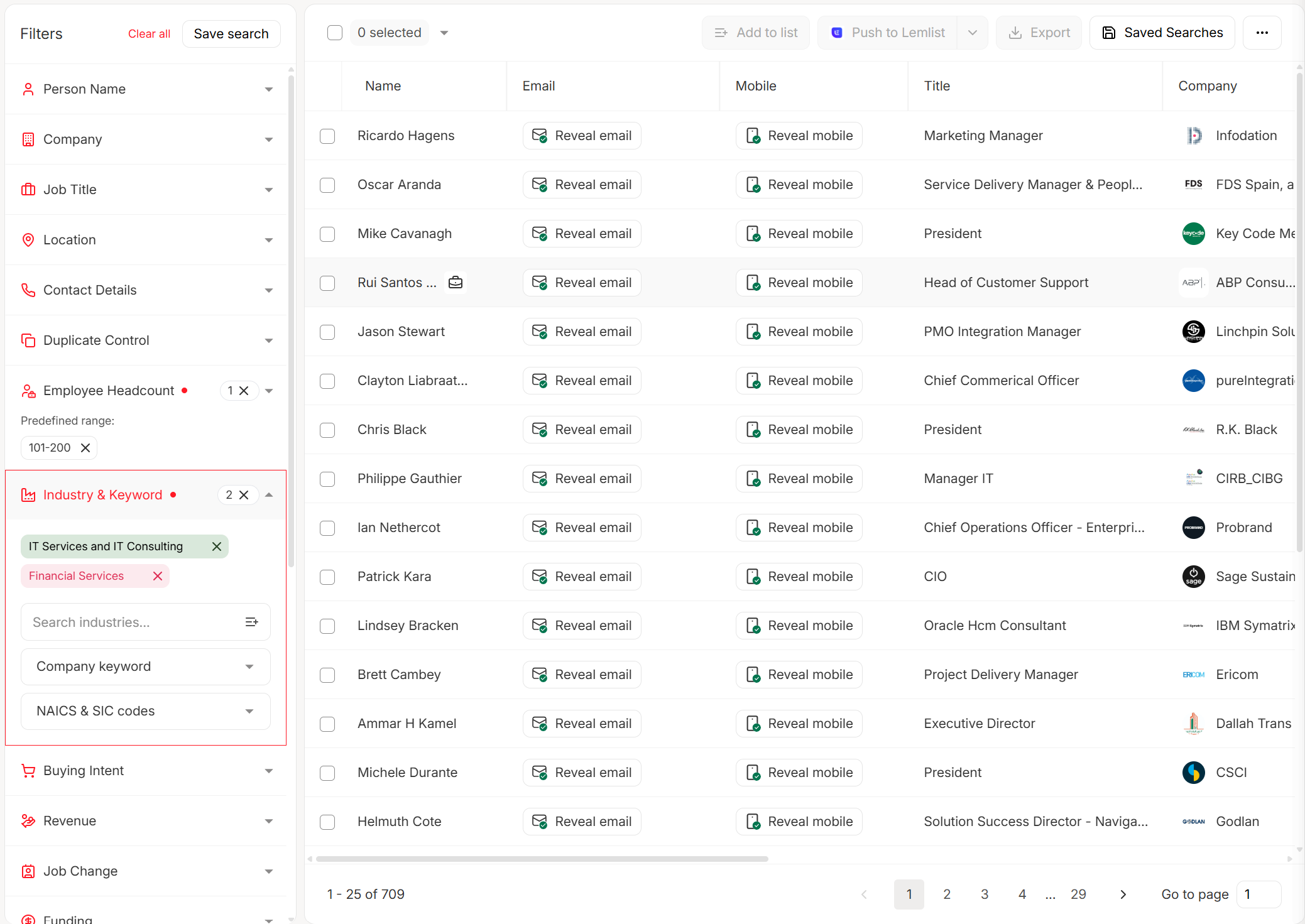
Spend three minutes, not thirty. You need three things: the prospect's role and tenure, any recent company news worth referencing, and intent signals suggesting they're actively evaluating solutions. For prioritization, layer in intent data - filtering your list to accounts already researching solutions in your category turns a cold outreach attempt into a warm one before you dial.
Distill your research into a one-sentence hypothesis about the prospect's likely pain point. That hypothesis becomes your opener.
Scripts That Actually Work
Scripts aren't meant to be read verbatim. They're frameworks - guardrails that keep you on track while leaving room to sound human. Here are three you can copy and adapt today.
Gatekeeper Script
"Hi, it's [Your Name] from [Company]. Is [First Name] available?"

[If asked what it's about:]
"I'm following up on an email I sent earlier this week about
[one-line value prop]. Happy to hold if they're wrapping up."
Confident and honest beats clever every time. Don't try to trick the gatekeeper - they've heard every trick. The "following up on an email" bridge works because it implies an existing thread, even if the email was automated.
Decision-Maker Opener
"Hey [First Name], it's [Your Name] from [Company].
I appreciate I've called out of the blue - have you got
30 seconds for me to explain why, and you can decide
if we should keep talking?"

[If yes:]
"We're working with [similar company/role] on [specific outcome].
I noticed [trigger - funding, hiring, tech change].
How are you currently handling [problem area]?"
The "30 seconds" ask is a pattern interrupt. It gives the prospect control, which paradoxically makes them more likely to say yes. Follow with a reason tied to their world, then an open question that gets them talking.
SaaS variant: If you're selling to other SaaS companies, the "Is now a bad time?" opener consistently tests well. It flips the expected dynamic - most prospects say "no, go ahead" reflexively, which gives you the floor. Try: "Hey [First Name], is now a bad time? [Pause.] Great - I'll be quick. We help [role] at [company type] solve [problem]. Worth a 2-minute conversation?"
Voicemail Script
"Hey [First Name], [Your Name] from [Company].
Quick reason for my call - [one sentence on relevant trigger
or outcome]. I'll try you again [day/time], or you can
reach me at [number]. Talk soon."
Keep it under 30 seconds. Data shows a 26.85% callback reach rate, so voicemails aren't wasted effort - but only if they're tight and give a clear reason to call back.
Handling Objections
Objections aren't rejection. They're the prospect telling you what they need to hear next.
"Not a good time." "Totally fair. Give me two minutes, and if it's not relevant, I won't call again." This reframes the ask from "give me your time" to "let me earn it."
"Just send me some info." "Happy to - but so I send the right thing, quick question: are you currently using anything for [problem area], or starting from scratch?" Pivot to qualifying before you lose them to an inbox they'll never check.
"We already have a provider." "Makes sense - most teams we talk to do. Out of curiosity, what would need to change for you to evaluate something new?" Acknowledge, relate, redirect.
"Not interested." "Fair enough. Just so I know - is it the timing, or is [problem area] genuinely not a priority right now?" A clarifying question often reveals the real objection hiding behind the polite brush-off.
"What's the price?" "Compared to what you're spending now, or compared to doing nothing?" This reframe shifts the conversation from cost to value and buys you another 60 seconds.
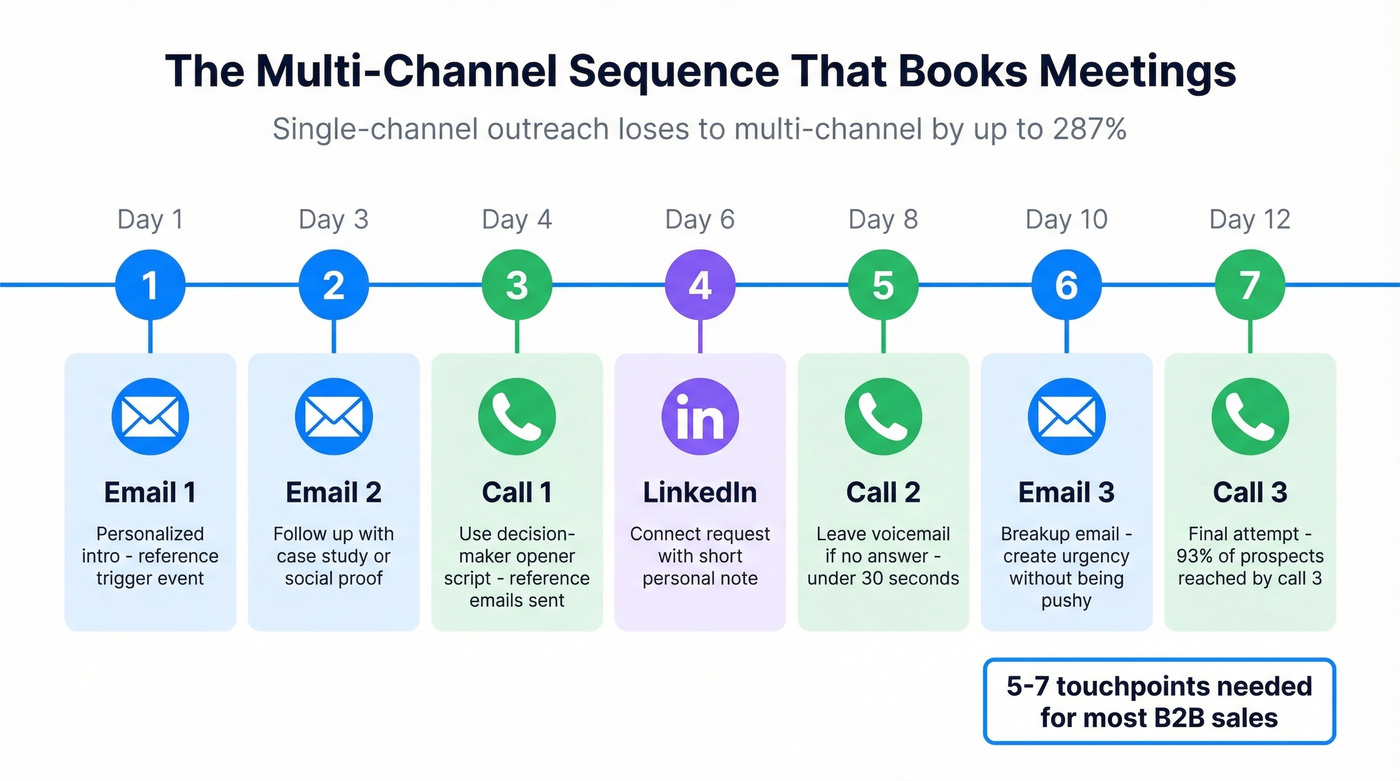
Most B2B sales require 5-7 touchpoints. A single "no" isn't a closed door.

Bad numbers kill cold calling before the first ring. Prospeo's 125M+ verified mobile numbers refresh every 7 days - not every 6 weeks. Teams like Meritt tripled their connect rate to 20-25% after switching.
Stop burning dials on dead numbers. Start with verified data.
Don't Just Call - Build a Sequence
Look, cold calling alone is a losing strategy in 2026, even with perfect data. Multi-channel sequences combining calls, email, and social touches outperform single-channel outreach by up to 287%. Use email to warm the lead, then call the openers. A recurring debate on r/sales is whether phone outreach is "worth it" given AI outreach and email automation - the practitioner consensus is clear: phone still wins on immediacy and real-time objection handling, but only when it's one piece of a coordinated sequence, not the whole strategy.
Mistakes That Kill Your Numbers
When numbers are down, most managers blame the script. In our experience, that's usually wrong. Here's a faster diagnostic:
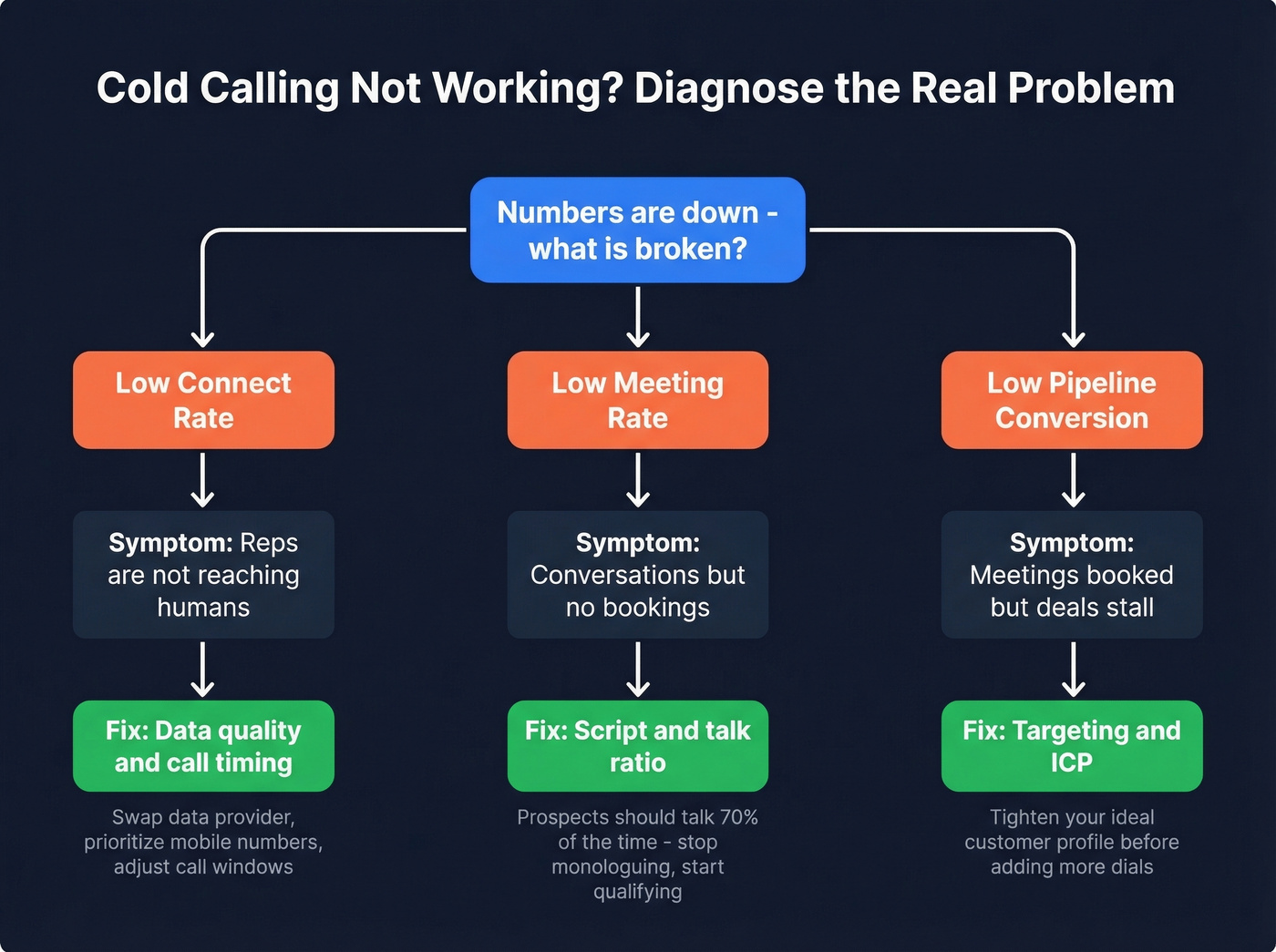
Low connect rate = data or timing problem. Your reps aren't reaching humans. Fix the list quality first, then adjust call windows. This isn't a coaching issue.
Low meeting rate from conversations = script or qualification problem. Reps are reaching people but not converting. Check the talk ratio - prospects should be talking 70% of the time. If reps are monologuing, they're pitching instead of qualifying. Use frameworks over rigid scripts, and make sure reps are doing at least 3 minutes of pre-call research.
Low pipeline conversion from meetings = targeting problem. You're booking meetings with the wrong people. Go upstream and tighten your ICP filters before adding more dials.
Compliance Rules for 2026
Compliance isn't optional anymore. TCPA lawsuits surged roughly 95% year-over-year, with class actions spiking 285% in September alone. The Supreme Court's McLaughlin v. McKesson decision means district courts aren't bound by FCC interpretations, creating a patchwork of jurisdictional risk that makes every campaign a legal question.
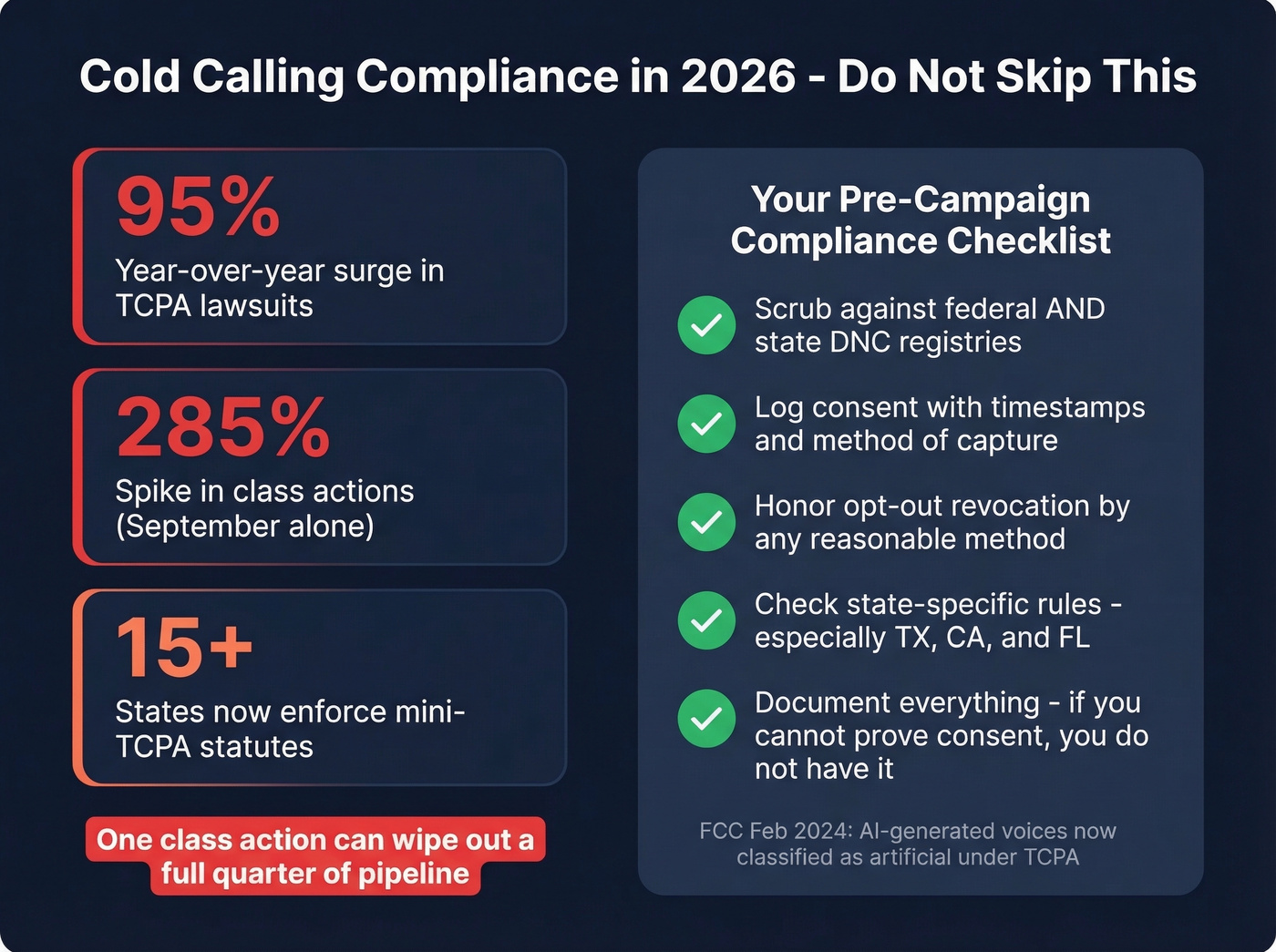
The FCC's February 2024 ruling classified AI-generated voices as "artificial or prerecorded" under TCPA - so if you're experimenting with AI voice agents, consent requirements apply. Texas SB 140 expanded "telephone solicitation" to include texts and tied violations to treble damages. At least 15 jurisdictions now enforce mini-TCPA statutes.
Your compliance checklist before every campaign:
- Scrub against federal and state DNC registries
- Log consent with timestamps and method
- Honor revocation by any reasonable method
- Check state-specific rules, especially Texas, California, and Florida
- Document everything - if you can't prove consent, you don't have it
Skip this section at your own risk. One class action can wipe out a quarter's pipeline.
Best Tools for the Job
Data Providers
Your data provider is the single most important tool in your stack. Bad data poisons everything downstream. Prospeo delivers 98% email accuracy and 125M+ verified mobiles with a 30% pickup rate on a 7-day refresh cycle - pricing starts free. For enterprise teams with bigger budgets, ZoomInfo ($15K-$40K+/yr) and Cognism (~$1K-$3K/mo) offer broader platform features but at dramatically higher cost.
If you're comparing vendors, start with a shortlist of data enrichment services and sales prospecting databases so you don't miss better-fit options.
Dialers
| Tool | Starting Price | G2 Rating | Best For |
|---|---|---|---|
| Google Voice | $10/user/mo | 4.1 | Solo reps, basics |
| Dialpad | $15/user/mo | 4.4 | AI transcription |
| OpenPhone | $15/user/mo | 4.7 | SMB teams |
| CloudTalk | $19/user/mo | 4.4 | International calling |
| Nextiva | $20/user/mo | 4.5 | Unified comms |
| RingCentral | $20/user/mo | 4.3 | Enterprise scale |
| JustCall | $29/user/mo | 4.3 | CRM integrations |
| Aircall | $30/user/mo | 4.4 | Mid-market sequences |
| Talkdesk | $85/user/mo | 4.3 | Contact centers |
| Five9 | $159/user/mo | 4.1 | Enterprise AI |
OpenPhone is a strong value pick for small teams. Mid-market teams running structured sequences should look at Aircall or Close - Close bundles a CRM with a built-in dialer, which eliminates one integration headache. If you're already on Dialpad, it's worth scanning Dialpad alternatives before you commit long-term.
For CRM, HubSpot (free tier), Salesforce, or Close all work. Pick whichever your team already uses. If you're standardizing your stack, compare a few examples of a CRM and contact management software options first.
AI Coaching Tools
Real-time sentiment coaching and AI call simulation are compressing SDR ramp time from 3-6 months to as little as 45 days. Analysis of AI-assisted outreach found that context-driven calls drove 36% higher meeting conversion compared to generic cold calls. Pricing ranges from $30/user/mo for basic coaching to $25K+/yr for enterprise AI voice platforms. Worth piloting, but don't skip the fundamentals.
If you're building a full outbound stack, start with a ranked list of SDR tools and then layer in sales prospecting techniques that match your market.
Every cold call starts with data. Prospeo gives you verified direct dials, buyer intent signals across 15,000 topics, and 30+ filters to build lists worth calling - all at $0.01 per lead.
Double your connect rate before you touch a single script.
Quick Recap
Before you scale dials, make sure these fundamentals are locked in: verify your data weekly, research every prospect for at least three minutes, lead with a hypothesis instead of a pitch, and always embed calls inside a multi-channel sequence. Nail these basics and the scripts above will do the rest.
FAQ
Is B2B cold calling legal in 2026?
Yes, but compliance is significantly harder. TCPA lawsuits surged 95% YoY and 15+ states now enforce mini-TCPA statutes with independent penalties. Scrub DNC lists, log consent with timestamps, and verify state-specific rules - especially in Texas, California, and Florida - before every campaign.
How many dials should an SDR make daily?
A common target is 60-80 dials per day. With a 5-10% connect rate, that yields 3-8 live conversations. Sixty dials to verified mobiles outperform 150 dials to stale office lines every time - quality data is the multiplier.
What's a good connect rate?
Industry average runs 3-10%. Teams using verified direct dials consistently hit the upper end - Meritt reached 20-25% after switching providers. Below 5%, the problem is almost certainly your data, not your timing or script.
Cold calling or cold email - which converts better?
Neither alone. Cold calls convert at 2-5% meeting rates; cold emails get 4-8% reply rates. Multi-channel sequences combining both outperform either channel by up to 287%, making the "either/or" debate irrelevant for serious outbound teams.
What's the best time to make sales calls?
Tuesday through Thursday, 10-11am or 2-3pm in the prospect's local time zone. Call five minutes before the hour to catch people in the gap between meetings - this simple timing hack consistently lifts connect rates by several percentage points.