

How to Build a B2B Customer Profile That Actually Works
Most B2B teams have an ICP document. It lives in a Google Doc nobody's opened since Q2, describing a company that sounds suspiciously like the founder's dream customer - not the ones actually closing. The take on r/b2bmarketing is blunt: these are "fairytale personas" built without talking to customers or sales, and they collect dust.
A strong B2B customer profile changes that - when it's scored, tiered, and wired into your CRM.
The Short Version
- Start with your 50-100 best customers, not assumptions. Define "best" by LTV and expansion revenue, not biggest logos.
- Go beyond firmographics. Add technographics, buying triggers, and committee mapping.
- Score and tier every account (A/B/C). Tier A gets white-glove outbound. Tier C gets nurture sequences.
- Enrich and operationalize in your CRM so the profile isn't shelfware.
What Is a B2B Customer Profile?
Per Gartner's framework, a B2B customer profile - also called an ideal customer profile or ICP - describes the attributes of a prospective company most likely to buy your product and become a loyal, profitable customer. It's account-level, not individual-level. That distinction matters more than most teams realize.
Stop building buyer personas before you have an ICP. Company-level targeting comes first; individual messaging comes second.
| Concept | Level | Definition |
|---|---|---|
| ICP / Customer Profile | Company | Attributes of your best-fit accounts |
| Buyer Persona | Individual | Roles and motivations within those accounts |
| TAM / SAM | Market | Total addressable universe of possible accounts |
Build the ICP first. Personas and TAM sizing flow from it.
Why ICP Alignment Drives Revenue
The numbers aren't subtle. Companies with strong ICP alignment see 38% higher win rates, 36% higher retention, and 208% more marketing-attributed revenue. With average B2B close rates sitting at 29% and 84% of reps missing quota, the margin for targeting error is zero.
Here's the thing: B2B buying committees have exploded. Gartner puts the average at five decision-makers, but that's the floor. Mid-market firms average seven people involved in a purchase, and enterprise deals often involve 10 or more - sometimes 20+. Meanwhile, 86% of purchases stall due to internal disagreements.
Without a clear profile, your reps are pitching the wrong accounts, reaching the wrong people inside those accounts, and losing deals to committee confusion they never saw coming. A sharp ICP doesn't just improve targeting. It tells you which fights are worth picking.
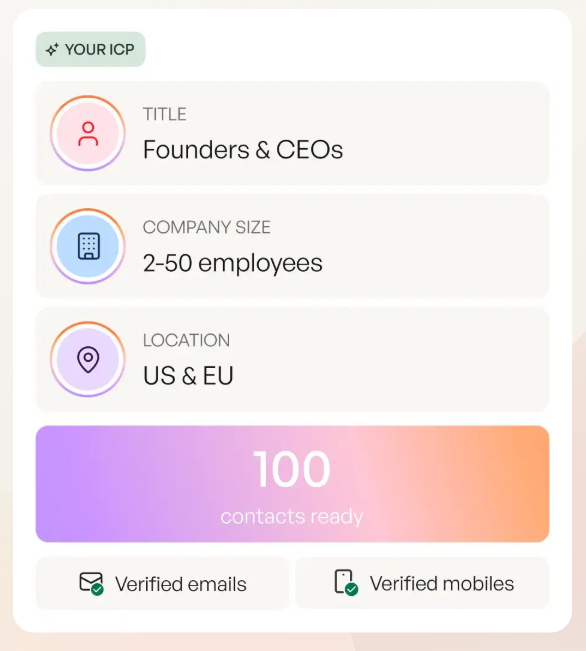
What to Include in Your Profile
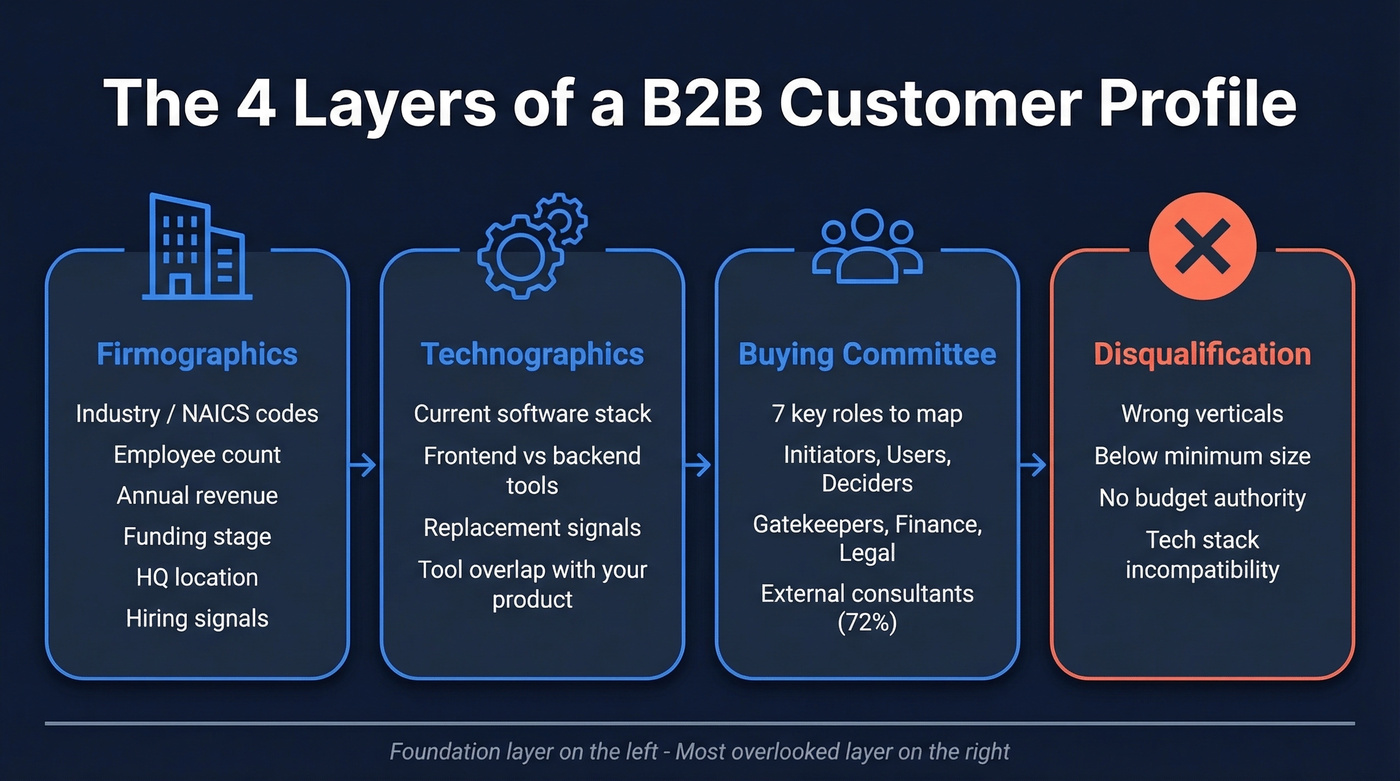
A template without a data source is a homework assignment, not a strategy. Four layers separate a useful profile from a decorative one.
Firmographics
This is the foundation: industry/vertical using NAICS or SIC codes, employee count by department where possible, annual revenue, funding stage, HQ and office locations, and ownership type.
Hiring signals are underrated. A company adding 15 SDRs is telling you something about their growth trajectory that revenue alone won't.
Technographics
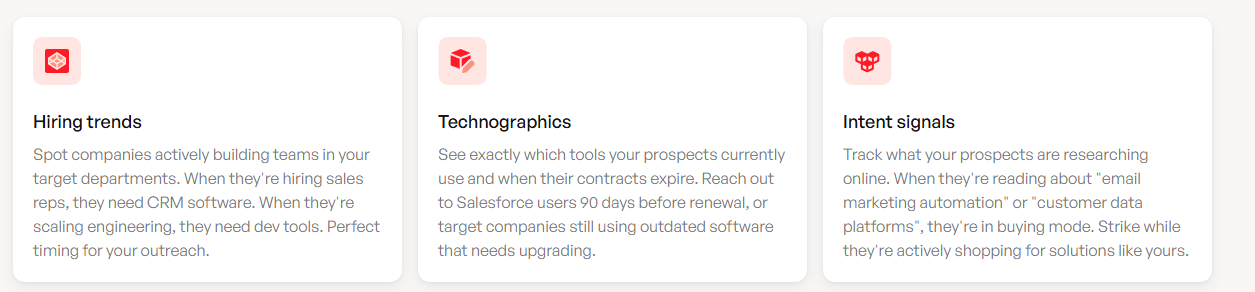
This is where most profiles fall short. The average company runs 100+ software applications, and 60% of software purchases are replacements - meaning the tech stack you saw six months ago might already be wrong.
Three collection methods worth knowing. Web crawling tools like BuiltWith ($295/mo) and Wappalyzer ($250/mo) detect frontend technologies reliably. Job-posting inference tools like TheirStack ($59/mo) reveal backend and internal tools that crawlers miss entirely. Accuracy runs 70-90%, with frontend detection on the higher end and backend inference closer to the lower bound.
Enterprise platforms like ZoomInfo ($15K-$40K/yr) and Demandbase ($30K-$100K+/yr) bundle enrichment with ABM - overkill for most mid-market teams building their first ICP.
Buying Committee Map
You need to know who's in the room. Seven roles matter: Initiators identify the need. Users live in the product daily. Influencers shape the evaluation. Deciders sign off. Gatekeepers control access and information flow. Finance approves budget. Legal and Compliance can kill a deal at the finish line. And increasingly, external consultants - 72% of companies now bring them into the evaluation.
Your messaging has to differ by role. The CIO cares about integration and security. The end user cares about workflow friction. The CFO cares about ROI timeline. One pitch deck doesn't work for all seven.
Disqualification Criteria
This is the most underrated section. Define what you won't pursue: wrong verticals, companies below your minimum viable size, accounts with no budget authority at the contact level, or tech stack incompatibility that makes implementation a nightmare.
A negative ICP prevents SDRs from chasing dead-end accounts. We've seen teams cut prospecting waste by 30-40% just by documenting what to skip.

Your B2B customer profile is only as good as the data behind it. Prospeo gives you 30+ search filters - buyer intent, technographics, headcount growth, funding, job changes - to turn your ICP into a live target list. 300M+ profiles. 98% email accuracy. $0.01 per lead.
Stop letting your ICP collect dust in a Google Doc.
B2B Customer Profile Example
Here's a filled-in profile for a mid-market SaaS company selling a marketing analytics platform:
| Attribute | Details |
|---|---|
| Industry | SaaS, Healthcare, Fintech |
| Company Size | 200-500 employees |
| Revenue | $20M-$50M |
| Geography | North America, Western Europe |
| Decision-Makers | CIO, Head of Marketing, Procurement Lead |
| Tech Stack | Salesforce, HubSpot, Slack |
| Annual Budget | $50K-$100K |
| Buying Triggers | New product launch, market expansion |
| Disqualification | <50 employees, no dedicated IT team, government/public sector |
Notice the disqualification row. That's what separates a useful profile from a wishlist. The buying triggers row is equally important: "new product launch" and "market expansion" are observable signals your SDRs can monitor to time outreach, rather than spraying cold emails at every firmographic match.
How to Build One Step by Step
Analyze Your Best Customers
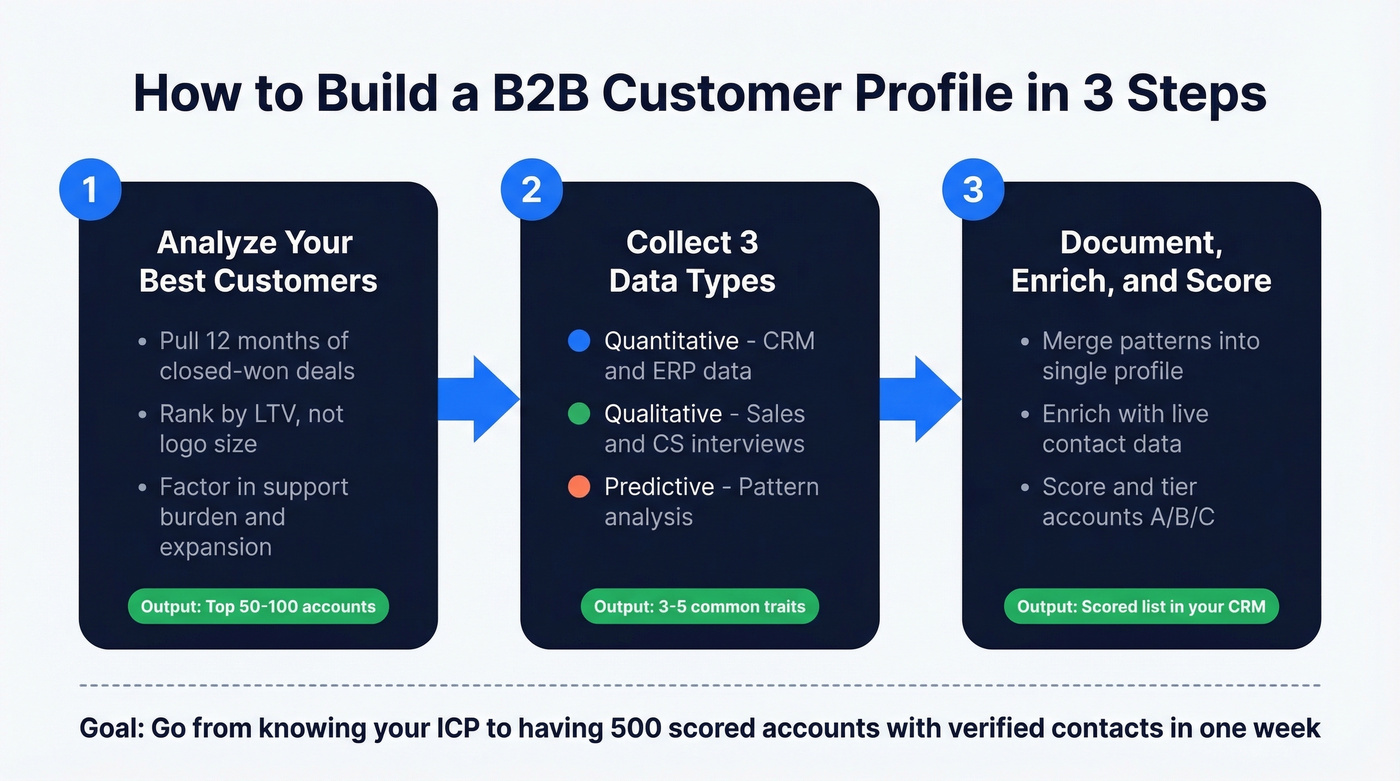
Pull your closed-won deals from the last 12 months and rank them. Don't rank by logo size or contract value alone - define "best" by LTV, low support burden, short sales cycles, and expansion revenue. Your most profitable customers often aren't your largest. They're the ones who close fast, rarely file tickets, and expand without heavy hand-holding.
If you need a starting point, use an ideal customer profile template and adapt it to your data.
Collect Three Data Types
Quantitative data comes from your CRM and ERP: deal size, CLTV, sales cycle length, win rate. Qualitative data comes from sales and CS interviews, customer surveys, and lost-deal debriefs. Predictive data comes from pattern analysis across historical behavior.
When you layer all three, 70-80% of your wins will share three to five common traits. Those traits become your ideal client profile. We've run this exercise with multiple teams, and the patterns are always there once you stop relying on gut feel.
Document, Enrich, and Score
Merge your pattern analysis into a single profile document. Then enrich it with live data. This is where most teams stall - the ICP is defined, but nobody can find verified contact data for matching accounts.
If you're comparing vendors, start with a shortlist of data enrichment services and map them to your CRM workflow.
Prospeo covers 300M+ profiles with 30+ search filters including technographics, buyer intent across 15,000 Bombora topics, job changes, and headcount growth. The free tier gives you 75 emails/month plus 100 Chrome extension credits, and paid plans run roughly $0.01 per email. With a 92% API match rate, you're not manually hunting for emails after the enrichment step.
The goal is to go from "we know our ICP" to "we have a scored, verified list of 500 accounts with direct dials for three contacts each" in the same week.
How to Score and Tier Accounts
Once your profile is enriched, score every account against it. Here's a 100-point rubric we've used:
If you want to formalize this, build your scoring rules like a proper lead scoring model (even if it's account-level).
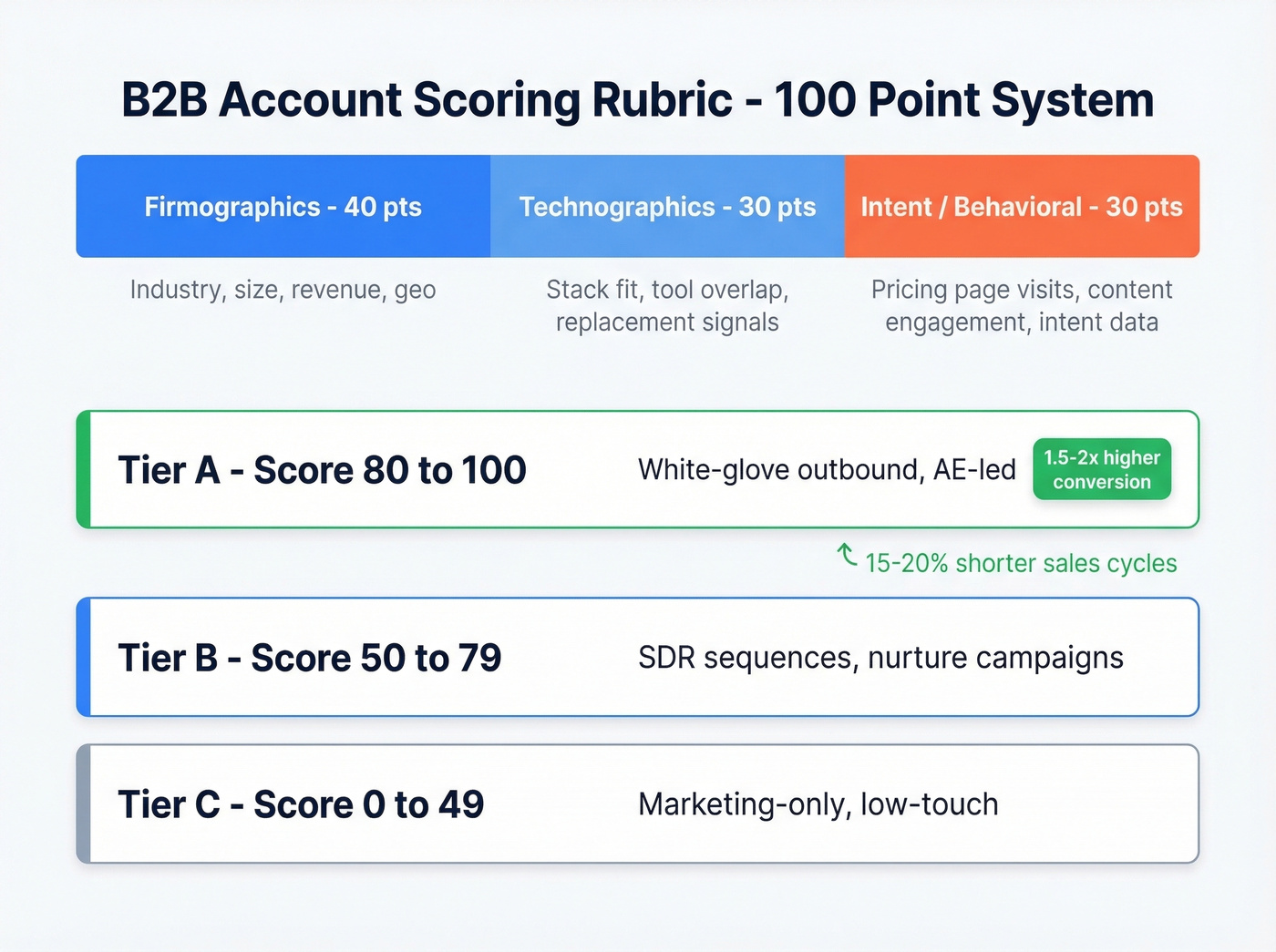
| Category | Weight | What You're Scoring |
|---|---|---|
| Firmographics | 40 pts | Industry, size, revenue, geography |
| Technographics | 30 pts | Stack fit, tool overlap, replacement signals |
| Intent / Behavioral | 30 pts | Pricing page visits, content engagement, intent signals |
Then tier based on total score:
| Tier | Score Range | Treatment |
|---|---|---|
| A | 80-100 | White-glove outbound, AE-led |
| B | 50-79 | SDR sequences, nurture campaigns |
| C | 0-49 | Marketing-only, low-touch |
Tier A accounts typically convert at 1.5-2x the rate of Tier B, with 15-20% shorter sales cycles. Connect your scoring to CRM routing and SDR prioritization so the tiers drive behavior - not just reporting. For teams running an ABM motion, this is where account-based marketing stops being a buzzword and starts being a workflow.
One caveat: if your average deal size is under $10K, you probably don't need a three-tier scoring model at all. A simple yes/no ICP fit filter will outperform a complex rubric that nobody maintains. Save the scoring sophistication for deals where the math justifies the overhead.
Mistakes That Kill Your Profile
Every team thinks their ICP is data-driven until you ask where the data came from. These mistakes show up in every practitioner thread about ICPs:
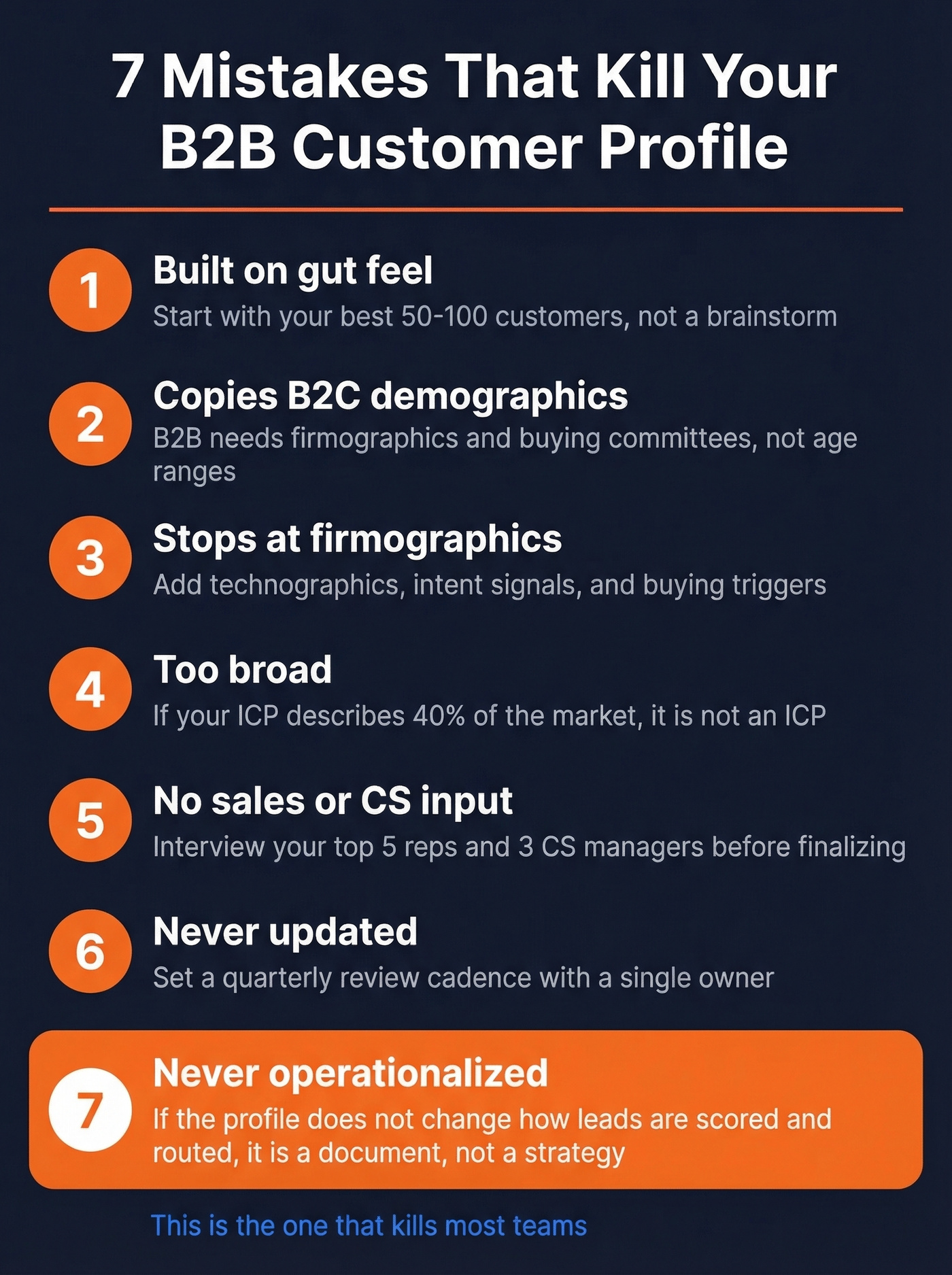
- Built on gut feel. Start with your best 50-100 customers, not a brainstorm session.
- Copies B2C demographics. B2B profiles need firmographics, buying committees, and journey complexity - not age ranges.
- Stops at firmographics. Add technographics, intent signals, and buying triggers.
- Too broad. If your ICP describes 40% of the market, it's not an ICP. Narrow until it hurts.
- No sales or CS input. Interview your top five reps and three CS managers before finalizing.
- Never updated. Set a quarterly review cadence with a single owner.
- Never operationalized. If the profile doesn't change how leads are scored and routed, it's a document, not a strategy.
Let's be honest - number seven is the one that kills most teams. The profile exists, it's even pretty good, and then it sits in Notion while SDRs keep working the same unfiltered lead lists they had before.
How to Keep Your ICP Alive
A B2B customer profile is a living document, not a launch-day artifact. Set a quarterly review cadence and assign a single owner - usually RevOps. Give them RACI ownership so updates don't depend on committee consensus.
Every quarter, review win rate by tier, CAC payback period, net revenue retention, and sales velocity. If Tier A accounts aren't converting meaningfully better than Tier B, your scoring model needs recalibration. Feed in fresh inputs: G2 reviews mentioning your product, CS escalation patterns, product usage data from your CDP, and lost-deal analysis.
Version-control the document. When you update disqualification criteria or shift tier thresholds, log the change and the reasoning. Six months from now, you'll want to know why you dropped healthcare from Tier A - and whether that decision still holds.
To keep the profile actionable, tie it to your lead generation workflow and your outbound operating rhythm.
Firmographics, technographics, buying triggers - this article covers what belongs in your profile. Prospeo enriches every account with 50+ data points, refreshed every 7 days, so your CRM always reflects reality. 92% match rate on enrichment. No stale records killing your outbound.
Enrich your CRM with the data your ICP actually needs.
FAQ
What is a B2B customer profile?
It's a description of the company attributes - industry, size, revenue, tech stack, buying triggers - that define your most profitable potential customers. It's account-level, not individual-level, and it tells your team which companies deserve outbound effort and which to skip.
How is a customer profile different from a buyer persona?
A customer profile describes the ideal company. A buyer persona describes the ideal person within that company. Build the ICP first - you can't write a useful persona until you know which accounts that person works at.
How often should you update your ICP?
Quarterly at minimum. Review win/loss data by tier, check for market shifts, and validate disqualification criteria. Assign a single RevOps owner so updates don't fall through the cracks.
What tools help build and enrich a customer profile?
A CRM like Salesforce or HubSpot for deal data, plus an enrichment platform for verified contacts and technographics. Prospeo covers 300M+ profiles with 98% email accuracy and 30+ filters starting free. BuiltWith adds dedicated stack detection at $295/mo. Budget $60-$600+/mo depending on scale.
How many ICPs should a company have?
One to three - one per distinct product line or market segment. More than three means you haven't prioritized, and your SDRs are spreading too thin across mismatched accounts.