

How to Choose the Right B2B Data Partner in 2026
A RevOps lead we know ran a three-tool bake-off last quarter. The "best" database - the one with the biggest logo and the fattest contract - created 4,000 duplicate contacts in Salesforce within five days. The cheapest option had better phone connect rates. Choosing a B2B data partner isn't about picking the biggest name. It's about picking the right fit.
The cost of getting it wrong is brutal. B2B contact data decays roughly 2.1% per month, which means about 22.5% of your database goes stale every year. The average organization loses $12.9M annually to poor data quality, and reps waste an estimated 500 hours per year just validating contact information that should've been accurate at the point of delivery. That's missed pipeline, burned sender reputation, and quota carriers chasing ghosts instead of closing deals.
What You Need (Quick Version)
Most teams need a three-layer stack, not a single all-in-one platform:
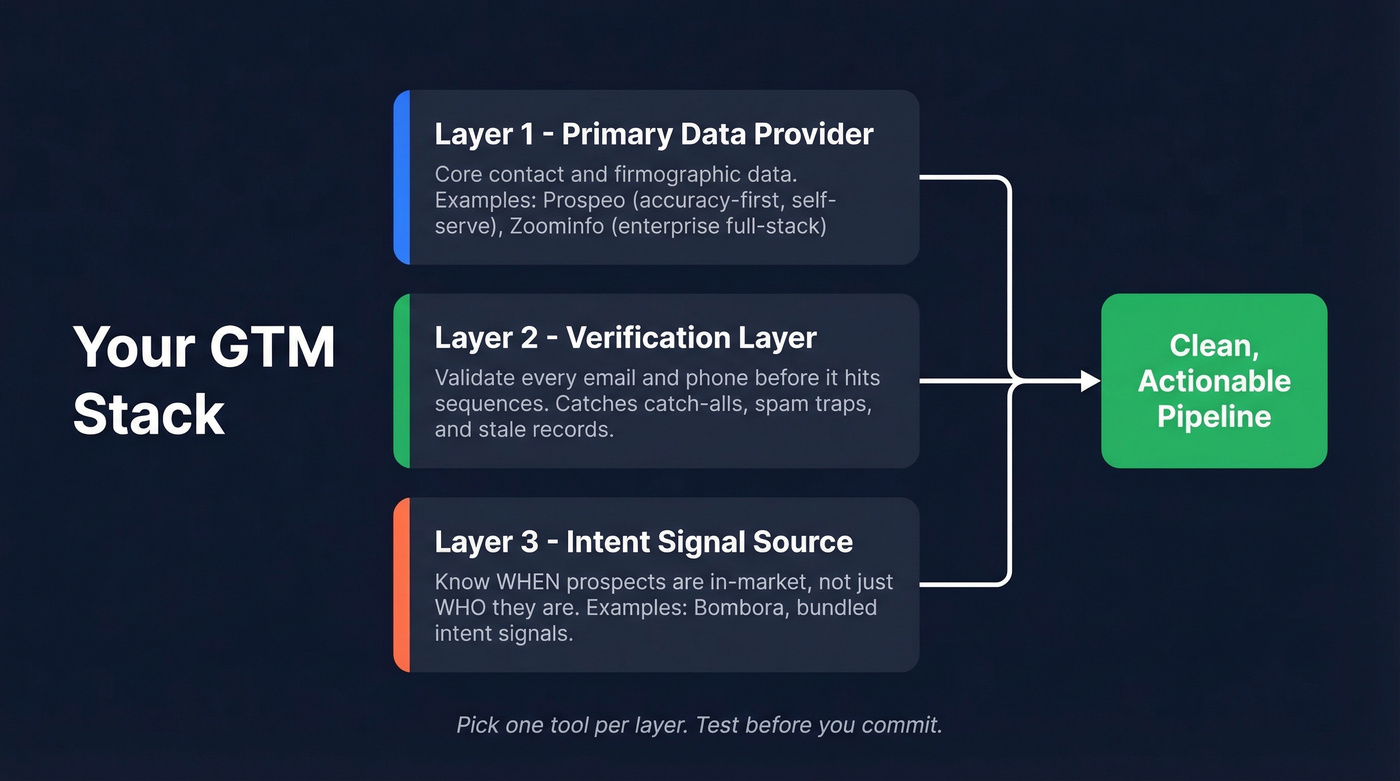
- Primary data provider - your core source for contact and firmographic data. If you need the full enterprise GTM suite with intent and workflow automation baked in, ZoomInfo is the default. If you want accuracy-first data without an enterprise contract, Prospeo delivers 98% verified emails on a 7-day refresh cycle with self-serve pricing starting free.
- Verification layer - even "verified" databases have gaps. Run every list through a dedicated verification step before it hits your sequences. (If you’re comparing tools, start with an email verifier benchmark.)
- Intent signal source - knowing who to contact matters less than knowing when they're in-market. Bombora ($12K-$40K/year) is the standalone standard. Some platforms bundle intent; ZoomInfo has its own signal based on web activity, and others layer Bombora data directly. (If you’re building this layer, see how teams identify buyer intent signals.)
Pick one tool per layer. Test before you commit.
What a B2B Data Partner Actually Is
A data vendor sells you a list. A data partner integrates into your workflow, refreshes continuously, and becomes infrastructure you depend on. That distinction matters because switching providers causes major disruptions - retraining reps, rebuilding integrations, re-mapping fields, and months of messy CRM data during the transition.
You're buying five types of data from a provider like this:
- Contact data - emails, direct dials, job titles, reporting structure
- Firmographic data - company size, revenue, industry, location
- Technographic data - what software the prospect's company runs (more on technographics if you’re new to it)
- Intent data - signals that a company is actively researching your category
- Trigger events - job changes, funding rounds, headcount growth
No single provider excels at all five. The best strategy is picking a primary partner that nails the first two, then layering specialized tools for the rest. With MQL-to-SQL conversion sitting at just 15% and lead-to-customer rates hovering around 1.5-2.5%, every bad contact at the top of the funnel compounds into lost revenue at the bottom.
How to Evaluate Data Partners
Before you talk to a single vendor, run through these eight questions. They'll save you from signing a contract you regret.
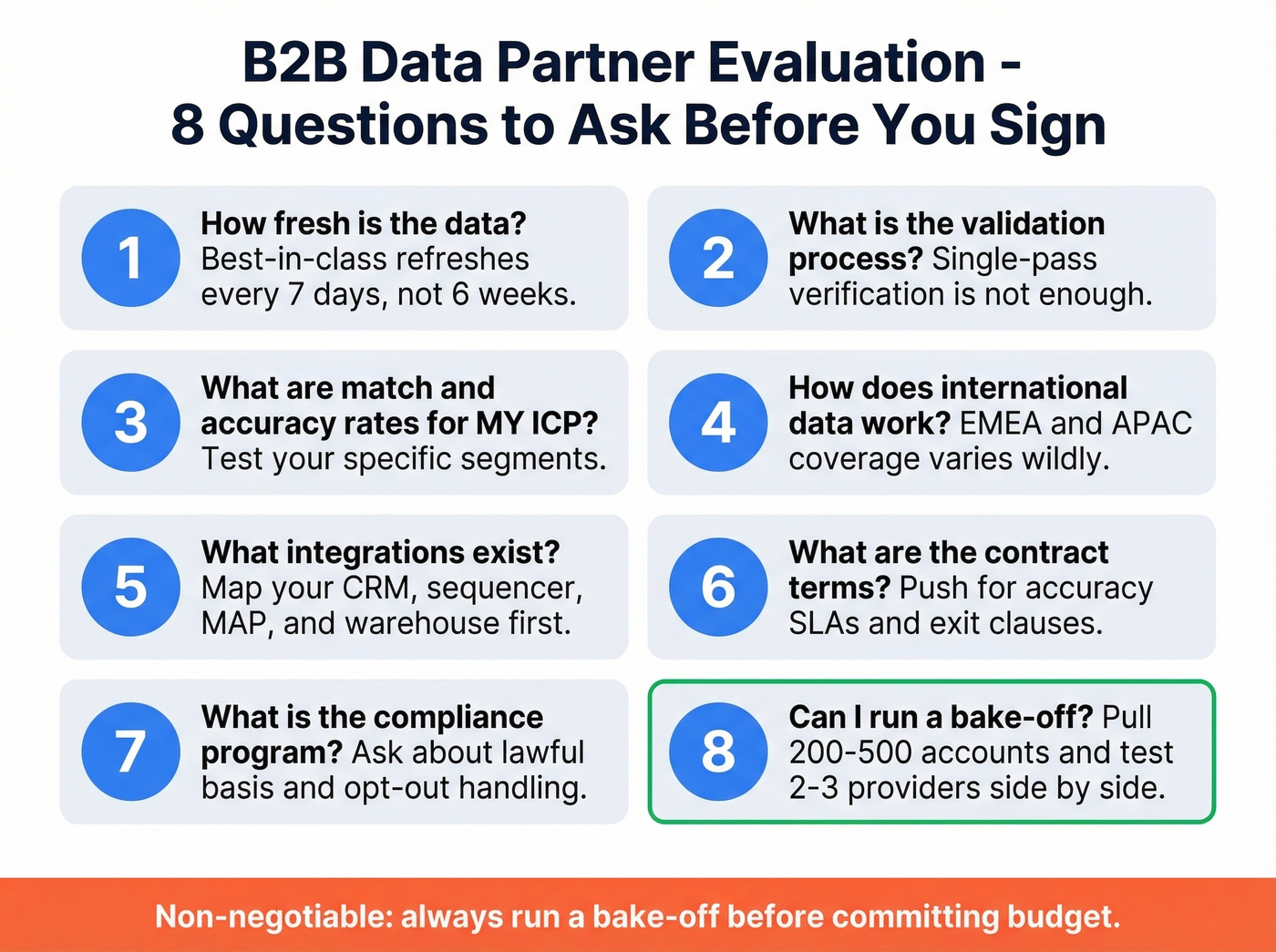
1. How fresh is the data, and how often does it refresh? Industry average is roughly six weeks. The best providers refresh every 7 days. "Regularly updated" means nothing - demand specifics.
2. What's the validation process? Single-pass email verification isn't enough. Ask about catch-all handling, spam-trap removal, and whether they verify at the point of delivery or just at ingestion. (If you’re tightening deliverability, add spam trap removal to your checklist.)
3. What are typical match and accuracy rates for my ICP? A provider with 95% accuracy on US enterprise accounts might drop to 60% on European mid-market. Get numbers for your specific segments. (If your ICP definition is fuzzy, fix your Ideal Customer Profile first.)
4. How does international data handling work? EMEA and APAC coverage varies wildly. If you sell globally, test each region separately.
5. What integrations exist? Map your stack - CRM, sequencer, MAP, data warehouse - and confirm native connectors before you demo. (If you’re standardizing ops, a RevOps Tech Stack blueprint helps.)
6. What are the contract terms? Negotiate minimum accuracy SLAs, transparent overage pricing, and termination clauses if quality benchmarks aren't met. Annual lock-ins are the norm at ZoomInfo. Push back.
7. What's the compliance program? Ask upfront about lawful basis, opt-out handling, and data broker registration.
8. Can I run a bake-off on my own data? Non-negotiable. Pull 200-500 target accounts and run them through two or three providers simultaneously. Compare match rates, email validity, and direct-dial coverage against contacts you already know.

You just read that the average org loses $12.9M/year to bad data. Prospeo's 5-step verification, 7-day refresh cycle, and 98% email accuracy exist to kill that problem. 300M+ profiles, 30+ filters, self-serve pricing starting free - no enterprise contract required.
Run your own bake-off. 75 free emails, no sales call needed.
The Coverage Problem Nobody Talks About
One practitioner on r/sales_intelligence ran a 500-account comparison across Lusha, Apollo, ZoomInfo, and Cognism. The results were "all over the place" with "almost no overlap" on mid-market companies. That's not an outlier - it's the norm.
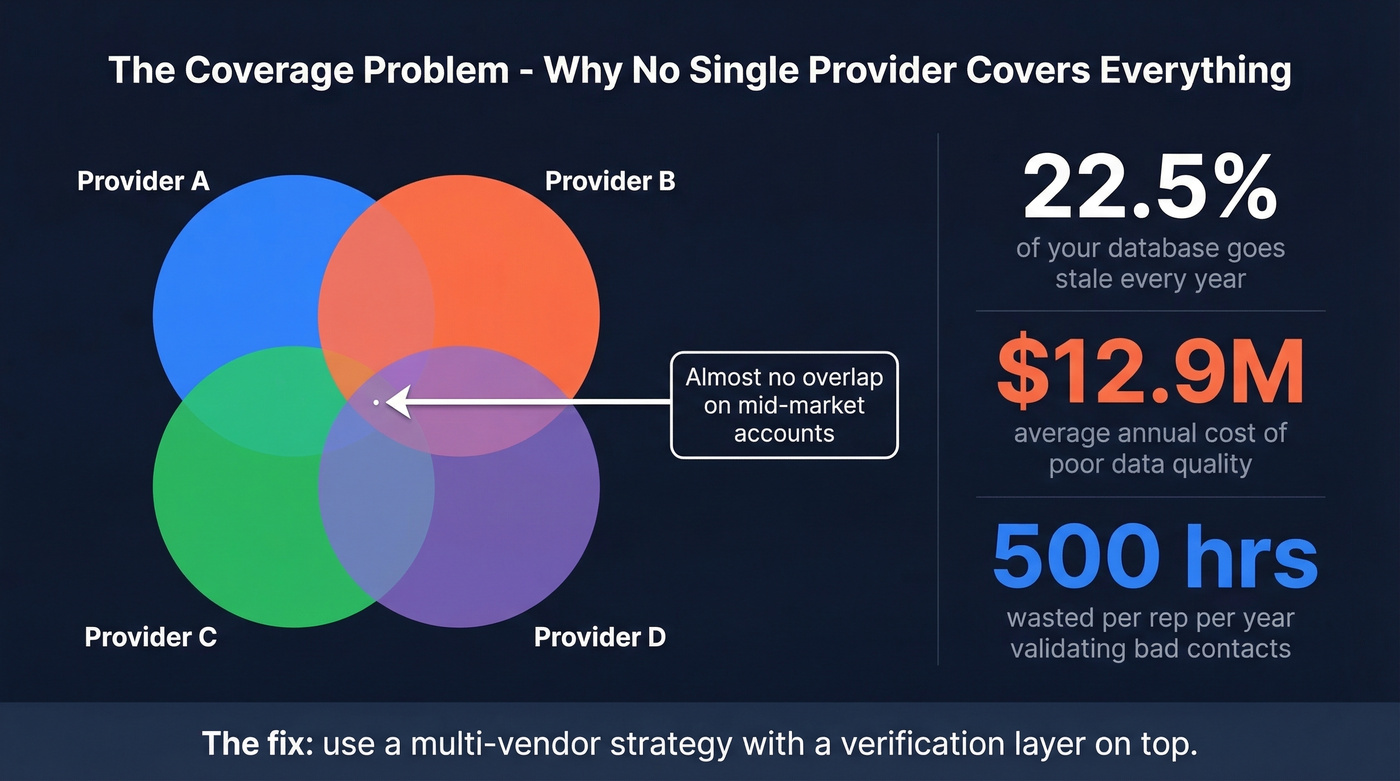
Every database has blind spots. None of them cover everything, and upgrading to a premium tier doesn't always unlock net-new records. Sometimes you're just paying more for the same contacts with shinier packaging.
Here's the thing: if your average deal size is under $15K, you probably don't need a $30K+ data platform. A high-accuracy email finder paired with a sequencer will outperform an enterprise suite that your team only uses at 20% capacity. The r/coldemail community is full of teams burning budget on Apollo upgrades and Clay workflows when their real problem is data accuracy, not data volume. (If you’re scaling outreach, use a dedicated outbound email automation tool and keep data separate.)
This is why a multi-vendor strategy matters. Your primary provider handles the bulk of prospecting. A secondary source fills gaps for specific regions or verticals. And a verification layer ensures that whatever you're pulling from any source is still accurate when it hits your sequences. (For more options, compare data enrichment tools before you commit.)
Best B2B Data Partners for 2026
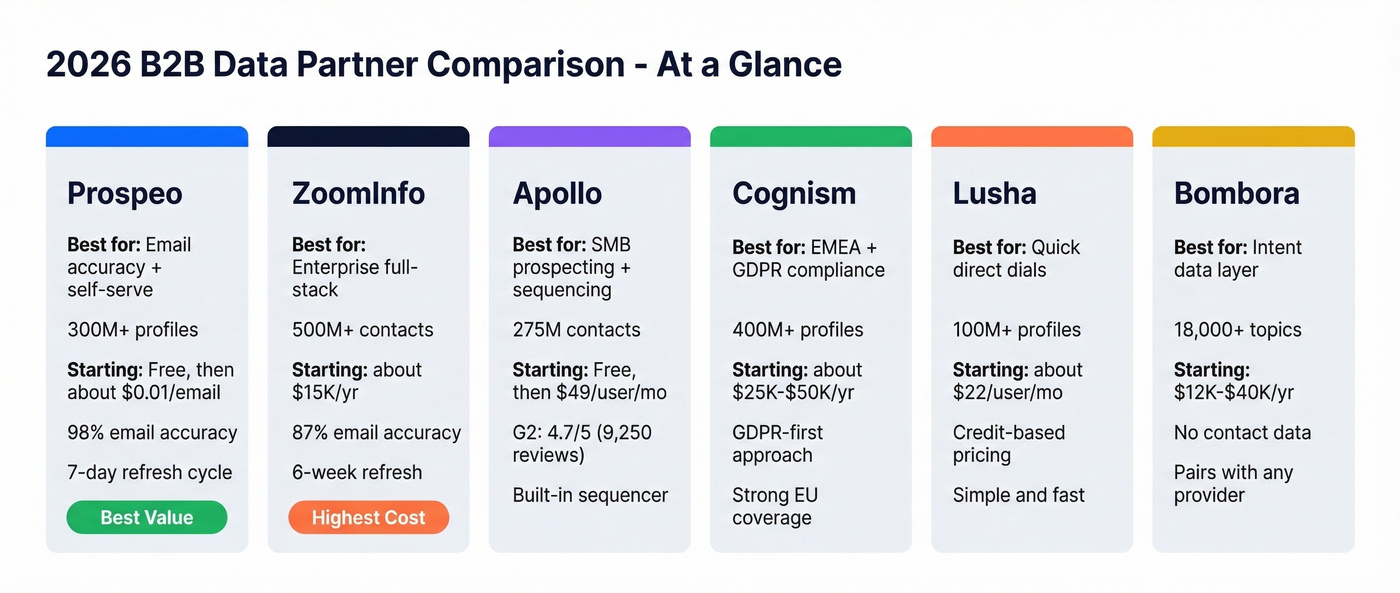
| Provider | Best For | Database Size | Starting Price | G2 Rating |
|---|---|---|---|---|
| Prospeo | Email accuracy + self-serve | 300M+ profiles | Free / ~$0.01/email | - |
| ZoomInfo | Enterprise full-stack | 500M+ contacts | ~$15K/yr | 4.5/5 (8,875) |
| Apollo | SMB prospecting + sequencing | 275M contacts | Free / $49/user/mo | 4.7/5 (9,250) |
| Cognism | EMEA coverage + compliance | 400M+ profiles | ~$25K-$50K/yr | 4.5/5 (1,200) |
| Lusha | Quick direct dials | 100M+ profiles | ~$22/user/mo | 4.3/5 (1,566) |
| Bombora | Intent data layer | 18,000+ topics | $12K-$40K/yr | - |
| Coresignal | Enrichment at scale | 75M companies | $49/mo | - |
| People Data Labs | Developer-first enrichment | 70M+ companies | ~$98/mo | - |
| Bright Data | Raw web data at scale | 58M+ company profiles | $250/100K records | - |
Prospeo
Use this if: You need verified emails and direct dials that actually connect, without signing an enterprise contract or talking to sales.
Prospeo's database covers 300M+ profiles with 143M+ verified emails at 98% accuracy and 125M+ verified mobile numbers hitting a 30% pickup rate. The 7-day data refresh cycle is six times faster than the industry average. Thirty-plus search filters - including buyer intent across 15,000 Bombora-powered topics, technographics, job changes, and headcount growth - let you build targeted lists without exporting garbage. We've tested this against several competitors, and the difference in bounce rates is immediately obvious. (If you’re still shopping, see our ranked list of the best B2B database options.)
The Chrome extension (40K+ users) works across company websites and CRMs for one-click prospecting, and native integrations push directly into Salesforce, HubSpot, Smartlead, Instantly, Lemlist, Clay, Zapier, and Make. Real results: Snyk's 50-person AE team went from a 35% bounce rate to under 5%, driving a 180% increase in AE-sourced pipeline and 200+ new opportunities per month. Pricing runs ~$0.01 per lead with a free tier to start.

Skip this if: You need a full-stack GTM platform with built-in sequencing, website chat, and ABM orchestration. Pair Prospeo with your sequencer of choice for that workflow.
ZoomInfo
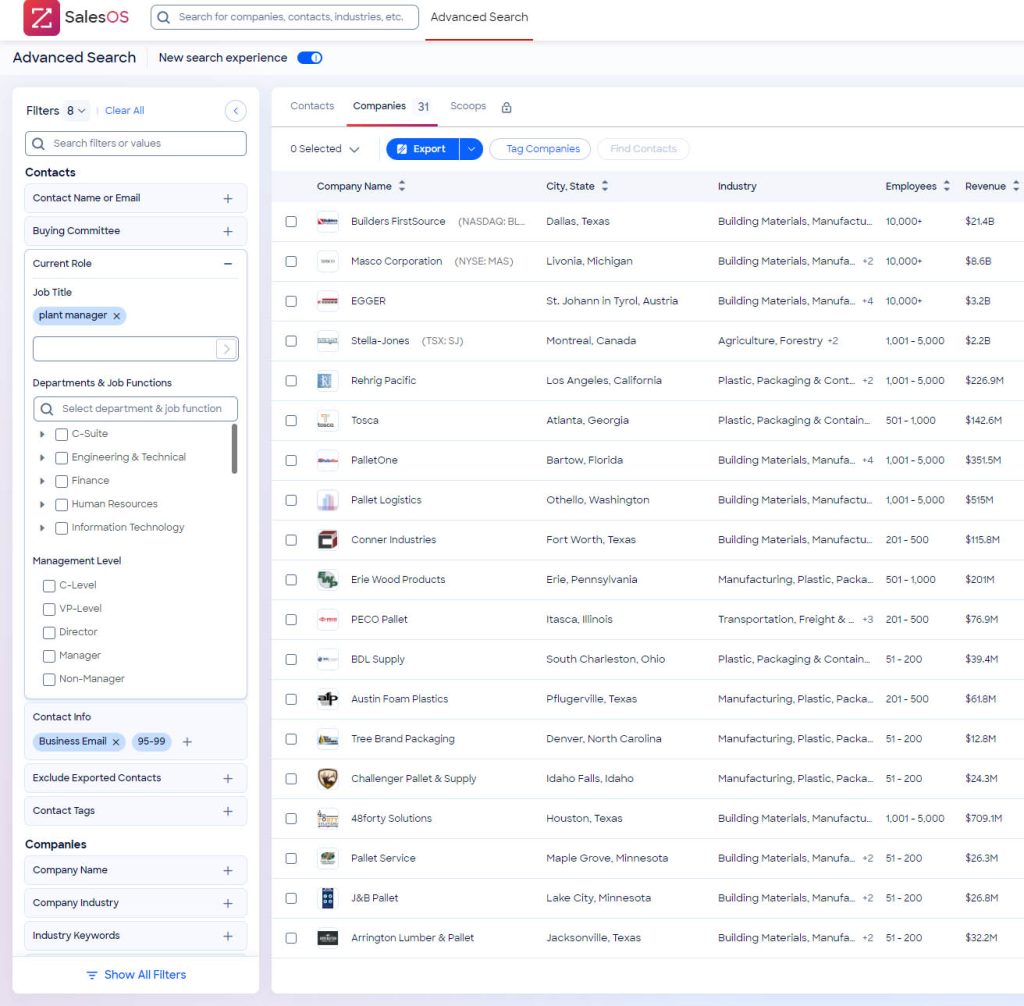
Use this if: You're a 50+ rep org that needs a single platform covering contact data, intent signals, and workflow automation - and you have the budget to match. ZoomInfo's Professional tier starts around $15K/year for up to three users and 5,000 annual credits. Advanced runs ~$25K, Elite ~$40K. Those are base prices, though. Add-ons for intent data, mobile numbers, and extra seats push real-world costs to $30K-$60K for a mid-market team. Annual contracts only, and auto-renewal clauses are commonly flagged as aggressive on Reddit.
Skip this if: You're a team under 20 reps or a Series A company watching burn. We've seen teams pay for intent and workflow modules they never activate. ZoomInfo wins on database depth and platform breadth, but email accuracy sits around 87% versus best-in-class providers, and the cost per lead is roughly 10x higher than self-serve alternatives.
Apollo
Apollo is the default for SMB and early-stage teams that want prospecting and sequencing in one tool without a five-figure contract. The free tier is genuinely generous, paid plans run $49-$119/user/month, and the database covers 275M contacts with 65+ filters. The built-in sequencer means you can find, enrich, and email from a single platform. A G2 rating of 4.7/5 across 9,250 reviews speaks for itself.
The tradeoffs are real, though. Accuracy drops noticeably outside the US, especially in EMEA and APAC. Apollo has had security incidents in the past, which matters if your compliance team scrutinizes vendor security posture. And if you're scaling outbound volume, the credit system gets expensive fast - a frustration that surfaces constantly in r/coldemail threads.
Cognism
For teams selling into EMEA where GDPR compliance isn't optional (it never is, but some teams treat it that way). Cognism's database covers 400M+ profiles. GDPR-first positioning means cleaner consent trails and fewer legal headaches. Expect mid-five-figure annual contracts, typically $25K-$50K, with a demo-led sales process. G2 4.5/5 across 1,200 reviews.
Where it breaks down: US-only ICPs. Cognism's US data doesn't match ZoomInfo's depth, and the pricing doesn't justify it for domestic-only teams.
Lusha
Best when you need a phone number in 10 seconds and don't want to learn a new platform. Pro runs ~$22/user/month, Premium ~$52. Credit-based pricing: 1 credit per email, 5 per direct dial. Simple, fast, effective.
Breaks down when you need volume. The "unlimited" Scale plan has fair-use caps around 2,000-5,000 contacts per month, and heavy prospecting teams burn through credits fast. The data depth doesn't compete with full-database providers for complex ICP targeting.
Bombora
Bombora is the intent data specialist - it doesn't give you contacts, it tells you which companies are actively researching topics relevant to your product across 18,000+ topics. The intent data market hit $4.49B in 2026 and is growing 16.6% annually, which tells you how seriously GTM teams take timing signals. Pricing runs $12K-$40K/year depending on topic volume and integrations.
The catch: 91% of B2B marketers use intent data, but only 24% report exceptional ROI. Add this layer only after your contact data is clean and your sequences are converting. Intent signals on top of bad emails just means you know who to miss.
Coresignal
API-first enrichment platform with 75M company records, 176ms API response time, and EWDCI certification. Starts at $49/month. Best for data engineers building custom enrichment pipelines at scale - not for reps who need a search bar.
People Data Labs
Developer-first enrichment covering 70M+ companies and 3B+ person records with strong entity resolution for linking people to companies. Starts ~$98/month. Build your own enrichment workflows via API - this isn't a prospecting tool.
Bright Data
Scraping infrastructure and pre-built datasets covering 58M+ company profiles across 195 countries. Starts at $250 per 100,000 records. Best for teams building custom data pipelines from raw web sources - infrastructure for data engineers, not a plug-and-play prospecting platform.
Compliance - What to Ask Before You Sign
GDPR fines run up to EUR20M or 4% of global revenue. CPRA statutory damages hit $100-$750 per violation. Business emails that identify individuals are personal data under GDPR - there's no B2B exemption.
Before signing with any provider, ask these five questions:
- What's your lawful basis for processing this data? Legitimate interest is common but must be documented. Ask to see the assessment.
- Can you produce consent records and DSAR logs on request? If they hesitate, walk away.
- Are you registered as a data broker in states that require it (California, Vermont, Oregon)?
- How do you handle suppression lists and opt-outs? Do they honor Global Privacy Control signals?
- What happens to my data if I terminate the contract? Deletion timelines and proof of deletion matter.
CCPA applies if your company has $25M+ revenue, processes data on 100K+ California consumers, or derives 50%+ of revenue from selling or sharing personal information. Most B2B companies selling into the US hit at least one threshold. (If you need a deeper checklist, use our B2B compliance guide.)
A multi-vendor strategy only works when your primary partner nails contact and firmographic data. Prospeo delivers 143M+ verified emails at 98% accuracy, 125M+ mobile numbers with a 30% pickup rate, and intent data across 15,000 Bombora topics - all at ~$0.01/email.
Replace your weakest data layer with the most accurate one.
FAQ
What's the difference between a B2B data partner and a data vendor?
A vendor sells you a static list once. A partner provides continuously refreshed data integrated into your CRM with accuracy SLAs and native connectors. Partners refresh on a set cycle (the best do it weekly), while vendor lists start decaying the moment you download them.
How much does a B2B data partner cost?
Most mid-market teams spend $5K-$20K/year across two or three tools. Free tiers exist - Prospeo offers 75 verified emails per month at no cost - while enterprise platforms like ZoomInfo run $30K-$60K/year with add-ons.
How do I test a provider before committing?
Pull 200-500 target accounts through two or three providers' free tiers simultaneously. Compare match rates, email validity, and direct-dial coverage against contacts already verified in your CRM. A structured bake-off like this takes one week and prevents six-figure mistakes.
Do I need more than one data provider?
Usually yes. Coverage varies wildly by ICP and region - practitioners report almost no overlap across vendors on mid-market accounts. A primary B2B data partner plus a verification layer is the minimum viable stack. Many teams cross-validate records with a secondary source to fill regional gaps.
Is B2B contact data subject to GDPR?
Yes. Business emails identifying individuals are personal data under GDPR. Your data provider must demonstrate lawful basis, honor opt-outs, and provide DSAR compliance - there's no blanket B2B exemption under EU law.