

B2B Digital Lead Generation: The 2026 Guide With Actual Numbers
Most B2B digital lead generation fails for three reasons: bad data, slow follow-up, and no budget reality check. Not tactics. Not "thought leadership." Your team is blasting cold emails at a ~2% reply rate because half those addresses bounced and the other half aren't buyers. This guide gives you CPL benchmarks, channel budget minimums, and the tool stack to fix that.
The short version: Start with verified contact data, pick two or three channels you can actually afford, and respond to leads within five minutes.
What Digital Lead Generation Means in 2026
B2B digital lead generation is the process of using online channels - email, paid ads, content, intent data - to identify and capture potential buyers. An MQL has engaged with your content or matched your targeting criteria. An SQL has been vetted by a human with real buying potential.
Most teams generate plenty of MQLs. Typical MQL-to-SQL conversion rates run 10-30% depending on channel and ICP tightness, which means 70-90% of your marketing leads won't make it to a sales conversation. That's where everything breaks.
The B2B Institute's 95/5 rule makes it worse: only about 5% of your total addressable market is actively buying at any given time. Bain research shows 80-90% of buyers already have a vendor shortlist before they start researching, so you're fighting for a sliver of attention among people who've mostly already decided. Understanding this dynamic is the first step in generating leads online without burning budget on the 95% who aren't ready.
What B2B Leads Actually Cost
Every lead gen guide talks about "generating more leads." Almost none talk about what those leads should cost. Here are the 2026 benchmarks from First Page Sage:
| Industry | Paid CPL | Organic CPL | Blended CPL |
|---|---|---|---|
| B2B SaaS | $310 | $164 | $237 |
| Financial Services | $761 | $555 | $653 |
| Cybersecurity | $411 | $404 | $406 |
| IT & Managed Services | $617 | $385 | $503 |
| eCommerce | $98 | $83 | $91 |
For B2B SaaS specifically, the combined customer acquisition cost runs about $239. The rule of thumb: your LTV:CAC ratio should be at least 3:1. If you're spending a third or more of a customer's lifetime value just to acquire them, no amount of lead volume fixes your unit economics. These numbers should anchor every digital lead generation decision you make.
Channels That Work (With Real Budgets)
Every guide tells you to "use social selling" and "invest in content." Nobody tells you what it actually costs. Here's the reality, based on mid-market ROI data:
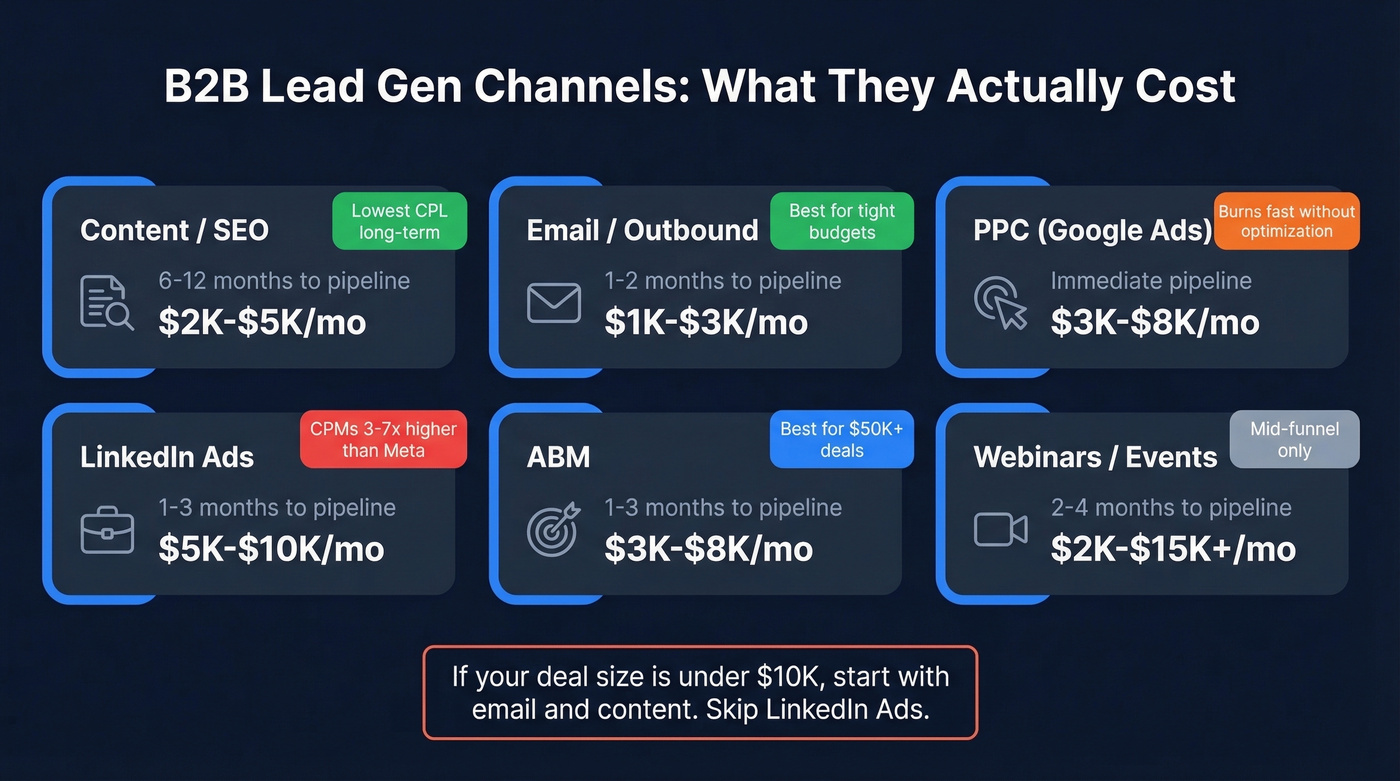
| Channel | Time to Pipeline | Min. Monthly Spend |
|---|---|---|
| Content / SEO | 6-12 months | $2K-$5K |
| Email / Outbound | 1-2 months | $1K-$3K |
| PPC (Google Ads) | Immediate | $3K-$8K |
| LinkedIn Ads | 1-3 months | $5K-$10K |
| ABM | 1-3 months | $3K-$8K |
| Webinars / Events | 2-4 months | $2K-$15K+ |
LinkedIn CPMs run $60-$200 for B2B audiences. Meta sits at $8-$30. That's not a typo - LinkedIn is 3-7x more expensive per impression. B2B buyers now engage across roughly 10 channels before purchasing, up from 5 in 2016, so you need multi-channel coverage to stay competitive. But if your budget is under $3K/month, start with email automation and content. LinkedIn Ads are a luxury until you've validated your messaging on cheaper channels.
Webinars work best as mid-funnel conversion events. Don't expect them to generate cold pipeline on their own.
Here's our honest take: If your average deal size is under $10K, you probably don't need LinkedIn Ads or ABM platforms at all. We've watched teams burn $8K/month on LinkedIn campaigns that would've performed better as targeted cold email at one-tenth the cost.

You just saw the CPL benchmarks - $237 blended for B2B SaaS. Half that cost is wasted when emails bounce. Prospeo's 98% email accuracy and 7-day data refresh cut bounce rates below 4%, so every dollar you spend on outbound actually reaches a real buyer.
Stop paying $237 per lead just to hit dead inboxes.
The Tool Stack You Actually Need
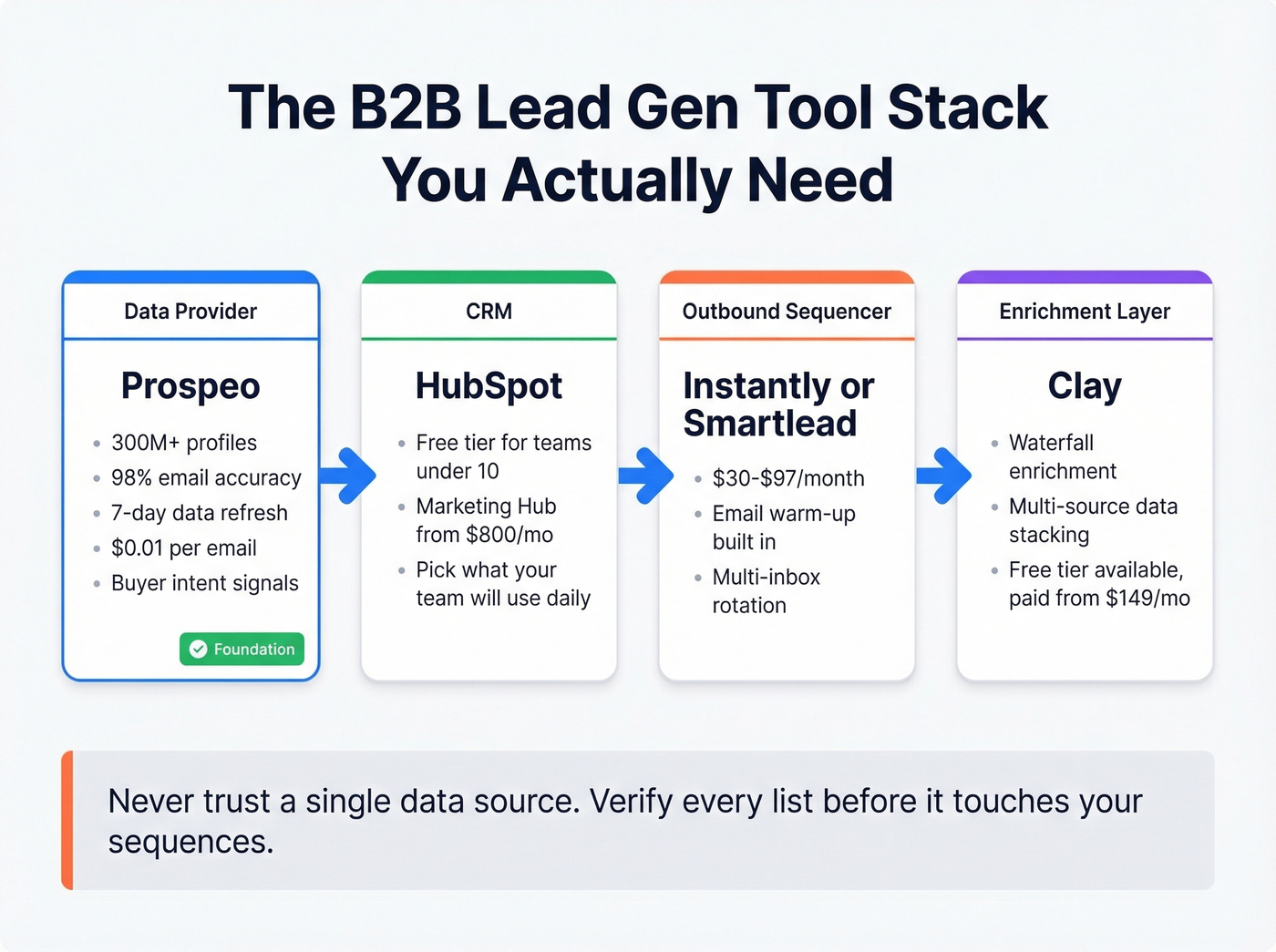
The lead gen tools market hit $7.4B in 2025 and is projected to reach $16.2B by 2034. Most teams buy too many tools and integrate none of them properly. You need four categories: a data provider, a CRM, an outbound sequencer, and an enrichment layer.
Data Provider
This is where your stack lives or dies. Prospeo covers 300M+ professional profiles with 98% email accuracy and a 7-day data refresh cycle - the industry average is six weeks. You get 30+ search filters including buyer intent powered by Bombora, technographics, job changes, and headcount growth signals. It integrates natively with HubSpot, Salesforce, Instantly, Smartlead, Lemlist, and Clay. Pricing starts free with 75 verified emails per month, and paid plans run about $0.01 per email - compare that to ZoomInfo at $15K-$40K+/year. Meritt, one of Prospeo's customers, saw their bounce rate drop from 35% to under 4% after switching, and their pipeline tripled from $100K to $300K per week.

CRM, Sequencer, and Enrichment
CRM: HubSpot. The free tier is genuinely good for teams under 10 reps. Marketing Hub starts at $800/month when you need automation. Don't overthink this - pick whatever your team will actually use daily (see examples of a CRM).
Outbound sequencer: Instantly or Smartlead. Both run $30-$97/month and handle email warm-up, rotation, and multi-inbox sending. They're functionally similar; pick whichever your team prefers.
Enrichment/workflow: Clay. Free tier available, paid plans from $149/month. Nothing else matches its flexibility for waterfall enrichment and multi-source data stacking, though it gets expensive at scale.
Let's be honest about one thing: never trust a single data source. A popular critique in r/LeadGeneration is that Apollo's data is user-populated and unverified - one practitioner called it "jack of all trades, master of none." Apollo's fine for list building at $0-$149/month per user, but run every list through a dedicated email verifier before it touches your sequences.
Speed-to-Lead: The KPI Nobody Tracks
Marketing handed sales 200 MQLs last month. Sales says only 15 were worth calling. Nobody's looking at the 42-hour average response time.
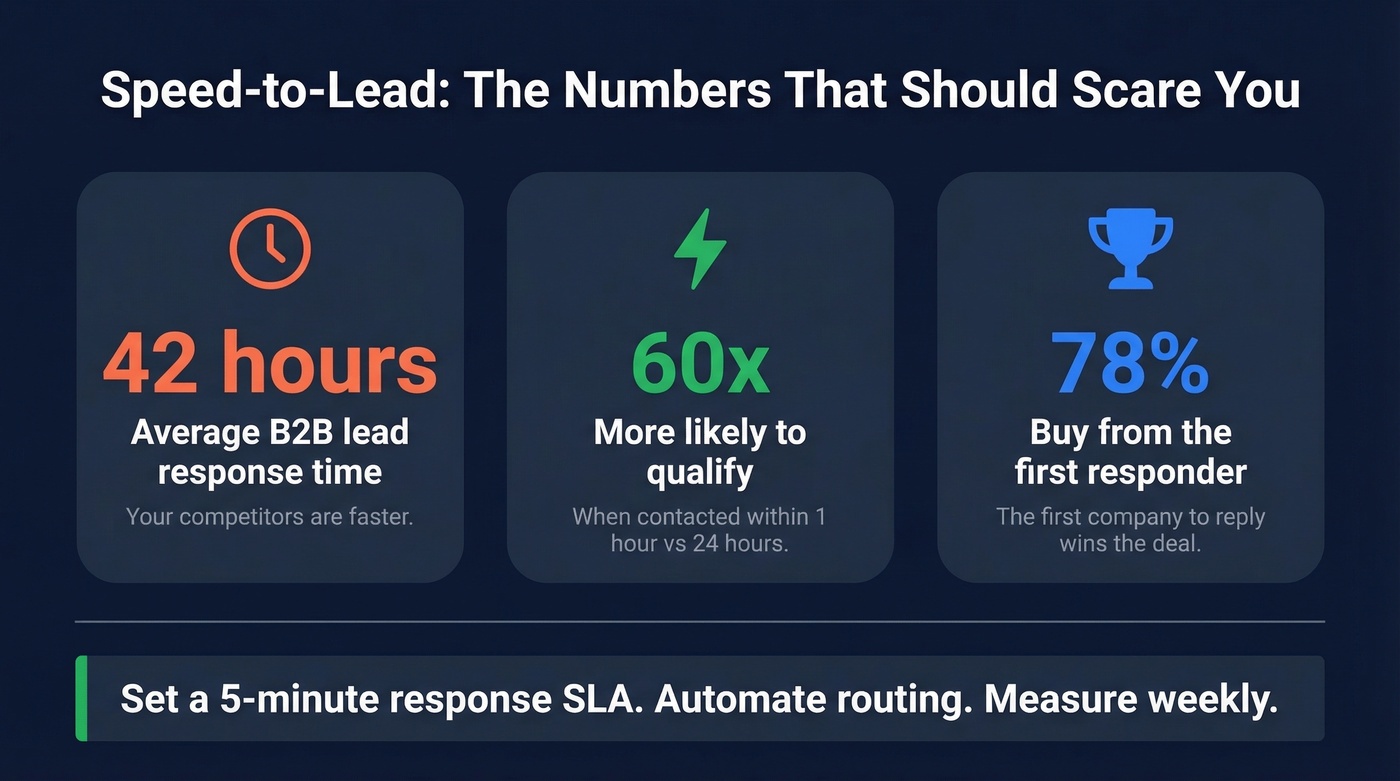
Research widely attributed to Harvard Business Review is damning: leads are 60x more likely to qualify when contacted within one hour versus 24 hours. And 78% of customers buy from the first company that responds. You can have the best data, the tightest ICP, and the most compelling sequences - but if your reps take two days to follow up, you've already lost.
In our experience, the teams that set a 5-minute response SLA outperform everyone else by a wide margin. Automate routing. Set SLAs. Measure speed-to-lead weekly as a revenue KPI, not a vanity metric. This applies whether you're sourcing leads through inbound forms or outbound sequences - speed wins either way (more on the importance of follow-up in sales).
AI in B2B Lead Gen - What's Real
Daily AI tool usage is up 233% in six months according to the Slack Workforce Index. Juniper Research projects AI-automated customer interactions will jump from 3.3B to 34B+ by 2027.
Only about a third of B2B organizations have implemented agentic AI at scale. For most digital lead generation teams in 2026, AI's biggest impact is in email personalization, lead scoring, and automated routing - not fully autonomous prospecting. Start there. The teams we've seen get burned are the ones who bought an AI agent before they had clean data to feed it.
Mistakes That Kill Your Pipeline
79% of marketing leads never convert into sales - and the reasons are almost always systemic, not tactical.
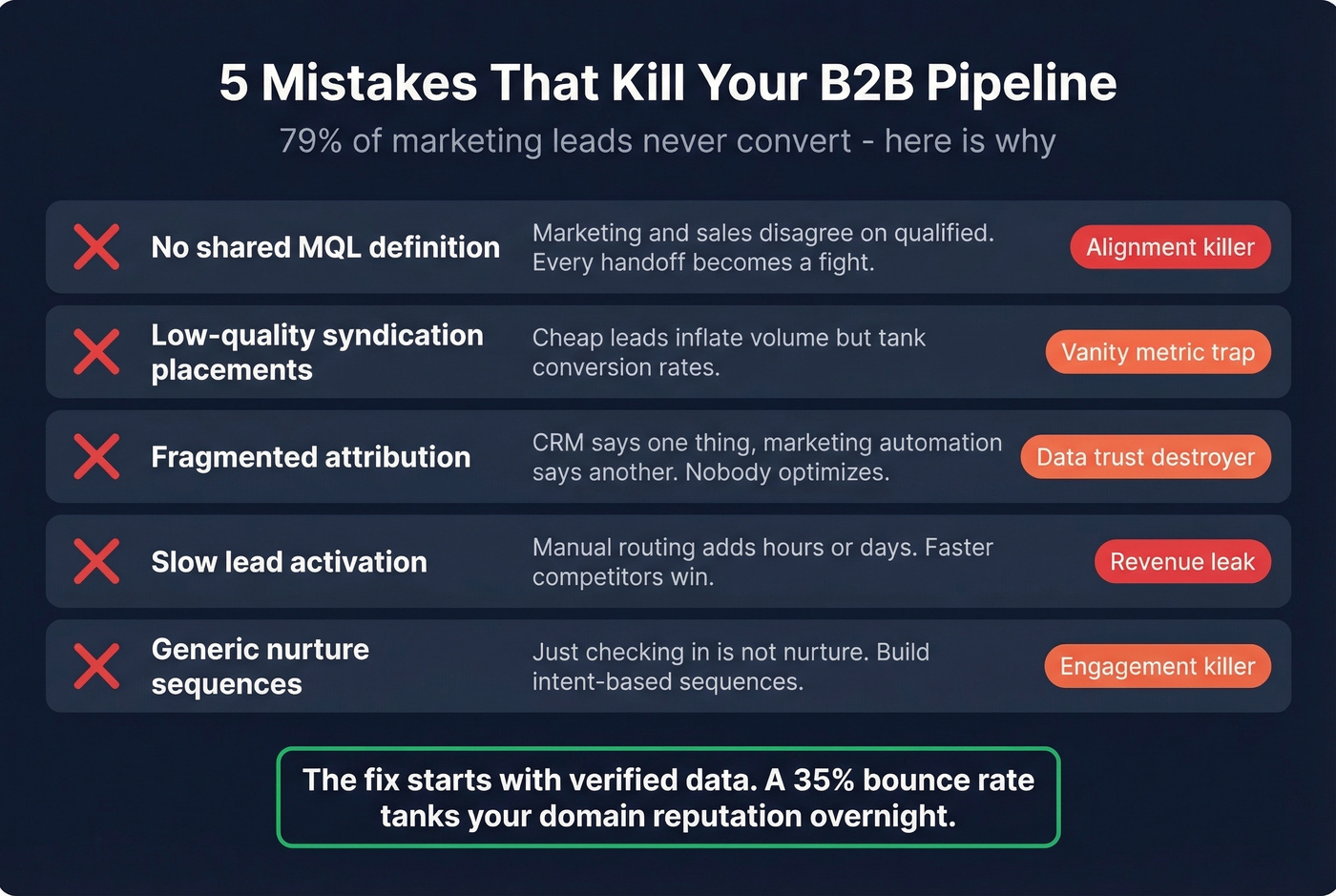
No shared MQL definition. Marketing and sales disagree on what "qualified" means. Without shared definitions and SLAs, every handoff is a fight.
Low-quality placements inflating volume. Cheap syndication drives MQL numbers up and conversion rates down. Skip it unless you can vet the publisher's audience quality yourself.
Fragmented attribution. Your CRM says one thing, your marketing automation says another. Nobody trusts the data, so nobody optimizes.
Slow lead activation. Manual routing adds hours or days. Automate this or accept that faster competitors will win.
Generic nurture sequences. "Hi {first_name}, just checking in" isn't nurture. Build intent-based sequences that respond to what the prospect actually did.
We've seen this pattern too many times: an SDR exports 5,000 contacts, 35% bounce, and domain reputation tanks overnight. A verification process with catch-all handling, spam-trap removal, and honeypot filtering before any email hits your sequence isn't optional - it's the foundation every B2B digital lead generation program sits on (see email bounce rate and email deliverability).

The best tool stack means nothing if your data provider feeds you stale contacts. Prospeo refreshes 300M+ profiles every 7 days - not every 6 weeks - with 30+ filters including buyer intent, technographics, and job changes. At $0.01 per email, it's 90% cheaper than ZoomInfo.
Build your lead gen stack on data that's actually current.
FAQ
What's a good cost per lead in B2B?
B2B SaaS averages $237 blended CPL, while financial services runs $653 and cybersecurity sits at $406. Use the LTV:CAC ratio of 3:1 as your benchmark - if your CAC exceeds one-third of customer lifetime value, your unit economics need work before you scale spend.
How long does online lead generation take to produce pipeline?
Email and outbound can generate pipeline in 1-2 months with verified data and tight ICP targeting. PPC delivers leads almost immediately but requires $3K-$8K/month minimum. Content and SEO take 6-12 months but produce the lowest CPL long-term.
What's the minimum budget to start?
You can launch for under $1K/month using a free data tier, HubSpot's free CRM, and an outbound sequencer like Instantly at $30/month. Meaningful LinkedIn Ads require $5K-$10K/month - don't start there unless your deal sizes justify it.
Is cold email still effective in 2026?
Average reply rates hover around 2%, but teams with verified data, tight ICP targeting, and multi-channel sequences consistently build pipeline. The difference is data quality and speed-to-lead, not volume - Meritt tripled their pipeline after switching to verified contacts with under 4% bounce rates.